We Are All Human, Or None Of Us Are.

“The rights of every man are diminished when the rights of one man are threatened.” – John F. Kennedy

This blog post previously appeared in Common Weal’s weekly newsletter. Sign up for the newsletter here.

If you’d like to support my work for Common Weal or support me and this blog directly, see my donation policy page here.

The UK is slipping even further into a dark, dark place. Let’s just be clear from the outset: once you declare someone, anyone, as not worthy of human rights you are declaring them to not be worthy as humans. And once you declare someone, anyone, as not being a worthy human, you might be next. Human rights apply to all of us, or to none of us.

Watching Nigel Farage spend a day of unrelenting media coverage this week to show off his latest idea of stripping migrants of their human rights and putting them in concentration camps was sicking. Worse, was seeing Keir Starmer’s response which was basically “we’ll do it too, but better”.

Then we got treated to a second day of it as former Conservative MSP Graham Simpson defected and attracted all of the airwaves to Farage again, followed for a third day by another defection in the form of former Labour Councillor Audrey Dempsey. Make no mistake. If you thought that was merely a coincidence, then you missed the deliberate strategy there.

Farage’s proposal is to follow a decade-long Conservative shibboleth of declaring that those “foreign courts” in Europe who safeguard our human rights via the European Convention on Human Rights are the worst kind of evil and the UK needs to withdraw from it. He’ll put in its place a “British Bill of Rights” that will apply only to British citizens and instead of “the state” telling you what you can do, you’ll have the freedom to do anything unless the state says you can’t do it.

One of the things he wants to do is to round up Afghan nationals who collaborated with the British armed forces during the invasion and occupation of that country. Many of these people now live under the threat of torture and execution by the Taliban since the latter reconquered the country and took back control. Many of these people had their personal details of their involvement with British forces leaked due to the UK’s appalling data security. Some received emergency evacuation. Some, it seems, did not.

Not surprisingly, the Taliban themselves appear to be quite happy to “receive” these people if Farage gets to implement his plans. When asked about whether he’d do it too Keir Starmer, a former human rights lawyer, said, effectively, ‘we’re not taking that option off the table’.

Removing the UK from the ECHR is not going to be as easy as waving a legislative wand. The rights bill is baked into the Belfast/Good Friday Agreement and can only be amended with the agreement of Ireland. Farage’s entire plan can be vetoed with a single memo containing the word “No”.

Or Northern Ireland could leave the UK, which would considerably smooth the passage of his plan. There’s still a complication in that ECHR is also baked into the Scotland Act and thus any attempt to disapply it to devolved areas in Scotland would require a legislative consent motion. But as Brexit has shown, this can simply be overridden by a Farage (or Starmer) Government. Or they could unilaterally amend the Scotland Act directly. Devolution will be no protection for Scotland in the way that it is for Northern Ireland.

“My partner is a migrant and is not a UK citizen nor likely to become one. Whenever someone says “prioritising British citizens”, they mean deprioritising and delegitimising my family.”

Even if the “British Bill of Rights” contains a carbon copy of the ECHR and it remains applying to everyone in general (i.e. Farage isn’t allowed to disapply it to Irish, Commonwealth, EU or non-EU citizens as he’s hinted) then we still have to remember that the actual purpose of doing this is to disapply it to specific people in specific instances whenever they become a nuisance to The State.

We’ve long been fed lines of the “bad person” who is “abusing human rights law” to avoid deportation for flimsy reasons like their cat is sick or they’d miss chicken nuggets (the actual stories behind those propaganda lines are far more nuanced). The point is that if such a person existed, these radicalised factions within the UK want to declare them less-than-human and to punish them for it.

This all matters because, sooner or later, it may well affect you. It’s certainly already affecting me. My partner is a migrant and is not a UK citizen nor likely to become one. Whenever someone says “prioritising British citizens”, they mean deprioritising and delegitimising my family. We also have to remember that I don’t just support Scottish independence, I work for an activist organisation that advocates for it. I am paid to agitate against the State in support of secession. In some countries, that’s not a job – it’s a death penalty offence. It might be me they strip citizenship from and declare to be unworthy of human rights.

Which, of course, means it might be you too. Or it might be Nigel Farage. Because even he is only a lost election and a charge of “collaboration with the previous regime” away from seeing his human rights abused too. As the famous line from the play A Man for All Seasons goes: “If you cut down the laws, and you’re just the man to do it, do you really think you could stand upright in the winds that would blow then?”

Human rights must apply to all of us or they apply to none of us. So I would ask Farage (and Starmer, and any other MP tempted to support this idea) a question: Please look through the rights guaranteed by the ECHR. Which rights do you wish would no longer apply to you, personally?

Because if he gets his way, one day they might not.

Private Equity Ate My Cats’ Lunch

“The standard private equity playbook: jawbone the unions, cut costs even at the price of damaging longer-term success, do a sale-leaseback of real property assets, take whatever public money you can get from communities eager to save their industries, and do an “add-on”—the Indiana Glass buy. And collect fees.” – Brian Alexander

This blog post previously appeared in Common Weal’s weekly newsletter. Sign up for the newsletter here.

If you’d like to support my work for Common Weal or support me and this blog directly, see my donation policy page here.

Regular followers will know of our three Policy Podcats (we still miss you Jinx) who were frequent uninvited guests on the old Policy Podcast. Being cats, they’re generally quite picky about the food we buy for them and it took us a while to settle in with a company that they liked. Last month, that company went bankrupt after 50 years of trading and after just a few years of being bought out by a private equity firm.

Private equity is a parasite on the already unwell body that is consumer capitalism. It takes the logic of capitalism to its furthest extreme and is designed to supercharge the extraction of value from a system that is already designed to extract (not create) value.

The version of capitalism that you’re probably thinking of runs something like this. I, a Capitalist with access to some degree of wealth, am able to invest that wealth into some kind of venture. Perhaps I’m particular passionate about the production of widgets and wish for everyone to be able to buy them.

So I build a widget factory, stock it with widget-making machines and hire people to run those machines. I pay people for their time, but ultimately the value I create by buying materials for the widget factory and selling the widgets is mine to disburse as I please. If my factory makes a profit, I make money.

Marx lived in that kind of world and pointed out that while the Capitalist owned the machines, it’s the workers who run them who actually create the value – they are the ones who produce value through their labour. Without their labour, the machines don’t run (though the rise of automation may be changing that assumption).

However, so long as the workers don’t own the capital, they don’t have the power to deploy that capital and thus are ripe for exploitation by those who own but do not labour. Communal ownership – Communism – was his solution to that imbalance as workers would share in the risk of the business but would also share in the power granted by it too.

It has been shown even in today’s world that worker ownership of businesses in Scotland results in better working conditions, better worker morale and higher productivity. We don’t live in a mostly Communist world though and so Capitalism ended up moving to the next stage in its development.

You see, while I, the Capitalist, can make a fair bit of money by building a widget factory then buying and selling widgets, that’s still a lot of work and a lot of risk. Under market capitalism, other people can build widget factories and maybe their widgets are better than mine, or cheaper, or they have better advertising and they end up selling more than I can.

It would be faster and easier to look for someone who has already built a factory and buy it from them. Maybe I could buy several and merge them together. If I buy ALL of them, then I have a monopoly and can control the market. Even if I don’t get all that way, then I can at least split the market between as few of my friends as possible and we can fix prices together.

Capitalists have always hated “free markets”. What they want are cartels and monopolies. This is how we get the situation where, for example, virtually all luxury sunglasses – regardless of their “brand” – are owned by the same company.

“BlackRock owns about 5% of just about every company on the planet that issues enough shares to attract its attention.”

But what if there’s an even faster way to wealth? We could, for example, not own a single factory but instead buy a small share in all of the factories. Not enough to need to bother with the responsibility of actually doing anything with them, but enough to extract a small profit from all of them.

Asset Managers like BlackRock and The Vanguard Group make billions this way – BlackRock owns about 5% of just about every company on the planet that issues enough shares to attract its attention. It’s very telling that when the world was very concerned about the monopoly power of the merger of computer software giants Microsoft and Activision, BlackRock already owned shares both of them and so could continue extracting its passive income regardless. That one company extracts about $20 billion every year from the global economy without having to do much to earn it.

But what if there was an even faster way to make a LOT of money? Enter, the world of private equity.

Unlike the more passive actors like BlackRock, private equity firms take a much more active role in the companies they own and to do this effectively, they need to own substantial fractions of them – perhaps owning them outright. Unlike a Capitalist buying out their competition though, they tend to spread themselves across multiple sectors. Crucially, unlike the widget entrepreneur, they are much less attached to the output of the widget factory than they are about the profits they can extract from it. Those profits can and should be boosted as much as possible, as quickly as possible.

And one way to do that is to cut costs – fire half the workers and get the other half to work twice as hard. Maybe even replace them with robots that make widgets of questionable quality, but don’t need to be paid at all. Cut materials. Cut research funding into the future of widget development. You could even take more money from the company than they actually make in profits – get them to remortgage all of their buildings and max out their credit cards then give you a “loan”.

This is why you see so many companies that were previously profitable suddenly start racking up massive debts when they’re bought by private equity. And when it gets too much and the banks start calling in those debts, you can make one last round of profit by firing everyone and selling the company’s assets for parts. What was once a profitable widget factory becomes a debt-ridden shell of itself and collapses.

This is what appears to have happened to the podcats’ food company. There’s a happy ending for them in that we’ve managed to source another company and the picky little furballs are eating it just as happily, but the march of private equity through the ruins of their own making continues.

Scotland needs a better way of managing its manufacturing and service economies. We need more in the way of sustainable and equitable investment. If you saw our daily briefing this week on the warnings about losses at the Scottish National Investment Bank you can see some of what we’d like to see – less parasitic profiteering and more patient finance, so that we can have an economy that works for All of Us, rather than just allowing a few already-rich folk to “win” capitalism at our expense.

Same Spin Everywhere

“You’re radically collaborative, profoundly empathetic, and deeply communal. Everyone who tells you anything different is selling the fear that is the only thing that can break that nature.” – Hank Green

This blog post previously appeared in The National as part of Common Weal’s In Common newsletter.
If you’d like to support my work for Common Weal or support me and this blog directly, see my donation policy page here.

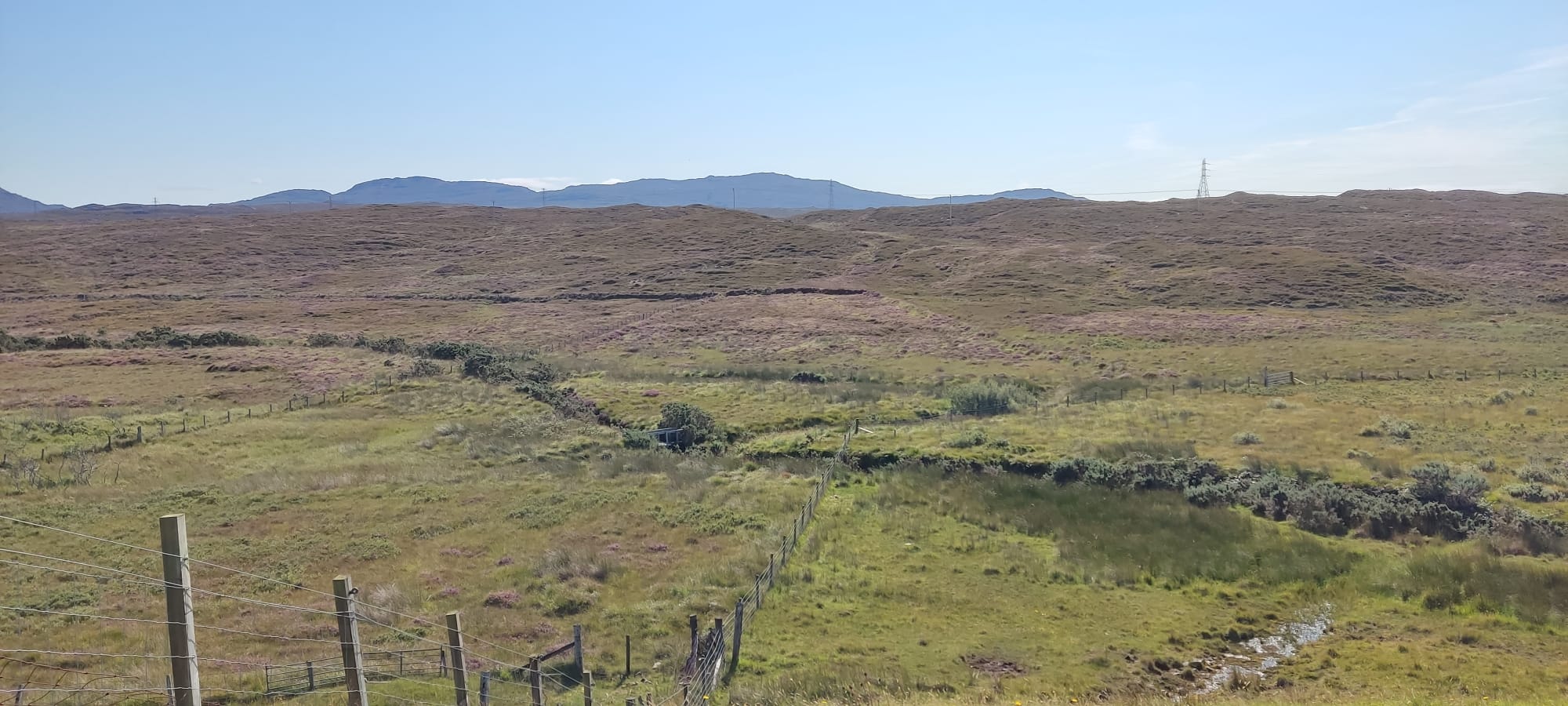
(The wind farm site discussed in this article will interpose between this ridge and the mountains in the background)

I was up in Skye this week to give one of my regular talks to activists and campaign groups around Scotland. It’s one of the aspects of my role at Common Weal that I enjoy the most and get the most out of even though it often means a lot of travelling. I’m very grateful to my hosts for not just organising the meeting but also putting me up for the night.

The evening was organised by the Breakish Windfarm Action Group who are currently concerned by plans to build a large windfarm development on a visually prominent part of the island. The estate owner, Lady Lucilla Noble, stands to profit massively from the site as will the Swedish developers Arise while tenant farmers are likely to see their livelihoods disrupted and restricted on what has been up till now land held as Common Grazings. They asked me to give a broader overview of how and why this is happening in Scotland and I duly prepared a presentation based around our proposals for how Scotland can publicly own our energy generation despite the Scottish Government’s excuse that “it’s reserved”. Shortest possible version: It’s only reserved if we want Government Ministers to own the energy. If we allow Local Authorities or communities to own it, it’s perfectly possible. It could even be funded in the same way. The only “downside” is that the Scottish Government wouldn’t get to control it. See Common Weal’s policy paper “How to own Scottish energy” for more details.

What I heard during the night though had both myself and my partner shaking our heads in disbelief. The story in Skye is that a landowner has contracted with a foreign company to extract vast profit from the resources of Scotland over the objections of the local community, without adequately compensating or benefiting said community, while obfuscating the planning process and making it is difficult as possible for the community to “properly” object as processes such as environmental studies and public inquiries cost tens to hundreds of thousands of pounds to complete – trivial amounts for the corporations but far beyond the reach of ordinary people to compete with. Everyone involved fully expects that even if the community is able to punch above its weight in terms of negotiating and bargaining power, Scottish Ministers will just override any objections because the Government’s primary goals are to make the Scottish GDP line go up by means of encouraging “inwards investment” – if doing that pushes climate goals too, then they suppose that’s fine too.

This is precisely the same story that is happening in my village at the moment where a French company is negotiating with a local land owner to build a massive solar farm and battery park. Just about the only thing that differs are the names of some of the people (and even then only some of them because it turns out that Ross Lambie, one of the local councillors for the ward I live in and who sits on our local Planning Committee is an absentee landlord bidding to use some land he owns in Skye to host a temporary housing for the construction workers being shipped in to install the turbines).

We’re not the only two communities facing this. Scotland is awash with largely foreign capital flooding places with applications for developments that even at their best won’t benefit communities nearly as much as they should (the £5,000 per Megawatt of community benefit funding that some of these developments offer is a shadow of the 30 to 100 times as much local revenue retained by full community ownership). Local planning offices report being completely overwhelmed trying to properly scrutinise applications and that goes double for areas with active community councils where volunteer councillors are expected to scrutinise highly technical documents without the resources to do so. Scottish Ministers are far too prone to allow projects to move up to the Energy Consents Unit to ensure that they can make the decisions – overriding local democracy as they do so – but this just concentrates the problem further. The ECU is similarly overwhelmed with more than 4,500 projects having been passed to them since December 2018. An average of almost two new applications per day. Ministers cannot not be expected to properly scrutinise these projects even if this was their only full time job.

And what happens if a dodgy developer does, by chance or fortune, get their application denied or made conditional to the point that they decide the profit margins aren’t high enough? Well, they just resubmit the application and try again or move on to the next community and hope they can’t pay as much attention. Communities need to be lucky every time. Corporations only need to get lucky once.
I’m not against renewable energy as a rule. We need more of it. What I’m asking for is for the Scottish Government to start abiding by its own party-approved policies. We need a Scottish Energy Development Agency (SEDA) to start producing a proper strategic map of Scotland. A map not just of where Scotland’s renewable resources are but where our actual demand is too. The overflow of development without coordination (compounded by frankly idiotic policies from Westminster such as blocking policies like Zonal Pricing) is leading to millions of pounds of consumer’s money being paid to energy generators in constraint payments. Wind turbines already generate profit almost for free once they’re built – the only way to make them more profitable for the multinationals and foreign public energy companies who own them is for them to make the profit without even generating the energy.

In addition to the SEDA we urgently need the Scottish Government to stop its opposition to public ownership of energy and to start allowing Scottish communities to be the owners of these developments.
Communities have been left alone to fight each application individually when it turns out that they are all facing the same spin everywhere. I am very happy to see that communities are increasingly banding together such as the 9CC group in Ayrshire or the recent conference of Community Councils in Inverness, but it’s clear that these groups themselves need support to start talking together, across Local Authority lines. Maybe that’s what it’ll take for Ministers to start paying proper attention. Maybe the next conference has to happen outside Holyrood itself.

The injustice of situations like where I live or in Skye or in hundreds of other communities is going to seriously harm public support for the renewable transition that we need. I’m not against renewable energy. I am against being screwed over by the people who own them. I’m against the injustice of communities not being given a stake in that transition and being told that their voice is irrelevant or a nuisance. But if my experience this week in Skye tells me anything, it’s that communities are ready to make that voice exactly as loud as it needs to be, especially as the elections approach. I hope Ministers will be listening. Or that their replacements might be.