The Scottish Government wants to avoid reforming Council Tax

“I hate paying taxes. But I love the civilization they give me” – Oliver Wendell. Holmes

This blog post previously appeared in Common Weal’s weekly newsletter. Sign up for the newsletter here.

If you’d like to support my work for Common Weal or support me and this blog directly, see my donation policy page here.

A stock photo of a street in Glasgow emphasising a row of above-shop flats

Image Source: Unsplash

In the run up to the 2021 Scottish Parliamentary Elections, the SNP published their election manifesto with a promise to hold in depth discussions about reforming local taxation, culminating in a Citizens’ Assembly on the subject. After they were returned to Government, they embedded that idea in the 2021 Programme for Government and explicitly elevated the idea that Council Tax reform would be part of this discussion from an idea to an promise.

I remember this being an exciting time in Scottish politics. I was still riding the high from being an expert witness in the Scottish Climate Assembly (and didn’t yet know how badly the Government would let them down). After multiple years of failure to reform or replace one of Scotland’s most badly broken taxes, this was finally a change for politicians to admit that they were part of the problem, to step out of the way and to let citizens tell them what to do instead.

It was never going to be that simple. Despite the success of the Climate Assembly to produce radical ideas – or because of that success in the face of the politicians’ unwillingness to relinquish power and implement those ideas – the promise of a Citizens’ Assembly before the 2026 election dragged on. It was never formally dropped, but Nicola Sturgeon’s Government did not appear to take any action towards setting it up.

When she resigned in 2023, time was tight for the Humza Yousaf Government to pick up the policy. One lesson from the Climate Assembly was that they can take a year to plan, several months to undertake and then a year to properly analyse the results. By his tenure, there was still time to create the Assembly but he’d be passing the job of actually reforming Council Tax to the next Parliament.

And then he, too, resigned. Without once to my knowledge even mentioning the Assembly and not doing much at all to reform local tax by other means (other than his disastrous ad hoc announcement of a freeze to rates during a local government revenue crisis).

And now, in the waning days of the Parliament and with zero time to implement anything new at all, John Swinney’s Government still hasn’t formally cancelled that 2021 manifesto promise but they have clearly decided that they’ll break it.

Instead of a Citizens’ Assembly, his Government has put out a very standard public consultation on some options that they’ve considered around reforming Council Tax while also stating that even if they accept one of them after next year’s election that we shouldn’t expect any actual change to the tax any time within even the next Parliament. We’ll submit our formal response to that consultation and you can too here, but I wanted to use my column this week to discuss their proposed options.

The first thing to say is that they’ve effectively ruled out replacing Council Tax entirely.

The Scottish Government has presented four proposals for reform of Council Tax. This first is the most minimal change possible, though it’s one that has been advocated for as long overdue. The current Council Tax isn’t based on what your house is worth now but what it was worth in 1991. Keeping the current rates and bands but revaluing houses to ensure they are all in the correct and appropriate band would fix problems that have crept in over 30 years of rampant but uneven house price speculation (I’ve seen houses worth £30,000 and worth £300,000 both marked as Band D for Council Tax).

This has been designed to be “revenue neutral” with the current system and as such doesn’t do much to cut taxes for people already in appropriate and low bands or to raise taxes for those appropriately in high bands. It does fix the problem of possibly half of Scotland being in the wrong tax band but this effectively means a lot of upheaval to the system for comparatively little actual gain – even where that gain is necessary.

Two intermediate steps are to change the current 8 Band system to a 12 Band system with one aimed at keeping taxes more or less the same for folk in lower band houses and adding addition bands for the extremely wealthy at the top and the other being more “progressive” by reducing tax rates slightly for lower bands and and increasing it for upper bands.

And finally, there is a 14 band system that looks much like the 12 band “progressive” proposal but with a slightly greater cut for lower bands and a slightly higher increase for upper bands.

The problem with all of these proposals is that the banding system for Council Tax is inherently unfair. Not just in its present form where a house worth 10 or 100 times more than a cheap, Band A house will still only pay about 3.5 times more in Council Tax, but even if the bands were reformed or extended as the Government has proposed here, that problem will always exist.

The very rich who live in houses in the top band will always pay less than their fair share of tax and that means that those in the poorest households will always pay more than their fair share. Even the 14 band system would only apply a maximum differential rate of about eight times as much Council Tax for a house sitting near the bottom of the highest band (starting at £1.83 million) compared to one sitting at the top of the lowest band (£65,000).

This means that a house worth more than 28 times another will only pay about eight times as much tax. What the Government is claiming is a more progressive tax proposal than the current system is still nonetheless deeply regressive and its claim of being “revenue neutral” still means, in effect, the poor are paying a massive tax subsidy to the rich.

“Nine out of ten houses in Scotland are worth less than £400,000.”

Instead, we argue for a proportionate Property Tax similar to the one used in many countries in Europe where the property tax is based on a percentage of the current value of the house – doing away with bands entirely (One could argue to make things even more proportional and add surcharges on very expensive houses in the same way that we don’t pay a flat income tax rate but a progressive one based on how high our salary is – but let’s make the case for a flat percentage tax first, then we can discuss going further). This removes the inherent problem of banding. A house worth ten times as much will always pay ten times as much tax.

One of the arguments against property taxation as opposed to taxing income is the “ability to pay”. It’s often held up that there will be asset rich, income poor people stereotyped as a lonely widow living in her mansion after the kids leave the family home. The truth is that while I’m sure that there will be people in a situation like that, there are better mitigations available than holding the rest of the country back from reforming and replacing an outdated tax system.

The consultation document itself considers a couple of these such as phasing in the tax over several years to make it easier for people to adjust their finances to copy with any increases or allowing people to defer the tax for several years – perhaps until the sale of the house or the death of the owner, though this may result in people having to face a large lump sum tax bill when that time comes.

Another option, one that we may suggest in our response, might be to limit the increase someone pays due to the transition to some percentage of their income or to expand Council Tax discounts to cover people in that situation. Over time though, this would become less of a problem. House prices in general will adjust to reflect their tax bill and houses that are currently overvalued may reduce in price as a result of a high tax burden attached to them (something that wouldn’t happen if we abolished property taxes for a local income tax as some have suggested).

A final point to make in this column is the fact that people don’t really understand just how unequal property wealth actually is in Scotland. This can be seen in the Daily Express’s claim that the Scottish Government’s proposal would mean a tax of up to £6,600 on “hard working families”, without mentioning that this is what would be paid only in the biggest change proposed (the 14 band system) and this rate would only apply to the most expensive houses worth more than £1.83 million.

Very few “hard working families” in Scotland live in £1.8 million houses. In fact, thanks to this consultation, we now know how many households live in worth £1.83 million or more. This band would cover just 0.02% of houses in Scotland – fewer than 15,000 out of Scotland’s more than 2.6 million homes.

In fact, as you can see in our Graph of the Week this week, we can plot the various government proposals (in this case we’ve just plotted the most and least progressive of the four) in comparison to how much more or less people would pay in Council Tax compared to a fair Property Tax. If we moved to our Property Tax then a small house in Band A could see its tax bill halve, while a £2 million mansion would see a substantial increase of £6,000 or more. The “breakeven” point between the current Council Tax (and, in fact, all four of the Government’s proposed reforms) is a house worth £400,000 that is or should be in Band F.

This threshold is at about the 90% percentile of house prices. Nine out of ten houses in Scotland are worth less than £400,000. That means that nine out of ten households in Scotland are currently paying more than their fair share of Council Tax and would benefit from a fair percentage based Property Tax. It also means that all four of the Government’s proposed Council Tax reforms would tweak but would not remove this inequality.

The Scottish Government is, in effect, continuing to protect Scotland’s top 10% of property owners at the expense of everybody else. This is a key lesson that we will be including in our response to the consultation and I hope you will too.

The Council Tax is outdated, unfair and needs to change. The argument of that fact was won more than a quarter of a century ago. That the Government accepts the need for a progressive and fair tax but still cannot bring itself to propose one is a dereliction of duty. That they’ve broken a manifesto commitment to let the people come up with a solution instead is a democratic scandal.

And that they’ve stated that even if they win the next election, they’re not going to implement the solution in the next Parliament just means that this consultation looks like it’s much more about delaying change for another decade rather than righting the wrongs of the lack of change so far.

We can do better than this, especially when the solutions are already clear and understandable. Please submit a response to this consultation and do make clear to your local MSPs that you want to see Council Tax fixed properly, fairly and for the ultimate benefit of All of Us.


Information is still not free enough

“Truth never damages a cause that is just.” – Mahatma Gandhi

This blog post is an extended version of an article that previously appeared in The National as part of Common Weal’s In Common newsletter.
If you’d like to support my work for Common Weal or support me and this blog directly, see my donation policy page here.

Long time followers will know of my personal conviction that democracy cannot exist without transparency. There is a long list of issues that this impacts. If we can’t see what Government is talking about. Who is talking to them. What money is being spent where. Where that money is coming from. How policies are being formed. How their impact is being measured. If any of these things are happening only behind closed doors, then we cannot properly hold Government to account or ensure that they are meeting their promises.

The current legislation around Freedom of Information in Scotland is decent but it is also out of date and needs reform and expansion. It was one of the first Bills passed by the recommenced Scottish Parliament, but it has been creaking at the seams for some time.

In 2019, the Post-Legislative Scrutiny Committee in the Scottish Parliament picked up the Freedom of Information (Scotland) Act – known in shorthand as FOISA – and decided to see where it could be updated. We were keen supporters of this process and you can see me give evidence to the committee here. Several areas of reform were identified including a major one where the increasing use of private companies and ‘arms-length’ bodies to deliver public services may be weakening the effect of our Freedom of Information.

One prominent and oft-cited example is that if a Local Authority owns a care home, then you have the ability to submit an FOI request to get information about the care home. However, if the Local Authority sells off that care home to a private company and then hires them to provide care services then you might find that you can’t submit the same kinds of FOI requests. You might also not be able to submit certain requests to the Local Authority such as a request to see the terms of the contract they signed to ensure that they’re not overpaying the private company for care as an FOI request of that kind can be blocked due to ‘commercial sensitivity’.

In this way, privatisation could well be used as a shield against freedom of information. If a corrupt or ill-willed public body wished to conceal something it was doing from view, then they could simply privatise it. The committee determined that there was therefore merit in the idea that the transparency should follow the public money, not the public bodies. That is, if a private company is using public money to deliver a service then it should be just as subject to Freedom of Information as if that service was being delivered ‘in house’ by a public body.

Unfortunately, the Scottish Government decided in the end to not do anything with the Committee’s recommendation to rectify this problem which prompted Labour backbench MSP Katy Clark to submit a Members’ Bill calling for reform of the legislation to strengthen FOI powers in this area. You can listen to my interview with her on the Bill in Episode 138 of the Common Weal Policy Podcast when she was just at the start of the process of introducing the Bill.

A consultation into her Bill has just concluded but we have submitted our response to it largely agreeing with its aims but calling for it to go further in a few areas.

One of these areas is in the concept of ‘proactive disclosure’. Right now, there is a great deal of information being held by Government that you could have put out into the public domain if you submitted an FOI request for it but, until someone does, it will remain secret. This is a problem. Public information should be public and not subject to the whim of someone, somewhere coming up with the appropriate question.

For example, perhaps you want to check to see if someone in particular has been lobbying the Scottish Government and might be doing it in a way that it doesn’t appear on the Lobbying Register. Emails are not Registered Lobbying in the same way that a face-to-face conversation is.

If an organisation doesn’t want you to know that they’ve been lobbying Government Minsters then keeping the conversations to email and phone calls is a decent way of doing it because you need to have some idea that they ARE lobbying Government before you can submit an FOI. Under the current Lobbying Register legislation, even if an organisation would WANT to disclose that information, they are not allowed to.

But let’s say you do have that idea and you decide that you do want to find out what Dr Craig Dalzell, Head of Policy & Research at Common Weal has been saying in email communications with Angus Robertson about the Scottish Government’s Independence White Papers, for example. That’s a perfect valid FOI request and those emails will be released. [I have no idea who submitted that FOI by the way, but it was a good one! Especially as it confirmed that Robertson knocked back Common Weal’s offer to advise on said White Papers given that we had already done the work for them]

Continue reading

Scotland is still breaching your right to environmental justice

“Until justice rolls down like water and righteousness like a mighty stream.” – Martin Luther King Jr.

This blog post previously appeared in Common Weal’s weekly newsletter. Sign up for the newsletter here.

If you’d like to support my work for Common Weal or support me and this blog directly, see my donation policy page here.

Image Credit: Tim van der Kuip, Unsplash

Who do you phone if your rights have been breached?

Who goes to jail for breaching them?

These are questions that are far more serious than most of us realise. Without adequate justice when your rights are breached, you cannot prevent them from being breached again.

A report by the UN’s Economic Commission for Europe has found that for the last fifteen years, Scotland has breached our rights to accessible economic justice – rights protected by the Aarhus Convention. You can read the full report here.

What this means is that if your right to a clean and safe environment is breached then Scotland is failing in its duty to ensure that your right to challenge the perpetrator in court and to receive “fair, equitable, timely and not prohibitively expensive” justice has been diminished. In particular, while the report does mention that Scotland has complied with the Convention in certain areas (such as by accepting a reasonable definition of the term “prohibitively expensive” and in protecting claimants against onerously inflating legal costs, especially during appeals), there are still areas lacking compliance such as complications around how court fees can inflate overall costs above reasonable limits and how legal aid is often inadequate for funding complex environmental legal cases which restricts who can argue for their rights only to those who can afford it.

This all may seem like it’s a step removed from the actual breach of your right to a clean environment but it’s not really. The two are effectively one and the same. If you cannot take someone to court and receive justice if they breach your environmental rights then they can breach those rights without fear of any consequences. Which almost certainly means that they will have a strong incentive to breach those rights. This will be particularly important if the Ecocide Bill currently moving through Parliament does not pass before the end of the session in late March and is allowed to fall as it would signal to polluters that Scotland will quite happily allow the worst of them to commit the worst kinds of environmental harm and there would be little that we could do to take them to court.

The report found that Scotland was failing in several areas to restore our rights to justice which is a strong indictment against a Government that once held itself up as one of the world leaders in tackling the climate emergency (before, of course, cancelling its legally binding climate targets as a means of avoiding breaking the law and possibly facing the kinds of justice that the Aarhus Convention is supposed to protect access to).

The Scottish Government also dropped its Human Rights Bill which would have fully brought the right to a healthy environment into Scots Law. Part of the reason why it failed was that as a devolved nation, Scotland cannot formally sign up to international treaties. We can, however, legislate Scots Law so that we “act as if” we are members of those treaties and simply align our domestic law to them whether we’ve signed them or not. However, it was found that the Scottish Government cannot use devolved law to compel the UK Government to “act as if” it has aligned with a treaty that it has not signed. In effect, devolution means that the Scottish Government cannot use Scots Law to prevent the UK Government from breaching human rights in Scotland that the Scottish Government thinks you should have but the UK Government thinks that you should not have.

It gets worse at a UK level however. Where the Scottish Government is “merely” failing in its legal duties to protect our access to environmental justice, the UK Government is actively holding those rights in contempt and is threatening to withdraw from Aarhus altogether precisely to avoid legal challenges to policies and decisions that would harm the environment. In this, it joins a worryingly large club of countries who stood together a decade ago to declare a climate emergency but who have since backslid into climate denial and attempts to accelerate the destruction of our biosphere while claiming that doing so would “bring energy bills down” when, in fact, it will do the precise opposite.

We’ve encountered the fight for rights to mean something before. During our long and ultimately unsuccessful campaign to bring about a Scottish National Care Service we argued against the Scottish Government’s approach which was to simply declare that everyone had a right to care. Their rights-based approach, we argued, was not doomed because the rights they sought to grant were bad – we steadfastly campaigned for Anne’s Law and the right for folk in care homes to receive essential visitors – but because the approach itself was flawed.

“In short, who do you call when someone breaches your human rights? ”

Instead, we argued for the “Four R’s” of rights, responsibilities, resources and relationships.

First, we needed to define the right that was being granted or was being deemed worthy of protection. In this we agreed with the Scottish Government.

But next we need to see who is responsible for delivering or protecting those rights and who is responsible when those rights are breached – in short, who goes to jail if your right to acceptable care is broken? The carer who harmed or neglected you? The private care agency that didn’t train them properly as a means of creaming off a bit more profit? The Local Authority that hired the agency instead of delivering care as a publicly-owned service? Or the Scottish Government Minister who cut Local Authority budgets and forced them to pick a cheaper option?

That last question ties in with resources. Not just the resources to prevent your rights from being broken but also the resources required to restore them when they are or to seek justice to ensure that your broken rights can be repaired.

And finally, relationships. This is particularly acute in care where it is too often delivered almost like a faceless and decidedly uncaring procedure – A rotating list of carers visiting for 15 minutes a day, checking tasks off a list, leaving, then a different person coming the following day. But when it comes to rights it also means ensuring that you understand your relationship to your rights, that you know when they have been broken or someone is threatening to break them and that you know what to do in response. In short, who do you call when someone breaches your human rights?

Now apply those principles to your right to a healthy environment and your right to environmental justice. You can quickly see how, in Scotland, we fall short of the standards of the Aarhus Convention especially given that so many of the critiques of Scotland’s shortcomings were focused on things like inadequate resourcing of legal aid.

The Scottish Government must double down its efforts to comply with international environmental justice law just as it must do so with the fights for environmental justice themselves. They must also take the fight to Westminster to prevent the UK Government from breaching our rights. In an era where we are seeing climate justice being eroded almost as fast as the climate itself, we must protect hard-won rights no matter who tries to breach them. Once they’re gone, they won’t come back and we might even be actively prevented from fighting for their return.

What ‘real security’ means in light of recent cyberattacks

“People used to talk about the American Dream. Now they talk about the Azure uptime guarantee.” – Daniel Vincent Kramer

This blog post previously appeared in The National as part of Common Weal’s In Common newsletter.
If you’d like to support my work for Common Weal or support me and this blog directly, see my donation policy page here.

purple and blue light digital wallpaper

(Image Source: Unsplash)

[Note: This article was published a few days before the AWS outage that caused havoc throughout multiple digital services – including banks and security devices – on Monday 20th October. This incident was accidental, but serves to highlight the potential impact of a deliberate shutdown of such services.]

If you asked the previous US Government what “security” meant, they might have said “defence”.

If you ask the current Trump US Government what it means, they’ll tell you that “defence” is a “woke” word and that we should be talking about “war” instead.

If you ask the only marginally less belligerent UK Government that question, they’ll still answer by pointing at the same tools – that “security” means nukes, jets and the diversion of the equivalent of half of the NHS’s budget into building even more nukes, jets and other weapons of war.

Meanwhile, this year, multiple important companies not just in the UK but globally and ranging from manufacturers to retail stores have been knocked almost completely out of production by cyberattacks.

There’s no suggestion that the various attacks are related or are the result of a single, hostile state actor but there’s little reason to imagine that they couldn’t be and largely irrelevant whether they are or not.

Our economy has become vastly more complex and interlinked than it was in the past and has simultaneously become more fragile in the face of unexpected shutdowns.

So in a rare moment of aligning with an organ of the British intelligence sector, I share the concerns of the National Cyber-Security Centre when they say that British businesses have to start doing more to secure their IT systems and to create plans for how to keep running if something happens – potentially with plans to run systems without networked computers or with pen-and-paper backups if required.

This should be standard practice in all businesses and not just those vulnerable to cybersecurity incidents. My colleague Robin was recently caught in one of Scotland’s worst power blackouts in several years when – it seems – workers cut a critical power and telecoms cable resulting in several villages being cut off from the modern world for several days.

This included substantial risk factors like the possibility of someone falling ill and being unable to call for emergency services or even to alert the local health clinic.

I’m also reminded of a story someone told me during the early phases of the pandemic. They worked in a public leisure centre and when things started to kick off they realised that their centre would likely become a hub for emergency measures so asked their manager where the disaster planning folder was. The reply they got was “What folder? We don’t have one.”

That centre ended up being used for vaccine deployment but they were also made aware that there were plans to use them as an emergency school (to help spread pupils out), as an emergency health centre (to reduce pressures on the NHS) and, if things got really bad, as an emergency morgue.

What my contact tried to explain to officials was that they could well do any of those but trying to do all of them – as seemed to be the plan at the time – would mean working out how to keep not-yet-vaccinated people away from people sick with Covid at the same time as not forcing school kids to walk past lines of body bags on their way to class.

All while a barebones staff of mostly furloughed, mostly low wage, and increasingly traumatised staff were trying their best just to get by.

The whole thing was a mess of lack of planning for what should have been a foreseeable disaster. In 2019 we knew that a future pandemic was inevitable at some point but the lessons from previous pandemics and pandemic wargame exercises had not and still have not been fully implemented. We warned about this in our 2020 policy paper Warning Lights.

Since then, the foreseeable disasters like pandemics, climate change or malicious hackers have been joined by another one – a hostile government that actively controls our tech sector. We’ve seen some hints of this in the form of the UK’s response to Chinese technology in things like our digital networks (I know of Scottish Local Authorities who are actively replacing such systems at the moment) but the USA is becoming just as large a threat.

It is no longer an unthinkable hypothesis that an unstable President like Donald Trump could have a bad morning and order US companies to spy on British networks or to just lock companies or governments out of Apple, Google and Microsoft and nor is the prospect of an unaccountable billionaire like Elon Musk amplifying hate across social networks, advocating for the violent overthrow of our democratic institutions and threatening to simply shut down access to his own networking devices if he doesn’t get his way.

We need to follow the EU’s example of drastically reducing our dependence on America for tech like the software we use to operate our Government.

The Scottish Government has to start thinking seriously about what real security means in the 21st century. For me, it means resilience as much as anything else. It means ensuring that Scotland can cover our fundamental economy without relying on a partner who may now be unreliable.

Scotland grows enough food to feed everyone here (We grow enough barley alone to meet the calorie needs of 9 million people – it’s just that most of it becomes whisky and most of the rest goes into animal fodder).

We produce enough energy to cover domestic needs sustainably (though we’re not nearly self-sufficient enough in manufacturing the means to harness that energy and far too much of our production is owned by foreign companies).

There are few countries in the world in a better and more stable geopolitical position (other than the targets strapped to our backs in the form of British nukes hosted here).

The rest becomes an issue of ensuring that things remain secure and that we are resilient when breaches do occur so that things don’t grind to an absolute halt.

If I was designing a Scottish defence sector, one of the major departments would be a team of penetration testers whose job it would be to hack Scottish companies then fix the holes they find.

What is important is that once those basics are covered, we see that the actual threats to us are much diminished compared to what the shrill warmongers of the headlines want us to believe and that those that remain certainly can’t be solved by diverting money from health and welfare budgets to build jets to carry US nukes that we now see would be more part of the problem than part of the solution.

Perhaps instead of bolstering Departments for War, we can start to think about what a world that works for peace could look like. It starts by working out how we’d cope if things go wrong and then working out how to make sure they don’t.

SNP Members back Common Weal’s public energy strategy (again)

“All the mega corporations on the planet make their obscene profits off the labor and suffering of others, with complete disregard for the effects on the workers, environment, and future generations. As with the banking sector, they play games with the lives of millions, hysterically reject any kind of government intervention when the profits are rolling in, but are quick to pass the bill for the cleanup and the far-reaching consequences of these avoidable tragedies to the public when things go wrong. We have a straightforward proposal: if they want public money, we want public control. It’s that simple.” – Michael Hureaux-Perez

This blog post previously appeared in Common Weal’s weekly newsletter. Sign up for the newsletter here.

If you’d like to support my work for Common Weal or support me and this blog directly, see my donation policy page here.

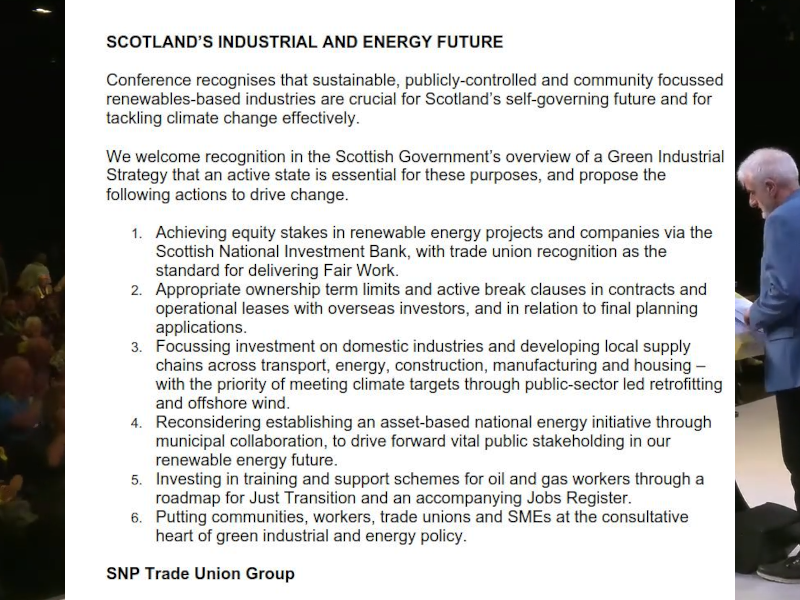
The SNP members at their conference this month backed a major energy motion supported by the SNP Trade Union Group (TUG). This motion was developed in consultation with the STUC and with energy experts including myself and deeply integrates several aspects of Common Weal’s proposals for reform of the Scottish energy sector – including by moving forwards plans to bring energy into Scottish public ownership.

The motion was passed by acclaim and without objection meaning that this is now the fourth time that the SNP members have voted for an energy motion including public ownership at their national conference – each time achieving overwhelming or unanimous support. You can watch the presentation of the motion starting from the 1 hour 10 minute mark here.

The motion itself (pictured above) focusses on six key areas which are worth explaining in some detail.

1. Achieving Equity Stakes

Something that Common Weal has long advocated for is for the Government to stop just handing money to very large, often already very rich, companies in the form of tax breaks, loans or outright grants is no longer appropriate for a renewable energy sector that has for many years now demonstrated the ability to make a profit without public subsidy. At the same time, we’ve been shouting for some time about the obscenely high level of foreign ownership in the Scottish economy – particularly within the fundamental economy like energy.

Instead of just throwing money at the sector, the Scottish Government should demand equity – ownership shares – in return for public money and should even demand a public equity share as a precondition for planning permission or the granting of option rights in projects like the successors to ScotWind. Denmark recently did precisely this, calling for a minimum 20% public stake in offshore renewable projects.

This is, of course, a bit easier for Denmark as they have several publicly owned energy companies who, by definition, meet that stake simply by doing their job. Scotland – starting from the position of not having a public energy company – may have to take a position similar to that of GB Energy, being a kind of silent investment partner who merely provide the money and take the profits rather than taking an active role in developing the project.

However this should be merely a first step where small stakes are used as a training ground to build up the experience needed for the Scottish energy company to start joining projects as a co-developer, start to bid for projects on their own and then to move to a “no bid” process whereby the Scottish energy company simply start running all new Scottish energy projects by default.

The second part of the proposal is important for the initial “silent investor” stages. It would not do for the Scottish Government to be effectively investing in and buying ownership stakes in companies who treat their workers unfairly, so this provision would be an additional incentive for companies that if they want the support of Government then they have to meet a minimum standard of workers’ rights.

This is the approach the Scottish Government took to distinguish themselves from the UK with their “Green Freeports” which does show that the Fair Work principles are themselves not strong enough and might be of limited actual impact, but they do still represent a floor below which Government-supported jobs should not fall.

2. Appropriate ownership limits and break clauses

One of the things we discovered when researching for our second ScotWind paper was the discovery that the lease terms for offshore wind projects can stretch into multiple decades despite the turbines themselves reaching “breakeven” and starting to make a profit sometimes after only five or seven years or so. The “NR4” round of offshore wind in England promised a 60 year lease period for wind turbines.

With a normal lifespan of 20 to 30 years, this means that the lease would cover the operational lifespan of two or three generations of such turbines and if the five year payback period is achieved, then the lease could generate up to 50 years worth of energy profits.

Our default position is that until Scotland has the capacity to manufacture and install turbines ourselves then it’s fine to hire a developer to do it for us and perfectly acceptable for them to expect to recoup their investment and make a reasonable profit but that after a lease period that is as short as practical (say, ten years), ownership of the turbine should then be transferred to Scottish public ownership.

There is a caveat here. If the turbines have a 20 year lifespan, then nationalising them on year 19 would effectively just mean letting the corporations take all the profits and then socialising the decommissioning costs (much like what has happened with the Scottish oil sector).

In addition to a short lease there should also be strict break clauses whereby if the developer does not meet minimum standards such as on workers’ rights or if they break promises to invest in local supply chains or otherwise no longer meet reasonable standards as an operator in Scotland then the Government should activate a break clause in the contract, pull the lease in and give it to a Scottish public operator – this is precisely what the Government did in 2021 to nationalise ScotRail.

This is also how Scotland effectively nationalises all of our renewable energy for no cost to the electricity consumer. All we need to do is ensure that the current generation of generators are brought into public hands soon enough that they can pay for their replacements. This doesn’t just need to happen at a national scale with large developments like ScotWind. This can scale down to the community level where communities should be able to take over small onshore wind and solar farms.

That a community in Scotland recently failed to take over their local wind farm because a Scottish public body didn’t even consider the possibility of this shows how badly out of step Scottish policy is with the will of the people right now (I’m told that the community in question is now in the process of trying to buy out the land under the turbines so that they’ll get the rent from that and will control the next round of leases in the future – good luck to them).

3. Local supply and retrofitting

There is a massive mismatch between the Scottish Government’s energy supply policy and their energy demand policy (such that the latter exists). We all recognise that the climate emergency means that we need to use resources more efficiently. We also recognise that the vast majority of fuel poverty is caused by the fact that we need so much fuel to heat our homes. New buildings could be (but aren’t being) built so that they use an absolute minimum of energy (a properly built Passive House can use less energy to heat in a year than yours does in a winter month).

Transport policy could also be built to minimise energy use via much greater use of public transport for the vast majority of people. That traffic jam your stuck in where every car has an average of 1.1 people inside it is just about the least efficient way of moving people that could possibly be devised. Turning that traffic jam from a queue of fossil fuel burning cars into one of electric cars might be cleaner, but it’ll still double Scotland’s current electricity demand (inefficient heating would double it again).

So this part of the motion aims to double down on efforts to retrofit buildings and to boost local supply of materials to do so (for instance, the vast majority of sustainable insulation made from things like cellulose is imported into Scotland despite so much of our land being covered by monoculture sitka spruce plantations)

This week in one of our daily briefings (sign up here to get a short article on a news story that caught our eye every weekday) was on the story that one of the UK’s insulation projects had failed so badly that 98% of homes covered by it need to get it ripped out and redone. We outlined how to do this kind of work better not by relying on throwing money at companies and then not checking their work but by establishing the task as a public works infrastructure project to properly coordinate it and make it cheaper and more efficient to do. This plan has won favour at previous SNP conferences but, as with so many of our plans for public infrastructure, has been ignored by the leadership.

4. Establish an energy company

The SNP membership has supported a Scottish public energy company since we started lobbying for it in 2017. The SNP leadership has had to be dragged kicking and screaming towards that support too. The first Scottish Government plan for a Scottish electricity retail company fell afoul of a UK energy market that overwhelmingly favours large cartels over small providers and, as we warned at the time, an energy company that lacked its own generators and other assets would be entirely at the mercy of global energy price spikes. That proposal was dragged along without the reforms we warned would be needed until it was scrapped in 2021.

Earlier this year, another push from members to get the policy back on the books was blocked by the Government under the excuse that it couldn’t be enacted under the limits of devolution. We responded with a paper laying out six ways that Scotland could own Scottish energy assets under devolution – including via a network of municipal energy companies or via a National Mutual model where Scottish residents are shareholders in the company instead of Scottish Ministers (which is the actual thing that the Scotland Act blocks).

“The excuse that Scotland simply has to let “Foreign Direct Investment” suck our country dry, again, isn’t washing any more.”

This paper forms the heart of this part of the motion and we’re very happy that the SNP conference unanimously supported it. It is now clear SNP policy that Scotland should publicly own Scottish energy assets via whichever means that Devolution allows. I would favour either the Mutual model where the company is collectively owned by all of the people of Scotland or, failing that, by a National Energy Company collectively owned by the 32 Local Authorities.

Either way, the NEC should be combined with a mandate for the NEC to actively support municipal and community energy companies – co-investing with them in Public/Public Partnerships to help them bootstrap each other up to the point where the larger scale proposals outlined above like taking over existing developments at end-of-lease or outright developing ScotWind-scale projects becomes viable.

What is clear now is that the Scottish Government has run out of excuses. Their refusal to adopt a policy of publicly owning Scottish energy has not more legislative barriers left and now flies directly in the face of the will of their own party. I would expect to see their upcoming election manifesto reflect this will and, should the SNP be part of the Government after the elections, I expect to see proposals to bring about the NEC laid down and developed with all possible speed.

5. Invest in training and a Just Transition Jobs Register

The Just Transition is not going well. Despite the best efforts of polluting megacorporations to try to ride their climate emergency through just a few more quarterly shareholder targets, people are leaving the sector in Scotland either through choice or – as the closure of Grangemouth has highlighted – through the choice of others. However, we’re not seeing these skilled workers move into the renewables sectors at anywhere near the rate we need.

A policy passed at SNP conference a few years ago was the idea of a Just Transition Jobs Register. This would track how many people where being employed in the fossil fuel sectors and in the renewables sectors, would measure how many people were moving from the former to the latter each year and would actively seek to improve pathways to increase that flow. When the policy initially passed it was, again, completely ignored by the party leadership so its inclusion here in another motion must serve to highlight its importance.

6. Putting Communities and Workers First

Where the Just Transition is happening it’s too often being seen as a thing to do to workers, not as a thing for and by workers. I’ve seen corporate “Just Transition” plans that were entirely designed to transition the /company/ to a more sustainable footing but did so by replacing older workers with new apprentices rather than retraining existing staff. Meanwhile, studies like the one done by Platform in 2020 show that workers in the affected sectors already have very good ideas about how they’d like to see a transition happen while highlighting their concerns that they lack the power to do it.

Communities have similar ideas but also lack power. There are growing concerns about the flood of renewable developments in and around communities or the rise of electrical pylons designed to shunt energy past communities who are suffering from fuel poverty while not receiving any of the benefits of hosting the infrastructure. Even a plan such as ensuring that solar panels are built on houses and brownfield sites before taking away amenity space or Common Grazing land from locals would go a long way to helping people buy into the transition rather than turning against it because they see their environment transformed only to benefit companies and landowners.Conclusion

This motion represents a major victor for Common Weal’s influence within Scotland’s political circles but it’s an even bigger one for SNP members who have voted, again, for policies like this despite the party leadership trying to tell them that it couldn’t be done. The excuse that Scotland simply has to let “Foreign Direct Investment” suck our country dry, again, isn’t washing any more.

This isn’t merely an issue confined to the SNP, however. The other progressive parties in Scotland are all overwhelmingly in favour of policies like this too. It would be a Courageous Decision (in the Yes Minister sense) for leadership to continue to ignore not just the will of a majority of Scottish voters on this issue but the unanimous decision of their own party’s membership at their own conference.

Which hasn’t stopped them up till now – and therein lies the issue even with motions like this. There is still a vast gulf between “what members instruct their party to do” and “what the party actually does” with very little in the way of accountability or oversight to bridge that gap.

This is a problem in all political parties and may be a fundamental problem with political parties that limit their ability to manage a democratic government. The solutions to that are probably a topic for another time, but until then I encourage the members who supported this motion to make their voices heard. Do what you can to ensure that its principles make it into the upcoming manifesto. Do what you can to ensure that your local candidates support those principles. And make sure that they understand that your support of their election is dependent on them listening to their members.

And the message to other parties: If the SNP won’t do this despite that election, who will? Perhaps you?

Carbon Offsetting Could Never Work

“while the guilty discharge of carbon dioxide from twenty return flights and snowmobile rides and sixty hot meals a day served in polar conditions would be offset by planting three thousand trees in Venezuela as soon as a site could be identified and local officials bribed.” – Ian McEwan

This blog post previously appeared in Common Weal’s weekly newsletter. Sign up for the newsletter here.

If you’d like to support my work for Common Weal or support me and this blog directly, see my donation policy page here.

The theory behind carbon offsetting is as follows. You conduct an activity that emits greenhouse gases to the equivalent of one tonne of carbon dioxide. This could be one tonne of carbon dioxide. Or it could be 40kg of methane, or 44 grams of sulphur hexafluoride (used as a tracer gas and as an insulator in high voltage electrical equipment).

Let’s say it was caused by your private jet flight.

A private jet flight can emit about one tonne of carbon dioxide per passenger over the course of a 1,000 km flight from Edinburgh to London and back, compared to about a quarter of that for a commercial flight and about 3.5% of that for a train journey.

Now, you’ve been getting a lot of flack for your private jet flights and the climate damage they cause but you’re not willing to actually stop taking them, so you decide to add a little surcharge to the cost of your flight to buy one “carbon credit”. This is effectively a certificate that adds to a pot of money somewhere. Nations are supposed to issue only so many of these certificates in a year and to decrease the amount the issue each year – forcing people who can’t buy a certificate to reduce emissions instead.

Someone, somewhere else, decides to do something climate friendly that will pull one tonne of carbon dioxide out of the atmosphere and lock it away where it can’t cause climate damage. Maybe they plant a tree. When they do, they get awarded a carbon credit from the pot of money, along with the money you paid for the credit certificate – subsidising their tree planting.

So, the theory goes, the emissions caused by your private jet flight are sucked out of the atmosphere by the tree and everything is carbon neutral or “Net Zero”. Scotland in particular has gone all in on encouraging these projects to the point that where the large estates that dominate Scotland were once used for shooting grouse and deer they are increasingly used by billionaires and private equity funds to harvest carbon credits instead.

The real world is a lot more complicated than that and involves all kinds of financial fineagling including the global trade of certificates so that nations who are reducing emissions faster (or who never emitted as much as richer nations did) can sell their “excess” credits as well as trade in future credits that haven’t been issued yet but everyone is sure they one day will which doesn’t sound like a financial bubble in the making at all.

“The actual amount of carbon actually captured under carbon credit schemes over the past 25 years could be as little as a tenth of what was advertised.”

The financial side of the carbon credit sector is worthy of its own article but I want to talk this week about the carbon absorption side of things. A new study has just been published that looked at 25 years of carbon removal projects – ranging from “low tech” solutions like tree planting to “high tech” solutions like directly removing CO2 from the air and pumping it into caves or old oil wells.

They found multiple problems with the entire carbon credit industry that render the whole idea nearly worthless. These range from “double counting” issues (If I plant a tree that absorbs one tonne of carbon dioxide I get to claim I’m reducing my own emissions by one tonne but if I sell a carbon credit to you then you also get to claim that you are reducing your emissions be one tonne – both can’t be true), through timing issues (your private jet flight starts causing climate damage from the moment you take it, but my tree could take several years to reabsorb the emissions so that they stop causing damage), through failures in the projects (if a wildfire – perhaps one caused by your private jet flight – burns down my forest, then it can no longer absorb the carbon you emitted), through the permanence of the capture of carbon even if the scheme works (If the tree eventually dies and rots, or if the carbon you stored in the cave eventually leaks out, then it just ends up back in the atmosphere again over a timescale ranging from a few decades to a couple of thousand years where the original fossil fuels had stored that carbon for hundreds of millions of year).

All in, they found that the actual amount of carbon actually captured under carbon credit schemes over the past 25 years could be as little as a tenth of what was advertised.

This all goes to show the scam that is the “carbon credit” model of climate change mitigation. Very rich people are paying money basically as an environmental equivalent of medieval church indulgences to salve their soul as they continue to disproportionately wreck the planet and then often the same rich people and the corporations they own are extracting that money in carbon credits for schemes that do nothing to actually reduce the harm they caused.

Meanwhile, the Government is chasing a “Net Zero” climate target that basically only says “we promise to keep harming the planet until 2045, and then we’ll stop but we won’t fix the damage we’ve caused” while selling out any hope of actual land reform because of all of the carbon credit money sloshing around driving up land prices beyond the hopes of communities to own the ground under their feet.

And now we know that even as they do that, the pollution won’t stop and the “mitigations” don’t work.

The Scottish Government must take the warnings of this paper to heed and adjust their climate strategy accordingly. No more carbon credits can be sold for the purpose of “offsetting” current emissions, only for removing carbon already present due to historic emissions.

Current emissions must be reduced urgently, taxed appropriately and regulated away. Investments must be ramped up to reduce and eliminate demand for pollution fuels and products. Where carbon capture still has its place, regulations must be tightened and compliance enforced – it does us absolutely no good if we base our climate strategy on “a new forest will balance emissions in 2046” if the forest burns down in 2044 with no time to replace it.

In 2019, Common Weal published our Common Home Plan which showed how Scotland could achieve True Zero carbon emissions and actively start to repair the damage we’ve caused to the planet. The Government still has time to take on this blueprint, albeit it will now be harder and more expensive to enact because to the delays, but even then it will still be cheaper than missing those climate targets because we let the billionaires keep pollution on the promise that they’d fix it later – which we now know, they never could.