Covid lessons should have been learned in real time

“A man may plant a tree for a number of reasons. Perhaps he likes trees. Perhaps he wants shelter. Or perhaps he knows that someday he may need the firewood.” – Joanne Harris

This blog post previously appeared in Common Weal’s Daily Briefing newsletter. Sign up for the newsletter here.

If you’d like to support my work for Common Weal or support me and this blog directly, see my donation policy page here.

A stock photo of vials of Covid-19 vaccines

Common Weal looks at the second report of the UK Covid Inquiry with some frustration. It’s not that we don’t agree with the findings, its that we were reporting on these issues in real time. There is no finding in this report that Common Weal did not raise at the time.

We believe there is a conclusion to be drawn from this; society needs more than a small political class talking to a small community of corporate and public sector leaders in private and a small media class in public. We need national debate to include many more voices and perspectives and for those to be taken seriously.

Let’s look at three of the key findings. First, that we were lax to begin the lockdown and poorly prepared for it when we did. This is something Common Weal identified early. We were warning that we should have moved to lock-down early in March 2020 and had already been raising fears the previous month.

By 16 March 2020 we were utterly bemused at the decision to allow 9,400 people to attend a Lewis Capaldi concert in Aberdeen less than a week before we were in full lockdown. We were issuing almost daily warnings in the week running up to lockdown. And then, when lockdown started, Common Weal warned that the UK Government was making a mess of it and that Scotland’s determination to stick to a ‘four nations’ approach was a mistake.

So when Scotland gradually started to diverge, we warned that it was too little too late. Again, as we approached the end of the first lockdown we warned that nothing like sufficient preparation had been made to suppress the virus once we were (partially) reopened.

But it is perhaps the second main conclusion that is most important here – the failure of testing. The difference between needing one lockdown and needing multiple lockdowns was the extent to which we could suppress the virus in the interim period via a testing regime. The entire first lockdown should have been focussed on developing a comprehensive approach. We warned this at the time.

Yet against all the global public health advice, the official Scottish Government position was that “testing is a distraction”. This was inexplicable and we were so concerned that Common Weal strayed out of our comfort zone to produce a public health policy paper in which we set out a testing regime we thought had the best chance of successfully suppressing Covid.

We published it as Ending Lockdown. The Scottish Government ignored it and so as the second lockdown approached we produced a more detailed version. Eventually a watered-down version of our proposals was belatedly put in place. We continue to believe that there remains a chance that the second lockdown could have been avoided altogether if a more rigorous approach was taken.

It is also worth noting that while Common Weal suggested that an elimination strategy was the only one that had actually worked (in New Zealand), it would take steps the Scottish Government would see as too radical to achieve that – closing roads outside airports, ports and the border and putting ‘testing borders’ in place.

For some reason the then First Minister thought it was possible to start talking about a strategy of elimination without taking any of these measures. That she did anyway certainly justifies the criticism of this stance in the report. It was vainglorious rather than credible.

And that leads to the third main conclusion – that there was a narrow and closed-off leadership approach which harmed policy creation, and that the First Minister spent too much time doing television briefings which should have been shared among other senior figures.

Again, this problem was quite clear at the time and something that we commented on a number of times but was not picked up in wider media debate. This resulted in a failure to scrutinise what was actually happening.

There are other issues we expect the Scottish inquiry to cover, including the cover-up of the first outbreak of Covid which took place in a large corporate hotel and policy of sending Covid-positive patients into care homes. Certainly there is no doubt that in Scotland we did not see the utter chaos and rampant corruption that we saw at Westminster, but this is a low bar.

While this report is welcome, we believe that there remains insufficient scrutiny of the extent to which civic Scotland stopped asking questions and stopped challenging decisions for months on end. Common Weal managed to derive policy positions which are now being vindicated from publicly available source material and we did it at the time. Nothing in the inquiry report published yesterday cannot be found from the content in the links above.

The problem is that the sense of national emergency, the political culture of the Sturgeon court, the legitimate universal fear and uncertainty that the lockdown induced and unhelpful and uninformed social media commentary combined to suspend politics and reduce scrutiny at a point where it was never more needed.

What is the lesson we should really learn from the pandemic? Don’t wait for lessons to be learned, pay attention at the time and ask difficult questions. It leads to better decisions. Then again, we did warn about this in the first week of lockdown…

Covid lessons should have been learned in real time

When banks own housebuilders, house prices go up

“A banker is a fellow who lends you his umbrella when the sun is shining, but wants it back the minute it begins to rain.” – Mark Twain

This blog post previously appeared in The National as part of Common Weal’s In Common newsletter.
If you’d like to support my work for Common Weal or support me and this blog directly, see my donation policy page here.

The way we build houses in the UK could be costing you an average of almost £67,000. This could be fixed by making housebuilding a public infrastructure project rather than a means for very rich shareholders to transfer your wealth to themselves.

Volume housebuilder Taylor Wimpy released its annual report for 2024 yesterday and the details in it, which look excellent from the viewpoint of a corporate shareholder, reveal much that is broken with the UK’s housing sector.

The first important number in their report is the number of houses completed. Taylor Wimpy is one of the UK’s largest volume housebuilders – likely to be in the top three this year in terms of completed projects – yet built only 10,593 houses in 2024 – a substantial reduction over the previous three years (though they claim to be on track for about 14,000 this year).

The second is their claimed operating pre-tax profit of £416 million. The word “profit” is a very fluid term in the world of corporate accountancy as it’s relatively easy for companies to move money around via “one time charges”, inflated director bonuses or “loans” to subsidiaries or parent companies, so a better number to judge a company like this is the money it granted to its shareholders as a dividend as this represents money extracted from the company and not reinvested in any way (not even in the form of the labour of those hypothetical overpaid directors). The dividend for shareholders in 2024 was £339 million.

This means that the houses built by Taylor Wimpy in 2024 generated a dividend to shareholders of an average of almost exactly £32,000 per house. This is how much lower house prices could have been had the company not been in the business of extracting profits via dividends. Had the company been a not-for-profit business entirely, then its houses could each have been almost £40,000 cheaper.

It gets worse for you, the house-buyer, because it’s very likely that you’d be taking out a mortgage to buy that house and you’ll be required to pay interest to the bank on that loan. £40,000 added to a 25 year mortgage at 4.5% interest will result in you paying back £66,700 over that time. To say again, this isn’t the cost to you for paying for anything to do with the construction of the house itself. This is the cost to you for paying interest on the additional loan you took out to pay for the profits of the company, most of which were paid out as dividends to the company’s shareholders.

And who are those shareholders? Our old friends, US based asset managers BlackRock and Vanguard Group are near the top of the heap, owning about 15% of the company between them. Several of the other owners are banks like HSBC and Barclays. This means that if you have a Barclays mortgage, then part of the interest you are paying on your mortgage is being used to service the loan you took out to pay the dividend they gave to themselves to inflate the price of your house.

If Scotland had a National Housebuilding Company as we’ve advocated for the best part of the last decade, then we could be building houses at as close to not-for-profit as possible and could reinvest any surpluses into other public infrastructure to make the places around our houses and the services we need in our community more resilient.

If we built the houses to the plan proposed in Good Houses for All, then they would be constructed at a far higher quality than the conventional timber frame “diddy boxes” (our Board Director and premier architect Malcolm Fraser’s not-so-affectionate name for them) favoured by the volume development sector and would force remaining private developers to drastically improve the quality of their constructions (doing so wouldn’t even reduce their profits because such buildings are now cost-competitive with the diddy-boxes and then create further savings in terms of energy costs).

“If the whole of the UK brought in a Land Tax equivalent to our suggested baseline value of 0.63%, then Taylor Wimpy would owe an additional £2.14 million per year on its banked land”

A final point to note in their report is the amount of landbanking they do. Landbanks are when a company buys up land but then does not build on it for an extended period of time (or sometimes never, or the land itself becomes a commodity to be traded between companies). The report states that the company currently owns £3.4 billion worth of land spread across 79,000 “short term plots” and 139,000 plots in their “strategic pipeline”. They also purchased more plots last year than their number of completions so the total size of their landbank has increased. Given their completion rate over the past few years, they could stop buying land for around 20 years without risking running out.

Decreasing the supply of land without putting it to the intended use of housebuilding is a major factor not just in inflating the price of land but also actively preventing land from being used for building either by other volume developers, by Local Authorities or even by enterprising self-builders. Scotland should consider bringing in a Land Tax to charge companies for the land they own and should consider an additional surcharge on the land tax to account for vacant or landbanked land (which would encourage developers to build so that they can get the land off their books). If the whole of the UK brought in a Land Tax equivalent to our suggested baseline value of 0.63%, then Taylor Wimpy would owe an additional £21.4 million per year on its banked land – still a small fraction of its overall profits.

The way we build houses in this country is badly broken and has resulted in volume developers constructing cheap, cold, damp houses that are not fit for the purpose of living because the purpose of the houses is to extract wealth and deliver it to shareholders. Until we move to fix that and to end the financialisation of housing, we’ll all keep paying a very real and very substantial price for the roof over our head.

The Scottish Government wants to avoid reforming Council Tax

“I hate paying taxes. But I love the civilization they give me” – Oliver Wendell. Holmes

This blog post previously appeared in Common Weal’s weekly newsletter. Sign up for the newsletter here.

If you’d like to support my work for Common Weal or support me and this blog directly, see my donation policy page here.

A stock photo of a street in Glasgow emphasising a row of above-shop flats

Image Source: Unsplash

In the run up to the 2021 Scottish Parliamentary Elections, the SNP published their election manifesto with a promise to hold in depth discussions about reforming local taxation, culminating in a Citizens’ Assembly on the subject. After they were returned to Government, they embedded that idea in the 2021 Programme for Government and explicitly elevated the idea that Council Tax reform would be part of this discussion from an idea to an promise.

I remember this being an exciting time in Scottish politics. I was still riding the high from being an expert witness in the Scottish Climate Assembly (and didn’t yet know how badly the Government would let them down). After multiple years of failure to reform or replace one of Scotland’s most badly broken taxes, this was finally a change for politicians to admit that they were part of the problem, to step out of the way and to let citizens tell them what to do instead.

It was never going to be that simple. Despite the success of the Climate Assembly to produce radical ideas – or because of that success in the face of the politicians’ unwillingness to relinquish power and implement those ideas – the promise of a Citizens’ Assembly before the 2026 election dragged on. It was never formally dropped, but Nicola Sturgeon’s Government did not appear to take any action towards setting it up.

When she resigned in 2023, time was tight for the Humza Yousaf Government to pick up the policy. One lesson from the Climate Assembly was that they can take a year to plan, several months to undertake and then a year to properly analyse the results. By his tenure, there was still time to create the Assembly but he’d be passing the job of actually reforming Council Tax to the next Parliament.

And then he, too, resigned. Without once to my knowledge even mentioning the Assembly and not doing much at all to reform local tax by other means (other than his disastrous ad hoc announcement of a freeze to rates during a local government revenue crisis).

And now, in the waning days of the Parliament and with zero time to implement anything new at all, John Swinney’s Government still hasn’t formally cancelled that 2021 manifesto promise but they have clearly decided that they’ll break it.

Instead of a Citizens’ Assembly, his Government has put out a very standard public consultation on some options that they’ve considered around reforming Council Tax while also stating that even if they accept one of them after next year’s election that we shouldn’t expect any actual change to the tax any time within even the next Parliament. We’ll submit our formal response to that consultation and you can too here, but I wanted to use my column this week to discuss their proposed options.

The first thing to say is that they’ve effectively ruled out replacing Council Tax entirely.

The Scottish Government has presented four proposals for reform of Council Tax. This first is the most minimal change possible, though it’s one that has been advocated for as long overdue. The current Council Tax isn’t based on what your house is worth now but what it was worth in 1991. Keeping the current rates and bands but revaluing houses to ensure they are all in the correct and appropriate band would fix problems that have crept in over 30 years of rampant but uneven house price speculation (I’ve seen houses worth £30,000 and worth £300,000 both marked as Band D for Council Tax).

This has been designed to be “revenue neutral” with the current system and as such doesn’t do much to cut taxes for people already in appropriate and low bands or to raise taxes for those appropriately in high bands. It does fix the problem of possibly half of Scotland being in the wrong tax band but this effectively means a lot of upheaval to the system for comparatively little actual gain – even where that gain is necessary.

Two intermediate steps are to change the current 8 Band system to a 12 Band system with one aimed at keeping taxes more or less the same for folk in lower band houses and adding addition bands for the extremely wealthy at the top and the other being more “progressive” by reducing tax rates slightly for lower bands and and increasing it for upper bands.

And finally, there is a 14 band system that looks much like the 12 band “progressive” proposal but with a slightly greater cut for lower bands and a slightly higher increase for upper bands.

The problem with all of these proposals is that the banding system for Council Tax is inherently unfair. Not just in its present form where a house worth 10 or 100 times more than a cheap, Band A house will still only pay about 3.5 times more in Council Tax, but even if the bands were reformed or extended as the Government has proposed here, that problem will always exist.

The very rich who live in houses in the top band will always pay less than their fair share of tax and that means that those in the poorest households will always pay more than their fair share. Even the 14 band system would only apply a maximum differential rate of about eight times as much Council Tax for a house sitting near the bottom of the highest band (starting at £1.83 million) compared to one sitting at the top of the lowest band (£65,000).

This means that a house worth more than 28 times another will only pay about eight times as much tax. What the Government is claiming is a more progressive tax proposal than the current system is still nonetheless deeply regressive and its claim of being “revenue neutral” still means, in effect, the poor are paying a massive tax subsidy to the rich.

“Nine out of ten houses in Scotland are worth less than £400,000.”

Instead, we argue for a proportionate Property Tax similar to the one used in many countries in Europe where the property tax is based on a percentage of the current value of the house – doing away with bands entirely (One could argue to make things even more proportional and add surcharges on very expensive houses in the same way that we don’t pay a flat income tax rate but a progressive one based on how high our salary is – but let’s make the case for a flat percentage tax first, then we can discuss going further). This removes the inherent problem of banding. A house worth ten times as much will always pay ten times as much tax.

One of the arguments against property taxation as opposed to taxing income is the “ability to pay”. It’s often held up that there will be asset rich, income poor people stereotyped as a lonely widow living in her mansion after the kids leave the family home. The truth is that while I’m sure that there will be people in a situation like that, there are better mitigations available than holding the rest of the country back from reforming and replacing an outdated tax system.

The consultation document itself considers a couple of these such as phasing in the tax over several years to make it easier for people to adjust their finances to copy with any increases or allowing people to defer the tax for several years – perhaps until the sale of the house or the death of the owner, though this may result in people having to face a large lump sum tax bill when that time comes.

Another option, one that we may suggest in our response, might be to limit the increase someone pays due to the transition to some percentage of their income or to expand Council Tax discounts to cover people in that situation. Over time though, this would become less of a problem. House prices in general will adjust to reflect their tax bill and houses that are currently overvalued may reduce in price as a result of a high tax burden attached to them (something that wouldn’t happen if we abolished property taxes for a local income tax as some have suggested).

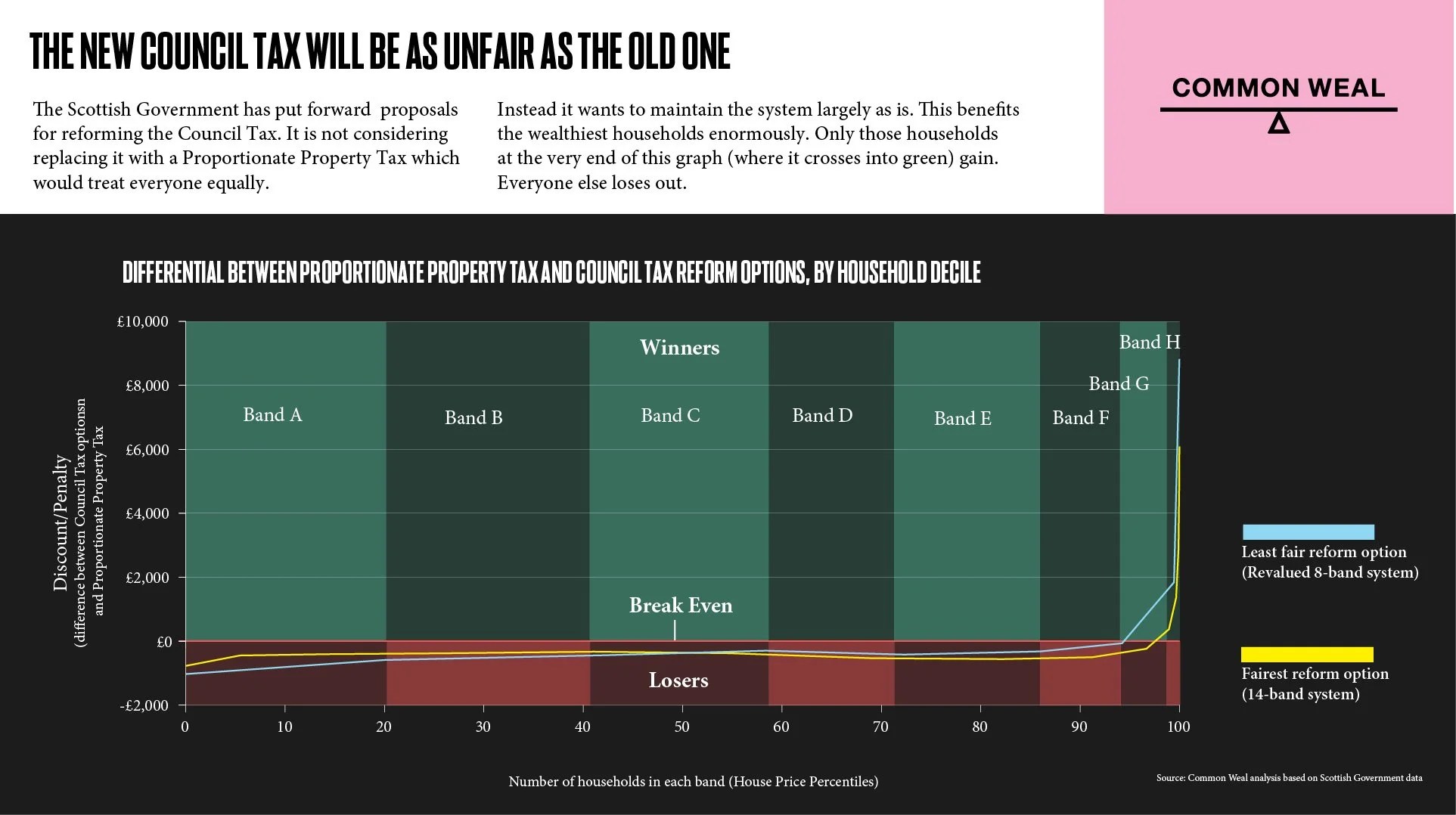
A final point to make in this column is the fact that people don’t really understand just how unequal property wealth actually is in Scotland. This can be seen in the Daily Express’s claim that the Scottish Government’s proposal would mean a tax of up to £6,600 on “hard working families”, without mentioning that this is what would be paid only in the biggest change proposed (the 14 band system) and this rate would only apply to the most expensive houses worth more than £1.83 million.

Very few “hard working families” in Scotland live in £1.8 million houses. In fact, thanks to this consultation, we now know how many households live in worth £1.83 million or more. This band would cover just 0.02% of houses in Scotland – fewer than 15,000 out of Scotland’s more than 2.6 million homes.

In fact, as you can see in our Graph of the Week this week, we can plot the various government proposals (in this case we’ve just plotted the most and least progressive of the four) in comparison to how much more or less people would pay in Council Tax compared to a fair Property Tax. If we moved to our Property Tax then a small house in Band A could see its tax bill halve, while a £2 million mansion would see a substantial increase of £6,000 or more. The “breakeven” point between the current Council Tax (and, in fact, all four of the Government’s proposed reforms) is a house worth £400,000 that is or should be in Band F.

This threshold is at about the 90% percentile of house prices. Nine out of ten houses in Scotland are worth less than £400,000. That means that nine out of ten households in Scotland are currently paying more than their fair share of Council Tax and would benefit from a fair percentage based Property Tax. It also means that all four of the Government’s proposed Council Tax reforms would tweak but would not remove this inequality.

The Scottish Government is, in effect, continuing to protect Scotland’s top 10% of property owners at the expense of everybody else. This is a key lesson that we will be including in our response to the consultation and I hope you will too.

The Council Tax is outdated, unfair and needs to change. The argument of that fact was won more than a quarter of a century ago. That the Government accepts the need for a progressive and fair tax but still cannot bring itself to propose one is a dereliction of duty. That they’ve broken a manifesto commitment to let the people come up with a solution instead is a democratic scandal.

And that they’ve stated that even if they win the next election, they’re not going to implement the solution in the next Parliament just means that this consultation looks like it’s much more about delaying change for another decade rather than righting the wrongs of the lack of change so far.

We can do better than this, especially when the solutions are already clear and understandable. Please submit a response to this consultation and do make clear to your local MSPs that you want to see Council Tax fixed properly, fairly and for the ultimate benefit of All of Us.

Information is still not free enough

“Truth never damages a cause that is just.” – Mahatma Gandhi

This blog post is an extended version of an article that previously appeared in The National as part of Common Weal’s In Common newsletter.
If you’d like to support my work for Common Weal or support me and this blog directly, see my donation policy page here.

Long time followers will know of my personal conviction that democracy cannot exist without transparency. There is a long list of issues that this impacts. If we can’t see what Government is talking about. Who is talking to them. What money is being spent where. Where that money is coming from. How policies are being formed. How their impact is being measured. If any of these things are happening only behind closed doors, then we cannot properly hold Government to account or ensure that they are meeting their promises.

The current legislation around Freedom of Information in Scotland is decent but it is also out of date and needs reform and expansion. It was one of the first Bills passed by the recommenced Scottish Parliament, but it has been creaking at the seams for some time.

In 2019, the Post-Legislative Scrutiny Committee in the Scottish Parliament picked up the Freedom of Information (Scotland) Act – known in shorthand as FOISA – and decided to see where it could be updated. We were keen supporters of this process and you can see me give evidence to the committee here. Several areas of reform were identified including a major one where the increasing use of private companies and ‘arms-length’ bodies to deliver public services may be weakening the effect of our Freedom of Information.

One prominent and oft-cited example is that if a Local Authority owns a care home, then you have the ability to submit an FOI request to get information about the care home. However, if the Local Authority sells off that care home to a private company and then hires them to provide care services then you might find that you can’t submit the same kinds of FOI requests. You might also not be able to submit certain requests to the Local Authority such as a request to see the terms of the contract they signed to ensure that they’re not overpaying the private company for care as an FOI request of that kind can be blocked due to ‘commercial sensitivity’.

In this way, privatisation could well be used as a shield against freedom of information. If a corrupt or ill-willed public body wished to conceal something it was doing from view, then they could simply privatise it. The committee determined that there was therefore merit in the idea that the transparency should follow the public money, not the public bodies. That is, if a private company is using public money to deliver a service then it should be just as subject to Freedom of Information as if that service was being delivered ‘in house’ by a public body.

Unfortunately, the Scottish Government decided in the end to not do anything with the Committee’s recommendation to rectify this problem which prompted Labour backbench MSP Katy Clark to submit a Members’ Bill calling for reform of the legislation to strengthen FOI powers in this area. You can listen to my interview with her on the Bill in Episode 138 of the Common Weal Policy Podcast when she was just at the start of the process of introducing the Bill.

A consultation into her Bill has just concluded but we have submitted our response to it largely agreeing with its aims but calling for it to go further in a few areas.

One of these areas is in the concept of ‘proactive disclosure’. Right now, there is a great deal of information being held by Government that you could have put out into the public domain if you submitted an FOI request for it but, until someone does, it will remain secret. This is a problem. Public information should be public and not subject to the whim of someone, somewhere coming up with the appropriate question.

For example, perhaps you want to check to see if someone in particular has been lobbying the Scottish Government and might be doing it in a way that it doesn’t appear on the Lobbying Register. Emails are not Registered Lobbying in the same way that a face-to-face conversation is.

If an organisation doesn’t want you to know that they’ve been lobbying Government Minsters then keeping the conversations to email and phone calls is a decent way of doing it because you need to have some idea that they ARE lobbying Government before you can submit an FOI. Under the current Lobbying Register legislation, even if an organisation would WANT to disclose that information, they are not allowed to.

But let’s say you do have that idea and you decide that you do want to find out what Dr Craig Dalzell, Head of Policy & Research at Common Weal has been saying in email communications with Angus Robertson about the Scottish Government’s Independence White Papers, for example. That’s a perfect valid FOI request and those emails will be released. [I have no idea who submitted that FOI by the way, but it was a good one! Especially as it confirmed that Robertson knocked back Common Weal’s offer to advise on said White Papers given that we had already done the work for them]

Continue reading

You Have Options Too: An Open Letter to John Swinney

“Squeezing the lives of people is now being proposed as the saviour of the planet. Through the green economy an attempt is being made to technologise, financialise, privatise and commodify all of the earth’s resources and living processes.” – Vandana Shiva

This blog post previously appeared in The National.
If you’d like to support my work for Common Weal or support me and this blog directly, see my donation policy page here.

wind turbines on snowy mountain under clear blue sky during daytime

DEAR First Minister John Swinney,

The UK is running away from the hard choices on energy. Its dismissal of ideas like zonal pricing – ­currently the only scheme yet presented that would allow the UK to maximise renewable energy generation, minimise infrastructure costs like ­pylons and to reduce fuel poverty while giving communities more incentive to take control of their own local energy generation – has been rightly criticised by you last week in a statement where you called out the UK for not doing enough on energy policy.

It was concerning to note, though, that your critique wasn’t backed up by much on what you want the UK to actually do instead. Even as you complained about the UK “ruling out all options to bring down ­energy bills” by abandoning zonal pricing, I’m not clear if you support it or would bring it in if you had the power to do so.

We all know that Scotland’s devolved powers in energy are limited and that, right now, you couldn’t do something like this, but also missing from your critique was what you plan to do with the powers you do have.

Scotland’s own devolved energy ­strategy has been woefully lacking in recent years – from the sell-off of ScotWind at ­bargain basement prices, through ­dropping ­climate targets that were designed to push ­action ever forwards, to flogging off (sorry, “­encouraging foreign direct investment in”) every piece of our renewable energy sector to multinational companies and ­foreign public energy companies to ensure that everyone in the world can profit from Scotland’s energy except us.

We can take another path, though. ­Scotland must ensure that we own our own renewable energy future and the way to do that is by bringing it into public ownership. Here are several ways that you could do it.

1) A National Energy Company

This is what most of us think of when we think about “Scottish public energy”, and it’s the model that the Welsh Government adopted under the name Ynni Cymru. This is a single national company, owned by the Scottish Government or by Scottish ministers (similar to Scottish Water), that would own, generate and sell energy to consumers.

There is a snag to this plan in that the Scotland Act currently prohibits the ­Scottish Government from “owning, ­generating, transmitting or storing” electricity, so if we want the National Energy Company to be based around supplying ­electricity, then the first thing that the Scottish ­Government could be doing is mounting a pressure campaign to amend the Act – it puts Scotland in the ridiculous position that it’s legal for the Welsh Government to own a wind turbine in Scotland but not the Scottish Government.

Until that campaign is successful, there is something you can do.

The Act quite specifically bans your Government from owning electricity ­generators. It does not ban other forms of energy. A National Heat Company based around deploying district heat networks could supply all but the most remote of Scottish households.

While this would be a large infrastructure project, it wouldn’t be larger than the one required to build the electricity pylons we need if we’re going to electrify heat instead and the pipes would have the advantage of being underground and out of sight while ultimately providing heat to homes in a cheap, more efficient and ultimately more future-proof way that the current setup of asking people to buy heat pumps and just hoping that the grid can cope with the demand.

2) Local Electricity Companies

So, First Minister, let’s say that you’re not a fan of campaigning for the devolution of more powers and really want Scotland to be generating electricity. You can’t create a National Electricity Company but you can encourage local authorities to set up their own Local Electricity Company.

Conceivably, the 32 councils could even jointly own one National Electricity Company – the Scotland Act merely bans the Scottish Government from owning the company.

In many ways, this would be an even better idea than the Scottish Government doing it. Government borrowing ­powers are far too limited and you’d need to ­campaign for more borrowing powers to get the scale of action required to build the infrastructure we need – but councils have a trick up their sleeves.

They are allowed to borrow basically as much money as they like so long as the ­investment the borrowing allows brings in enough of a return to pay back the loan. This is very likely how Shetland Council will finance its plan to connect the islands via tunnels – the construction would be paid for via tolls on traffic.

Energy, as we know, is very profitable indeed so there should be absolutely no issue with councils being able to pay back their loans and then to use the revenue from their energy generation to subsidise local households against fuel poverty and to support public services.

If we want to go even more local than this, then councils and perhaps the Scottish National Investment Bank could support communities to own their own energy.

We’ve seen multiple times that community ownership generates many times as much local wealth building – as well as skills and jobs – than the current model of private ownership plus paltry “community benefit funds”.

3) A National Mutual Energy Company

This is another national-scale energy company that the Scottish Government could launch but in this case wouldn’t own or control. Instead, the “National Mutual” would be owned by the people of Scotland.

In this model, every adult resident of ­Scotland would be issued one share in the company. They wouldn’t be able to sell it and they’d have to surrender it if they ever stop living in Scotland, but ­other than this, it would be much like owning a share in companies like Co-op.

The company would be run as any other commercial company and would be beholden not to the Government but to its shareholders – us. We’d jointly ­decide ­future energy strategy and even potentially have a say in how much of the company’s operating surpluses are invested in future developments or distributed to shareholders (again, us) as a dividend.

This model would be particularly suited to very large energy developments that cut across local authority or even national borders or to help develop offshore assets. Imagine ScotWind had been owned by the people of Scotland, instead of being flogged off to multinational companies in an auction that had a maximum bidding price attached.

Conclusion

First Minister, I applaud you for keeping up some sense of pressure on the UK Government on energy.

As we make the necessary ­transitions ­required of us under our obligations to end the climate emergency, this is one of the sectors of Scotland that will change the most. It’s vital that we get this ­transition right, or not only will ­Scotland see yet another generation of energy ­potential squandered in the same way that the coal and oil eras were, we’ll see Scottish ­households bear the weight of others ­profiting from that transition while we still experience crushing levels of poverty and economic vulnerability.

The UK Government may be ruling out all of their options on energy but that doesn’t mean that you need to do the same. We don’t need to wait until independence – as vital as it is – or to wait until Westminster gets its act together – which may or may not happen. We – you – have options too. It’s time to take them.

Yours, expectantly …

A Year In Common Weal – 2024 Policy Review

“Success is not how high you have climbed, but how you make a positive difference to the world.” – Roy T. Bennett

This blog post previously appeared in Common Weal’s weekly newsletter. Sign up for the newsletter here.

If you’d like to support my work for Common Weal or support me and this blog directly, see my donate page here.

image_2024-12-14_224511435

Intro

Welcome to the end of 2024. I can feel the Dùbhlachd tightening around me these days. I’ve always been a rather solar powered person (with a longtime ritual of greeting midsummer by reading outdoors under the midnight glow) and while I’m not afflicted – as some of my friends are – with full blown Seasonal Affective Disorder, I do feel the urge to crawl under a duvet and hibernate until the sun returns. Humans weren’t made to run a summer schedule in the middle of winter – we should be huddled around the hearth telling stories and hoping that the pickled fruits last till Spring.

Nonetheless, I’m looking forward to my winter break and some time to switch off, chill, and break into the aforementioned pickles – possibly with some home smoked cheese!
Until then, I want to leave you this year with a round up of what we got up to at Common Weal – especially as this year marked our tenth anniversary! We remain very possibly the most productive think tank in Scotland (supporting all of our staff members while the whole think tank earns less that the First Minister does – if you’d like help us correct that, then please sign up as a regular donor). We published 12 substantial policy papers, policy briefings or consultation responses this year plus we submitted several more less substantial consultation responses to the Scottish or UK Governments (many really are barely worth the time to submit but if we don’t then it gets held against us when it comes time to lobby properly for the outcome we want). This is all in addition to the whole staff writing in our weekly newsletter and our regular In Common Column in The National, plus all of the other media appearances we make with our work. Not a bad return for an average donation of £10/month! Regular newsletter readers will, no doubt, remember many of the stories and policy papers but newer subscribers or folk who have been a bit overwhelmed with the news of the year (i.e. all of us) may have missed a few things.

Continue reading

How To Replace Council Tax

“Is this Paradise?’
‘I can guarantee you that it isn’t,’ Jubal assured him. ‘My taxes are due this week.” – Robert A. Heinlein

This blog post previously appeared in The National as part of Common Weal’s In Common newsletter.
If you’d like to throw me a wee tip to support this blog, you can here.

untitled - 2024-10-31T173408.922.png.article-962

Last week I took part in The National’s series on Council Tax reform with a 20 minute conversation with journalist Xander Elliards on some of Common Weal’s ideas for replacing Council Tax with a value-proportionate Property Tax and then extending that tax to create an effective Land Tax.

You can watch the interview here

You can read Common Weal’s policy papers on Council Tax replacement here:
A Property Tax for Scotland
Taxing Land In Scotland

TCG Logo 2019

September in Common Weal

“This is what ultimately matters: where you end up, not the speed at which you get there, or the number of people you impress with your jittery busyness along the way.” – Cal Newport

This blog post previously appeared in Common Weal’s weekly newsletter. Sign up for the newsletter here.

image_2024-10-03_164920733

Common Weal is one of Scotland’s most prolific think tanks, especially given our size and shoestring budget (you can help us by throwing us a few more shoestrings here). Since I’ve been a part of the team here we’ve had a target of releasing around one publication per month but every year we completely blow past that target. This year is looking like it’ll be no different, especially given that this month we’re publishing FOUR papers for your reading pleasure. This is a testament to our expert working groups – our stalwart teams of some of the best minds in Scotland who volunteer far more of their time than we have any right to ask for to help produce this work. They really have been the model to follow and one that I hope to spend next year developing in a replicable way.

Of course, both of the groups who did the work I want to talk about this week themselves work in very different ways – our Care Reform Group have met via Zoom almost every week for almost four years now whereas our Energy Group function more as an email forum who form ad hoc cells of specialists when they want to talk about a specific topic (such as National Grid transmission or heating Scottish homes). In both cases, they’ve acted as ambassadors to other stakeholders in their respective fields and the result is that it’s becoming increasingly difficult for the Scottish Government to talk to anyone without encountering our ideas whether they want to or not. I’m immensely grateful for everything our Groups do for us and for the way that they’ve helped make Scotland a better place for All of Us.

As to the papers themselves, since there are so many of them this week, I thought I’d use my newsletter column to give you a quick summary of them and point you to them if you want to read more.

Continue reading

How Not To Dispose Of Disposable Cups

If it can’t be reduced –
If it can’t be reduced
Reused, repaired – REUSED REPAIRED
Rebuilt, refurbished, refinished, resold
Recycled or composted – OR COMPOSTED
Then it should be – THEN IT SHOULD BE
Restricted, redesigned – RESTRICTED
REDESIGNED or removed – REMOVED!
From production – FROM PRODUCTION
Pete Seeger

This blog post previously appeared in Common Weal’s weekly newsletter. Sign up for the newsletter here.
If you’d like to throw me a wee tip to support this blog, you can here.

image_2024-08-29_130259512-1

The Scottish Government still doesn’t understand what a Circular Economy is or how to bring the public with them as they implement it. This has been made clear by their latest ad hoc and misjudged approach to dealing with disposable cups. Their consultation on the levy has been launched here and Common Weal will get our response in in due course, please make sure your voice is heard too.

The proposal shouldn’t be as contentious as this and I should shouldn’t be on the side of fighting it – especially as I both agree with and support the goal behind the policy; to reduce resource use and waste produced by our single-use consumerism.

The policy as it stands, a 25p levy on disposable cups purchased as part of a takeaway drinks order, though risks seeing people as consumers to be punished into doing the “right thing” even as producers are allowed to make it impossible to make the right choice.

Continue reading

Answering Lochgilphead

“Albert grunted. “Do you know what happens to lads who ask too many questions?”
Mort thought for a moment.
“No,” he said eventually, “what?”
There was silence.
Then Albert straightened up and said, “Damned if I know. Probably they get answers, and serve ’em right.”
― Terry Pratchett, Mort

This is a companion piece to my article on a talk I gave to AyeFyne in Lochgilphead in May 2023. Read that article here for context.

Continue reading