Same Spin Everywhere

“You’re radically collaborative, profoundly empathetic, and deeply communal. Everyone who tells you anything different is selling the fear that is the only thing that can break that nature.” – Hank Green

This blog post previously appeared in The National as part of Common Weal’s In Common newsletter.
If you’d like to support my work for Common Weal or support me and this blog directly, see my donation policy page here.
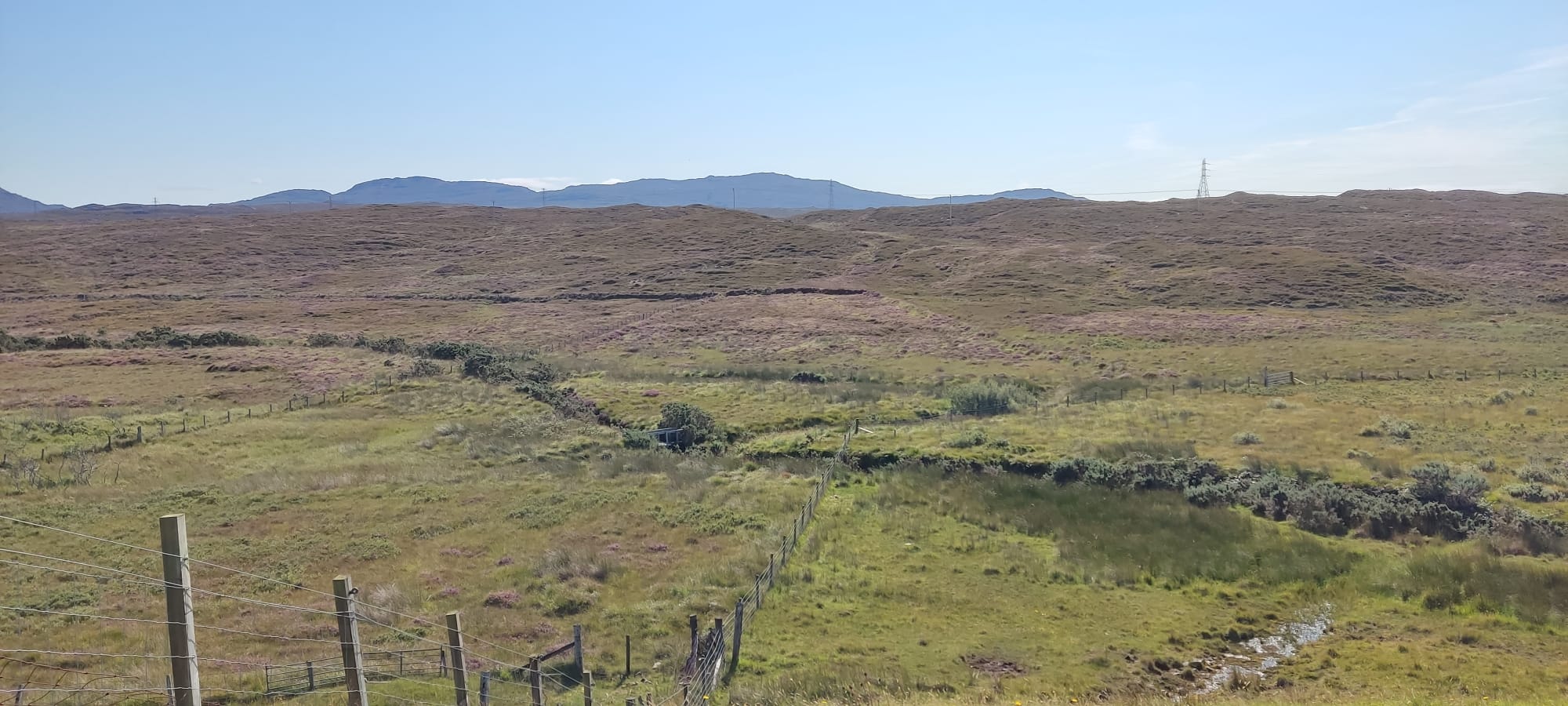
(The wind farm site discussed in this article will interpose between this ridge and the mountains in the background)

I was up in Skye this week to give one of my regular talks to activists and campaign groups around Scotland. It’s one of the aspects of my role at Common Weal that I enjoy the most and get the most out of even though it often means a lot of travelling. I’m very grateful to my hosts for not just organising the meeting but also putting me up for the night.

The evening was organised by the Breakish Windfarm Action Group who are currently concerned by plans to build a large windfarm development on a visually prominent part of the island. The estate owner, Lady Lucilla Noble, stands to profit massively from the site as will the Swedish developers Arise while tenant farmers are likely to see their livelihoods disrupted and restricted on what has been up till now land held as Common Grazings. They asked me to give a broader overview of how and why this is happening in Scotland and I duly prepared a presentation based around our proposals for how Scotland can publicly own our energy generation despite the Scottish Government’s excuse that “it’s reserved”. Shortest possible version: It’s only reserved if we want Government Ministers to own the energy. If we allow Local Authorities or communities to own it, it’s perfectly possible. It could even be funded in the same way. The only “downside” is that the Scottish Government wouldn’t get to control it. See Common Weal’s policy paper “How to own Scottish energy” for more details.

What I heard during the night though had both myself and my partner shaking our heads in disbelief. The story in Skye is that a landowner has contracted with a foreign company to extract vast profit from the resources of Scotland over the objections of the local community, without adequately compensating or benefiting said community, while obfuscating the planning process and making it is difficult as possible for the community to “properly” object as processes such as environmental studies and public inquiries cost tens to hundreds of thousands of pounds to complete – trivial amounts for the corporations but far beyond the reach of ordinary people to compete with. Everyone involved fully expects that even if the community is able to punch above its weight in terms of negotiating and bargaining power, Scottish Ministers will just override any objections because the Government’s primary goals are to make the Scottish GDP line go up by means of encouraging “inwards investment” – if doing that pushes climate goals too, then they suppose that’s fine too.

This is precisely the same story that is happening in my village at the moment where a French company is negotiating with a local land owner to build a massive solar farm and battery park. Just about the only thing that differs are the names of some of the people (and even then only some of them because it turns out that Ross Lambie, one of the local councillors for the ward I live in and who sits on our local Planning Committee is an absentee landlord bidding to use some land he owns in Skye to host a temporary housing for the construction workers being shipped in to install the turbines).

We’re not the only two communities facing this. Scotland is awash with largely foreign capital flooding places with applications for developments that even at their best won’t benefit communities nearly as much as they should (the £5,000 per Megawatt of community benefit funding that some of these developments offer is a shadow of the 30 to 100 times as much local revenue retained by full community ownership). Local planning offices report being completely overwhelmed trying to properly scrutinise applications and that goes double for areas with active community councils where volunteer councillors are expected to scrutinise highly technical documents without the resources to do so. Scottish Ministers are far too prone to allow projects to move up to the Energy Consents Unit to ensure that they can make the decisions – overriding local democracy as they do so – but this just concentrates the problem further. The ECU is similarly overwhelmed with more than 4,500 projects having been passed to them since December 2018. An average of almost two new applications per day. Ministers cannot not be expected to properly scrutinise these projects even if this was their only full time job.

And what happens if a dodgy developer does, by chance or fortune, get their application denied or made conditional to the point that they decide the profit margins aren’t high enough? Well, they just resubmit the application and try again or move on to the next community and hope they can’t pay as much attention. Communities need to be lucky every time. Corporations only need to get lucky once.
I’m not against renewable energy as a rule. We need more of it. What I’m asking for is for the Scottish Government to start abiding by its own party-approved policies. We need a Scottish Energy Development Agency (SEDA) to start producing a proper strategic map of Scotland. A map not just of where Scotland’s renewable resources are but where our actual demand is too. The overflow of development without coordination (compounded by frankly idiotic policies from Westminster such as blocking policies like Zonal Pricing) is leading to millions of pounds of consumer’s money being paid to energy generators in constraint payments. Wind turbines already generate profit almost for free once they’re built – the only way to make them more profitable for the multinationals and foreign public energy companies who own them is for them to make the profit without even generating the energy.

In addition to the SEDA we urgently need the Scottish Government to stop its opposition to public ownership of energy and to start allowing Scottish communities to be the owners of these developments.
Communities have been left alone to fight each application individually when it turns out that they are all facing the same spin everywhere. I am very happy to see that communities are increasingly banding together such as the 9CC group in Ayrshire or the recent conference of Community Councils in Inverness, but it’s clear that these groups themselves need support to start talking together, across Local Authority lines. Maybe that’s what it’ll take for Ministers to start paying proper attention. Maybe the next conference has to happen outside Holyrood itself.

The injustice of situations like where I live or in Skye or in hundreds of other communities is going to seriously harm public support for the renewable transition that we need. I’m not against renewable energy. I am against being screwed over by the people who own them. I’m against the injustice of communities not being given a stake in that transition and being told that their voice is irrelevant or a nuisance. But if my experience this week in Skye tells me anything, it’s that communities are ready to make that voice exactly as loud as it needs to be, especially as the elections approach. I hope Ministers will be listening. Or that their replacements might be.

The Lie Under The Nuclear Promise

“Ours is a world of nuclear giants and ethical infants. We know more about war than we know about peace, more about killing than we know about living. We have grasped the mystery of the atom and rejected the Sermon on the Mount.” – Omar N. Bradley

This is a rough transcript – edited for text medium – of the speech I gave at Scottish CND’s fringe meeting at the STUC Annual Congress on April 29th, 2025.

If you’d like to support this blog, you can throw me a tip at my Ko-Fi.

yellow and black road sign

When I was invited here, I was given a very broad remit for the topic of discussion. I thought I was going to talk today about the economics of nuclear bombs perhaps by way of talking about opportunity costs of investing in nuclear weapons – and what we could be building instead. Or maybe I’d talk about the cost of rebuilding a nuked city – though the images we’re seeing in real time from Palestine show that those costs can be visited upon humanity without us splitting a single atom. But when I sat down to decide what to actually say, something else came to mind entirely.

Here is my proposal for discussion: It is possible for an economy the size of the UK’s to sustain a civilian nuclear power sector without nuclear weapons. It is not possible for it to sustain a nuclear weapons sector without civilian nuclear power. Therefore, when politicians claim to back new nuclear power – especially in Scotland – despite renewables being cheaper, more effective, cleaner, faster to deploy and more secure, what they are actually doing is trying to shore up support for nuclear bomb infrastructure but they know they can’t say that.

To give a bit of a back story about myself and how I very nearly became an example of that proposal in action. Some here might know that I’ve not always been a policy wonk.
My degrees are in physics. I have a Masters in Laser Physics and Optoelectronics and a PhD in two-photon fluorescence with applications in distributed optical fibre sensing (don’t worry – no-one else understands it either).

Back in 2010, I was giving a lecture about my PhD work in London and got talking afterwards with someone who turned out to be from AWE Aldermaston. They were interested in some of the “extreme environment” applications for my research but amusingly, we had to cut the conversation short when he said “I don’t think I should say any more in case you start working out some secrets”. Probably for the best, though I’ll never know if my next thoughts were correct or not…

The point of that story is that I could very well have gone down that route. Several of my friends went into conventional military engineering. A couple went into civilian nuclear – including one who had to leave because he wasn’t willing to give up a dual citizenship for a promotion.

If we only had the couple hundred jobs sustained by the bomb sector, why would unis run those physics courses? As my friend Robbie [Mochrie] on this panel can attest – would he be teaching his courses if there were no jobs for his students to go into?

Where would the physicists and engineers who didn’t get those jobs go? Sure…some might become policy wonks…but while I love my job, I didn’t need to become a laser physicist to get it.

As an analogy, imagine trying to plan for an oil company and someone magics away all of the world’s plastic but nothing else changes. You’d lose a tiny fraction of your customer base but you’d still be selling oil to all the people with cars and gas boilers. You wouldn’t see much change in your business model.

A nuclear bomb sector without a civilian nuclear power sector is a bit like trying to run an oil company when all the cars are electric, the boilers are heat pumps and we recycle all of our plastics. The economics don’t work.

So bear this in mind when the politicians talk about bringing new nuclear power Scotland. There might well be a case for it – I’m not ideologically against it. But renewables are so cheap and Scotland’s potential so great that we don’t need that kind of civilian nuclear sector here. Unless…they want them here for the reason they know they can’t say.

Where Next For Grangemouth?

“Nobody wants to spend money to build a more resilient city because nobody owns the risk.” – Jeff Goodell

This blog post previously appeared in Common Weal’s weekly newsletter. Sign up for the newsletter here.

If you’d like to support my work for Common Weal or support me and this blog directly, see my donate page here.

The Scottish Government risks throwing good money after bad in its latest promise to take £25 million from the remaining ScotWind fund and use it to prop up Grangemouth.
This is in addition to the more than £100mn already earmarked between the Scottish and UK Governments amongst which is “Project Willow” – a plan that was launched to reduce the carbon footprint of the refinery and to find uses for it beyond fossil fuels. [Edit: Since writing this, the UK Government has also matched the Scottish Government’s £25mn pledge with an additional £200mn – but it’s for the same schemes so this article is for them now too]

That plan, however, was upended when owners Ineos decided to close down the plant because in this country we let billionaires decide the future of nationally strategic assets instead of our democratic governments.

I’ve written before about my position on a lot of this. I’m a full advocate for a Just Transition for workers who are facing losing their job as their workplace reaches its entirely foreseen and entirely necessary closure or reformation in light of the climate emergency. What I’m appalled about is politicians using that idea of a Just Transition as an excuse to do anything about that transition. As I wrote last week, “No ban without a plan” is an entirely justifiable slogan – except for the people who were supposed to come up with the plan.

Continue reading

The Scottish and UK Governments are both wrong on DRS

“This book was written using 100% recycled words.” – Terry Pratchett

This blog post previously appeared in The National as part of Common Weal’s In Common newsletter.
If you’d like to throw me a wee tip to support this blog, you can here.

a green traffic light sitting next to a store

Both the Scottish and UK Governments are wrong on Deposit Return Schemes.
The DRS is back in the news now that Keir Starmer – in yet another show of policy innovation – has decided to copy/paste the previous Conservative Government’s plan for a deposit return scheme – the proposal where you pay a small deposit when you buy things like drinks and receive the money back when you return the packaging to a deposit return machine (sometimes known as a “reverse vending machine”). His plan includes the previous plan to exclude glass from the scheme and he has refused to allow an exemption to the Internal Markets Act that would allow Scotland to both include glass and to introduce the scheme at all without having to wait for the UK to do it.

It really is impressive to me how the UK can be so backwards that it is utterly unable to bring in a circular economy scheme that is already near-ubiquitous across central Europe (and used to be common in Scotland if you’re old enough to remember Barr’s ‘gless cheques’ before they ended their scheme in 2015) and utterly baffling how vulnerable we are to lobbying by companies who want to keep dumping the costs of their pollution onto consumers and the environment. I’ve told this story many times but I remember being in an informal roundtable in Holyrood in the early days of the planning for the Scottish scheme and a representative from a major supermarket and a representative from a major multinational drinks company both argued against the concept of DRS. Both went a bit more silent when I mentioned that in my previous holiday to Prague I had personally deposited a drinks bottle made by the latter into the DRS machine hosted by the former. If they can do it in one country, why not another? As I say – it was never about “could”, but about “why should we, when we profit more by not doing it?”

Continue reading

Tool Libraries Are Overdue

“I have always imagined that Paradise will be a kind of library.” – Jorge Luis Borges

This blog post previously appeared in Common Weal’s weekly newsletter. Sign up for the newsletter here.

If you’d like to support my work for Common Weal or support me and this blog directly, see my donate page here.

image_2025-01-09_143839802

In December 2021, the Scottish Government made a promise to the Scottish Climate Assembly. In December 2024, their deadline passed with the promise now overdue.

Continue reading

The Climate Climbdown

“If a pandemic can induce governments to take emergency actions, why can’t a climate breakdown that threatens to kill off the very life-support systems of the planet do the same? After this, there can be no more excuses for passivity.” – Andreas Malm

This blog post previously appeared in The National as part of Common Weal’s In Common newsletter.
If you’d like to throw me a wee tip to support this blog, you can here.

image_2024-11-13_090439965

Scotland – once a nation that held itself up as a world leader in climate ambitions – has formally repealed important carbon emission targets in a vote that would have had unanimous support but for the abstention of the Greens.

The Scottish Government still holds that Scotland will be a “Net Zero” nation by 2045 but has yet to demonstrate how we will actually reach that goal, especially as interim targets like the 2030 target just repealed continue to be missed.

To be clear on why this vote took place, the Scottish Government put the target into actual legislation as a show of force on its climate ambitions. A “mere” government policy target could have simply been broken and forgotten about as is all too common amongst governments of all colours but once placed in law, the government would have been acting unlawfully if the target was missed.

Continue reading

The Shape Of Solar Scotland – Part II

“In a time in which Communist regimes have been rightfully discredited and yet alternatives to neoliberal capitalist societies are unwisely dismissed, I defend the fundamental claim of Marxist theory: there must be countervailing forces that defend people’s needs against the brutality of profit driven capitalism.” – Cornel West

This blog post previously appeared in Common Weal’s weekly newsletter. Sign up for the newsletter here.

If you’d like to support my work for Common Weal or support me and this blog directly, see my donate page here.
image_2024-11-19_131314546

A year ago this month I told the story of a new renewables development that had been planned for next to my village and how it put me in the very unexpected position of actively opposing something that most would expect me to have been wildly in favour of. A 100MW solar farm, plus another 100MW worth of battery capacity, worth around £150 million that would produce more power than this village could use ten times over. At the time of its initial proposal it would have been the largest solar farm not just in Scotland but in the entire UK (though since then, several larger projects have been proposed – I’ll come back to that in a bit).

My objection has never been about the renewables themselves – we need more in general and we really need more solar power in particular to balance a grid that is a little too tilted towards wind power – but it has been about control and who benefits from a project that would, in effect, turn a semi-rural Clydesdale village into an industrial estate power station with some houses on the edge. We do now have a few updates, courtesy of a meeting facilitated between the company and the local residents association (the unelected body we have representing the village because we don’t even have an elected Community Council here, never mind proper European-style municipal government) and held in the office of our constituency MSP and Cabinet Secretary for Energy and Net Zero Màiri McAllan. I should say that I, personally, wasn’t at this meeting (and neither was Màiri herself as she’s on parental leave) and only found out that it happened at all when the association published the minutes of the meeting on the village Facebook page almost a month after the fact.

My main objection to the project has never been about the renewables themselves but about place, ownership and benefit.

Continue reading

How To Replace Council Tax

“Is this Paradise?’
‘I can guarantee you that it isn’t,’ Jubal assured him. ‘My taxes are due this week.” – Robert A. Heinlein

This blog post previously appeared in The National as part of Common Weal’s In Common newsletter.
If you’d like to throw me a wee tip to support this blog, you can here.

untitled - 2024-10-31T173408.922.png.article-962

Last week I took part in The National’s series on Council Tax reform with a 20 minute conversation with journalist Xander Elliards on some of Common Weal’s ideas for replacing Council Tax with a value-proportionate Property Tax and then extending that tax to create an effective Land Tax.

You can watch the interview here

You can read Common Weal’s policy papers on Council Tax replacement here:
A Property Tax for Scotland
Taxing Land In Scotland

TCG Logo 2019

How Not To Dispose Of Disposable Cups

If it can’t be reduced –
If it can’t be reduced
Reused, repaired – REUSED REPAIRED
Rebuilt, refurbished, refinished, resold
Recycled or composted – OR COMPOSTED
Then it should be – THEN IT SHOULD BE
Restricted, redesigned – RESTRICTED
REDESIGNED or removed – REMOVED!
From production – FROM PRODUCTION
Pete Seeger

This blog post previously appeared in Common Weal’s weekly newsletter. Sign up for the newsletter here.
If you’d like to throw me a wee tip to support this blog, you can here.

image_2024-08-29_130259512-1

The Scottish Government still doesn’t understand what a Circular Economy is or how to bring the public with them as they implement it. This has been made clear by their latest ad hoc and misjudged approach to dealing with disposable cups. Their consultation on the levy has been launched here and Common Weal will get our response in in due course, please make sure your voice is heard too.

The proposal shouldn’t be as contentious as this and I should shouldn’t be on the side of fighting it – especially as I both agree with and support the goal behind the policy; to reduce resource use and waste produced by our single-use consumerism.

The policy as it stands, a 25p levy on disposable cups purchased as part of a takeaway drinks order, though risks seeing people as consumers to be punished into doing the “right thing” even as producers are allowed to make it impossible to make the right choice.

Continue reading

Extracting Oil and Profits

“No idea is above scrutiny and no people are beneath dignity.” – Maajid Nawaz

The following are two short articles I had published last week. The first, on Foreign Direct Investment, appeared in The Herald and the second, on Ed Milliband ending oil licences, appeared in The National.

If you’d like to throw me a wee tip to support this blog, you can here.

image_2024-07-15_125309614

Scotland must drop its addiction to foreign investment

Ian McConnell’s highlighting of Scotland’s continued dependency on “foreign direct investment” offers a welcome opportunity to once again explain why the policy – supported by multiple Scottish Governments – is acting to the detriment of the Scottish economy.

All investment demands an expectation of a return on that investment and the fact that the investment is coming from outwith Scotland obviously means that those returns must leave via the same route. Scottish Government figures show that since the start of devolution, more than a quarter of a trillion pounds has been net extracted from Scotland and that around £10 billion was extracted from Scotland in the most recent year we have data for. Further analysis by Common Weal shows that as a proportion of our economy, this is the highest rate of profit extraction of any of our peer nations with the exception of a handful of micro-states and tax havens as well as higher than any of the World Bank’s income groups, including the poorest and most indebted nations. Scotland, in that sense, runs an economy with European levels of economic development but with West African levels of foreign exploitation and profit extraction.

This isn’t just an issue of money. Companies that are mobile enough to invest in Scotland are mobile enough to remove that investment unless they get the political kickbacks they want (see the discussions around Scotland’s Green Freeports, for example. Or Grangemouth.) and thus present a direct intervention against our democracy. They also tend to more weakly embed jobs and skills in the economy and are more willing to leave workers on the scrapheap if some other nation decides to attract their “investments” instead of us.

The Scottish Government should drop its addition to FDI and should concentrate on building up domestic sources of investment (starting with reforms to the Scottish National Investment Bank) and should focus not on quick “GDP Growth” and accelerations of shareholder profits but on sustainable development not just of companies but of their workforces and the wellbeing of the communities in which they live.

Ed Miliband’s stance is welcome but it does not go far enough

The news that Ed Milliband has halted new oil and gas licences is a very welcome change of direction for UK politics and effectively brings the UK Government into line with what was the Scottish Government’s policy on new oil and gas in January last year. As it stands now though, the Scottish Government has backtracked on their opposition to new oil and has been extremely vague about the conditions under which it would support a ban. To be clear, it is one thing to state that you’d only support a licence if environmental checkpoints are met but if you don’t state what those checkpoints are or what a properly compliant oil licence would look like, then all you are doing is deferring responsibility for the decision either way.

The Supreme Court’s ruling last month that oil extraction must fully account for all oil emissions is significant here. Until then, a case was being built that a “Net Zero” oil rig would be one that transported workers to and from it without burning fossil fuels (Scope 1 emissions) and was powered by renewable energy instead of a fossil fuel power plant (Scope 2 emissions) but that basically washed its hands of whatever happened to the oil it extracted (Scope 3 emissions). If you bought some of their oil and burned it, that wasn’t their problem. This can no longer be the case and so brings into question the very possibility of a compliant oil rig. The Scottish Government should outright admit that either their support for oil must be ditched, or their remaining climate policies must.

As welcome as Milliband’s decision is, it likely doesn’t go far enough. He’s equally stated that he won’t revoke licences already granted but not yet being exploited nor will he shut down oil wells that are still economically producing oil. Half a decade ago in 2019, Friends of the Earth’s “Sea Change” report found that if the world is to meet its collective climate targets then not only must new licences be blocked and unexploited licences revoked, at least 20% of the economic oil in wells that are currently open must stay in the ground.

A Just Transition for workers is vital and I sympathise with Unite’s “no ban without a plan” slogan, but I fear that the politicians will stick to the easy option of “no ban” rather than what they should do, which is to bring those workers into the room immediately and help them design the plan that grants them the Just Transition they want and deserve before another political deferral forces a chaotic collapse of the oil industry and sees oil workers dumped just like their predecessors in the coal industry were.

TCG Logo 2019