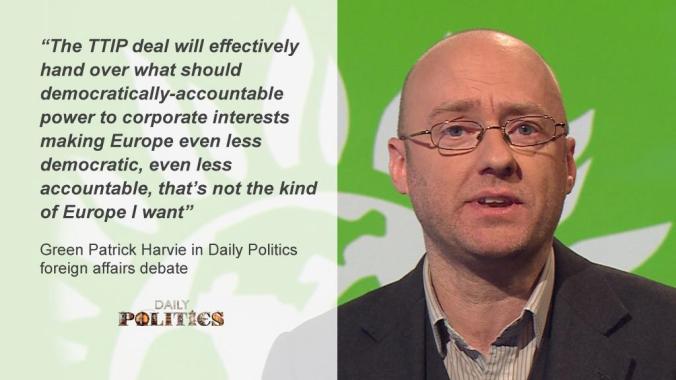
What is it?
The Transatlantic Trade and Investment Partnership (TTIP), also known in the US as the Transatlantic Free Trade Agreement (TAFTA), is a free trade agreement currently being negotiated between the United States of America and the European Union. It is largely based on the North American Free Trade Agreement (NAFTA) signed between the USA, Canada and Mexico in 1994 and is a cousin to various other trade agreements being negotiated between the US and other states such as the Trans-Pacific Partnership.
What’s so good about it?
Proponents argue that TTIP will eliminate trading tariffs and other trade barriers between the EU and US and will allow the harmonisation of health and safety laws and other regulations ensuring that goods and services exported to either or both blocs can be made to comply with regulations in all areas. They argue that this will bring economic growth and increased trade.
What’s so bad about it?
From a trading tariff standpoint, it is hard to see how this agreement will bring much in the way of benefit. Due to prior trading agreements organised via the World Trade Organisation, tariffs between the EU and US average at a little under 3% so there is little to be achieved by eliminating them. Instead the concern with TTIP lies mainly in its focus on non tariff related matters.
One major concern lies in the idea of “harmonising” the likes of health and safety law. The Greens, along with our partners in the European Free Alliance, strongly oppose any measure which would bring historically more stringent European health and safe regulation “down” to historically more lax American standards. As an example, there are currently large divergences between the US and EU with regards to which chemicals are allowed to be used in the agricultural sectors. The EU currently bans the use of growth hormones in meat and milk production whereas they are in common use in the US. Unless TTIP acts to ban such hormones in US (unlikely given the strength of the agribusiness lobby with American politics) then it is difficult to see how forced “harmonisation” of these laws would do anything other than open the EU to such produce. Similar arguments extend to subjects like the production, regulation and labelling of products containing Genetically Modified Organisms (GMOs).
Similarly, one of the arguments levelled by proponents of unconventional gas and “fracking” is that disasters and pollution caused by lax US safety standards could not happen here. If TTIP acts to bring EU standards down to US standards then this argument is undermined.
This example leads to another major concern of TTIP. Draft proposals leaked to the public indicate that corporations would be given the power to legally challenge any member state which acted against the principals of TTIP and maintained any real or perceived “barrier to trade” against the corporation. This could include breaking the prohibition of chemicals banned in the EU but legal in the US within the agricultural or chemical sectors mentioned.
These legal challenges, known as Investor-to-State Dispute Settlements (ISDS), have occasionally been seen within countries such as challenges launched against the Slovakian government when it attempted to renationalise its health insurance sector or against the Egyptian government when it attempted to increase the national minimum wage. Under TTIP the scope for companies to use ISDS’s could be greatly expanded. For instance, this could mean that American private health insurance companies could attempt to sue for “access” to our NHS market and any attempt to keep the healthcare of our citizens in public hands could be deemed a “barrier to trade”. At the very least, the possibly lengthy and complex legal battles would prove an expensive drain of time and tax-payers money.
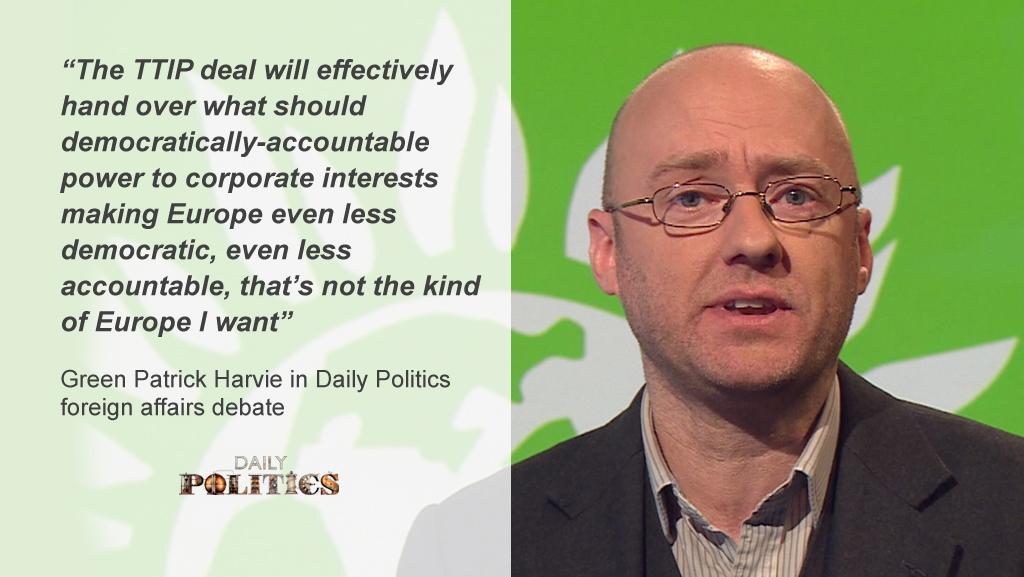
Finally, another particular concern about TTIP is the fact that all of this negotiation is being done behind closed doors and away from the democratic process. The UK government and our MEPs have very little direct access even to the documentation of the treaty and many of the concerns raised have only become apparent after documents were leaked to the public. Without proper democratic scrutiny and transparency this treaty simply cannot address the needs of the 500 million+ citizens to be affected by it. A treaty of this magnitude simply cannot be decided by a few industry lobbyists.
What can we do about it?
Education is key. So far TTIP has seen vanishingly little media coverage so many people are still unaware of even its existence never mind the implications of the treaty if it were to come into force as it currently stands. Several papers have been referenced at the end of this article explaining TTIP in more detail and anyone interested in the topic should certainly read them and share them with others.
Whilst this treaty is largely occurring way above even National level politics, the impact of it will be felt at all levels. Lobbying your local representatives at all levels of government (i.e. MSPs, MPs and MEPs) to express your interest and ask them to pass your concerns on is vital. Seeking their opinions and where they or their party’s differ from yours can also be powerful, especially in an election year.
Finally, you can get involved in the grassroots activism. Many online petitions exist and can be signed and many social media sites are frequently used to seek out and share information. Joining your local political party or activist group can also help you get more directly involved in campaigning for reform of this important treaty.
Further Reading
European Green Party Position Paper — “TTIP – Too many untrustworthy promises and real risks”
http://europeangreens.eu/brussels2014/content/position-paper-ttip
Green European Foundation — EU Trade Policy: analysing the impact of TTIP.
http://gef.eu/uploads/media/Analysing_the_impact_of_the_TTIP_Report_seminar.pdf
The Greens/EFA Group — “TTIP: no agreement between the EU and the US without high standards for the environment and for consumers”
http://www.greens-efa.eu/fileadmin/dam/Documents/Events/09_11_13_TTIP/131106%20Greens%20Group%20TTIP%20resolution%20for%20EGP.pdf
Anna Meyer and Jessica Walton — “A Citizen’s Guide to TTIP”
http://www.farmbillfairness.org/s/A-Citizens-Guide-to-TTIP-y93z.pdf
Friends of the Earth – The TTIP of the anti-democracy iceberg
http://www.foeeurope.org/sites/default/files/foee_factsheet_isds_oct13.pdf
UCU – TTIP: What it is and why we should be worried
http://www.ucu.org.uk/media/pdf/6/n/ucu_translantictradebriefing_jan14.pdf
Unison – TTIP: A Unison Briefing
https://www.unison.org.uk/upload/sharepoint/On%20line%20Catalogue/22410.pdf
British Embassy Washington – TTIP and the Fifty States
https://www.gov.uk/government/uploads/system/uploads/attachment_data/file/245085/TTIP_and_the_50_States_GovUK.pdf
European Commission – TTIP: The Economic Analysis Explained
http://trade.ec.europa.eu/doclib/docs/2013/september/tradoc_151787.pdf


 The Common Green