A list of my books and policy publications, mostly but not exclusively via Common Weal.
Books
Direction
Contributing Author, Common Weal, 2023.
A book that sets out a structural framework for a strategy to achieve Scottish independence via a coordinated.
Caring For All
Contributing Author, Common Weal, 2022.
A blueprint for a Scottish National Care Service that is locally controlled, publicly owned, not-for-profit, and free at the point of need.
Sorted: A Handbook for a Better Scotland
Contributing Author, Common Weal, 2022.
A vision for a shared future in an independent Scotland, Sorted imagines the country ten years after independence assuming it followed the principles and policies of the first ten years of Common Weal’s policy output.
A Better Nation
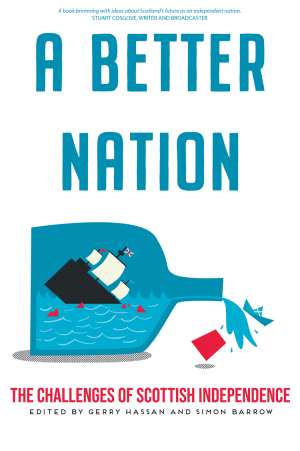
Contributing Author, Luath Press, 2022.
I wrote a chapter on trade and Scotland’s place in the world – trade is not simply a numbers game of ever increasing volume. Scotland has to consider the impact of our imports on Scotland’s domestic economy as well as the impact our exports have on others.
A New Scotland
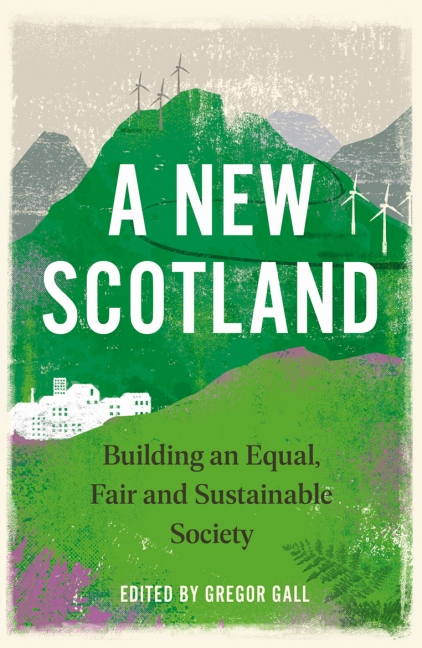
Contributing Author, Pluto Press, 2022.
I co-wrote a chapter with Mike Danson on the impact of Scotland’s concentrated pattern of land ownership on Scotland’s rural communities and how democratic control of that land could unlock community development.
All of Our Futures
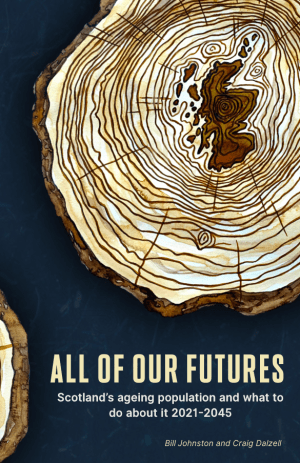
Co-Author, Common Weal, 2021.
Written with Bill Johnston, we challenge negative approaches ageing and old age by exposing the baleful influence of neoliberalism and ageism on policy and public perceptions. This book explores and breaks through barriers to healthy ageing in Scotland in areas such as work, health, housing, pensions and community development and attempts to look forward to 2045 towards a country that we can be proud to grow older in.
Our Common Home/The Common Home Plan

Contributing Author, Common Weal, 2019.
The world’s first national-scale, comprehensive and fully-budgeted Green New Deal plan, The Common Home Plan would result in Scotland becoming carbon-negative within 25 years of commencement and would result in a society that was wealthier, fairer, happier and healthier.
Scotland The Brave
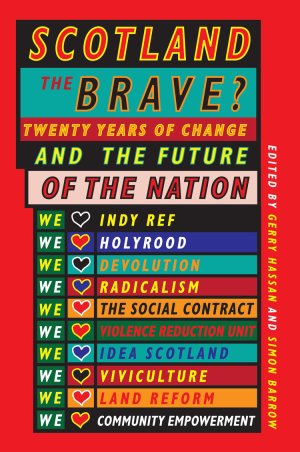
Contributing Author, Luath Press, 2019.
In a book reflecting on twenty years of devolution, I wrote a chapter calling for current politicians to consider the impact their policies will have twenty years from now.
Scotland: An Atlas of Opportunity
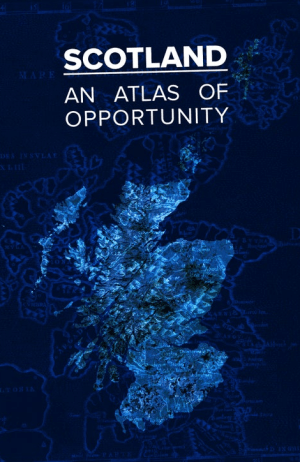
Contributing Author, Common Weal, 2018.
A truly stunning detailed map of Scotland produced by Common Weal and Lateral North. This atlas shows Scotland as a nation of strengths and opportunity, shows where our people, resources and advantages lie and hopes to pull Scotland away from negative notions of the country being a poor, wee backwater.
How To Start A New Country
Contributing Author, Common Weal, 2018.
Starting from the day after Scotland makes the decision to become an independent country there will be a lot of work to do to ensure that we have built up and installed all of the institutions needed to run a modern nation-state. This book charts the three year process between that decision and formal Independence Day.
Policy Papers (Updates coming)
A Silver Chain
“Whilst the purpose of this report is to specifically critique the report produced by the Growth Commission it is done so in the spirit of the principle laid out by the First Minister on the latter’s publication. If the Growth Commission report was produced to be discussed, then this report seeks to add to that discussion”
A critique of the Growth Commission’s approach to monetary policy in an independent Scotland. In particular, the “six tests” in the paper as well as the linking of Scotland’s economy to London’s financial institutes could act as a significant barrier to ever creating an independent currency and could well lead to Austerity being forced upon Scotland.
An Unequal Kingdom
“The 2014 Scottish independence referendum did not result in Scotland becoming an independent country but neither did it fully or finally resolve Scotland’s place within the United Kingdom”
There are good reasons to argue for the reform of the UK into a more federal structure but until a plan is presented which can answer the questions and overcome the barriers explored in the paper then the point of further discourse will be limited at best.
Scotland’s Data Desert
“Well served though Scotland may be as a region, as a country it remains a relative “data desert” compared to nearby independent countries.”
Scotland is reasonably well served by data compared to other parts of the UK but there are areas in which provision could be significantly improved. Further, an independent Scotland would no longer be able to rely on data from the UK. Scotland needs its own Scottish Statistics Agency.
Scotland’s National Bank
“Scotland can learn from any of the many models of banking that are out there and if we choose to, it is eminently possible that we could add to that rich history with our own distinct approach.”
If an independent Scotland chooses to launch its own currency then it shall need a Central Bank to regulate and secure it. This paper examines how central banks are run in other countries and draws out the lessons and principles that Scotland could apply.
Social Security For All Of Us
“Scotland can, if it chooses to be bold, creative and ambitious, use the opportunity presented by independence to build a social security system for all of us.”
Post-independence, Scotland will need to build a new social security system. This paper offers a vision of what it might look like.


Air Departure Tax: A Post-Brexit Analysis
The Scottish Government put out a call for evidence for their proposal to cut and eventually eliminate air passenger duty (or, as it’s now going to be known, Air Departure Tax).
Common Weal duly obliged and submitted our economic analysis. It’s just as well we did because the government then admitted that it hadn’t done any itself.
The White Paper Project v1.0
The first iteration of Common Weal’s White Paper Project. Our attempt to re-state the case for independence in a rational, evidence based manner. It is our first step towards a “consolidated business plan for the establishment of a new nation state”.
Beyond GERS
GERS (Government Expenditure and Revenue Scotland) 2015/16 reported Scotland’s fiscal deficit to be in the region of £14 billion per year, portraying Scotland as the country experiencing some of the most challenging financial circumstances in Europe.
However, this study must be viewed firmly in the light of Scotland being a member nation of the United Kingdom and, as such, any attempt to use them to project the finances of an independent Scotland must be treated with caution and qualification.
Claiming Scotland’s Assets
When examining the historical precedents of state separation and how they deal with division of assets and debts, it is revealed that whilst no previous example of independence provides exact parallels to Scotland’s case, there will be far more nuanced options ahead of us than were discussed in 2014 and that no matter which one we end up with, Scotland will be in a far better position financially because of it with savings to be had amounting to between £800 million and £2 billion per year.
Scotland’s Currency Options Post-Brexit
In the particular light of the post-Brexit situation, Scotland’s currency options had to be re-opened and revisited. In this report, the macroeconomic considerations underlying a decision on currency were examined and several likely options were considered by highlighting the strengths and weaknesses of each. The report concludes by recommending that an independent Scotland launch its own sovereign currency, initially linked to the Pound Sterling.
The Economics of Shale Gas Extraction
Until the publication of this report, much of the lobbying against shale gas extraction, or fracking, was based on the environmental impacts. Whilst this is a vital area of argument, the economics of the industry was left largely unchallenged. This report examined case studies in the United States as well as the scientific and economics literature to put together a picture of the shale gas industry as one based on temporary job gains, a Boom-and-Bust mentality which will devastate local economies and an energy sector heavily dependent on subsidy and unsustainably high gas prices.

 The Common Green