Same Spin Everywhere

“You’re radically collaborative, profoundly empathetic, and deeply communal. Everyone who tells you anything different is selling the fear that is the only thing that can break that nature.” – Hank Green

This blog post previously appeared in The National as part of Common Weal’s In Common newsletter.
If you’d like to support my work for Common Weal or support me and this blog directly, see my donation policy page here.
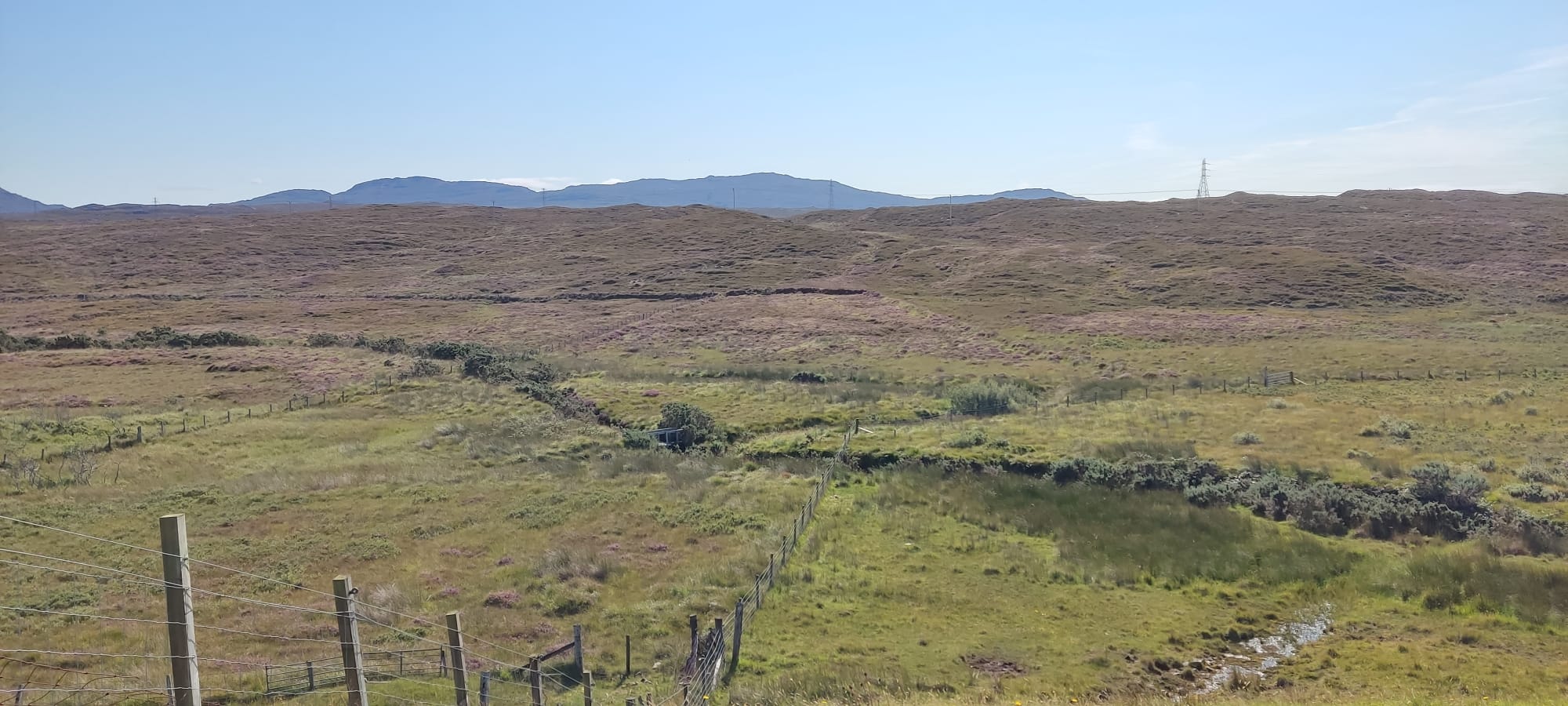
(The wind farm site discussed in this article will interpose between this ridge and the mountains in the background)

I was up in Skye this week to give one of my regular talks to activists and campaign groups around Scotland. It’s one of the aspects of my role at Common Weal that I enjoy the most and get the most out of even though it often means a lot of travelling. I’m very grateful to my hosts for not just organising the meeting but also putting me up for the night.

The evening was organised by the Breakish Windfarm Action Group who are currently concerned by plans to build a large windfarm development on a visually prominent part of the island. The estate owner, Lady Lucilla Noble, stands to profit massively from the site as will the Swedish developers Arise while tenant farmers are likely to see their livelihoods disrupted and restricted on what has been up till now land held as Common Grazings. They asked me to give a broader overview of how and why this is happening in Scotland and I duly prepared a presentation based around our proposals for how Scotland can publicly own our energy generation despite the Scottish Government’s excuse that “it’s reserved”. Shortest possible version: It’s only reserved if we want Government Ministers to own the energy. If we allow Local Authorities or communities to own it, it’s perfectly possible. It could even be funded in the same way. The only “downside” is that the Scottish Government wouldn’t get to control it. See Common Weal’s policy paper “How to own Scottish energy” for more details.

What I heard during the night though had both myself and my partner shaking our heads in disbelief. The story in Skye is that a landowner has contracted with a foreign company to extract vast profit from the resources of Scotland over the objections of the local community, without adequately compensating or benefiting said community, while obfuscating the planning process and making it is difficult as possible for the community to “properly” object as processes such as environmental studies and public inquiries cost tens to hundreds of thousands of pounds to complete – trivial amounts for the corporations but far beyond the reach of ordinary people to compete with. Everyone involved fully expects that even if the community is able to punch above its weight in terms of negotiating and bargaining power, Scottish Ministers will just override any objections because the Government’s primary goals are to make the Scottish GDP line go up by means of encouraging “inwards investment” – if doing that pushes climate goals too, then they suppose that’s fine too.

This is precisely the same story that is happening in my village at the moment where a French company is negotiating with a local land owner to build a massive solar farm and battery park. Just about the only thing that differs are the names of some of the people (and even then only some of them because it turns out that Ross Lambie, one of the local councillors for the ward I live in and who sits on our local Planning Committee is an absentee landlord bidding to use some land he owns in Skye to host a temporary housing for the construction workers being shipped in to install the turbines).

We’re not the only two communities facing this. Scotland is awash with largely foreign capital flooding places with applications for developments that even at their best won’t benefit communities nearly as much as they should (the £5,000 per Megawatt of community benefit funding that some of these developments offer is a shadow of the 30 to 100 times as much local revenue retained by full community ownership). Local planning offices report being completely overwhelmed trying to properly scrutinise applications and that goes double for areas with active community councils where volunteer councillors are expected to scrutinise highly technical documents without the resources to do so. Scottish Ministers are far too prone to allow projects to move up to the Energy Consents Unit to ensure that they can make the decisions – overriding local democracy as they do so – but this just concentrates the problem further. The ECU is similarly overwhelmed with more than 4,500 projects having been passed to them since December 2018. An average of almost two new applications per day. Ministers cannot not be expected to properly scrutinise these projects even if this was their only full time job.

And what happens if a dodgy developer does, by chance or fortune, get their application denied or made conditional to the point that they decide the profit margins aren’t high enough? Well, they just resubmit the application and try again or move on to the next community and hope they can’t pay as much attention. Communities need to be lucky every time. Corporations only need to get lucky once.
I’m not against renewable energy as a rule. We need more of it. What I’m asking for is for the Scottish Government to start abiding by its own party-approved policies. We need a Scottish Energy Development Agency (SEDA) to start producing a proper strategic map of Scotland. A map not just of where Scotland’s renewable resources are but where our actual demand is too. The overflow of development without coordination (compounded by frankly idiotic policies from Westminster such as blocking policies like Zonal Pricing) is leading to millions of pounds of consumer’s money being paid to energy generators in constraint payments. Wind turbines already generate profit almost for free once they’re built – the only way to make them more profitable for the multinationals and foreign public energy companies who own them is for them to make the profit without even generating the energy.

In addition to the SEDA we urgently need the Scottish Government to stop its opposition to public ownership of energy and to start allowing Scottish communities to be the owners of these developments.
Communities have been left alone to fight each application individually when it turns out that they are all facing the same spin everywhere. I am very happy to see that communities are increasingly banding together such as the 9CC group in Ayrshire or the recent conference of Community Councils in Inverness, but it’s clear that these groups themselves need support to start talking together, across Local Authority lines. Maybe that’s what it’ll take for Ministers to start paying proper attention. Maybe the next conference has to happen outside Holyrood itself.

The injustice of situations like where I live or in Skye or in hundreds of other communities is going to seriously harm public support for the renewable transition that we need. I’m not against renewable energy. I am against being screwed over by the people who own them. I’m against the injustice of communities not being given a stake in that transition and being told that their voice is irrelevant or a nuisance. But if my experience this week in Skye tells me anything, it’s that communities are ready to make that voice exactly as loud as it needs to be, especially as the elections approach. I hope Ministers will be listening. Or that their replacements might be.
You Have Options Too: An Open Letter to John Swinney

“Squeezing the lives of people is now being proposed as the saviour of the planet. Through the green economy an attempt is being made to technologise, financialise, privatise and commodify all of the earth’s resources and living processes.” – Vandana Shiva

This blog post previously appeared in The National.
If you’d like to support my work for Common Weal or support me and this blog directly, see my donation policy page here.

wind turbines on snowy mountain under clear blue sky during daytime

DEAR First Minister John Swinney,

The UK is running away from the hard choices on energy. Its dismissal of ideas like zonal pricing – ­currently the only scheme yet presented that would allow the UK to maximise renewable energy generation, minimise infrastructure costs like ­pylons and to reduce fuel poverty while giving communities more incentive to take control of their own local energy generation – has been rightly criticised by you last week in a statement where you called out the UK for not doing enough on energy policy.

It was concerning to note, though, that your critique wasn’t backed up by much on what you want the UK to actually do instead. Even as you complained about the UK “ruling out all options to bring down ­energy bills” by abandoning zonal pricing, I’m not clear if you support it or would bring it in if you had the power to do so.

We all know that Scotland’s devolved powers in energy are limited and that, right now, you couldn’t do something like this, but also missing from your critique was what you plan to do with the powers you do have.

Scotland’s own devolved energy ­strategy has been woefully lacking in recent years – from the sell-off of ScotWind at ­bargain basement prices, through ­dropping ­climate targets that were designed to push ­action ever forwards, to flogging off (sorry, “­encouraging foreign direct investment in”) every piece of our renewable energy sector to multinational companies and ­foreign public energy companies to ensure that everyone in the world can profit from Scotland’s energy except us.

We can take another path, though. ­Scotland must ensure that we own our own renewable energy future and the way to do that is by bringing it into public ownership. Here are several ways that you could do it.

1) A National Energy Company

This is what most of us think of when we think about “Scottish public energy”, and it’s the model that the Welsh Government adopted under the name Ynni Cymru. This is a single national company, owned by the Scottish Government or by Scottish ministers (similar to Scottish Water), that would own, generate and sell energy to consumers.

There is a snag to this plan in that the Scotland Act currently prohibits the ­Scottish Government from “owning, ­generating, transmitting or storing” electricity, so if we want the National Energy Company to be based around supplying ­electricity, then the first thing that the Scottish ­Government could be doing is mounting a pressure campaign to amend the Act – it puts Scotland in the ridiculous position that it’s legal for the Welsh Government to own a wind turbine in Scotland but not the Scottish Government.

Until that campaign is successful, there is something you can do.

The Act quite specifically bans your Government from owning electricity ­generators. It does not ban other forms of energy. A National Heat Company based around deploying district heat networks could supply all but the most remote of Scottish households.

While this would be a large infrastructure project, it wouldn’t be larger than the one required to build the electricity pylons we need if we’re going to electrify heat instead and the pipes would have the advantage of being underground and out of sight while ultimately providing heat to homes in a cheap, more efficient and ultimately more future-proof way that the current setup of asking people to buy heat pumps and just hoping that the grid can cope with the demand.

2) Local Electricity Companies

So, First Minister, let’s say that you’re not a fan of campaigning for the devolution of more powers and really want Scotland to be generating electricity. You can’t create a National Electricity Company but you can encourage local authorities to set up their own Local Electricity Company.

Conceivably, the 32 councils could even jointly own one National Electricity Company – the Scotland Act merely bans the Scottish Government from owning the company.

In many ways, this would be an even better idea than the Scottish Government doing it. Government borrowing ­powers are far too limited and you’d need to ­campaign for more borrowing powers to get the scale of action required to build the infrastructure we need – but councils have a trick up their sleeves.

They are allowed to borrow basically as much money as they like so long as the ­investment the borrowing allows brings in enough of a return to pay back the loan. This is very likely how Shetland Council will finance its plan to connect the islands via tunnels – the construction would be paid for via tolls on traffic.

Energy, as we know, is very profitable indeed so there should be absolutely no issue with councils being able to pay back their loans and then to use the revenue from their energy generation to subsidise local households against fuel poverty and to support public services.

If we want to go even more local than this, then councils and perhaps the Scottish National Investment Bank could support communities to own their own energy.

We’ve seen multiple times that community ownership generates many times as much local wealth building – as well as skills and jobs – than the current model of private ownership plus paltry “community benefit funds”.

3) A National Mutual Energy Company

This is another national-scale energy company that the Scottish Government could launch but in this case wouldn’t own or control. Instead, the “National Mutual” would be owned by the people of Scotland.

In this model, every adult resident of ­Scotland would be issued one share in the company. They wouldn’t be able to sell it and they’d have to surrender it if they ever stop living in Scotland, but ­other than this, it would be much like owning a share in companies like Co-op.

The company would be run as any other commercial company and would be beholden not to the Government but to its shareholders – us. We’d jointly ­decide ­future energy strategy and even potentially have a say in how much of the company’s operating surpluses are invested in future developments or distributed to shareholders (again, us) as a dividend.

This model would be particularly suited to very large energy developments that cut across local authority or even national borders or to help develop offshore assets. Imagine ScotWind had been owned by the people of Scotland, instead of being flogged off to multinational companies in an auction that had a maximum bidding price attached.

Conclusion

First Minister, I applaud you for keeping up some sense of pressure on the UK Government on energy.

As we make the necessary ­transitions ­required of us under our obligations to end the climate emergency, this is one of the sectors of Scotland that will change the most. It’s vital that we get this ­transition right, or not only will ­Scotland see yet another generation of energy ­potential squandered in the same way that the coal and oil eras were, we’ll see Scottish ­households bear the weight of others ­profiting from that transition while we still experience crushing levels of poverty and economic vulnerability.

The UK Government may be ruling out all of their options on energy but that doesn’t mean that you need to do the same. We don’t need to wait until independence – as vital as it is – or to wait until Westminster gets its act together – which may or may not happen. We – you – have options too. It’s time to take them.

Yours, expectantly …

What I’d Sacrifice For Wellbeing

“Equality is not a concept. It’s not something we should be striving for. It’s a necessity.” – Joss Whedon

This is a transcript – edited for text medium – of the speech I gave at the Independence Forum Scotland Conference in Perth on the 14th of June 2025

If you’d like to support this blog, you can throw me a tip at my Ko-Fi.

Image Source: Independence Live

The previous speaker posed us the question of what would it look like to bridge the gap between defining a Wellbeing Economy and achieving one. I’m going to try to look at that problem through the lens of sacrifice.

Those opposing economic change often frame the transition away from the status quo as causing us sacrifice.

Whether it’s sacrificing something abstract like the idea that “GDP Growth will make you rich”, even though it hasn’t.

Whether it’s “The climate transition will force you to give up your conveniences”, as if the only way to live sustainably is by moving into the forest, gathering berries and being robed in hemp homespun like some kind of hedge witch (actually…that sounds good…)

It’s sometimes even the outright conspiracy theory level of “15 Minute Neighbourhoods will take away your freedom to drive for 45 minutes to find a post box, if you can get past the military checkpoints at the end of your street”.

But what if a Wellbeing Economy wasn’t about sacrificing anything we’d miss? What if it actually was about fixing the things that are wrong with the way we live today?

In the next session you’re all going to be asked the question “What does a wellbeing economy look like?”. I’d like to throw in a few ideas here about what it means to me but looking through the eyes of what I might have to sacrifice to get there.

First – the daily commute. I’ve already sacrificed that. I’ve worked from home since the pandemic. I know. I get the privilege. I have a job that can be worked from home and, more importantly, I have a home that can be worked from. Not everyone who has the former has the latter. I’m a homeowner so I could modify my house to retrofit in an office. Renters in Scotland often can’t. Renters in Germany have the right to make reasonable modifications to their home though. So maybe we need to sacrifice the kind of landlord lobby that holds Scotland back and builds a housing sector for their profit rather than our wellbeing.

On the commute itself, the Scottish Government recently ditched its target of reducing car miles after being told they weren’t doing anything to meet it. The extra pollution this failure will result in will sacrifice people. That’s not a wellbeing economy.

Second, still on houses, I’d like to sacrifice my heating bill. Our housing sector is built for developer profits too, so we get cheap, crap, cold, damp houses that are hard to repair and retrofit. And we have a retrofitting strategy built around dumping the responsibility to fix things on you, rather than treating this as a massive public works infrastructure job for the public good.

I’d like to sacrifice buying things. The biggest mindset shift we as a society went through in the last twenty years was from “I need a thing, I’ll walk down the High Street and buy one” to “I need a thing, I’ll drive to the out-of-town outlet to buy one” to “I need a thing, I’ll buy it from Amazon Prime and have someone with a crap job deliver it to me tomorrow”. The next mindset shift needs to be “I need a thing, I’ll walk down the High Street and borrow one from the library”. The Scottish Government made a promise to the 2021 Climate Assembly to deliver 75 new Tool Libraries by the end of 2024. They only delivered 9. And the Minister at the time told me that they knew that 75 wasn’t enough to create that mindset shift but that they “hoped that the private sector would fill the gap”. Guess what. It didn’t.

While I’m down the High Street, I’d like to sacrifice the Thatcherist mindset that “there’s no such thing as society”. That mindset has actively pushed society out of our lives in favour of consumerism. Think about your community. How many of you can think of a space that you can go to, where you have a reasonable chance of accidentally meeting someone that you know. And it’s a place where you can exist for as long as you like without the expectation of buying something?

The protests over the removal of the steps in Buchanan St in Glasgow are emblematic of this. Let’s face it. Those steps aren’t particularly nice. It’s not a green urban nature reserve – it’s bare stone. They’re not comfy to sit on. It’s in the middle of a walking route. But they are a place to be in the middle of the city where you can gather and not buy and consume. They are a focal point for protest and organisation more generally – if that’s not “society”, what is? Glasgow Council keeps wanting to turn them into shops. I wonder if that plan is about suppressing protest more than it’s about encouraging consumerism.

It’s about sacrificing need and poverty. I want to see a Job Guarantee so that everyone who wants to work can work. But I also want a Universal Basic Income so that no-one needs to work, even if they want to. That need is what really keeps us poor. Keeps us powerless because it keeps us working for crap wages and bad conditions because if we don’t, we’re told that someone more desperate than us can replace us. The rich above us weaponise the poor below us to enrich themselves. It doesn’t even matter where “we” are in that ladder, because there’s always someone richer weaponising someone poorer.

And that’s the final thing I’d like to sacrifice to create a wellbeing economy. The idea that we’re not all in this together. The idea that there are people in this world who are better than you. Whether it’s by dint of Magic Blood, or by the power of their Magic Hat that can make you a Commander of the British Empire. Or whether it’s an overtanned manbaby who wanted to play with real life toy soldiers on his birthday. Or whether it’s any number of warlords who think that history will remember them kindly for their warcrimes or their desire to murder civilians by the score.

That’s what a wellbeing economy means to me. No Kings. Not real ones, not fake ones. Just a society that puts All of Us First.

Poor Show Swinney

“People almost invariably arrive at their beliefs not on the basis of proof but on the basis of what they find attractive.” – Blaise Pascal

This blog post previously appeared in Common Weal’s weekly newsletter. Sign up for the newsletter here.

If you’d like to support my work for Common Weal or support me and this blog directly, see my donation policy page here.

John Swinney claims to support the elimination of child poverty from Scotland, but he has admitted that he also believes – without actual evidence – that social security payments discourage poor people from working.

John Swinney’s only tangible policy on which he was elected as leader of the SNP and then First Minister of Scotland was a promise to eliminate child poverty. Note that he didn’t promise to reduce poverty or even to move faster than previous reduction targets (that he is so far failing to meet). He didn’t even, as his predecessor did, celebrate that child poverty in Scotland was merely a little lower than in England. He promised to eliminate child poverty. He has yet to explain “how”.

At the weekend, Swinney appeared to close down one of the tools that the Government has been using effectively to bring down child payment. The Scottish Child Payment is offered to adults who look after one or more children (the payment is on a per child basis – without the two-child limit seen in England) and who qualify for certain social security payments such as Universal Credit (if you think you might qualify you can check here). Frankly, the payment was brought in at a time and in a manner that stretches the devolved Scottish budget to its limits without the introduction of new taxes (such as our Land Tax) to pay for it but its impact on child poverty has been significant. The Scottish Government claims that the payment has contributed – along with their other poverty reduction policies – to lifting 100,000 children out of poverty.

Last weekend, Swinney announced that he was not considering further increases to the payment. Not, as might actually be reasonably defensible, on the grounds of budget constraints but because he believed that the payment was now high enough that a further increase would “reduce the incentive to actually enter the labour market.

In other words, he believes that increasing the child payment to £40 per week – something that the IPPR believes would lift another 20,000 children out of poverty – would discourage poor people from working.

This is, in short, complete crap. It is a claim that is not backed up by any data. In fact, if you have read my UBI article from the other week, you’d know that it is a claim that is completely countered by the facts. Giving people enough money to live on regardless of their life circumstances does not discourage people from working. In the most recent long-running study it was found that the total number of hours worked by UBI recipients did not change compared to their peers in the control group but that may did take the opportunity of the financial safety net to take a chance on a better paid, more worthwhile or more enjoyable job. Where studies have noticed UBI recipients dropping out of work it is almost universally not because “poor people are lazy and want to sit on the sofa” but because people use their safety net to study, to reduce hours as they run up to retirement or – pertinent to this article – to spend more time looking after their children.

With his comments, John Swinney is repeating the Conservative prejudice that the poor only work because it is marginally preferable to starvation and so any attempt to increase the number of workers in the economy can only be done by ramping up the costs of not working.

What Swinney is essentially saying is that while we shouldn’t have child poverty in Scotland, just bringing people to a penny over the poverty line would be enough for him, regardless of what that means for the people involved.

Cutting off the possibility of increases to social security because of self-imposed fiscal limits or rules (self-imposed even in this case not just because of slavish adherence to the philosophy of the 2018 Sustainable Growth Commission but due to a refusal to look at alternative mechanisms within devolution to increase revenue – see, again, our Land Tax) would be bad enough, but Swinney is making his case based on poverty being somehow the consequences of a lifestyle choice or moral failing. The poor, he apparently thinks, deserve their poverty unless they prove they are willing to not be poor.

This is a far cry from just a few years ago when there was a demonstrable majority across the Scottish Parliament for a guaranteed minimum income for all or a true Universal Basic Income (which probably explains the lack of push to bring in those policies).

The 2016 Holyrood elections are looming to the point of candidates being selected and manifestos being written. Swinney is obviously concerned enough about the rise of the far right to hold a summit about it (ineffectual as it was) but he surely must realise that the means of defeating the far right does not lie in gaming the political system to lock them out (see Germany), or in adopting their policies to try become them (see the UK) but in offering a real, credible alternative to Centrist Austerity and policy failure that leads to those populists gaining a base.

Instead of poor showmanship, Swinney could be providing leadership and actually taking action to meeting the goals he has set himself. The Scottish Government already has a poor track record of cancelling “inconvenient” government targets like climate emissions or reductions in car miles. Let’s not see the target of eliminating child poverty in one of the world’s richest nations become another one.

Fair Pay For All

“Employees keep the business doing what it does. It’s important to pay them accordingly.” – Hendrith Vanlon Smith Jr.

This blog post previously appeared in Common Weal’s weekly newsletter. Sign up for the newsletter here.

If you’d like to support my work for Common Weal or support me and this blog directly, see my donation policy page here.

The Scottish Government’s approach to Fair Work Principles are laudable, but should they go further by not just mandating minimum pay standards for low paid workers, but also maximum pay standards for the CEOs who underpay them?

Continue reading

It’s Scotland’s Economy – Or Is It?

“It is not inequality which is the real misfortune, it is dependence.” – Voltaire

This blog post previously appeared in The National as part of Common Weal’s In Common newsletter.
If you’d like to support my work for Common Weal or support me and this blog directly, see my donation policy page here.

Chivas Regal Scotch Whisky

Deliberate Government policy has resulted in Scotland’s economy being outsourced to foreign-owned companies to the point that we scarcely have a home-grown economy left any more. In a world of threats to global trade, this is a major problem.

Continue reading

The Last Stand of the Oil Barons

“You never change things by fighting the existing reality.
To change something, build a new model that makes the existing model obsolete.”  – R. Buckminster Fuller

This blog post previously appeared in The National as part of Common Weal’s In Common newsletter.
If you’d like to support my work for Common Weal or support me and this blog directly, see my donation policy page here.

Station

The oil and gas sector advocacy group Offshore Energies UK has claimed that if it gets more political and financial support than the sector already gets then the UK could produce half of the 15 billion barrels of oil we’ll need before 2050 with the rest being imported from increasingly unstable and unreliable countries like the USA.

However, rather than feeding even more monetary and political capital into the insatiable maw of the companies that caused the climate emergency, it would be a far better idea would be to aggressively drive down that demand by investing instead in a Green New Deal that would reduce the heat we need in our homes, remove the need for that heat to be produced by oil and would retire fuel-hungry modes of transport like internal combustion cars in favour of active travel and electrified public transport.

Continue reading

Demolishing Our Future Again

“As you will no doubt be aware, the plans for development of the outlying regions of the Galaxy require the building of a hyperspatial express route through your star system, and regrettably your planet is one of those scheduled for demolition. The process will take slightly less than two of your Earth minutes. Thank you.” – Douglas Adams (The Hitchhiker’s Guide to the Galaxy )

This blog post previously appeared in Common Weal’s weekly newsletter. Sign up for the newsletter here.

If you’d like to support my work for Common Weal or support me and this blog directly, see my donation policy page here.

The demolition of the Wyndford towers in Glasgow marks a sad end for the residents and campaigners who fought for years to prevent their loss. The fall of those towers represents a lot about failings in Scotland – and particularly in Glasgow – around approaches to construction, approaches to place-making and our approach to what we think residential housing is for.

The destruction of the towers was done almost entirely on short term financial grounds and because the owners of the towers were able to pass the costs of the demolition onto others rather than paying it themselves.

There were two chief arguments used. The first was a design argument that said that the buildings couldn’t be adequately retrofitted but this case was expertly dismantled by architect (and Common Weal Director) Malcolm Fraser. The second was a financial one that said that it was cheaper to demolish and rebuild than to retrofit.

This, again, was refuted on the grounds that the demolition plan didn’t take into account of the environmental impact of the resources used to rebuild.

Many of our building materials are carbon intensive – particularly concrete and steel (alternatives to both are coming online but aren’t quite there yet) – thus whenever we have a building in place, we have to consider the “embodied carbon” involved. Once a block of concrete is cast and all of the carbon it emits during its manufacture, transport and curing has been emitted then it doesn’t emit any more. However, grinding it into dust, throwing it into landfill and replacing it with a new block of concrete will result in more carbon emissions. Wood is kind of the opposite but still worth mentioning. Wood absorbs carbon when it grows but emits it when it rots or is burned as waste. Either way, when a building material is replaced with a new one, the “embodied carbon” price has to be paid. Obviously, therefore, to avoid more emissions than necessary, building materials should be used for as long as possible, should be RE-used when possible and replaced as infrequently as possible.

The problem is that we don’t have an effective carbon or externality tax in the UK that would price in such an effect. If it’s cheaper to tear down and building and let the planet pay the cost in emissions, that’s what Capitalism doesn’t just suggest should happen but actively demands must happen.

There is another aspect to the financial case though that has nothing to do with the carbon aspect and that is VAT. Right now in the UK if you want to buy materials for a new building, you’ll pay a reduced VAT rate of 5% but if you want to buy the same materials to retrofit that building you’ll pay 20% VAT. So there is a strong incentive for buildings to be torn down and replaced if that means qualifying for what amounts to a very large tax cut.

There are solutions to this. The obvious one would be to change VAT. In an era of climate emergency and in the absence of a full externality tax, the obvious solution would be a reversal of that situation to actively encourage retrofit over rebuild but most campaigners (like Fraser) would be content with at least an equal playing field.

Unfortunately, the UK Government isn’t moving very quickly in this field (though the previous Conservative government did temporarily cut VAT on some energy efficiency products) and while the Scottish Government is just as corralled by the volume developers who represent the companies who build many of the overpriced, cold and damp blocks of appreciating capital assets that some of us call “homes” but they do have the advantage of not having to worry much about VAT given that it’s a reserved tax. There are devolved options out there though.

Back in 2022, I was working with Malcolm on an idea to write up a proposal for a devolved tax that could try to level the VAT distinction between repair and rebuild. The Scottish Government couldn’t (or couldn’t cheaply) offer a tax rebate to subsidise the VAT on retrofits and couldn’t adjust the reserved tax directly and, as with the problems they have with bringing in a national land tax, they’d find it difficult to bring in a national construction tax. But the Scottish Government DOES have the power to bring in a local levy controlled by Local Authorities. Our idea then was that Scotland could bring in a Demolition Tax to intentionally raise the price of incidents like Wyndford tower to the point that repair and retrofit would be cheaper than the alternative.

But then, we were beaten to the punch by the Chartered Institute of Building who published essentially an identical proposal and did it likely better than I would have so I’ve been more than happy to endorse their work. I’m also pleased to note that the Scottish Greens have done likewise though I think they are currently the only party in Parliament to have done so. I’d like to know the reasoning behind why the other parties haven’t, if they’d like to tell me.

The devil in such a tax is in the detail though. If it’s set too low then it won’t discourage demolitions. If it’s set based on tax arguments like the infamous “Laffer Curve” so beloved by politicians who want to use it as a misguided excuse to cut taxes then it it’ll end up being “optimised” to maximise tax revenue. A properly set Demolition Tax should, in theory, eliminate all but the most essential of demolitions (demolitions on safety and disaster grounds should probably be exempt) and thus shouldn’t actually raise any tax revenue at all. Of course, this also raises the prospect of an owner letting their property simply decay rather either repair OR replace it – something that can be fixed by enforcing already extant regulations around maintaining buildings in good order along with early use of Local Authority powers to compulsory purchase property from landlords who fail in their responsibilities.

There’s an important point in this story that goes beyond the material and the engineering and that’s the lack of social planning and protection of communities. The Wyndford tower has taken 600 homes and will turn them into just 400 homes. Even if every former resident was offered a guaranteed place in one of the new homes (they weren’t) at a price they could afford there wouldn’t be enough houses for all of them. This demolition represents yet another dispersal of a community in a city that has basically defined itself by dispersal of communities for several generations now. Each one, even when they’ve created objectively better living conditions than what was there before (the New Towns project was a decidedly mixed bag in that regard – a subject for another time), that loss of community, of dislocation from friends and family, was often profound and itself generational in its impact. This is why one of our Big Ideas isn’t “Housing” but “Place”, because while four walls and a roof are a necessary component of living well in the modern world, it’s not a sufficient one and where it is and what it is connected to is important. Decidedly unmodern gendered language aside, John Donne was correct to say:

“No man is an Iland, intire of it selfe; every man is a peece of the Continent, a part of the maine; if a Clod bee washed away by the Sea, Europe is the lesse…”

— John Donne, Devotions upon Emergent Occasions, 1624

But if the continent of community is diminished when but a single part is torn away, what happens when every part is blown down and scattered to the winds?

Every decision that led to those towers coming down last week was made either uncaring of the community who called them home or despite those cares. Where the people were considered, it was done on an individualistic basis, as if each island would be fine if it was picked up and placed anywhere else.

I fear that lesson will be missed again. I see little evidence that the replacement buildings will endure for centuries longer than the less than four score and ten that their predecessor will. They’re certainly not being built with the kind of resource-preserving Circular Economy principles that we MUST be using in our constructions during a climate emergency. Otherwise, likely within the lifetime of some of those new residents, I fear that someone will be writing another eulogy similar to this one.

Image Credit: Ian Dick

Democracy By All Of Us

“Politics should be the part-time profession of every citizen who would protect the rights and privileges of free people and who would preserve what is good and fruitful in our national heritage.” –  Lucille Ball

This blog post previously appeared in The National as part of Common Weal’s In Common newsletter.
If you’d like to throw me a wee tip to support this blog, you can here.

Chamber

With a single act, the Scottish Parliament could radically overhaul our devolved democracy and put people at the heart of holding our legislators to account.

I’m grateful for the coverage The National gave to the the Independence Forum Scotland National Convention last weekend. It was wonderful to see the building activism in the room and delegates certainly kept me on my toes during the Energy World Cafe. The desire to see Scotland bring more of its energy resources into public hands is strong and I was glad to lay out how it could be done despite the limited powers of devolution.

Another question came out of the day about navigating similar limits in another area. One of Common Weal’s calls for the strengthening of our democracy is the creation of a second chamber in the Scottish Parliament that could take some of the weight off of the scrutiny committees, could make sure our laws are fit for purpose and – perhaps most crucially – could oversee the Parliamentarians themselves and hold them to account if and when they fall short of the standards expected of them. In this way it would act very much like the House of Lords down south or the elected or appointed upper chambers in many other countries (Scotland is one of the very few national-scale polities that don’t have an upper chamber – even most of the US states have one) but we want to improve on the highly corruptible model of appointing Lords for life based on their loyalty or political donations (still waiting on Labour delivering on the manifesto promise they made over a century ago to fix that one down south) or even the counter productive model of electing party-loyal people to that chamber (and thus replicating the US model where there is zero accountability when one party controls both houses and zero progress when they don’t). Instead, we want a Citizens’ Assembly where all registered voters in Scotland are entered into a lottery similar to jury duty and are called to serve in the Parliament. Appointments would be by random selection initially but the long list would be adjusted to ensure that the actual Assembly is balanced demographically across age, income, geographic representation and other factors (this model was used to great success in the 2021 Scottish Climate Assembly). Appointments would be generously paid (on par with MSP salaries) and would last a fixed time – we suggest a one year appointment with a third or a half of the chamber rotating out periodically – and there would be the same protections on returning to your job as there are for jury duty or paternal leave. The comparison to juries is a strong one. If we trust our peers to determine if it has been proven or not proven that someone has broken the law, then we are more than capable of determining whether or not the laws themselves are broken.

Sounds great, but the question we were asked at the Convention was whether or not Scotland has the power to set up such a Chamber.

If we were independence, it would be a relatively trivial matter to write the structure of the Chamber into our constitution but until then, the constitutional document we have to follow is the Scotland Act. Yes, the UK does have a constitution – it’s just not written down in one place and unlike the constitution of most nations, Westminster has sovereignty over it rather than being subordinate to it and so can change it whenever it likes.

As the Scotland Act doesn’t mention an Upper Chamber in its framework and as Westminster is extremely unlikely to exercise its power to write one into the Act, how could we set one up pre-independence?

Essentially we act as if we can.

The Scottish Parliament can set up advisory bodies or Commissioners to oversee the work of Parliament and even though we couldn’t mandate that they must follow the advice of those bodies (this was ultimately the source of the failure of the Climate Assembly – the Government decided they didn’t like the advice they were given so largely ignored it), Parliament and Government could collectively agree to follow those instructions – there’s nothing in the Scotland Act that actively prevents them from doing this just as nothing prevents parties whipping their members into voting along certain lines despite that not being an “official” part of our democracy.

Such an “unofficial” upper chamber wouldn’t be nearly as powerful as a constitutionally mandated one but that’s not to say that it would be powerless. Yes, something created by an Act of Parliament alone could be scrapped by one (a constitutional amendment would require a referendum). Yes, the Government could simply stop listening to its advice. This would place it on par with the other Commissioner bodies that exist around the Scottish Parliament. Yes, Westminster could overrule the Scottish Parliament and write a specific prohibition into the Scotland Act or elsewhere. This would place it on par with any other piece of legislation the Scottish Parliament has ever passed. If either of these barriers are enough to stop us, we might as well just give up on devolution entirely.

Scenes playing out across the world right now only serve to highlight how precious and vulnerable the very concept of democracy is and how no single person or even multi-person office can be trusted with more power than it needs. Scotland’s highly centralised form of government needs to be spread out a lot more locally but we also need more scrutiny and accountability at all levels from the top down. The best people to do that are All of Us appointed not to a House of Lords, but to a House of Citizens.

TCG Logo 2019

Continue reading

Platform Socialism

“With deregulation, privatisation, free trade, what we’re seeing is yet another enclosure and, if you like, private taking of the commons.” – Elaine Bernard

This blog post previously appeared in Common Weal’s weekly newsletter. Sign up for the newsletter here.

If you’d like to support my work for Common Weal or support me and this blog directly, see my donate page here.

App

Devolved Scotland doesn’t have many powers when it comes to unilaterally defending ourselves against a Trump trade tantrum that Starmer will supplicate and grovel to avoid – but the powers we have are surprisingly powerful.

Continue reading