We Are All Human, Or None Of Us Are.

“The rights of every man are diminished when the rights of one man are threatened.” – John F. Kennedy

This blog post previously appeared in Common Weal’s weekly newsletter. Sign up for the newsletter here.

If you’d like to support my work for Common Weal or support me and this blog directly, see my donation policy page here.
The UK is slipping even further into a dark, dark place. Let’s just be clear from the outset: once you declare someone, anyone, as not worthy of human rights you are declaring them to not be worthy as humans. And once you declare someone, anyone, as not being a worthy human, you might be next. Human rights apply to all of us, or to none of us.

Watching Nigel Farage spend a day of unrelenting media coverage this week to show off his latest idea of stripping migrants of their human rights and putting them in concentration camps was sicking. Worse, was seeing Keir Starmer’s response which was basically “we’ll do it too, but better”.

Then we got treated to a second day of it as former Conservative MSP Graham Simpson defected and attracted all of the airwaves to Farage again, followed for a third day by another defection in the form of former Labour Councillor Audrey Dempsey. Make no mistake. If you thought that was merely a coincidence, then you missed the deliberate strategy there.

Farage’s proposal is to follow a decade-long Conservative shibboleth of declaring that those “foreign courts” in Europe who safeguard our human rights via the European Convention on Human Rights are the worst kind of evil and the UK needs to withdraw from it. He’ll put in its place a “British Bill of Rights” that will apply only to British citizens and instead of “the state” telling you what you can do, you’ll have the freedom to do anything unless the state says you can’t do it.

One of the things he wants to do is to round up Afghan nationals who collaborated with the British armed forces during the invasion and occupation of that country. Many of these people now live under the threat of torture and execution by the Taliban since the latter reconquered the country and took back control. Many of these people had their personal details of their involvement with British forces leaked due to the UK’s appalling data security. Some received emergency evacuation. Some, it seems, did not.

Not surprisingly, the Taliban themselves appear to be quite happy to “receive” these people if Farage gets to implement his plans. When asked about whether he’d do it too Keir Starmer, a former human rights lawyer, said, effectively, ‘we’re not taking that option off the table’.

Removing the UK from the ECHR is not going to be as easy as waving a legislative wand. The rights bill is baked into the Belfast/Good Friday Agreement and can only be amended with the agreement of Ireland. Farage’s entire plan can be vetoed with a single memo containing the word “No”.

Or Northern Ireland could leave the UK, which would considerably smooth the passage of his plan. There’s still a complication in that ECHR is also baked into the Scotland Act and thus any attempt to disapply it to devolved areas in Scotland would require a legislative consent motion. But as Brexit has shown, this can simply be overridden by a Farage (or Starmer) Government. Or they could unilaterally amend the Scotland Act directly. Devolution will be no protection for Scotland in the way that it is for Northern Ireland.

“My partner is a migrant and is not a UK citizen nor likely to become one. Whenever someone says “prioritising British citizens”, they mean deprioritising and delegitimising my family.”

Even if the “British Bill of Rights” contains a carbon copy of the ECHR and it remains applying to everyone in general (i.e. Farage isn’t allowed to disapply it to Irish, Commonwealth, EU or non-EU citizens as he’s hinted) then we still have to remember that the actual purpose of doing this is to disapply it to specific people in specific instances whenever they become a nuisance to The State.

We’ve long been fed lines of the “bad person” who is “abusing human rights law” to avoid deportation for flimsy reasons like their cat is sick or they’d miss chicken nuggets (the actual stories behind those propaganda lines are far more nuanced). The point is that if such a person existed, these radicalised factions within the UK want to declare them less-than-human and to punish them for it.

This all matters because, sooner or later, it may well affect you. It’s certainly already affecting me. My partner is a migrant and is not a UK citizen nor likely to become one. Whenever someone says “prioritising British citizens”, they mean deprioritising and delegitimising my family. We also have to remember that I don’t just support Scottish independence, I work for an activist organisation that advocates for it. I am paid to agitate against the State in support of secession. In some countries, that’s not a job – it’s a death penalty offence. It might be me they strip citizenship from and declare to be unworthy of human rights.

Which, of course, means it might be you too. Or it might be Nigel Farage. Because even he is only a lost election and a charge of “collaboration with the previous regime” away from seeing his human rights abused too. As the famous line from the play A Man for All Seasons goes: “If you cut down the laws, and you’re just the man to do it, do you really think you could stand upright in the winds that would blow then?”

Human rights must apply to all of us or they apply to none of us. So I would ask Farage (and Starmer, and any other MP tempted to support this idea) a question: Please look through the rights guaranteed by the ECHR. Which rights do you wish would no longer apply to you, personally?

Because if he gets his way, one day they might not.

So You’ve Won Capitalism: An Open Letter To The Billionaires

“Democracy is supposed to be ‘of the people, by the people and for the people’. Capitalism is ‘of the capitalist, for the capitalist’. Period.” – Jerry Ash

This blog post previously appeared in The National.
If you’d like to support my work for Common Weal or support me and this blog directly, see my donation policy page here.

a bird's eye view of a beachfront home

Dear Billionaires,

I think we can all agree that you’ve won Capitalism. If the goal of Capitalism is to accumulate wealth via the canny deployment of capital (yours or someone else’s) for the purpose of spending that wealth on goods and services to improve your own lifestyle then you have been successful beyond measure. As a billionaire, you now possess more wealth than can be reasonably spent by any individual in a lifetime. In fact, you passed that measure a long, long time ago.

Continue reading

How to Launch a Scottish Wealth Tax

“I am opposing a social order in which it is possible for one man who does absolutely nothing that is useful to amass a fortune of hundreds of millions of dollars, while millions of men and women who work all the days of their lives secure barely enough for a wretched existence.” – Eugene V. Debs

This blog post previously appeared in The National.
If you’d like to support my work for Common Weal or support me and this blog directly, see my donation policy page here.

person holding fan of us dollar bill

(Image Source: Unsplash)

“From each according to their ability, to each according to their need”. This used to be the core credo of parties of the Left – particularly the Labour Party in Britain – but it appears to have been eroded to the point of meaninglessness. Wealth inequality is increasing at an unimaginable rate and is currently substantially higher than income inequality. The rich are taking from all of us far more than they need and are giving back far less than what they are able to. This is a self-reinforcing problem such as where people who were able to buy houses when they were cheap (perhaps during Thatcher’s Right to Buy demolition of the social housing sector) became able to rent them out at ever increasing rates to people who can’t now afford to save the deposit to buy a house because house prices are rising faster than they can save due to the amount they have to spend on rent. Even the Office of Budget Responsibility is now warning (as I did several years ago in my book All of Our Futures) of the fiscal risks looming due to the number of people still privately renting when they retire and who will simultaneously be unable to afford to keep paying those rents and won’t have any capital saved in their house to subsidise their inadequate state pensions.

It’s not for no reason that the British public are increasingly demanding that the UK Government brings in a wealth tax to rebalance our increasingly unstable economy. I will say that there are good reasons for the UK to not bring in “a wealth tax” – by which I mean a single annual payment calculated as a certain percentage of the value of all of the assets and possessions that you own. Prof. Richard Murphy has articulated many of them well. It’s hard to value those possessions. Easy to hide them. And there are other taxes that the UK could use – such as reforms to taxes on stocks, shares, pensions and capital gains – that would achieve much of the same result. Not that the UK Government is going to do any of that either unless the pressure escalates to the point that the impossible becomes inevitable.

Let’s say, however, that the Scottish Government wants to take the first step. Could we do it here instead of waiting for the UK?

The patterns of wealth ownership in Scotland are substantially different than in the UK (particularly in London and the South East). We don’t have quite as many financial billionaires floating about the place. We don’t have as much wealth in stocks and shares – mostly because we don’t have a stock exchange in Scotland any more. Our generally lower rates of pay mean comparatively lower rates of wealth stored in pensions. There are, however, two sectors in Scotland where wealth is substantially stored and which could be taxed using devolved tax powers – Land and buildings.

Scotland already has its Land and Buildings Transaction Tax but despite the Scottish Greens seeking to apply what they called a “mansion tax” to it this would remain merely a surcharge on the transfer of assets, not a wealth tax applied to the holding of them. If you never bought another mansion, you’d never pay the mansion tax.

Council Tax is the most outdated and badly broken tax Scotland still insists on inflicting on the poor. The Scottish Government has stated that they’re not even going to think about reforming it until the end of this decade. This is completely unacceptable, especially as the solution is obvious. We need to scrap Council Tax and replace it with a tax based on a percentage of the present market value of the property. Common Weal argued that a rate of 0.63% would have been revenue neutral compared to Council Tax at the time we published the paper. That number could be recalculated now but we estimated then that a “revenue neutral” rate would actually mean a tax cut for eight out of 10 households as the burden of paying the tax would be placed more fairly on those who lived in the most expensive houses. We calculated that the “break even” point then would have been a house worth something like £400,000. This is based one a flat rate of tax too. We would argue that Councils should have the power to add progressive rates on extremely valuable properties like £1mn+ mansions or, as is the case with the current Council Tax, additional multipliers for multiple home ownership.

This would immediately act as a wealth tax both on the most expensive properties but also on multiple property ownership. Unlike Council Tax that is paid by occupants, our Property Tax would be paid by property owners and they could only pass on to their tenants the basic rate of tax. Landlords would have to pay any multiple ownership surcharges themselves.

The second wealth store in Scotland – land – is probably the greatest store of almost untaxed wealth in the country. Many countries tax the ownership of land as a distinct tax from properties built on it (sometimes because of local democracy, for example you might pay the land tax to your municipal government and your property tax to your regional government) but in Scotland there may be good reason to not do that but to simply extend the Property Tax to cover not just the land under and around your mansion but also the broader estate you own with it. Given that the two are often sold together, this will be much easier to put a price on than trying to calculate a separate Land Value Tax. We’ve estimated that doing this at the same flat rate as the Property Tax would bring in around £450 million a year in revenue – though this could be adjusted down to account for subsidies for small farms or up to better tax the 422 people who own half of Scotland.

One of the major advantages of both of these taxes – one that negates objections from both the UK and Scottish Government whenever taxes on the wealth have been suggested – is that it completely bypasses the idea that the rich will simply leave the country. Recent studies have shown that the idea of “millionaire flight” basically isn’t a thing (it’s not just a huge logistical hassle for comparatively little financial gain to pack everything up to go and live in a tax haven, even millionaires have friends and family as do their kids and tearing up those social bonds to save a bit of money just isn’t worth it) but this hasn’t stopped the media pushing that line anyway. Even if it was true, the wealth they have locked up in Scottish land and housing can’t move with them. The tax still needs to be paid by whomever owns them regardless of where they live (and many of the largest landowners in Scotland already don’t live here so the point is particularly moot there).

One of the biggest sources of instability in our current society and economy is wealth inequality. It urgently needs to be reigned in and reversed. If the UK Government persists in refusing to do it then there is at least something that the Scottish Government can do without having to wait for them. And if the current Scottish Government doesn’t want to do it either well, there are elections next year. Maybe politicians could suggest who we should vote for who will?

What Scottish Independence Could Deliver For The Welfare State

“How much time he gains who does not look to see what his neighbour says or does or thinks, but only at what he does himself, to make it just and holy.” – Marcus Aurelius

This blog post previously appeared in The National as part of Common Weal’s In Common newsletter.
If you’d like to support my work for Common Weal or support me and this blog directly, see my donation policy page here.

Back in the early days of Common Weal, while we were still finding our feet and building our reputation, we had an informal rule when it came to policy-making. We had to be able to show the policy working somewhere else.

This was because we felt that Scotland simply wasn’t ready for some of the radical ideas that we wanted to implement so being able to show it already working was a good way of building confidence in a nation too often told “we cannae dae it” (by which our opponents often mean “we shouldnae dae it” which is a different thing entirely).

We’ve since dispensed with that rule and we sometimes broke it even then (one of Common Weal’s very first policy papers, “In Place Of Anxiety”, was an advocacy for Universal Basic Income (UBI) long before it became one of the “cool” policies) but this isn’t to say that we can’t learn lessons from elsewhere.

Just this week, I was asked by a researcher which of our neighbour nations I’d like Scotland to copy if I could. My answer was that we shouldn’t copy any one but that I take a lot of inspiration from Germany on local democracy, from Denmark on energy strategy and from Norway for public ownership. Somewhere else we could do with taking inspiration from our neighbours is on social security.

The scenes this week from the UK’s attempts to hammer the poor and disabled and only backing down after shambolic chaos in the Parliament should be a lesson not just in humanity but in policy-making as well. Never fight a battle you haven’t won in advance. Never assume a large on-paper majority means certain absolute power.

With many of our neighbours basing their politics on proportional representation and coalition politics, this kind of legislation would have undergone a lot of negotiation and compromise long before arriving at the voting chamber.

The way that many of our neighbours deal with the issue of social security is markedly different from the UK in several ways. The first is that the systems are a lot more generous in general. Norway, Denmark and Sweden rank in the top three OECD nations for spending on disability protections at above 3% of GDP while the UK is well below the OECD average at less than 2%.

Many more social securities like unemployment protections follow a different model from the UK when they are calculated. In particular, instead of the flat rate paid under the UK’s Universal Credit, many countries follow a model where the protection you receive is based on a percentage of your previous income.

There are consequences to each of these models. A flat rate tends to be more redistributive if it is generous enough (which Universal Credit isn’t) whereas a proportional rate tends to be less disruptive to an individual who is already going through the shock of losing their job while still having bills to pay.

We’ve seen these impacts in the UK too. During the pandemic, the Covid furlough scheme was paid at a proportional rate to people who were employed but was often paid at a flat Universal Credit rate to self-employed people. This exposed a lot of people who were previously on the side of denigrating poor and vulnerable people as lazy slackers to just how meagre and cruel the UK “benefits” system is.

We had an opportunity then to get some serious change off the back of that and maybe we still see echoes of it in this week’s chaos but largely the Powers That Be wanted to make us forget that moment of reflection as quickly as possible.

On the other side and as tempting as it might be to copy a European-style unemployment insurance based on previous income, and as beneficial that would be to people in well-paid but otherwise insecure jobs, we have to remember that many people are not in well-paid jobs and that wage suppression has been rife in the UK for decades. Receiving 60% of your previous income when you were being paid poverty wages won’t protect you from poverty in unemployment.

So maybe rather than Scotland – particularly an independent Scotland – copying existing social security policies from our neighbours, we need to look to them for inspiration in another way and look back at that paper I mentioned at the start of this column.

Last year, the EU think tank the Coppieters Foundation published a paper called “A European Universal Basic Income” which found that a UBI sufficient to eradicate poverty across the entire union could be entirely paid for by relatively modest changes to income tax and the savings found from the reduction of poverty itself.

Its model called for a UBI of €6,857 per year for adults and half that for children under 14. This is the equivalent of £113 per week for adults and £57 per week for children. The paper claimed that the increase in income taxes to pay for this level of UBI would themselves be relatively modest and the “breakeven” point for people who’d pay more income tax than they’d receive in UBI would be at around the 80th percentile.

In other words, eight out of 10 people would be directly better off with the UBI. And, to repeat, while this is still a relatively small sum per person if you have no other income, it would be enough to eradicate poverty across the entire EU and would be cheaper overall – after the health, crime and social inequality costs of poverty are factored in – than the current systems.

When this paper came out I argued that this meant a UBI was now a moral imperative because it was cheaper than the cost of poverty, but there’s clearly a financial imperative too. Whether we’re discussing an independent Scotland seeking to create a better country for all of us or even just a cynical UK trying to save money in the face of a humiliating attempt to crush the poor, here is a solution we should all support. Eradicate poverty, save money, implement a Universal Basic Income.

Burning Down The House of Cards

“What are the odds that people will make smart decisions about money if they don’t need to make smart decisions—if they can get rich making dumb decisions?” – Michael Lewis, The Big Short

This blog post previously appeared in Common Weal’s weekly newsletter. Sign up for the newsletter here.

If you’d like to support my work for Common Weal or support me and this blog directly, see my donation policy page here.

Image Credit: Dominic Alves

Rachel Reeves has signalled that she is “open minded” about the banks lobbying her to repeal regulations that came in after the 2008 Financial Crash. If she does, she will be accepting responsibility for the next one the banks inevitably cause.

One of the most important films dealing with the financial sector since the 2008 Financial Crash was 2015’s The Big Short. Comedic, irreverent and outright scathing of those involved, yet it remains one of the most incisive explanations of the 2008 Financial Crash and it managed to make the intentionally obscure world of financial alchemy accessible to the lay person. I’d go as far to say that it did for the idea of ‘sustainable investment banking’ as the films Threads and The Day After did for the idea of a “survivable nuclear war”.

If you haven’t seen it, please do so and pay particular attention to the scene explaining the concept of “synthetic CDOs” – where investors could effectively gamble on the possibility of you defaulting on your mortgage, and other investors could gamble on whether or not those investors will win their bet, and more investors could gamble on the outcome of those bets…all without knowing anything at all about your finances and the state of your mortgage.

One of the things that made these ‘financial instruments’ so destructive was that the ‘investment’ side of the banking sector – the bit that involves people effectively gambling amongst themselves with money that maybe was theirs and maybe wasn’t – was entirely leveraged on the ‘retail’ side of the banking sector – that’s the bit where you put money in your savings account and ask the bank for a mortgage to buy a house – but was completely divorced from it to the point that one side didn’t understand what the other side was doing.

When the housing boom of the early 2000s came to an end in late 2007 and people started defaulting on mortgages, this would have normally been tragic for those losing their homes and a sign of a substantial economic recession but would have ultimately resulted in a bounce back. But all of those ‘investment firms’ sitting on top of the sector were gambling with money that they ‘knew’ was ‘safe’ (because ‘safe as houses’) despite the houses not being nearly as safe as people assumed.

Not just assumed. The way the CDOs were structured made it functionally impossible for anyone to actually assess the risk of their failure. Because it was impossible to work how and if they might fail, the credit agencies declared them to be safe (yes, really) which encouraged banks to pile money into them.

It got so bad that the investment sector was gambling with something like $20 for every $1 actually involved in the mortgages. The investment gambling sector was many times larger than the value of thing they were gambling on. The liabilities on the banks ‘if’ their sure bet failed reached the point of being larger than the GDP of the countries they were based in.

It would only take a small increase in the percentage of mortgage defaults to utterly bankrupt the banks. An increase that might be caused by investment bankers encouraging retails bankers to take on ever riskier mortgages (with ever higher profit margins), paying exorbitant bonuses to bankers who could sell larger and larger mortgages to people who couldn’t afford to pay them.

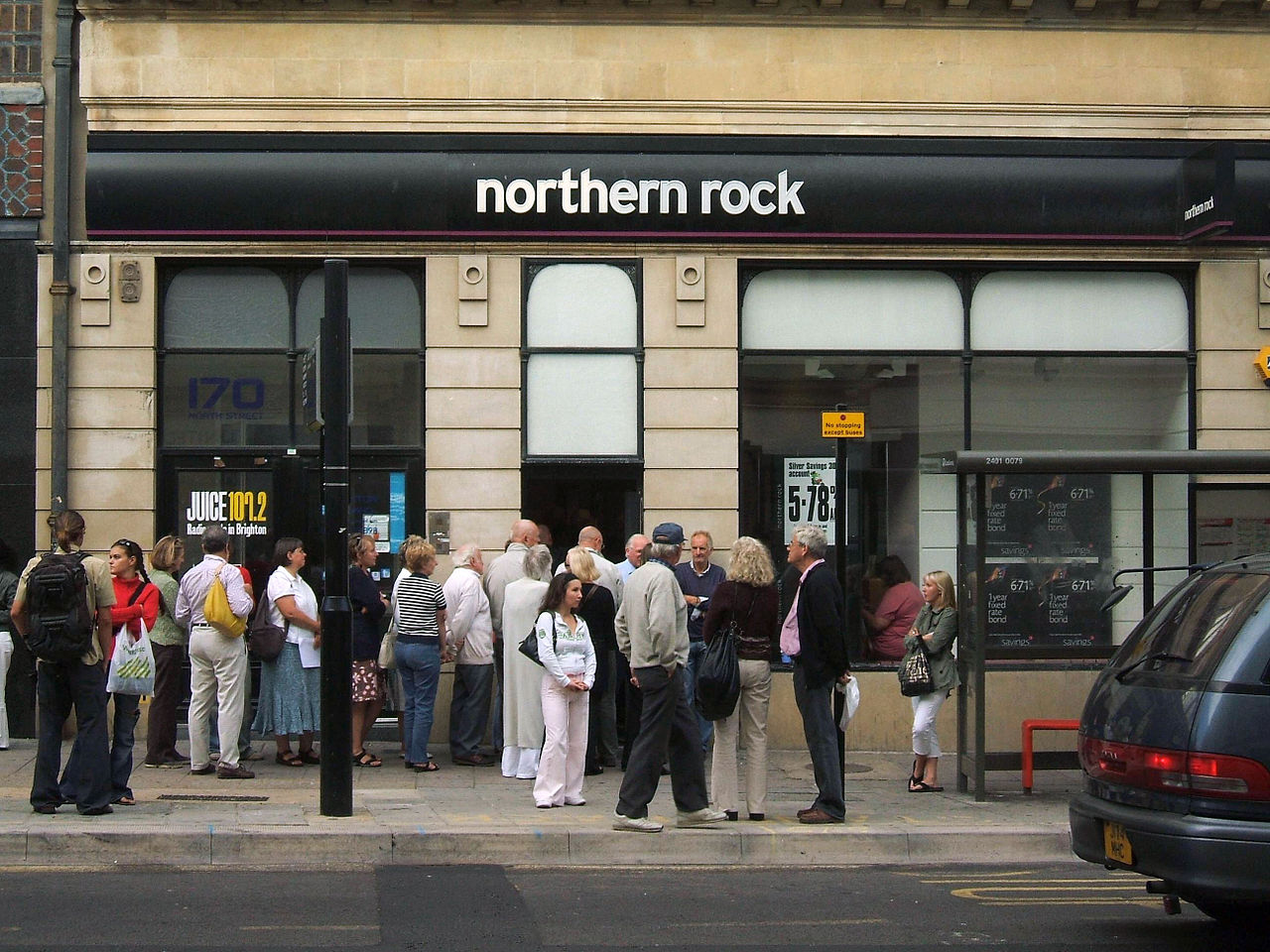
Which is what happened. And the backlash threatened to pull down other sectors of the economy because the bankers weren’t just gambling on mortgages but on everything just about up to and including whether or not the sky was blue and the fact that the investment wings were entwined with their retails wings meant that if their investment bank failed, the ATMs on the high streets could be shut down too (runs on banks like Northern Rock showed the visceral reality of people faced with losing their savings because of someone else’s mistakes).

Continue reading

The Lie Under The Nuclear Promise

“Ours is a world of nuclear giants and ethical infants. We know more about war than we know about peace, more about killing than we know about living. We have grasped the mystery of the atom and rejected the Sermon on the Mount.” – Omar N. Bradley

This is a rough transcript – edited for text medium – of the speech I gave at Scottish CND’s fringe meeting at the STUC Annual Congress on April 29th, 2025.

If you’d like to support this blog, you can throw me a tip at my Ko-Fi.

yellow and black road sign

When I was invited here, I was given a very broad remit for the topic of discussion. I thought I was going to talk today about the economics of nuclear bombs perhaps by way of talking about opportunity costs of investing in nuclear weapons – and what we could be building instead. Or maybe I’d talk about the cost of rebuilding a nuked city – though the images we’re seeing in real time from Palestine show that those costs can be visited upon humanity without us splitting a single atom. But when I sat down to decide what to actually say, something else came to mind entirely.

Here is my proposal for discussion: It is possible for an economy the size of the UK’s to sustain a civilian nuclear power sector without nuclear weapons. It is not possible for it to sustain a nuclear weapons sector without civilian nuclear power. Therefore, when politicians claim to back new nuclear power – especially in Scotland – despite renewables being cheaper, more effective, cleaner, faster to deploy and more secure, what they are actually doing is trying to shore up support for nuclear bomb infrastructure but they know they can’t say that.

To give a bit of a back story about myself and how I very nearly became an example of that proposal in action. Some here might know that I’ve not always been a policy wonk.
My degrees are in physics. I have a Masters in Laser Physics and Optoelectronics and a PhD in two-photon fluorescence with applications in distributed optical fibre sensing (don’t worry – no-one else understands it either).

Back in 2010, I was giving a lecture about my PhD work in London and got talking afterwards with someone who turned out to be from AWE Aldermaston. They were interested in some of the “extreme environment” applications for my research but amusingly, we had to cut the conversation short when he said “I don’t think I should say any more in case you start working out some secrets”. Probably for the best, though I’ll never know if my next thoughts were correct or not…

The point of that story is that I could very well have gone down that route. Several of my friends went into conventional military engineering. A couple went into civilian nuclear – including one who had to leave because he wasn’t willing to give up a dual citizenship for a promotion.

If we only had the couple hundred jobs sustained by the bomb sector, why would unis run those physics courses? As my friend Robbie [Mochrie] on this panel can attest – would he be teaching his courses if there were no jobs for his students to go into?

Where would the physicists and engineers who didn’t get those jobs go? Sure…some might become policy wonks…but while I love my job, I didn’t need to become a laser physicist to get it.

As an analogy, imagine trying to plan for an oil company and someone magics away all of the world’s plastic but nothing else changes. You’d lose a tiny fraction of your customer base but you’d still be selling oil to all the people with cars and gas boilers. You wouldn’t see much change in your business model.

A nuclear bomb sector without a civilian nuclear power sector is a bit like trying to run an oil company when all the cars are electric, the boilers are heat pumps and we recycle all of our plastics. The economics don’t work.

So bear this in mind when the politicians talk about bringing new nuclear power Scotland. There might well be a case for it – I’m not ideologically against it. But renewables are so cheap and Scotland’s potential so great that we don’t need that kind of civilian nuclear sector here. Unless…they want them here for the reason they know they can’t say.

Tariffs for Penguins

“Well, whiles I am a beggar I will rail,
And say there is no sin but to be rich,
And being rich, my virtue then shall be
To say there is no vice but beggary.
Since kings break faith upon commodity,
Gain, be my lord, for I will worship thee.”
― William Shakespeare, King John

This blog post previously appeared in Common Weal’s weekly newsletter. Sign up for the newsletter here.

If you’d like to support my work for Common Weal or support me and this blog directly, see my donation policy page here.

white and black penguin on snow covered ground during daytime

Note: This article was published on April 4th and the situation has developed substantially since then with the tariffs on most countries (with the notable exception of China) being reduced to 10% for the next few weeks or until Trump burps out some other policy after breakfast.

Trump’s tariffs are the product of a person who doesn’t understand the levers they are pulling, but the UK responding as if we achieved a victory is a flat out lie.

Donald Trump cannot conceive of a “positive sum game”, that is a deal where both parties end up coming away better off than they were before the deal was made. Collaborative community action is a positive sum game when the whole of the community is greater than the sum of its parts (watch once of those “Alone”-style survival programmes to get a glimpse into what true “individualism” actually means).

Trump believes that the only deal possible is a zero-sum game. If there is a “winner”, then there must be an equal and opposite “loser”.

Trump is also deeply narcissistic and believes that if he can perceive you “winning”, then HE must be the “loser” and that cannot be allowed to stand. In his “Art of the Deal”, a “fair” deal is one that he wins.

Now that the world is “fair” again, any attempt by any nation to apply a retaliatory tariff or other sanction will be met with fire, fury and injustice.

Don’t worry if you disagree with his logic or his assumptions here. The key to understanding the trade tariff announcements this week is not whether or not you think he’s right but whether or not HE thinks he is.

Sir Keir Starmer thinks he has won a diplomatic coup. That the “Special Relationship” has saved the UK from the wrath of Trump’s tariffs – at least compared to the EU. The UK got hit with a 10% tariff, the EU got 20%. This, if you watch the UK Government aligned media or commentators, is a sign that all of the begging and grovelling for concessions and special privileges helped take the edge off of a bad situation. Keir Starmer believes that his strategy is a vindication and that we must all “trust the process”.

Sir Keir Starmer is wrong. His actions played absolutely no role in how the tariff was applied to the UK. He could have begged harder and utterly prostrated himself in front of the golden throne. Or he could have stood straight and pushed back. It wouldn’t have mattered. Sir Keir Starmer is an irrelevance to Trump.

With a few exceptions like Trump’s hatred of foreign cars and the fact that these latest tariffs appear to be additional to the tariffs put on countries like China and Canada previously, the calculation of the rate for each country was disturbingly simplistic. For countries where the US has a trade surplus in goods (but not services – this will be important. Trump doesn’t believe that exports like Holywood movies, Microsoft Office subscriptions or licensing deals to produce goods outwith the USA under the Coca-Cola or McDonalds name are worth anything to the US), the rate is 10%. For countries where the goods trade balance is a deficit (i.e. a higher value of goods from country X enter the US that American goods leave for country X), then they took the value of the trade deficit (import value minus export value) and divided it by the value of imports. If a country sells $100 of goods to the US but only buys $60 worth back, then $100-$60 / $100 = 0.4, so they get an 40% tariff. Except Trump then halved the values above the 10% floor because he’s “being nice” (which, of course, undermines his stated purpose of the tariffs being the minimum amount required to restore a trade balance – once again, it doesn’t matter if you see why he’s wrong, only that he doesn’t).

This is why countries like Madagascar and some of the world’s poorest countries are high on the list. The largest single item that Madagascar exports to the USA is vanilla – one of the most valuable spices in the world at around $83 million per year. Goods experts from the USA to Madagascar are comparatively sparse. There isn’t much that the US can send that they can’t get from somewhere closer and, more crucially, high value goods are of limited value to a populace who can’t afford them. Madagascar isn’t “ripping the USA off”. They’re just selling spices that the USA is about to realise they used to really enjoy.

Other anomalies abound like the mention of sub-national states like the Falkland Islands and France’s “we don’t call them colonies any more” territory of St Pierre and Miquelon that sits off of Newfoundland in Canada. There are two main theories why these substates are included. One being that some Musk-ish techbro made the list by asking Grok or another chatbot for a “list of countries” and it returned a list of countries that have a country code top level internet domain like .uk or .eu (though if they did, I’m surprised that they had the awareness to remove .su so they didn’t try to apply a tariff on the Soviet Union despite America being somehow completely unable to export ANYTHING to them for going on 35 years now). The other is that they just copy/pasted the CIA Factbook list of notable polities which includes several sub-state territories of various kinds. (Fun Fact: I had to do this precise kind of filtering while writing our Profit Extraction paper because the World Bank’s database I used also includes various substates, suprastate regions like “West Africa” and multiple nations that no longer exist but did exist when the Bank started tracking their data).

The omissions are interesting too. Russia and Belarus were omitted “because we already have sanctions on them” but Iran – which is also under US sanctions – was not. There’s a very telling thing going on when you look at the nations that Trump is willing to break the sharpie out and deviate from the formula for.

There are two most “fun” additions to the tariff list. The British Indian Ocean Territory which is essentially exclusively inhabited by a US military base (the people who used to live there before the UK and USA ethnically cleansed them call them the Chagos Islands). The other, being widely reported, is the Australian external territory of the Heard and McDonald Islands. They got a 10% tariff as well (remember, 10% is the floor rate for countries where the US is already “winning” on trade). Major exports from these islands are…nothing. There is no trade. There are no people there. It’s mostly just penguins. Penguins aren’t widely known for their genius at negotiating international trade deals, but still somehow they managed to achieve the same level of success against Trump as Sir Keir Starmer.

And this is the core point. The Trump Trade War of 2025 has no logic to it (see Robin’s briefing this week on how nations SHOULD be applying tariffs as a means of correcting for pollution and other “externalities” that capitalism fails to pay for), it’s going to spiral worse for the countries that fight back, worse still for American consumers, and only marginally better for the countries that lick the boot to try to pick off country-specific, sector-specific or even just personal exemptions – at the cost of their own surrendering their own sovereignty to the Great Orange One.

But don’t be fooled by any of Starmer’s claims that he has steered the UK through the choppy waters better than, say, the EU. The numbers are there and plain to see. The UK got 10% not because of “winning”, or “losing”, or diplomatic ability, but because the UK simply doesn’t matter to Trump.

But still. “Trust the process”, Starmer asked us to believe, while failing to negotiate any better than a penguin.

Continue reading

The Last Stand of the Oil Barons

“You never change things by fighting the existing reality.
To change something, build a new model that makes the existing model obsolete.”  – R. Buckminster Fuller

This blog post previously appeared in The National as part of Common Weal’s In Common newsletter.
If you’d like to support my work for Common Weal or support me and this blog directly, see my donation policy page here.

Station

The oil and gas sector advocacy group Offshore Energies UK has claimed that if it gets more political and financial support than the sector already gets then the UK could produce half of the 15 billion barrels of oil we’ll need before 2050 with the rest being imported from increasingly unstable and unreliable countries like the USA.

However, rather than feeding even more monetary and political capital into the insatiable maw of the companies that caused the climate emergency, it would be a far better idea would be to aggressively drive down that demand by investing instead in a Green New Deal that would reduce the heat we need in our homes, remove the need for that heat to be produced by oil and would retire fuel-hungry modes of transport like internal combustion cars in favour of active travel and electrified public transport.

Continue reading

Disabling People

“Just knowing your rights (or your worth or value) will never be enough if you are powerless to force someone else to respect them.” – Alice Wong, Disability Visibility

This blog post previously appeared in Common Weal’s weekly newsletter. Sign up for the newsletter here.

If you’d like to support my work for Common Weal or support me and this blog directly, see my donation policy page here.

Chair

The UK Labour Government is doing to disabled people what the Conservatives before them didn’t think they could get away with.

Continue reading

Where Next For Grangemouth?

“Nobody wants to spend money to build a more resilient city because nobody owns the risk.” – Jeff Goodell

This blog post previously appeared in Common Weal’s weekly newsletter. Sign up for the newsletter here.

If you’d like to support my work for Common Weal or support me and this blog directly, see my donate page here.

The Scottish Government risks throwing good money after bad in its latest promise to take £25 million from the remaining ScotWind fund and use it to prop up Grangemouth.
This is in addition to the more than £100mn already earmarked between the Scottish and UK Governments amongst which is “Project Willow” – a plan that was launched to reduce the carbon footprint of the refinery and to find uses for it beyond fossil fuels. [Edit: Since writing this, the UK Government has also matched the Scottish Government’s £25mn pledge with an additional £200mn – but it’s for the same schemes so this article is for them now too]

That plan, however, was upended when owners Ineos decided to close down the plant because in this country we let billionaires decide the future of nationally strategic assets instead of our democratic governments.

I’ve written before about my position on a lot of this. I’m a full advocate for a Just Transition for workers who are facing losing their job as their workplace reaches its entirely foreseen and entirely necessary closure or reformation in light of the climate emergency. What I’m appalled about is politicians using that idea of a Just Transition as an excuse to do anything about that transition. As I wrote last week, “No ban without a plan” is an entirely justifiable slogan – except for the people who were supposed to come up with the plan.

Continue reading