“Just war theory has been converted into a form of apologetics for whatever atrocities your favored state is carrying out.” – Noam Chomsky
This blog post previously appeared as an article in Secure Scotland‘s Whit Noo? magazine, for which I received a commission.
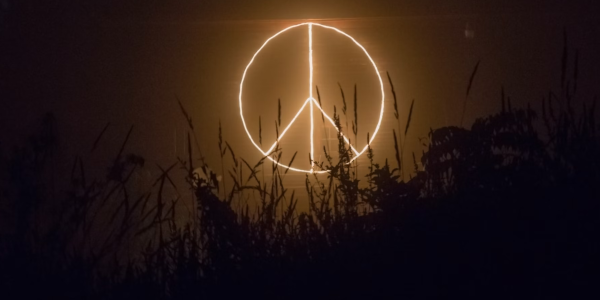
People sometimes mistake pacifism for inaction when it is the very opposite. To choose and to strive for peace is just as affirmative an action as to choose and to strive for violence. It is not something that happens due to the absence of violence or because we are protected by violence from some threat outwith or within. I write these words on the 14th of July 2024. The day after an attempted act of horrific violence against Donald Trump – a person with whom I share little in terms of worldview or aspirations and yet he is a person who, as with all people, I do not wish the harm he received nor the harm he very narrowly avoided and which some others that day sadly did not.
This essay is not about those events nor the events that led to them nor those that shall follow from them other than to say that my mantra that we should all strive always for peace is very much at the top of my mind as I write.
Today as I write this, Scotland took a positive action in striving for peace as it formally incorporated the UN Convention on the Rights of the Child (UNCRC) into law. It has been a long journey for this legislation involving as it did a court case that found that the initial version of the Bill to incorporate the charter breached the limits of devolution. As briefly as I can; despite ratifying the UNCRC in 1991, the UK itself has not yet incorporated the Convention into domestic law and as such does not bind itself to the charter except insofar as domestic law has been written in concordance with aspects of the convention. The UK takes a “dualist” approach to international law and considers a treaty or a convention like UNCRC to only apply if it has been incorporated using domestic law. By contrast some countries, like Germany, take a “monist” approach where the mere act of signing an international convention applies it as law to the nation and subsequent domestic legislation is void if it breaches the convention.
The Scottish Government sought to incorporate the whole of the treaty into Scots Law, which would compel all legislation in Scotland to comply with UNCRC. However, the Supreme Court found that the original drafting would have compelled Westminster legislation that applied in Scotland to comply with UNCRC and this was found to be an overreach of devolution (though note, Westminster, being the superior Parliament, could have compelled Holyrood legislation to comply had the situation been reversed). If this sounds a little like the UK Government reserving the ability to breach the rights of children in Scotland…let’s just say that there are unresolved political issues here.
The approach that the Scottish Government took here is interesting when we think about what could be done in terms of striving for peace and security. The Scottish Parliament lacks the ability to sign conventions like UNCRC but it has shown leadership in “acting as if” it can and signing the terms of such conventions into law – as least as far as devolved legislation applies. So my question for discussion – could this be done elsewhere, even if it meant looking at treaties that Scotland and the UK are not part of?
To my non-legal mind I think it might – the policy decision for the Scottish Government to remain as closely aligned to EU policies as possible post-Brexit certainly paves the way. Just because one has the power to diverge from such policies, doesn’t mean one has to.
So could the Scottish Government take on the principles and ideas of international treaties that the UK is not part of but which may help foster peace and security both in Scotland and abroad?
The treaty highest of my list here would be the Treaty on the Prohibition of Nuclear Weapons. TPNW goes far further than the Non-Proliferation Treaty in the way that it compels State Parties to take active steps to denuclearise and to not support nuclear weapons. Scotland “acting as if” it was a member of this treaty would have significant implications for several areas of domestic Scottish policy. It may not allow Scotland to prevent the UK hosting the weapons in Scotland or transiting them along Scottish roads but it may prevent Scottish public bodies from assisting or facilitating such activities, it may prevent the Scottish Government or other public bodies giving subsidies or other support to companies involved with the nuclear weapons supply chain and it may allow for the Scottish Government to tailor its foreign aid and other international work in light of how it engages with nuclear weapons states. Scotland could take the same approach with other treaties where the UK falls short, especially if it involves conventions around climate change, war or the refugees that too often result from our failures to prevent either.
There’s a deeper level here too that comes from this – far beyond the practical implications of signing such conventions into law and then acting as if we adhered to them and that is the change in attitude that comes from striving for peace, rather than for violence. Education, from school age upwards, needs to change to incorporate a pacifist approach to conflict management. One that seeks not to “divide” on political issues then to somehow come back together again afterwards (or to keep dividing…) but to foster true cooperation, to listen to the concerns of others instead of trying to debate them, “win” and tell the other side that now they have to “get over it”.
Striving for peace is difficult, especially in divisive times of conflict, but it is something that can be practised by individuals just as well as nations. This may be something to consider the next time you face a conflict or a divisive issue. Ask how it could be resolved in a more peaceful way. Maybe if enough of us start acting as if we already live in a world of peaceful cooperation, we’ll find that we can.

Discover more from The Common Green
Subscribe to get the latest posts sent to your email.


Interesting read,
LikeLike
Pingback: PfG 2024 – Serving Scotland | The Common Green