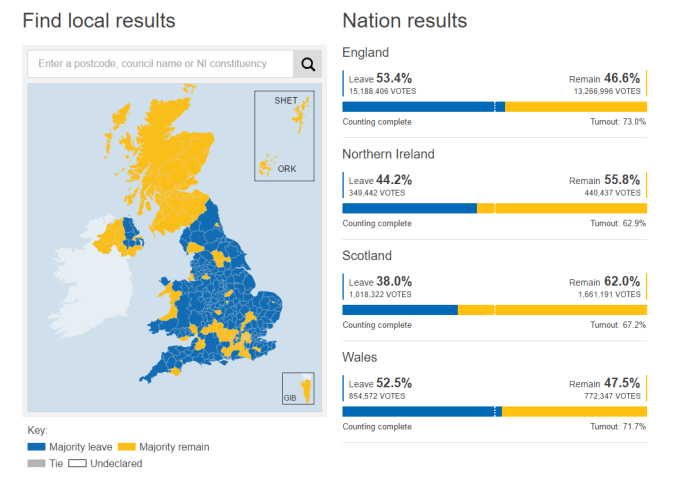
Well that’s that then. Votes cast and counted and the UK, by a margin of 51.9% to 48.1% have voted to Leave the European Union. The long, fractious and never really embracing journey that the UK has been on shall now enter a new phase. I can only guess as to where it’ll end up.
You may have heard by now though that the vote across the nations and regions of our “One Nation” was not homogeneous.
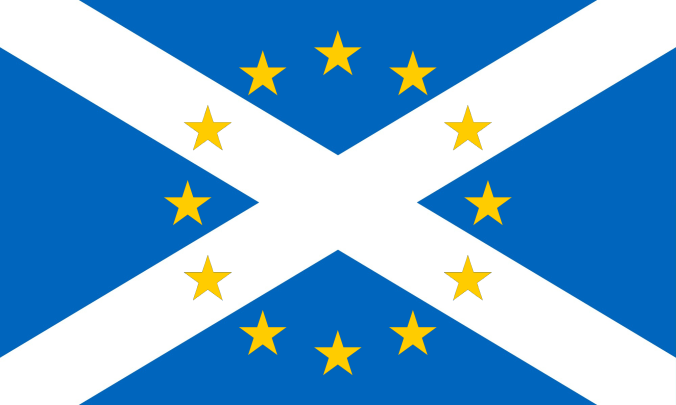
England and Wales voted to Leave. Scotland and Northern Ireland voted to Remain. It represents yet another rejection by Scotland of “UK” politics and I believe that, as previously stated, a second independence referendum is now inevitable. The First Minister has herself confirmed this morning that the Scottish Government is now going to actively pursue one whilst also seeking to negotiate directly with the EU to try to preserve and protect our relationship. I do not believe that we will find that door to be particularly tightly closed.
As for Leave, once they’ve dealt with the resignation of David Cameron, probably a few key allies too, and have taken over the Tory party they’ll have to get into the grit of actually disengaging with the EU.
The EU Commission has already made it clear, understandably, that they would prefer Article 50 to be triggered as soon as possible so that they can get the whole business done and dusted. Leave, however, are still trying to be cagey. Some of the talking heads in the media today are still even hinting at an “alternative” plan like a Vienna Convention type disengagement. The big problem with that idea is that, even if it’s possible, it can be vetoed by any of the remaining 27 states. If the EU insists that Article 50 and a formal discussion is the way to go then it can indeed insist that it shall be.
It’s still very far from certain what the UK’s future relationship with Europe will actually be once all is done and dusted.
Indeed, there’s an outside chance that a Brexit may not yet happen. It could be that the Tory leadership changeover results in a General Election…which the Tories then lose. Labour, especially one which actively campaigned on the point, could well ignore the referendum result. At this point I wouldn’t discount any possibility, no matter how unlikely.
Assuming though that Boris Johnson and chums take the reigns and we go through Article 50 and Brexit happens, there’s still several possibilities (ranging from EFTA, through a set of Swiss style biateral treaties, through a CETA/TTIP type deal and out to the “default” WTO regulations only) which I outlined here.
I’m particularly disturbed by some of the rhetoric which stuck. Lord Ashcroft’s on-the-day polling found a solid correlation between likelihood of voting Leave and support for the argument that it would help “Take Back Control”.
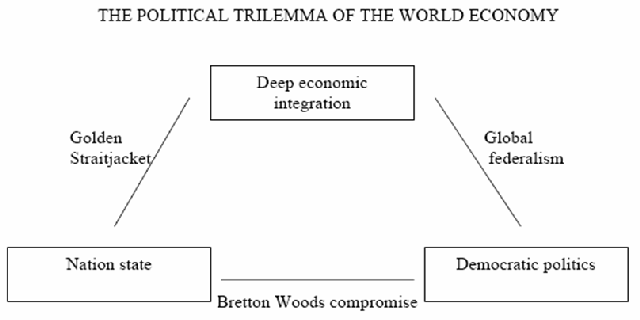
I mentioned in my article on sovereignty that countries which pin themselves to the idea of national level politics, especially to the point of it becoming a geas, can bind themselves into the Globalisation Trilemma. If, as I suspect they will, Leave use their win to forge towards turning the UK into some kind of Free Market paradise then the concept of democratic politics could find itself severely compromised.
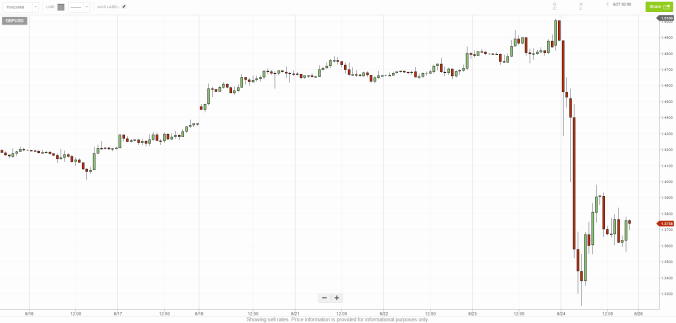
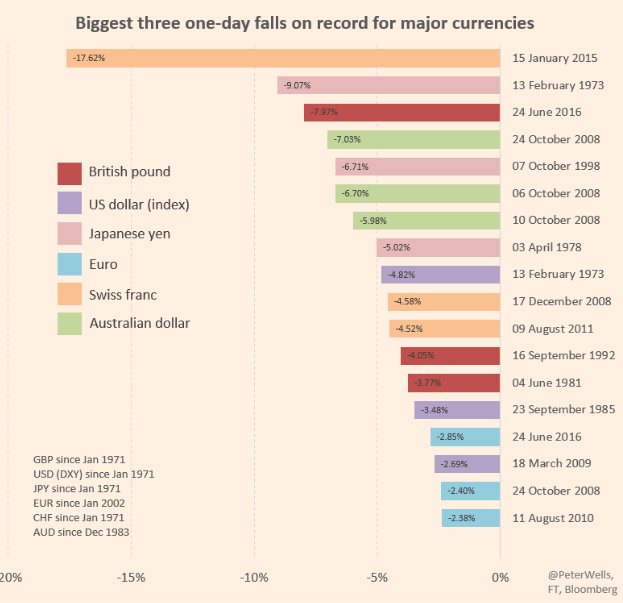
Speaking of the Free Market, it was in the financial world that the most “excitement” of election night was to be found. The polls, public and private, in the days running up to voting day had starting indicating a Remain vote. This had pushed the value of the GBP up significantly as traders started “buying the rumour“. When the Sunderland vote came in though it was the first indication that things were not going to go well for Remain. That one result caused a panic sell in the markets which did not improve as the night went on. By morning, the “Great” British pound had fallen to the weakest point seen since 1985 and, after a morning-after retracement, had lost 8% of its value. This is the worst single day hit that the pound has ever taken, twice as deep as plunge as 1992’s “Black Wednesday” and the third deepest single day hit ANY major currency has taken in modern times. History books shall be written on this point alone.
It should be of very careful note that against the Euro, the Pound lost about 10% of its value compared to 2015. This is important because the UK had a trade deficit with the EU of about £68 billion in 2015. Assuming all things other than currency being equal then that trade deficit could be expected to rise to £75 billion simply because it’s now more expensive to import goods and services from Europe.
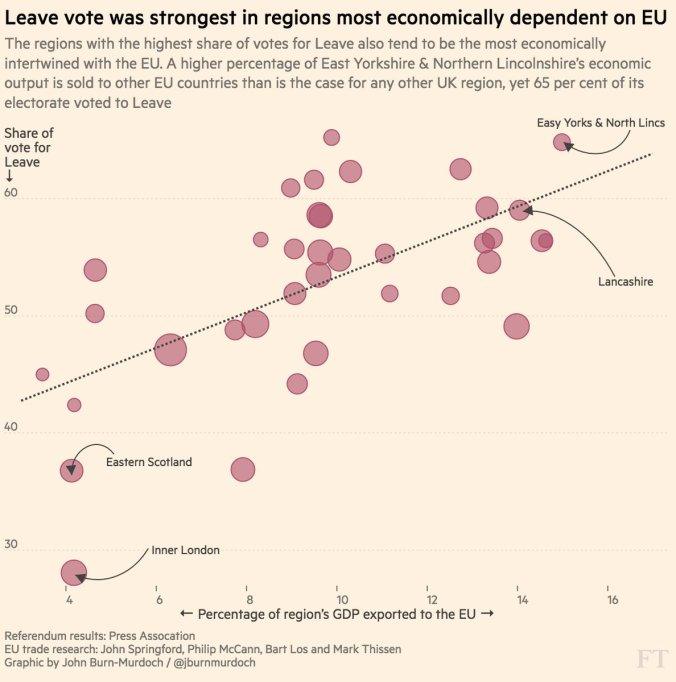
This difference in trade, around £7 billion, represents almost exactly the amount that Leave claimed that we’d “save” in net contributions to the EU. There may well be no gains, no money for the NHS or anything else that was promised. I hope I’m wrong. Because if I’m not, the areas which most voted Leave are also the areas most likely to be dependent on the EU for trade. They will be the areas most reliant on a good deal and/or economic plan for what comes after.
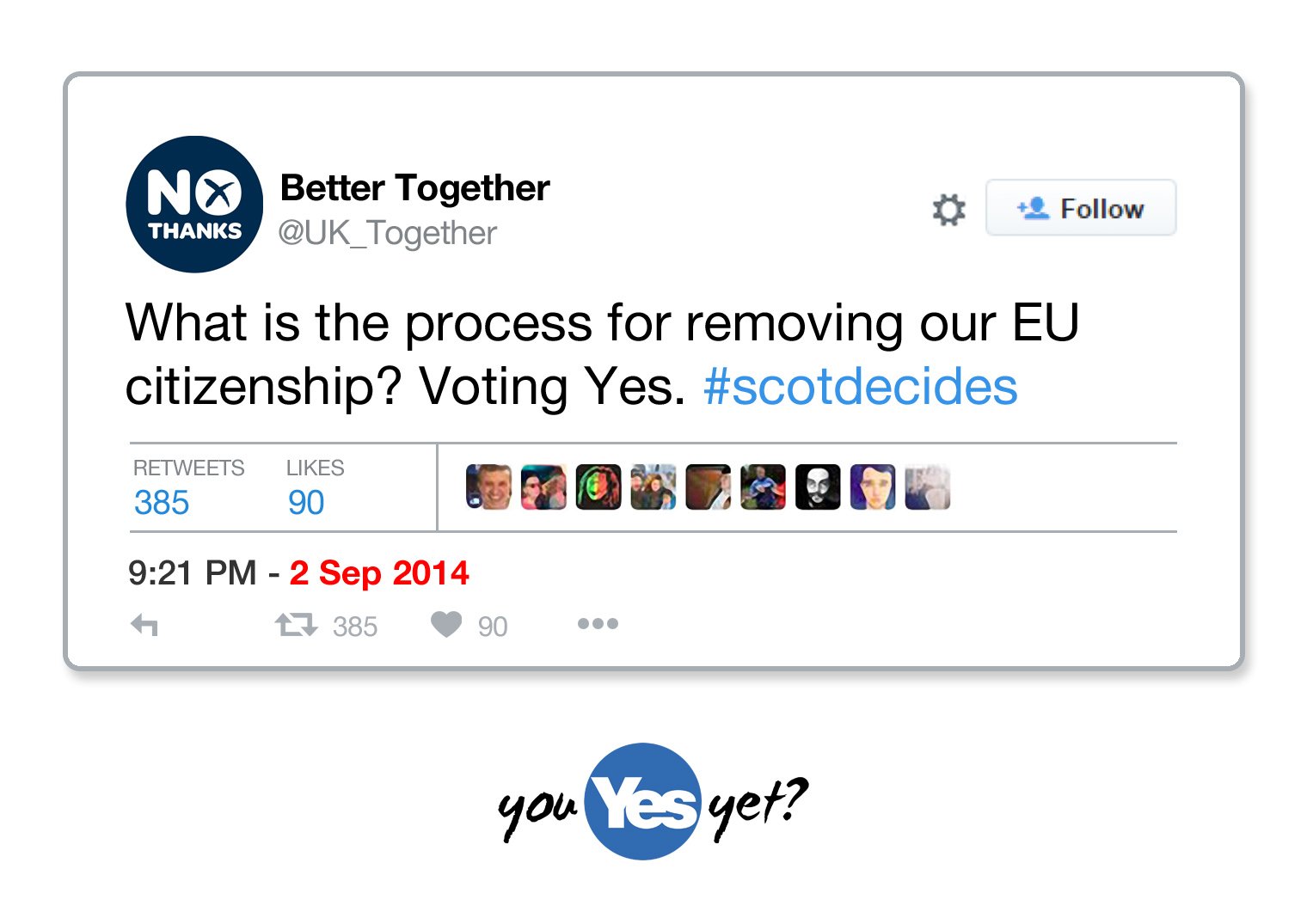
As for Scotland, it’s looking now almost inevitable that this result will hasten another go at an independence referendum and, this time, not only will it not be called until we’re ready but it’s looking rather like a lot of former No voters who had been promised that their vote would ensure their EU membership have now seen that whisked away. It has been enough to convince many that independence is now the best option ahead of Scotland. If you happen to be one of them, Welcome.
The Greens and the SNP, will now be exploring all options to protect and preserve our EU relationship. We’re in very uncertain times now with few precedents to guide us so what form this will all take is a matter of pure speculation.
My own preferred option could take the form of direct negotiations between the Scottish Government and the EU resulting in some kind of deal whereby if an independence referendum is held and won in the period before formal Brexit then a newly independent Scotland could “inherit” the UK’s old seat with no loss of continuity. Of course, this would require the co-operation of the Westminster government to allow such negotiations to take place or to even acknowledge that the result in Scotland is significant. It would be a tragedy of democracy if we were simply ignored.
I’ve got no easy answers for the next few months, or years. I’m as much an unwilling passenger as everyone else who voted Remain yesterday. I’ll try my best to work out where we’re going just as soon as it becomes apparent though. And who knows. Maybe, just maybe, we’ll get off early.
As said from the outset and throughout this series I’ve noted my severe disappointment in both “Official” campaigns. In a way, I’m not all that surprised. Not only has the entire debate been played from the outset as a debate on the future ideological direction of the Conservative party more than it has been about the future of the UK’s involvement with the rest of Europe it’s quite clear that I, like very many others, have simply not been within the target demographic for either campaign. When it comes to voting on Thursday, my vote shall be cast rather despite the “Official” campaigns rather than because of it. I can offer a few final thoughts and observations on both result predictions and the potential aftermaths of them.
Qualifier: The following article shall cite political views which represent, to the best of my understanding, the positions of the Official Remain and Leave campaigns. As such they may not necessarily represent the views held by myself or by any organisations or political parties of which I am a member. My own views shall be indicated throughout.
Likely to be one of the “softer” issues in this debate as unlike immigration and unlike the economy it’s one that doesn’t render down so easily into simply numbers. This doesn’t mean it’s any less important. How we feel about the concept of “Europe” plays a very large part both in what we will want out of that relationship, what we will want Europe to become and what we want ourselves to become either within or outwith the Union. It also tells us a lot about how we see our relationship with our governments which means that the result on Thursday may well have deeper ramifications on how the United Kingdom itself is governed. Sovereignty, who controls the locus of power and where it resides, is a policy on which your position may well lie in how you define it.
This is just a quick side note to my Are EU In or Out? series as a response to Vote Leave‘s recently published Leaving Framework, their plans for what comes after a Leave vote. If you will, it’s their White Paper moment. You can read it here (or here).
Qualifier: The following article shall cite political views which represent, to the best of my understanding, the positions of the Official Remain and Leave campaigns. As such they may not necessarily represent the views held by myself or by any organisations or political parties of which I am a member. My own views shall be indicated throughout.
Are EU In or Out? – Part 1: What is The EU? can be read here
Are EU In or Out? – Part 2: A Brief History of Brexit can be read here
Are EU In or Out? – Part 3: The Issues – Immigration can be read here
Are EU In or Out? – Part 4: The Issues – Trade, Economy and Finance can be read here
Brexit Negotiations
One of the more contentious moments of the 2014 Scottish Independence campaign came about within the discussions over “what comes next?”. The post-vote negotiations over the unstitching of Scotland from the rest of the UK would have represented challenge at least on par with the separation of Ireland or the decolonisation process, if not greater. This may not have been helped by the fact that the British Union does not contain a formal legal mechanism for constituent member nations to leave, the Edinburgh Agreement and all that came after was essentially invented ad hoc. In contrast, the European Union does have a formal leaving mechanism in the form of Article 50 of the Treaty of the European Union, albeit that this mechanism has not been put into practice and was drafted only after the experience of Greenland’s process of leaving the European Communities in 1985. As this paper points out though, the comparison between Greenland and any UK leaving process is unlikely to be more than superficially similar as Greenland’s economic and political interaction with the EC at the time revolved very substantially around their fishing industry whereas the UK is far more economically and politically integrated.
The polls are tight. Neck-and-neck, even. Far too close to call and we’re only a couple of weeks away now. I think we owe it to ourselves to consider the possibility of a Brexit vote and to ask just what the Official Leave campaign wants to get out of their desired result, whether or not it’d be easy – or even possible – to achieve and if it actually chimes with the desires of many of their voters.
Qualifier: The following article shall cite political views which represent, to the best of my understanding, the positions of the Official Remain and Leave campaigns. As such they may not necessarily represent the views held by myself or by any organisations or political parties of which I am a member. My own views shall be indicated throughout.
Are EU In or Out? – Part 1: What is The EU? can be read here
Are EU In or Out? – Part 2: A Brief History of Brexit can be read here
Are EU In or Out? – Part 3: The Issues – Immigration can be read here
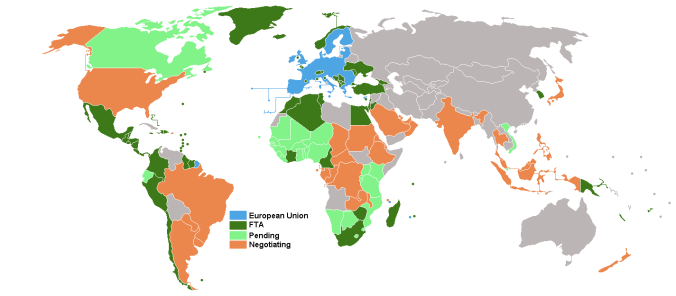
Active, Pending and Proposed Free Trade Agreements involving the EU
Trade, Economy and Finance
If immigration has been the big push card for Leave then the Economy has been the same for the official Remain campaign. Once again, as in the 2014 Scottish Independence Campaign, nothing says “Project Fear” like that Great Leap into the Unknown that comes with trying to predict the state of the economy after a shock event like Brexit (Little tip. In this era of rampant financial speculation, if anyone could actuallypredict the economy, there wouldn’t be one because that person would now have ALL the money). Similarly, Leave, whilst fighting a much weaker campaign in this respect, are promoting the fear of overburdening and uncontrollable regulation which is holding the UK back from its true potential. Of course, the parallels with the 2014 indyref abound on both sides. It certainly shall be interesting if and when a second indyref comes round and the words spoken by several prominent figureheads involved in this current campaign end up held against them (of course, this may well happen to unwary activists on our side too)
Qualifier: The following article shall cite political views which represent, to the best of my understanding, the positions of the Official Remain and Leave campaigns. As such they may not necessarily represent the views held by myself or by any organisations or political parties of which I am a member. My own views shall be indicated throughout.
Are EU In or Out? – Part 1: What is The EU? can be read here
Are EU In or Out? – Part 2: A Brief History of Brexit can be read here
The EU Referendum Issues
I’ll say again that I believe that the “Official” Remain and Leave campaigns in this referendum are almost as dreary and dire as the other. It’s rather depressing how we’re witnessing something as momentous as the potential future of Europe being used as leverage for something as petty as an internal debate about the future leader of the Conservative party. Worse than that though is the attitude towards the issues. It’s almost as if BOTH sides looked at “Project Fear” – the 2014 Scottish anti-independence campaign which, through unrelenting negativity and naesaying, managed to turn a 30 point lead into a 10 point lead and ravaged public trust in both their member political parties (Labour in particular) and in the media which reported for them – and took the very worst aspects of it into their hearts.
It’s been left to the “Unofficial” campaign to speak not only to and for the Scottish dimension (as typified by “The Wee BlEU Book” by Alyn Smith MEP and Ian Hudghton MEP and which I consider to be required reading before the vote) but also for Green and Left voters (as typified by groups such as Another Europe is Possible and DiEM25 which recently held an excellent conference on the Left case for Remain).
This series of articles began as a response to someone I know who was asking for as balanced a case as I could write on the debate. I find that I cannot, given the campaign and my place in it, give a strictly neutral view but I can do as follows. I shall take the primary issues as encountered in the media and shall attempt to lay out the “Official” position on that issue by Leave and Remain. I shall then add my own commentary on that issue. This may result in my agreeing with one or other of the “Official” campaigns or it may have me disagreeing with both and offering an alternative path.
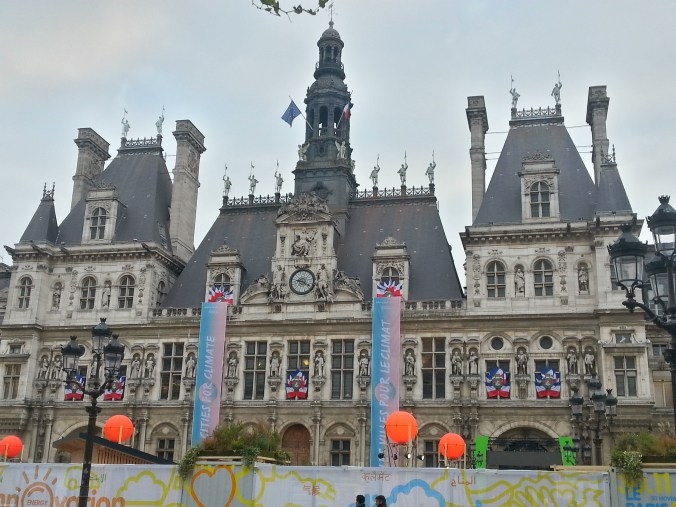
The EU flag flying beside the French national flag over the Hôtel de Ville in Paris.
The referendum on the UK’s membership of the EU is fast approaching and, now that the Scottish parliamentary elections are out of the way, we are now shifting our focus upon it. I know that, especially amongst the activists, election fatigue is high but we really must not let this event pass us by.
For my own part, I am decided. I shall be voting to Remain within the EU and will be doing so out of rejection of both the official Remain and Leave campaigns. Whilst I have written about some of the issues important to me previously, it’s time to expand upon them whilst commenting on the issues important to both of the official campaigns. I shall attempt to outline these as objectively as I can whilst also laying out my own hopes and opinions on those issues.
In this article, I shall first outline the structures of the EU and some of what it actually does before moving on in a subsequent article to look at the issues being discussed in the referendum itself.
What is the EU and how does it work?
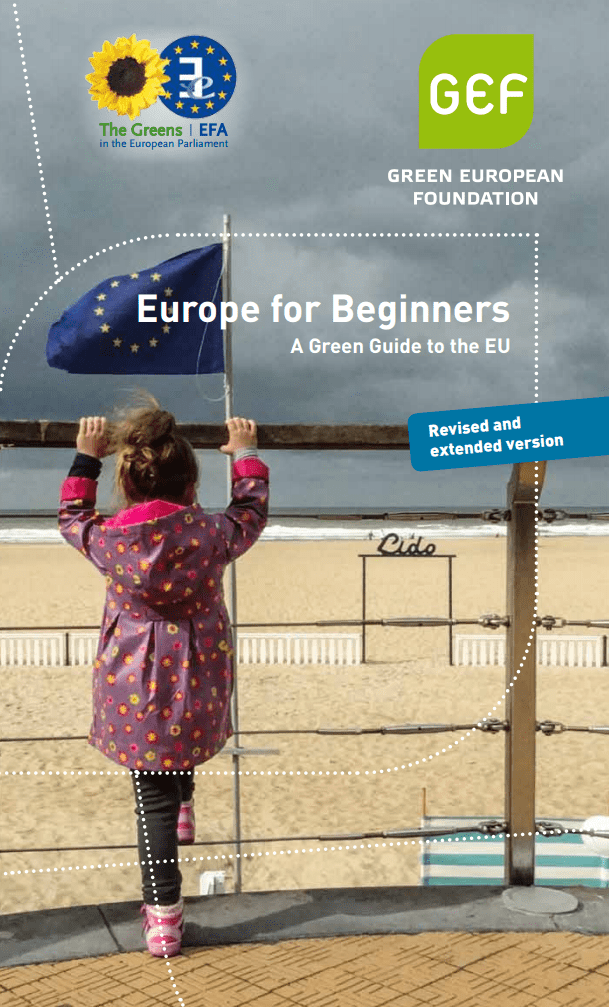
First, before the issues themselves, it’s best to understand just what the EU is, how it came about and what it does now. To help with this, the Green/EFA group in the European Parliament produced the following guide. Whilst some points are highlighted with the Green viewpoint on things, the document is largely objective and highly readable. I suggest that all voters who have any doubts or vagueries give it a good look through certainly before the vote and preferably before continuing here. Click the image or here to read.
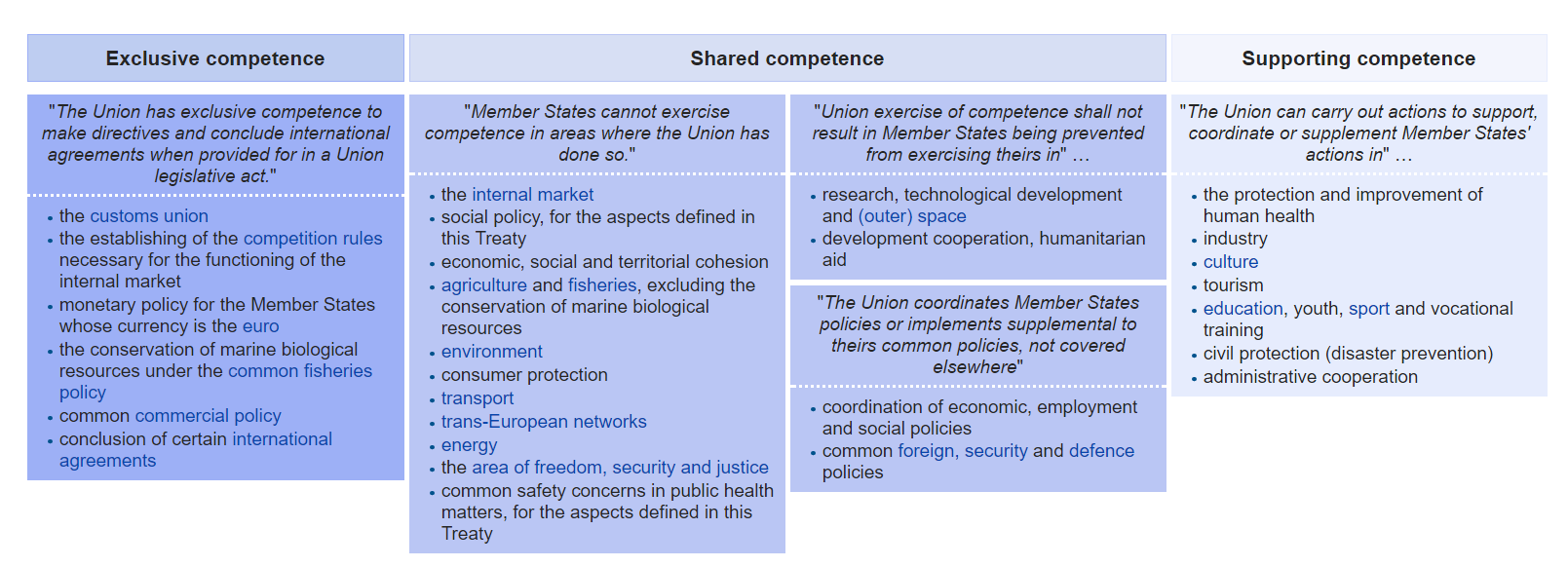
To attempt a brief(-ish) overview, the EU is an ongoing project which rose from the ruins of WWII initially as an attempt to arrange the politics of Europe such that war between the European nations, particularly between France and Germany, would never again be possible. This process began with the gradual interlinking of the French and German economies via the Coal and Steel Community in 1953 and gradually expanded into other economic areas and into the political sphere beginning with the 1957 Treaty of Rome (the preamble of which includes the first use of the now widespread adage and long term goal of the EU towards “ever closer union”) and the founding of the European Economic Community. In 1993, the Maastricht Treaty created the European Union and the single European currency, the euro, and laid out the powers it would have in areas both intergovernmental (i.e. by agreement of all members but without strictly superceding their national sovereignty) and supranational (i.e. powers directly administered by the Parliament). These became known as the “Three Pillars of the European Union”. This structure was then further amended by the 2009 Treaty of Lisbon which formally created the European Union as we know it today as a distinct legal personality and which laid out exactly where the EU takes exclusive competence preceding national member governments, where competence is shared and where the EU merely “supports” national governments achieve their own distinct policy.
Today, the European Union consists of 28 national members which each take roles of varying degrees of embeddedness with the Union.
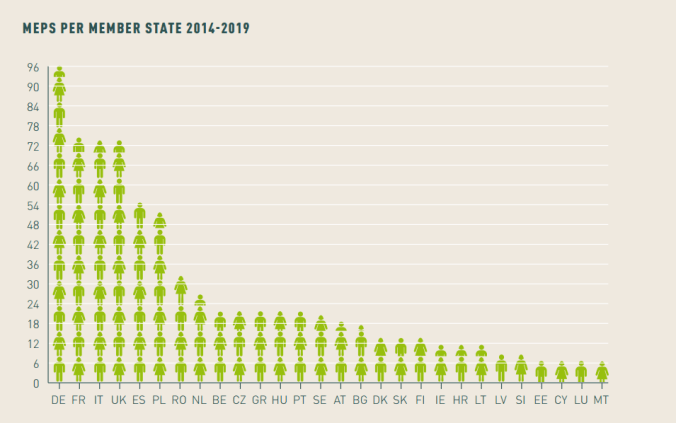
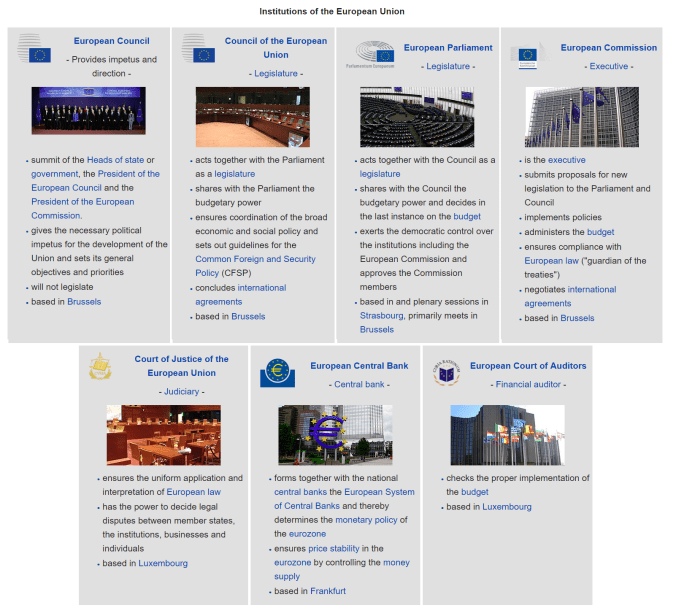
The Legislative Branch of the Union is primarily represented by the European Parliament and Council of Ministers. This Parliament, with 751 members, is the second largest democratically elected legislative body on the planet after the national Parliament of India (the UK’s House of Lords with 803 members and the Chinese National People’s Assembly with 2987 are the only two larger lawmaking bodies but these are not democratically elected) and is elected every five years (the last vote being in 2014) by a system known as “degressive proportionality”. Essentially, each member nation gets an allocation of not less than 6 MEPs and not more than 96 Members to the Parliament, roughly in line with their population as a fraction of the whole EU but arranged so that a few large nations (Especially, Germany, France, Italy and the UK) cannot dominate proceedings.
Within each member nation the MEPs are elected via the proportional d’Hondt system similar to that used in the Scottish parliamentary election regional ballot. which ensures that many more views from within a nation can be heard than would be the case under, say, the First Past the Post system used in the UK General Elections.
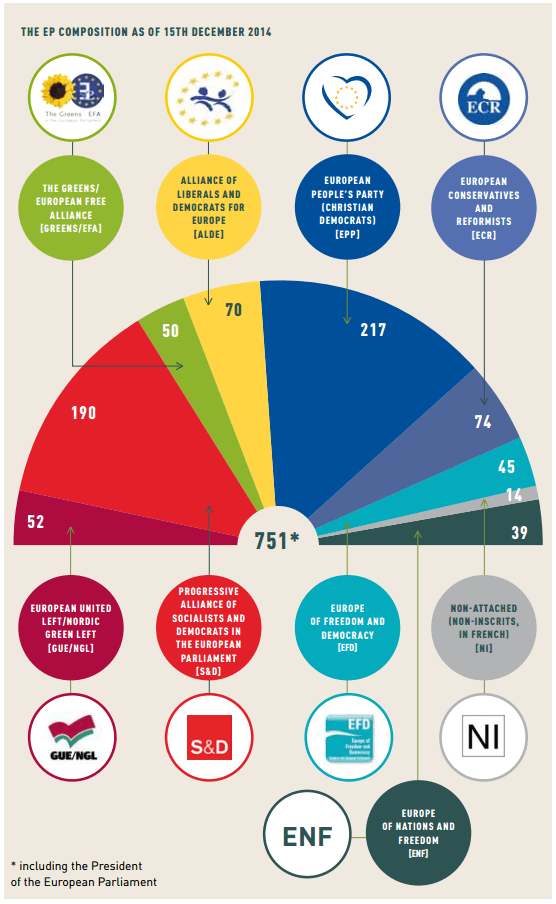
In common with many parliaments throughout the world, the MEPs are also arranged by party affiliation with national political parties banding together with groups of similar ideology such as the Green/European Free Alliance (which includes Green and Regional/Autonomist parties such as the Scottish Green Party, the SNP and Plaid Cymru); The Progressive Alliance of Socialists and Democrats (which includes the Labour party); The Alliance of Liberals and Democrats for Europe (of which the Lib Dems are members); the European Conservatives and Reformists (where the Conservatives, unsurprisingly, find their ideological partners). A study by VoteWatch.eu has found that the group to which a particular MEP belongs is a far greater predictor of voting preference than national identity. MEPs tend to vote on party lines rather than national lines. Though an informal and likely unintentional inclination this, in practice, further serves to dilute the inclination for any particular member nation taking the reigns over the whole continent.
The other major legislative body in the EU is the Council of the European Union (sometimes known as the Council of Ministers) which acts more-or-less as the bicameral segment of the Legislative body and consists of one appointed seat per member state. Unlike the Parliament, however, the person sitting on that seat is decided on a more ad hoc basis depending on the issue being discussed. For example, if a bill on agricultural policy is scheduled then the members may send their national government minister for agriculture. Within the UK this has, on occasion, caused some implication with regard to the structure of devolution whereby an issue which overwhelmingly affects an area either within or controlled by Scotland (for example, fishing) may end up being negotiated by a UK Minister who doesn’t actually have responsibility over that area due to its devolution to the Scottish Government whilst the Scottish government minister who DOES have responsibility may not attend as they are not a member of the national government.
One interesting dynamic within the EU is that whilst the European Parliament and the Council of the European Union votes on whether or not EU laws come into force they don’t themselves generally have the power to initiate legislation (except under very limited circumstances). They cannot themselves propose those laws. Whilst this serves as another check against unbridled power (The President of the Parliament cannot declare themselves Dictator of Europe then have Parliament approve the motion and give them ALL the power) the body which balances this leads us into one of the more maligned and less understood aspects of the governance of the Union.
The Executive Branch of the EU and the area with the power to propose new legislation is the European Commission. Also known as “The unelected, faceless bureaucrats from Brussels”. Yes, it is true that they are unelected by the public (once again, UK citizens should be well used to unelected folk making laws for us. We call them Lords.) but are instead appointed by the national member states, each state taking one chair on the (as of 2016) 28 member council. The UK’s current representative is Baron Hill of Oareford (Yup. Our own unelected, faceless bureaucrat is ALSO an unelected member of the House of Lords. You don’t get much more “British” than that).
The Commission is backed by some 23,000 employed civil servants who do all that background paper shuffling and departmental stuff involved in running a continent spanning government with over 500 million citizens. This said, if that sounds like a lot of people, the UK Government’s civil service (not including devolved administrations) employs some 423,000 people.
The European Commission is also backed by the European Council (not to be confused with the Council of Europe which is a non-legislative body more similar to the United Nations and which helped codify democratic ideals such as the European Convention on Human Rights nor should it be confused with the Council of the European Union). The European Council is, again, a body of 28 members, one each per member state, and is comprised of either the heads of state or heads of government of each of those members. The UK’s representative here is the Prime Minister, currently David Cameron. This body formally exists to “provide the Union with the necessary impetus for its development” and essentially guides the strategic overview and crisis management of the Union as well as allowing an outlet for the overall view and attitudes of the governments of the member countries (although, as previously noted, at the Parliament level political party remains a greater predictor of overall voting intention of individual MEPs).
The Court of Justice of the European Union functions as the Judicial Branch of the European Union and acts to ensure that member states apply agreed treaties and rules within the EU equally, ensure that member states do not pass laws which run contrary to the rules of EU membership and protect the rights of EU citizens under those rules. A good recent example of the functioning of this body occurred when the Court issued guidelines to Scottish and UK courts over the implementation of alcohol minimum unit pricing in Scotland.
Number six in the list of institutions within the EU is the European Central Bank which administers the monetary policy of the Eurozone, the 19 member countries of the EU which are in formal currency union with each other and use the euro as their currency. The euro has been one of the major creative exercises of the European Union in that it is a response to the stated goal of attempting to create financial stability within the Union and to allow as few internal barriers to trade as possible.
There exists a macroeconomic principle known as the “Impossible Trinity” which states that a country cannot completely have free control over internal interest rates and monetary policy, completely fix exchange rates and have free capital flow all at the same time. Historically, many countries kept a stable exchange rate and have kept control of the interest rates but had to tightly control capital flow to do so (Some readers may remember the tourist travel allowances in use up until the early 1970’s).
Many countries, the UK included, now allow capital to flow freely and keep the right to control money printing and interest rates but accept that exchange rates between currencies will now be volatile which will impact the prices of imports and exports to and from that country.
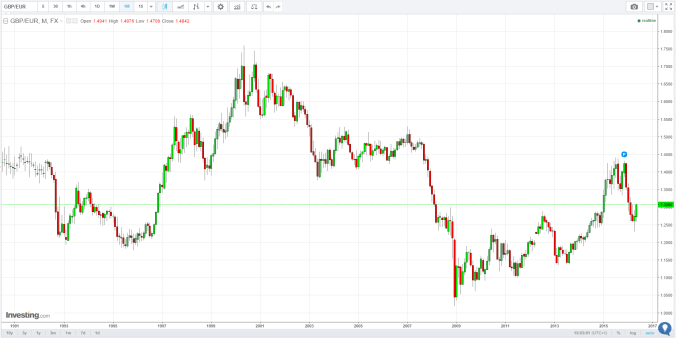
The exchange rate between the £ and € since the latter’s launch.
The Eurozone is an example of an attempt by countries to lock their mutual exchange rates (A euro in France is worth exactly the same as a euro in Germany), whilst allowing capital to flow freely around the continent but at the price of individual countries no longer being able to set their own interest rates or freely increase or reduce their internal money supply.
The system is not without its flaws, of course, (no monetary system can be) and the comparative advantages and disadvantages of monetary union as well as the specific structures of the Eurozone are topics of extremely heated debate (and likely always will be).
Whilst the eventual joining of the Eurozone is expected (although not, strictly, actually enforcably required) of EU members, some members, the UK and Denmark, enjoy a formal opt-out from membership of the Eurozone whilst others, like Sweden, have simply no intention of joining until their citizens demand a referendum on joining. Still others, like newest member Croatia, have stated a desire to join the Eurozone but do not currently meet the strict criteria for entry. (For comparison, even without the opt-out, the UK would also fail to meet the euro convergence criteria unless it could reduce both budget deficit and total debt to GDP ratios by more than a third).
The final institution of the European Union is probably the least sung of all. The European Court of Auditors is a final check and balance within the governance of the union and continuously reviews the spending of the EU’s budget. Once again, its membership is appointed based on one member per member state.
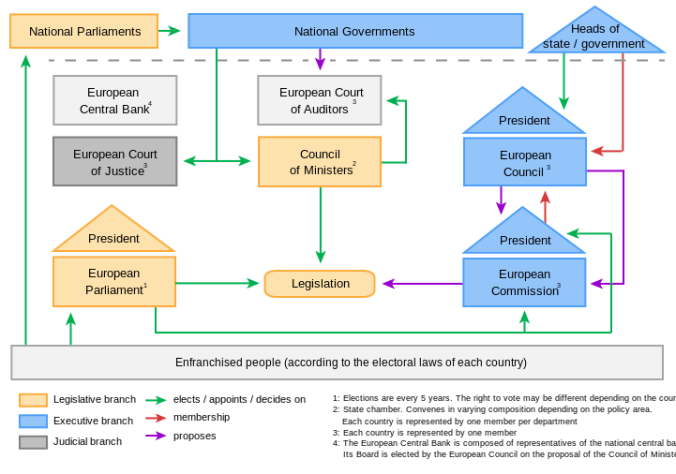
A summary of the Institutions of the European Union and how they interact.
I’m an EU Citizen. What’s in it for me?
From the passing of the Maastricht Treaty in 1992, the concept of EU Citizenship was born and granted to (almost) every citizen of a member nation (for exceptions, see the Youtube video near the top of this article). This citizenship is stated to be supplementary to national citizenship and grants a citizen several rights to do with the EU. These include:
The right to vote in and stand for positions in the European Parliament in any EU state depending on your residence.
The right to vote in and stand for positions in local elections (In Scotland, this means Community Council, Regional Authority and Scottish Parliamentary elections) under the same conditions as nationals of this state. Note that this does not guarantee (but also does not forbid) the right to vote or stand in national elections or referendums which is why EU citizens were permitted to vote in the 2014 Scottish independence referendum (which was a “regional” referendum) but have been blocked by the UK Government from voting in the upcoming EU referendum.
Access to EU Government documents and to petition the EU Parliament, including the right to request information in any of the official languages of the EU and to receive a reply in that same language.
The right to free movement and residence. You may move to and within any EU member nation as freely as one of their nationals and may claim residence there just as freely. You have the right to move anywhere within the EU for the purposes of bettering you standards of living and are not tied to reasons of employment to do so. This right also forms the basis of the Schengen Agreement which removes border controls between participating countries.
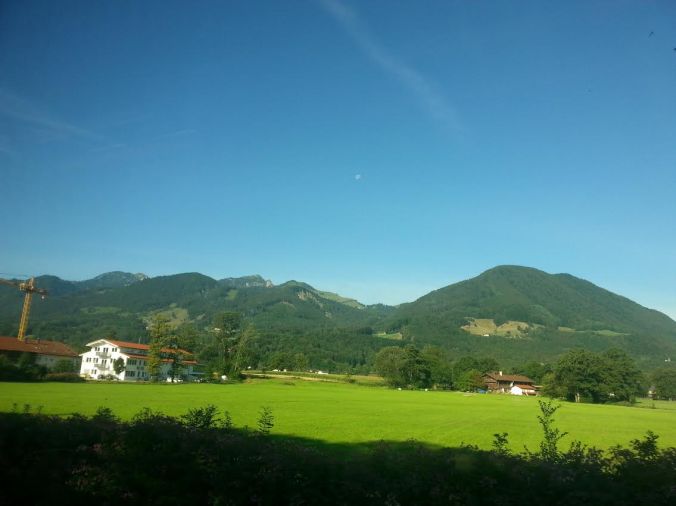
Somewhere almost exactly on the Austria-Germany border.
The right to consular protection. One of the lesser known perks of EU membership. If you happen to be in a country which does not host an embassy belonging to your home nation and you are in need of their assistance then you may visit the embassy of any other EU member nation and they will be required to give you the same treatment as they would one of their own citizens. This right is perhaps under-appreciated by British citizens due to the size of the UK’s diplomatic network but there are still countries around the world in which the UK is not represented but in which your EU citizenship would grant you this protection. Examples include the Central African Republic (which has a French embassy), Liberia (In which you would visit the German embassy) and Lesotho (in which Ireland maintains an embassy).
Of all of these personal rights, perhaps the one most under scrutiny and debate within the context of the upcoming referendum is the right to free movement. For some, this is a freedom to move labour to where it is needed and to move and potentially retire and countries with rather more sun than the UK enjoys. For others, it is a gateway for rich nations to be flooded by economic migrants from poorer nations or, worse, for the economically inactive to take advantage of comparatively generous welfare systems and to mooch off the labour of others.
In Part 2: – A Brief History of Brexit, I shall outline the UK’s personal history with Europe and how we got to point of holding the referendum on our membership.
The big hot-button issue of the debate. Immigration. The implications for the UK both in and out of the EU and the positions of the Official Remain and Leave campaigns as well as my own thoughts.
So what happens next if Leave wins? What are our options for future UK-EU relations and which of them come closest to what you want compared to what the Official Leave campaign wants?
A side note on Vote Leave’s Leaving Framework White Paper. In my opinion, it is seriously lacking in several factual areas and deserves widespread media scrutiny.
The European Court of Justice has released its judgment of the Scottish Government’s proposals to introduce a minimum unit price on alcohol.
Their judgment, published here, states that the proposals as written would be illegal on the grounds of being discriminatory towards cheap alcohol imports and thus would be a restriction on the free movement of goods within the EU.
They have, however, upheld the Scottish Governments arguments that MUP would lead to substantial health and social benefits and have agreed that it would, indeed, meet the goals of both reducing hazardous alcohol consumption and alcohol consumption in general (in an earlier article I noted that Scottish consumption of alcohol can be seen as substantially higher than the UK average simply by examining the tax records).
The court has therefore not banned MUP completely but has ruled that it cannot be implemented until and unless the national courts (i.e. Edinburgh and then the inevitable appeal to the Supreme Court in London) rule that the same alcohol reductions cannot be achieved via taxation. This sets out a test to be met by the Scottish Government.
But if that test is failed and taxation ruled appropriate, what form could it take?
The obvious first step would be alcohol duty but this is currently a reserved power and its devolution was ruled out of the Smith Agreement and the subsequent Scotland Act 2015 Bill. I would think it unlikely, given the current track record, that an amendment to devolve alcohol duty would succeed at this point so I think I’m safe in assuming that it will remain in Westminster hands. Nor, do I suspect, will George Osborne be keen to adjust his own plans for the UK simply to allow the Nationalists even a moment of victory so I can’t see him being amenable to changing alcohol duty at UK level either.
There is another way though, as pointed out by Andy Wightman on Twitter today, the Scottish Government currently DOES have the power to create new LOCAL taxes. If the courts ultimately agree with the ECJ that taxation would be just an effective method of reducing alcohol consumption as MUP then this would be a method within the competence of the Scottish Government to implement without further devolution or delay.
Such a tax need not be set locally, national legislation could fix the rate, though the advantages to doing so are quite strong. By keeping money within areas particularly blighted by alcoholism and alcohol abuse and by allowing the rates to be set to particularly target these areas the greatest good could be done the fastest. Conversely, those areas which perhaps see a lot of through traffic, people traveling into town for a responsible night out say, but suffer little actual harm from chronic abuse may wish to set rates somewhat lower so as to avoid driving away too much business.
While we’re looking at locally devolved alcohol sales taxes we could also take the advantage of the discussion to bring back proposals for alcohol production taxes too. Scotland is perhaps best known for its whisky exports but what is lesser known is the fact that many of the most famous distilleries actually employ comparatively few people and yet produce vast sums of money for their generally multinational corporate owners without doing all that much for a local area which often gives their very name to that drink. Given that these distilleries, and many brewers and other manufacturers, cannot easily move elsewhere (and certainly cannot move out of Scotland) then a local production tax seems particularly apt. Again, by setting it locally and by allowing local people a say in how it is set then they are in a position of power again and can directly benefit from our renowned exports.
Personally, I welcome the prospect of minimum unit pricing and do believe that it would be an effective aid to our national alcohol problem but my challenge to the government is that if the courts rule otherwise, there is still something we can do. Indeed, even if they don’t….why not both?


 The Common Green