If You Want To End Homelessness, Give People A Home

“Homelessness is illegal. In my city no one is homeless although there are an increasing number of criminals living on the street. It was smart to turn an abandoned class into a criminal class, sometimes people feel sorry for the down and outs, they never feel sorry for criminals, it has been a great stabilizer.”
–  Jeanette Winterson

This blog post previously appeared in Common Weal’s weekly newsletter. Sign up for the newsletter here.

If you’d like to support my work for Common Weal or support me and this blog directly, see my donation policy page here.

Image Source: M J Richardson, CC-BY-SA. The Social Bite Village in Granton, Edinburgh

I’ve been thinking a lot lately about the difference between ‘good’ policies and ‘easy’ policies. There are some ideas out there that politicians find very easy to do, regardless of whether they are good or bad. And some that politicians find very hard to do no matter how much good they’d do.

Universal Basic Income (UBI) is an excellent example of this. As a paper exercise, it looks fairly straightforward. Just find out where everyone is, identify a means of paying everyone and then just pay everyone a certain amount of money regardless of whether they ‘need’ it or not.

It has been shown dozens of times now that these kinds of unconditional cash payments work. They reduce all of the negative markers of poverty, they do it more effectively than ‘means tested’ alternatives, and they do so so effectively that several recent pilots have found that the money granted in the UBI was less than the cost of ‘fixing’ the poverty caused by not having a UBI.

This is a massively ‘good’ policy but it’s not an ‘easy’ one. The challenges of unwinding the existing welfare system – and all of its deliberately punitive negatives – is extremely difficult in the sense that if you happen to miss a month between someone’s last Universal Credit payment and their first UBI payment, then that person could suffer extreme hardship.

It’s hard in the sense of identifying everyone who should be paid and how to pay them – including people who don’t have bank accounts or stable addresses or who may have their finances constrained for any number of reasons. It’s also hard in the political sense that the first reaction from too many who would reach to oppose a UBI is “Why should they get something for nothing?”.

There’s another policy that is pretty much objectively proven now to result in overwhelming positive outcomes, has been shown to be cheaper than not doing it, and will almost certainly get that same final question in response to it – Housing First.

The principle of Housing First is that everyone, regardless of means or circumstance, should have a roof over their head. If someone finds themselves homeless, then this principle means that you don’t wait until support services have deemed whether or not they are worthy of support.

You don’t have the person jump through all kinds of paperwork to prove they need that support. You don’t make judgements on whether or not their lifestyle meets some kind of moral minimum before granting them support. Instead, the first thing you do is provide that person with a house that they can live in for as long as they want at no cost.

You can see the objection immediately. “I pay my rent/mortgage! I didn’t get my house for free!”. Well, I didn’t either, and nor have I had the misfortune of having to sleep rough but I know people who have and I’m well aware that any of us are only one bad day away from having it happen to us.

An excellent paper was published last week by the English think tank the Social Market Foundation that reviews Housing First pilot schemes in Scotland, England, Finland and Canada as part of a campaign to roll Housing First out to all rough sleepers in England and to, in effect, end homelessness.

“In Scotland, it was found that giving someone a ‘free’ house was about £10,000 per person, per year cheaper than just leaving them to sleep on the streets.”

The details of the schemes differ slightly – mostly in whether the house granted to the person is part of a ‘homeless village’ or whether the houses are embedded within communities, but all share the principle that a house is not a reward for taking part in the scheme nor are moral judgements around sobriety or substance use either a barrier to entering the scheme or a cause for eviction. In the words of the Finnish study “dwelling is the foundation on which the rest of life is put back together”.

The Scottish examples orbit around the Pathfinder programme that ran from 2019-2022 and found that while the average cost per participant in the programme was around £13,350 per year, the average cost of homelessness was estimated to be about £23,000 per person, per year. In other words, giving someone a ‘free’ house was about £10,000 per person, per year cheaper than just leaving them to sleep on the streets.

Similar levels of savings were found in the Finnish example (€15,000/£12,770 per person per year) and in the Canadian example ($CAD 4,850/£2,611 per person, per year). The SMF estimate that if Housing First was rolled out to as many rough sleepers as is currently possible (i.e. all those who aren’t barred from accessing public funds) then around 9,300 people would avoid sleeping rough and the public purse would save around £178 million.

On that subject of people who have no recourse to public funding, they do advocate that this should change. In all the current rancour about migration right now, you might have failed to spot a very obvious flaw in the current system for supporting asylum seekers. In the UK, asylum seekers – those who have claimed asylum from political repression or other forms of discrimination – are barred from working, are barred from many forms of housing and often don’t have their own funds to fall back on.

They are provided meagre housing by the state (getting a room, basic food and a £10 a week is not the High Living that those stoking xenophobia in Britain right now claim it is. If anyone wishes to dispute this point, I challenge them to live for six months on only the means provided to an asylum seeker and write a report of their experiences.)

But they are often turned out of that housing the moment their asylum claim is deemed legitimate and they become political refugees. Without work up till that point, with few support networks around them and without any other fall back plan – it’s no wonder that so many new refugees in Britain end up spending that first night of freedom – or an extended period afterwards – sleeping rough.

Outcomes for those passing through Housing First programmes have almost without exception delivered better outcomes for participants than the services available to them before they entered the programme. In the Scottish programme, more than 80% of participants were still in housing after two years. Not a single participant was evicted from the programme.

In the English pilot schemes, not one participant who left the programme ended up sleeping rough again within the first year. In all of the studies, the mental and physical health of participants improved, they were less likely to commit a crime and less likely to be the victims of a crime.

There appears to be almost no downside of a policy like Housing First and yet I still describe it as politically hard to do largely because of the political cost rather than the financial, moral and social cost of homelessness. This needs to be tackled head on. If it produces better outcomes than existing policies and is cheaper than those policies then it becomes a moral imperative to do that hard thing.

Scotland can end homelessness, end the negative stigma around people who lose the roof over their head, can increase social cohesion and heal some of the divides between us and can do it while saving money. All we need to do to make this happen is to give a homeless person a free house.

We Are All Human, Or None Of Us Are.

“The rights of every man are diminished when the rights of one man are threatened.” – John F. Kennedy

This blog post previously appeared in Common Weal’s weekly newsletter. Sign up for the newsletter here.

If you’d like to support my work for Common Weal or support me and this blog directly, see my donation policy page here.

The UK is slipping even further into a dark, dark place. Let’s just be clear from the outset: once you declare someone, anyone, as not worthy of human rights you are declaring them to not be worthy as humans. And once you declare someone, anyone, as not being a worthy human, you might be next. Human rights apply to all of us, or to none of us.

Watching Nigel Farage spend a day of unrelenting media coverage this week to show off his latest idea of stripping migrants of their human rights and putting them in concentration camps was sicking. Worse, was seeing Keir Starmer’s response which was basically “we’ll do it too, but better”.

Then we got treated to a second day of it as former Conservative MSP Graham Simpson defected and attracted all of the airwaves to Farage again, followed for a third day by another defection in the form of former Labour Councillor Audrey Dempsey. Make no mistake. If you thought that was merely a coincidence, then you missed the deliberate strategy there.

Farage’s proposal is to follow a decade-long Conservative shibboleth of declaring that those “foreign courts” in Europe who safeguard our human rights via the European Convention on Human Rights are the worst kind of evil and the UK needs to withdraw from it. He’ll put in its place a “British Bill of Rights” that will apply only to British citizens and instead of “the state” telling you what you can do, you’ll have the freedom to do anything unless the state says you can’t do it.

One of the things he wants to do is to round up Afghan nationals who collaborated with the British armed forces during the invasion and occupation of that country. Many of these people now live under the threat of torture and execution by the Taliban since the latter reconquered the country and took back control. Many of these people had their personal details of their involvement with British forces leaked due to the UK’s appalling data security. Some received emergency evacuation. Some, it seems, did not.

Not surprisingly, the Taliban themselves appear to be quite happy to “receive” these people if Farage gets to implement his plans. When asked about whether he’d do it too Keir Starmer, a former human rights lawyer, said, effectively, ‘we’re not taking that option off the table’.

Removing the UK from the ECHR is not going to be as easy as waving a legislative wand. The rights bill is baked into the Belfast/Good Friday Agreement and can only be amended with the agreement of Ireland. Farage’s entire plan can be vetoed with a single memo containing the word “No”.

Or Northern Ireland could leave the UK, which would considerably smooth the passage of his plan. There’s still a complication in that ECHR is also baked into the Scotland Act and thus any attempt to disapply it to devolved areas in Scotland would require a legislative consent motion. But as Brexit has shown, this can simply be overridden by a Farage (or Starmer) Government. Or they could unilaterally amend the Scotland Act directly. Devolution will be no protection for Scotland in the way that it is for Northern Ireland.

“My partner is a migrant and is not a UK citizen nor likely to become one. Whenever someone says “prioritising British citizens”, they mean deprioritising and delegitimising my family.”

Even if the “British Bill of Rights” contains a carbon copy of the ECHR and it remains applying to everyone in general (i.e. Farage isn’t allowed to disapply it to Irish, Commonwealth, EU or non-EU citizens as he’s hinted) then we still have to remember that the actual purpose of doing this is to disapply it to specific people in specific instances whenever they become a nuisance to The State.

We’ve long been fed lines of the “bad person” who is “abusing human rights law” to avoid deportation for flimsy reasons like their cat is sick or they’d miss chicken nuggets (the actual stories behind those propaganda lines are far more nuanced). The point is that if such a person existed, these radicalised factions within the UK want to declare them less-than-human and to punish them for it.

This all matters because, sooner or later, it may well affect you. It’s certainly already affecting me. My partner is a migrant and is not a UK citizen nor likely to become one. Whenever someone says “prioritising British citizens”, they mean deprioritising and delegitimising my family. We also have to remember that I don’t just support Scottish independence, I work for an activist organisation that advocates for it. I am paid to agitate against the State in support of secession. In some countries, that’s not a job – it’s a death penalty offence. It might be me they strip citizenship from and declare to be unworthy of human rights.

Which, of course, means it might be you too. Or it might be Nigel Farage. Because even he is only a lost election and a charge of “collaboration with the previous regime” away from seeing his human rights abused too. As the famous line from the play A Man for All Seasons goes: “If you cut down the laws, and you’re just the man to do it, do you really think you could stand upright in the winds that would blow then?”

Human rights must apply to all of us or they apply to none of us. So I would ask Farage (and Starmer, and any other MP tempted to support this idea) a question: Please look through the rights guaranteed by the ECHR. Which rights do you wish would no longer apply to you, personally?

Because if he gets his way, one day they might not.

Work To Live

“[W]hen your politics no longer have room for empathy, things spin into an amoral chaos. Not only the desperate suffer. Who gets hurt and who stays safe becomes hard to predict.” – Luis Alberto Urrea

This blog post previously appeared in Common Weal’s weekly newsletter. Sign up for the newsletter here.

If you’d like to support my work for Common Weal or support me and this blog directly, see my donation policy page here.

A new German study into Universal Basic Income publishes its final report, showing once again why UBI is a moral imperative. To illustrate those results we could imagine a world where we already have a UBI, but someone wants to study the effect of taking it away and creating the world we live in right now.

In 2021, 122 volunteers had their Universal Basic Income withdrawn from them in pilot project to study the impact of forcing people to work to earn enough money to survive. The participants in the “Work to Live” (WtL) programme were followed for three years alongside 1,580 people who retained their Universal Basic Income of €1,200 per month, regardless of their circumstances, spending intentions or any income they earned on top of their UBI. In 2025, the project published its final report.

Proponents of the “Work to Live” scheme claimed that inducing the fear of starvation, destitution and homelessness in workers would have multiple positive impacts on economic growth including increased work productivity and an increase in the number of hours worked as those without a UBI would be motivated to ensure that they could afford to keep a roof over their head. They also claimed that removing the UBI would increase people’s freedom to choose how to live their lives, without government oversight.

Now, finally, after three years of study, we have some evidence around those claims.

Jobs

Perhaps the most cited claim of “Work to Live” proponents is the idea that UBI makes workers lazy and idle – happy to coast along in their job knowing that they don’t need to earn enough to pay their bills or, in some circumstance, are content to sit completely idle on their sofa existing entirely on their UBI. The study found some surprising results in this regard. The group who had their UBI withdrawn worked essentially the same number of hours as the control group – both working an average of 40 hours a week – but the WtL group reported a substantial decrease in job satisfaction compared to the control. Satisfaction with the income they did receive also dropped markedly with the largest drop coming shortly after the withdrawal of their Basic Income and the gap only marginally closing again as they adapted to their new income levels.

While WtL proponents claimed that the motivational impact of taking away €1,200 a month would spur people to move out of their dead-end jobs or to try to improve their situation through education and training, the opposite was found to be true with the WtL group less likely to change their job and more likely to drop out of education to seek work. Satisfaction within work also dropped for the WtL group, both for those who did seek different employment and for those who stayed where they were at the start of the study.

Autonomy and Self-Determination

“Freedom” is at the heart of the Work to Live campaign, giving people the choice of how to live their life by choosing how to maintain that lifestyle. Those too poor to live a certain way have the freedom to seek those means or to choose to give up those dreams and live within more modest means.

The Work to Live study again confounded those expectations by noting a significant decrease in perceived autonomy compared to the group who retained their Universal Basic Income, with women in particular feeling more constrained by their life without a Basic Income than men. Paradoxically, participants reported that they felt like they had less “free time” in the day after losing their UBI, despite working similar hours to the control group. WfL participants spent notably less time doing non-productive activities outside work such as “volunteering”, “visiting friends” and “sleeping” with an average WtL participant sleeping on average 75 minutes less per week than a control group peer who retained their UBI – despite not spending that extra time in productive work.

Wellbeing

Work to Live advocates often claim that earning money rather than getting it “for free” would increase the sense of satisfaction of holding it and that this would translate into greater life satisfactions as one could look around at the lifestyle bought with that earned money rather than gained via a “handout”.

The pilot programme found once again that these expectations were not backed up by the lived experience of the participants. Life satisfaction dropped markedly shortly after the withdrawal of the UBI and remained more-or-less static in the three years after. This pattern was shared across other satisfaction metrics such as satisfaction with social interactions, the quality of sleep and satisfaction with the money participants had (even when controlled for the total amount of income). Overall stress levels – stress being a significant causative factor in many chronic health conditions – was higher in WtL participants than in the control group.

Finances

The philosophy of Work to Live teaches that money is a precious commodity and must be used wisely. Proponents have claimed that UBI encourages wasteful spending. The study found instead that withdrawal of UBI caused participants to cut their spending on a wide variety of items, including those vital to living comfortably. The largest cut came to vacations, with WtL participants spending almost 60% less on holidays than their UBI peers despite having the same amount of time off work. They also cut spending on clothing by 25%, 5% on everyday needs like food and 2% less on electricity and heating.

Unexpected Effects

Not all of the assumptions about the Work to Live pilot were borne out and some results were completely unexpected. One of the claims against UBI is that as it is an inherently Socialist idea (despite some Libertarian proponents) and thus those who receive a UBI are highly motivated to vote for left-leaning political parties. The study found that WtL participants did not substantially change their voting intention between parties but were less likely to vote at all whether for their preferred party or another.

Work to Live proponents claimed that UBI would make people inherently lazy, but the study found that, in fact, WtL participants were more likely to procrastinate on tasks or to avoid doing them entirely (perhaps in the hope that a problem they were anxious about would “go away”) though there was little change either way on individual propensities to do a task ahead of a deadline or at the last minute once it was decided that the task could not be avoided.

Finally, the sense of basic risk taking amongst participants was largely unchanged with the exception that WtL participants were less likely to risk changing their current job to take on another, despite the opportunity of potentially achieving higher pay or better conditions.

Conclusion

The Work to Live pilot programme has joined other similar studies in showing that attempting to coerce workers into productivity through the threat of destitution leads to more stress, more anxiety and lower rates of public, social and democratic participation and fails to achieve its goal of leading to more hours worked. It is recommended that participants have their Universal Basic Income restored and that other nations who have not yet implemented a UBI scheme of their own join the rest of the civilised world by doing so as soon as practicable.

And Finally

If you’ll allow me to drop the kayfabe at the end of this piece. This new German study into the impacts of Universal Basic Income joins with and do not contradict the increasingly vast body of all of the other studies that have been done into UBI. The results are as strong as all of the others too but the long term nature of the study adds extra weight to its findings as does the detailed examination of how living without the anxiety that capitalism imposes on us actually improves people’s lives. You can read more about that study here.

Here in Scotland, there is currently a Parliamentary majority in support for a Scottish UBI (the SNP, Greens and Lib Dems both support UBI as party policy and Labour indicate support for a weaker form of Minimum Income) but the UK Government (both Conservative and Labour versions) are ideologically against it, refusing even to facilitate the running of a Scottish UBI pilot despite the success of one in Wales. Studies into the costing of extending UBI schemes across the EU have found that they would be cheaper to implement than is currently being spent mitigating the poverty caused by the lack of one (that is, implementing a UBI would SAVE money, after the costs of poverty are included). The Scottish Government must bring back, as a priority, its plans to test and to ultimately roll out a UBI across Scotland. Much more pressure must be brought to bear on the UK Government to facilitate this rollout as while a UBI would undoubtedly be much easier to implement in an independent Scotland, the costs of poverty – particularly the child poverty that the current First Minister wishes to “eradicate” – are far too high and far to urgent to wait until then. We don’t need more data, or more pilot studies, or more poor people waiting for someone to do something. We just need that action, now, to give us all a Universal Basic Income to allow us to live without the fear, anxiety or exploitation that comes from poverty. Any further argument against UBI has to contend with the data presented in this study and in others and any further argument for delay must accept responsibility for the continued suffering that delay imposes. The time for a UBI is now. Once we have it, I’ll pass over to those who would like to perform a study arguing why it should be taken away.

Continue reading

Where Are The Peacemakers?

“Peace cannot be kept by force; it can only be achieved by understanding.” – Albert Einstein

(This blog post previously appeared in Common Weal’s weekly newsletter. Sign up for the newsletter here.)

Chess

Rishi Sunak has finally, though sooner than expected, called a General Election and has launched his campaign promising to conscript teenagers into the military (or force them to do unpaid labour instead). Rather than gear up for yet another round of war, where are the promises to promote peace both at home and abroad?

Continue reading

Judge Them By Our Actions

“For the powerful, crimes are those that others commit.” – Noam Chomsky

(This blog post previously appeared in Common Weal’s weekly newsletter. Sign up for the newsletter here.)

The scenes coming out of Israel and Gaza are beyond abhorrent – and unlike wars of even just a few years ago, it’s playing out in real time on our own screens – atrocity careful curated by algorithm to keep us watching whatever social media platform we’re watching it on. The scenes this week of the UK Parliament almost collapsing into party-tribal anarchy over what flavour of “ceasefire” is the only one they could support has done the UK no favours in terms of its international reputation or its ability to be a responsible and reliable partner for peace when negotiations do finally, too late, begin to end the conflict, hopefully once and for all.

But the problems for the UK’s involvement in this run deeper. Before the chaos of the Opposition Day Motion debate in Parliament many of the detractors on social media attempted to delegitimise the concept of the debate saying that the UK simply had no possible influence over the situation and that the calls for a ceasefire were purely symbolic at best and grandstanding at worst.

However, the UK is not a purely symbolic bystander in this (not that should excuse those who are bystanders. As Desmond Tutu said, those who remain “neutral” in situations of injustice, side with the oppressor). The actions of the UK are deeply entwined with the humanitarian disaster unfolding in front of us.

For a start, the UK is the only country that has consistently abstained from United Nations level votes for a ceasefire in Gaza. These abstentions wouldn’t have swung the vote (which have been consistently vetoed by the USA regardless of their overwhelming result) but that abstention does provide the US the diplomatic cover of not being the only ones to oppose peace. That is a symbol that cannot be ignored.

More directly, the UK is openly providing military aid with the specific aim of supporting Israel and Israel has used UK infrastructure (including Scottish Government owned Prestwick airport) for military purposes. If the International Court of Justice does find that their observed plausible risk of genocide is borne out, then the UK must ask itself (or be asked by the court) to what extent that military assistance opens the UK to a charge of complicity in any war crimes that may have taken place.

Another problem is in the nature of international law itself as far too many countries – the UK included – appear to treat it as an inconvenience only to be obeyed when someone they don’t like breaks it.

With that in mind, I have been watching part of the case moving through the ICJ this week where Palestine has asked the court to make a ruling on whether or not the occupation of Palestine by Israel is illegal. In brief, the case is that while the occupation of foreign territory during wartime can be legal, the continued occupation of that territory beyond what is absolutely necessary both in scale, scope and time is unlawful and that those limits have been exceeded. The case can be watched here, with the UK’s own submission to the case due some time on Friday 23rd.

That submission will be interesting because Palestine themselves used the UK’s own actions as precedent in its evidence session on Monday. Specifically, the UK’s occupation (and forced deportation) of the Chagos Islands that was declared unlawful in 2021. The UK Government had been making some moves towards obeying the order to end the occupation but this itself appears to have reversed since the return of David Cameron to Government and who in January completely halted and cancelled talks and “ruled out” return of the islands to those the UK had forcibly removed from their homes claiming – despite evidence – that it was “not possible” for people to live there any more. If an occupier has left occupied land incapable of supporting those removed from it, then that is a problem for the occupier to fix.

There is a real danger of this story repeating itself in Gaza, with the continued destruction of homes and infrastructure and the sheer amount of unexploded ordinance surely hiding under the rubble of those homes making the prospect that people who have been forcibly displaced ever returning more remote and more unlikely by the day.

If and when the UK does decide that it can no longer stand by from or actively support atrocity, then it will have to reflect on the atrocities it has committed in turn. There will come a time to prosecute the war crimes committed over the course of the conflict in Israel and Palestine and each and every one of those crimes absolutely must be prosecuted whether committed by an enemy or an ally (or, indeed, by oneself). But the UK’s own actions are being held up to the world as an example of unacceptable behaviour and this matters because if it does not accept that behaviour as unacceptable by ourselves then we provide cover for those who wish to commit those same crimes on others. The world is judging others by our actions and we are falling woefully short of any measure that we should hold up as an example to aspire to.

Postscript:- The UK’s evidence to the ICJ quite brazenly started off with a statement to the effect of “We know you’re looking at our actions in Chagos – Please don’t judge Israel by our actions.”

TCG Logo 2019

We Need To Talk About: Hypothecated Taxes

Hypothecated taxes are designed to undermine the NHS – Prof. Richard Murphy

There’s been an idea floating around recently – mostly pushed by the Lib Dems but floated elsewhere too – that the solution to NHS England’s current, catastrophic crisis is an additional income-linked tax (either a new tax or an addition to income tax or National Insurance) which would raise money specifically for health spending.

NHSqueue.png

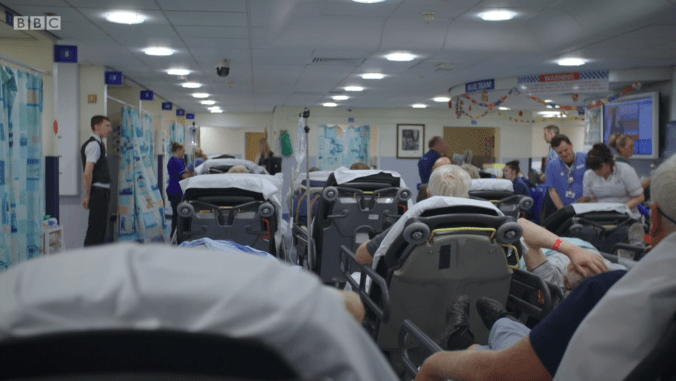
Queuing for bedspace in an English hospital

Other schemes have been suggested, like an addition to income tax to be spent on education. This idea of having a dedicated tax which raises revenue for a specific purpose is known as ‘hypothecation‘ and here is why it is a terrible idea.

Continue reading

We Need To Talk About: A Negative Income Tax

First up, my apologies for going a little dark on the blog recently. Last month, I promised my thoughts on Scotland’s currency options going into the next independence campaign. That promise has turned into something a little bit larger than expected and will be coming soon. I think you’ll like it.

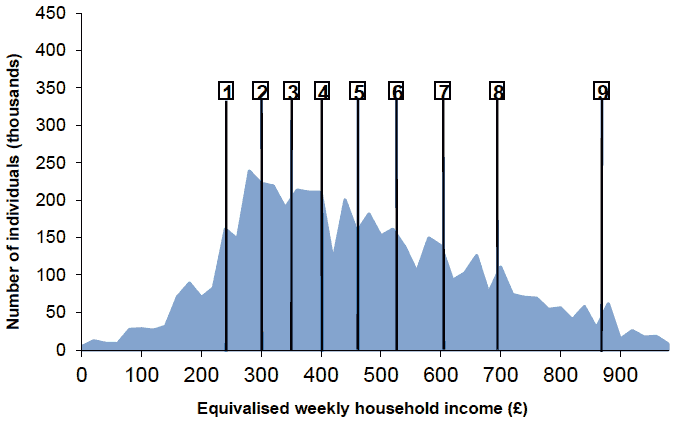
income decile

Scotland’s Income Distribution 2013-14

In the meantime, I’ve been pondering on some possible options regarding how we could reform Scotland’s welfare system, especially in the light that the UK has been explicitly called out by the United Nations for breaching human rights obligations due to the suffering caused by Austerity, inequality and the unfair and miserly welfare system in which too many find themselves trapped. The use of sanctions has been singled out as particularly cruel with countless cases of hardship and even deaths being directly linked to their use.

Both the Greens and Common Weal have been steadfast supporters of the policy of Citizen’s Income (or Universal Basic Income), a policy which is rapidly gaining traction around the world and is starting to look as if its time has come.

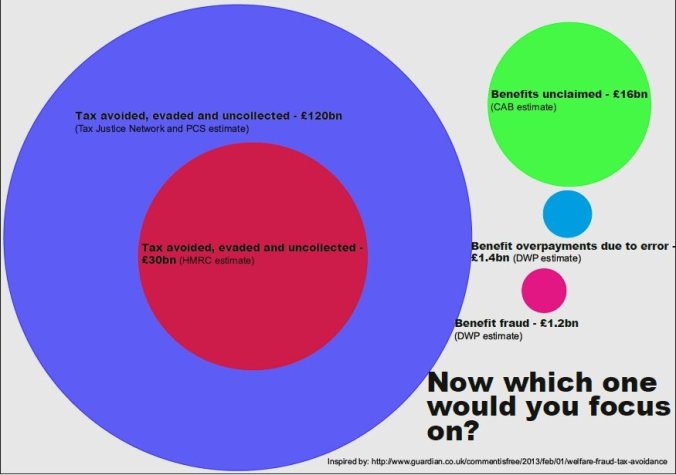
Under this policy the entire welfare system – with all its inequalities, complicated means-tested targeting, exceptions, exemptions, loopholes, paperwork, cheats, dodges, admin errors, fraudsters, bureaucracy and people simply missing out entirely because they don’t know they’re owed money or do but don’t, can’t or won’t claim – is done away with and replaced with a simple, regular payment to every citizen. You can’t claim money you’re not owed (except possibly by claiming for a dead relative or for kids you don’t have) and you can’t be missing out on money you don’t think you’re due. By the way, unclaimed money in the UK welfare system outweighs fraudulently claimed money by more than a factor of 10 and is dwarfed by tax avoidance by up to a factor of 100!

tax-v-benefit-fraud-graph-excellent-2

A Universal Basic Income also gives everyone a stake in the system and a guaranteed safety net if and when it is needed (in much the same way that the NHS is open and free at the point of use even if you can afford private care).

One of the downsides of Basic Income is that it does involve a large amount of money transfers. If we wanted to give all 5.3 million citizens of Scotland a Basic Income of, say, £73.10 per week (~£3,800 per year, the same as the current Jobseekers Allowance) then it would involve a monetary transfer of £20.1 billion per year which is only a couple of billion less than the entire social protection program for Scotland (which, of course, pays out a rather larger sum than £73.10 per week to many people such as pensioners and those with disabilities). Now, of course, this doesn’t imply that Basic Income would cost £20 billion per year. The idea would be that some threshold income would be set above which the income would be taxed back off you until the costs balanced and then onwards till you were a net contributor and helped to fund others (or, as an alternate POV, you were paying into the system to cover yourself for the times when you needed to withdraw). Regardless, the scale of the monetary transfers may be a significant bureaucratic barrier but so is the current piece-meal system that it would be replacing.

I fully support Citizen’s Income as a policy for an independent Scotland but we can’t do it now as we don’t have powers over welfare. I’m not keen on putting grand plans on hold till that day though so I’ve been giving thought to how Scotland could achieve a similar goal of a universal safety net using powers that we have right now. We don’t have power over welfare but do, finally and after great trials and tribulations, have powers over most of income tax.

This led me to thinking about a project advocated in 1968 by the economist Milton Friedman. The Negative Income Tax.

The concept is this. Instead of just having a low earnings threshold below which you pay zero tax (The UK Personal Allowance fulfills this purpose here) why not a threshold below which you receive a tax refund?

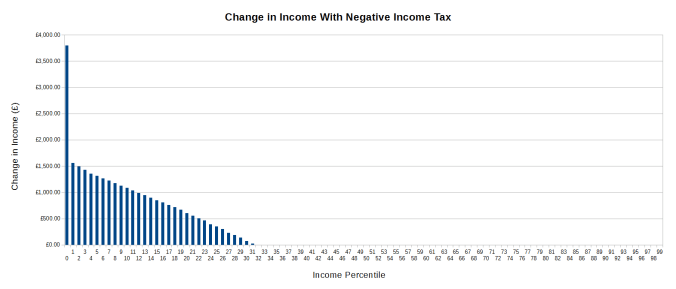
In this scheme Scotland could set an income threshold, say £16,500 – the equivalent of a full time job on the Living Wage. If you earn less than that in a year, the difference between what you earn and the threshold could be taxed at NEGATIVE 23%. If you only earned, say, £10,000. You would receive as a stipend 23% of £6,500 which is £1,495. If you earned nothing in the year, you’d receive 23% of £16,500 which is around £3,800 – The same as the current Jobseekers Allowance. The tax rate of -23% was chosen specifically to create that latter situation. One could easily imagine different rates or even a progressive system to cover people who fall seriously below the threshold proportionately more than those who only fall slightly under.

This system wouldn’t be a perfect substitution for Citizen’s Income for a few reasons. Most significantly, it is a lot easier to abuse or cheat the system by under-reporting one’s income, for example. If rates and thresholds are set inappropriately it may also lead to disincentives to work at around the threshold where someone converts from a recipient to a contributor though in the simple scheme proposed here this is less of an issue.

Negative income tax does have an advantage over Citizen’s Income by reducing the volume of monetary transfer though as only those who are earning below the threshold receive the stipend rather than everyone.

So how much would this cost? To find out, I’ve done some modelling using available income statistics, in particular the breakdown of income percentiles for the UK (percentile resolution income data for Scotland doesn’t seem to be easily available. If anyone out there knows of someone who does have it then please contact me, I’d be very interested in seeing it) .

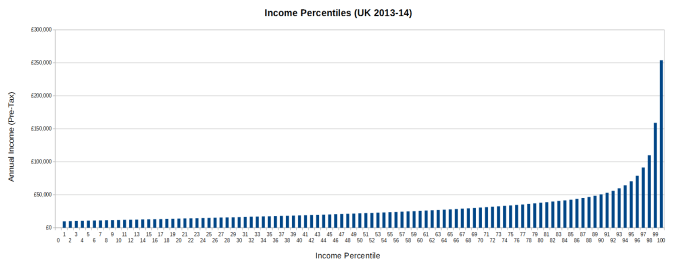
Income Percentiles

One shocking thing about the UK is that the threshold we set, of £16,500 per year (which is, remember, the amount that said to be required to maintain a decent standard of living) is not reached until the 32nd percentile. Almost one in three workers in the UK are not earning enough to live on.

If we now add our negative income tax to this model to see how much a median person within each percentile would receive it looks something like the following.

Change in Income - No UR Tax

Something to bear in mind it this income percentile data only includes people who have at least some kind of earned income. It does not include the unemployed or those who are unable to or are not seeking work, the “economically inactive”. The ONS estimates that these two groups together make up around 21.6% of the UK working age population. If we factor that group into the figures modeled here (and assuming that Scotland’s figures are roughly in line with the UK’s which will be good enough for this back-of-envelope calculation) we can estimate that the negative income tax would cost Scotland around £2.4 billion per year.

This is where things get a little tricky for the policy idea. The obvious answer to meet the costs is by adjusting the upper rates of income tax to render the scheme revenue neutral. The problem is that the UK (and Scotland) are predominantly low wage, high inequality countries. We’ve already stated that if you’re on the absolute basic wage you’re already earning more than almost a third of other workers (and this doesn’t include those earning nothing). If you pay the 40% Higher Rate, you’re in at least the 86th percentile – the top 15% of earners – and if you pay the 45% Additional Rate (assuming you are even taking those earnings as “income” and aren’t transferring money into dividends or using more arcane accounting wizardry to minimise one’s tax bill) then you are in at the very least the top 2% of earners. This doesn’t leave a very large tax base from which to levy the required funds (This was one of the reasons that the policy advocated by the Greens for the return of the 50% rate was based on reasons of income and wealth equality rather than revenue raising and did not make any spending predictions or promises based on additional revenue from this band).

If one DID want to raise income taxes to find the £2.4bn then doing it solely through the Additional Rate simply would not be possible. Even raising it to 95% (and assuming that everyone pays it) would only cover half of that bill. In order to do it with the Higher Rate, both Higher and Additional Rates would need to be raised to a minimum of 58%.

Now, a normal, independent country would not face this problem because it would be able to tailor the other half of the balance sheet as well. If a negative income tax is replacing welfare spending then the welfare budget would decrease and the balance sheet would..well..balance. But in Scotland’s case, welfare is reserved so what becomes a simple exercise in government policy which would pay for itself and hugely benefit the poorest in our society becomes a constitutional question and a financial bung of £2.4 billion per year to Westminster. Whilst we have the “powers” to adjust our tax rates, Scotland just simply does not have the ability to use them in any kind of effective manner. Those who demand that “we use the powers we have” whilst blocking the levers which would otherwise allow us to do so should reflect on their actions and words. I’m thinking particularly of our Secretary of State “for” Scotland, the “Right Honourable” David Mundell who, as we remember, has not only taunted the Scottish Government towards “using our powers” but has also threatened to tax any welfare top-ups the Scottish Government might be willing to grant. I hold no great hope of Westminster’s generosity extending to them returning saved welfare money in order to pay for a negative income tax.

I’m open to suggestions at this point. If anyone can square this circle, please…please tell me. I think I’ve found a policy which, on paper, would be within Scotland’s current powers to implement but I can’t find a way to make it work within the pitiful financial constraints of our devolution. I don’t want to have to “wait till indy” to get some of this vital work started nor am I content knowing that people could be helped but cannot be because of Westminster’s refusal to either do it or to hand over the reigns to someone who will.

This shouldn’t be such a difficult process. Only in Scotland, within the United Kingdom, in the 21st century, where we’re told we’re incapable of governing ourselves, whilst those who say that they can govern stand by and either do nothing or actively work against us, does it become one.

tcg-logo6c

An Arbitrary Failure

Smith

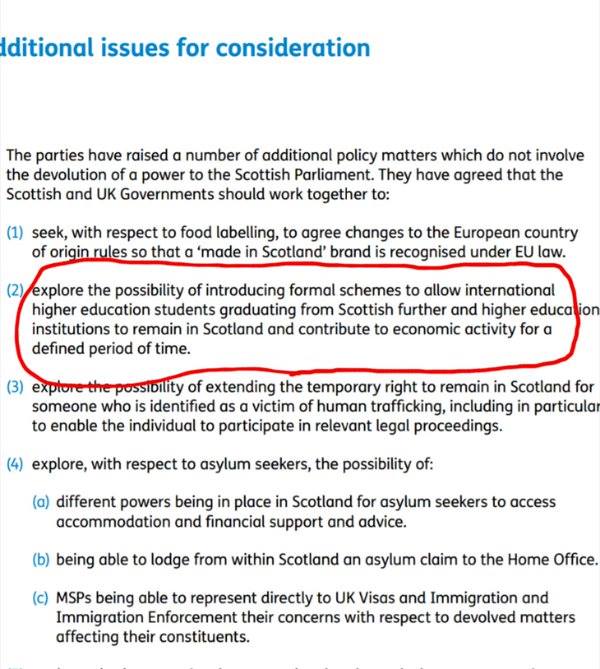
The relevant passage from the Smith Commission Report. Page 28.

David Mundell, who is currently crowing that the Smith Commission has been delivered “in full”, has just blocked a key element of it.

All of the Smith parties agreed to consult on the possibility of allowing Scotland to issue post-study visas for visiting students to allow them to continue working (and paying taxes) in Scotland, the country which educated them, after they graduate.

Mundell has just blocked that proposal without such consultation and before the Scottish Affairs Committee looking into it has even had a chance to report back. (Story here)

One of the most upsetting moments in my own personal indyref campaign was hearing from a young lass whose partner was one such visiting student. He had come to Scotland to study engineering and, after falling in love both with our country and one of its inhabitants he decided that he wanted to stay, to build his career and to make Scotland his home. Just two weeks after his graduation, the UK Government rewarded his endeavour with arrest, incarceration in Dungavel and deportation.

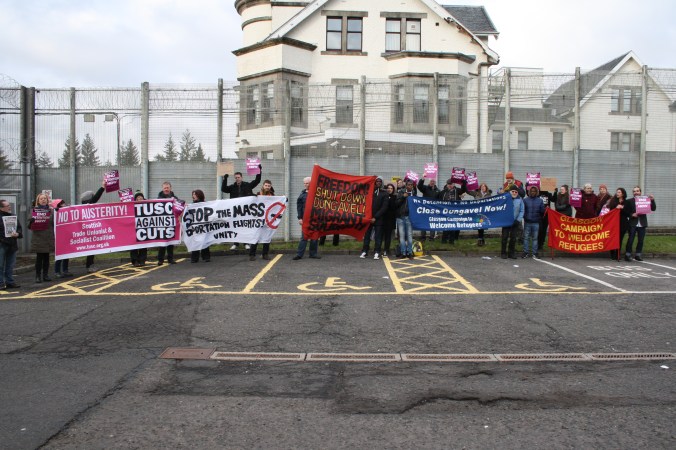
Dungavel3.jpg

Protests outside the Dungavel Detention Centre. Source: Wikipedia.

This is not how a civilised country should treat other human beings. Instead, we should be encouraging those who, after all, pay significant sums of money towards their education to find a place within Scotland should they choose to do so. Many will find high paid, highly skilled and highly sought after jobs. Many others will start businesses of their own and CREATE those same jobs. Even the graduates who choose to leave Scotland will, if they are treated with respect, go on to strengthen our trade and business links with the countries to which they go. Something to bear in mind with respect to the UK’s worrying trade deficit combined with a currency value currently at the lowest level since the Tories took power and which is rapidly approaching the weakest value it’s had in 30 years.

Think about it David. If you were incarcerated and forcibly ejected from here simply because you had graduated, would you look upon this country favourably afterwards? Of course not. Would you consider sending your kids to study in a country which threatened to do the same to them? Of course you wouldn’t.

As Smith notes, this policy doesn’t require any additional powers to be devolved, indeed the similar Fresh Talent scheme used to be implemented in Scotland between 2005 and 2008 and was rolled out successfully to the entire UK until 2012 when it was scrapped by the Coalition government.  Mundell’s decision therefore seems especially arbitrary, short-sighted and, frankly, smacks of nothing less than a jumped-up Governor throwing his weight around simply because he thinks he cannot be challenged.

tcg-logo4

Unweaving Tangled Skeins

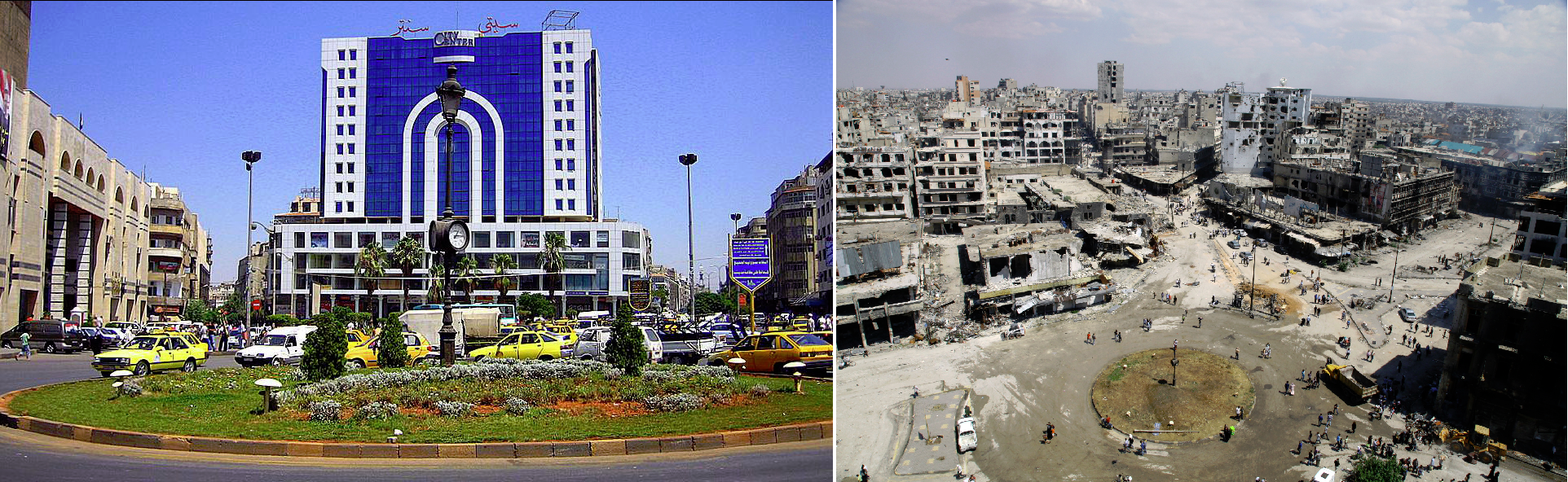
The Old Clock Square in Hom, Syria. Left - Before the war. Right - The ruins of the war.

The Old Clock Square in Homs, Syria. Left – Before the war. Right – The ruins of the war.

 It seems certain now that within the next few days or weeks the House of Commons will, for the second time in as many years, be asked to vote to go to war in Syria. I have no doubt that the picture painted will be one of us plucky Brits bravely defending ourselves against an utterly inhuman, utterly irredeemable, utterly evil and, most importantly, completely monolithic force and that after a short, sharp military action peace will be restored and reign supreme. The difference between this time and last is that last time the evil monolith was the Assad Regime. This time, it’s ISIS.

 We always seem to be sold war on such simple terms. Often, we seem to buy it because of them. But the world out there beyond the red-top tabloids is rarely so black-and-white. The conflict in Syria is less so than most.

Continue reading

Four Conservative Policies Which Attack Your Human Rights

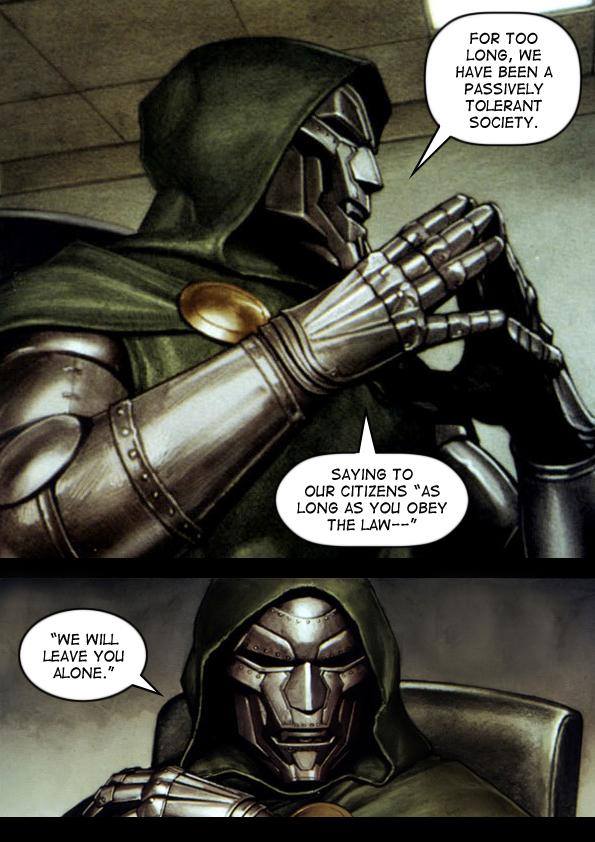
Somehow, it doesn't seem so bad when a comicbook supervillain says it.

In my previous post, I outlined the Conservative plan to strip you of your Human Rights and replace the ECHR (Full text of the Convention here: http://www.echr.coe.int/Documents/Convention_ENG.pdf) with a British Bill of Rights. I maintained then that I didn’t believe that the Tories actually want to remove, in general, any of the rights within the bill but do want to give themselves the power to remove your rights selectively whenever it chooses to.

We will still have to wait to see what any proposed British Bill of Rights actually contains to see if this prediction bears fruit but while reading up on this it has become quite clear to me that several imposed or proposed policies skirt a very fine line with regard to the articles within the ECHR. I’d hazard a guess that if any of your Human Rights are to be removed then the following would be the ones to watch.

Continue reading