Use energy to win independence, rather than independence to win energy

“The problem with the idea of cause and effect is that what is deemed the cause is an effect.” –  Mokokoma Mokhonoana

This blog post previously appeared in The National as part of Common Weal’s In Common newsletter.
If you’d like to support my work for Common Weal or support me and this blog directly, see my donation policy page here.

Scotland doesn’t need independence to start owning our own energy.

It feels like 2025 has come full circle for us at Common Weal. January started for us with an announcement from the Scottish Government that it was “not possible” to bring Scottish renewable energy into public ownership – an announcement made after the publication of a poll showing that more than 80% of people in Scotland favoured them doing so. We responded with a briefing paper called “How to own Scottish energy” which laid out the logic behind their announcement, why that logic was flawed and how they could bring energy into public ownership despite their own objections.

In short, the Government’s stance is based on an extremely narrow reading of the Scotland Act which actively prohibits the Scottish Government or Scottish Ministers from owning electricity generating, storage or transmission assets. Under this reading, there cannot be a “National Electricity Company” designed and owned in the same way as some public corporations in Scotland like CalMac or ScotRail.

However, we showed in our paper that various options were not blocked by this prohibition. For example, a Minister-owned “National Heat Company” could be designed to build and own district heat networks to keep us all warm (the prohibition is specifically about electricity, not other forms of energy). The Government could also build a National Energy Company and hand ownership over to a consortium of Scotland’s 32 Local Authorities. Or each Council could own their own energy companies. Or the Government could back the creation of a private energy company that is mutually owned by every adult resident of Scotland. Or, instead of complaining about the limits of devolution, they could be applying pressure on the UK Government to amend what is very clearly a completely obsolete prohibition in the Scotland Act (especially as a narrow reading of it also prohibits the Scottish Government from erecting solar panels on its own buildings).

Come forward now to December and the SNP have kicked off their 2026 election campaign with a new paper essentially saying the same thing as they did earlier this year except framing it around “we’ll do it, but only after independence”. On public ownership in particular, they aren’t advocating for the full-scale nationalisation of energy but their ambition appears to extend only to communities owning up to 20% of local renewable projects.

20% is far better than the current level of a rounding error above 0%, but it’s clear that even within devolution, the Scottish Government could do far more than it’s currently doing to support communities by giving them grants and loans to purchase stakes in developments, to pressure developers to sell or grant those stakes to communities as a condition of planning permission or the renewal of licences and to actively use opportunities like the “repowering” of developments, the end of their licence periods and break-clauses in contracts that would allow poorly performing developers to have their licences withdrawn and transferred to public bodies (in much the same way as the Government took ScotRail back from Abelio in 2022)

This doesn’t get the UK Government off the hook though.

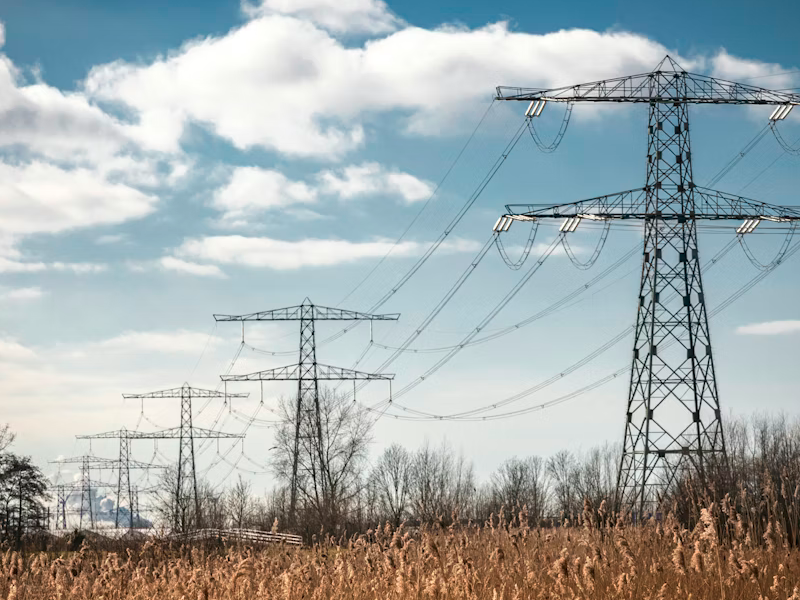
Their recent announcement that some £28 billion will be added to consumer energy bills to pay for vital energy grid upgrades is going to stick in the craw of people whose energy bills are already too high. Worse will be that most of the profits of that investment will flow into multinational companies – including foreign public energy companies – with none returning to the consumers themselves. These investments, too, should be made on a staked ownership basis so that the people paying for them – us – should become shareholders in the investments and see a return on our investment. To make things perfectly clear, if the UK Government had announced that it was going to fully publicly own the assets built via this spending, then the added costs on your bill would be the same. In other words, the choice to publicly own the UK’s new energy assets will cost you the same as the choice to leave them in private hands.

“Can’t we use our public owned energy to help win back our independence, rather than claiming more weakly that we can use independence to win back our energy?”

The same will be true of assets in an independent Scotland – but given the Scottish Government’s “all in” approach to “inward investment” (something their plan published this week mentions more often than public ownership), I can completely see them making the same mistake and forcing us to pay for assets that someone else will profit from.

I freely admit that there are aspects of Scotland’s energy transition that are not in Scotland’s hands and which are not likely to be easily negotiated away as part of an adjustment to devolution such as Scottish consumers being forced to pay for extremely expensive and risky nuclear projects that even NESO (formerly, the National Grid) now says are not needed to meet Green energy targets but this does not let the Scottish Government off from making the changes it can make now rather than using the dangling carrot of independence as a means of delaying action. If anything, independence will come less from making a promise that might be fulfilled afterwards but by taking tangible actions now that push devolution to the limit and then saying to voters “if you want more, you know what to do”.

If it truly is, as the Scottish Government says, Scotland’s Energy – then shouldn’t we take back as much as we can now as use that as leverage to win the rest? Can’t we use our public owned energy to help win back our independence, rather than claiming more weakly that we can use independence to win back our energy?

Undermining Our Principles

“The more expeditiously we can end this plague on earth caused by the landmine, the more readily can we set about the constructive tasks to which so many give their hand in the cause of humanity.” – Diana, Princess of Wales

This blog post previously appeared in The National as part of Common Weal’s In Common newsletter.
If you’d like to throw me a wee tip to support this blog, you can here.

image_2024-12-07_131858185

In a year of countless and boundless horrors, where war crimes and crimes against humanity are now so routinely fed to us in real time on social media that we are seemingly utterly numb to those suffering them and indifferent to or even cheering on those who commit them, who had “Scottish First Minister apparently breaches international land mine ban treaty” on their list of things to watch out for?

As reported by LBC’s Gina Davidson, last week, outside a primary school where he was launching a new literacy programme, FM John Swinney was asked about the then breaking news that the USA was changing its policies and giving Ukraine anti-personnel land mines to deploy during its war against Russia. Swinney stated that territorial integrity must be defended and that he “supported the actions taken”.

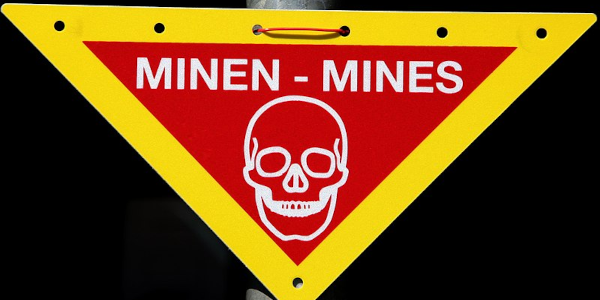
There’s a problem with this – that statement looks very much like a breach of Article 1(c) of the 1997 Ottawa Treaty that banned the use of AP mines – and in particular banned any state signed up to the treaty from taking any action to “assist, encourage or induce” any other state (whether signed up to the treaty or not) from using such weapons. The UK – and thus Scotland – is a state party to the treaty and all aspects of government, including the devolved governments, are bound by it.

Continue reading

Ageing For Indy?

“The afternoon knows what the morning never suspected.” – Robert Frost

This blog post previously appeared in Common Weal’s weekly newsletter. Sign up for the newsletter here.
If you’d like to throw me a wee tip to support this blog, you can here.

image_2024-09-21_120152945

I’m writing this on the 18th of September 2024. Ten years on from the independence referendum is a day of sober reflection. I certainly have a lot of memories of that day in particular as I spent it under a warm blue sky (much like today, though not quite as warm) going door-to-door to get out the vote amongst folk our campaign group, Yes Clydesdale, had identified as likely to vote Yes. The shattering of my hope was still several hours away, the grief of the following days and the determination to get back on my feet again was a little further away again. I remember many of my conversations that day but two stick out in particular right now.

Continue reading

Rolling Over Scotland

“As the tail on our back disappeared as we no longer had any use for it, nuclear weapons will also disappear once we realize, we no longer have any need for them. But no matter how much we daydream, it will never happen as some sort of grand geopolitical gesture of international collaboration – somebody has to take the first step – one nuclear-capable state has to take that first leap of bold faith and naive trust! The question is, who will it be? The first nuclear nation to abandon its nuclear weapons, will be the First Peacemaking Nation of Earth – and their head of state, the First Peacemaker.” – Abhijit Naskar

(This blog post previously appeared in Common Weal’s weekly newsletter. Sign up for the newsletter here.)

This week saw the publication of the 11th paper in the series of the Building A New Scotland Independence White Papers by the Scottish Government, this time looking at the defence and foreign affairs and the policies that the current SNP/Green Scottish Government would advocate should they form the Government of that independence Scotland.

The paper was recently described by Alyn Smith as a sign that the Government had “done its homework when it comes to foreign policy and security”. Unfortunately, he is very far from the mark on that. The paper instead shows a profound ignorance about the process of becoming an independent state and a serious contempt for the internal party democracies of the parties involved.

Continue reading

The Welsh Way Forward

“Where two principles really do meet which cannot be reconciled with one another, then each man declares the other a fool and a heretic”
– Ludwig Wittgenstein

(This blog post previously appeared in Common Weal’s weekly newsletter. Sign up for the newsletter here.)

image_2024-02-07_124803052

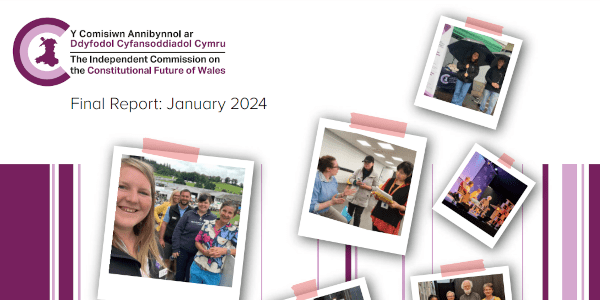
The only reasonable constitutional future for Wales that is not viable is the status quo. This was the ultimate conclusion of the final report from the Independent Commission on the Constitutional Future of Wales which published last week after several years of patient, diligent and thorough work. While initially set up to examine the prospect of Welsh independence, it took a much broader view, pulling in thoughts and ideas from across the constitutional divide in a way that Scotland could and must learn from.

Continue reading

Better For Who?

“If politicians don’t care about the electorate and lie to them, they can’t expect the electorate to care back and vote them in. An election must be more than a search for honesty in a snake pit.” – Stewart Stafford

(This blog post previously appeared in Common Weal’s weekly newsletter. Sign up for the newsletter here.)

This month marked eight years since the Scottish Independence Referendum and it’s fair to say that they have not been a quiet eight years. Brexit, pandemic, economic turmoil and the grinding poverty caused by over a decade of Austerity are taking their toll on the wellbeing of the country. It’s certainly not the promised “sunlit uplands” or even the pre-2014 “status quo” that many thought they were voting for. As we move into a fresh independence campaign, it’s worth looking back at some of the things we were promised in 2014 by the pro-Union campaign and how those promises have panned out since.

image_2022-10-03_134124375

Continue reading

Protecting Pensioners

“You’re mugging old ladies every bit as much if you pinch their pension fund” – Ben Elton

(This blog post previously appeared in Common Weal’s weekly newsletter. Sign up for the newsletter here.)

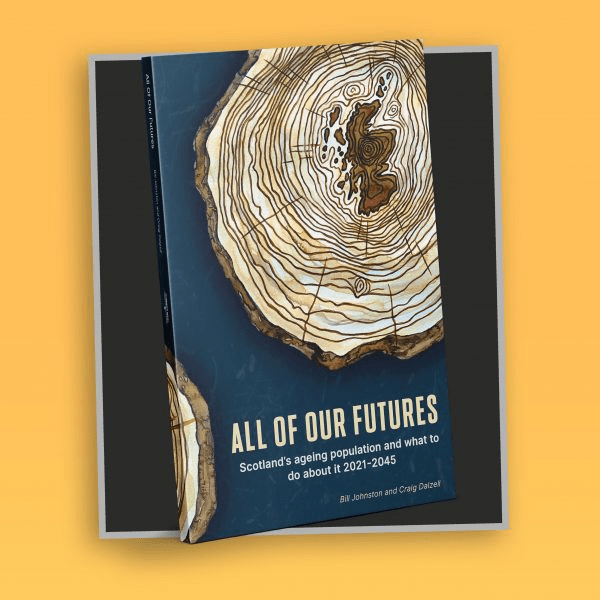
Last year, Bill Johnston and I published our book All of Our Futures – an exploration of ageism in Scotland, how it causes inappropriate policies regarding age and ageing and what Scotland could do instead to create a country that we can all safely, securely and proudly grow older in. In one of the chapters we discuss how an independent Scotland could improve policies around pensions.

This is one of the topics of great interest to everyone on all sides of the constitutional campaign but it’s also a topic that few attempt to tackle in any great detail. However the team here at Common Weal recently realised that while this chapter of the book represents our most up to date thinking on an independent Scotland’s policies towards pensions, we don’t actually have a dedicated Policy Paper on the topic beyond some higher level aspects such as in our 2017 paper on Social Security or discussions around debt and asset transfers found in our book How to Start a New Country or my paper for the Scottish Independence Convention, Parting Ways. This newsletter article will go some way to redressing this but it can only remain a short summary of what is laid out in much greater detail in the book. One thing in particular to bear in mind when discussing pensions is that there are two aspects of them which must be handled differently if not quite entirely separately. The state pension and private pensions.

image_2022-08-07_171932595

Continue reading

The Demographics of Independence: 2022 Mini-Update

“In most polls there are always about 5 percent of the people who ‘don’t know.’ What isn’t generally understood is that it’s the same people in every poll.” – George Carlin

(This blog post previously appeared in Common Weal’s weekly newsletter. Sign up for the newsletter here.)

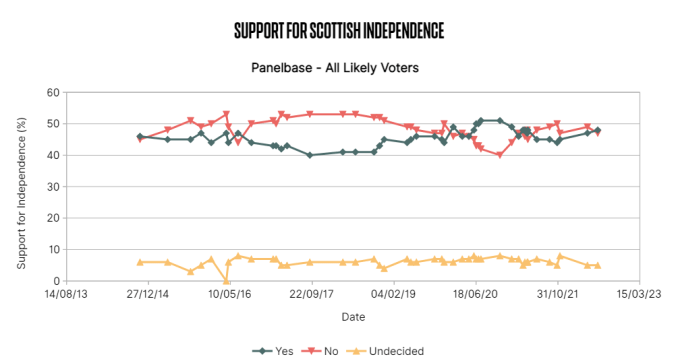
Since 2017, I’ve been collecting and deeply diving into Scottish polling data around independence. The last full report was published a little under a year ago but with the re-launch of the independence campaign ahead of the independence referendum that the Scottish Government hopes to hold next October, now is a good time to revisit that study. While I keep an eye on all polling from all polling companies in Scotland I tend to restrict my deeper analysis to those published by Panelbase as they tend to break up their dataset into more varied subsets than others like YouGov and thus provide a richer story for those trying to find out not just how many people support independence but who they are. Since August last year, there have only been five Panelbase polls asking Scotland about independence, including the one just released this week, so there isn’t yet enough data to publish another full Demographics of Indy report. However, given that this latest poll is the first since the First Minster’s indyref announcement and it returned a majority for support for independence I felt it was worth giving a mini-update in this news column. Please read the full policy paper series – comprising the 20212018 and 2017 editions – for my methodologies and all of the caveats involved in peering darkly through the lens of polling data.

OVERALL SUPPORT

image_2022-07-15_110526634

Continue reading

Finally, the Campaign Continues

“The proverb warns that, ‘You should not bite the hand that feeds you.’ But maybe you should, if it prevents you from feeding yourself.” – Thomas Stephen Szasz

(This blog post previously appeared in Common Weal’s weekly newsletter. Sign up for the newsletter here.)

And so, after many years of false starts and being told to “hold, hold” it looks like we’re finally off and back into a new independence campaign, a little shy of a decade after the previous one kicked off.

On Tuesday Nicola Sturgeon announced an update to her plan to deliver an independence referendum in the first half of this Parliamentary term. “Plan A” had always been to seek a sanctioned referendum by way of a formal Section 30 order to the UK Government resulting in something akin to the 2012 Edinburgh Agreement. But with Boris Johnson now and Theresa May before him being consistent in denying such a request, pressure had been mounting to deliver some kind of “Plan B”.

This week, we saw what that would look like. Should a Section 30 order not be forthcoming then the Scottish Government shall bring forward a Referendum Bill anyway and ask the Parliament to approve it. Given the pro-indy majority between the SNP and the Scottish Greens, it would be a miracle and a scandal if it doesn’t pass though – assuming no other party comes out at least as pro-referendum – all eyes will be on those pro-referendum (and the handful of quietly pro-independence MSPs within the Unionist parties) to see if they argue for a free vote or break with any party whip to vote the Bill. Will there be a repeat of Wendy Alexander’s 2008 “Bring it on” moment from any of the parties? I doubt it. Indeed, the biggest challenge to the referendum process – particularly an unsanctioned referendum – is the other side not playing at all.

image_2022-07-04_110324757

Continue reading

The Nuclear Sunset

“We humans were smart enough to invent nuclear weapons but not smart enough to not invent them.”  – Marty Rubin

(This blog post previously appeared in Common Weal’s weekly newsletter. Sign up for the newsletter here.)

This week is a historic milestone in the long campaign against nuclear weapons. On January 22nd, 2021, the Treaty on the Prohibition of Nuclear Weapons (TPNW) came into force having been passed by the support of 122 countries at the United Nations in July 2017. This treaty comprehensively bans nuclear weapons in all of their forms, bans countries from developing those weapons, funding their development, hosting weapons owned by others or even allowing them to be transported through their territory. 1 country (the Netherlands) voted against the treaty and another (Singapore) abstained. Several countries, including the United Kingdom, all other nuclear armed states as well as NATO nations, did not vote.

One of the strictures of the treaty was to set up a regular forum where State Parties (those countries who have signed and ratified the treaty) could come together and lay down the processes required to meet the various commitments that the treaty binds them to. This week, the First Meeting of the State Parties came together in Vienna to begin that process of bringing about the end of the age of nuclear weapons. A nuclear sunset to conclude the nuclear dawn that broke on July 16th, 1945.

(Source: Wikimedia Commons)

Continue reading