Submerged In Leith

“And so castles made of sand slips into the sea, eventually.” – Jimi Hendrix

(This blog post previously appeared in Common Weal’s weekly newsletter. Sign up for the newsletter here.)

Why is Edinburgh considering building housing on land that may be underwater before their mortgages are paid off?

In the Herald this week, a plan was announced to build 300-odd houses in a currently brownfield site at Edinburgh Harbour in Leith. This comes just over a year after approval was granted for a 600 home development at the other end of the harbour. Scotland has a housing crisis and the only way out of it is to build up housing stock so that it exceeds demand and begins to bring house prices down to actually affordable levels again and we build them in a way that doesn’t subject the residents to fuel poverty or, as may be the case here, assets stranded as a result of poor construction or the climate emergency. Scotland may have been one of the first countries in the world to declare a climate emergency but we’re still far from acting like it when it comes to policy.

In 2019, Edinburgh Council followed Holyrood in accepting that climate emergency and soon after they published a climate readiness plan on what they planned to do about it. It’s actually pretty good in terms of the policies it lays out and from what I’ve seen of Edinburgh lately, they seem to be making a decent shout of making progress towards the goals as stated, however there is one glaring omission to the plan and it pains this resident of a land-locked Local Authority to point it out – the plan only mentions the threat of sea level rise once, only does so in passing and does not recommend any policies or actions to address it. I’ve discussed this issue before with respect to Scotland’s airports, but it’s obviously time to look at it again.

Continue reading

Paying the Price of Climate Delay

“How is it that we already have so many solutions to the climate crisis that don’t compromise human rights or justice, but the only solutions being seriously considered are the ones that do?” – Mikaela Loach

(This blog post previously appeared in The National.)

red dragon statue near body of water during night time

The Climate Change Committee has declared that it no longer finds the Scottish Government’s Net Zero plan to be credible. That the Government will breach its statutory duty to reduce carbon emissions by 2030 by 75% (with no catch up plan in place to reach Net Zero by 2045) and that instead of there being a comprehensive strategy to reach Net Zero, the best we have is a serious of ad hoc, disconnected announcements. This comes off the back of the Scottish Government being found to be acting unlawfully by not publishing the expected carbon impact of its policies, in line with those statutory targets. Not to mention that “Net Zero” is itself insufficient as it merely promises that Scotland will continue to pollute until 2045 before stopping but makes no promise to fix the damage we’ve already caused (particularly on the Global South both in the present and during our colonialist exploitation of those nations).

Continue reading

Land Reform, Or Another Power Grab?

“The free society is characterized by the radical decentralization of all kinds of power. Confederal structures do not rule over communities; they are the means by which communities cooperate.” – Roy San Filippo

(This blog post previously appeared on Bella Caledonia.)

Corgarff

The Scottish government has introduced land reform legislation to encourage community ownership by granting ministers powers to intervene in the sale of estates of more than 1,000 hectares. The ruling Scottish National party said the bill, the biggest package of reforms in years, aimed to “revolutionise land ownership in Scotland” by empowering rural and island communities and increasing transparency in large land transactions.

In 2016 the last round of Land Reform made it easier for communities to buy out parcels of land, however the rampant rise in land prices – often now driven by so-called “Green Lairds” looking to cash in on carbon credits – have locked those same communities out of being able to afford to buy that land. With a few exceptions – such as in Langholm – the parcels of land being bought by communities have been getting smaller.  A report published in 2022 found that despite a steady rate of successful community buyout projects continuing much as it had since the start of devolution, the actual hectarage of land transferred had all but stalled with around 97% of all community owned land in Scotland being transferred before the passing of the 2016 Act.

Continue reading

Have The Conservatives Outlawed Themselves?

“The abyss doesn’t stare back. It winks.” – Kresley Cole

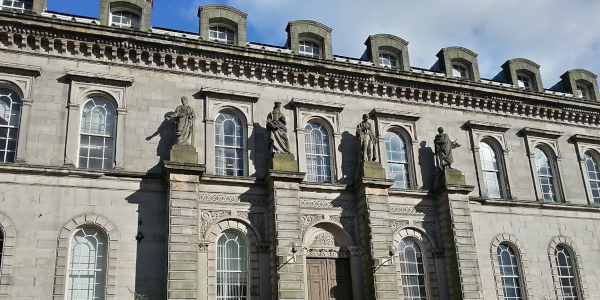
Justice

The UK Conservatives have published their new definition of “extremism” in their continuing attempts to lock down any possibility of dissent against their increasingly authoritarian rule (the hope that that rule will only last another few months as an election looms can be quelled by the fact that the UK Labour Party isn’t particularly likely to roll back on any of these measures.

However, as with many attempts to capture as many “inconveniences” as possible under the new definition, the party has run the risk of putting itself on the list of extremists too.

Continue reading

A Hollow Frame

“Spare your words, your actions will speak for you.” – Akiroq Brost

(This blog post previously appeared in Common Weal’s weekly newsletter. Sign up for the newsletter here.)

Imagine you’re applying for planning permission to build a house. Normally, the process would involve drawing up fairly detailed plans about what the house would look like. No plan goes perfectly to plan though and some changes are inevitable as the building process occurs but if the final building does deviate substantially from the initial plan there can be consequences up to and including being ordered to tear the whole thing down and start again. What you can’t do is gain permission to build “a house” without answering the basic questions like “What size is it?”, “How many bedrooms will it have?” or “Will it be made entirely of asbestos?”.

Over the past few months Common Weal have been incredibly busy replying to just a few of the public consultations that the Scottish Government and Scottish Parliament have been publishing. I’ve written before about the sheer volume of them, how much effort goes into each response and how little they often achieve despite the rare moments of serious influence or the fact that if folk don’t respond to them then vested interests end up dominating the responses and thus what the Government can point to as justification for their plans.

Continue reading

Rolling Over Scotland

“As the tail on our back disappeared as we no longer had any use for it, nuclear weapons will also disappear once we realize, we no longer have any need for them. But no matter how much we daydream, it will never happen as some sort of grand geopolitical gesture of international collaboration – somebody has to take the first step – one nuclear-capable state has to take that first leap of bold faith and naive trust! The question is, who will it be? The first nuclear nation to abandon its nuclear weapons, will be the First Peacemaking Nation of Earth – and their head of state, the First Peacemaker.” – Abhijit Naskar

(This blog post previously appeared in Common Weal’s weekly newsletter. Sign up for the newsletter here.)

This week saw the publication of the 11th paper in the series of the Building A New Scotland Independence White Papers by the Scottish Government, this time looking at the defence and foreign affairs and the policies that the current SNP/Green Scottish Government would advocate should they form the Government of that independence Scotland.

The paper was recently described by Alyn Smith as a sign that the Government had “done its homework when it comes to foreign policy and security”. Unfortunately, he is very far from the mark on that. The paper instead shows a profound ignorance about the process of becoming an independent state and a serious contempt for the internal party democracies of the parties involved.

Continue reading

A UBI Is Now A Moral Imperative

“The solution to poverty is to abolish it directly by a now widely discussed measure: the guaranteed income.” – Martin Luther King Jr.

(This blog post previously appeared in Common Weal’s weekly newsletter. Sign up for the newsletter here.)

A new research paper has found that a Universal Basic Income sufficient to eliminate poverty across the entire EU would cost about as much as defence and, in some modelled scenarios, would cost less than the poverty it eliminated. In other words, bringing in a Universal Basic Income could cost less than the price we’re currently paying by not doing it.

Continue reading

Judge Them By Our Actions

“For the powerful, crimes are those that others commit.” – Noam Chomsky

(This blog post previously appeared in Common Weal’s weekly newsletter. Sign up for the newsletter here.)

The scenes coming out of Israel and Gaza are beyond abhorrent – and unlike wars of even just a few years ago, it’s playing out in real time on our own screens – atrocity careful curated by algorithm to keep us watching whatever social media platform we’re watching it on. The scenes this week of the UK Parliament almost collapsing into party-tribal anarchy over what flavour of “ceasefire” is the only one they could support has done the UK no favours in terms of its international reputation or its ability to be a responsible and reliable partner for peace when negotiations do finally, too late, begin to end the conflict, hopefully once and for all.

But the problems for the UK’s involvement in this run deeper. Before the chaos of the Opposition Day Motion debate in Parliament many of the detractors on social media attempted to delegitimise the concept of the debate saying that the UK simply had no possible influence over the situation and that the calls for a ceasefire were purely symbolic at best and grandstanding at worst.

However, the UK is not a purely symbolic bystander in this (not that should excuse those who are bystanders. As Desmond Tutu said, those who remain “neutral” in situations of injustice, side with the oppressor). The actions of the UK are deeply entwined with the humanitarian disaster unfolding in front of us.

For a start, the UK is the only country that has consistently abstained from United Nations level votes for a ceasefire in Gaza. These abstentions wouldn’t have swung the vote (which have been consistently vetoed by the USA regardless of their overwhelming result) but that abstention does provide the US the diplomatic cover of not being the only ones to oppose peace. That is a symbol that cannot be ignored.

More directly, the UK is openly providing military aid with the specific aim of supporting Israel and Israel has used UK infrastructure (including Scottish Government owned Prestwick airport) for military purposes. If the International Court of Justice does find that their observed plausible risk of genocide is borne out, then the UK must ask itself (or be asked by the court) to what extent that military assistance opens the UK to a charge of complicity in any war crimes that may have taken place.

Another problem is in the nature of international law itself as far too many countries – the UK included – appear to treat it as an inconvenience only to be obeyed when someone they don’t like breaks it.

With that in mind, I have been watching part of the case moving through the ICJ this week where Palestine has asked the court to make a ruling on whether or not the occupation of Palestine by Israel is illegal. In brief, the case is that while the occupation of foreign territory during wartime can be legal, the continued occupation of that territory beyond what is absolutely necessary both in scale, scope and time is unlawful and that those limits have been exceeded. The case can be watched here, with the UK’s own submission to the case due some time on Friday 23rd.

That submission will be interesting because Palestine themselves used the UK’s own actions as precedent in its evidence session on Monday. Specifically, the UK’s occupation (and forced deportation) of the Chagos Islands that was declared unlawful in 2021. The UK Government had been making some moves towards obeying the order to end the occupation but this itself appears to have reversed since the return of David Cameron to Government and who in January completely halted and cancelled talks and “ruled out” return of the islands to those the UK had forcibly removed from their homes claiming – despite evidence – that it was “not possible” for people to live there any more. If an occupier has left occupied land incapable of supporting those removed from it, then that is a problem for the occupier to fix.

There is a real danger of this story repeating itself in Gaza, with the continued destruction of homes and infrastructure and the sheer amount of unexploded ordinance surely hiding under the rubble of those homes making the prospect that people who have been forcibly displaced ever returning more remote and more unlikely by the day.

If and when the UK does decide that it can no longer stand by from or actively support atrocity, then it will have to reflect on the atrocities it has committed in turn. There will come a time to prosecute the war crimes committed over the course of the conflict in Israel and Palestine and each and every one of those crimes absolutely must be prosecuted whether committed by an enemy or an ally (or, indeed, by oneself). But the UK’s own actions are being held up to the world as an example of unacceptable behaviour and this matters because if it does not accept that behaviour as unacceptable by ourselves then we provide cover for those who wish to commit those same crimes on others. The world is judging others by our actions and we are falling woefully short of any measure that we should hold up as an example to aspire to.

Postscript:- The UK’s evidence to the ICJ quite brazenly started off with a statement to the effect of “We know you’re looking at our actions in Chagos – Please don’t judge Israel by our actions.”

TCG Logo 2019

Wealth Taxes and Land Reform

“It takes a strong leader to collaborate with others in an effort to bring about real change.” – Germany Kent

(My speech at the 2024 Scottish Labour Spring Conference fringe event on land reform, hosted by REVIVE)

gray concrete building near lake under white sky during daytime

Devolution has meant that Scotland has more responsibility than power. Tax powers as they are have limited scope to effect meaningful change to an unequal society.

Our most powerful devolved tax – income tax – has proven extremely hard to use and eats a lot of political capital – chiefly as it’s too easy for the very rich to avoid and everyone else doesn’t get paid nearly enough.

But income inequality is far outstripped by wealth inequality both in Scotland and in the UK and in a capitalist economy where those with wealth can use it to rent-seek off the backs of the folk who worked to earn it, we have a problem where it matters less who gets paid how much, it’s who hoards it after that.
We need a system of wealth taxes to rebalance our economy, cut down on the dragon’s hordes of the multi-billionaires who could never hope to spend it usefully in a lifetime and to ensure that assets are more efficiently used for the benefit of all of us.

Scotland has a lot of power to do good here if we choose to and while this isn’t the time or the place to discuss what we could do if the Scottish Parliament had more powers, it most certainly is the place to discuss what we can do now.

Continue reading

Devolving Building Safety

“The fact is, free markets don’t provide safety. Only regulation does that. You want safe food, you better have inspectors. You want safe water, you better have an EPA. You want a safe stock market, you better have an SEC. And you want safe airlines, you better regulate them too.”
– Michael Crichton

(This blog post previously appeared in Common Weal’s weekly newsletter. Sign up for the newsletter here.)

A couple of weeks ago, Nicola and I chatted on the Policy Podcast about the pile of public consultations overflowing our desks and the desks of our colleagues – it’s worth a listen as while it’s often a thankless task that takes up a lot of time for very little result, the result that comes from it is a vital part of our democracy.

Amusingly, during the podcast I mentioned that because we’re a Scotland-based think tank and Scottish politics structures are an order of magnitude more accessible than UK political institutions are (which isn’t to say that access is easy…) we very rarely engage with UK level public consultations. It’s amusing, because in the past week as I’ve been chipping away at our consultation pile, I’ve ended up responding to two UK consultations – one on the sustainability of UK debt and another on the topic of today’s column – a proposal to devolve a new tax power to Scotland.

Continue reading