The White Paper Project

“Work as if you live in the early days of a better nation.” – Alasdair Gray

wpp-v1-cover

Today I get to announce the launch of a very long awaited project I and the rest of Common Weal have been working on for quite some time now. We announced back in September that we have been working on renewing the case for Scottish independence by publishing a successor to the Scottish Government’s “Scotland’s Future” document.

Version 1.0 of the Common Weal White Paper can be download here or by clicking the image above.

This is a leaner document than Scotland’s Future was. That document was as much a party political campaign device as it was a blueprint for independence. It not only sought to describe the powers which would come to Scotland independence but also sought to convince voters of the SNP’s own vision for independence. There was nothing inherently wrong with this latter task per se and other parties too sought to promote their own distinct visions as well – as they will all do so again throughout the next independence campaign but this is not the task of an independence White Paper. This paper shall, as far as possible, not seek to propose a list of policy ideas which an independent Scotland could do nor shall it attempt to convince you of the merits of those policies. It merely lays out the technical and structural requirements which must be in place for Scotland to become an independent country once we, the voters, decide that it should become so.

It is a “consolidated business plan for the establishment of a new nation state”.

To this end, the White Paper is split into several broad sections. Part 1, Process and Structures, covers the foundation of a National Commission – a cross party and cross administration body which will be tasked with designing and implementing the institutions and systems which need to be set up in the time between the independence referendum and the formal independence day. It is one thing to state, for instance, “There shall be a Scottish Central Bank”. It is quite another to decide how large it needs to be, where it needs to be based and who needs to be hired to run it. The National Commission shall also be given interim borrowing powers so that it is able to issue bonds, raise capital and fund the construction of the vital infrastructure Scotland would need to either move from rUK or build from fresh.

Part 2, Key Institutions of an Independent Scotland, covers all those things we kept being asked questions about during the last referendum. Would we have a constitution? A currency? What would we do about borders? Defence? All these and more. Of course it’s not yet possible to answer every question in this regard. Some of it will be up for negotiation with rUK, some of it will be dependent on the shape of the Brexit deal between the UK and the EU and Scotland’s relationship with both in the run up to independence but we’re making a stab at as much as we can and this is the section which will perhaps be most expanded upon as the Project is iterated in future versions.

Speaking of negotiations, Part 3 covers the prospective shape of some of these – chiefly the allocation of debt and assets and what rUK’s response to our leaving shall mean for our claim on them. Also covered to some degree is how Scotland will interact with various international and supranational organisations although it should be stated once again that no case shall be strongly made for Scotland’s joining or refusal to join any of these organisations. That shall be left to the party or parties which seek to form the first independent Scottish parliament.

Finally, Part 4 outlines the position of Scotland as far as finance and borrowing goes as well as outlining as best we can the default fiscal budget for year one of independence. It is, of course, almost impossible to place any kind of actual certainty or promise on such a budget as it is based on several key assumptions such as the desire to keep both public spending and the various tax revenue streams broadly similar to their position at present. If a party decided to scrap the entire tax system and replace it with one of their own devising then it would have to be up to them to explain how that worked and project the revenue to be gained from it and how it would be spent. Other assumptions include Scotland spending the money assigned to it in GERS for various “UK projects” on projects of similar value and in similar accounting lines (so that, to pick an arbitrary example, our “share” of UK economic development funding spent outside Scotland but from which Scotland “benefits” would instead be spent on economic development within Scotland). Again, whether or not this happens will be a case for the individual parties to make and will depend entirely on accurately and precisely how the current fiscal projections for a devolved Scotland within the UK map onto the fiscal situation of an independent Scotland.

Once again, this is not the completion of the White Paper. This is the beginning. You will see that there are several sections which need to be expanded and built upon and items like costs and figures will be updated as time goes on (the default budget, for instance, is based on 2015-16 figures but – as we’ve probably noticed by now – Scotland didn’t become independent in 2015-16 so these precise figures will be revised as and when they should be). Some areas require the attention of people with specific experience and expertise in them to be able to complete so we are openly calling for those experts who are able and willing to contribute. Please contact us if you want to be involved. Let’s work to build the early days of our better nation.

TCG Logo 7.png

The Common Green’s 2016 Retrospective

2016 has been a bit of a year.

The Reaping of the Celebrities aside, it feels to some like we’ve endured an annus horribilis matched or exceeded only by the 2008 global financial crisis.

Time for a little look back at some of the events on which I’ve pondered throughout the year.

Independence Day (Postponed)

On the 24th March, we marked the day that Scotland would have become independent had we voted Yes in 2014. We’ve all wondered what that day would have been like instead of the grey, slightly dismal day we had. As it was, I wrote a poem. No-one read it. Probably for the best.

It has been somewhat impressive that the independence movement has stayed as together as it has. It’s not what it was, sure, but the steady diminishing of “The Vow”has likely played a substantial part in keeping us focused on our goal. Our ‘Betters’ in Westminster have ploughed a steady furrow through the year from January and the casual dismissal of key parts of it right up to December and the UK Government relying on the ability to completely overturn everything devolution stands for as part of their defence in court.

Add to this, the constant, overriding obsession from the Unionist parties about claiming that the SNP has an overriding obsession about independence and it’s no wonder the agenda never really left the table. If I were them, I’d be spending less time ensuring independence becomes inevitable and the default mode of thought in Scotland and more time making the UK look like the kind of place we’d rather not leave. Of course, there’s also an old saying about never interrupting your opponent when they’re making a mistake…

The Scottish Elections

Seat Allocation

There didn’t seem to be much to actually talk about in the run up to the 2016 Scottish elections. Almost everyone seemed to assume that the SNP would walk another majority and the Unionist parties set mostly about trying to cannibalism each other’s vote with a display of almost policy free British nationalism. It was, of course, it was the Ruth Davidson Party for a Stronger Opposition To Admitting Which Party She Belongs To which won that contest.

Image result for ruth davidson campaign leaflet

Most others seemed to be scrabbling around asking if some kind of “tactical voting” campaign would best benefit their own party of choice, something which I rejected for several reasons. Indeed the voting system used by Scotland actively discouraged such a thing in a way that the UK General Election’s FPTP system does not. A good thing as far as proportional democracy goes but this did  not help when I was out on the doorsteps and confronted by more than a few folk who simply didn’t understand how to vote using AMS. It’s not even easy to explain in a short sentence or two.
There were a few actual policies to come out of the campaigning though. The SNP promised to marginally modify Council Tax, Labour tried to marginally modify it marginally more, the Greens suggested actually fixing the whole thing instead. Whilst the SNP won the government, the lack of a clear majority means that this issue still isn’t quite settled. We’ll find out early next year how much compromise is made to the SNP’s manifesto and how much the various parties are willing to compromise on their stances in order to get the budget passed. Between this and the ongoing saga of the PFI scandals, it certainly sets things up to be interesting for next year’s regional authority elections.

The EU Referendum

Brexit

The big event of the year. If I had thought that the 2014 No campaign was dire and that the elections since then were facile, this one took the cake. BOTH official campaigns embarked on a fact-free trail of fire and woe which was utterly embarrassing to watch. It got to the point a couple of weeks before the vote that I had simply had enough of the propaganda, the willful misunderstanding of EU structures and the outright ignorance of basic facts that I had to write something about it myself. I thought that maybe two or three blog posts would be enough to cover things…I ended up writing eight plus a post-results round up. My “Are EU In or Out?” series has since been credited as being one of the more informative blogs on the subject (I’ll leave it to others to agree with those sentiments and thank those who made them) as despite my obvious leanings towards a remain vote I at least laid out the positions as fairly as possible and quoted my sources. Once again, I’ll be watching the ongoing events closely throughout next year as the UK Government slowly begins to realise that it’s not playing some kind of game of poker and starts trying to come up with something resembling an actual plan for leaving the EU in some kind of orderly and structured manner. I also have bridges to sell to anyone who’s interested.

Global Trumpism

Brexit will never happen. Trump won’t get the Republican nomination. Trump won’t come close in the elections. There’s no way he could win. There’s no way that his advisors will continue to let him spout off on twitter to his heart’s desire on many globally important subjects.

I think it’s safe to say that 2016 has not been a good year for political predictions in general.

I still maintain my hope that he’ll be surrounded by a group of advisors able to “filter” his commands into something a little more survivable but since that group of advisors increasingly seems to be the type of things he’s pulled up from the bottom of the swamp he promised to drain I’m wondering just how hopeful I should actually be.

Perhaps we should really have that discussion now about why things like Brexit and Trump have started happening.

Common Weal

More positively from my perspective, 2016 saw my joining Common Weal as a volunteer researcher and then becoming their Head of Research as they, we, gear up for our biggest project since the foundation of the think tank. The White Paper Project. A new case for independence based on our All of Us First ideals. My own work has established the case for an independent Scottish currency (and we’ll be producing another paper very shortly on the technical details of how one is launched), examining the historical precedents behind debt and asset allocation during separation negotiations and how they’d relate to Scotland and rUK, and explaining in detail the insufficiency of GERS as an indicator of Scotland’s financial position post-independence. Other papers have been produced by others on the case for a National Investment Bank, understanding the impacts of child poverty in Scotland, proposals for reforming Scotland’s housing policies and others.

Early in the new year, we’ll be publishing our White Paper at the Scottish Independence Convention and asking people to give their thoughts on what we have and to help improve it, approve of it and take it forward to the point where the entire independence movement can get behind it and push it into the next campaign. I hope to meet a few of you there.

Onwards to 2017

2016 has been a bit of a year. But not one that’s been as bad as I’ve probably made out. Globally, there have been a number of success stories as well and we’d do well to pay better and more attention to them (One of my own Resolutions for next year will be to do better do avoid getting stuck in the mire of gloom, anger and ‘fake news’ too abundant on social media). The potential for a Greener planet is increasing by the day as the cost of renewables continues its freefall. Scotland is doing well to take part in some of this revolution although it’s also clear that much more could be done if only we had the power to do it and weren’t constrained by a government still wedded to fracking and Big Capital nuclear boondoggles.

20160324_132351.jpg

So here’s a wee toast to the back end of 2016 and for a hopeful start to 2017. We got through this one, we’ll get through the next. Let’s try to enjoy it more this time.

tcg-logo6c

[Edit: Article posted about an hour before the announcement of the deaths of Carrie Fisher and Richard Adams. Screw you 2016.]

Beyond GERS:- A Response to Comments

And if he is compelled to look straight at the light, will he not have a pain in his eyes which will make him turn away to take and take in the objects of vision which he can see, and which he will conceive to be in reality clearer than the things which are now being shown to him? – Plato, The Republic. Book VII – The Allegory of the Cave

I probably should have foreseen the level of engagement that my latest article for the Common Weal White Paper Project – Beyond GERS – has generated.

Most of it has been positive and the best of the critical response has at least been constructive.

JKtweet.jpg

(As flattered as I am by the attention, I don’t particularly include this comment in either of those categories)

Spurred on by the mention of the paper by David Torrance in The Herald, I’ve become aware of several misunderstandings and misconceptions surrounding a few of the comments which have been made so feel that these must be addressed in a constructive manner. This paper represents a large leap away from where the independence debate has stood – more or less stationary – for the past two years so some further explanation of some of the points is warranted.

1. The Data Source is Wrong

This first clarification comes off the back of Kevin Hague’s article here which examines some of the figures used to back my arguments. His chief objection is that I used PESA 2016 (which covers up till financial year 2014/15) as the basis for my disaggregation of UK and Scottish geographic spends and that I should have used CRA 2015/16 instead (and, to his great credit, he makes the case that doing this strengthens our case from a financial perspective). Whilst this is a point to which I would not necessarily object I can only remind that Hague also admits that the latter source wasn’t actually published until after Beyond GERS thus was unavailable at the time of writing and that my conclusion makes it quite clear that this publication should be considered as a first step – to be updated as new data develops.

We must remember that the data for 2015/16 will continue to be updated and refined for several years from now – most of these documents will show refinements and adjustments running up to five years before they “drop off” the table. We must also remember that whilst this study assumes the case of Scotland becoming independent today, the simple fact is that we are not, we will not be and it will be several years at a reasonable minimum before we are. Despite the efforts of some economic analysts to divine the state of the economy several years hence, quite probably the only certain conclusion one can reliably reach on such things is that these predictions will be wrong to greater or lesser degree, one way or the other.

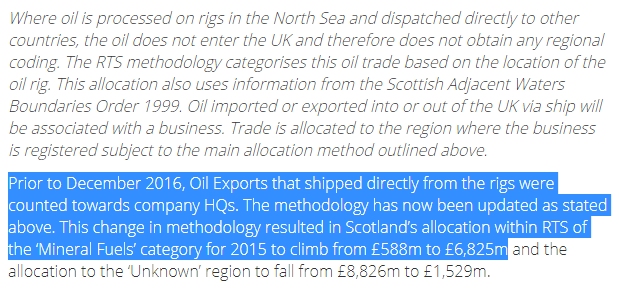
Would using GERS 2014/15 have made for a neater comparison? Possibly. Certainly though the baseline deficit was relatively similar so the task at hand not significantly different. But I’ll give you 20 £Scots to whatever that would be worth in £Sterling that the more shrill objectors I’ve encountered would have immediately demanded to know from where I was conjuring up £1.8 billion of oil revenue.

oil-revenue

(Of course, given that the 2016 Autumn Statement is now projecting >£1.5bn of oil revenue per annum in coming years, maybe I could have just claimed extraordinary prescience…)

On one particular point of attention, Hague wonders if I have overestimated the effect of overseas spending to the tune of £2.4 billion. This number was reached via a share of the total UK’s total overseas spend rather than the more modest figures assigned in CRA which applies a “who benefits” formula to spending where possible and a population share where not. The rationale for this choice being that, as outlined in the paper, one of the arguments used directly against Scottish independence was the breadth and reach of the UK’s diplomatic service. Whilst a credible case is made that the UK’s diplomatic service is, while broad, rather more inefficient than it need be I am left feeling comfortable with the idea that others who do not necessarily support independence would now surely recognise that if Scotland wanted to replicate that reach then it would be within our budget to do so. If it’s strictly an overestimate, that’s fine. I’d rather think of it as a potential for investment into Scotland being a genuine force for good in the world.

2. This Means Cuts to Scottish Defence

In two of the cases mentioned, Spending according to the EU average or at NATO target levels, this represents an INCREASE in the amount of spending within Scotland, along with estimations of the economic impact caused by this increase. Only in one of the cases – a level of spend similar to Ireland and in accordance with their policy of neutrality and involvement in UN Peacekeeping missions – would this represent an actual cut to defence. If one were to consider reducing actual in-Scotland spending on defence and were to do it in such a way as to risk jobs – then it would be absolutely right to consider how those savings could be invested into other sectors of the economy which may carry with them far higher fiscal multipliers than defence spending does. As the IMF have noted more than once, rational defence spending levels are rarely decided out of “concerns about the state of the economy“.

This said, defence is an issue which is very much bound up in policy and it is a subject that we really need to have a serious discussion about. Scotland’s defence requirements post-independence are likely to be very different from that of the UK as a whole or even Scotland within the UK.

If, for example, you believe that Scotland’s defence threats are, in order:
1) Nukes from Russia
2) Tanks from Russia
3) Terrorism
4) Troops from Russia

Then you’re likely to end up creating a defence force entirely inadequate at tackling the actual threats to our national security (The top four of which probably look more like: 1) Climate Change. 2) Internal unrest 3) Terrorism. 4) Cyber Attack. None of these need aircraft carriers, outward force projection or nukes to effectively combat). Common Weal will soon be producing our vision of what defence actually means in structural and strategic terms.

3. Closing the Tax Gap = Raising Income Tax

One of the implications made by Hague – and which was picked up by Torrance – was that closing the tax gap to raise an additional £3.5 billion could be equated to a ~30% increase in income tax level. This is a particularly misleading way of representing this particular point, not least because the research quoted in the paper makes it clear that the inefficiencies, loopholes and avenues for avoidance and evasion lie far more within the realms of VAT, corporation tax, capital gains and inheritance tax. The fact that these taxes are all currently reserved to Westminster aside, the implication that closing the tax gap automatically means an increase in tax rates for those who already pay their full share and obligation is simply wrong.

This mode of thinking, I believe, is symptomatic of the main problem that this paper is trying to tackle. Too many political commentators (on both sides of the debate) have gotten far too used to thinking about Scotland strictly in terms of being a wee region of the UK with limited powers. When just about the only major tax power Scotland has control over is income tax, perhaps it’s tempting to think of solutions purely in terms of that one tax but if you want to think about Scotland as an independent country – even if you’re against the idea and want to attack it – you must think about Scotland in terms of BEING an independent country. An independent Scotland would, of course, have full control over all of the taxes currently employed. Most importantly, it would be fully in control of the power and opportunity to completely dispense with the UK tax code and start again with a better, more efficient, more effective one designed explicitly for the Scottish economy. If a pro-Union commentator wishes to fight on this point then they have to be prepared to defend the current UK system, explain away its flaws and why we’re not getting any of the solutions that folk like Tax Research UK can identify as well as attacking any proposals that we push forward.

4. We’d Be Defaulting on the UK’s Debt

The stated objective of the Westminster government in the 2014 campaign was to have the rUK recognised as the “continuing” or, at least, the “successor” state to the United Kingdom (the difference is largely semantic. In the former, the UK would continue unchanged in law but with reduced territory and perhaps a change of name. In the latter, the UK would strictly cease to exist but rUK would inherit all of the rights and obligations of the former state) and for Scotland to be recognised as a “new” state (The link prior went so far as to claim that the 1707 Treaty of Union “extinguished” the country of Scotland as a legal entity despite the UK describing itself to the UN 2007 as being composed of “two countries [Scotland and England], one principality [Wales] and a province [Northern Ireland]“). This state of affairs would carry with it significant advantages for rUK – notably, it would lessen any serious challenge towards their holding the UK’s permanent seat on the UN Security Council which was the case when Russia became the successor to the USSR – but carries with it many obligations also. The historical precedents are clearly laid out and extensively referenced in my paper Claiming Scotland’s Assets but readers should also consider G.F. Treverton’s book on the subject Dividing Divided States.

Essentially, where one country successfully claims “continuing” or “successor” status then it accepts that all of the mobile debts and assets of the former state belong solely to it (non-mobile assets like mineral rights, military bases and public buildings – including public companies and any mobile assets deemed essential to their running – are almost always split geographically). This means that a “continuing” rUK owns all of the UK’s debt in its own name. Scotland can no more default on them than can a former lodger default on your mortgage.

Now, if the side negotiating on behalf of the UK wishes to make the case that Scotland should take on a share of debts, perhaps by offering a share of assets to their value, then this is something that Scotland could consider, accept or refuse. There is a very good case to be made that Scotland doesn’t actually need or want a population share of the UK’s mobile assets. We may need a few £billion worth of military equipment – assuming we can’t buy newer or more appropriate equipment elsewhere. We may need a couple of £billion (those stalwart supporters of independence, Scotland in Union, estimated not more than £1 billion) to set up essential government departments currently lacking – assuming we can’t borrow the money at better rates on the open market. We may need a couple tens of £billions to support our new currency and set up the investment banks we’ll need to start rebuilding our economy. After that, it really does start to become a stretch to consider what other assets we would actually need which would justify accepting over £130 billion worth of debt. Answers on a postcard on that one please.

5. rUK Won’t Pay Pensions to People in Scotland

The current rules regarding the UK state pension are quite clear. If you meet the requirements for one, including paying up to 30 years worth of National Insurance, then you are entitled to a UK state pension when you retire. Should you retire outside of the UK then, depending on which country you retire to, you may or may not receive an annual increment to that pension and changes to things like exchange rate and purchasing power may erode or enhance the value of that pension but the basic premise is laid out. In the absence of an agreement to the contrary, if someone has reached their 30 years contribution before I-Day or has even already retired then they can expect their full UK pension. If, for example, they end up paying 25 years UK NI and then 5 years of Scottish NI (or equivalent) then they can expect both governments to pay according to those shares. If someone lives their entire working life in an independent Scotland then the full share of that pension lies with Scotland. By this logic, at the point of independence, the full component of pension liabilities would fall on rUK as, at that point, no Scottish NI would have been paid.

This should not be a controversial point as this was precisely the stance that the UK government itself took during indyref1 and is entirely consistent with the stance laid out above that rUK would act as the continuing state to the UK.

At least one commentator has suggested that the UK could “change the law at the stroke of a pen” to block payment of extra-rUK pensions. I guess they could. It’d be a “brave” move though. I doubt they’d be able to pass that bill over the howls of horror from all the other British emigrants currently drawing that pension. I’d also love to hear their explanation to both rUK citizens who choose to move to Scotland at some point after independence as well as to their core voting base of those British nationalists who would certainly seek to retain their UK citizenship post independence and may even reject the offer of taking Scottish citizenship to which they may be entitled.

That same commentator also suggested that, rather than a blanket ban on extra-rUK payments, the blockade could be limited solely to Scotland. I find it extremely difficult to suggest a way in which that this could be done which wouldn’t be seen as a blatantly discriminatory attack on pensioners based solely on place of residence.

“You can have your pension paid to you anywhere on the planet*”
*except Scotland

I’m far from a legal authority but I’m fairly sure that one could be challenged in the courts.

Now, if an agreement over pensions liability sharing IS reached then this may change and, being that it is entirely a political negotiation, it’s difficult to predict ahead of time what that agreement would look like. Common Weal will soon be producing our own suggestions about what a Scottish pension system may look like and how it would interact with the rest of the social security network. This may include some form of cash settlement from rUK to Scotland to compensate Scottish residents for the NI they’ve paid into the UK system over the years. More on that in good time.

It is true that the Scottish Government claimed in the Scotland’s Future White Paper that they would take up the pension liabilities. This was part of their stance that Scotland would share UK successor status with rUK and would share assets and debts. Remember that it was the No campaign which originally claimed that this wouldn’t be possible. If this has changed; if the pro-Union campaign wants now to seriously suggest asset and liability sharing. Time to make us a serious offer. We may even agree to it.

6. But the SNP said ‘X’ in their White Paper!

Whether on pensions or currency or any other campaign point this is the comment which, to my mind, represents a total vindication of what Common Weal are trying to achieve through our White Paper Project. That we’ve moved the debate on so much that these segments of No campaign have now flipped from saying that Scotland’s Future was utterly without merit and should be scrapped in entirety to now demanding that its proposals should be accepted in full we’ve revealed that their own case for the Union yet to move on one iota from their position two years ago. They haven’t adapted their arguments to the new circumstances caused, especially, by Brexit and they haven’t even considered the possibility that when they demanded that the Yes campaign drop a previous campaign point and adopt a new one that we might actually do it. They’re still stuck in the Cave, blinking at the light and yearning for the shadows they sneered at two years ago.

Finally

I completely welcome comment and scrutiny of this and other work that we produce. I am more than open to adopting suggestions where they contribute to the project and to updating figures as data are refined or as time moves circumstances on. I shan’t accept some of the more blatant misreadings of this report and I certainly shan’t accept some of the more low-brow comments dismissing this work based on my own academic credentials (as if one is incapable of utilising transferable skills or of ongoing learning after graduation) and as if this is an entirely solo effort with no more thought put into it than a casual personal blog rather than the extensively referenced, collaboratively researched and professionally peer reviewed work that it is.

I’ve often found in this “post-truth” age that those who’ll gleefully tell us not to listen to “experts” when they disagree with them are all too often the same people who demand that we only listen to “experts” when others say the same thing. I’d like to hope that all of us can put that attitude behind us and start discussing the actual issues.

tcg-logo6c

Beyond GERS

Today has seen the publication of my latest contribution to Common Weal’s White Paper Project. Click here to take you to the launch page or on the image below to take your directly to the paper. Further coverage can be found here and here in The National.

Beyond GERS cover.png

Preface

GERS (Government Expenditure and Revenue Scotland) 2015/16 reported Scotland’s fiscal deficit to be in the region of £14 billion per year, portraying Scotland as the country experiencing some of the most challenging financial circumstances in Europe.

However, this study must be viewed firmly in the light of Scotland being a member nation of the United Kingdom and, as such, any attempt to use them to project the finances of an independent Scotland must be treated with caution and qualification.

The very act of independence will result in significant redistributions and reallocations of government resources which will likely result in economic benefits accruing to Scotland. Additionally, decisions on how to establish and govern new Scottish state institutions will also improve Scotland’s budget at the point of set-up, further strengthening the fiscal position vis-à-vis that presented in GERS and that of the rest of the United Kingdom.

Key Points

• The act of independence brings with it many structural changes which will significantly benefit Scotland’s fiscal position to the effect of several billion pounds equivalent per year.

• By shifting the focus of defence from one of outward projection and nuclear deterrent to one more in line with modern European nations, savings of approximately £1.1 billion per year can be realised. Even in the event of Scotland committing to NATO member defence spending targets of 2% of GDP, the increased spending within Scotland can be expected to have additional economic benefits resulting in tax revenue increases of around £300 million per year compared to the status quo.

• A reasonable case for the debt and asset negotiations due to independence will result in Scotland saving up to £1.7 billion per year in debt interest repayments.

• The legal requirement of the UK Government to provide the UK State Pension for all those who have met the criteria would likely have to be the subject of negotiation post-independence, but the expectation would be that this would lead to billion-pound savings for the Scottish Government in at least the first year.

• A substantial fraction of unidentifiable spending accounted to Scotland is, in all likelihood, spending to cover UK wide government functions which Scotland may or may not choose to replicate or reproduce in some form post independence. Whilst savings will be made by reason of lower running costs and wages in Scotland compared to London, the additional economic benefits of spending in Scotland instead of elsewhere in the UK could result in additional tax revenues of approximately £719 million per year.

• The opportunity for an independent Scotland to redesign the tax code from the ground up, eliminating built in inefficiencies, loopholes and exceptions will help reduce the “tax gap” by approximately one-third, increasing revenue by about £3.5 billion per year.

• Whilst the UK’s tax revenue as a percentage of GDP is around the OECD average, many countries neighbouring it successfully maintain higher rates of tax revenues which, if replicated in Key Points: Scotland, could further improve the financial situation by several billions per year.

• Even without increasing tax revenue as a percentage of GDP, an independent Scotland could be placed in a position of relative “deficit parity” with the current UK budget.


Regular readers will know now that Common Weal has been very hard at work looking at the issues surrounding the independence debate, especially those arguments which just simply didn’t convince a certain segment of voters. We were all hoping that ‘someone else’ would come along and do this right after the last referendum but, for various reasons, it hasn’t happened. So Common Weal has decided to just roll up our collective sleeves and do it.

We’ve already published a paper reopening the currency debate, debt and assets, a proposal for a National Investment Bank and others. We want to produce further papers on pensions, defence, customs and excise, a detailed paper on the role of the Central Bank of Scotland, and others. All working up to a paper not just showing the limitations of accounting exercises like GERS but doing away with it entirely and building a case for an independent Scottish budget built from the ground up to suit our needs, rather than just being a tweaked version of what the UK does.

We are incredibly under resourced for this work but we think it’s work worth doing.

If you do too, perhaps you’d like to consider a donation to Common Weal to help us on our way: www.allofusfirst.org/donate
tcg-logo6c


Trump Tops It

Nemo autem regere potest nisi qui et regi.
No one is able to rule unless he is also able to be ruled. – Seneca, De Ira – On Anger.

trump.jpg

So Donald Trump will become the 45th President of the United States.

A sentence that I hoped I’d never have to actually write in a non-fictional article.

I’ll leave much of the “what went wrong” analysis to others except to say that maybe the “centre-left” (however broadly you want or need to define it) will finally come to realise that the short term gains of triangulating towards your right-wing opponents and just banking that your left wing base support will carry you through because they have no-where else to go has hit its limits. It didn’t work for Pasok. It didn’t work for Labour. It hasn’t worked for the Democrats.

Because, of course, the base does have somewhere else to go. They can choose to simply not vote or they can vote for the charismatic but context free option. Both of these choices happened last night. (Of course, there are other factors too. There seems to have been a very significant “Urban vs Rural” split just to name one).

What’s done is done though and now we need to adjust to our new reality as best we can. Scotland will feel the impact of this vote, so we need to have a think about where and how we can react.

TTIP

As with so many things, Trump has made deeply conflicted statements regarding his view of international trade agreements. He has both come out strongly against TTIP, TPP and NAFTA (mostly because Clinton was in favour) whilst also saying that post-Brexit UK would be “front of line” for a trade deal (mostly because Obama said we wouldn’t be).

For opponents of TTIP it may well be that the final nail in the coffin could come from an unlikely ‘ally’ indeed. Of course, if Trump manages to square his circle and fulfill both of his promises then independence may well be our bolthole to get away from them.

Climate Change

Trump is about to become the most powerful climate change denying leader on the face of our planet. I really do feel pity for folk in places like Florida who have voted for a series of polices which may well erase significant chunks of their state from the map.

Scotland should absolutely become the counter-example to his fossil energy expansion plans. If America is not going to be the world’s hub for renewable research, development and deployment then we should take it on (we’ll even welcome immigrant scientists and engineers who want to come and help us do it!).

We absolutely cannot sustain a fracking economy in the face of this. For a start, if Trump goes full frack then it may depress prices below the point of sustainability without subsidy. This is my warning to anyone hoping to kick the Scottish fracking can down the road till it’s safely after indy. There’s no mountain of cash for Scotland here. Turn away.

NATO

Trump has made several rather worrying comments about NATO. It looks greatly as if he will push hard for all members to raise defence spending up to the target level of 2% of GDP per annum (amongst other requirements). Right now, the UK is one of only a few member countries to do this (despite slashing spending within Scotland…but that’s a story for another time). More worryingly is Trump’s threat to hang NATO allies and even members out to dry should they “fail to pay”. I believe it is time for Scotland to revisit the discussion on our independence being predicated on NATO membership. For our own security, could it be that the EU’s proposed joint defence plans offer better security than the uncertain and unreliable ‘protection’ offered by Trump? Would Scotland be a better force for good in the world if we placed our efforts into UN Peacekeeping missions rather than by being part of an alliance built up to bulwark ourselves against a Warsaw Pact which no longer even exists?

Final Thoughts

These are, of course, the earliest of days and we’re going to have to wait to see both how President Trump differs from Candidate Trump (if, indeed, they do). Who Trump places in his cabinet (I’ve heard from friends in the States that VP Mike Pence may well be the one who does most of the day-to-day work behind the throne…except his record as governor of Indiana is far from stellar both within the economic and in social policy).

My slight hope is that Trump ends up surrounded by a very thick layer of advisors who are able to..”filter”..his outbursts and orders into something that’s a little more suitable for humans living on planet Earth. If that happens, maybe we’ll just about get through this.

tcg-logo6c

Postscript:- At time of writing, Clinton is still (marginally) AHEAD of Trump in the popular vote despite Electoral College going decisively to Trump. Come on America. It’s actually quite hard to create a voting system which is even worse than FPTP for selecting a single nationwide seat but somehow you’re still clinging on to it.
(Before anyone asks, my pre-result gutfeel prediction was that Clinton would win the EC and Trump would win the Popular Vote, the exact opposite of what appears to have happened. Rant still stands.)

Brexit Means…?

Brexit Club2

Today sees the news that the High Court has ruled that the Prime Minister cannot declare the triggering of Article 50 of the Treaty of the European Union ex cathedra and must seek the approval of Parliament before doing so.

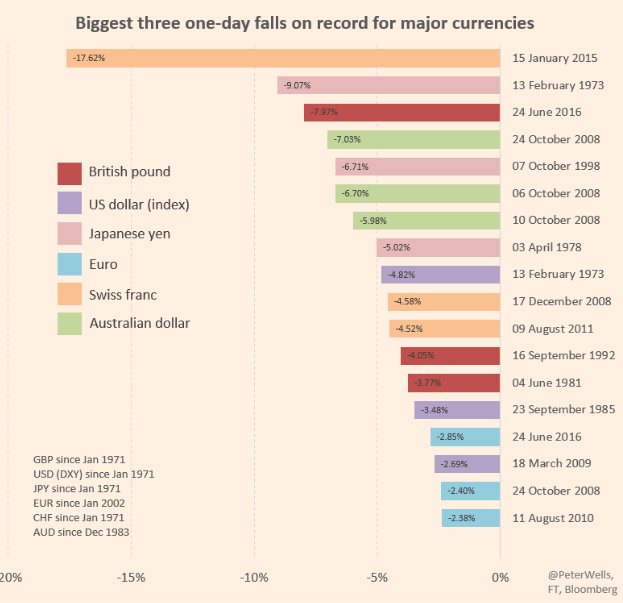
This news triggered a spike in the value of the beleaguered pound…for all of six minutes before it fell back to a baseline rise in preparation of the Bank of England’s inflation and interest rate report 90 minutes later.

GBP.png

Of course, the UK Government will protest this ruling and likely appeal it to the Supreme Court which may overturn the ruling but assuming it does not, what can Parliament do to Article 50?

Already there are murmurs of the possibility to the House of Commons voting against the possibility of triggering Article 50 at all and effectively canceling Brexit altogether. Whilst this could be legal – the EU Referendum was entirely a consultation and conferred no obligation on the government one way or the other – I can’t possibly fathom a situation of this happening without there being actual riots in the pro-Leave streets of England and Wales.

Whilst Scottish and Northern Irish MPs may well have a mandate to back such a move on the grounds that those nations voted to Remain there is perhaps a wiser mode of opposition, one which could be adopted by pro-Remain or at least pro-NotADugsBrexit MPs.

Instead of opposition to Article 50 entirely, there should be a principle of opposition to an Article 50 trigger which takes us into negotiations without the foggiest clue of what we want to negotiate.

scottish-independence-6348782
Imagine we tried to pull that trick in indyref1

Four months on from the referendum it’s clear that “No Running Commentary” has been code for “We Have No Plans”. That’s completely unacceptable now. It is time to see the Brexit White Paper. Both Government and Opposition should bring to Parliament a list of their goals, objections and red lines and fashion them into an initial statement of will to take to the EU negotiating table. Sure, there will be compromise and change after that and yes, there may be “no running commentary” throughout the process but the people of the UK must be able to judge what we come out with against what we went in with so that we may decide if the negotiations are successful enough to accept the deal offered.

There may well be a Parliamentary vote – or perhaps even another referendum – on that said deal in due course although it should be noted that once Article 50 is triggered there’s no very clear way back in – although the door is being held open by the EU. Any such vote will not be based on the “deal” versus “Stay in the EU, no harm, no foul”. It’ll be between the ‘deal’ and ‘the hardest of all Brexits’.

So that’s my challenge to the various UK parties – both Leave and Remain. What does Brexit mean to you?


Regular readers will know now that Common Weal has been very hard at work looking at the issues surrounding the independence debate, especially those arguments which just simply didn’t convince a certain segment of voters. I think we were all hoping that ‘someone else’ would come along and do this right after the last referendum but, for various reasons, it hasn’t happened. So Common Weal has decided to just roll up our collective sleeves and do it.

We’ve already published a paper reopening the currency debate, debt and assets, a proposal for a National Investment Bank and others We want to produce further papers on pensions, defence, customs and excise, a detailed paper on the role of the Central Bank of Scotland, and others. All working up to a paper not just showing the limitations of accounting exercises like GERS but doing away with it entirely and building a case for an independent Scottish budget built from the ground up to suit our needs, rather than just being a tweaked version of what the UK does.

We are incredibly under resourced for this work but we think it’s work worth doing.

If you do too, perhaps you’d like to consider a donation to Common Weal to help us on our way: www.allofusfirst.org/donate
tcg-logo6c

Renewing Scotland: Part 2 – Harnessing Potential

Renewing Scotland: Part 1 – Grasping the Grid here

Energy Storage.png

Source here

In my last article I discussed the set up of the UK electrical grid and outlined why its design is not conductive to the development of a renewable future based largely in Scotland and that that potential future, should we develop it, would vastly outstrip our own demand.

In this one I’ll be taking a look at some of the technology which will get us there. The generation side of things has already been well discussed but one of the large detracting claims against renewables is their intermittent nature and the need for energy storage. In this, large and rapid steps are already being taken. Of course, there’s only so much that a 2,000 word blog post can discuss in an area that can cover many books and hours of lectures. This is just an introduction to a vast area of research.

The Wind Blows High, The Wind Blows Low

The first thing anyone can tell you about most renewables is that they are either intermittent, unpredictable or both. The wind is usually blowing somewhere but the strength of the wind is highly variable at any particular site.

normalised-wind-speeds505x273

In the UK, the wind blows fast enough to turn a turbine more than 95% of the time but this may still leave the equivalent of several days in the year when there’s almost no power generation no matter how many turbines there are. Similar issues may occur with solar – it is, of course, dark at night and short, gloomy winter days won’t produce as much power as Scotland’s annual sunny Tuesday in July – and while tidal power, like Scotland’s new Meygen installation, is predictable years in advance, they only produce power according to the cycle of the tides which may not be in sync with demand. It should be noted though that with proper understanding of siting, event intermittent tidal can produce some guaranteed baseload.

Some mileage towards our goal of 100% renewable power will be gained simply by building overcapacity into the system although this quickly increases the cost of the system. The complimentary nature of our renewable sources is also a major boon. As it turns out, the long, solar friendly summer days of the UK and the dark windy winter nights mean that a combination of solar and wind is very nearly self balancing over longer time periods.

Germany-renewable-energy-power-weekly.png

Germany-renewable-energy-power-daily.png

Source here

Of course, stability over days, weeks and months means little if it doesn’t also come with stability over seconds, minutes and hours. No-one wants their lights flickering or power dropping randomly. At some point, we must start considering building energy storage into the grid. This, rather than generation, will be the challenge of renewables. As pointed out in the previous part of this series, we more than have the resources, we just need to be able to spread them out so that demand is met at all times.

Bottling Lightning

energy-storage

Just as no one energy generator can suit every need, so no one energy storage device can suit all purposes. Every storage device has its own capacity (i.e. how much energy it can store. This can also be coupled with energy density which will determine the volume of the device for a given amount of stored energy) and its own discharge rate (which determines the power delivered by the device and also determines how long the device can run before depleted) as well as other more economic factors such as cost per kWh (Terminology note. If a device can output 1 kW of power and can maintain that for one hour before depletion, it has a storage capacity of 1 kWh) and cycle lifetime (many storage devices degrade or fail after a number of charge/discharge cycles so must be replaced regularly)

As the chart above suggests, the various technologies can be ranked according to their energy and power ratings and thus can be discussed in terms of their distinctive roles within the energy storage network.

ES roles.png

Seconds to Minutes – Surge Protecting and Load Balancing

On short timescales, we’re not so much discussing energy storage as load balancing. On extremely short timescales, less than a couple of seconds, there are various devices embedded within the grid infrastructure designed to ensure that all generators are frequency and phase matched and that the grid is free from noise.

On slightly longer scales, seconds to minutes, the amount of power supplied must match demand at all times even if the wind drops or a power station happens to go down right at the moment that everyone in the country sticks the kettle on at the end of some popular TV program or the other. It can take time to spin up turbines which are idle but conversely it can also take time for spinning turbines to wind down. In a conventional grid, this is where large powerplants, with turbines weighing many tonnes each, has an advantage over relatively small turbines found in wind generators. This time it takes for a large plant’s turbine to spin down gives the grid time to react and bring other plants online.

This problem can be mitigated by technologies such as dedicated flywheels which provide the same inertial storage as was found in the conventional generators.

Whilst the mechanical infrastructure required to run a flywheel (Vacuum pumps, cryocoolers, computer control etc) can be more complex than a battery of similar size they do have advantages in that they can have a longer lifespan in terms of charge and discharge cycles. This makes them particularly suited for rapid response and frequent use roles such as maintaining grid stability during short spikes and dips in demand and supply.

Minutes to Hours – Timeshifting and Demand Curve Smoothing

Flywheels can be used to store and deliver energy for a surprisingly long time, one recent example of a magnetically levitated, vacuum sealed flywheel can store 5 kWh and output 3 kW implying a run down time of over an hour and a half.

At some point though, some of the advantages of current battery technology begin to take over. The abovementioned flywheel is described as being moveable “by forklift” whereas a 5 kWh Li-ion battery is more like a two-person lift. The exact position of this overlap is likely to be highly dependent on how the various technologies develop but with much of the focus of current research being in batteries for the vehicle industry, the high end of this time scale is likely to be dominated by that technology for some time.

The importance of this region of storage technology lies in dealing with the various timeshifts and demand curve smoothing which will be required when managing a renewable grid. The sun shines (unsurprisingly) during the day but, especially during the winter, demand is at its highest in the evening. This may be compounded once everyone has transitioned to electric vehicles, all thirsty for a recharge after the working day although even this can be managed through smartgrid technology which can schedule your highest demand appliances such that they run when the supply/demand ratio is favourable.

This is the timescale on which much of the technology is already well established (albeit not yet at the scales required for a nation level energy storage based grid) and even with the battery sector, many technologies exist from familar Li-ion and lead-acid batteries to less well known molten sodium/sulphur cells and flow batteries (see page 20 onwards here). All of these different battery designs come with their own energy densities, power cycle lifetimes and (crucially when aiming to reach a “Green” economy) environmental impacts. New technologies may also provide further breakthroughs in the future.

Hours, Days and Longer – Power Reserves

Whilst a properly designed, diverse renewable grid will rarely see prolonged periods of demand exceeding supply it can happen. A series of cold, dull, calm winter nights with short, foggy days never giving the solar panels enough time to charge the batteries supplying our evening heaters is about the most challenging period that the Scottish grid could reasonably expect. Linking the Scottish grid to other grids around Europe and beyond will help in most cases but this ultimately merely pushes the problem around rather than ultimately solves it. There will still be instances, especially if Europe also moves towards a 100% renewable supply, when demand exceeds supply across the entire network.

To mitigate this, various longer term storage devices must be considered. Chief amongst these is pumped hydro.

This principle here is simple. Two lakes, one higher than the other, linked via a reversible turbine. When supply exceeds demand, water is pumped to the upper reservoir. When demand exceeds supply, it is dropped back down and generates electricity. The cycle efficiency of this process is remarkably high, up to 90%, and the stored water can be held for a long time compared to capacitors, flywheels and batteries, being governed by the evaporation and other losses in the reservoir. Every meter you can raise a tonne of water gives you around 9.8 kJ (2.7 Wh) of stored potential energy (before losses).

The major downside of pumped hydro is that its energy density is comparatively low meaning that very large areas need to be flooded to provide the required capacity and there are significant geographic constraints on the placement of such reservoirs. The best locations for hydro (pumped and unpumped) in Scotland have largely already been developed with significantly constrains further expansion.

Offshore water resources can offer some additional capacity here in the form of lagoon  storage tidal – although without pumping this can only raise water by a couple of meters meaning vast areas must be encircled to capture enough energy to be useful and the power can only be released when the tide is lower than the stored water which reduces the ability of the storage to produce energy on demand.

Another more speculative offshore hydro storage method is currently in development off the coast of Belgium. This method involves building a shaft out at sea from which the water can be pumped out to create the required potential energy drop. The process can then be reversed and the sea allowed to flow back into the shaft. If the engineering challenges allow this to be built in seas more than a couple of tens of meters deep then this technology could greatly compliment Scotland’s offshore wind resources.

Which takes us to one last set of ideas for long term storage.

With a surfeit of cheap offshore energy at our disposal we could be channeling some of it into energy intensive chemical storage processes. One of the conceptually simplest methods is cracking seawater into hydrogen. The hydrogen economy is one which is still vying for some share of the post-internal combustion vehicle industry given that hydrogen fuel cells offer some of the highest energy density processes by unit mass of any chemical reaction. The problems with it is that hydrogen also offers the lowest energy density chemical reaction per unit volume – a pipe carrying hydrogen gas needs to be substantially larger than a pipe carrying a similar mass of natural gas. There are also material considerations as hydrogen tends to adsorb into, embrittle and escape from just about anything you try to pump it through. To save on infrastructure, we could consider blending the hydrogen into the existing natural gas network but this only takes us so far as we can only blend in so much without affecting the quality of the gas. Finally, there are concepts involving of combining liquid hydrogen (cooled to below 20 K, -253 C) with superconducting electrical lines (cooled by the hydrogen) but these too are a long way off practical realisation.

But wait a moment. That idea of using the existing natural gas infrastructure. Why not take that a step further too? Why not extract not just hydrogen from seawater by CO2 as well? If we can do that, we can make use of an economy already so addicted to oil that it’s difficult to change and turn it to our advantage. We could make carbon neutral hydrocarbons, store them until they are needed and then either burn them in our vehicles (assuming the process turns out to be cleaner and more effective than electrical cars turn out to be) or in existing gas power plants (assuming localised pollution issues are taken care of) or create some kind of fuel cell economy based on them.

The US navy is experimenting with this idea in order to shorten supply lines for their aircraft carriers as well as enabling them to keep operational when the nearest refueling station may well be the one they are currently bombing into rubble but Scotland could adapt for more peaceful means. It’s also the first step along the way to going from a low carbon economy, through a carbon neutral economy and onwards to a carbon negative economy where we are pulling more excess CO2 out of the environment than we are putting in (which will be an essential step if we want to not only avoid climate change damage but if we want to fix the damage we’ve already caused).

This process is (currently) fairly inefficient, involves moving vast quantities of water (the concept above processes 23,000 litres of water for every litre of fuel produces) and carries some problems to be solved involving the capturing of excess methane (methane is 25 times as potent a greenhouse gas as carbon dioxide so any leakage could lead to our carbon removal scheme doing more harm than good) but I could well see an offshore rig built in the middle of an offshore wind farm acting not only as a service base and energy storage platform for the turbines but also as a plant producing natural gas and other hydrocarbons and piping them ashore. There’s an idea that could turn Scotland into an oil producing nation, sustaining high skill offshore work for as long as the wind blows and the tide turns.

And I bet that’s an energy plan you never thought you’d see come from a Green.

Finally

So we’ve looked at the current status of the electrical grid in Scotland and now we’ve examined what’s needed to store energy and mitigate intermittency in supply. In the next part, I’ll try and give some idea of what the whole renewable grid would look like when it’s up and running. And just to finish off this already fairly video heavy post I’ll leave off with just one more explaining a few more storage devices (including stored heat which is a whole other area I haven’t covered) and their pros and cons.

tcg-logo6c