Communities have been priced out of owning Scotland

“My people are few. They resemble the scattering trees of a storm-swept plain…There was a time when our people covered the land as the waves of a wind-ruffled sea cover its shell-paved floor, but that time long since passed away with the greatness of tribes that are now but a mournful memory.” – Chief Seattle, Chief Seattle’s Speech (1854)

This blog post previously appeared in Common Weal’s weekly newsletter. Sign up for the newsletter here.

If you’d like to support my work for Common Weal or support me and this blog directly, see my donation policy page here.
Two new reports show that the rate of land transfers to community ownership in Scotland has dropped to the lowest level since the start of devolution and that a poll of the Scottish public shows near-unanimous support for more land reform over and above that which may be delivered by the recent Land Reform Bill.

The recently passed Land Reform Bill is simultaneously “the most radical land reform legislation in the history of devolution” (the Government’s characterisation of it) and so weak that even before it has achieved Royal Assent, 96% of people polled say it doesn’t go far enough and that they want more. Who the other 4% are is not known but they’re probably the kind of person who would answer in the negative to a question like “Are puppies cute?”

How these two statement can both be true and accurate is a reflection not of the strength of the 2025 Land Reform Bill but a reflection of the weakness of the previous round of land reform in 2016.

This Bill was designed to strengthen community right to buy rules laid down in yet still previous land reform attempts in 2015 and 2003, specifically granting Ministers the power to force a compulsory sale of sale to communities for the purposes of sustainable development even if the land owner wasn’t willing to sell or couldn’t be identified.

A few years ago, I wrote an analysis of a report published looking at the rate of transfers of land to Scottish communities since the start of devolution. The results were stark. It found that despite the 2016 round of reforms being specifically aimed at making community land transfers easier, there were serious other barriers looming. In particular, the assets being transferred were getting smaller and smaller even though the overall number of transfers were still proceeding steadily. What this meant is that where before a community might have been able to enact a community buyout of the entire estate on which they lived or their local wind farm, communities were instead only buying out perhaps their village hall or even just the old phone box to turn into a medical station or pop-up craft store.

I’m not berating some of these initiatives as they are undoubtedly a good thing. I’m not even trying to suggest that communities lack ambition in their purchases. I’m saying that they are being blocked from realising their ambition by land prices surges that are making it impossible to purchase land.

One of the aspects of the latest Bill is that communities must be notified ahead of a large land sale and must be given time to put together a purchase bid. But if the price is still so high that they cannot put together the cash regardless of time, then the notice is merely an insult added to the injury.

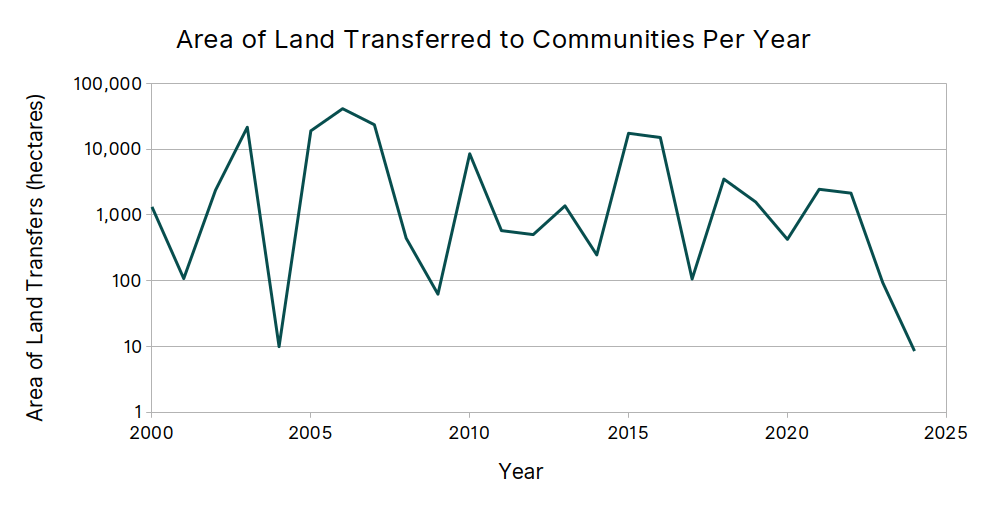
Move forwards three years to now and that community land report has been refreshed and brought up to date. Unfortunately, the results are even worse now. In the years between 2000 and 2023, an average of 7,023 hectares of land were transferred to community ownership each year. In 2024, just 8.46 hectares were transferred to community ownership. This is the lowest rate of transfer in a single year since 2000.
Worse, the total number of transfers has fallen off a cliff too. From a peak of 80 transfers in 2021, Scotland only transferred 23 parcels of land to communities in 2024.
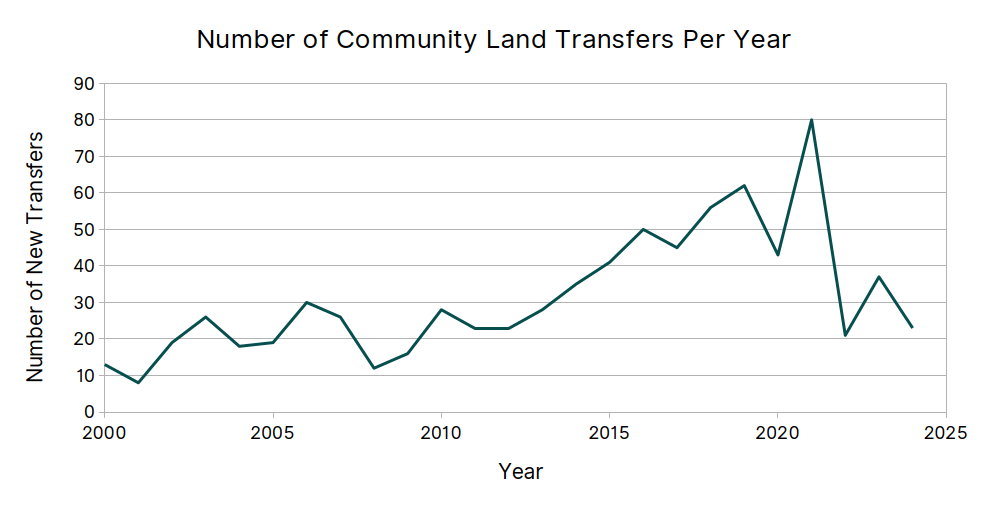
Now, that peak of 80 in 2021 does show some evidence of delays caused by Covid in 2020 but even then, while the country was in total lockdown for much of that year, 43 transfers were made covering 423 hectares. In 2020, during the worst global pandemic of a lifetime, Scotland managed to transfer to community ownership 50 times as much land as it was able to do in 2024.

The drop in 2024 represents a total reversal of the progress made from 2014 which saw a substantial and sustained rise in communities being able to buy the land under their feet. These results show that far from the 2016 Act accelerating land transfers, they have almost halted since then. 95% of all of the land in community ownership in Scotland was transferred to communities before the 2016 Act took effect.

“The latest round of Land Reform clearly won’t be enough to fix this problem and it’s clearly not enough to satisfy what is as close to a unanimous poll of the Scottish public as it is practically possible to find.”

I believe that the reason for this stagnation is the same as the one I noted in 2022. Scottish land prices are being inflated beyond any reasonable expectation by speculators going all in on buying up land for carbon offsetting, encouraged by a Scottish Government that is similarly all in on encouraging “foreign direct investment” as the sole tool of boosting Scottish GDP, regardless of the cost to our future economy or our present communities.

The thing is though, I wonder if the votes on the Land Reform Bill might have been different had this latest report been public knowledge before it passed. It would have been valuable leverage for those campaigning for strong powers of community buyouts in that Bill. It might well have led to amendments designed to counter this trend of people being priced off the land.

I wonder why the Government didn’t publish this report then or even allude to its findings via its own amendments. I’m fairly sure that they would have had advance knowledge of the findings of the report to some degree (I know this because I recently had a Freedom of Information request on another issue knocked back on the excuse that while the Government had the data, it was due to be published anyway within a couple of months – which it duly was). Yet little was said during the various debates around this Bill.

The latest round of Land Reform clearly won’t be enough to fix this problem and it’s clearly not enough to satisfy what is as close to a unanimous poll of the Scottish public as it is practically possible to find. This is clearly an issue that must be revisited in the next Parliament. We’ll be keeping a close eye on manifestos as they are published and, of course, we’ll continue to campaign (with your support) for real land reform so that Scotland can start working for All of Us, rather than just the very few who can afford to buy the land under our feet.
To Build Houses, First Buy The Land

“I think we’ve been through a period where too many people have been given to understand that if they have a problem, it’s the government’s job to cope with it. ‘I have a problem, I’ll get a grant.’ ‘I’m homeless, the government must house me.’ They’re casting their problem on society. And, you know, there is no such thing as society. There are individual men and women, and there are families.” – Margaret Thatcher

This blog post previously appeared in Common Weal’s weekly newsletter. Sign up for the newsletter here.

If you’d like to support my work for Common Weal or support me and this blog directly, see my donate page here.

image_2025-01-29_150318951

Why are houses so expensive?

There are many reasons. To take just a few, Developers only build private housing at a rate just high enough to keep prices up and subsidies flowing, certain areas are being particularly pressured by those rich enough to own multiple homes at the expense of the local community, and – as we pointed out in our book All of Our Futures – the UK’s decision to push the burden of pensions away from the state and onto individuals has created a culture of “climbing the housing ladder” with “victory” meaning extracting the wealth you’ve accumulated through ever increasing house prices so that you can pay for retirement or, increasingly, so that you can give it to a private care firm owned by a tax-dodging hedge fund. That is, if you’re allowed to buy a house at all and aren’t destined to be one of the increasing number of private renting pensioners who face destitution due to rents and the lack of means to pay for care (something we warned about in All of our Futures but only recently being picked up as a problem by places like the FT).

Continue reading

A Year In Common Weal – 2024 Policy Review

“Success is not how high you have climbed, but how you make a positive difference to the world.” – Roy T. Bennett

This blog post previously appeared in Common Weal’s weekly newsletter. Sign up for the newsletter here.

If you’d like to support my work for Common Weal or support me and this blog directly, see my donate page here.

image_2024-12-14_224511435

Intro

Welcome to the end of 2024. I can feel the Dùbhlachd tightening around me these days. I’ve always been a rather solar powered person (with a longtime ritual of greeting midsummer by reading outdoors under the midnight glow) and while I’m not afflicted – as some of my friends are – with full blown Seasonal Affective Disorder, I do feel the urge to crawl under a duvet and hibernate until the sun returns. Humans weren’t made to run a summer schedule in the middle of winter – we should be huddled around the hearth telling stories and hoping that the pickled fruits last till Spring.

Nonetheless, I’m looking forward to my winter break and some time to switch off, chill, and break into the aforementioned pickles – possibly with some home smoked cheese!
Until then, I want to leave you this year with a round up of what we got up to at Common Weal – especially as this year marked our tenth anniversary! We remain very possibly the most productive think tank in Scotland (supporting all of our staff members while the whole think tank earns less that the First Minister does – if you’d like help us correct that, then please sign up as a regular donor). We published 12 substantial policy papers, policy briefings or consultation responses this year plus we submitted several more less substantial consultation responses to the Scottish or UK Governments (many really are barely worth the time to submit but if we don’t then it gets held against us when it comes time to lobby properly for the outcome we want). This is all in addition to the whole staff writing in our weekly newsletter and our regular In Common Column in The National, plus all of the other media appearances we make with our work. Not a bad return for an average donation of £10/month! Regular newsletter readers will, no doubt, remember many of the stories and policy papers but newer subscribers or folk who have been a bit overwhelmed with the news of the year (i.e. all of us) may have missed a few things.

Continue reading

How To Replace Council Tax

“Is this Paradise?’
‘I can guarantee you that it isn’t,’ Jubal assured him. ‘My taxes are due this week.” – Robert A. Heinlein

This blog post previously appeared in The National as part of Common Weal’s In Common newsletter.
If you’d like to throw me a wee tip to support this blog, you can here.

untitled - 2024-10-31T173408.922.png.article-962

Last week I took part in The National’s series on Council Tax reform with a 20 minute conversation with journalist Xander Elliards on some of Common Weal’s ideas for replacing Council Tax with a value-proportionate Property Tax and then extending that tax to create an effective Land Tax.

You can watch the interview here

You can read Common Weal’s policy papers on Council Tax replacement here:
A Property Tax for Scotland
Taxing Land In Scotland

TCG Logo 2019

Repopulating Cleared Scotland

“This high-souled gentry and this noble and far-descended peasantry, ‘their country’s pride,’ were set at naught and ultimately obliterated for a set of greedy, secular adventurers, by the then representatives of the Ancient Earls of Sutherland.” – Donald Sage

(If you’d like me to speak at your conference or activist group, give me a shout. Find out more about the training and outreach I offer here. If you’d like to throw me a wee personal tip to support that work, you can here.)

brown and grey stone house near hills

My Provocation Speech at Community Land Scotland’s “Own Yersel” land reform conference on 10th May. You can watch my speech and the others in the session below.

https://youtu.be/h141kVWHh-s?t=6987

Continue reading

Land Reform, Or Another Power Grab?

“The free society is characterized by the radical decentralization of all kinds of power. Confederal structures do not rule over communities; they are the means by which communities cooperate.” – Roy San Filippo

(This blog post previously appeared on Bella Caledonia.)

Corgarff

The Scottish government has introduced land reform legislation to encourage community ownership by granting ministers powers to intervene in the sale of estates of more than 1,000 hectares. The ruling Scottish National party said the bill, the biggest package of reforms in years, aimed to “revolutionise land ownership in Scotland” by empowering rural and island communities and increasing transparency in large land transactions.

In 2016 the last round of Land Reform made it easier for communities to buy out parcels of land, however the rampant rise in land prices – often now driven by so-called “Green Lairds” looking to cash in on carbon credits – have locked those same communities out of being able to afford to buy that land. With a few exceptions – such as in Langholm – the parcels of land being bought by communities have been getting smaller.  A report published in 2022 found that despite a steady rate of successful community buyout projects continuing much as it had since the start of devolution, the actual hectarage of land transferred had all but stalled with around 97% of all community owned land in Scotland being transferred before the passing of the 2016 Act.

Continue reading