“It’s a Common Weal program for government.” – In an email sent to Common Weal today.
Today saw the return of the Scottish Parliament for the 2017/18 session and the opening speech by the First Minster introducing her program for government. You can watch the full speech below.
After far too long of what seemed like the political doldrums of a couple of fairly drab elections and the ever endless string of intentionally depressing political headlines, this speech was a remarkably refreshing change of pace with some fairly strong statements of intent in several areas.
Notably, Common Weal appears to be finally having a significant influence on the political direction of government with several of our policies now being talked about openly or outright adopted as policy.
“The GERS figures are not meant to be anything other than a way of showing the current position under the present arrangements.” – The BBC
The annual Government Expenditure and Revenue report is out and, as withpreviousyears, I’ve written an analysis of the report and what it means for Scotland. The GERS report itself can be downloaded here.
A more detailed analysis I have prepared for Common Weal can also be read here.
The UK is a deeply unequal union and London continues to capture a greater and greater proportion of the wealth of the state to the detriment of everywhere else. This single fact has to frame everything we think and say about the finances of Scotland.
‘Twas the night before GERSmas, and all through Scotland
The bloggers were screiving; their time near at hand.
The headlines were crafted with doom and despair
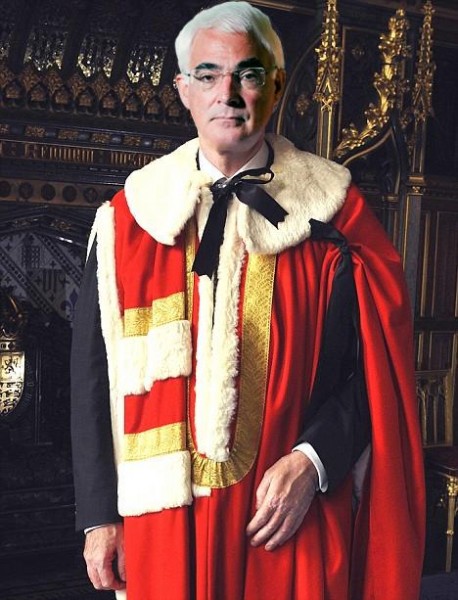
In hopes that Lord Darling soon would be there.
The MPs were nestled all snug in their beds,
While visions of oil money gushed through their heads.
And Brown with his spreadsheet, and Mackay (who’ll fudge it),
had just settled accounts and balanced the budget –
When outside the office there came such a racket,
They wondered if Ewing had started to frack it.
“Scotland can, if it chooses to be bold, creative and ambitious, use the opportunity presented by independence to build a social security system for all of us.”
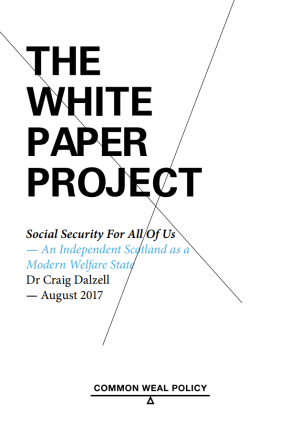
I’m proud to present my latest report for the Common Weal White Paper Project, Social Security For All Of Us – An Independent Scotland as a Modern Welfare State.
The report can be downloaded here or by clicking the images below. There has also been coverage in The National here and here.
“GDP is increasingly a poor measure of prosperity. It is not even a reliable gauge of production” – The Economist
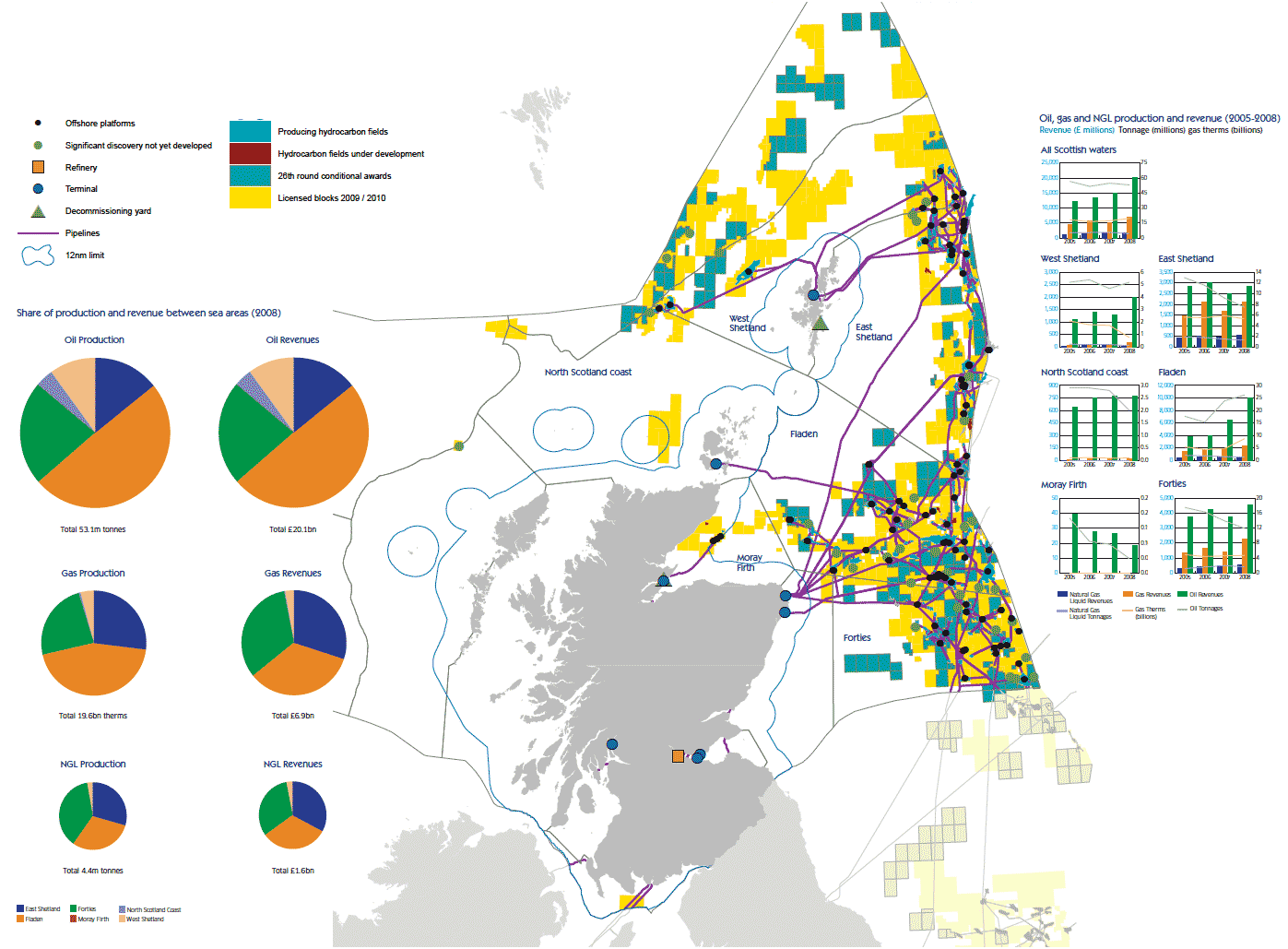
There’s a bit of a story happening around Scotland’s oil trade since Wings Over Scotland highlighted an otherwise completely unreported change in the way the UK measures how much oil it trades with the world and where in the UK it comes from.
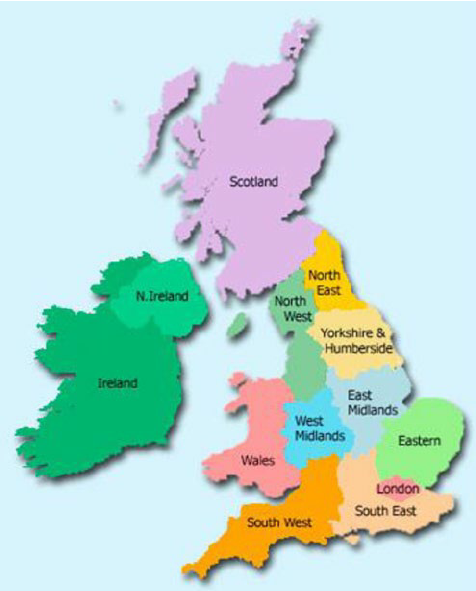
The story stems from the way that the UK calculates its balance of trade with the rest of the world and specifically how it then decides which region of the UK is responsible for that trade. To do this, the UK is split into 12 regions based on the Government Office Regions of England plus Scotland, Wales and Northern Ireland. (These boundaries are also used by Eurostat for their NUTS 1 statistics)
There’s another “region” of the UK not displayed on the map. Not all trade can be firmly allocated to a single region and not all trade can be allocated to a region at all. This is the “Unknown Regions” of the UK. Most prominent amongst this kind of trade, at least within Scottish political circles, is trade generated by offshore activities.
There are many different ways one could approach this allocation – the methodology – and the way you do it can result in very different results. Now, if you’re the UK and are looking at UK stats these figures don’t really matter so much but they do become very relevant if you’re looking at one part of the UK and what its economy might look like if it decided to, say, discuss holding a vote for independence. Suddenly, even UK government departments start getting very interested in Scottish trade.
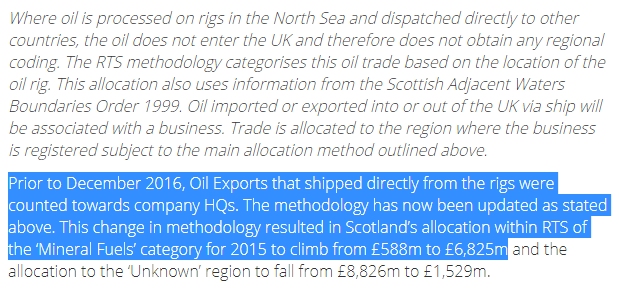
The particular story here concerns a change in the trade methodology around offshore oil in Scotland waters. Particularly, oil which is exported out of the UK directly from the rigs without it ever touching the UK land boundaries. Previously, much of this oil has been allocated to the Unknown Region but the change now meant that it would be allocated to Scotland. This has led to an increase in the recorded value of Scottish minerals exports for 2015 from £588 million to £6,825 million. Quite a substantial jump and one which has spread around social media. Time for a wee breakdown of what it means and take the chance to clear up a few misunderstandings I’ve seen along the way.
(This is a complex topic, after all)
“Let the children once see clearly the gross injustice of our present land system and when they grow up, if they are allowed to develop naturally, the evil will soon be remedied.” – Elizabeth Magie, inventor of “The Landlord’s Game”, the precursor to Monopoly.
For a game about rampant, exploitative capitalism and a race to deliberately bankrupt your mates, in some ways Monopoly looks remarkably egalitarian compared to modern Britain
“I am deeply concerned that if we do not fund healthcare and social care adequately people will lead much worse lives” – Sir Michael Marmot, commenting on his latest life expectancy report.
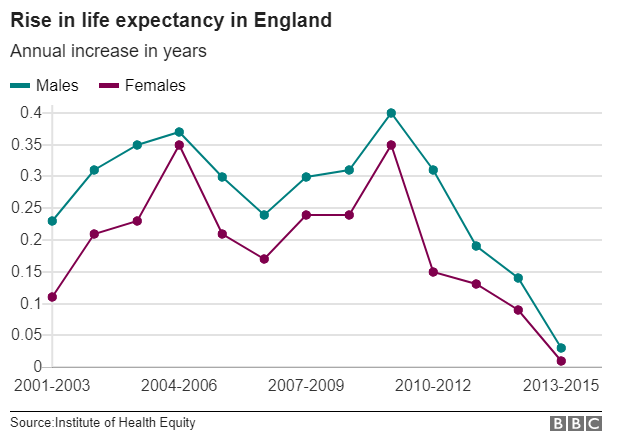
Yesterday, the Marmot Life Indicators report was published which showed that there has been a dramatic fall in the rate of increase of life expectancy in England. In fact, it has stalled completely.
For most of the last decade and a half, a baby born in one year could expect to live about 4 months longer than a child born the previous year. This rate had also been increasing through that period though the trend was broken in 2010.
2010 was also the year that the Tories came to power and started implementing their Austerity program. Now, yes, correlation isn’t causation but this isn’t the first time that a health or wellbeing indicator has been linked to Tory policy. Just a few months ago, a report was published which blamed Austerity for the premature deaths of 30,000 people in England and Wales in 2015 alone.
And whilst these studies are limited to England or England and Wales the causes of the so-called “Glasgow Effect” are now well known and have been linked to similar policies of deprivation and deliberate political attack.
But what was the UK Government’s response to yesterday’s report? Today they accelerated the rate of increase in the state pension age such that if you are currently aged 39-47 you will now need to work till you are 68.
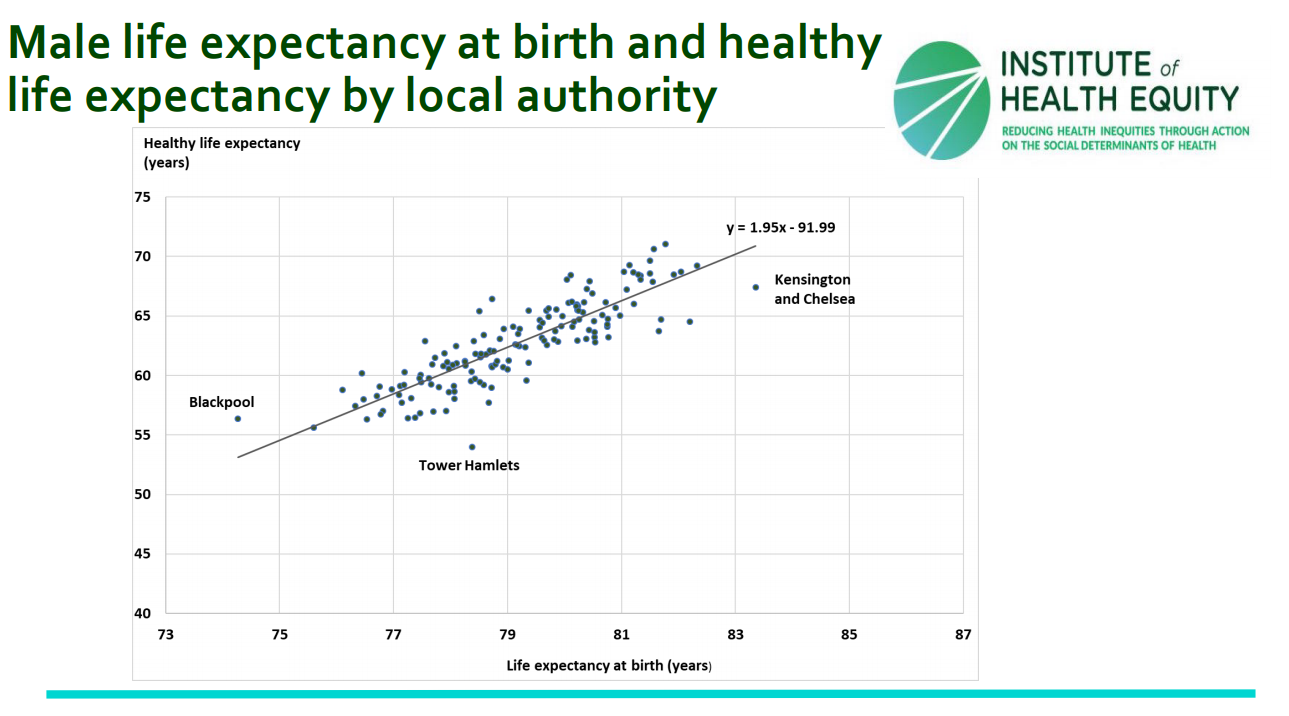
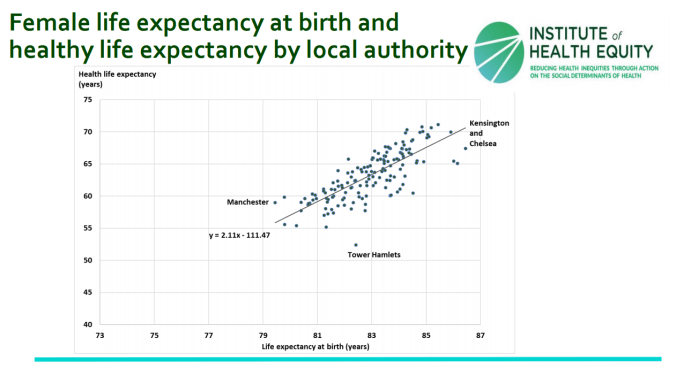
This means that if you live in the most deprived areas of the UK, such as Blackpool or Glasgow you can expect your retirement to last just 6 years, whereas someone from a rich borough of Kensington – where average life expectancy is 84 – could expect almost a decade longer than that.
The Marmot report also highlighted something which isn’t talked about enough within this topic. The issue of healthy life expectancy. Our average person in Blackpool might live to 74 but they can only expect to reach 57 with a fair degree of health.
(Click either chart to embiggen in a new tab)
Welcome to Tory Britain in the 21st Century. Where you’re not just expected to work till you drop. You’re expected to pick yourself up again and continue working for another decade beyond that. And don’t you dare try to claim disability or we’ll put you through so many hoops and tests and stress and pain that it stands a good chance of actually killing you.
There’s no wonder that the UK has now been called out by the United Nations for its appalling treatment of the most vulnerable amongst us.
Now I’m not amongst the particular cohort of folk affected by this pension change but it’s starting to become very personal to me. It’s very much starting to feel like my parent’s generation will be the last in the UK who will be allowed to meaningfully retire – and given that my mother is a WASPI woman, this is a particularly depressing point.
I no longer expect to receive a state pension from the UK. Even if I do manage to age fast enough to catch up to the state pension I fully expect that by the time I get there the next phase of cuts will have meant that the formerly universal pension will be means-tested. If I happen to own more than £X in savings and assets…tough. No pension for me.
So I’m going to need a new plan to ensure that what retirement I eventually get is endurable. If the current work climate continues, it’s unlikely that I’ll be able to build up anything like the private pension that previous generations were able to claim so I can’t even rely on the private sector to bail me out.
The way things are going I’m going to have to do something a little more drastic. It looks like I need to win myself an independent Scotland, rebuild the entire welfare system from scratch and replace the byzantine labyrinth of means-tested “benefits” with a Universal Basic Income.
So..no pressure then…
This is where the independence campaign is becoming more personal. It’s rapidly getting to the point that folk may support independence not just because it’s desirable nor even just because it would be personally beneficial. It is approaching the stage where independence is becoming essential just to maintain a decent standard of living.
I’ve already heard from people in the campaign who now must win independence for various reasons. One so that they can escape the UK’s appalling immigration system and bring their fiancé to Scotland. Another so that they can ensure that they won’t be treated as a second class settled resident due to them being a non-UK EU citizen.
I think this could be the seed of a hundred stories waiting to be told. If you’re someone who is in a similar situation who now not just wants but actually needs independence for some reason, I’d like you to get in touch. Just email me through my contact page here. I’d like to offer some space to get these stories out there.
(Anonymity will, of course, be maintained unless you specifically tell me to publish your name)
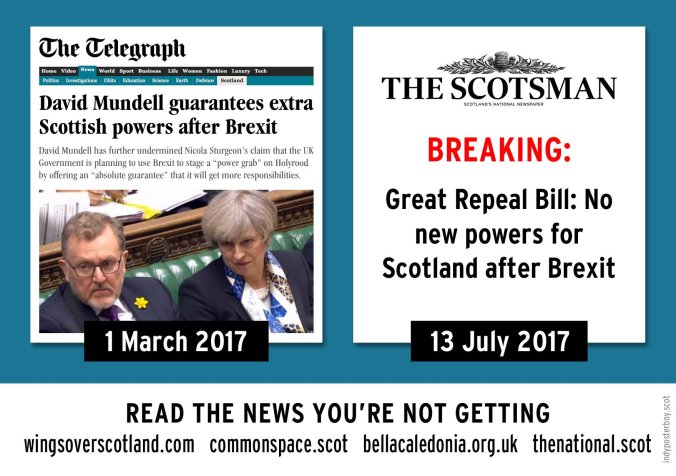
“I can give an absolute guarantee that after the United Kingdom leaves the EU, the Scottish Parliament and Scottish Ministers will have more powers than they have today” – David Mundell, 1st March, 2017.
The UK Government published the Great Repeal BillEuropean Union (WIthdrawal) Bill 2017-19 yesterday and I’ll let you guess how long that “absolute guarantee” lasted.
I’m going to have a look at the Repeal Bill (as I shall refer to it for the rest of this article) but I would heartily encourage folk to read the reactions of Ian Dunt and Andrew Tickell first. They are wise, know much and I can merely summarise for them.
“Tomorrow’s GDP figures will confirm whether or not Scotland entered a second quarter of economic downturn in the first three months of 2017.” – Scottish Conservatives. 4th July 2017.
The quarterly Scottish GDP figures were released today after a long build up in a press anxious to see if Scotland was on, as the Express put it, the “BRINK OF RECESSION” (their emphasis).
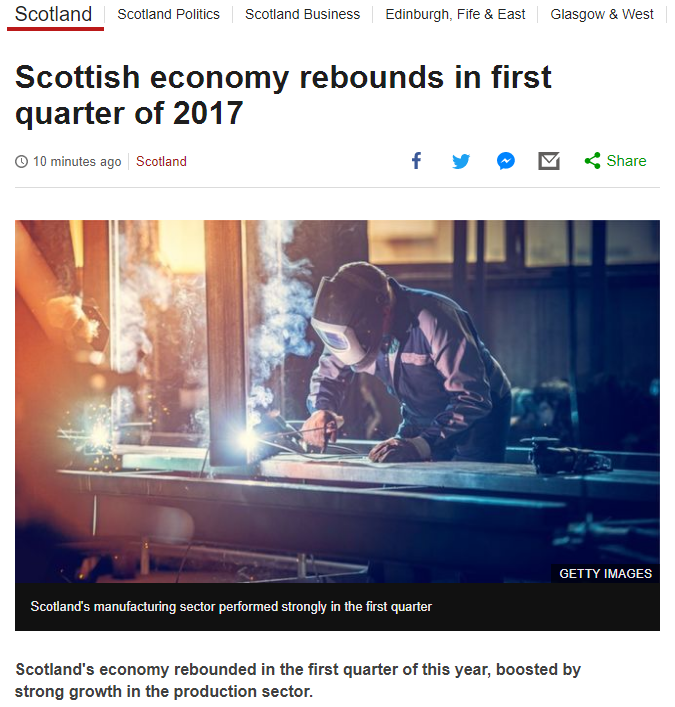
The headline figures are that in Q1 2017, Scotland’s economy grew by 0.8% which is up substantially on the -0.2% contraction seen in Q4 2016. This positive growth also means that the two successive quarters of negative growth which define a technical recession were not met.
The UK’s GDP growth over Q1 2017 was 0.2% though in my last blog post I put substantial attention onto the point that we should treat such comparisons with a great deal of care given the large regional inequalities within the UK. I’d very much like to see the GDP of the UK broken down across its regions (especially London) before commenting too much on it.
And before we all start patting ourselves on the back at avoiding our “predicted” recession, it’s worth actually diving into the numbers and seeing what they do and do not tell us about the Scottish economy.
“Annual income twenty pounds, annual expenditure nineteen nineteen and six, result happiness. Annual income twenty pounds, annual expenditure twenty pounds ought and six, result misery.” – Dickens, David Copperfield
The shape of the next UK economic crisis has become apparent. It may have already begun and it’s not at all clear how it can be avoided or mitigated.
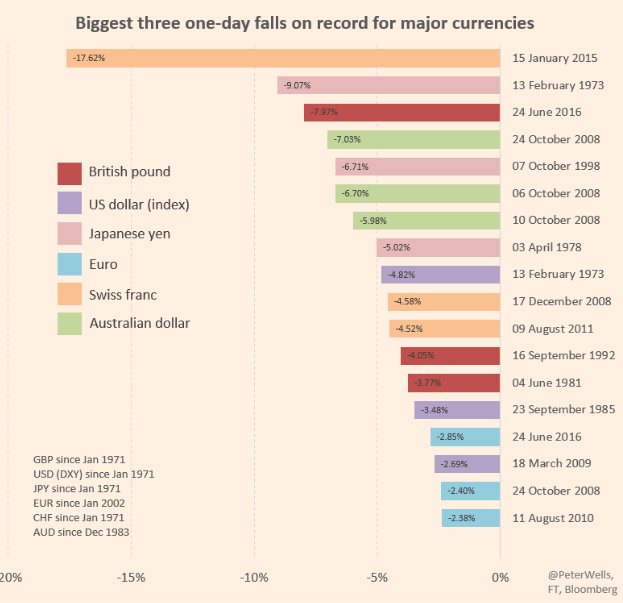
On the 23rd June 2016, the United Kingdom, for a variety of reasons, voted to leave the European Union. The immediate impact of this was an almost unprecedented drop in the value of the pound with respect to its major trading partner currencies.
Not much of a problem, the defenders said, as a weakened currency has its merits as well as demerits. Exports should become cheaper, which would boost foreign trade.
This may have been true in times gone by but economies have grown vastly more complex than this. Many products manufactured in the UK consist of sub-components drawn from multiple countries and globalised supply chains have grown STAGGERINGLY complex.
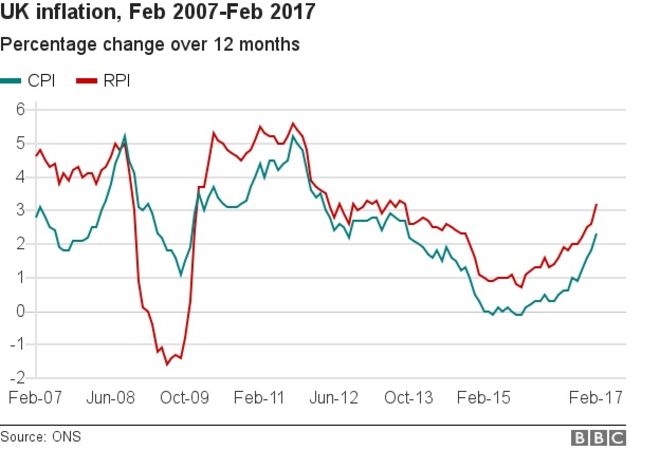
What this has meant is that even the goods that Britain manufactures here have seen their “input prices” increase, which has pushed up the price of goods even despite the fall in currency strength. Add to that, the fact that the UK imports far more than it exports – it has one of the largest trade deficits as %GDP in the OECD – and it becomes clear why prices have started rising again in Britain. After five years of declining inflation rates and almost a year of zero price increases, inflation has returned with a vengeance.
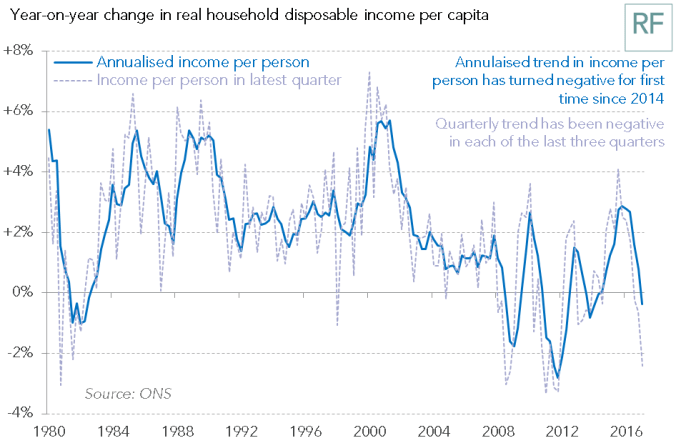
But this needn’t be a terrible thing. In fact, inflation can often be quite useful as it erodes the value of debts (which is why creditors and asset holders hate it so much). So long as wages keep up with the rising prices then for those who don’t depend on the rising value of assets or debts it can be manageable. So how are we doing on that point?
So inflation is rising and wages are declining, so we’re in the situation where meeting our needs and maintain a decent standard of living is becoming more and more difficult. But even this could be mitigated or reversed if the government were to step in and support the economy by investing or by otherwise injecting money into it.
And so this is the root of the coming crisis. Prices are rising, wages are stagnating, savings have been drained, credit cards have been maxed out, and the government is pulling out of the business of providing government and public services so you need to spend even more to replace it. We no longer have enough money to meet our basic needs, never mind the disposable income to buy the widgets we need to consume to keep the wheels of the economy turning.
Up here in Scotland, there are signs that the crisis is already upon us. The Fraser of Allander Institute published a report today warning about the precarious nature of the Scottish economy saying that it was stagnating with relation to the UK economy as a whole. Some will almost certainly be quick to blame this on the Scottish government (the phrase “uncertainty of a divisive second independence referendum” comes to mind). There are certainly some things that the Scottish Government could do to help – a National Investment Bank should be high on the list and a good shake up of the domestic agenda would be welcome – but the ultimate cause of this slow-down does not originate in Scotland nor will its solution come from here (at least until the levers of power are returned to the country upon independence).
The problem, ultimately, is that Britain isn’t Great. Britain is Weird. Britain is a deeply unequal country on a scale which, compared to its neighbours, is utterly baffling.
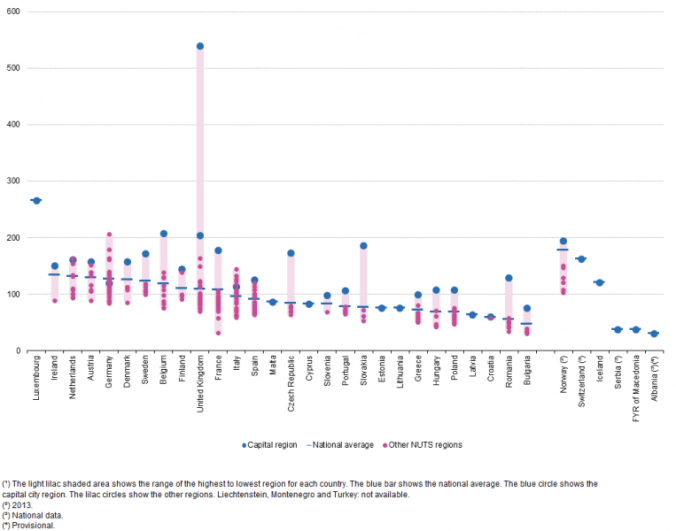
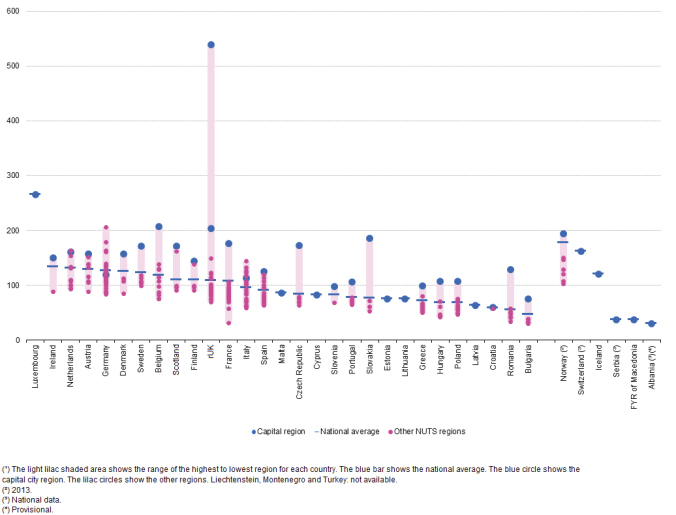
In many countries, the capital city will be the richest region of the nation. This is normal – Money wants to be close to power – but the UK’s disparity really needs to be seen to be believed. Here is the GDP/capita for each of the EU28 and EFTA countries broken down by region. Spot the odd one out.
(Note that the UK has two capital dots. The lower one is London as a whole. The upper one is just Inner London)
Whenever statistics about Scotland are produced, they’re often given with reference to the “UK average” or the “UK as a whole” but the extreme disparity of Britain masks the picture. Detailed analysis by Prof Mike Danson of Heriott-Watt University has shown that Scotland’s GDP per capita is the third highest region of the UK (after London and the South-East) and, if we were an independent state, we’d be the 9th highest in Europe. In fact, we can disaggregate out the Scottish data from the chart above and catch a glimpse what we’d look like as an independent country.
Taken on this view, Scotland no longer looks like a “below average” region of the UK but a fairly normal Western European country. Far more like Finland or Denmark than, say, Greece.
As Prof Danson says, the obsession with comparing Scotland to misleading “UK average” figures leads to commentators ending up unable to take a step back and ask what is happening across and within the UK and where the problems really are. Until this happens, Scotland will continue to stagnate within the UK as the overinvestment of London continues (and is likely to get worse through the Brexit process in a desperate attempt to prop up the financial sector there).
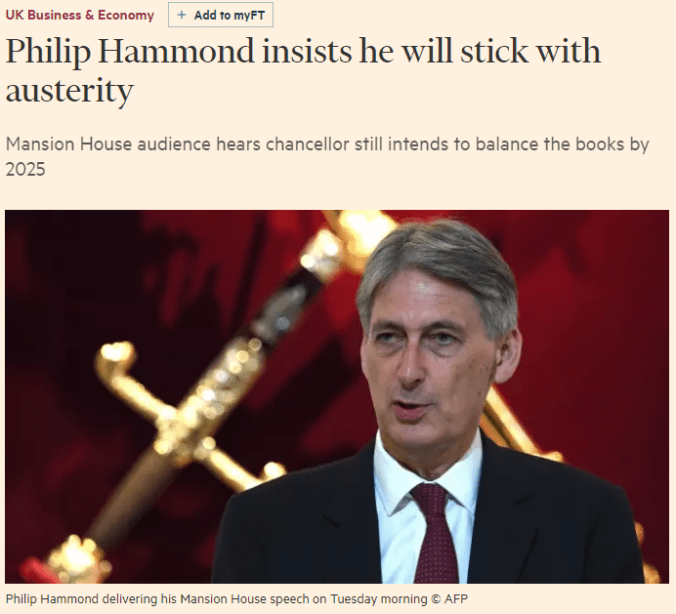
As said earlier, there is a way out of the coming credit crisis but it’s going to involve not more Austerity but a whole lot less. Economists are increasingly coming around to the realisation that the Government’s debt is your surplus and that governments can take on that debt almost without limit (unlike you who have hard limits on credit and the ability to repay it) and – if they have their own currency – can print money in order to provide services (unlike, again, you who would go to jail if you tried that).
Once again, there is a certain amount that the Scottish government can – and should – do at the moment to help but it will always be stymied by the very tight rules of devolution. There’s little to no hope of the UK changing course any time soon (even Corbyn’s Labour is solidly committed to “balancing the budget“) and the hard Brexit the Tories and Labour are both pursuing is being increasingly differentiated by the amount of damage the plans will cause rather than any attempt to prevent it. The Sick Man of Europe seems destined to return to the UK. I only hope that Scotland doesn’t catch its cold.





 The Common Green