And Then There Were Two

“It is likely that such a replacement will be from the Brexiteer wing. Rees-Mogg has ruled out a run for the job but I think he’d be happier as Chancellor of the Exchequer under his able deputy PM Boris Johnson” – The Common Green, November 2018

“Why PM Boris Johnson should appoint Jacob Rees-Mogg as Chancellor” – Bernard Ingram, June 2019

The Conservative and Unionist Party’s leadership contest has completed its first phase and has whittled the number of candidates down to two. These two will now make their case to some 120,000 Tory party members across the UK who will vote for their preference.

Once they have done so, Boris Johnson will become the leader of the party and, unless there is a general election, will become Prime Minister of the UK.

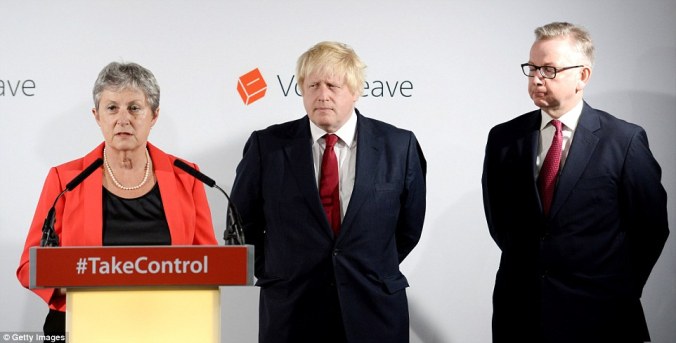
After the last three years of dismal Brexit jockeying the only thing that could have made this any more Brexit-y would be if the other person in the race had been Michael Gove. Then we could have relived that picture of the two of them standing at their “victory” press conference with that “What do we do now?” look plastered over their faces.

359EAD6800000578-3657802-image-a-222_1466766694596

But alas, Gove was knocked out by two votes and the other contender is Jeremy Hunt. And that look may have gone but believe me, the question hasn’t been answered.

So, with the caveat that my last attempt at a Brexit prediction failed badly because of my assumption of rationality and basic competence, let’s try and answer it. What will PM Johnson have to do once he takes the helm?

Continue reading

Withdrawing Agreement

“Diplomacy is the art of letting someone else have your way.” – Sir David Frost

I was preparing this week to talk about the “Meaningful Vote” in the House of Commons which would have ratified or rejected Theresa May’s woefully inadequate Brexit deal.

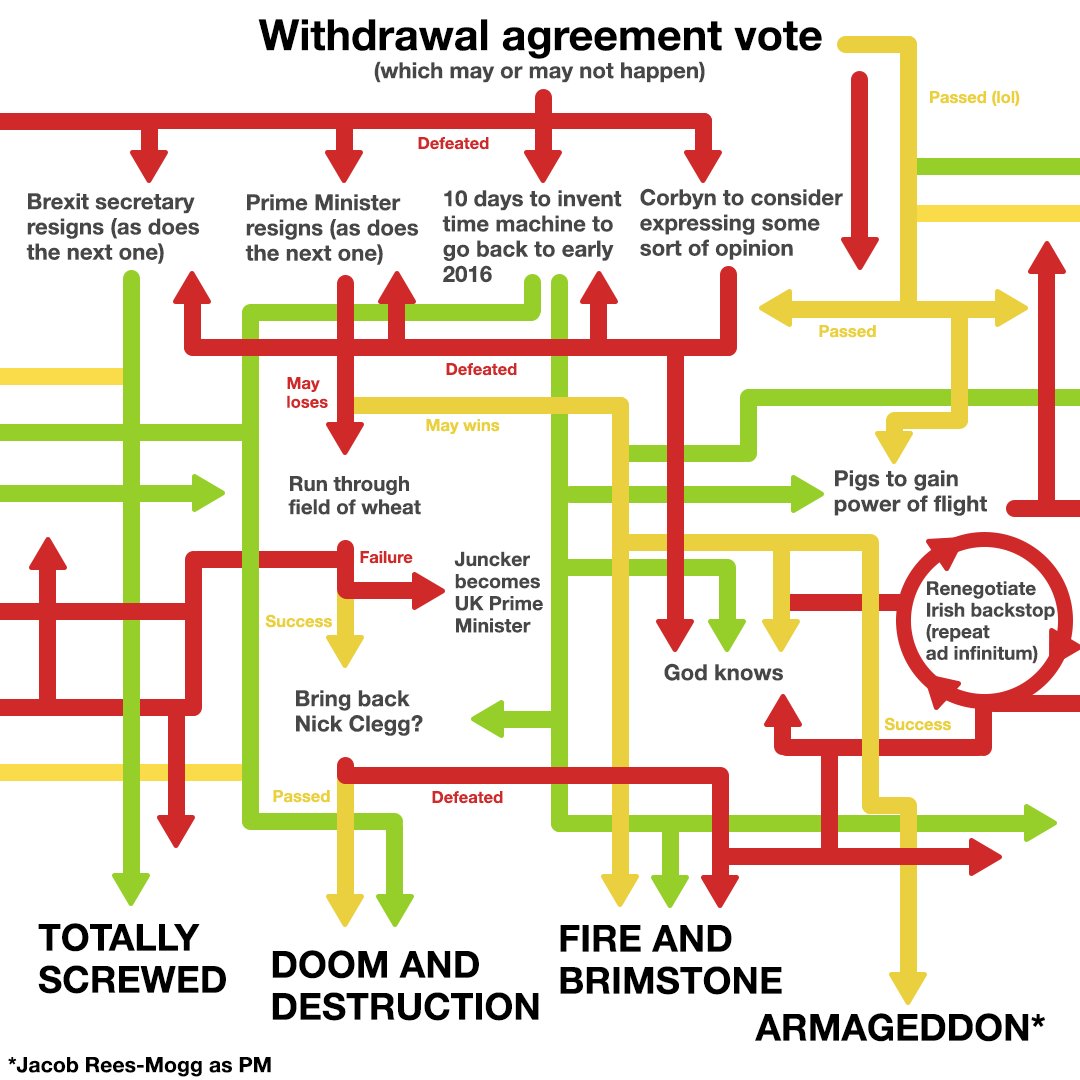
A parody timeline of the Brexit negotiations. An incomprehensible tangle of flow lines point to scenarios such as "We're screwed", "Bring back Nick Clegg" and "Jacob Rees-Mogg as PM".

But things have progressed somewhat since I started planning that post. In a direction not necessarily to the advantage of the UK government. Theresa May, Strong and Stable, took her deal from the table.  She started into the face of the humiliation of losing a vote possibly by a triple digit majority and ran away to try to renegotiate with the EU – who have already said that renegotiation is not possible. If it turns out that they were not entirely solid on that principle, then they’ll surely exact a high price for any changes.

Continue reading

As Many As Are Agreed

“No democratic nation has ever signed up to be bound by such an extensive regime, imposed externally without any democratic control over the laws applied, nor the ability to decide to exit the arrangement.” – Dominic Raab in his resignation letter as Brexit Secretary.

I pity the journalists who have to do this kind of thing for a living. Especially the ones who have to wait several hours before seeing their article in print. A week is a lifetime in politics. Today, an hour merely felt like one.

BrexitAgreement

The Brexit Withdrawal Agreement has finally been agreed between the EU and UK negotiating teams. It has also been agreed by the Cabinet of the government – albeit only “collectively” (read: not unanimously – merely by majority. Rumours speak of an 18-11 vote). It now needs to be passed by the UK and EU Parliaments and then it’s done. So…what could go wrong?

So, what’s in it and what has happened

Continue reading

We Need To Talk About: GERS (2017-18 Edition)

“Facts are stubborn things, but statistics are pliable.” – Mark Twain

There’s no day that’s guaranteed to set the heather alight amongst Scottish political social media sects like the release day of the annual Government Expenditure and Revenue Scotland report – also known as GERS.

GERS

I want to make one thing clear up front. No serious commentator now suggests that GERS can be used as is as a projection of the finances of an independent Scotland. My 2016 paper “Beyond GERS” shows some of the changes that would need to be made for this to be the case. But as a set of accounts for Scotland, the region of the UK, I’m content to use GERS as it is. Maybe improvements can and should still be made, but this is true for all statistical publications and the team behind the report do the best they can within their remit.

So what does this year’s publication tell us about Scotland, the region? Continue reading

It’s Beginning To Look A Lot Like GERSmas

A photo of the Scottish countryside. The sky is split between the moon and the night on the left and the sunset on the right.

It’s beginning to look a lot like GERSmas
It’s on the news, you know.
The size of the deficit, is all that matters to it
No deeper in shall the headlines go.

It’s beginning to look a lot like GERSmas
What will the numbers have in store?
To the rest of the UK, we compare ourselves today
It becomes a chore.

If a tax here is tweaked and everyone is freaked
imagine if they tried something more.
To reform all the land, make sure fracking stays banned
tax the rich till they’re sore.
But till we can then GERS we have and here it comes again.

It’s beginning to look a lot like GERSmas
Here, again, we go.
The fight about all the stats, the guesstimates and the facts
Where we stand I doubt we’ll ever know.

It’s beginning to look a lot like GERSmas
For calm, I shall now say.
Why don’t we have a truce, and not let Twitter run a loose
This GERSmas day….

Just this GERS-mas day.

Merry GERSmas everybody.

The Common Green logo comprising the words "The Common Green" above the Common Weal "balance" icon

We (Still) Need To Talk About: Budget Underspends

“Journalism is what we need to make democracy work.” – Walter Cronkite

It’s that time of year again. Amazingly, despite the looming catastrophe that is Brexit, this week has been one of those “slow news” weeks. Of the kind that manage to get pages out of very minor things like essentially reprinting old stories with the numbers slightly updated.

I am, of course, talking about the perennial “Scottish Government Underspend” story.
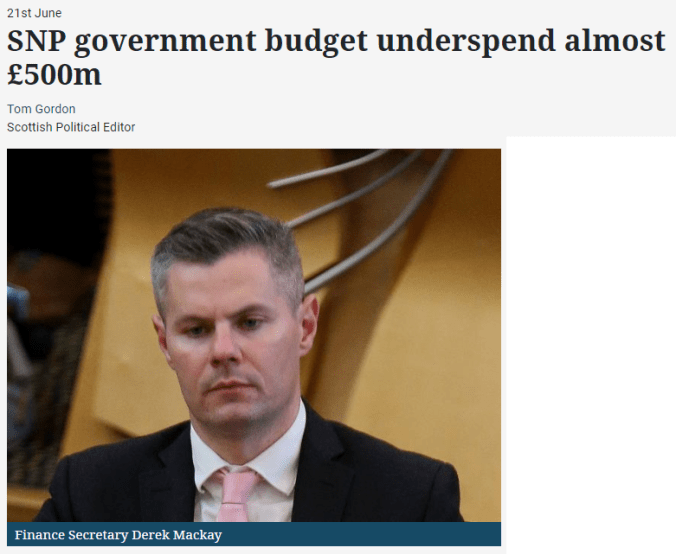
A screengrab of the Herald article on the budget underspend. Headline "SNP government budget underspend almost £500 million"

I covered this before back in the early days of this blog (it remains the most read article on here so far – even excluding the annual reposts). Others, like Wings Over Scotland, have covered it pretty much every year since.

Here’s the short version though.

  1. Opponents are complaining that the Scottish Government aren’t spending everything they’ve been given in the Block Grant or raised through taxes and are claiming that the Government are starving services of resources.
  2. This year the “underspend” is “almost £500 million” (actually, the article later says that it’s £453 million).
  3. But the Scottish Budget is pretty much fixed annually.
  4. And the Scottish Government has extremely limited borrowing powers for revenue – £600 million per year, £1.75 million maximum.
  5. If it DID try to use them, you can bet that the same opponents would be raging at the thought of the Scottish Government going into debt.
  6. The solution to avoid debt is to budget conservatively – if you had to set an ice-cream cone budget at the start of the year but your ice-cream purchases varied between 800 and 1,200 cones depending on weather – you’d need to budget for 1,200. If you only bought 800, then you’d have a 400 ice-cream cone underspend.

Without borrowing powers or an independent currency, budget underspends are an inevitable feature of the annual budget.

Though complicating the above point is that until 2006-07, Scottish Executive underspends were, in great part, retained by the UK Government. This was corrected after a negotiation between the UK Government and the then new SNP Scottish Government and the accumulated £1.5 billion was gradually fed into the budgets of the next several years.
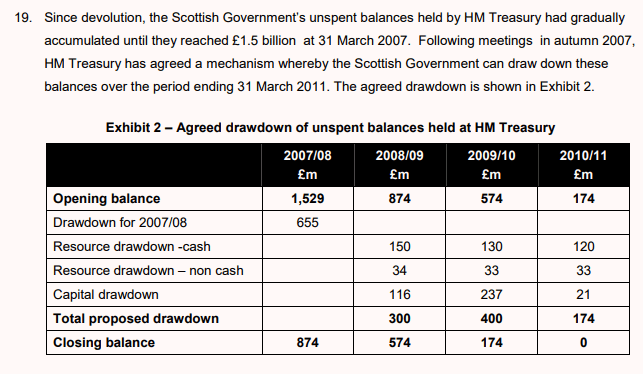
An excerpt from an Audit Scotland report detailing the

Since then, underspend money gets carried over to next year’s budget (though, as that budget will have an underspend too it’s a bit of a moot point).

One thing often missed in the “Budget Underspend” headlines is the actual nature of the sum involved. It’s not all cash sitting in the bank. Some of it will be due to underspending due to less-than-projected spending items (like the ice-cream cone budget issue). Some of it will be due to projects coming in underbudget possibly due to good management, possibly due to currency or price fluctuations (if your ice-cream cones cost £1 in January but drop to £0.80 by June, you might underspend even if you still buy 1,200 cones).

But a good chunk of the underspend could be from things like depreciation of assets which can’t be spent on other things at all – even if the asset is sold (The metaphor gets a little strained here, but if your ice-cream cone is worth less as a half-eaten, melted pile than it was when you bought it fresh, it’s not as if you can sell the cone and pocket the difference in price).

Another thing often missing from these headlines is the inevitable revision afterwards – calculating National budgets down to the penny turns out to be quite tricky. If you remember last year’s headline that the government had underspent by £191 million, you probably missed the reporting that that figure was later revised down to only £85 million after final accounting adjustments were made.

Indeed, this year’s figures have ALREADY been revised downwards. Stripping out the non-cash items and money already budgeted for but not yet spent then it only leaves around £66 million to be spent on something else.

But £66 million is still a fair bit of money though isn’t it? Surely, the government could just, you know, budget better?

To answer that question we’d be best to do another thing that doesn’t really come across in reporting if one looks at the situation one headline at a time. Examine the trend.

To that end, I’ve spend a fair bit of time trawling through annual Consolidated Accounts to pull together the underspends from this and previous years. I managed to get back to the accounts for the year 2005-2006 before the trail gets fragmented. Before this point, the Scottish Executive accounts operated in a substantially different way (see the segment on Resource Accounting and Budgeting here). Underspends still happened, but comparing them like-for-like with years after 2004 may not be strictly fair. I also haven’t been able to locate the 2002-03 underspend at all.

As far as I can tell though and if the revision mentioned stands, this year’s underspend may well be the lowest since the start of devolution.
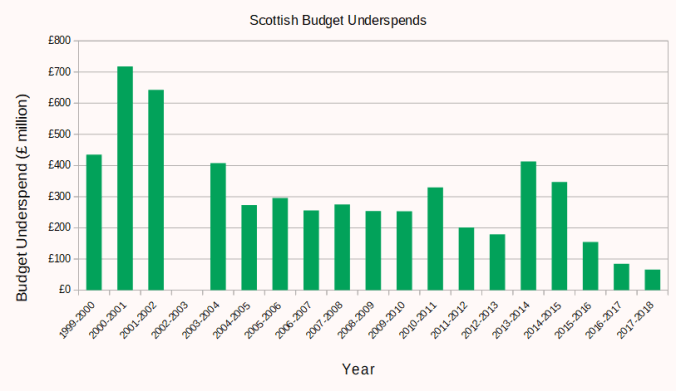
A bar chart of Scottish budget underspends since devolution. There is a clear trend downwards from the 2000-2001 high of £718 million down to the 2017-18 low of £66 million.

And if we compare the underspends to the budget as a whole we begin to see just how small a story this all becomes. The Scottish Government’s devolved budget is on the order of £32 billion. A £66 million underspend is about 0.21% of that budget – or about 18 hours worth of spending across the year.
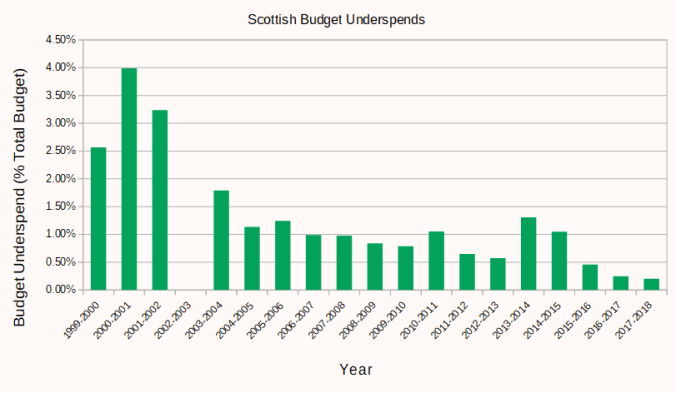
The underspend bar chart converted to percentages of the total budget. From 4% in 2000-2001 to 0.21% in 2017-18

Even the initial estimate of £453 million was about 1.4% of  the total budget – if it really was all spendable cash, it’d be the equivalent of about five days worth of spending.

This is not to say that the budget underspend won’t become an issue. It was simplier back in the days when the bulk of the Scottish budget came from the block grant and tax powers were both limited and largely unused. Now, with divergent income tax rates and bands and an impossibly complex Fiscal Framework, there is a risk that the devolution settlement gets strained to breaking point. The David Hume institute has described it as an “interesting cocktail” of arrangements.

I don’t know what the future holds for this story. I could see a time, possibly as soon as next year, where the Scottish Government revenue budget slips from “underspend” to “overspend”. I already know what the reaction of the opponents will be if that happens.

I could hope that the media will up its game here and try to explain these issue in more detail than an attention grabbing headline.

Sadly, I can see my 2015 article just being reposted again in 2019.

The Common Green logo comprising the words "The Common Green" above the Common Weal "balance" icon


We Need To Talk About: The Growth Commission Report

If this is a discussion document – It’s time to start discussing it.

The Growth Commission’s long-awaited report is finally out and will surely take some time to fully digest. It has been described as a discussion document and a starting point for the revitalised case for independence; not the final word on SNP policy or national trajectory.

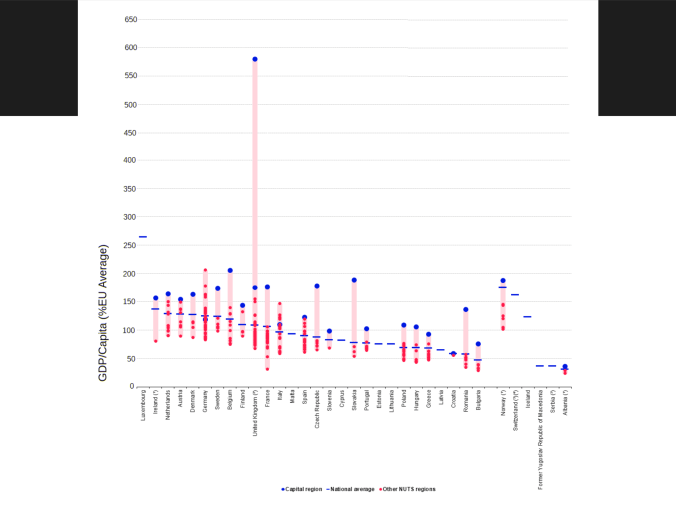
In many ways, the report covers ground now very familiar to campaigners in the independence debate. We’re all now quite familiar with the deep and systemic flaws of the UK’s economic system especially its regional inequality which, quite frankly, is embarrassing when compared to neighbouring countries in Europe.

14

(Source: Eurostat)

Continue reading

unDemocracy

“I think it would be a good idea” – Apocrypha attributed to M. Gandhi on his being asked what he thought of Western civilisation.

The UK Government’s handling of Brexit continues to be veer somewhere between being a shambles and a criminally negligent disaster.

From its position on customs which remains something like “We have no idea what we want and we’re damn sure we’re not going to lift a finger to plan for it.”

Through its tearing away from anything even remotely connected to the EU – including Euratom (which means good luck running a nuclear power plant or obtaining a medical radiological), the Gallileo satellite system (to which the British response was a petulant “We’ll build our own…somehow”) and fundamental human rights which protect us all from the whims of governments that act a bit like the current UK one does.

Continue reading

An Unequal Kingdom

“A system of government as close to federalism as you can have in a nation where one part forms 85% of the population” – Gordon Brown, 2014

The “F-word” is rearing its head again in Scottish politics. Federalism. An idea sometimes presented as a “credible” alternative to Scottish independence and a way of granting Scotland greater autonomy over its own affairs whilst maintaining the unity of the United Kingdom. Unfortunately, it’s also an idea that is rarely presented in any greater detail than that previous sentence.

Both Scottish Labour and the Scottish Liberal Democrats have flirted with this idea throughout their history and have been doing so again recently. In an attempt to raise the level of debate about this subject, I have just co-authored my latest policy paper for Common Weal with long-time constitutional activist Isobel Lindsay which you can read here or by clicking the image below. Isobel also has an article in the Sunday Herald which you can read here.

Unequal Kingdom Cover

Continue reading

Scotland’s Data Desert

My latest policy paper for Common Weal – Scotland’s Data Desert – has just been published and can be read here or by clicking the image below. There has also been coverage of the report in The National here and here.

Cover

As a region of the UK, Scotland is in many ways better served by data gathering and analysis than its counterparts. However, as Scotland takes greater control over domestic issues and as the constitutional debate continues to look towards a future in which Scotland takes full responsibility for its own affairs the question is raised as to whether even this level of data provision is adequate for current or future needs – especially in a world where data becomes ever more vital in the development and support of policy. Well served though Scotland may be as a region, as a country it remains a relative “data desert” compared to nearby independent countries.

Many times we’ve watched as politicians and activists have misused data in the public sphere. Sometimes this manifests as a simple misunderstanding of what the data actually says (As when people ask how much of Scotland’s trade leaves the UK via “English ports”). Sometimes though, it’ll be used to make a political point in ways that the data doesn’t really support (such as discussions which use GERS to project beyond what it actually says on Scotland’s finances). There have also been instances of policies being implemented on the basis of limited evidence or of policies being implemented and then left to run without any program in place to monitor their effectiveness.

My latest policy paper for Common Weal is the culmination of over a year of research into the gaps and limitations of data provision in Scotland and discussion with people within the data sectors and civil service in Scotland and the UK. As a political lobbying and research organisation, we are – like many others – dependent on access to data to be able to inform our work and many times we have hit barriers where key data couldn’t be released or simply did not exist.

A Scottish Statistics Agency could help address many of these issues by expanding, co-ordinating and codifying data gathering within Scotland.

An independent Scotland will certainly need its own data and statistics agency but this isn’t just an independence issue as it could be done right now in a devolved Scotland and there are compelling reasons to do so. As said, Scotland already goes above and beyond the UK’s data gathering in many areas but there is certainly room to grow further.

The SSA could well take the form of a monolithic, centralised agency – a bit like the UK’s ONS – in which most or all policy level data is gathered by or for them. It could equally take the form of a more decentralised system whereby a central body co-ordinates and issues targets and directives but the actual gathering could be done by specialised bodies, statisticians embedded within government departments and even by academics and think-tanks. If this model was employed then a system of “kitemarks” could be used to mark data which meets the stringent Code of Practice which would identify data as being good enough for policy-making.

This kitemark system is already used by the UK Statistics Agency (the governing body which regulates the ONS) but could be used to either reflect a Scotland which applies even higher standards than the UK or could be expanded to identify data from outside of government (such as academics and think tanks) which meet those standards. This could allow for greater prespectives to influence government but could also limit the misuse of data by third parties by setting a benchmark to meet.

Of course, this isn’t just a problem of gathering data. As said above, often the data is gathered but difficult to find, difficult to manipulate or cannot be easily combined with other data due to conflicts in their methodologies. Where data can be combined, it has been a reported problem that different groups may be doing the same processing independently. This increases the chance of errors creeping in and also, crucially, results in a lot of time wasted between those groups.

An SSA could therefore be charged with ensuring that policy data meets high standards of trust, transparency, usability and consistency. It could also be responsible for maintaining a central data portal – much like Eurostat or the Gapminder Project – which would allow access to as much data as possible but can do it in a way which makes that data easy to view whether the viewer is an interested member of the public or an expert researcher.

People will, of course, ask how much an SSA would cost and, in truth, the answer is difficult unless we know the precise model – it’s harder to count the budget of a decentralised model than a centralised one – but where Scotland’s proportional share of the UK’s spend on statistics may be around £15 million, other nearby countries like Denmark and Sweden spend several times this figure and create several hundred highly skilled jobs in the process. Even these sums are comparatively small in terms of national budgets but will surely pay for themselves in terms of better targeted, better monitored and, quite simply, better policies.


Common Weal’s ability to do research of this kind is entirely reliant on the generosity of our donors and supporters, both one-off and regular. If you would like to contribute, please visit our website at: allofusfirst.org/donate/

TCG Logo 7