When banks own housebuilders, house prices go up

“A banker is a fellow who lends you his umbrella when the sun is shining, but wants it back the minute it begins to rain.” – Mark Twain

This blog post previously appeared in The National as part of Common Weal’s In Common newsletter.
If you’d like to support my work for Common Weal or support me and this blog directly, see my donation policy page here.
The way we build houses in the UK could be costing you an average of almost £67,000. This could be fixed by making housebuilding a public infrastructure project rather than a means for very rich shareholders to transfer your wealth to themselves.

Volume housebuilder Taylor Wimpy released its annual report for 2024 yesterday and the details in it, which look excellent from the viewpoint of a corporate shareholder, reveal much that is broken with the UK’s housing sector.

The first important number in their report is the number of houses completed. Taylor Wimpy is one of the UK’s largest volume housebuilders – likely to be in the top three this year in terms of completed projects – yet built only 10,593 houses in 2024 – a substantial reduction over the previous three years (though they claim to be on track for about 14,000 this year).

The second is their claimed operating pre-tax profit of £416 million. The word “profit” is a very fluid term in the world of corporate accountancy as it’s relatively easy for companies to move money around via “one time charges”, inflated director bonuses or “loans” to subsidiaries or parent companies, so a better number to judge a company like this is the money it granted to its shareholders as a dividend as this represents money extracted from the company and not reinvested in any way (not even in the form of the labour of those hypothetical overpaid directors). The dividend for shareholders in 2024 was £339 million.

This means that the houses built by Taylor Wimpy in 2024 generated a dividend to shareholders of an average of almost exactly £32,000 per house. This is how much lower house prices could have been had the company not been in the business of extracting profits via dividends. Had the company been a not-for-profit business entirely, then its houses could each have been almost £40,000 cheaper.

It gets worse for you, the house-buyer, because it’s very likely that you’d be taking out a mortgage to buy that house and you’ll be required to pay interest to the bank on that loan. £40,000 added to a 25 year mortgage at 4.5% interest will result in you paying back £66,700 over that time. To say again, this isn’t the cost to you for paying for anything to do with the construction of the house itself. This is the cost to you for paying interest on the additional loan you took out to pay for the profits of the company, most of which were paid out as dividends to the company’s shareholders.

And who are those shareholders? Our old friends, US based asset managers BlackRock and Vanguard Group are near the top of the heap, owning about 15% of the company between them. Several of the other owners are banks like HSBC and Barclays. This means that if you have a Barclays mortgage, then part of the interest you are paying on your mortgage is being used to service the loan you took out to pay the dividend they gave to themselves to inflate the price of your house.

If Scotland had a National Housebuilding Company as we’ve advocated for the best part of the last decade, then we could be building houses at as close to not-for-profit as possible and could reinvest any surpluses into other public infrastructure to make the places around our houses and the services we need in our community more resilient.

If we built the houses to the plan proposed in Good Houses for All, then they would be constructed at a far higher quality than the conventional timber frame “diddy boxes” (our Board Director and premier architect Malcolm Fraser’s not-so-affectionate name for them) favoured by the volume development sector and would force remaining private developers to drastically improve the quality of their constructions (doing so wouldn’t even reduce their profits because such buildings are now cost-competitive with the diddy-boxes and then create further savings in terms of energy costs).

“If the whole of the UK brought in a Land Tax equivalent to our suggested baseline value of 0.63%, then Taylor Wimpy would owe an additional £2.14 million per year on its banked land”

A final point to note in their report is the amount of landbanking they do. Landbanks are when a company buys up land but then does not build on it for an extended period of time (or sometimes never, or the land itself becomes a commodity to be traded between companies). The report states that the company currently owns £3.4 billion worth of land spread across 79,000 “short term plots” and 139,000 plots in their “strategic pipeline”. They also purchased more plots last year than their number of completions so the total size of their landbank has increased. Given their completion rate over the past few years, they could stop buying land for around 20 years without risking running out.

Decreasing the supply of land without putting it to the intended use of housebuilding is a major factor not just in inflating the price of land but also actively preventing land from being used for building either by other volume developers, by Local Authorities or even by enterprising self-builders. Scotland should consider bringing in a Land Tax to charge companies for the land they own and should consider an additional surcharge on the land tax to account for vacant or landbanked land (which would encourage developers to build so that they can get the land off their books). If the whole of the UK brought in a Land Tax equivalent to our suggested baseline value of 0.63%, then Taylor Wimpy would owe an additional £21.4 million per year on its banked land – still a small fraction of its overall profits.

The way we build houses in this country is badly broken and has resulted in volume developers constructing cheap, cold, damp houses that are not fit for the purpose of living because the purpose of the houses is to extract wealth and deliver it to shareholders. Until we move to fix that and to end the financialisation of housing, we’ll all keep paying a very real and very substantial price for the roof over our head.


How “Me First” pensions make the UK’s debt more expensive

“With a roof over his head he had ceased to work, living off his pension and his wits, both hopelessly inadequate.” – Spike Milligan

This blog post previously appeared in Common Weal’s weekly newsletter. Sign up for the newsletter here.

If you’d like to support my work for Common Weal or support me and this blog directly, see my donation policy page here.

Image Source: Unsplash

This week has been an overwhelming one when it comes to trying to work out what news to focus on. If you’re a subscriber to Common Weal’s new Daily Briefings you’ll have received an email every weekday this week with a short article with our take on an important news story that day (If you haven’t subscribed – click here).

What you won’t have seen is that every day this week we’ve had to choose between three or four stories, each of which would been a shoe-in on any “normal” day. Even in well covered stories that you will have seen elsewhere, there are nuggets of information that caught our eye that were perhaps glossed over.

Earlier this week there was a strong set of headlines about the sudden spike in the UK’s debt interest. It’s not just that the UK’s total amount of public debt is still rising, but the amount that it pays in interest to service that debt is getting much more expensive. While interest rates have been rising across the developed world since the period of unusually low interest rates between the 2008 Financial Crisis and the 2019 Covid pandemic, the UK is expected to end up with the highest debt interest rates in the G7 in the near future.

There are nuances around how much that will actually affect us. The surface level explanation is that if more public money goes into servicing debt interest then it means less to spend on other public services. A layer down though shows that not all debt interest is created equal.

Particularly, interest payments paid to service debt held by the Bank of England is booked as a revenue for the bank but, as the bank is a publicly owned Central Bank, all profits from the bank are paid back to the UK Government. So it’s a bit like you owning your own house but still insisting on paying rent to the owner. At best, it’s just shuffling money between different bank accounts.

Another layer down is to ask who owns the rest of the debt. Where bonds are held by people or companies overseas, that could be a problem because that represents public money being extracted out of the country. Where it’s held by UK companies, it might be less of a problem because those companies will be spending that money into the UK economy somehow – and thus you can think of the debt interest as acting more like a public subsidy towards those companies (whether or not they are companies that you want to see subsidised is a different question).

And then there are savers and investors. The interest your bank pays you on your savings (“What interest? What savings?”, I hear you say; I know., but that’s a different question too) is, from their perspective, the same “cost” to them as the debt interest is to the UK Government. We don’t see it as that though. We see it as a benefit of saving money. Their cost is our gain.

The same goes when your pension (“What pen…”, OK, I get it!) invests in government bonds. That debt interest payment is your savings growing into something you can spend in retirement to sustain a decent lifestyle.

But why have the UK’s interest rates shot up so much and why have they shot up higher than the rest of the G7?

Part of the explanation affects all of those nations – rebounds from the global pandemic, climate related supply issues, global conflicts and Trump’s trade wars all play a part – though the UK appears to be particularly exposed to some of them, especially – since Brexit – to Trump.

Other impacts are more local. Since Liz Truss and arguably before that, the UK has seen a slew of unstable and uncertain governments that have reduced confidence in the investors who want to buy UK debt, which pushes up the price they demand in order to bear the risk of a default. Some of it is that those investors are highly neoliberal and have seen the UK Government – particularly Starmer, Sunak and Johnston – as being not nearly neoliberal enough and thus are applying pressure for the UK to abandon what they see as “loose fiscal policy” and return to more Austerity.

But there’s one reason that was mentioned in passing in both the FT and BBC that caught my eye and that’s the changing patterns in those pension investments I just mentioned.

“An average British worker now retires with something like 11 different pension pots spread over 9 different pension providers.”

It used to be that most pensions were “defined benefit” pensions. That is, your workplace pension payment was based on some fraction of your salary at the point of retirement. This ensured that you could maintain your lifestyle at the point of retirement without too much of a drop in income and provided a stable financial floor for the rest of your life. But it was hard to manage for companies and pension funds, often led to headlines about companies creating shortfalls in their funds, and was difficult to extract a lot of profit from.

Over the course of the 1990s onwards, there was a push to move workers out of defined benefit pension schemes into defined contribution schemes. These are essentially just glorified bank savings accounts. You final pension is dependent not on your final salary but on how much you are able to save over the course of your working life.

In an age of fragmented careers and squeezed pay, this is proving difficult. In our book All of Our Futures, we found that an average British worker now retires with something like 11 different pension pots spread over nine different pension providers. The risk of pensioner poverty – or even destitution if your savings run out before you die – is very real.

Pertinent to this story though is the change in investor culture as a result of that shift. The thing about defined benefit pensions is that they demand long term planning and stability – which means aiming for long term investments. These can be in things like rentable property and assets (there’s a reason that the Canadian pension sector pension fund owns Aberdeen, Glasgow and Southhampton airports) but they also invest in government bonds – especially the very long payback bonds like 30 and 50 year bonds. They tend to have to invest with solidarity in mind and thus look to benefit all of their members in the long run.

Defined contribution schemes, however, are much more focused on an individualistic “Me First” push for a quick gain – particularly in the earlier years of a saver’s scheme (many DC schemes do tend to move into safer investments towards the end of a saver’s career as a safeguard against being wiped out with no time to recover before retirement). What this does though is pull demand away from long, “safe”, investments and push it towards higher risk, higher (potential) reward investments. This, in turn, pushes the price of longer dated investments up as they try to compete.

So we end up with an extremely volatile situation of people’s livelihoods being dependent on risky investments and the safeguard of long dated government bonds becoming so much more expensive that the Government starts cutting public services – including those that retired people rely on.

It doesn’t even make us any richer! Pensioner poverty rates have been static for the past 20 years and the rest of us face a future of having neither enough savings nor even enough capital wealth from inflated house prices to sustain ourselves. The only people who got rich from this shift in pension cultures are the folk who took commissions from the defined contribution schemes (until very recently, the UK had some of the most expensive pension fund management fees in the developed world and still has issues with things like high cost and complexity of moving your savings for ethical or financial reasons).

A better way would be to be a bit more Canadian. To bring Scottish workplace pensions into public hands and have them invest in Scottish infrastructure (either directly – though that Canadian scheme is apparently not the best landlord when it comes to the homes it directly owns – or through vehicles like the Scottish National Investment Bank).

The economy needs to be rebalanced towards patience and long-term security rather than grabbing a quick buck and trying to not drop it. An economy that puts “Me First” apparently works for almost no-one. An economy that puts “All of Us First” is one that will work for everyone.

So You’ve Won Capitalism: An Open Letter To The Billionaires

“Democracy is supposed to be ‘of the people, by the people and for the people’. Capitalism is ‘of the capitalist, for the capitalist’. Period.” – Jerry Ash

This blog post previously appeared in The National.
If you’d like to support my work for Common Weal or support me and this blog directly, see my donation policy page here.

a bird's eye view of a beachfront home

Dear Billionaires,

I think we can all agree that you’ve won Capitalism. If the goal of Capitalism is to accumulate wealth via the canny deployment of capital (yours or someone else’s) for the purpose of spending that wealth on goods and services to improve your own lifestyle then you have been successful beyond measure. As a billionaire, you now possess more wealth than can be reasonably spent by any individual in a lifetime. In fact, you passed that measure a long, long time ago.

Continue reading

It’s Scotland’s Economy – Or Is It?

“It is not inequality which is the real misfortune, it is dependence.” – Voltaire

This blog post previously appeared in The National as part of Common Weal’s In Common newsletter.
If you’d like to support my work for Common Weal or support me and this blog directly, see my donation policy page here.

Chivas Regal Scotch Whisky

Deliberate Government policy has resulted in Scotland’s economy being outsourced to foreign-owned companies to the point that we scarcely have a home-grown economy left any more. In a world of threats to global trade, this is a major problem.

Continue reading

Work To Live

“[W]hen your politics no longer have room for empathy, things spin into an amoral chaos. Not only the desperate suffer. Who gets hurt and who stays safe becomes hard to predict.” – Luis Alberto Urrea

This blog post previously appeared in Common Weal’s weekly newsletter. Sign up for the newsletter here.

If you’d like to support my work for Common Weal or support me and this blog directly, see my donation policy page here.

A new German study into Universal Basic Income publishes its final report, showing once again why UBI is a moral imperative. To illustrate those results we could imagine a world where we already have a UBI, but someone wants to study the effect of taking it away and creating the world we live in right now.

In 2021, 122 volunteers had their Universal Basic Income withdrawn from them in pilot project to study the impact of forcing people to work to earn enough money to survive. The participants in the “Work to Live” (WtL) programme were followed for three years alongside 1,580 people who retained their Universal Basic Income of €1,200 per month, regardless of their circumstances, spending intentions or any income they earned on top of their UBI. In 2025, the project published its final report.

Proponents of the “Work to Live” scheme claimed that inducing the fear of starvation, destitution and homelessness in workers would have multiple positive impacts on economic growth including increased work productivity and an increase in the number of hours worked as those without a UBI would be motivated to ensure that they could afford to keep a roof over their head. They also claimed that removing the UBI would increase people’s freedom to choose how to live their lives, without government oversight.

Now, finally, after three years of study, we have some evidence around those claims.

Jobs

Perhaps the most cited claim of “Work to Live” proponents is the idea that UBI makes workers lazy and idle – happy to coast along in their job knowing that they don’t need to earn enough to pay their bills or, in some circumstance, are content to sit completely idle on their sofa existing entirely on their UBI. The study found some surprising results in this regard. The group who had their UBI withdrawn worked essentially the same number of hours as the control group – both working an average of 40 hours a week – but the WtL group reported a substantial decrease in job satisfaction compared to the control. Satisfaction with the income they did receive also dropped markedly with the largest drop coming shortly after the withdrawal of their Basic Income and the gap only marginally closing again as they adapted to their new income levels.

While WtL proponents claimed that the motivational impact of taking away €1,200 a month would spur people to move out of their dead-end jobs or to try to improve their situation through education and training, the opposite was found to be true with the WtL group less likely to change their job and more likely to drop out of education to seek work. Satisfaction within work also dropped for the WtL group, both for those who did seek different employment and for those who stayed where they were at the start of the study.

Autonomy and Self-Determination

“Freedom” is at the heart of the Work to Live campaign, giving people the choice of how to live their life by choosing how to maintain that lifestyle. Those too poor to live a certain way have the freedom to seek those means or to choose to give up those dreams and live within more modest means.

The Work to Live study again confounded those expectations by noting a significant decrease in perceived autonomy compared to the group who retained their Universal Basic Income, with women in particular feeling more constrained by their life without a Basic Income than men. Paradoxically, participants reported that they felt like they had less “free time” in the day after losing their UBI, despite working similar hours to the control group. WfL participants spent notably less time doing non-productive activities outside work such as “volunteering”, “visiting friends” and “sleeping” with an average WtL participant sleeping on average 75 minutes less per week than a control group peer who retained their UBI – despite not spending that extra time in productive work.

Wellbeing

Work to Live advocates often claim that earning money rather than getting it “for free” would increase the sense of satisfaction of holding it and that this would translate into greater life satisfactions as one could look around at the lifestyle bought with that earned money rather than gained via a “handout”.

The pilot programme found once again that these expectations were not backed up by the lived experience of the participants. Life satisfaction dropped markedly shortly after the withdrawal of the UBI and remained more-or-less static in the three years after. This pattern was shared across other satisfaction metrics such as satisfaction with social interactions, the quality of sleep and satisfaction with the money participants had (even when controlled for the total amount of income). Overall stress levels – stress being a significant causative factor in many chronic health conditions – was higher in WtL participants than in the control group.

Finances

The philosophy of Work to Live teaches that money is a precious commodity and must be used wisely. Proponents have claimed that UBI encourages wasteful spending. The study found instead that withdrawal of UBI caused participants to cut their spending on a wide variety of items, including those vital to living comfortably. The largest cut came to vacations, with WtL participants spending almost 60% less on holidays than their UBI peers despite having the same amount of time off work. They also cut spending on clothing by 25%, 5% on everyday needs like food and 2% less on electricity and heating.

Unexpected Effects

Not all of the assumptions about the Work to Live pilot were borne out and some results were completely unexpected. One of the claims against UBI is that as it is an inherently Socialist idea (despite some Libertarian proponents) and thus those who receive a UBI are highly motivated to vote for left-leaning political parties. The study found that WtL participants did not substantially change their voting intention between parties but were less likely to vote at all whether for their preferred party or another.

Work to Live proponents claimed that UBI would make people inherently lazy, but the study found that, in fact, WtL participants were more likely to procrastinate on tasks or to avoid doing them entirely (perhaps in the hope that a problem they were anxious about would “go away”) though there was little change either way on individual propensities to do a task ahead of a deadline or at the last minute once it was decided that the task could not be avoided.

Finally, the sense of basic risk taking amongst participants was largely unchanged with the exception that WtL participants were less likely to risk changing their current job to take on another, despite the opportunity of potentially achieving higher pay or better conditions.

Conclusion

The Work to Live pilot programme has joined other similar studies in showing that attempting to coerce workers into productivity through the threat of destitution leads to more stress, more anxiety and lower rates of public, social and democratic participation and fails to achieve its goal of leading to more hours worked. It is recommended that participants have their Universal Basic Income restored and that other nations who have not yet implemented a UBI scheme of their own join the rest of the civilised world by doing so as soon as practicable.

And Finally

If you’ll allow me to drop the kayfabe at the end of this piece. This new German study into the impacts of Universal Basic Income joins with and do not contradict the increasingly vast body of all of the other studies that have been done into UBI. The results are as strong as all of the others too but the long term nature of the study adds extra weight to its findings as does the detailed examination of how living without the anxiety that capitalism imposes on us actually improves people’s lives. You can read more about that study here.

Here in Scotland, there is currently a Parliamentary majority in support for a Scottish UBI (the SNP, Greens and Lib Dems both support UBI as party policy and Labour indicate support for a weaker form of Minimum Income) but the UK Government (both Conservative and Labour versions) are ideologically against it, refusing even to facilitate the running of a Scottish UBI pilot despite the success of one in Wales. Studies into the costing of extending UBI schemes across the EU have found that they would be cheaper to implement than is currently being spent mitigating the poverty caused by the lack of one (that is, implementing a UBI would SAVE money, after the costs of poverty are included). The Scottish Government must bring back, as a priority, its plans to test and to ultimately roll out a UBI across Scotland. Much more pressure must be brought to bear on the UK Government to facilitate this rollout as while a UBI would undoubtedly be much easier to implement in an independent Scotland, the costs of poverty – particularly the child poverty that the current First Minister wishes to “eradicate” – are far too high and far to urgent to wait until then. We don’t need more data, or more pilot studies, or more poor people waiting for someone to do something. We just need that action, now, to give us all a Universal Basic Income to allow us to live without the fear, anxiety or exploitation that comes from poverty. Any further argument against UBI has to contend with the data presented in this study and in others and any further argument for delay must accept responsibility for the continued suffering that delay imposes. The time for a UBI is now. Once we have it, I’ll pass over to those who would like to perform a study arguing why it should be taken away.

Continue reading

PfG 2024 – Serving Scotland

“When the dispute over the Means Test was in progress there was a disgusting public wrangle about the minimum weekly sum on which a human being could keep alive.” – George Orwell

This blog post previously appeared in Common Weal’s weekly newsletter. Sign up for the newsletter here.

image_2024-09-10_091756759

Serving Scotland, what exactly?

The Scottish Government’s latest Programme for Government, titled “Serving Scotland”, is little more than a list of platitudes covering some of the most brutal public service cuts in years coupled with a paring back of all sense of ambition in what should be a critical year of laying groundwork for the next election (if you take a short-termist political party view of things) or the rapid ramping up of actions to halt and mitigate climate change (if you’d prefer there to be a liveable biosphere in the next couple of generations).

The PfG is divided into four of the Government’s overarching strategies so it’s worth picking them apart one by one.

Continue reading

It’s Time To Tax Scottish Land

“All I wish to make clear is that, without any increase in population, the progress of invention constantly tends to give a larger proportion of the produce to the owners of land, and a smaller and smaller proportion to labor and capital.” – Henry George

This blog post previously appeared in The National as part of Common Weal’s In Common newsletter.
If you’d like to throw me a wee tip to support this blog, you can here.

image_2024-09-09_204513798

Last week, I had the pleasure to address SNP members at the Revive Coalition’s fringe meeting on land reform where I presented Common Weal’s proposal to bring a land tax to Scotland. As the meeting wasn’t filmed, I want to discuss the issue here for the benefit of members (and non-members) who couldn’t be there. I am also delighted that after our fringe, members gave overwhelming support to two motions that would enable such a tax. Taxing land in Scotland is now solidly SNP policy and the Scottish Government should bring forward a Bill to enable it at the earliest opportunity. With the Scottish Government pledging to bring in fresh cuts of in excess of £500 million, to ignore a tool that would almost entirely avoid the need for them is simply unacceptable.

Continue reading

A UBI Is Now A Moral Imperative

“The solution to poverty is to abolish it directly by a now widely discussed measure: the guaranteed income.” – Martin Luther King Jr.

(This blog post previously appeared in Common Weal’s weekly newsletter. Sign up for the newsletter here.)

A new research paper has found that a Universal Basic Income sufficient to eliminate poverty across the entire EU would cost about as much as defence and, in some modelled scenarios, would cost less than the poverty it eliminated. In other words, bringing in a Universal Basic Income could cost less than the price we’re currently paying by not doing it.

Continue reading

The Eternal Workforce

“Austerity should not be a death sentence. Every person should be able to retire with the benefits they’ve earned and dignity they deserve.” – Fuad Alakbarov

(This blog post previously appeared in Common Weal’s weekly newsletter. Sign up for the newsletter here.)

Last week, while everyone else was watching a septuagenarian finally start the job he was born to do, some stats were released by the ONS that revealed that he is not alone in the “grey workforce”. An increasing number of older people in the UK are entering, re-entering or remaining within the workforce. It paints a picture of the older workforce that reveals underlying weaknesses and vulnerabilities in the UK economy.

image_2022-09-30_131613517

Continue reading

A Financial Flatspin

“Someone is sitting in the shade today because someone planted a tree a long time ago.” – Warren Buffett

(This blog post previously appeared in Common Weal’s weekly newsletter. Sign up for the newsletter here.)

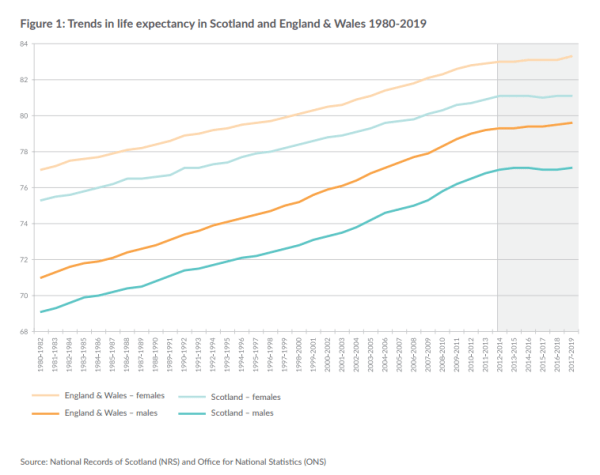
An extremely disturbing report was published this week looking into life expectancy in Scotland and the UK. It found that the consistent gains in life expectancy that we have experienced for much of the 20th century and into the first decade of the 21st has stalled and has even started to decline for some groups – especially the poorest and most deprived. This stall was abrupt and started in 2012 and has had the effect of knocking around 16 months of life off of the average Scot compared to pre-2012 trends.

image_2022-06-11_203636097

(Image Source: GCPH)

 This was not due to a “natural limit” of life expectancy being reached (though such a limit does almost certainly exist) nor have neighbouring countries experienced this stall to anywhere the same degree. The stall is not due to Covid, nor any other endemic illness. Drug-related deaths in Scotland are rising and this is having a measurable impact on average life expectancy but life expectancy has also stalled for non-drug users so this cannot explain everything either. Nor is it due to obesity or even due to climate change (though the former had more of an impact than the latter). All of these factors and more could be isolated, accounted for and controlled for in the study. Once this was done, there remained still an additional adverse impact on our life expectancy.

The conclusion of the report is that there is one stark cause above all of the other factors that has resulted in our lives being, on average, shorter than they otherwise would have been. In 2010 the UK Government began a massive socio-economic experiment called Austerity. This, the report finds, has been the primary cause above all others for the harm done to our health and wellbeing. It has sucked vital resources out of public services and starved households of the resources required to replace them. Poverty and deprivation – deliberately applied by political choice – has killed people earlier than they otherwise would have died.

It is in this context that we must view the other major reports published this week – the Scottish Government’s Resource Spending Review and Capital Spending Review. These financial reviews lay out the plans for devolved government spending over the next four or five years up till the end of this Parliament. The choices being made are grim.

Continue reading