One Year of The Common Green

The Common Green blog just hit its first anniversary.

Initially started as a continuation of my monthly column in Yes Clydesdale’s Aye Magazine and to help support and expand on points made during my pitch as a potential list candidate in the upcoming Holyrood elections, it has grown to a rather larger audience than I had expected with over 32,000 visitors dropping by to read articles.

Several of those articles even went fairly viral, as these things sometimes inexplicitly do, with my early discussion of last year’s GERS figures, the prototype for my “We Need To Talk About:” series in which I pull some details out of under-reported stories, (look out for an updated version later this week when this year’s figures are published) and my dissection and explanation of the Holyrood election voting system doing particularly well (the latter article has even been republished and incorporated into a couple of school and university courses).

By far and away the most popular article I’ve written so far though was a take down of one of last year’s big scare stories. “We Need To Talk About: Budget Underspends” accounts for one in four of this site’s pageviews and was a reaction to the near blanket media coverage of an SNPBAD story which could have been neatly resolved by any political journalist with a pocket calculator (or, as it turned out, a Green activist without one!). Whilst it’s probably no surprise that an article in support of the SNP on a Green page is more likely to find favour among supporters than one critical of them, I think it spoke also to a deeper sense of despair with the way the media still tries to treat a Scotland which went through a political awakening and education during the indyref and is showing very little sign of letting that go yet. That story was a lesson that we’re not going to let politicians just make spurious claims any more and not question them. And we’re not going to let them get away without answering those questions either.

So thank you to everyone who helped this blog get to where it is, to those in the 110 countries and territories who have enjoyed reading what I’ve greatly enjoyed writing and thank you to everyone who shared the articles around (I get trackback links from the strangest places sometimes) and I’m glad to have helped people learn and talk about issues which would have otherwise passed us by.

Here’s to 2016 and beyond and, as a little bonus, below is a copy of my first formally published piece of political writing (long before I had joined a political party) for the Aye Magazine back in November 2013. Final thanks to Bill Oliphant for convincing me to do it. You knew not what you had wrought.
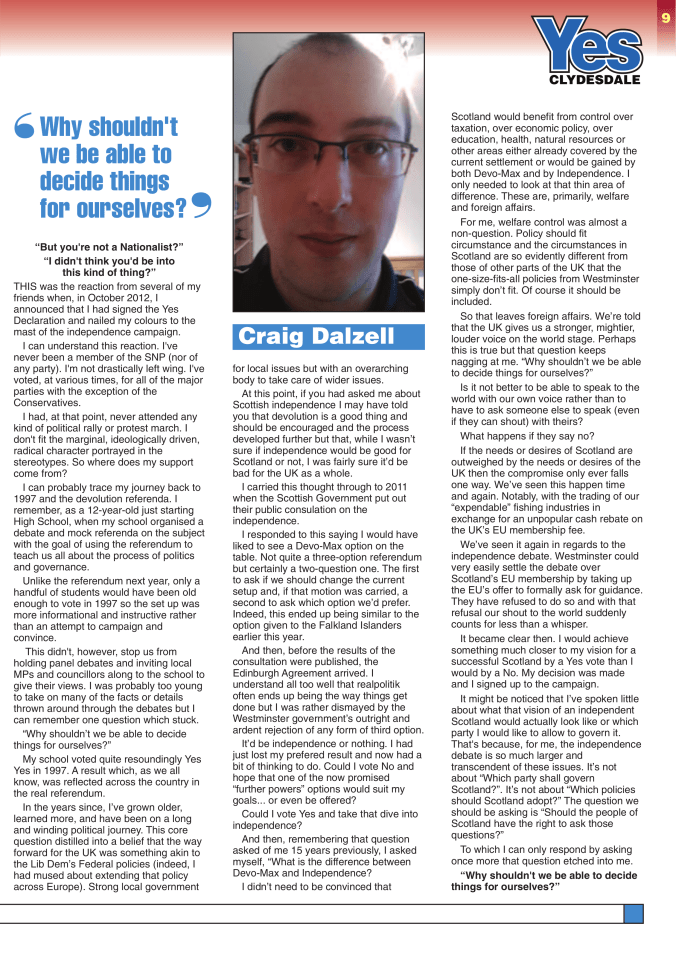
Why Shouldnt.png

tcg-logo5

We Need To Talk About: The “Tactical Vote”

“People who think about politics every day greatly overestimate how much time the average person spends thinking about politics” – A maxim that every political activist should pin on their wall.

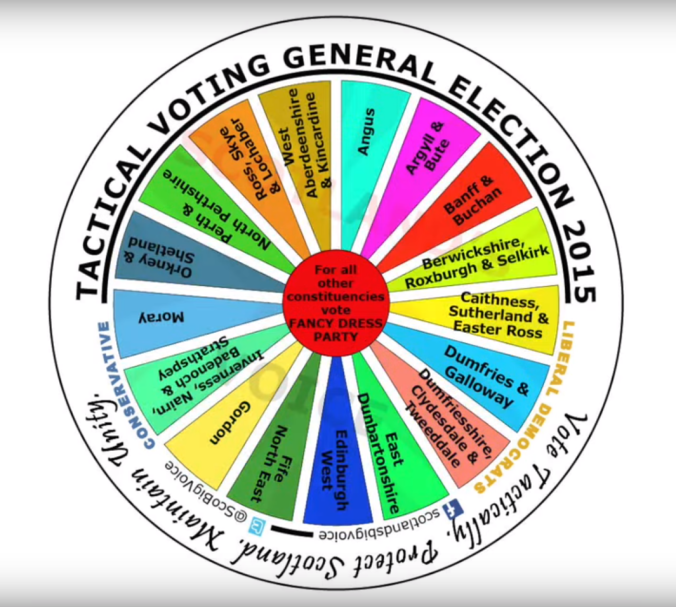
Wheel.png

One of the many, many parodies of the #SNPOUT “Tactical Voting Wheel” seen in the run up to the 2015 UK General Election. Source: Youtube

We’re just about to cross into the single digit weeks remaining before the 2016 Holyrood elections and among a subset of the political campaigning community the inevitable debate over the “tactical vote” rumbles on. I, myself, have had a couple of fairly interesting conversations with a few such voters over the past couple of days which crystalised a few thoughts in my head about it.

Continue reading

We Need To Talk About: Local Taxation


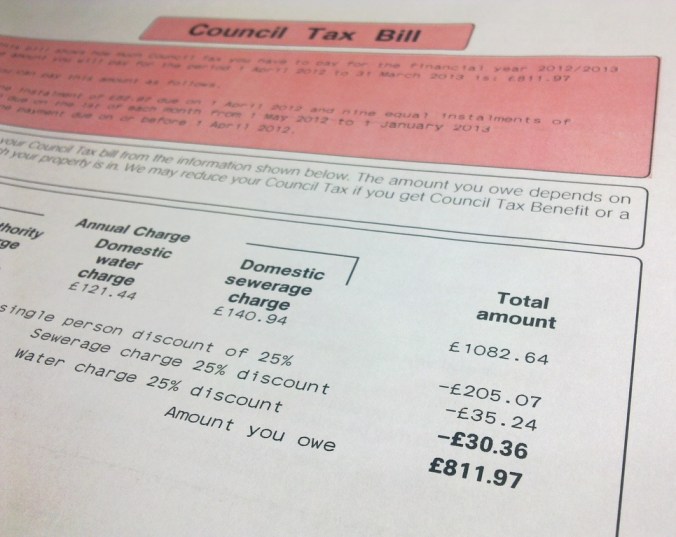
Council

Source: Flickr

Next year brings in the Scottish Parliamentary Elections and with it comes the proposals from each of the parties on how best to use the limited powers that the Scottish Government will have at its disposal. No doubt, much of the news and comment will be around whether or not the (marginally) expanded powers over income tax coming in under the Scotland Bill 2012 will be used and by how much.

Our approach towards local taxation, however, will perhaps lead to a far more fundamental change to the fabric of our society. There is also far greater scope within the devolution powers to do something a bit more radical that simply raising or lowering the rate of tax by a penny or so (or repeatedly defending one’s reasons for not doing so). It is therefore important, before the campaigning season begins in earnest, to understand what our options are and the potential impacts of them.

Continue reading

Greening Your Vote

Note: This article assumes that readers are fully familiar with the AMS voting system used in Scotland. If you are not or would like a refresher please read this article first:- How Scotland Votes: A Guide to the Scottish Elections

Greening Your Vote in the Scottish Elections

SGPlogoI’ve mentioned in a previous post that we in the Greens general regard the First Past the Post voting system as an unfair and unrepresentative system. It punishes all of those parties which poll less than about 35% of the electorate with fewer seats than they deserve whilst rewarding those parties which can achieve just slightly more than that with almost all of the power. For a smaller party like the Greens this means that looking for seats within the constituency vote is a particularly difficult enterprise and, in all likelyhood, would result in a waste of resources more effectively spent elsewhere.

For this reason it is very likely that you, as a voter, will not see a Green candidate on your constituency ballot paper next year (although exceptions like party co-convenor Patrick Harvie’s campaign in Kelvin will be one to seriously watch).

The great advantage within Scottish politics, however, lies in the Regional ballot. I’ve detailed in my How Scotland Votes article how this ballot is used to ensure proportionality within the parliament as a whole but this article intends to deal with another of its great strengths. The regional ballot allows voters who may describe themselves as “traditional” voters of one party to compliment or nuance their voting intentions by voting for another party as well.

I will here argue that in the Holyrood elections next year there is great scope for many voters to consider seeing a regional vote for the Greens not as a “splitting” of their vote but as a strengthening of it. Even when your “traditional” Constituency affiliation has been with the Labour party or the Liberal Democrats or with the SNP there is much that you may also find appealing within Green politics and much which may lead to you to giving us your Regional vote.

Continue reading

We Need To Talk About: The Green Investment Bank

gib-logo-green-background

Another day. Another broken promise from Westminster. I had been expecting news like this since the referendum last September but I’ve been frankly shocked by the rate at which they’ve been coming and where the hammer-blows have been falling.

Today it was announced that the Government will sell off the Green Investment Bank. The bank, capitalised with some £3 billion of taxpayers money, was set up in 2012 with the mandate for providing investment and incentive for renewable schemes across the UK. Its headquarters were located in Edinburgh in a bid, as it was reported at the time, to attempt to head off the push for Scottish Independence. Indeed, even just the week before the referendum dire warnings were uttered about the potential of Scotland “losing” the bank if we voted Yes (The news that the bank hadn’t actually been investing more than a token amount within Scotland in its first year or so was, of course, conveniently placed to the side).

Instead, now that we’ve “safely” voted No, the bank is to have up to 70% of its shares sold off to private interests for somewhere around £1.4 billion, under half of its initial capitalisation, at a time when it has just announced that it has become profitable.

Of course it’s not all just about the outright betrayal of Scottish voters. In this move, as well as last week’s scrapping of onshore wind incentives, David Cameron and his new Tory majority government are flexing their ideological muscles. Gone utterly is their “Greenest Government Ever“. To quote Scottish Greens co-convener Patrick Harvie on the topic today:

“The sell-off of the Green Investment Bank proves that David Cameron’s comment about wanting to ‘cut the green crap’ has now become a full-blown mantra for a right-wing Government determined to wreck our renewable energy opportunities. The bank was a half-hearted effort by the Tory-Libdem Coalition, with limited powers and funding. Rather than taking another backward step we need governments to go further and faster on developing new energy sources and cleaner industries as the need to leave fossil fuels in the ground becomes ever more urgent.”

Added to this is the call from Green Party of England and Wales MP Caroline Lucas:

“The Government’s rash and irresponsible plan to sell off a large chunk of the Green Investment Bank calls into question their commitment to investing in a low carbon economy.

“At precisely the time when we should be leading the world in the fight against climate change our Government appears to be in retreat. The Government should keep at least a majority stake in the Green Investment Bank to ensure investor confidence is upheld and the commitment to low-carbon lending remains.”

This is just another string of sell-offs by the Government of profitable parts of public service at a substantial loss to the taxpayer (joining such company as the East Coast Mail Line, The Channel Tunnel, The Royal Mail and many of the banks bailed out in 2008). It is purely an ideological move by the Tories to get the Government out of the business of owning any kind of body capable of serving the public.

I have to wonder what they think the endgame is. Just what do they want Tory Britain to look like?

And is there a place in it for us on the ground?

TCG logo