The conversion of an industry to public ownership is only the first step towards Socialism. It is an all-important step, for without it the conditions of further progress are not established. One important consequence is a shift of power that resolves the conflict between public and private claims. The danger of the State machine being manipulated by private vested interests is thus reduced. – Aneurin Bevan
(This blog post previously appeared in Common Weal’s weekly newsletter. Sign up for the newsletter here.)
Wales risks creeping ahead of Scotland in progressive policy again, if the Welsh Government adopts proposals put forward by the Institute for Welsh Affairs to radically increase the amount of community owned energy in Wales.
Their new paper, Sharing Power, Spreading Wealth, is a comprehensive map of the state of public energy in Wales and identifies just about every angle that we’ve been campaigning for in Scotland (including mention of the role of Ynni Cymru – the new public energy company set up by the Welsh Government based on our Powering Our Ambitions model of a National Energy Company).
The paper, like much of our energy campaigning, identifies profit extraction from energy resources as a major driver of the current cost of living crisis as well as a major barrier against the development of renewable energy around communities (it’s a bit of a hard sell to see your landscape covered in wind and solar generators knowing that your own energy bills keep going up and none of the profits stay similarly within eyeshot) but also identifies that Wales along, with even more limited devolved funding than Scotland has, is unlikely to be able to nationalise the entire sector.
“Spare your words, your actions will speak for you.” – Akiroq Brost
(This blog post previously appeared in Common Weal’s weekly newsletter. Sign up for the newsletter here.)
Imagine you’re applying for planning permission to build a house. Normally, the process would involve drawing up fairly detailed plans about what the house would look like. No plan goes perfectly to plan though and some changes are inevitable as the building process occurs but if the final building does deviate substantially from the initial plan there can be consequences up to and including being ordered to tear the whole thing down and start again. What you can’t do is gain permission to build “a house” without answering the basic questions like “What size is it?”, “How many bedrooms will it have?” or “Will it be made entirely of asbestos?”.
Over the past few months Common Weal have been incredibly busy replying to just a few of the public consultations that the Scottish Government and Scottish Parliament have been publishing. I’ve written before about the sheer volume of them, how much effort goes into each response and how little they often achieve despite the rare moments of serious influence or the fact that if folk don’t respond to them then vested interests end up dominating the responses and thus what the Government can point to as justification for their plans.
“So much for Objective Journalism. Don’t bother to look for it here–not under any byline of mine; or anyone else I can think of. With the possible exception of things like box scores, race results, and stock market tabulations, there is no such thing as Objective Journalism. The phrase itself is a pompous contradiction in terms.” – Hunter S. Thompson
(This blog post previously appeared in Common Weal’s weekly newsletter. Sign up for the newsletter here.)
I had a fascinating discussion on the Policy Podcast the other week. I spoke to a couple of our comrades at Melin Drafod, a Welsh pro-indy think tank who recently published a report on the fiscal position of an independent Wales (while they don’t directly reference any of our similarwork for an independent Scotland, it’s very interesting to see how the same structural weaknesses in devolution rear their head and how the same international principles and precedents also apply to Wales in similar ways to Scotland). They also organised a strategy seminar at the weekend attended by Robin on behalf of Common Weal and also by many members of the Welsh independence movement such as Plaid Cymru leader Adam Price. It’s a fascinating discussion and I encourage you all to listen to it.
During the discussion a very interesting question was raised that has been burrowing into my head since. I asked a question about the state of the UK’s media and how it plays its role in the unity of the British State. I reflected that from where I am it looks largely like Scotland has its own local media – much of it fragmented, underfunded or taking its orders from elsewhere, but some of it doing at least as best it can to tell us about what’s happening in Scotland – and then there is the UK media that gives a view of and from London. Never mind that we suffer from a limited outlook on and of the rest of the world, what we often lack is a view of the rest of the UK. I’d hazard that unless you have a specific interest in looking for information about it, you probably don’t really know all that much about what’s going on in Northern Ireland, or Wales, or Cornwall or even right across the border in the North of England (unless you live in the South of Scotland and get ITV Border from Cumbria rather than STV). Not unless whatever is happening is “big enough” to affect London in some way…then it gets noticed. I asked if the view from Wales was similar and my guests more or less confirmed it with the caveat that Scottish local news media is probably stronger than in Wales, especially after the sad demise of their iteration of The National newspaper.
Now here’s the question that has been niggling at me. I can see why things would be set up this way. Paymasters for a highly centralised state with a highly centralised economy probably want to know what is happing around them and around them is London. When cuts come, it’s easier to cut away at the periphery (i.e. everywhere else) and so local media erodes away. It’s also possibly true that the UK’s centralising political agenda is reinforcing itself through that media. What used to be a “Precious Union” of voluntarily associating states is being rapidly reframed as a unitary state of “Britain” and a unitary state requires a unitary message over and above any rustic notions of regional distinctiveness. So by broadcasting the same “London-First” message out to the provinces, you can ensure that they all hear the same message, sing the same song and believe in the same vision for the country. This whole state of affairs was hilariously and wonderfully illustrated in James Robertson’s poem “The News Where You Are”.
But is that strategy working? In one sense, keeping England relatively ignorant about Scotland (except insofar as the “national” message that Scotland is heavily subsidised by the UK is starting to stick in the “wrong” places), or Scotland relatively ignorant about Wales or vice versa has its role in dividing us from those who we would otherwise be standing in solidarity with. If we can’t see them, we can’t see our differences, sure, but we also can’t see our common strengths either.
This is something I see done much, much better in countries around – and even across – Europe. Organisations like Arte do a fantastic job of showcasing the best of Europe in a way that really does foster a common sense of “Europeness” because of all of its cultural corners, not in spite of them.
(And if you want a view of Scotland from the continent right now, then I can’t recommend enough theirrecent documentary on the current bedraggled state of the independence movement and compare it to one by dbate from a couple of years before. The light might be on for Scotland in Europe, but we have to understand what is being illuminated by it)
However the strategy of only broadcasting “the news where we are” might also be reaching its limit. Not only because access to information is generally easier these days (“generally” because access to MISinformation has never been easier and the search engines that act as our primary gatekeeper on the internet are straining under the weight of that misinformation combined with information-free “SEO” techniques and AI-driven confident-but-mindless drivel) but because there might well be another narrative forming in the minds of those who receive that news from where we are not. Namely, that if all of us around the periphery of the UK are seeing only the London-eye view of the “Precious Union” then that becomes our only point of contact with that Union. Then we who, as James Robertson said, can each see who we are end up comparing ourselves to that single point of contact. Of course, none of us really do. And so we start to question why we might want to stay in a union that doesn’t represent us, who we are or who we want to be. Ironically, if the Union celebrated the commonalities of all of us, it might have done more to bring us all together. It might even learn a little about itself and about us in the process and be all the stronger for it.
I’d really like to chew on this idea a bit more. Especially why the centre of the Union appears unable now to do precisely that and instead has resorted simply to trying to deny independence through sheer force of will. If you are involved in media circles and would like to discuss this and other aspects of the media in Britain on the Podcast then please do get in touch. Till then, let’s all try and do a bit more to look out into the world, to find out about our kindred spirits elsewhere and to see the news where we are not.
“Collaboration has no hierarchy. The Sun collaborates with soil to bring flowers on the earth.” – Amit Ray
(This blog post previously appeared in Common Weal’s weekly newsletter. Sign up for the newsletter here.)
This week saw the annual launch of the Scottish Government’s Programme for Government – its stated aims for the next year in Parliament. Usually at this time I’d be taking you through a deep dive of the various policy announcements and what they might mean for Scotland. The truth is though there isn’t really all that much there to dive into. Most of the major programmes mentioned in it (such as the National Care Service or the Circular Economy) have already been announced and are underway and many of the truly new announcements simply aren’t all that exciting. Even I, policy-geek amongst policy-geeks, can’t bring myself to get too excited about the devolution of the Aggregates Levy – the tax paid on taking stones and soil to landfill. It was one of the taxes devolved to Scotland in the wake of Indyref, the Smith Commission and the eventual Scotland Act 2016. The others were Income Tax (significant, but already straining at the seams of what is possible under devolution), Air Passenger Duty (the devolution of which was scrapped because of a potential legal fight with the EU), the assignment of VAT revenues (the devolution of which was scrapped because no-one could work out how to actually do it) and now Aggregates Levy (which will finally be devolved seven years and two Holyrood Elections after the mandate to do so). According to GERS, it’s currently worth around £58 million per year which is almost 1/16 of the estimated margin of error in the calculation of Scotland’s overall tax revenue.
The only other really noteworthy item is that the Scottish Government has finally acceded to the campaign to bring in the kind of tourist tax that almost all of us will be familiar with if we’ve travelled anywhere in Europe. Back in August, I spoke to the National about this kind of tax and mentioned the possibility of using it to fund or subsidise public transport and that perhaps tourists could be granted a free travel pass when they arrive in return.
But let’s talk about the most important policy announcement in this year’s PfG – so important that someone decided to leak it to the press ahead of time. The Scottish Government has decided to bring in an emergency rent freeze – backdated to the day of the PfG, though the legislation still needs to pass through Parliament. At the time of writing, we don’t yet know many of the details of the freeze itself including whether or not the Government will subsidise landlords for implementing the freeze. The news report announcing the leak mentioned a source who said that if the cost of the freeze was met by landlords then it would cost the Government nothing – this certainly suggests that if the landlords don’t cover the freeze then the Government may look at giving them partial or full compensation in the way that Liz Truss may be about to do to energy companies. It’s difficult to say how much this could cost as the freeze may only be for a limited duration (say, till March 2023) and many landlords – particularly in the public sector – only raise rates anyway once per Financial Year in April and some private landlords either do the same or weren’t planning to raise rates anyway (will they claim otherwise now if they can expect “free” money from the Government for doing so?).
“There is not a crime, there is not a dodge, there is not a trick, there is not a swindle, there is not a vice which does not live by secrecy.” – Joseph Pulitzer
(This blog post previously appeared in Common Weal’s weekly newsletter. Sign up for the newsletter here.)
(Since the original publication of this post, Ellen joined me on the Common Weal Policy Podcast to discuss the issues raised in more detail. You can listen to that show here.)
—
Common Weal has been at the forefront of Scottish democratic and governance reform since our inception – it’s one of the things that attracted me personally into the orbit of the organisation. One of our earliest campaign success stories was the creation of the Scottish lobbying register which, despite its many and still critical flaws, at least gives us some insight into who is talking to the Scottish Government and about what. Another area where we’ve been gaining ground is our ongoing campaign for better Scottish statistics – the Scottish Government has still not picked up our call for a dedicated Scottish Statistics Agency to fill gaps in data provision despite overwhelming support from SNP members three years ago.
Where these two areas intersect is how we, as citizens, gain access to data and information produced by the government which might be difficult to find or not published at all. You have a right called Freedom of Information which allows you to ask public bodies (including the government itself) about the information it holds on various topics. It can be a question such as how much has been spent on a project? Or how many times a Minister has met a specific person? Or anything else that isn’t routinely published or that the Government has good reason to not publish (perhaps due to national security concerns). There are, of course, caveats such as declining to publish information that would be difficult or expensive to obtain (perhaps the question was too broad or requires someone to trawl through a half-forgotten archive of paper records). All of this legislation is important. If we don’t know who is talking to government, what government is telling itself or what they’re not telling us then we cannot hold them to account for their actions. I’d go as far to say that an opaque government is inherently corrupt or, at least, cannot adequately demonstrate that it is not.
However, there are flaws in the current FOI legislation as well and we have been campaigning on reform to the legislation as well. In 2019 I took part in a very memorable meeting at the Scottish Parliament where we discussed various aspects of possible reform.
These reforms include ending “corporate confidentiality” in public-private contracts after the contracts have been signed (so we know precisely how much we’re spending and on what – especially on large infrastructure projects), mandating that private companies in receipt of public money should be covered by FOI when they spend it (so that government can’t hide behind a wall of privatisation), and – most serious of all – that government should end its unlawful practice of treating FOI requests from some people differently from others (such as allowing Ministers to “review”, delay or block FOI requests submitted by journalists). One of our key recommendations was to address a fundamental flaw in the FOI process itself which is that in order to get information into the public domain, you first need to be able to ask a question about it.
To ask the question “For the minutes of the meeting between the Minister for Energy and Coal Billionaire Joe McSmoke in August 2019?”, you first need to have some kind of suspicion that such a meeting even took place and that there’s a possibility that it was minuted and that those minutes were recorded in a way that is publishable. Instead, we’ve called for public bodies to adopt what we’ve termed to be a “Glass Wall” approach whereby any information that would normally be disclosed by a properly submitted FOI should be proactively published in a browsable archive (we may still need to submit something similar to an FOI to the curator of said archive to be able find said information but the point is that you wouldn’t need to).
I’m glad to say that many of these suggestions were accepted by the Committee and, eventually, by the Government itself. It brought about an investigation by the Information Commissioner to ensure that the recommendations were being carried out (especially the ending of unlawful interference of FOI by ministers) and which published last week.
It was this report that led me to discovering another fundamental flaw in the FOI process that surprised me and also throws the entire system into serious doubt as to its ability to ensure transparent government.
Folk in Indy circles will no doubt be aware of the ongoing story about the UK Government’s “secret polling” into public attitudes on the Union. This polling was done in around 2018 (so is almost certainly out of date now) but was never publicly published. A court case recently concluded with an instruction to publish the data and the latest in this story is that the UK Government is still refusing to publish and may need to be challenged again.
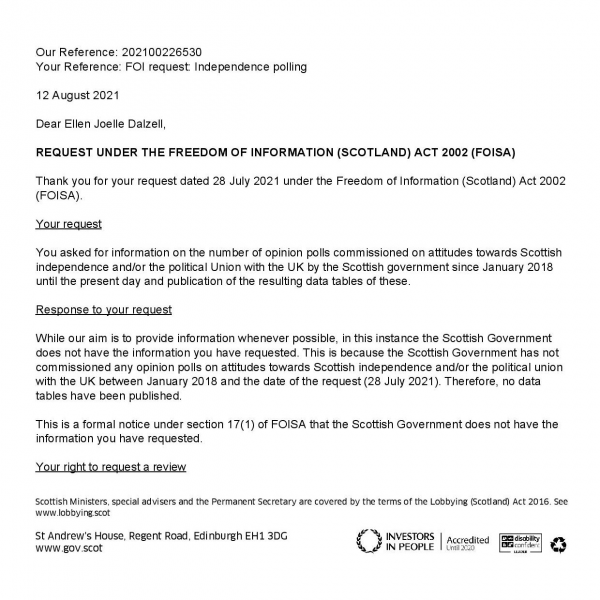
However, there is a twist to this story. When this all kicked off last year my wife Ellen asked the obvious but unasked question – If the UK Government isn’t publishing its polling on attitudes towards independence, why couldn’t the Scottish Government publish its own internal polling on the topic? Even better, once both were published, we could compare and contrast the results of the various questions asked. Not being able to find that polling in any of the public databases, Ellen submitted an FOI for its release and, to both of our surprise, we were told that the reason that this data hadn’t be published before and couldn’t be published now was because the Scottish Government hadn’t conducted any public polling on attitudes in the time between January 2018 and July 2021 when the request was submitted.
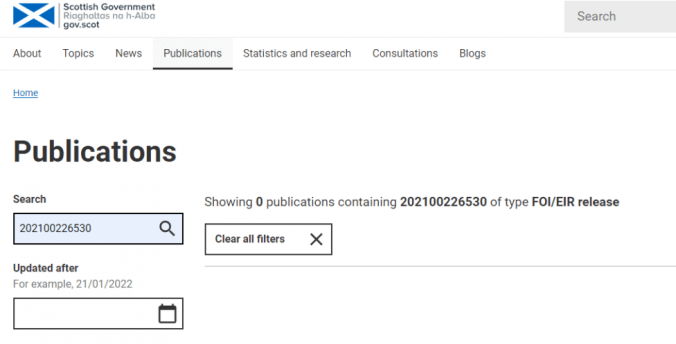
This could and should have been a major story last year and Ellen planned to send it around journalistic circles just as soon as a linkable version appeared on the Scottish Government FOI database. Several days passed without it doing so. Then weeks. Then a couple of months. To this day, if you search for her FOI request it still returns no result.
The Information Commissioner’s report last week brought the topic back to the front of our mind and Ellen contacted the Commissioner to try to find out if there was a reason that this FOI would not be published. The prompt reply frankly shocked us. A private reply to an FOI is considered by the Scottish Government to be a fulfilment of FOI legislation and puts the information into the “public domain” but there is no obligation in the legislation for the reply to be entered into a public database. Doing so is merely considered “best practice”.
Consider this for a moment. There is an obligation on the Scottish Government to respond to FOI requests but so long as they give the information to the person who asked the question, there is no obligation on them to let anyone else know about it. But, as it is now a public document, “leaking” it as I have done above isn’t even leaking – it’s just sharing a public document.
But this leads us to another question – how many FOI requests have been answered by private email and not shared more widely? I don’t think it’s a question anyone but the Scottish Government can answer with certainty but there may be a way of taking at least a stab at it. Whenever you submit an FOI request, you are given a unique reference number. That number – as per Ellen’s FOI above – takes the form of the year of submission and then a string of numbers. That string of numbers appears to be not random but at least somewhat sequential. The earliest FOI in the database is FoI/16/00690 published on October 23rd 2017 and the most recent as of the time of writing – published on May 24th 2022 – is FOI/202200296591. As of the time of writing there are 8879 FOI replies in the database. I don’t know if the sequence of ID numbers includes documents other than FOIs (is document 202200296592 some other letter to or from a civil servant perhaps?) but I can’t imagine why it would. It may be that some of these FOIs have been sent to other public bodies (such as Local Authorities) and published in their own databases but – as said above – we have a clear example of at least one FOI to the Scottish Government that has not been published. Assuming each of these numbers does refer solely to a unique FOI request and its reply and the reference number is as sequential as it appears to be then that may suggest that in the worst case, less than 30% of FOI requests to the Scottish Government have been published in a public manner beyond a direct reply to the person who submitted the request. I dearly hope there’s an explanation out there that means that things aren’t as bad as that. If anyone has one, please do let me know.
I’d be really interested to hear your experiences with this. If you have submitted an FOI request and found that your reply is not on the database then let us know. I’m not sure what we can do from there. We could probably do more to train up volunteers to submit FOIs and have them share their replies with us but how can we do more than that? Does Common Weal have to publish these FOIs ourselves? Do we have to partner with some journalists to create a “Shadow Repository” of all of the FOIs the Government didn’t want you to see? Will just the threat of doing so force an explanation from the Government? Whether by actual legislation or, as a distant second, firm departmental commitments to actually follow “best practice” the Scottish Government should and must publish ALL FOI requests that it responds to. Even the “frivolous” ones. Even the “vexatious” ones. Even the “inconvenient” ones from journalists and especially even the ones that reveal that the Scottish Government hasn’t been doing work that it should have been doing as it prepares to fight another independence campaign. For their part, the Information Commissioner’s office confirmed to us that it is not within their remit to force FOI replies to be published again, because it is not a statutory requirement.
As I said at the top of this piece, I don’t think we can have a functioning democracy without transparency and accountability. Corruption is inevitable if power remains in the dark and behind closed doors. If only a select few have access to information, the same results. From a very practical standpoint, it’s also a complete waste of resources to have to blindly keep asking the same FOI questions because you didn’t know that someone else asked for the same information some time before you. In a very real sense there can be no freedom without freedom of information. The Scottish Government can and must ensure that all of us can see what it is doing at all times. If they don’t, we have to ask the final obvious, unasked question. What, precisely, are they hiding from us?
“The conditional programs inherently use poverty as a threat. That’s Cruel. Shouldn’t we be ashamed of ourselves?” ― Karl Widerquist
The mounting crisis caused by the COVID-19 pandemic is forcing countries to adopt unprecedented measures to combat it. In addition to the public health measures such as physical distancing (not social distancing. At times like this we need MORE social solidarity) we’re also seeing unprecidented measures being deployed to salvage an economy that has practically ground to a halt. Unlike any economic recession since possibly the 1930s we’re seeing a combined demand and supply shock. The virus makes it hard to make and sell things and everyone is at home in quarantine so no-one is buying the things anyway.
This isn’t true of all sectors of course and a great deal of effort is being expended to keep essential services like food deliveries running. In addition to my friends working in the health service and my family working in the care sector, my hat goes absolutely off to my friends working in the food sector. When the day comes that we’re allowed to buy a round for each other again, they’ve all more than earned a few from me.
“Fact be virtuous, or vicious, as Fortune pleaseth” – Thomas Hobbes
It’s that time again! The annual GERS report has been released and interested parties continue to analyse, pick apart and spin the numbers as required. And my now annual tradition of diving into the numbers continues with another installment.
“Perhaps the answer is that it is necessary to slow down, finally giving up on economistic fanaticism and collectively rethink the true meaning of the word “wealth.” Wealth does not mean a person who owns a lot, but refers to someone who has enough time to enjoy what nature and human collaboration place within everyone’s reach.” – Franco Bifo Berardi
This weekend will see the SNP conference and the long awaited vote on whether or not to adopt the Sustainable Growth Commission’s report as the party’s main economic strategy for an independent Scotland. After almost a year of discussing this document, the party will have their final say on whether or not to adopt it as party policy.
I have written tens of thousands of words of critique, commentary and policy work on this topic. There will be more to come between the time that this blog is published and the vote on Saturday afternoon. Much of it has been centred around currency and the macroeconomic policies. Here, I’d like to look at things from a slightly different lens. How does the Growth Commission reflect upon Nicola Sturgeon’s plan to introduce a Scottish Green New Deal?
If this is a discussion document – It’s time to start discussing it.
The Growth Commission’s long-awaited report is finally out and will surely take some time to fully digest. It has been described as a discussion document and a starting point for the revitalised case for independence; not the final word on SNP policy or national trajectory.
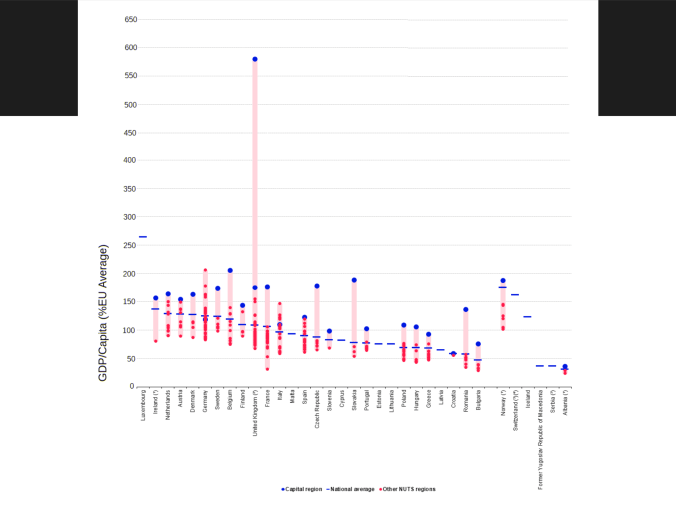
In many ways, the report covers ground now very familiar to campaigners in the independence debate. We’re all now quite familiar with the deep and systemic flaws of the UK’s economic system especially its regional inequality which, quite frankly, is embarrassing when compared to neighbouring countries in Europe.
“A system of government as close to federalism as you can have in a nation where one part forms 85% of the population” – Gordon Brown, 2014
The “F-word” is rearing its head again in Scottish politics. Federalism. An idea sometimes presented as a “credible” alternative to Scottish independence and a way of granting Scotland greater autonomy over its own affairs whilst maintaining the unity of the United Kingdom. Unfortunately, it’s also an idea that is rarely presented in any greater detail than that previous sentence.
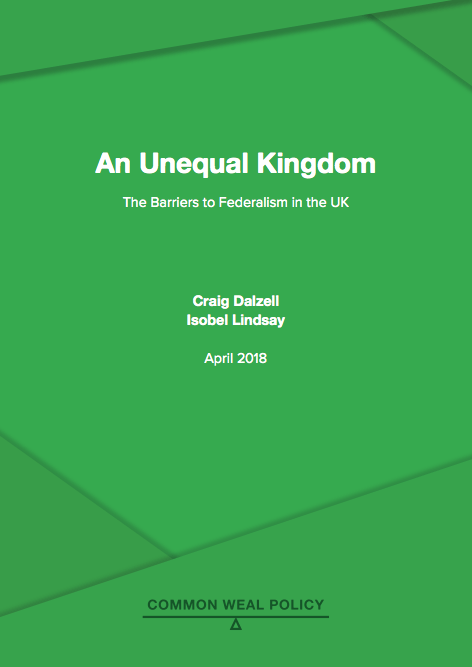
Both Scottish Labour and the Scottish Liberal Democrats have flirted with this idea throughout their history and have been doing so again recently. In an attempt to raise the level of debate about this subject, I have just co-authored my latest policy paper for Common Weal with long-time constitutional activist Isobel Lindsay which you can read here or by clicking the image below. Isobel also has an article in the Sunday Herald which you can read here.






 The Common Green