The Devolution Journey: Devolution and Tax

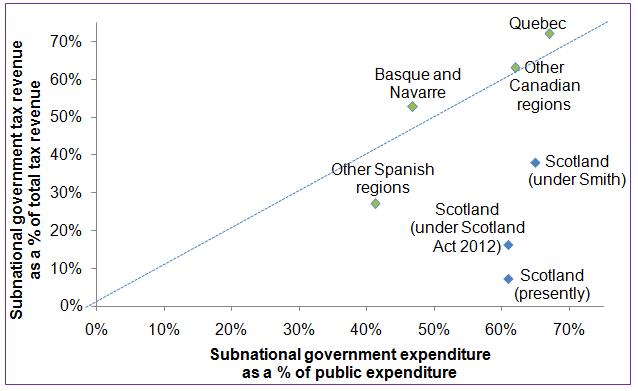
A comparison of the % of devolved control in Scotland now, under 2012 and under Smith as well as a comparison with Spain and Canada. Source: Scottish Government.

A comparison of the % of devolved control in Scotland now, as it will be under the Scotland Act 2012 and under Smith Commission recommendations as well as a comparison with Spain and Canada. Source: Scottish Government.

Monday the 9th of November saw the Scotland Bill 2015 make a further step towards completion. This Bill, which has been the result of the aftermath of the 2014 independence referendum, will mark another milestone on the devolution “journey” Scotland is traveling upon.

Some of the commentary both during the actual debate in the House of Commons and in the days since have shown considerable confusion at just how the system of devolution in the UK works at the moment and how it is to change with the implementation of the Bill. Before we really settle into a meaningful debate on whether or not any “additional powers” for Scotland will be to and for Scotland’s benefit we need to actually understand what those new powers are, what we have now and how they can be used.

This article shall focus on the powers over taxation devolved to the Scottish Parliament as this area will be undergoing several rapid changes over the next few years and much of the confusion amongst members of the public has arisen from the conflation of several phases of devolution.

One must understand the rather unplanned and piecemeal nature of the progression of devolution for Scotland, there is certainly no clear “destination” to that “journey”, and this reflects and contributes to the confusion but there are three major points in the form of the Scotland Act 1998 which formed the Scottish Parliament after the success of 1997 Devolution Referendum; the Scotland Act 2012 which resulted from the 2007 Calman Commission and the aforementioned Scotland Act 2015 resulting from the Smith Commission of 2014.

Continue reading

How To Start a Currency From (Almost) Scratch

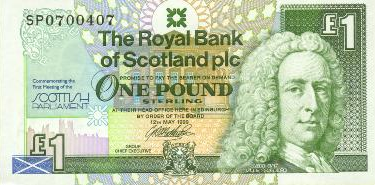
An RBS £1 Note – Scottish Parliament Commemorative Issue

It’s fairly widely acknowledged that one of the weaker aspects of the 2014 Scottish Independence debate was that surrounding currency. I still hold to my long-standing view that all options open to us were and are equally viable. All come with unique benefits, all carry characteristic risks. All that was required was the will to manage those risks. Scottish Independence should never have even been about the question “Which currency should we use?”. I believe that instead, the real question was “Should we, in Scotland, have the right to ask that question?”

Recently though, the catastrophic circumstances facing Greece have focused minds back to this first question and many are now convinced that before we go into another debate on independence we must be able to answer the questions we failed to answer last year. So let us take a scenario where Scotland is faced with setting up its own currency. Just what would that involve?

Continue reading

We Need To Talk About: The Green Investment Bank

gib-logo-green-background

Another day. Another broken promise from Westminster. I had been expecting news like this since the referendum last September but I’ve been frankly shocked by the rate at which they’ve been coming and where the hammer-blows have been falling.

Today it was announced that the Government will sell off the Green Investment Bank. The bank, capitalised with some £3 billion of taxpayers money, was set up in 2012 with the mandate for providing investment and incentive for renewable schemes across the UK. Its headquarters were located in Edinburgh in a bid, as it was reported at the time, to attempt to head off the push for Scottish Independence. Indeed, even just the week before the referendum dire warnings were uttered about the potential of Scotland “losing” the bank if we voted Yes (The news that the bank hadn’t actually been investing more than a token amount within Scotland in its first year or so was, of course, conveniently placed to the side).

Instead, now that we’ve “safely” voted No, the bank is to have up to 70% of its shares sold off to private interests for somewhere around £1.4 billion, under half of its initial capitalisation, at a time when it has just announced that it has become profitable.

Of course it’s not all just about the outright betrayal of Scottish voters. In this move, as well as last week’s scrapping of onshore wind incentives, David Cameron and his new Tory majority government are flexing their ideological muscles. Gone utterly is their “Greenest Government Ever“. To quote Scottish Greens co-convener Patrick Harvie on the topic today:

“The sell-off of the Green Investment Bank proves that David Cameron’s comment about wanting to ‘cut the green crap’ has now become a full-blown mantra for a right-wing Government determined to wreck our renewable energy opportunities. The bank was a half-hearted effort by the Tory-Libdem Coalition, with limited powers and funding. Rather than taking another backward step we need governments to go further and faster on developing new energy sources and cleaner industries as the need to leave fossil fuels in the ground becomes ever more urgent.”

Added to this is the call from Green Party of England and Wales MP Caroline Lucas:

“The Government’s rash and irresponsible plan to sell off a large chunk of the Green Investment Bank calls into question their commitment to investing in a low carbon economy.

“At precisely the time when we should be leading the world in the fight against climate change our Government appears to be in retreat. The Government should keep at least a majority stake in the Green Investment Bank to ensure investor confidence is upheld and the commitment to low-carbon lending remains.”

This is just another string of sell-offs by the Government of profitable parts of public service at a substantial loss to the taxpayer (joining such company as the East Coast Mail Line, The Channel Tunnel, The Royal Mail and many of the banks bailed out in 2008). It is purely an ideological move by the Tories to get the Government out of the business of owning any kind of body capable of serving the public.

I have to wonder what they think the endgame is. Just what do they want Tory Britain to look like?

And is there a place in it for us on the ground?

TCG logo