The White Paper Project

“Work as if you live in the early days of a better nation.” – Alasdair Gray
wpp-v1-cover

Today I get to announce the launch of a very long awaited project I and the rest of Common Weal have been working on for quite some time now. We announced back in September that we have been working on renewing the case for Scottish independence by publishing a successor to the Scottish Government’s “Scotland’s Future” document.

Version 1.0 of the Common Weal White Paper can be download here or by clicking the image above.

This is a leaner document than Scotland’s Future was. That document was as much a party political campaign device as it was a blueprint for independence. It not only sought to describe the powers which would come to Scotland independence but also sought to convince voters of the SNP’s own vision for independence. There was nothing inherently wrong with this latter task per se and other parties too sought to promote their own distinct visions as well – as they will all do so again throughout the next independence campaign but this is not the task of an independence White Paper. This paper shall, as far as possible, not seek to propose a list of policy ideas which an independent Scotland could do nor shall it attempt to convince you of the merits of those policies. It merely lays out the technical and structural requirements which must be in place for Scotland to become an independent country once we, the voters, decide that it should become so.

It is a “consolidated business plan for the establishment of a new nation state”.

To this end, the White Paper is split into several broad sections. Part 1, Process and Structures, covers the foundation of a National Commission – a cross party and cross administration body which will be tasked with designing and implementing the institutions and systems which need to be set up in the time between the independence referendum and the formal independence day. It is one thing to state, for instance, “There shall be a Scottish Central Bank”. It is quite another to decide how large it needs to be, where it needs to be based and who needs to be hired to run it. The National Commission shall also be given interim borrowing powers so that it is able to issue bonds, raise capital and fund the construction of the vital infrastructure Scotland would need to either move from rUK or build from fresh.

Part 2, Key Institutions of an Independent Scotland, covers all those things we kept being asked questions about during the last referendum. Would we have a constitution? A currency? What would we do about borders? Defence? All these and more. Of course it’s not yet possible to answer every question in this regard. Some of it will be up for negotiation with rUK, some of it will be dependent on the shape of the Brexit deal between the UK and the EU and Scotland’s relationship with both in the run up to independence but we’re making a stab at as much as we can and this is the section which will perhaps be most expanded upon as the Project is iterated in future versions.

Speaking of negotiations, Part 3 covers the prospective shape of some of these – chiefly the allocation of debt and assets and what rUK’s response to our leaving shall mean for our claim on them. Also covered to some degree is how Scotland will interact with various international and supranational organisations although it should be stated once again that no case shall be strongly made for Scotland’s joining or refusal to join any of these organisations. That shall be left to the party or parties which seek to form the first independent Scottish parliament.

Finally, Part 4 outlines the position of Scotland as far as finance and borrowing goes as well as outlining as best we can the default fiscal budget for year one of independence. It is, of course, almost impossible to place any kind of actual certainty or promise on such a budget as it is based on several key assumptions such as the desire to keep both public spending and the various tax revenue streams broadly similar to their position at present. If a party decided to scrap the entire tax system and replace it with one of their own devising then it would have to be up to them to explain how that worked and project the revenue to be gained from it and how it would be spent. Other assumptions include Scotland spending the money assigned to it in GERS for various “UK projects” on projects of similar value and in similar accounting lines (so that, to pick an arbitrary example, our “share” of UK economic development funding spent outside Scotland but from which Scotland “benefits” would instead be spent on economic development within Scotland). Again, whether or not this happens will be a case for the individual parties to make and will depend entirely on accurately and precisely how the current fiscal projections for a devolved Scotland within the UK map onto the fiscal situation of an independent Scotland.

Once again, this is not the completion of the White Paper. This is the beginning. You will see that there are several sections which need to be expanded and built upon and items like costs and figures will be updated as time goes on (the default budget, for instance, is based on 2015-16 figures but – as we’ve probably noticed by now – Scotland didn’t become independent in 2015-16 so these precise figures will be revised as and when they should be). Some areas require the attention of people with specific experience and expertise in them to be able to complete so we are openly calling for those experts who are able and willing to contribute. Please contact us if you want to be involved. Let’s work to build the early days of our better nation.

TCG Logo 7.png

Beyond GERS

Today has seen the publication of my latest contribution to Common Weal’s White Paper Project. Click here to take you to the launch page or on the image below to take your directly to the paper. Further coverage can be found here and here in The National.

Beyond GERS cover.png

Preface

GERS (Government Expenditure and Revenue Scotland) 2015/16 reported Scotland’s fiscal deficit to be in the region of £14 billion per year, portraying Scotland as the country experiencing some of the most challenging financial circumstances in Europe.

However, this study must be viewed firmly in the light of Scotland being a member nation of the United Kingdom and, as such, any attempt to use them to project the finances of an independent Scotland must be treated with caution and qualification.

The very act of independence will result in significant redistributions and reallocations of government resources which will likely result in economic benefits accruing to Scotland. Additionally, decisions on how to establish and govern new Scottish state institutions will also improve Scotland’s budget at the point of set-up, further strengthening the fiscal position vis-à-vis that presented in GERS and that of the rest of the United Kingdom.

Key Points

• The act of independence brings with it many structural changes which will significantly benefit Scotland’s fiscal position to the effect of several billion pounds equivalent per year.

• By shifting the focus of defence from one of outward projection and nuclear deterrent to one more in line with modern European nations, savings of approximately £1.1 billion per year can be realised. Even in the event of Scotland committing to NATO member defence spending targets of 2% of GDP, the increased spending within Scotland can be expected to have additional economic benefits resulting in tax revenue increases of around £300 million per year compared to the status quo.

• A reasonable case for the debt and asset negotiations due to independence will result in Scotland saving up to £1.7 billion per year in debt interest repayments.

• The legal requirement of the UK Government to provide the UK State Pension for all those who have met the criteria would likely have to be the subject of negotiation post-independence, but the expectation would be that this would lead to billion-pound savings for the Scottish Government in at least the first year.

• A substantial fraction of unidentifiable spending accounted to Scotland is, in all likelihood, spending to cover UK wide government functions which Scotland may or may not choose to replicate or reproduce in some form post independence. Whilst savings will be made by reason of lower running costs and wages in Scotland compared to London, the additional economic benefits of spending in Scotland instead of elsewhere in the UK could result in additional tax revenues of approximately £719 million per year.

• The opportunity for an independent Scotland to redesign the tax code from the ground up, eliminating built in inefficiencies, loopholes and exceptions will help reduce the “tax gap” by approximately one-third, increasing revenue by about £3.5 billion per year.

• Whilst the UK’s tax revenue as a percentage of GDP is around the OECD average, many countries neighbouring it successfully maintain higher rates of tax revenues which, if replicated in Key Points: Scotland, could further improve the financial situation by several billions per year.

• Even without increasing tax revenue as a percentage of GDP, an independent Scotland could be placed in a position of relative “deficit parity” with the current UK budget.


Regular readers will know now that Common Weal has been very hard at work looking at the issues surrounding the independence debate, especially those arguments which just simply didn’t convince a certain segment of voters. We were all hoping that ‘someone else’ would come along and do this right after the last referendum but, for various reasons, it hasn’t happened. So Common Weal has decided to just roll up our collective sleeves and do it.

We’ve already published a paper reopening the currency debate, debt and assets, a proposal for a National Investment Bank and others. We want to produce further papers on pensions, defence, customs and excise, a detailed paper on the role of the Central Bank of Scotland, and others. All working up to a paper not just showing the limitations of accounting exercises like GERS but doing away with it entirely and building a case for an independent Scottish budget built from the ground up to suit our needs, rather than just being a tweaked version of what the UK does.

We are incredibly under resourced for this work but we think it’s work worth doing.

If you do too, perhaps you’d like to consider a donation to Common Weal to help us on our way: www.allofusfirst.org/donate
tcg-logo6c


We Need To Talk About: GERS (2015-16 Edition)

O wad some Pow’r the giftie gie us. To see oursels as ithers see us! – To a Louse, Robert Burns

It’s that time again. The annual Government Expenditure and Revenue Scotland report is out. Click the link or the image below to read it for yourself.

GERS 2015-16

Actually it seems like only March that the last edition was out. What’s happening here?

Well, there was a consultation that almost no-one knew about which discussed a few methodological changes to GERS in line with the ‘new powers’ we’re getting and it also asked if the next report should be brought forward. I’m completely convinced that the fact that this means that we’re getting the report well before the Council election campaign next year is absolutely just a convenient side effect(!)…but no matter. We’ve got the data.

Tomorrow’s Headline Today

Scotland’s budget deficit remains at a little under £15 billion. As with last year, don’t expect a single news outlet to go one single step further with the story than that. Except maybe to say that oil revenue has dropped from £1.802 billion last year to just £60 million this year.

So what’s happened? Why hasn’t Scotland, which is “totally dependent on oil”, completely collapsed now that oil revenues have basically dropped to zero?

Last year, total revenues dropped by  around £500 million on 2013-14. This year, total revenues have INCREASED by £181 million. In fact, total revenue is higher than it was in 2012-13 when we received some £5.3 billion in oil revenue.

It’s also worth noting that if you only look at GERS 2015-16 then it looks like our deficit has increased by a couple of hundred million in the past year but if you look a bit deeper, and compare the numbers to previous GERS reports then something interesting happens.

In GERS 2014-15 our deficit was recorded as £14.8 billion but in GERS 2015-16 the 2014-15 deficit has somehow dropped by £622 million to £14.3 billion. Essentially, this shows one of the limits of GERS in that it is based on sometimes highly speculative estimates which get revised over time. It may be five years before we finally know the “true” accounts figures for this year. This accounting adjustment is extremely significant compared to, say, our “budget underspends” but unless you’ve read it here I expect it to pass entirely unnoticed.

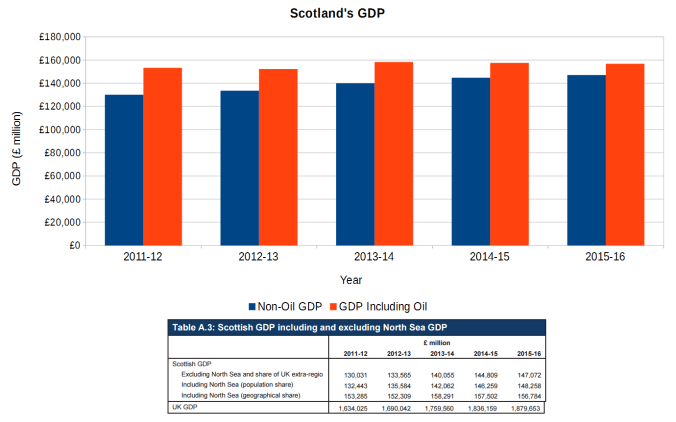
Now, what about our all hallowed GDP? It’s down by 0.45% from £157.502 billion in 2014-15 to £156.784 billion in 2015-16 (with non-oil GDP having increased by over £2.2 billion, the highest it’s ever been).

GDP GERS 2015-16.png

You know, perhaps it’s time we started measuring our economy in terms other than just GDP. We know it’s flawed. We know it throws up extremely strange results like Ireland’s “economy” growing by 25% because a few American companies moved their nameplates around. We know it doesn’t even particularly correlate to things like tax and ability to service debt very well.

Maybe it’s time we started measuring (and taxing) our country based on the things which actually matter.

But back to GERS.

Dutch Disease with Scottish Characteristics

So what’s going on here? Essentially it’s the same pattern first picked up last year. As oil prices drop, so do fuel costs. Which means everything from the costs of transporting goods to the heating and lighting costs for your home drops. This means you have more money to spend in the economy and companies have fewer overheads leading to either greater profits (thus, ideally, more tax revenue) or more room to invest in expansion.

This is a clear demonstration of the so-called “Dutch Disease” where high oil prices choke off the non-oil based economy in the form of the aforementioned fuel costs (it also tends to harden one’s currency but this is less of a factor in the Scottish case given that we don’t yet have one).

At the time of the last report I was criticised for pointing this out on the grounds that the oil price collapse “hadn’t fully fed through” hence I was jumping the gun on the observation. It shall be interesting to see if anyone says the same thing now. Could revenues drop any lower?

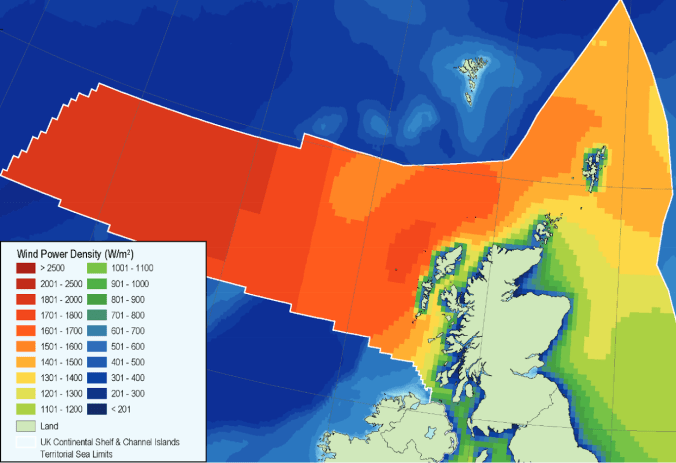
This should serve as somewhat of a warning to those itching for the return of high oil prices and certainly for those desperate to “replace” offshore oil with onshore fracking. It’s maybe time to have a good hard rethink about what kind of resources we want to develop in Scotland. Now, to be sure, I’ve nothing against our offshore industry and for those folk out there it’s been a pretty dreadful time. It’s just that, certainly as a Green, I think our offshore industry is on the wrong side of the country and should be based on wind/wave and tide rather than oil. You can be sure that  if the wind and tide stops flowing we’ll be dealing with problems a little bit larger than the state of our finances.

Scotland Offshore Wind Power Density

Scotland’s offshore Wind Power Density map

Sweet Fiscal Autonomy

As mentioned earlier, part of the methodological changes discussed in the GERS consultation was to do with looking at the taxes to be devolved to Scotland under the series of “vast, new powers” we’ve been generously granted.

In terms of actual revenue, chief amongst these is income tax (excluding interest and dividends, the ability to move the Personal Allowance or to adjust the definition of “income”) and VAT (excluding any actual control at all. We’re getting the VAT added to Scottish coffers and then an equivalent amount removed from the block grant. Yay.) along with comparatively minor taxes like landfill tax, aggregate levy and air passenger duty.

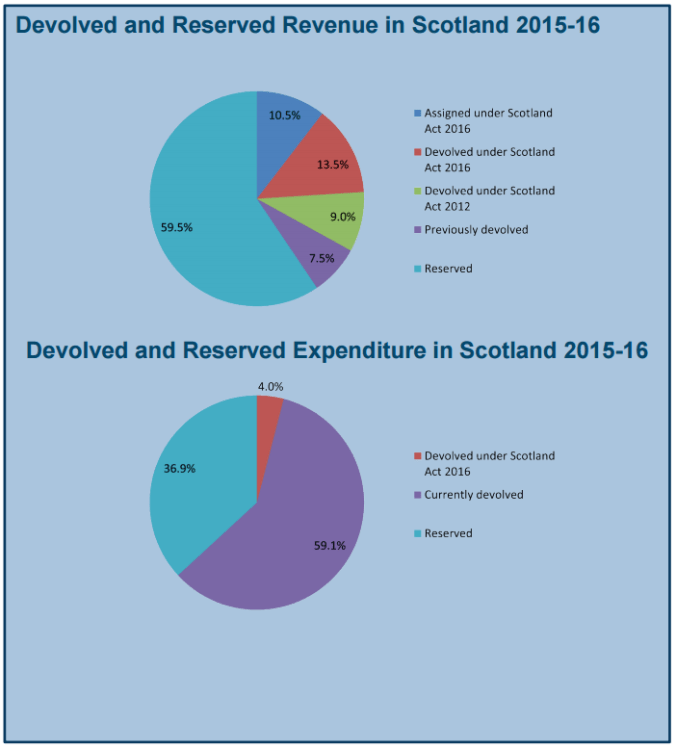
In total, the Scottish government will directly receive 40.5% of Scottish revenue (£21.8 billion this year) and, given the limitations on VAT and income tax, have actual, practical control over perhaps half of that. Devolved expenditure, however, will soon sit at 63.1% of total (£43.3 billion). Basically the Scottish government can only directly control enough income to fund perhaps about a quarter of what it’s directly responsible for delivering.

SFA.png

There’s a side issue in all of this related to that old topic of the budget underspends. Tucked away on page 47 of GERS there’s an interesting line which looks at the confidence intervals for some of the tax revenues used. Remember that the revenues given are estimates and are subject both to revision over time and change due to circumstances that the government cannot control. For example, if you move job half way through the tax year your income, therefore income tax, can change. If your job moves you to England, your entire income tax contribution moves from the Scotland side of the budget to the rUK one. Hence, the total income tax revenue estimate is subject to a margin of error, in this case of 1.0%.

The same goes for other taxes to greater or lesser degree to the effect that the margin of error over all of the taxes measured there is 1.6% or ±£570 million.

Remember that the Scottish Government has extremely limited borrowing powers. It can only “overspend” on the current budget by £200 million in a single year and cannot exceed a total current debt of £500 million. And yet income revenue, on which expenditure must be planned, has a margin of error of ±£570 million.

In the event, this year Scotland’s “underspend” was only £150 million. If you think you can plan a budget better than this then please, send it in. If not, might be a good idea to stop reporting and moaning about underspends.

Paying For It

PFI.png

Another little line that seems to have been added to GERS this year (on page 37) is a breakdown of the annual costs of financing Labour’s PFI and the SNP’s replacement NPD loans. There’s been a bit of a milestone reached there with the availability costs of PFI now exceeding £1 billion per year or over 15% of Scotland’s total capital budget and slated to increase even further over the next decade unless something is done about it. Don’t be surprised if this becomes a major issue for the council elections next year.

PFI.jpg

Of course and once again you wouldn’t know this if all you did was watch our Great British Broadcaster, the BBC. Their recent “investigation” into PFI couldn’t even bring itself to mention the name of the party which lumped this crippling financial burden on us.

Finally

I could go on. We could nip-pick at details like the mysterious addition to the expenditure budget of net EU contributions (there’s always been an annex discussing this but this is first year it has explicitly been counted in a separate line in Total Expenditure) or notice that for the first time in at least five years our debt interest paid has increased as our UK debt increases have started to outweigh the effect of falling bond yields.

It’s all a shell game though. We know that GERS isn’t nearly as important as people hold it to be nor is it nearly as informative as it should be. It’s not going to change many minds on its own nor does it tell us one single thing about the finances of an independent Scotland. If we want to do that, we’re going to need to build a national budget from scratch, taking into account all of the taxes (existing and new) that an independent Scotland might choose to levy. We also need to have a look again at what Scotland actually needs to spend its money on. Could we use Citizen’s Income to create from scratch a welfare system worthy of the name? Would a Scottish Government able to issue its own bonds on its own debt be able to get a better deal than the one we have right now?

Quite simply can Scotland as a nation see ourselves as better than others would prefer us to be seen?

tcg-logo6c

Poll: Scottish Independence and the EU

SaltireEU2

I’d like to run another informal poll. This time looking at attitudes towards independence in the light of the EU situation. Whilst all views are welcome I’m particularly interested in hearing from the segment of the voting population who are for Scotland’s independence from the UK but are skeptical of or outright against Scotland’s membership of the EU.

If, as appears highly likely, we are presented with an independence referendum predicated on EU membership, which way would you vote?

Please feel more than free to use the comments to expand on your thoughts. Incidentally, if you are someone who previously voted or were minded to vote No in 2014 but have since changed your mind to Yes, I’d also love to hear your views.

As previously, if this is your first time commenting on this blog or if you include more than a couple of external links in your comment it is likely that you’ll land in the moderation queue. I’ll try and approve things as quickly as I can.

tcg-logo6c

A Sovereign Currency for an Independent Scotland

As promised, I can finally reveal my work examining Scotland’s currency options going forward into the next independence campaign.

My report has been published through Common Weal and can be read here or by clicking the image below.

Currency cover

In it I first examine the macroeconomic considerations which go into selecting a currency option, chiefly looking at the interaction between movement of capital, interest rates and exchange rates. It turns out that it is impossible to have full control over all three at any one time so all currency options entail therefore some degree of risk or management requirements including the founding of infrastructure such as a Central Bank. All options have their advantages and disadvantages, their risks and rewards.

Continue reading →

We Need To Talk About: A Negative Income Tax

First up, my apologies for going a little dark on the blog recently. Last month, I promised my thoughts on Scotland’s currency options going into the next independence campaign. That promise has turned into something a little bit larger than expected and will be coming soon. I think you’ll like it.

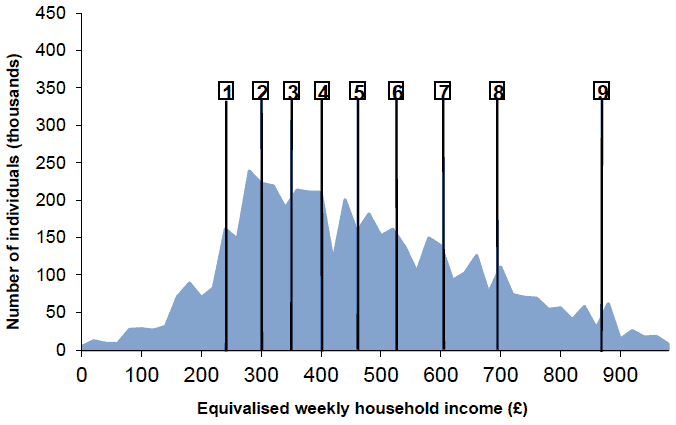
income decile

Scotland’s Income Distribution 2013-14

In the meantime, I’ve been pondering on some possible options regarding how we could reform Scotland’s welfare system, especially in the light that the UK has been explicitly called out by the United Nations for breaching human rights obligations due to the suffering caused by Austerity, inequality and the unfair and miserly welfare system in which too many find themselves trapped. The use of sanctions has been singled out as particularly cruel with countless cases of hardship and even deaths being directly linked to their use.

Both the Greens and Common Weal have been steadfast supporters of the policy of Citizen’s Income (or Universal Basic Income), a policy which is rapidly gaining traction around the world and is starting to look as if its time has come.

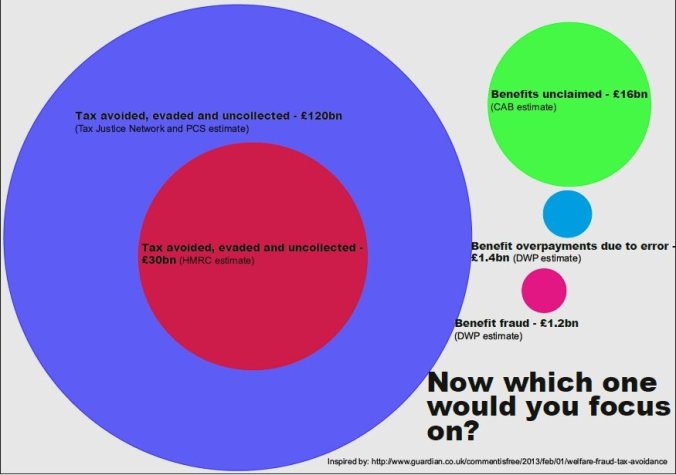
Under this policy the entire welfare system – with all its inequalities, complicated means-tested targeting, exceptions, exemptions, loopholes, paperwork, cheats, dodges, admin errors, fraudsters, bureaucracy and people simply missing out entirely because they don’t know they’re owed money or do but don’t, can’t or won’t claim – is done away with and replaced with a simple, regular payment to every citizen. You can’t claim money you’re not owed (except possibly by claiming for a dead relative or for kids you don’t have) and you can’t be missing out on money you don’t think you’re due. By the way, unclaimed money in the UK welfare system outweighs fraudulently claimed money by more than a factor of 10 and is dwarfed by tax avoidance by up to a factor of 100!

tax-v-benefit-fraud-graph-excellent-2

A Universal Basic Income also gives everyone a stake in the system and a guaranteed safety net if and when it is needed (in much the same way that the NHS is open and free at the point of use even if you can afford private care).

One of the downsides of Basic Income is that it does involve a large amount of money transfers. If we wanted to give all 5.3 million citizens of Scotland a Basic Income of, say, £73.10 per week (~£3,800 per year, the same as the current Jobseekers Allowance) then it would involve a monetary transfer of £20.1 billion per year which is only a couple of billion less than the entire social protection program for Scotland (which, of course, pays out a rather larger sum than £73.10 per week to many people such as pensioners and those with disabilities). Now, of course, this doesn’t imply that Basic Income would cost £20 billion per year. The idea would be that some threshold income would be set above which the income would be taxed back off you until the costs balanced and then onwards till you were a net contributor and helped to fund others (or, as an alternate POV, you were paying into the system to cover yourself for the times when you needed to withdraw). Regardless, the scale of the monetary transfers may be a significant bureaucratic barrier but so is the current piece-meal system that it would be replacing.

I fully support Citizen’s Income as a policy for an independent Scotland but we can’t do it now as we don’t have powers over welfare. I’m not keen on putting grand plans on hold till that day though so I’ve been giving thought to how Scotland could achieve a similar goal of a universal safety net using powers that we have right now. We don’t have power over welfare but do, finally and after great trials and tribulations, have powers over most of income tax.

This led me to thinking about a project advocated in 1968 by the economist Milton Friedman. The Negative Income Tax.

The concept is this. Instead of just having a low earnings threshold below which you pay zero tax (The UK Personal Allowance fulfills this purpose here) why not a threshold below which you receive a tax refund?

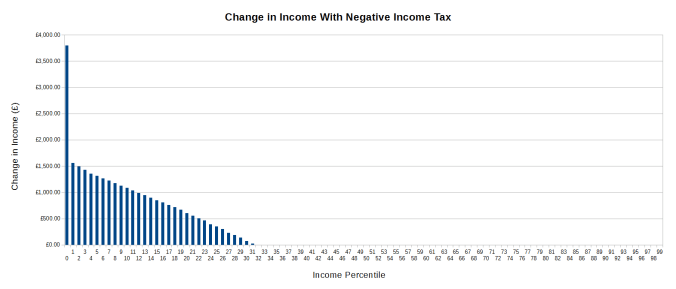
In this scheme Scotland could set an income threshold, say £16,500 – the equivalent of a full time job on the Living Wage. If you earn less than that in a year, the difference between what you earn and the threshold could be taxed at NEGATIVE 23%. If you only earned, say, £10,000. You would receive as a stipend 23% of £6,500 which is £1,495. If you earned nothing in the year, you’d receive 23% of £16,500 which is around £3,800 – The same as the current Jobseekers Allowance. The tax rate of -23% was chosen specifically to create that latter situation. One could easily imagine different rates or even a progressive system to cover people who fall seriously below the threshold proportionately more than those who only fall slightly under.

This system wouldn’t be a perfect substitution for Citizen’s Income for a few reasons. Most significantly, it is a lot easier to abuse or cheat the system by under-reporting one’s income, for example. If rates and thresholds are set inappropriately it may also lead to disincentives to work at around the threshold where someone converts from a recipient to a contributor though in the simple scheme proposed here this is less of an issue.

Negative income tax does have an advantage over Citizen’s Income by reducing the volume of monetary transfer though as only those who are earning below the threshold receive the stipend rather than everyone.

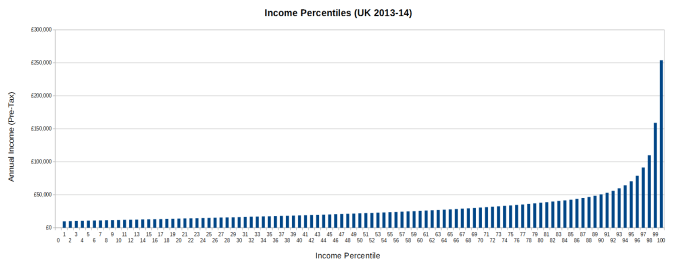
So how much would this cost? To find out, I’ve done some modelling using available income statistics, in particular the breakdown of income percentiles for the UK (percentile resolution income data for Scotland doesn’t seem to be easily available. If anyone out there knows of someone who does have it then please contact me, I’d be very interested in seeing it) .

Income Percentiles

One shocking thing about the UK is that the threshold we set, of £16,500 per year (which is, remember, the amount that said to be required to maintain a decent standard of living) is not reached until the 32nd percentile. Almost one in three workers in the UK are not earning enough to live on.

If we now add our negative income tax to this model to see how much a median person within each percentile would receive it looks something like the following.

Change in Income - No UR Tax

Something to bear in mind it this income percentile data only includes people who have at least some kind of earned income. It does not include the unemployed or those who are unable to or are not seeking work, the “economically inactive”. The ONS estimates that these two groups together make up around 21.6% of the UK working age population. If we factor that group into the figures modeled here (and assuming that Scotland’s figures are roughly in line with the UK’s which will be good enough for this back-of-envelope calculation) we can estimate that the negative income tax would cost Scotland around £2.4 billion per year.

This is where things get a little tricky for the policy idea. The obvious answer to meet the costs is by adjusting the upper rates of income tax to render the scheme revenue neutral. The problem is that the UK (and Scotland) are predominantly low wage, high inequality countries. We’ve already stated that if you’re on the absolute basic wage you’re already earning more than almost a third of other workers (and this doesn’t include those earning nothing). If you pay the 40% Higher Rate, you’re in at least the 86th percentile – the top 15% of earners – and if you pay the 45% Additional Rate (assuming you are even taking those earnings as “income” and aren’t transferring money into dividends or using more arcane accounting wizardry to minimise one’s tax bill) then you are in at the very least the top 2% of earners. This doesn’t leave a very large tax base from which to levy the required funds (This was one of the reasons that the policy advocated by the Greens for the return of the 50% rate was based on reasons of income and wealth equality rather than revenue raising and did not make any spending predictions or promises based on additional revenue from this band).

If one DID want to raise income taxes to find the £2.4bn then doing it solely through the Additional Rate simply would not be possible. Even raising it to 95% (and assuming that everyone pays it) would only cover half of that bill. In order to do it with the Higher Rate, both Higher and Additional Rates would need to be raised to a minimum of 58%.

Now, a normal, independent country would not face this problem because it would be able to tailor the other half of the balance sheet as well. If a negative income tax is replacing welfare spending then the welfare budget would decrease and the balance sheet would..well..balance. But in Scotland’s case, welfare is reserved so what becomes a simple exercise in government policy which would pay for itself and hugely benefit the poorest in our society becomes a constitutional question and a financial bung of £2.4 billion per year to Westminster. Whilst we have the “powers” to adjust our tax rates, Scotland just simply does not have the ability to use them in any kind of effective manner. Those who demand that “we use the powers we have” whilst blocking the levers which would otherwise allow us to do so should reflect on their actions and words. I’m thinking particularly of our Secretary of State “for” Scotland, the “Right Honourable” David Mundell who, as we remember, has not only taunted the Scottish Government towards “using our powers” but has also threatened to tax any welfare top-ups the Scottish Government might be willing to grant. I hold no great hope of Westminster’s generosity extending to them returning saved welfare money in order to pay for a negative income tax.

I’m open to suggestions at this point. If anyone can square this circle, please…please tell me. I think I’ve found a policy which, on paper, would be within Scotland’s current powers to implement but I can’t find a way to make it work within the pitiful financial constraints of our devolution. I don’t want to have to “wait till indy” to get some of this vital work started nor am I content knowing that people could be helped but cannot be because of Westminster’s refusal to either do it or to hand over the reigns to someone who will.

This shouldn’t be such a difficult process. Only in Scotland, within the United Kingdom, in the 21st century, where we’re told we’re incapable of governing ourselves, whilst those who say that they can govern stand by and either do nothing or actively work against us, does it become one.

tcg-logo6c

Are EU In or Out? – Part 7: Final Thoughts

Are EU In or Out? The Contents Page: here

Part 1: What is The EU? can be read here

Part 2: A Brief History of Brexit can be read here

Part 3: The Issues – Immigration can be read here

Part 4: The Issues – Trade, Economy and Finance can be read here

Part 5: The Issues – Brexit Negotiations can be read here

A Side Note – A Review of Vote Leave’s “Leaving Framework” White Paper is here

Part 6: The Issues – Sovereignty can be read here

Flags_outside_Parliament.jpg

Final Thoughts

As said from the outset and throughout this series I’ve noted my severe disappointment in both “Official” campaigns. In a way, I’m not all that surprised. Not only has the entire debate been played from the outset as a debate on the future ideological direction of the Conservative party more than it has been about the future of the UK’s involvement with the rest of Europe it’s quite clear that I, like very many others, have simply not been within the target demographic for either campaign. When it comes to voting on Thursday, my vote shall be cast rather despite the “Official” campaigns rather than because of it. I can offer a few final thoughts and observations on both result predictions and the potential aftermaths of them.

Continue reading →

Scotland’s Song

Today in March with grey dawn’s break,
A nation slumbers, not yet awake.
Our dreams on hold

In Alba.

Strange is the day we await to rise,
As strange Vows fail before our eyes.
But stranger still is

This Alba.

But songs of hope we still shall sing,
By our hands that hope we shall bring,
And the sun shall shine on

Our Alba.

Song of this land, we feel your call,
Your touch gently shall yet reach all,
Soon shall we live in

Saor Alba.

tcg-logo5

Poem after “Cassilda’s Song” by Robert W. Chambers

Custom whisky glass from Glencairn