Are EU In or Out? – Part 6: The Issues – Sovereignty

Qualifier: The following article shall cite political views which represent, to the best of my understanding, the positions of the Official Remain and Leave campaigns. As such they may not necessarily represent the views held by myself or by any organisations or political parties of which I am a member. My own views shall be indicated throughout.

Part 1: What is The EU? can be read here

Part 2: A Brief History of Brexit can be read here

Part 3: The Issues – Immigration can be read here

Part 4: The Issues – Trade, Economy and Finance can be read here

Part 5: The Issues – Brexit Negotiations can be read here

A Side Note – A Review of Vote Leave’s “Leaving Framework” can be read here
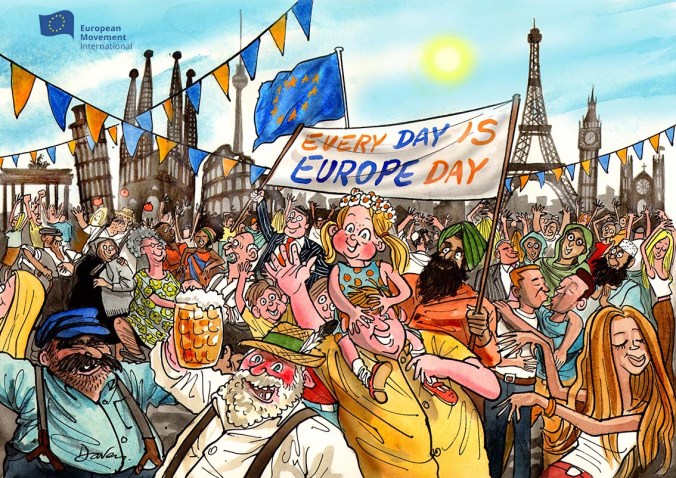
Europe Day

A poster for EMI’s 2016 Europe Day events.

Sovereignty

Likely to be one of the “softer” issues in this debate as unlike immigration and unlike the economy it’s one that doesn’t render down so easily into simply numbers. This doesn’t mean it’s any less important. How we feel about the concept of “Europe” plays a very large part both in what we will want out of that relationship, what we will want Europe to become and what we want ourselves to become either within or outwith the Union. It also tells us a lot about how we see our relationship with our governments which means that the result on Thursday may well have deeper ramifications on how the United Kingdom itself is governed. Sovereignty, who controls the locus of power and where it resides, is a policy on which your position may well lie in how you define it.
Continue reading

The Devolution Journey: Part 1 – The Treaty of Union

This is Part 1 of what shall become a companion piece to my previous history of devolution and tax powers which can be read here.

As we edge closer to the the May elections and (maybe) to the passing of the Scotland Act 2015 we can continue our reflection on the process and “journey” of devolution. My last piece on the subject looked solely at the transfer of tax powers to the Scottish Government since 1999. This one will look at several of the other functions of governance and the process of the transfer of power over other important areas. To do this though, we need to look back a little further.

Continue reading

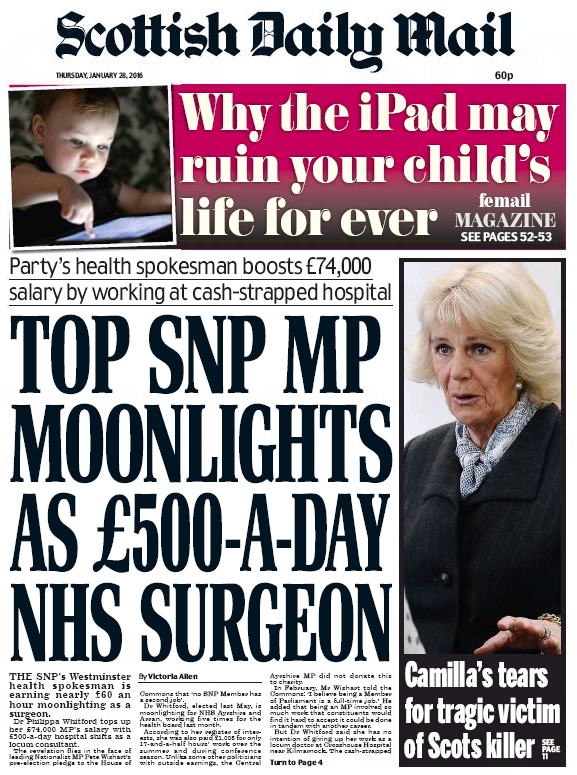
The Most Shameful Smear

It’s (hopefully) no secret that I’m not a member of the SNP so some may question my stepping in to this current scandal. I am, however, a member of Yes Clydesdale and it was through them that I first met Philippa Whitford (in fact, it was a talk organised by our group which went viral and was responsible for launching her political career).

Through the course of the indyref I had the opportunity to sit on Q&A panels alongside Philippa and can find absolutely nothing but praise to say about her.

She is a person of incredible knowledge and inspiration who took the incredibly brave step of moving from a hard fought career in healthcare to casting herself into the thankless kindergarten where people make animal noises” which is the House of Commons.

So to today and Dr Whitford finds herself the target of the latest and lamest SNPBAD smear yet.

whitford1.jpg

The actual story is that she gave up a substantial chunk of her Christmas and New Year holiday to cover for a sick colleague. She spent 5 days saving lives while others in the benches opposite hers spend their “moonlighting” days being paid to destroy the very NHS in which she works. (As Wings Over Scotland points out, she is also compelled to work a certain number of days as a surgeon per year if she is to maintain her license to practice so it’s hardly a job she’s just doing to top up her pocket money)

A little further digging reminds us of the increasing problems with medical staff in England causing more hospitals to hire locum doctors at fees of, on average, £1,700 per day.

That Labour’s Jackie Baillie would have the temerity to be complicit in this transparent smear is just one more notch on that party’s slide into irrelevance. If even they cannot resist their urge to try to find just one more SNPBAD story then I cannot see any reason why any voter would think them worthy of being the party of opposition in next year’s Parliament.

I’d put out a call asking the Baillie and Daily Mail to retract and apologise for this piece but I know how futile that would be. I do hope that everyone, even those on the other side of the political landscape from Dr Whitford and myself, feel as utterly appalled and ashamed for the state of the press as I do. We deserve so much better.

tcg-logo5

An Arbitrary Failure

Smith

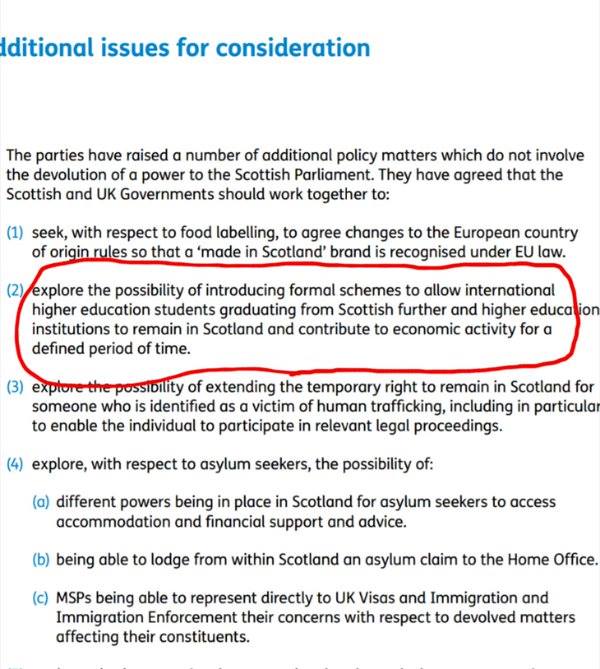
The relevant passage from the Smith Commission Report. Page 28.

David Mundell, who is currently crowing that the Smith Commission has been delivered “in full”, has just blocked a key element of it.

All of the Smith parties agreed to consult on the possibility of allowing Scotland to issue post-study visas for visiting students to allow them to continue working (and paying taxes) in Scotland, the country which educated them, after they graduate.

Mundell has just blocked that proposal without such consultation and before the Scottish Affairs Committee looking into it has even had a chance to report back. (Story here)

One of the most upsetting moments in my own personal indyref campaign was hearing from a young lass whose partner was one such visiting student. He had come to Scotland to study engineering and, after falling in love both with our country and one of its inhabitants he decided that he wanted to stay, to build his career and to make Scotland his home. Just two weeks after his graduation, the UK Government rewarded his endeavour with arrest, incarceration in Dungavel and deportation.

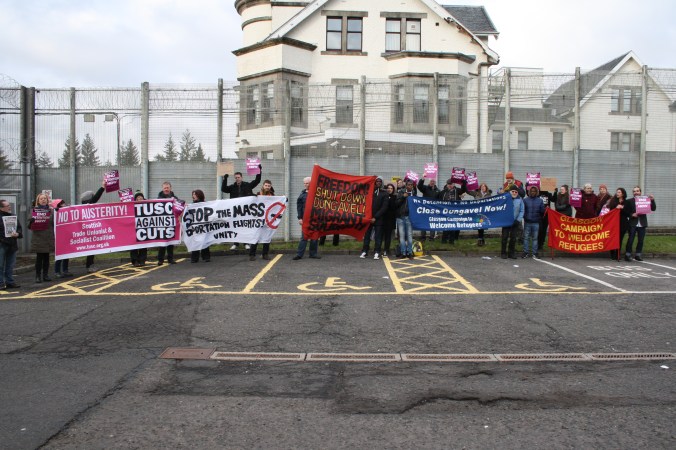
Dungavel3.jpg

Protests outside the Dungavel Detention Centre. Source: Wikipedia.

This is not how a civilised country should treat other human beings. Instead, we should be encouraging those who, after all, pay significant sums of money towards their education to find a place within Scotland should they choose to do so. Many will find high paid, highly skilled and highly sought after jobs. Many others will start businesses of their own and CREATE those same jobs. Even the graduates who choose to leave Scotland will, if they are treated with respect, go on to strengthen our trade and business links with the countries to which they go. Something to bear in mind with respect to the UK’s worrying trade deficit combined with a currency value currently at the lowest level since the Tories took power and which is rapidly approaching the weakest value it’s had in 30 years.

Think about it David. If you were incarcerated and forcibly ejected from here simply because you had graduated, would you look upon this country favourably afterwards? Of course not. Would you consider sending your kids to study in a country which threatened to do the same to them? Of course you wouldn’t.

As Smith notes, this policy doesn’t require any additional powers to be devolved, indeed the similar Fresh Talent scheme used to be implemented in Scotland between 2005 and 2008 and was rolled out successfully to the entire UK until 2012 when it was scrapped by the Coalition government.  Mundell’s decision therefore seems especially arbitrary, short-sighted and, frankly, smacks of nothing less than a jumped-up Governor throwing his weight around simply because he thinks he cannot be challenged.

tcg-logo4

The Devolution Journey: Devolution and Tax

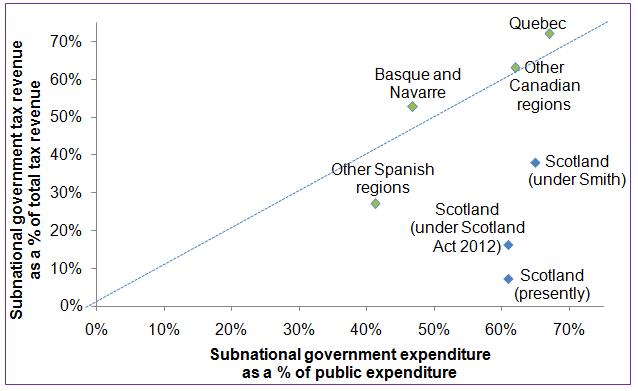
A comparison of the % of devolved control in Scotland now, under 2012 and under Smith as well as a comparison with Spain and Canada. Source: Scottish Government.

A comparison of the % of devolved control in Scotland now, as it will be under the Scotland Act 2012 and under Smith Commission recommendations as well as a comparison with Spain and Canada. Source: Scottish Government.

Monday the 9th of November saw the Scotland Bill 2015 make a further step towards completion. This Bill, which has been the result of the aftermath of the 2014 independence referendum, will mark another milestone on the devolution “journey” Scotland is traveling upon.

Some of the commentary both during the actual debate in the House of Commons and in the days since have shown considerable confusion at just how the system of devolution in the UK works at the moment and how it is to change with the implementation of the Bill. Before we really settle into a meaningful debate on whether or not any “additional powers” for Scotland will be to and for Scotland’s benefit we need to actually understand what those new powers are, what we have now and how they can be used.

This article shall focus on the powers over taxation devolved to the Scottish Parliament as this area will be undergoing several rapid changes over the next few years and much of the confusion amongst members of the public has arisen from the conflation of several phases of devolution.

One must understand the rather unplanned and piecemeal nature of the progression of devolution for Scotland, there is certainly no clear “destination” to that “journey”, and this reflects and contributes to the confusion but there are three major points in the form of the Scotland Act 1998 which formed the Scottish Parliament after the success of 1997 Devolution Referendum; the Scotland Act 2012 which resulted from the 2007 Calman Commission and the aforementioned Scotland Act 2015 resulting from the Smith Commission of 2014.

Continue reading

The Tories Have Delivered Us EVEL

Naval_Ensign_of_the_United_Kingdom.svg

The White Ensign. Possibly a fitting flag for the United Kingdom of England (plus others).

Thursday, October 22nd 2015. The day that Westminster ended, finally, any pretence that the United Kingdom consisted either of “One Nation” or of four nations joined as equals.

Now we live in a state in which one of those nations maintains a right and power over the other three and representatives from those latter nations have fewer rights to speak, to influence and to legislate than their colleagues and, by way of extension, voters from those nations have less control over how their state is run.

Continue reading

The (Economic) Madness of George

Giddy

Last night George Osborne’s Fiscal Charter was voted on and rammed through Parliament on the back of the Tory’s majority. Today, the media focusing more on the shambles that is the current Labour party and their confused approach to supposed Opposition combined with the rumbling rebellion in the ranks as the party tries in vain to come to terms with what their members actually want the party to stand for.

Consequently, as usual, much less has been said about the actual contents of the Bill and its effects on our economy.

Continue reading

Lying Track

Ian Murray, Scotland’s sole Labour MP, lied to the people of Scotland today.

This morning, 14th September 2015, he was interviewed on BBC Radio Scotland’s Good Morning Scotland primarily on the extent of his agreement with his party’s political realignment in the wake of their most recent leadership changeover.

In one segment he makes the statement that the Scottish Government appeared to favour awarding the Scotrail contract to the Dutch Government owned Abelio rather than renationalising Scotland’s railways.

The relevant comment beings at 5.50.

He appears to forget that under the Railways Act 1993 enacted by the Tories and never repealed under Labour, the Scottish Government is currently barred from either renationalising the railways or forming a company in which they own a controlling stake to bid for contracts and tenders.

Indeed, under this bill any government on the planet could potentially own and operate our railways except our own.

I’m sure that rather than this being a lie, personal or political, today’s comment was merely a slip of the mind and that Mr Murray will be submitting a bill to repeal this clause in the near future.

TCG logo

Unweaving Tangled Skeins

The Old Clock Square in Hom, Syria. Left - Before the war. Right - The ruins of the war.

The Old Clock Square in Homs, Syria. Left – Before the war. Right – The ruins of the war.

 It seems certain now that within the next few days or weeks the House of Commons will, for the second time in as many years, be asked to vote to go to war in Syria. I have no doubt that the picture painted will be one of us plucky Brits bravely defending ourselves against an utterly inhuman, utterly irredeemable, utterly evil and, most importantly, completely monolithic force and that after a short, sharp military action peace will be restored and reign supreme. The difference between this time and last is that last time the evil monolith was the Assad Regime. This time, it’s ISIS.

 We always seem to be sold war on such simple terms. Often, we seem to buy it because of them. But the world out there beyond the red-top tabloids is rarely so black-and-white. The conflict in Syria is less so than most.

Continue reading

We Need To Talk About: The Green Investment Bank

gib-logo-green-background

Another day. Another broken promise from Westminster. I had been expecting news like this since the referendum last September but I’ve been frankly shocked by the rate at which they’ve been coming and where the hammer-blows have been falling.

Today it was announced that the Government will sell off the Green Investment Bank. The bank, capitalised with some £3 billion of taxpayers money, was set up in 2012 with the mandate for providing investment and incentive for renewable schemes across the UK. Its headquarters were located in Edinburgh in a bid, as it was reported at the time, to attempt to head off the push for Scottish Independence. Indeed, even just the week before the referendum dire warnings were uttered about the potential of Scotland “losing” the bank if we voted Yes (The news that the bank hadn’t actually been investing more than a token amount within Scotland in its first year or so was, of course, conveniently placed to the side).

Instead, now that we’ve “safely” voted No, the bank is to have up to 70% of its shares sold off to private interests for somewhere around £1.4 billion, under half of its initial capitalisation, at a time when it has just announced that it has become profitable.

Of course it’s not all just about the outright betrayal of Scottish voters. In this move, as well as last week’s scrapping of onshore wind incentives, David Cameron and his new Tory majority government are flexing their ideological muscles. Gone utterly is their “Greenest Government Ever“. To quote Scottish Greens co-convener Patrick Harvie on the topic today:

“The sell-off of the Green Investment Bank proves that David Cameron’s comment about wanting to ‘cut the green crap’ has now become a full-blown mantra for a right-wing Government determined to wreck our renewable energy opportunities. The bank was a half-hearted effort by the Tory-Libdem Coalition, with limited powers and funding. Rather than taking another backward step we need governments to go further and faster on developing new energy sources and cleaner industries as the need to leave fossil fuels in the ground becomes ever more urgent.”

Added to this is the call from Green Party of England and Wales MP Caroline Lucas:

“The Government’s rash and irresponsible plan to sell off a large chunk of the Green Investment Bank calls into question their commitment to investing in a low carbon economy.

“At precisely the time when we should be leading the world in the fight against climate change our Government appears to be in retreat. The Government should keep at least a majority stake in the Green Investment Bank to ensure investor confidence is upheld and the commitment to low-carbon lending remains.”

This is just another string of sell-offs by the Government of profitable parts of public service at a substantial loss to the taxpayer (joining such company as the East Coast Mail Line, The Channel Tunnel, The Royal Mail and many of the banks bailed out in 2008). It is purely an ideological move by the Tories to get the Government out of the business of owning any kind of body capable of serving the public.

I have to wonder what they think the endgame is. Just what do they want Tory Britain to look like?

And is there a place in it for us on the ground?

TCG logo