Now that the polls have closed and we’ve got that agonising wait till we either crash out watching the TV pundits searching for anything to say or the results actually start coming in, I thought I’d throw out some completely informal, mostly gutfeel-based predictions of the numbers of seats won by each party.
Letter to the Editor: TTIP
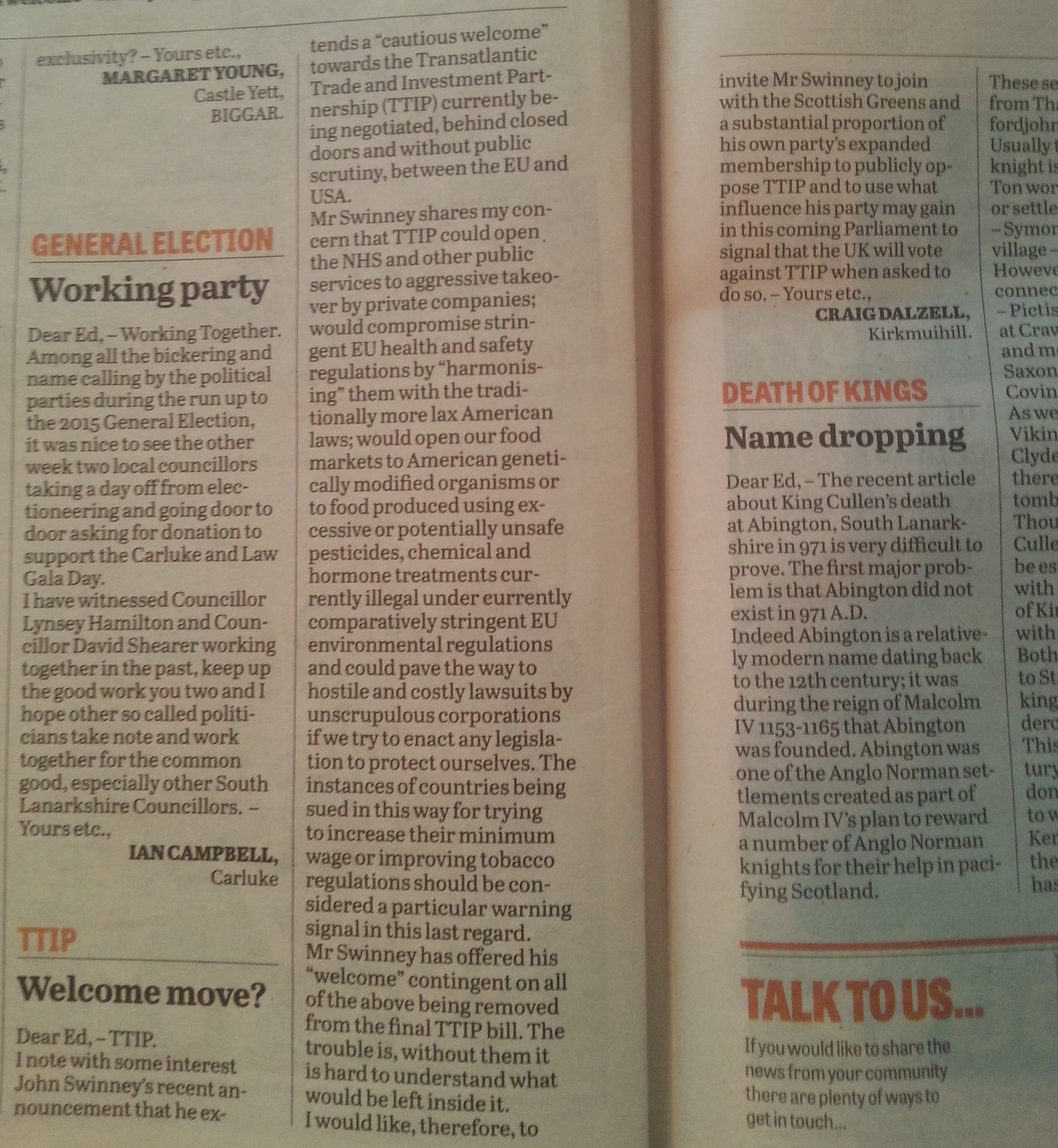
Printed in the Carluke and Lanark Gazette – 06/05/15
My letter to the Carluke and Lanark Gazette, printed on Wednesday 6th May, 2015.
A copy of the text is below the fold.
How to Make Housing Affordable
 (Image: Tenement House, Glasgow. Source: Wikipedia)
Housing is always a touchstone issue during election campaigns and this one is most certainly no different. Two of the most oft-quoted in the manifestos this time round are: “How can we build “Affordable Housing”?” and “How can we afford to build them at all?” It seems strange that we are quite content to allow banks to borrow, or even flat out create, the funds it requires to supply us with a mortgage for a house but it is almost anathema for a government to do something very similar. I am going to make the very simple case that we need to dispense with this illogical paradigm and start looking at how to build a stable, long term housing policy fit for purpose.
For the purposes of this exercise I looked at a couple of example mortgages available from the commercial banks today. One typical one offered me a £90,000 mortgage with an initial interest rate of 4.2% fixed for 2 years. Assuming that that rate didn’t change over the 25 year term of the mortgage I would be faced with paying £485 per month for those 25 years until the loan was paid off. The total amount repaid (discounting inflation) would be just over £145,000. Given that we are currently experiencing historic lows in our interest rates and that they are unlikely to drop further this gives us the lowest bound to the repayment. Add in, on top of that, the profit margin demanded by a private landlord and the costs soon mount up rather staggeringly. It really is no wonder that many of the UK’s richest people are in the property market.
But what would happen if the Government borrowed that money instead and invested it in a social house for me? Today, May 4th 2015, a 25 year UK bond attracts an interest rate of 2.515% (Source: http://uk.investing.com/rates-bonds/uk-25-year-bond-yield). The first thing to note is that this interest rate is guaranteed to be fixed for the entire 25 year term. There could be no uncertainty over the possibility of unaffordable interest rate rises of the kind which led to so much chaos during the 2008 crash. This opens the way to a long term government housing policy rather than the election-by-election tinkering we see now.
At this lower interest rate we could charge the same £485 per month and expect to have the loan paid off in full almost five and a half years early at a total cost of only £114,500, a saving of £31,000 or 21%. By having the government borrow for us, we can afford five houses for the price of four! Alternatively, the monthly rent could be cut by £80 per month and the 25 year term maintained whilst still undercutting any private landlords (even if they pass on their bank mortgage at cost).
What happens after the loan is paid off could be a matter for government policy. The rent could be maintained, providing the government with a ready and reliable revenue stream. Or the house could be granted at a discounted rate or entirely rent free to the tenant for the remainder of their occupation (with the house returning to the social stock once it is no longer required), or the rent could be reinvested into more housing stock to keep up with demands from population growth and (dare I mention that dreaded word?) immigration. The UK’s population is growing at less than 1% per year meaning that we’d need just one new house built every year for every one hundred in the stock. The rents from those hundred could easily accommodate for that level of demand. Our hypothetical £405 per month rent for 25 years is now just £410 per month, still greatly cheaper than our private landlord and we no longer need to worry about the costs of housing the next generation (wherever they come from).
Of course, many other questions still remain underneath this housing policy such as: where do we build these houses? (the old green belt versus inner city regeneration question), how do we manage (or tax) the land on which they are built?, what infrastructure do we build around them?, or how can we encourage business development in or near these areas to provide jobs for the residents. These are most certainly vital questions to be answered as part of a holistic and complete housing policy but one thing is certain. Neither your bank nor your private landlord concerns themselves with these questions. Even if none of them are answered within this article I believe that I have demonstrated that allowing a government to borrow to invest in our society need not be the terrible thing that some politicians would have you believe it would be. Surely, lining the pockets of the banks and landlords the way we currently are is the least effective, most costly way we could possibly be doing it? 
We Need To Talk About: The Transatlantic Trade and Investment Partnership (TTIP)
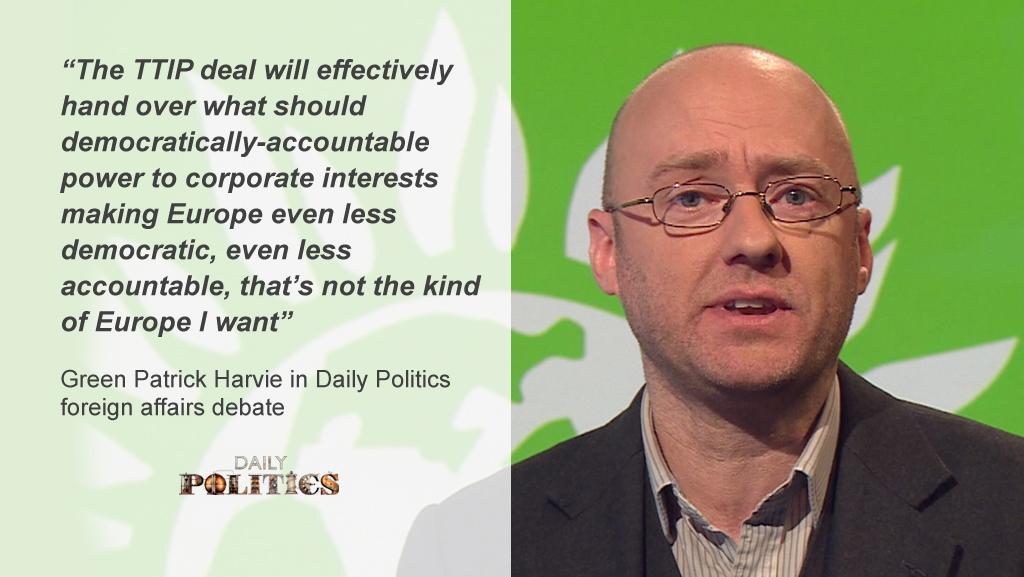
What is it?
The Transatlantic Trade and Investment Partnership (TTIP), also known in the US as the Transatlantic Free Trade Agreement (TAFTA), is a free trade agreement currently being negotiated between the United States of America and the European Union. It is largely based on the North American Free Trade Agreement (NAFTA) signed between the USA, Canada and Mexico in 1994 and is a cousin to various other trade agreements being negotiated between the US and other states such as the Trans-Pacific Partnership.
What’s so good about it?
Proponents argue that TTIP will eliminate trading tariffs and other trade barriers between the EU and US and will allow the harmonisation of health and safety laws and other regulations ensuring that goods and services exported to either or both blocs can be made to comply with regulations in all areas. They argue that this will bring economic growth and increased trade.
What’s so bad about it?
From a trading tariff standpoint, it is hard to see how this agreement will bring much in the way of benefit. Due to prior trading agreements organised via the World Trade Organisation, tariffs between the EU and US average at a little under 3% so there is little to be achieved by eliminating them. Instead the concern with TTIP lies mainly in its focus on non tariff related matters.
One major concern lies in the idea of “harmonising” the likes of health and safety law. The Greens, along with our partners in the European Free Alliance, strongly oppose any measure which would bring historically more stringent European health and safe regulation “down” to historically more lax American standards. As an example, there are currently large divergences between the US and EU with regards to which chemicals are allowed to be used in the agricultural sectors. The EU currently bans the use of growth hormones in meat and milk production whereas they are in common use in the US. Unless TTIP acts to ban such hormones in US (unlikely given the strength of the agribusiness lobby with American politics) then it is difficult to see how forced “harmonisation” of these laws would do anything other than open the EU to such produce. Similar arguments extend to subjects like the production, regulation and labelling of products containing Genetically Modified Organisms (GMOs).
Similarly, one of the arguments levelled by proponents of unconventional gas and “fracking” is that disasters and pollution caused by lax US safety standards could not happen here. If TTIP acts to bring EU standards down to US standards then this argument is undermined.
This example leads to another major concern of TTIP. Draft proposals leaked to the public indicate that corporations would be given the power to legally challenge any member state which acted against the principals of TTIP and maintained any real or perceived “barrier to trade” against the corporation. This could include breaking the prohibition of chemicals banned in the EU but legal in the US within the agricultural or chemical sectors mentioned.
These legal challenges, known as Investor-to-State Dispute Settlements (ISDS), have occasionally been seen within countries such as challenges launched against the Slovakian government when it attempted to renationalise its health insurance sector or against the Egyptian government when it attempted to increase the national minimum wage. Under TTIP the scope for companies to use ISDS’s could be greatly expanded. For instance, this could mean that American private health insurance companies could attempt to sue for “access” to our NHS market and any attempt to keep the healthcare of our citizens in public hands could be deemed a “barrier to trade”. At the very least, the possibly lengthy and complex legal battles would prove an expensive drain of time and tax-payers money.
Finally, another particular concern about TTIP is the fact that all of this negotiation is being done behind closed doors and away from the democratic process. The UK government and our MEPs have very little direct access even to the documentation of the treaty and many of the concerns raised have only become apparent after documents were leaked to the public. Without proper democratic scrutiny and transparency this treaty simply cannot address the needs of the 500 million+ citizens to be affected by it. A treaty of this magnitude simply cannot be decided by a few industry lobbyists.
What can we do about it?
Education is key. So far TTIP has seen vanishingly little media coverage so many people are still unaware of even its existence never mind the implications of the treaty if it were to come into force as it currently stands. Several papers have been referenced at the end of this article explaining TTIP in more detail and anyone interested in the topic should certainly read them and share them with others.
Whilst this treaty is largely occurring way above even National level politics, the impact of it will be felt at all levels. Lobbying your local representatives at all levels of government (i.e. MSPs, MPs and MEPs) to express your interest and ask them to pass your concerns on is vital. Seeking their opinions and where they or their party’s differ from yours can also be powerful, especially in an election year.
Finally, you can get involved in the grassroots activism. Many online petitions exist and can be signed and many social media sites are frequently used to seek out and share information. Joining your local political party or activist group can also help you get more directly involved in campaigning for reform of this important treaty.
Further Reading
European Green Party Position Paper — “TTIP – Too many untrustworthy promises and real risks”
http://europeangreens.eu/brussels2014/content/position-paper-ttip
Green European Foundation — EU Trade Policy: analysing the impact of TTIP.
http://gef.eu/uploads/media/Analysing_the_impact_of_the_TTIP_Report_seminar.pdf
The Greens/EFA Group — “TTIP: no agreement between the EU and the US without high standards for the environment and for consumers”
Anna Meyer and Jessica Walton — “A Citizen’s Guide to TTIP”
http://www.farmbillfairness.org/s/A-Citizens-Guide-to-TTIP-y93z.pdf
Friends of the Earth – The TTIP of the anti-democracy iceberg
http://www.foeeurope.org/sites/default/files/foee_factsheet_isds_oct13.pdf
UCU – TTIP: What it is and why we should be worried
http://www.ucu.org.uk/media/pdf/6/n/ucu_translantictradebriefing_jan14.pdf
Unison – TTIP: A Unison Briefing
https://www.unison.org.uk/upload/sharepoint/On%20line%20Catalogue/22410.pdf
British Embassy Washington – TTIP and the Fifty States
European Commission – TTIP: The Economic Analysis Explained
http://trade.ec.europa.eu/doclib/docs/2013/september/tradoc_151787.pdf

Just a Few Words on the Ongoing Crisis in the Mediterranean.

On the 15th April, 1912 a ship sank in the Atlantic. Of the 2224 crew and passengers, many of them migrants searching for a better life, over 1500 died when the Titanic went down.
As of the 20th of April, 2015 an estimated 1500 migrants searching for a better life have drowned in the Mediterranean this year.
The former humanitarian disaster etched itself onto our collective psyche. Inspired books, folk songs, films, exhibits, and memorials and resulted in changes in international law to ensure that it never happened again.
History will judge us most harshly if we turn our backs on this one.
For a few more words, here’s Frankie Boyle’s take on things: http://www.theguardian.com/commentisfree/2015/apr/20/britain-criminally-stupid-race-immigration
“We have streets named after slave owners. We profited from a vile crime and feel no shame. We fear the arrival of immigrants that we have drawn here with the wealth we stole from them. For much of the rest of the world we must be the focus of bitter amusement, characters in a satire we don’t understand. It is British people that don’t learn languages, or British history. Britain is the true scrounger, the true criminal.”
The Cameron / Milliband Not-Debate Review
I’ve spent this week fairly quiet due to work commitments but managed to find time this Thursday to watch the start of the mainstream televised election campaign beginning with the interviews and Q&A sessions with, separately, David Cameron and Ed Miliband.
If you haven’t yet watched the program and you wish to do so it can be viewed here
My Thoughts are below the fold.
Dr Craig Dalzell: Candidate Statement – Holyrood 2016
 By now many Green members in the South of Scotland will have received their ballot papers for the candidate selection for the Scottish Elections next year.
Here is my candidate statement as it appears in the ballot paper.
My political introduction came through the independence referendum when, early in the campaign, I joined Yes Clydesdale. Throughout the campaign I played an active role within the campaign team on the ground during canvassing, public events and street stalls as well as within the campaign literature regularly writing for Yes Clydesdale’s monthly magazine and helping to run the largest community page on Facebook outside of the official campaign pages.
(https://www.facebook.com/SaorAlbaGuBrath)
I particularly found a niche within the campaign on the topics of the economy, finance and energy policy and became a valued contributor through researching these topics and then sitting on panels during public meetings to take questions on them.
Having been convinced of the Green case and becoming part of the post-referendum surge it is a natural progression for me to help out in any way I can to further our goals.
As a Green MSP I shall strive to put my skills to work to help promote public engagement with and understanding in the important issues faced by our country. I am a great proponent of local and participatory democracy and would make it a goal to encourage as many people as possible to take an active part in the running of their area and to help people regularly stay in touch with their representatives so that the former can put their views across to us and make their concerns heard and so that the latter can keep people informed about ongoing debates and legislation.
—
If you’re a Green in the South of Scotland considering who to select for your representatives on next years list I hope that I meet your expectations. This is the largest candidate ballot that the Scottish Greens have ever carried out in this region and the strength of the pool of candidates is incredible. It’s going to be a tough choice for all voters but the team which we select will doubtless do the party and the country very proud indeed.

Why Democracy?
I’ve just listened to a very interesting discussion on The Public Philosopher program on Radio 4 asking just why do we use democracy to decide our politics and is it a fair and equal system?

(Click image for link to program or click: http://www.bbc.co.uk/programmes/p02h91r3)
Some of the questions raised include:
What does it mean to be a “fair” and “equal” system?
We currently give every voter one vote in an election but some have suggested giving some people more than one (indeed, in some elections such as the Labour Party’s electoral college based leadership elections some people do receive multiple votes each “worth” a different weight). Is this “fair”? Who should decide who gets more and would, say, a merit based exam merely exacerbate class division?
How does this link in to non-proportional voting systems like First Past The Post? Clearly if you are a swing voter in a marginal constiuency your vote has a far greater impact on the final result than a minor party voter in a seat that another party considers “safe”. Is it really a democracy at all when you can win a seat on 30% of votes cast, especially when turnout itself is only around 50%? (For more: https://thecommongreen.wordpress.com/2015/03/05/under-fptp/).
Questions were raised on gender equality within parties. The Scottish Greens have a clear commitment to gender equality and have structural and procedural levers in place to ensure it. Here we could consider that favouring someone over another for gender reasons may not be equal or fair but if it is done to correct an imbalance which cannot otherwise be eliminated then it is clearly has to be. One could spend a maddening amount of time thinking about the distinctions within equality and fairness.
Or does Democracy mean something else entirely? Is it less about how everyone gets to have a voice and more about making your government accountable? The “benevolent dictator” may protect everyone’s rights and make good decisions this year but if he gets replaced or goes bad next year and you can’t get rid of them then is that a stable system?
On the other side, there is a movement at the moment pushing for participatory decision making where the general public all vote on each policy rather than delegating a relatively small group of people to represent them. Does this harness the power of collective decision or does it simply allow majority oppression of the majority and populist policy? Is a fair democracy sometimes about making an unpopular but right and just decision?
All in, a thought provoking discussion and well worth a listen.
Scottish Greens D&G Hustings for Holyrood 2016
My contribution to the Dumfries and Galloway Hustings for the 2016 Scottish Elections.
The channel also has links to the videos of the other candidates there on the night. Each candidate was given (just!) two minutes to make their pitch.
It was a fun night and I look forward to the next one in Biggar tomorrow in front of Lanarkshire Branch.
A rough transcript of my speech (somewhat played with on the night) is below the fold:
We need to talk about GERS

Much has already been said about the publication of the latest round of the Government Expenditure and Revenue Scotland report or GERS (http://www.gov.scot/Resource/0047/00472877.pdf). Much rammying done over what these figures mean for an independent Scotland.
Answer: Not much. They tell us nothing about future policy direction. GERS isn’t a prediction of different circumstances, merely a snapshot of how current policy is affecting us.
More rammies have broken out over whether Scotland is or is not “subsidised” by money from the rest of the UK. Answer: This year and last, probably. But it’s yet to make up for the decades of cash flowing the other way to the tune of around £220 billion over the past 35 years. Little is said during this about the state of the UK’s finances to which we are compared. As a percentage of revenue, the UK deficit is currently worse than that of Greece at 15.6% versus 10.4% respectively!
Even less is said about how balanced Scotland’s economy is compared to the UK’s. If we are to be bound by (largely) the same economic rules and austerity agenda then we need to know if it is “working” for Scotland as well as for the UK as a whole.
Here is the table from the report breaking down the tax revenue from various sources.
 Scotland, by population, makes up 8.1% of the UK total. We should, all things being equal, contribute 8.1% of each of those different tax sources. Several disparities stand out to me.
The largest one is income tax. There is a £1.2 billion shortfall in our income tax receipts. This is despite Scotland’s higher employment rate. In essence, Scots are taking on lower paid jobs thus paying less in tax. Correcting that shortfall is the equivalent of taking every single worker in Scotland, part time and full time, currently earning less than the Living Wage and paying them a £25,000 salary instead. The lack of decent employment in Scotland is having a devastating impact on our nation’s finances and our ability to sustain public services. Incidentally, increasing employee pay would also raise the amount of National Insurance paid by several billions of pounds.
Ruth Davidson suggested fixing the deficit by raising the income tax rate, I simply say have more people earn more money and use that to pay more tax.
Whilst we’re looking at income, it’s worth looking at the other end of the spectrum. The large corporations touted as the “job creators” in this economic climate are largely based in London and the South East and the very rich pay a greater fraction of their taxes via Capital Gains and other wealth related taxes. Again, here, we see a shortfall in the amount paid compared to rUK removes over half a billion from Scotland’s accounts. Another £660 million are “missing” from our accounts due to shortfalls in both council tax and stamp duties. Policies designed to further inflate the London housing bubble simply don’t fit in a nation where the house prices are consistently comparatively lower.
But where does Scotland “over contribute” to the national finances? Tobacco, alcohol and gambling duties all contribute far in excess of our UK “share”. Some £640 million per year is collected off the back of spending on these items. Time and time again, studies have shown that a population ground down by stress and inequality turn to vice and addiction to ease the pressure (http://www.gcph.co.uk/assets/0000/1080/GLA147851_Hypothesis_Report__2_.pdf) and that income inequality in particular is the single strongest correlator with a nation’s overall wellbeing.

(Image: http://inequality.org)
If the economic policies of Westminster are designed to improve the lot of the top 10% (who have seen their share of national wealth increase from 20% to 35% of the total within my lifetime) then here is direct evidence that this strategy is most certainly not designed to help Scotland.
So why is no-one talking about all of this? Why do we hear nothing more than the same old back-and-forth mud slinging? There are plenty of journalists and politicians who have spent hours poring over the same data presented here. They must have the ability to spot the same patterns as anyone else can. Is it possible that it’s simply easier to complain about a problem than to identify the causes of it, much less actually suggest a solution?
 The Common Green