“Everything in politics seems impossible until the moment it becomes inevitable” – Craig Dalȝell
This blog post previously appeared in Common Weal’s weekly magazine. Sign up to our Daily Briefing and Weekly Magazine newsletters here.
If you’d like to support my work for Common Weal or support me and this blog directly, see my donation policy page here.
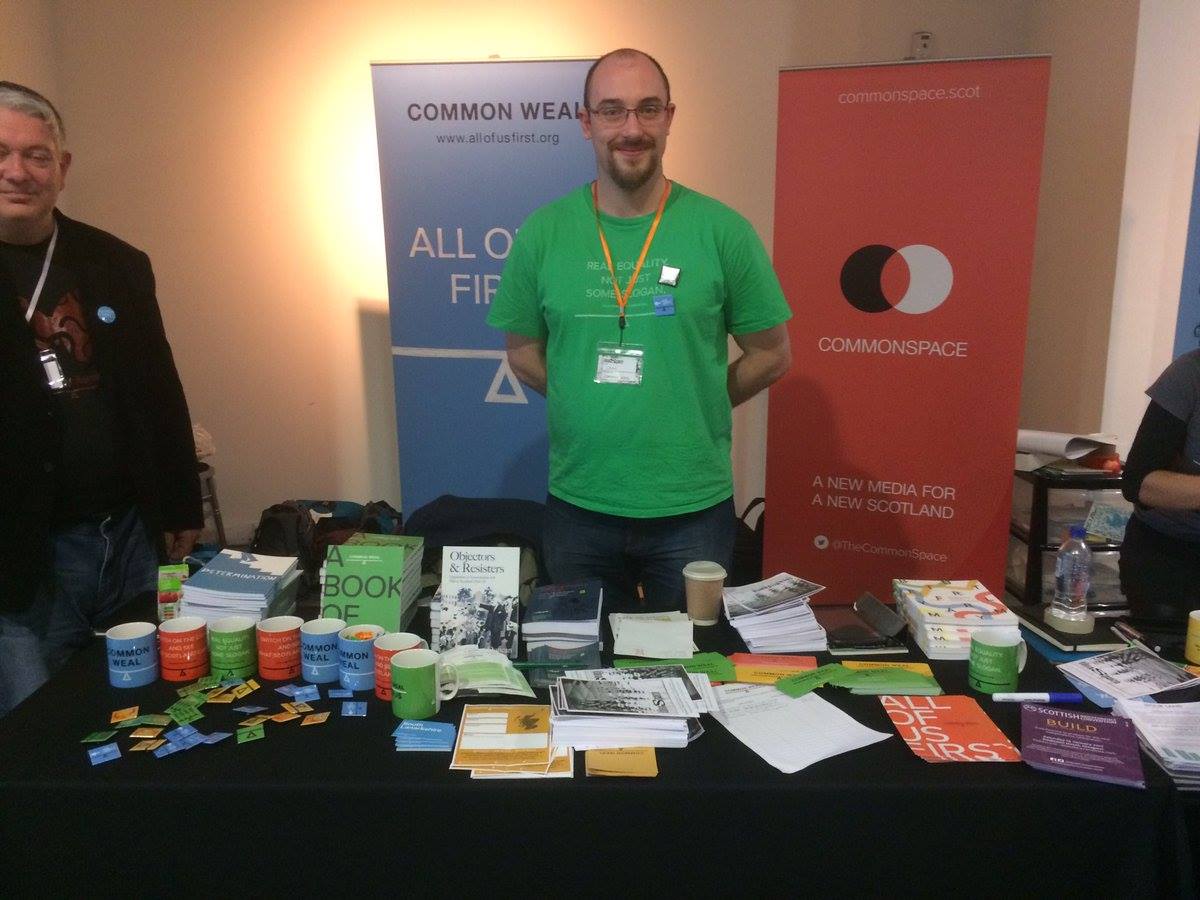
(I think this is the first photo of me at a Common Weal event – IdeaSpace, October 2016)
Time certainly does fly. Last week marked ten years since I published my first policy paper through Common Weal. By 2016, I had gone through a bit of a journey from my political radicalisation during the independence referendum, to losing my job and, as it turned out, my career as a laser engineer at the tail end of 2015.
In that intervening time I had kept up my political writing through my personal blog and it was an article there about GERS that caught the eye of Robin (who already knew me via previous campaigning together) and led him to asking me if I could help on a project about Fracking.
At that time, the political winds (including within the Scottish Government) were pushing very much in favour of fracking the hell out of Scotland and while the anti-fracking campaign had (and still has) a very strong case in terms of climate change, local environmental impact and in terms of long term energy security, the pro-fracking side were talking mostly about economics and when it comes to a campaign based on environmental principles vs a campaign based on making the GDP line go up, politicians are often much more easily swayed by the latter than by the former.
Hence the need for something different. I was asked to investigate the Economics of Shale Gas Extraction with a critical eye to see just how they actually held up. The result: They didn’t. Fracking does well to boost the profits of the owner of the well but the industry would create few jobs (especially in comparison to renewables or even the legacy oil industry), would produce even fewer local jobs and would do absolutely nothing in terms of energy security or the price of energy bills.
Even the profits made would only be made if gas prices are pushed anomalously high (thus, as we’ve most recently seen, the industry is sensitive to geopolitics) and if the companies involved are allowed to not pay the costs created by the pollution of the extraction and the burning of the gas.
I’m proud to say that that paper had a significant impact. It was widely read and adopted throughout the anti-fracking campaign in Scotland and that campaign would go on to win a moratorium against extraction that persists to this day (although there are still those seeking power who would reverse that ban).
Not bad for a first attempt at a policy paper!
Ten years later, I’ve published probably more than twenty more, plus co-authored half a dozen books, produced hundreds of hours of audio and video interviews and more. And don’t worry, this isn’t a retirement message quite yet – I still have at least a few more in me (you’ll very much want to keep an eye on the one I’m just finishing up at the moment!).
I’m always a bit embarrassed to self-promote but this seems like a moment that I shouldn’t pass up. I’d like to present the five policy papers written by myself that I look back on most fondly, either because of their sheer impact in the political scene or because they meant a lot to me in terms of subject matter.
Beyond GERS – 2016
If my fracking paper was the one that kicked off my time at Common Weal, Beyond GERS was the one that made my mark on the Scottish political scene. Beyond GERS sought to recontextualise the way we, as a nation, talked about the annual Government Expenditure and Revenue Scotland report as it was increasingly being used as a stick to beat the independence movement when it was, in fact, showing something rather different – that Scotland’s accounts were being grossly distorted by the fact that we were not independent in ways that made it very difficult to even talk about the finances of what lay beyond that horizon.
For example, just the fact of independence would cause a lot of civil servant jobs in London who are doing work ‘for’ Scotland to move to Scotland – along with the economic impact they would have when they live their lives in and around Edinburgh instead of in London.
The negotiations around debt and asset splits would cause significant changes which could very well lead to Scotland paying much less in debt interest each year (and almost certainly not more in interest even in a ‘worst case’ scenario). And then actual policy changes like choices to be made over how and where military budgets are spent or where and how large Scotland’s embassies would be could have significant impacts on our annual budgets.
The actual numbers in that paper are now out of date as is much of the methodology that went into calculating them. This was because, in additional to changes to devolution in 2017, one of the impacts this paper had was to change (and in my view improve) how GERS itself was presented. Other impacts were an increased focus on GERS in the context of independence which led to similar papers being produced looking at Wales and at Northern Ireland, which both reached similar conclusions to my own paper. It also led to multiple Scottish Government Ministers promising to produce their own version of a set of “post-indy accounts” for Scotland, though none have actually materialised yet.
Social Security for All of Us – 2017
It was Common Weal’s paper in 2013, In Place of Anxiety that was a major early developer of my political viewpoints, particularly its case for a Universal Basic Income. The concept had been around before then, of course, but that was my own introduction to it. In 2017, I had the opportunity to revisit the topic as part of a broader work on how an independent Scotland could redesign its welfare state.
As part of this I produced one of Scotland’s first fully costed Universal Basic Income schemes. It is meagre by today’s standards (equivalent to Universal Credit, but truly Universal) and I would now advocate for a UBI that meets some kind of adequacy standard of being able to actually prevent poverty rather than merely allow someone to live in poverty.
This paper had multiple impacts on the Scottish political world – not least, it played a role in pushing the major parties to make pledges around the idea of a UBI in the 2021 Scottish elections. The SNP, Greens and Lib Dems all came out in favour of a UBI and Scottish Labour presented a counter-plan around a Minimum Income Guarantee.
Sadly, none came to pass. The UBI pilot scheme proposed by the Scottish Government was blocked by the UK Government and their report into Minimum Income was all-but buried by the Government who had by then changed First Minister twice and were evidently no longer interested.
Ambitions for the next Parliament have also been scaled back with Labour and the Lib Dems dropping their pledges entirely, the SNP promising only pilot study of a Minimum Income study for artists and the Greens proposing a similar pilot for a UBI for care leavers. Both pilots are welcome, of course, but it’s still a step back from the loftier promises of 2021.
However, that journey from 2017 to now has been a remarkable one. Back then UBI was still a radically utopian idea in Scotland, fit only for academics and weird policy wonks. By 2021, Scotland had a Parliamentary majority in favour of UBI even if it lacked the power to implement one and that majority went across the constitutional divide – a rare thing these days.
It also led me to being picked up this year by Basic Income Network Scotland and joining them as a Trustee, so you can believe that I’ll be keeping the issue live as we go into the next Parliament to make sure those pilot schemes happen and then we eventually get a Basic Income rolled out to All of Us.
A Silver Chain – 2018
The Sustainable Growth Commission was the first major push by the SNP to produce a body of work on Scottish independence since the publication of its Scotland’s Future White Paper in 2014. It was widely anticipated but at Common Weal we had heard whispers and rumours that we weren’t going to like what was in it. Sure enough, when it was published we were, quite frankly, appalled. I received an ‘advance’ copy of the report just two hours before its midnight embargo and stayed up till 3am reading it – I was then on the radio at 8am the following morning being interviewed about it which made the late night rather worth it.
Over the course of that publication day, I hammered out this policy paper which was published a few days later. The biggest difficulty we had with the report was the ‘six tests’ it laid out that were put in place to block the launch of an independent Scottish currency in the event of independence. Tests that we still maintain would have been impossible to meet and that the act of adhering to the tests would have made it harder, not easier, to launch a new currency.
This wasn’t the only objection we had but it was the one that gained the most traction. The party had to put substantial effort into railroading an adoption motion through their conference that year – the rebellion amongst members was almost as great as the one they saw during the debate to become a pro-NATO party. It also led to the formation of what would become the Scottish Currency Group who have taken our work on an independent Scottish currency and have pushed on far beyond it. Keep an eye out for their next sets of work in the coming months.
Good Houses For All – 2020
There is no logical reason that I can fathom for building houses that leak unnecessary amounts of heat when the technology to build them better doesn’t just exist but now costs virtually the same as building them badly. At the same time, incentives to improve existing houses don’t exist because why should landlords bother to properly retrofit when it’s the tenant who pays less on their bills and instead you could just jack up their rent because they have nowhere better to go.
This paper sought to solve both problems. It laid out the finances of building passive energy efficiency grade houses (though not necessarily the PassivHaus standard as there are other ways to achieve similar levels of efficiency) for social rented stock. I found that doing this could deliver houses cheaper than the private sector would while still being profitable for Local Authorities. This would mean Councils could build essentially unlimited social houses and outcompete the private sector in both price and in quality.
In 2022, I was asked at a fairly high profile public event if I could win just one policy in my political career, which would it be? I chose this one. It has the potential to not just reduce but to eliminate fuel poverty in Scotland and would leave a legacy lasting potentially centuries.
So imagine my shock and surprise that just a few weeks later, MSP Alex Rowley got in touch and took us up on that challenge, introducing a Members Bill to make passive energy efficiency the minimum standard for new homes in Scotland. The Government, facing a massive defeat if they opposed the Bill, did the smart thing instead by simply adopting it as Government policy. There’s still a long road to go in making it all happen but there’s an excellent chance that it will. I hope that I don’t only win one Government policy in my entire career, but if I do I’ll be happy if I only win this one.
ScotWind: Privatising Scotland’s Future Again – 2022
In January 2022, the Scottish Government announced that the Crown Estate Scotland (an arms-length org, but one owned by and accountable to Scottish Ministers since 2017) had completed its auction of options to develop what was then the world’s largest offshore wind project – ScotWind.
Basically, companies bid to buy the right to come up with a plan to develop a particular patch of seas and then they can choose to either return the right to the Estate or “exercise their option” and start the process of developing it. The Government PR machine went into overdrive to talk up the benefits of selling these options. Headlines touted the hundreds of millions of pounds that would flow into the Scottish Treasury and what could be done with it as well as promises around the ‘supply chain’ that would bring hundreds of jobs to Scotland.
But I was looking at the actual reports and things didn’t seem right. As it turned out, the auction was badly flawed. Rather than a traditional option where the highest bid wins or one where a lowest reserve price was set, this one had a maximum bid ceiling set on it. Every winning bid won their option at exactly the bid ceiling (suggesting they might have paid more). Other problems became evident, such as absolutely minimal protections that in many cases would make it cheaper to break those supply chain promises and to pay the fines than to actually fulfil them.
I very quickly put together a report of these findings and we published just a few days after the initial announcement. Instantly, the news coverage flipped from repeating the party line of the success of the auction to taking a more critical eye. The newspaper article covering my report ended up being the most read article in the Herald’s history of publishing online. My follow up report a year later revealed that Scotland has potentially lost out on billions or maybe even tens of billions of pounds by botching the auction the way it did and an investigation into what happened is now underway.
The Next Ten(?) Years
Obviously, my actual job at Common Weal has changed substantially over the decade. I spend more time now managing our Working Groups and the various other people working on policies than I do writing myself. I also keep up with contributions to our Daily Briefing and weekly Magazine (you are subscribed to both, aren’t you?) and I do a lot of outreach, networking and public engagements (want me to speak at your local campaign group about any of my work? Get in touch!). But, I’m still heavily involved in developing my own policies too and, as I say, I think you’re going to like the one I’ve got coming up next.
And so, where for the next ten years? Honestly, the unemployed laser engineer I was ten years ago couldn’t have predicted where I’d be today so who knows? I do know that I couldn’t have done it without you. It’s folk who support Common Weal with their £10/month that have let me do everything I’ve done and can support me and the rest of the team to keep doing it. So, as proud as I am to have done it all, I’m so grateful to have been allowed to do so. Thank you.
And here’s to the next decade, where ever it takes us.