Land Reform, Or Another Power Grab?

“The free society is characterized by the radical decentralization of all kinds of power. Confederal structures do not rule over communities; they are the means by which communities cooperate.” – Roy San Filippo

(This blog post previously appeared on Bella Caledonia.)

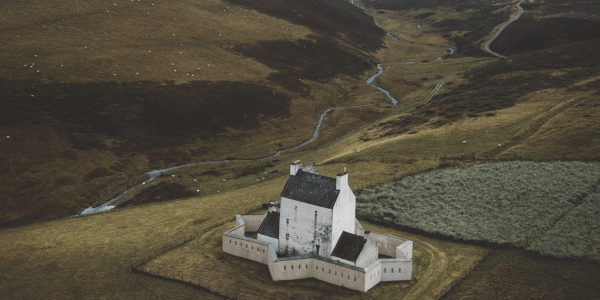
Corgarff

The Scottish government has introduced land reform legislation to encourage community ownership by granting ministers powers to intervene in the sale of estates of more than 1,000 hectares. The ruling Scottish National party said the bill, the biggest package of reforms in years, aimed to “revolutionise land ownership in Scotland” by empowering rural and island communities and increasing transparency in large land transactions.

In 2016 the last round of Land Reform made it easier for communities to buy out parcels of land, however the rampant rise in land prices – often now driven by so-called “Green Lairds” looking to cash in on carbon credits – have locked those same communities out of being able to afford to buy that land. With a few exceptions – such as in Langholm – the parcels of land being bought by communities have been getting smaller.  A report published in 2022 found that despite a steady rate of successful community buyout projects continuing much as it had since the start of devolution, the actual hectarage of land transferred had all but stalled with around 97% of all community owned land in Scotland being transferred before the passing of the 2016 Act.

Continue reading

A Hollow Frame

“Spare your words, your actions will speak for you.” – Akiroq Brost

(This blog post previously appeared in Common Weal’s weekly newsletter. Sign up for the newsletter here.)

Imagine you’re applying for planning permission to build a house. Normally, the process would involve drawing up fairly detailed plans about what the house would look like. No plan goes perfectly to plan though and some changes are inevitable as the building process occurs but if the final building does deviate substantially from the initial plan there can be consequences up to and including being ordered to tear the whole thing down and start again. What you can’t do is gain permission to build “a house” without answering the basic questions like “What size is it?”, “How many bedrooms will it have?” or “Will it be made entirely of asbestos?”.

Over the past few months Common Weal have been incredibly busy replying to just a few of the public consultations that the Scottish Government and Scottish Parliament have been publishing. I’ve written before about the sheer volume of them, how much effort goes into each response and how little they often achieve despite the rare moments of serious influence or the fact that if folk don’t respond to them then vested interests end up dominating the responses and thus what the Government can point to as justification for their plans.

Continue reading

Devolving Building Safety

“The fact is, free markets don’t provide safety. Only regulation does that. You want safe food, you better have inspectors. You want safe water, you better have an EPA. You want a safe stock market, you better have an SEC. And you want safe airlines, you better regulate them too.”
– Michael Crichton

(This blog post previously appeared in Common Weal’s weekly newsletter. Sign up for the newsletter here.)

A couple of weeks ago, Nicola and I chatted on the Policy Podcast about the pile of public consultations overflowing our desks and the desks of our colleagues – it’s worth a listen as while it’s often a thankless task that takes up a lot of time for very little result, the result that comes from it is a vital part of our democracy.

Amusingly, during the podcast I mentioned that because we’re a Scotland-based think tank and Scottish politics structures are an order of magnitude more accessible than UK political institutions are (which isn’t to say that access is easy…) we very rarely engage with UK level public consultations. It’s amusing, because in the past week as I’ve been chipping away at our consultation pile, I’ve ended up responding to two UK consultations – one on the sustainability of UK debt and another on the topic of today’s column – a proposal to devolve a new tax power to Scotland.

Continue reading

The Welsh Way Forward

“Where two principles really do meet which cannot be reconciled with one another, then each man declares the other a fool and a heretic”
– Ludwig Wittgenstein

(This blog post previously appeared in Common Weal’s weekly newsletter. Sign up for the newsletter here.)

image_2024-02-07_124803052

The only reasonable constitutional future for Wales that is not viable is the status quo. This was the ultimate conclusion of the final report from the Independent Commission on the Constitutional Future of Wales which published last week after several years of patient, diligent and thorough work. While initially set up to examine the prospect of Welsh independence, it took a much broader view, pulling in thoughts and ideas from across the constitutional divide in a way that Scotland could and must learn from.

Continue reading

The Cairngorms Climate Backlash

“The only purely popular government is local, and founded on local knowledge. The citizens can rule the city because they know the city; but it will always be an exceptional sort of citizen who has or claims the right to rule over ten cities” – G.K. Chesterton

(This blog post previously appeared in Common Weal’s weekly newsletter. Sign up for the newsletter here.)

image_2024-01-28_131515340

Continue reading

Scotland Deserves Local Democracy

“Nationalism can be a destructive force when it promotes intolerance and division. But it can also be a force for good, when it seeks to defend local autonomy against the homogenizing forces of larger entities.” – Maxime Bernier

(This blog post previously appeared in Common Weal’s weekly newsletter. Sign up for the newsletter here.)

image_2023-02-19_103755469

At the last UK General Election, the party that would go on to form the Government made a manifesto promise to increase police numbers across the whole of the UK. It was a popular policy and probably won a few votes, but there was a problem with meeting that policy. Policing is a devolved matter. The UK Government only has control over the police in England. They could, of course, invest heavily in police numbers and that investment would increase the Block Grant sent to devolved nations but there’s absolutely no guarantee that the money would be used to increase the number of cops in Scotland. There would be a certain amount of political pressure to “pass the money on” as intended and that pressure has certainly been sufficient in the past, but the structure of devolution means that the Scottish Government has the absolute right to spend the money on anything it sees fit. This makes perfect sense as the needs and demands of policing in Scotland might well be very different from that in England as might the style of policing – Scotland simply may not want or need a highly militarised, American style force designed to suppress any thought of democratic protest. Anyway, the people of Scotland didn’t vote for the policy at the last Scottish election so there was no mandate to act at all.

Westminster’s defence was that it simply didn’t trust the calibre of politicians in Holyrood to act responsibly and it didn’t really matter what they thought given that they were either safely compliant or could be written off as merely the opposition complaining for the sake of complaining (damned if you do; damned if you don’t). The UK Government really wanted to meet that manifesto pledge however and decided it wouldn’t look good if the devolved nations resist their will so it took steps. Three options were available. They could, with ease, simply pull the powers over policing away from the Scottish Government and place them in the hands of the UK Justice Minister. All that would take is a simple majority vote in the Commons, which they could easily whip through. The second option was to ring-fence the funding – to simply tell the Scottish Government that they weren’t getting it unless they promised to use it as the UK Government wanted. Finally, they could outright threaten Holyrood with “financial penalties” if they tried to divert the money elsewhere.

If this happened, I’m sure that Holyrood’s response would be similar to yours – one of democratic outrage and calls for Westminster to back off and stop stepping on the toes of devolution. How dare they even make a manifesto promise that lay outwith their powers?

Do we all share the same outrage when the Scottish Government does something similar to Scottish Local Authorities?

Scotland is one of the most centralised states in Europe (especially as we don’t have an actually-local tier of municipal government – our “Local” Authorities would be called Regional Government almost everywhere else in Europe). In fact, if Scottish independence resulted merely in all reserved powers at Westminster transferring to Holyrood then a single national Government would directly control more than 85% of all public spending in Scotland. This figure is even worse when we consider the amount of money that is ring-fenced by Holyrood and merely administered by Councils. Holyrood has in recent years directly threatened Councils with withheld funds unless Councils used their powers over one of the few taxes that they actually control to maintain the Council Tax freeze and, just last week, has actively threatened to fine Councils unless they use money as directed to boost teacher numbers. Meanwhile, John Swinney’s recent budget stated that he was using Holyrood’s powers “to the maximum extent that is responsible” which carries the implication that using Holyrood’s powers to pass reforms to Local Authority tax raising powers would be “irresponsible”.

This week, Scottish Local Authorities having been negotiating their budgets for the year. It’s a grim process. Folk I’ve spoken to in several councils and across multiple parties have been essentially saying that they’re being put in the position of either breaking the law by not passing a budget or breaking the law by passing a budget that causes active harm to people because of the inevitable cuts to social services. After years of “trimming the fat”, then “cutting to the bone”, Councils are at the point of outright amputations – simply closing down leisure centres or stopping care services for folk who need them. If you’ve seen more potholes in your local roads due to the last rounds of cuts then we might expect them to not get repaired or to get worse in coming years.

The strictures of Devolution are tight but they are not nearly as tight as the Scottish Government have implied. Whenever groups like ourselves have campaigned for the broadening of the Scottish tax base via tools like Council Tax reform, land taxes, wealth taxes or pollution taxes, we’re told that the Scottish Government doesn’t have the power to do so. This is only a half-truth. These taxes cannot be implemented as national taxes controlled by Holyrood and where the revenue flows to Holyrood, but many of them can be implemented if they are done so as local taxes where the revenue flows to the relevant Local Authority.

In 2013, the Scottish Government made its pledge towards treatment of Local Government, including promises of maintaining subsidiarity and local decision-making. More recently, they have pledged a reform of local government finances, guided by a Citizens’ Assembly, by the end of this Parliament though they’ve also made it clear that the reforms themselves would only be implemented beyond the next electoral horizon (should they be in power to do so). It is likely far too late now to give Local Authorities the powers to avert a budget crisis this year and I’ve yet to see willingness from Government to spend their way out of this hole – we’ll see soon what the implications of that will be – but this only heightens the urgent need for reform of Scotland’s finances and democratic frameworks to make them more sustainable and to avoid this kind of crisis in the future. Enabling legislation should be passed as soon as possible to give Councils more control over their own finances and to set local taxes as they deem appropriate, including in areas such as wealth, land and pollution.

With the resignation of Nicola Sturgeon this week and the SNP now likely to fight a leadership contest that hasn’t been seen in the party essentially for decades, it would be worth all candidates considering their pitch not just as one where they believe that they are the best personality to lead the party and, likely, the country but also one where they consider their policy pitch and agenda for their tenure. I will be watching closely to see if any of the candidates promise to uphold and accelerate those pledges. Who knows, we might even end up with something really radical – like the kind of truly local democracy that almost all of our peer nations in Europe simply call “normal”.
TCG Logo 2019

Better For Who?

“If politicians don’t care about the electorate and lie to them, they can’t expect the electorate to care back and vote them in. An election must be more than a search for honesty in a snake pit.” – Stewart Stafford

(This blog post previously appeared in Common Weal’s weekly newsletter. Sign up for the newsletter here.)

This month marked eight years since the Scottish Independence Referendum and it’s fair to say that they have not been a quiet eight years. Brexit, pandemic, economic turmoil and the grinding poverty caused by over a decade of Austerity are taking their toll on the wellbeing of the country. It’s certainly not the promised “sunlit uplands” or even the pre-2014 “status quo” that many thought they were voting for. As we move into a fresh independence campaign, it’s worth looking back at some of the things we were promised in 2014 by the pro-Union campaign and how those promises have panned out since.

image_2022-10-03_134124375

Continue reading

We Need To Talk About: GERS (2021-22 Edition)

“They were learning fast, or at least collecting data, which they considered to be the same as learning.” – Terry Pratchett

(This blog post previously appeared in Common Weal’s weekly newsletter. Sign up for the newsletter here.)

You can also read my previous work on GERS on this blog behind the following links: 2013-142014-152015-162016-172017-182018-19, 2019-20 and 2020-21.

Welcome to the second year of the Covid Discontinuity. As I noted last year, we’re in the middle of the worst possible thing that can happen to a statistician – a major event that throws out all of the carefully plotted trends and predictions. Last year I also used the phrase dreaded of every economic seer or scryer – “If things go back to normal next year…”

Well, they didn’t. Covid continued despite the best efforts of politicians in Scotland and the UK to ignore it, Brexit bit harder, the economic turmoil blamed on the escalating war in Ukraine caused a major fuel crisis that threatens to harm millions in the UK, inflation and interest rate spikes combined with continued wage repression raise the very real threat of a second Winter of Discontent and around Europe and the UK will be hosting Eurovision despite only coming second place.

In purely budgetary terms, this year’s GERS report suggests that Scotland’s finances do seem to be improving somewhat as the Covid support money slows down or stops completely (Don’t look at the ongoing pandemic, lost work and productivity due to illness or future increased health spending though…also don’t look at the massive looming catastrophe as cuts to social care are causing the NHS in England to grind to a halt and may be responsible for around 500 deaths a week in England alone…). The notional Scottish “deficit” is £23.7 billion – still higher than the pre-Covid trend of around £15 billion but down from last year’s exceptional £36.5 billion.

Continue reading

Democrat, Renew Thyself!

“And he said unto them, Ye will surely say unto me this proverb, Physician, heal thyself: whatsoever we have heard done in Capernaum, do also here in thy country.” – The Bible, Luke 4:23

(This blog post previously appeared in Common Weal’s weekly newsletter. Sign up for the newsletter here.)

The second in the series of the Scottish Government’s Independence White Papers has been published. Renewing Democracy through Independence presents the Government’s view on the state of democracy in the UK, the limits of Scottish voters’ democratic voices within the UK and how Scottish independence could improve the situation.

The paper outlines the various democratic deficits of the UK. From the unelected House of Lords, through the unproportional voting system of the UK General Elections, the lack of accountability that comes with majority governments in that UK, the fact that devolution is granted essentially at the pleasure of the UK Government and can be withdrawn or overridden at any time and, most importantly for a document promoting Scottish independence, the fact that despite pro-independence parties winning several elections in the years since the last independence referendum it essentially comes down to the whim of the UK Prime Minister to “allow” another one. The central claim is that the UK is insufficiently prepared to correct these democratic deficits from within and only an independent Scotland would free itself from them.

There’s little on the pages of this paper that is outright objectionable, indeed I and others at Common Weal have made some of the very same points in our work over the years, but this paper stands in a strange place without, apparently, a clear idea of its target audience. It’s too long and detailed to be read by anyone who doesn’t have an interest in politics but it’s simultaneously too shallow and, frankly, bland for anyone who does. As Chapter 2 of a unified Independence White Paper it would read as an introductory preamble to later chapters but as Paper 2 in a series of individual papers it doesn’t really stand alone in its own right. It certainly does little to say precisely what an independent Scotland would do to fill the gaps left in Scottish democratic structures after the undemocratic sections of UK governance are excised by independence. To that end, what follows is a brief attempt to fill that gap with what I would like to see every level of Scottish politics look like.

Continue reading

A Financial Flatspin

“Someone is sitting in the shade today because someone planted a tree a long time ago.” – Warren Buffett

(This blog post previously appeared in Common Weal’s weekly newsletter. Sign up for the newsletter here.)

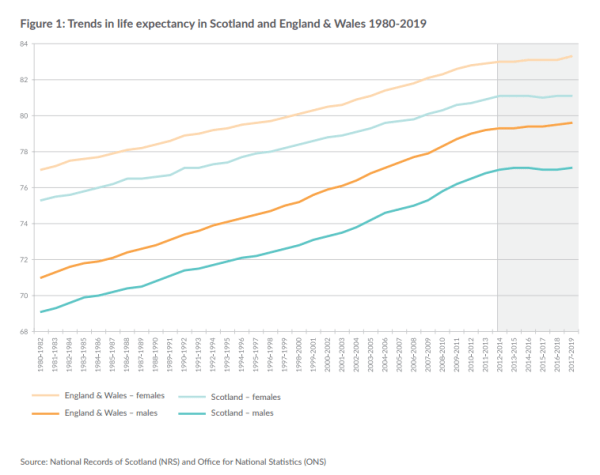
An extremely disturbing report was published this week looking into life expectancy in Scotland and the UK. It found that the consistent gains in life expectancy that we have experienced for much of the 20th century and into the first decade of the 21st has stalled and has even started to decline for some groups – especially the poorest and most deprived. This stall was abrupt and started in 2012 and has had the effect of knocking around 16 months of life off of the average Scot compared to pre-2012 trends.

image_2022-06-11_203636097

(Image Source: GCPH)

 This was not due to a “natural limit” of life expectancy being reached (though such a limit does almost certainly exist) nor have neighbouring countries experienced this stall to anywhere the same degree. The stall is not due to Covid, nor any other endemic illness. Drug-related deaths in Scotland are rising and this is having a measurable impact on average life expectancy but life expectancy has also stalled for non-drug users so this cannot explain everything either. Nor is it due to obesity or even due to climate change (though the former had more of an impact than the latter). All of these factors and more could be isolated, accounted for and controlled for in the study. Once this was done, there remained still an additional adverse impact on our life expectancy.

The conclusion of the report is that there is one stark cause above all of the other factors that has resulted in our lives being, on average, shorter than they otherwise would have been. In 2010 the UK Government began a massive socio-economic experiment called Austerity. This, the report finds, has been the primary cause above all others for the harm done to our health and wellbeing. It has sucked vital resources out of public services and starved households of the resources required to replace them. Poverty and deprivation – deliberately applied by political choice – has killed people earlier than they otherwise would have died.

It is in this context that we must view the other major reports published this week – the Scottish Government’s Resource Spending Review and Capital Spending Review. These financial reviews lay out the plans for devolved government spending over the next four or five years up till the end of this Parliament. The choices being made are grim.

Continue reading