Grim Drama Parked

“Tomorrow’s GDP figures will confirm whether or not Scotland entered a second quarter of economic downturn in the first three months of 2017.” – Scottish Conservatives. 4th July 2017.

The quarterly Scottish GDP figures were released today after a long build up in a press anxious to see if Scotland was on, as the Express put it, the “BRINK OF RECESSION” (their emphasis).

The figures themselves rather put a misstep into their charge.

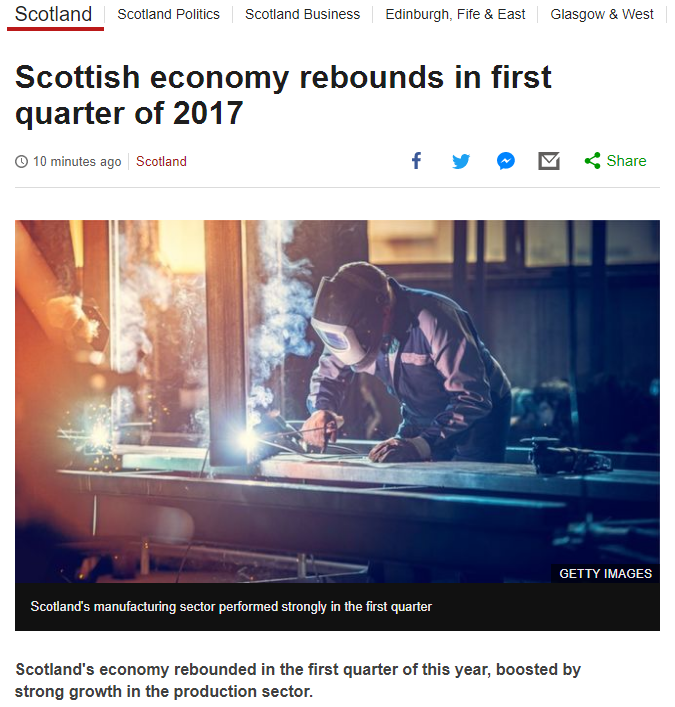
bbcgdp

The headline figures are that in Q1 2017, Scotland’s economy grew by 0.8% which is up substantially on the -0.2% contraction seen in Q4 2016. This positive growth also means that the two successive quarters of negative growth which define a technical recession were not met.

The UK’s GDP growth over Q1 2017 was 0.2% though in my last blog post I put substantial attention onto the point that we should treat such comparisons with a great deal of care given the large regional inequalities within the UK. I’d very much like to see the GDP of the UK broken down across its regions (especially London) before commenting too much on it.

And before we all start patting ourselves on the back at avoiding our “predicted” recession, it’s worth actually diving into the numbers and seeing what they do and do not tell us about the Scottish economy.

Continue reading

The Return of the Sick Man

“Annual income twenty pounds, annual expenditure nineteen nineteen and six, result happiness. Annual income twenty pounds, annual expenditure twenty pounds ought and six, result misery.” – Dickens, David Copperfield

The shape of the next UK economic crisis has become apparent. It may have already begun and it’s not at all clear how it can be avoided or mitigated.

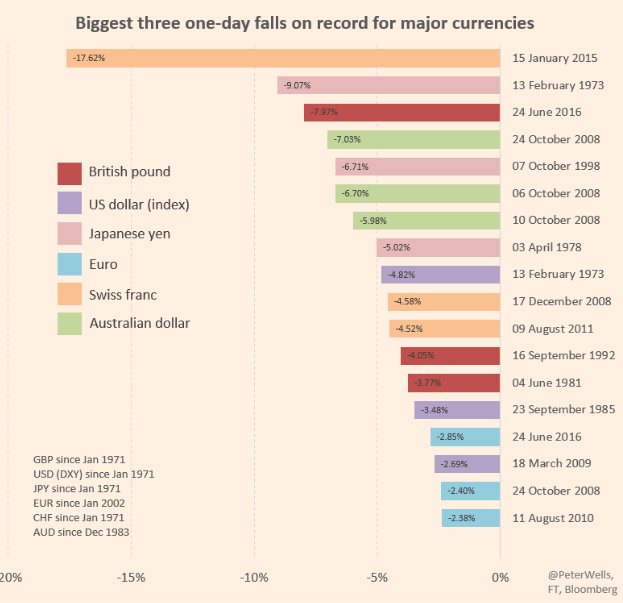
On the 23rd June 2016, the United Kingdom, for a variety of reasons, voted to leave the European Union. The immediate impact of this was an almost unprecedented drop in the value of the pound with respect to its major trading partner currencies.

Currency fall

Not much of a problem, the defenders said, as a weakened currency has its merits as well as demerits. Exports should become cheaper, which would boost foreign trade.

This may have been true in times gone by but economies have grown vastly more complex than this. Many products manufactured in the UK consist of sub-components drawn from multiple countries and globalised supply chains have grown STAGGERINGLY complex.

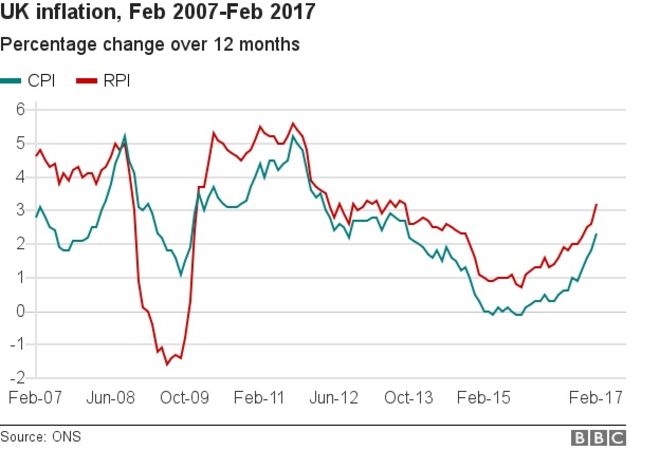
What this has meant is that even the goods that Britain manufactures here have seen their “input prices” increase, which has pushed up the price of goods even despite the fall in currency strength. Add to that, the fact that the UK imports far more than it exports – it has one of the largest trade deficits as %GDP in the OECD –  and it becomes clear why prices have started rising again in Britain. After five years of declining inflation rates and almost a year of zero price increases, inflation has returned with a vengeance.

_95250708_chart_inflation_mar17

But this needn’t be a terrible thing. In fact, inflation can often be quite useful as it erodes the value of debts (which is why creditors and asset holders hate it so much). So long as wages keep up with the rising prices then for those who don’t depend on the rising value of assets or debts it can be manageable. So how are we doing on that point?

Oh…

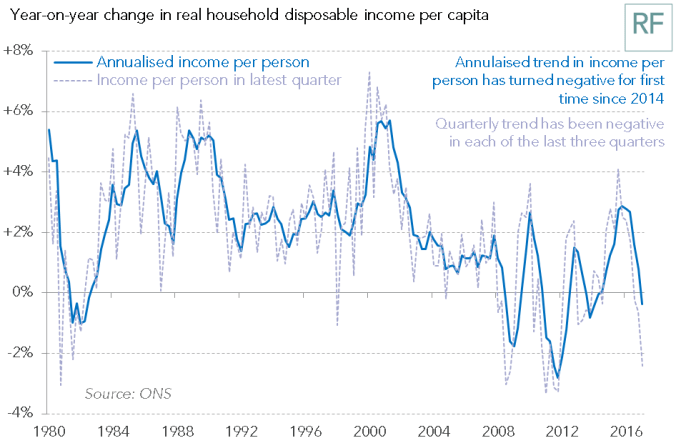
income.jpg

We’re not doing so well.

So inflation is rising and wages are declining, so we’re in the situation where meeting our needs and maintain a decent standard of living is becoming more and more difficult. But even this could be mitigated or reversed if the government were to step in and support the economy by investing or by otherwise injecting money into it.

So how’s the UK dealing with things? Well…

FT.png

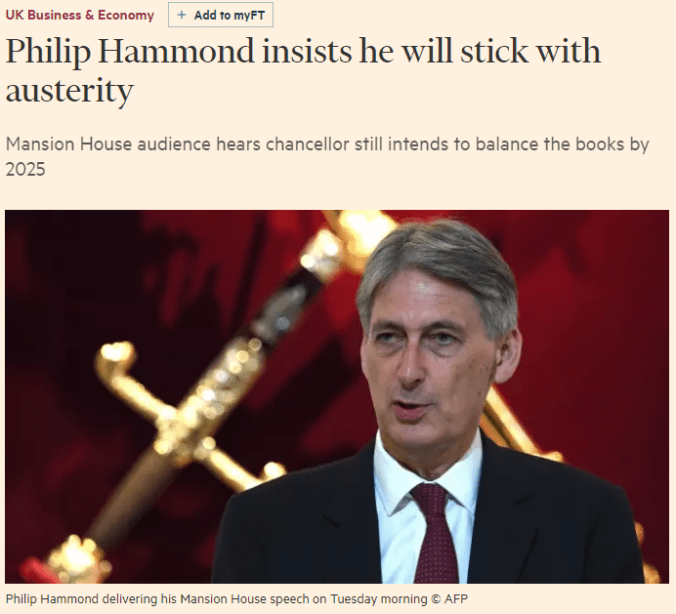
And so this is the root of the coming crisis. Prices are rising, wages are stagnating, savings have been drained, credit cards have been maxed out, and the government is pulling out of the business of providing government and public services so you need to spend even more to replace it. We no longer have enough money to meet our basic needs, never mind the disposable income to buy the widgets we need to consume to keep the wheels of the economy turning.

Up here in Scotland, there are signs that the crisis is already upon us. The Fraser of Allander Institute published a report today warning about the precarious nature of the Scottish economy saying that it was stagnating with relation to the UK economy as a whole. Some will almost certainly be quick to blame this on the Scottish government (the phrase “uncertainty of a divisive second independence referendum” comes to mind). There are certainly some things that the Scottish Government could do to help – a National Investment Bank should be high on the list and a good shake up of the domestic agenda would be welcome – but the ultimate cause of this slow-down does not originate in Scotland nor will its solution come from here (at least until the levers of power are returned to the country upon independence).

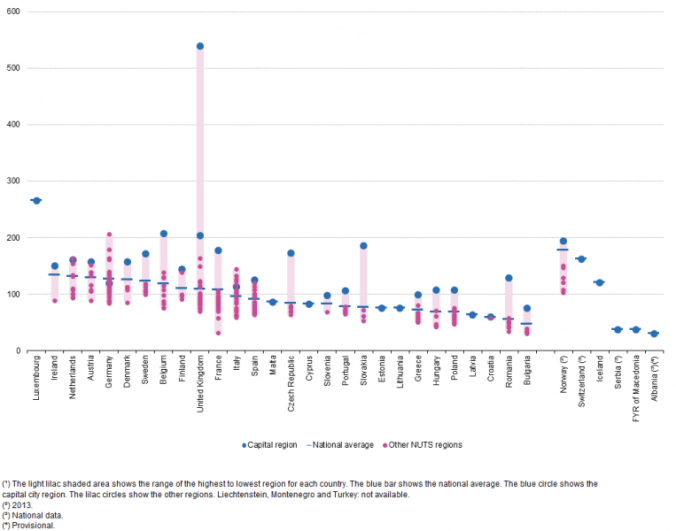
The problem, ultimately, is that Britain isn’t Great. Britain is Weird. Britain is a deeply unequal country on a scale which, compared to its neighbours, is utterly baffling.

In many countries, the capital city will be the richest region of the nation. This is normal –  Money wants to be close to power – but the UK’s disparity really needs to be seen to be believed. Here is the GDP/capita for each of the EU28 and EFTA countries broken down by region. Spot the odd one out.

763px-Gross_domestic_product_(GDP)_per_inhabitant_in_purchasing_power_standard_(PPS)_in_relation_to_the_EU-28_average,_by_NUTS_2_regions,_2014_(%_of_the_EU-28_average,_EU-28_=_100)_RYB2016.png

(Note that the UK has two capital dots. The lower one is London as a whole. The upper one is just Inner London)

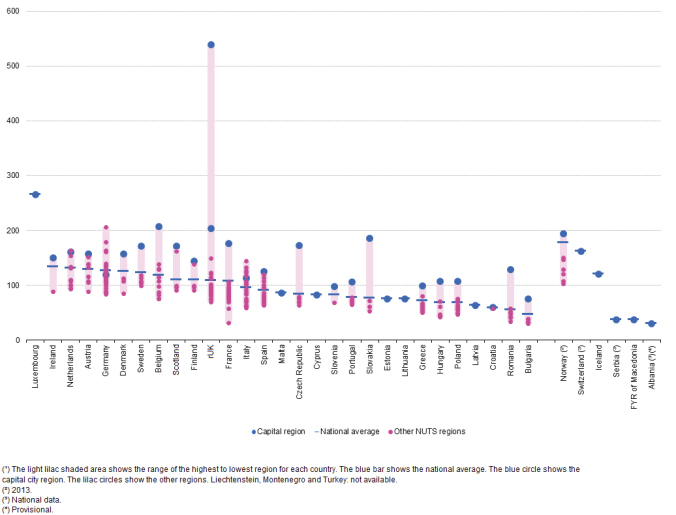
Whenever statistics about Scotland are produced, they’re often given with reference to the “UK average” or the “UK as a whole” but the extreme disparity of Britain masks the picture. Detailed analysis by Prof Mike Danson of Heriott-Watt University has shown that Scotland’s GDP per capita is the third highest region of the UK (after London and the South-East) and, if we were an independent state, we’d be the 9th highest in Europe. In fact, we can disaggregate out the Scottish data from the chart above and catch a glimpse what we’d look like as an independent country.

EU28 plus Scotland GDPcapita

(Edinburgh data estimated from 2011 NUTS 3 database)

Taken on this view, Scotland no longer looks like a “below average” region of the UK but a fairly normal Western European country. Far more like Finland or Denmark than, say, Greece.

As Prof Danson says, the obsession with comparing Scotland to misleading “UK average” figures leads to commentators ending up unable to take a step back and ask what is happening across and within the UK and where the problems really are. Until this happens, Scotland will continue to stagnate within the UK as the overinvestment of London continues (and is likely to get worse through the Brexit process in a desperate attempt to prop up the financial sector there).

As said earlier, there is a way out of the coming credit crisis but it’s going to involve not more Austerity but a whole lot less. Economists are increasingly coming around to the realisation that the Government’s debt is your surplus and that governments can take on that debt almost without limit (unlike you who have hard limits on credit and the ability to repay it) and – if they have their own currency – can print money in order to provide services (unlike, again, you who would go to jail if you tried that).

Once again, there is a certain amount that the Scottish government can – and should – do at the moment to help but it will always be stymied by the very tight rules of devolution. There’s little to no hope of the UK changing course any time soon (even Corbyn’s Labour is solidly committed to “balancing the budget“)  and the hard Brexit the Tories and Labour are both pursuing is being increasingly differentiated by the amount of damage the plans will cause rather than any attempt to prevent it. The Sick Man of Europe seems destined to return to the UK. I only hope that Scotland doesn’t catch its cold.

tcg-logo-7


Beyond The Headlines

“[I]f there is to be meaningful debate on this issue then the SNP have a lot of work to do to produce best possible data. The last thing they should do is trust that from London.” – Richard Murphy

Tax expert Richard Murphy, who is currently most notable for exposing the UK’s massive £120 billion per year tax gap, has written an article warning of relying on UK economic data to make the case against Scottish independence.

Murphy

Before he gets attacked too badly by hacks telling him that the Scottish economic data is produced by Scottish civil servants (Edit: I may already be too late on that) I thought I’d write a parallel piece pointing out what those civil servants have told me about the limits of some of their stats.

The first thing to remember in all of this is that the UK is not a federation or a confederation, it considers itself to be a unitary state of which Scotland is just one region of twelve (plus the “extra-regio” offshore regions). Therefore there is currently no real obligation to even gather the distinct statistics for Scotland and it really only has become important because of the independence campaign.

Tax Revenue

As I’ve pointed out in my paper Beyond GERS, the issue of apportioning tax revenue is fraught with subtle difficulty. GERS itself has updated its methodologies multiple times over the years (particularly since the SNP took the government in 2007. The GERS of today is no longer very closely related to the GERS created by Ian Lang to discredit Scotland in the early ’90’s). There are still differences in the results presented straight by HMRC and the data eventually “Scottishised” [To use the stats folk’s term] and presented in GERS.

Onshore corporation tax is a good example of this. Where an overall UK stat may simply count the location of the HQ of a company for the purposes of assigning corporation tax and this may make sense from a unitary state perspective (albeit this is becoming less true as globalisation increases the ability for multi-national companies to move resources across borders).

For many companies though, the profits one which corporation tax are paid are not generated at the HQ. This is obvious in the case of, for example, a large retail chain which has stores across the country. To correct for this, HMRC and GERS both use different methodologies to apportion the tax more evenly. Various measures (and the weighting applied to those measures) such as estimating volume of sales, number of employees, amount of capital spent in the region and overall population are all used in different ways to reach slightly different estimates. As a result, HMRC estimates that in 2015-16 Scotland produced 7.1% of the UK’s corporation tax compared to 7.3%% estimated by GERS – a gap of  about £100 million.

One can also see possible limits of these methodologies especially if taken individually. For example if one looks at employees then one could probably consider a company (and, it should be stressed that this is a completely hypothetical company) which employs a dozen people in Scotland to make, say, a high value, highly exportable product with a geographic link (call it a similarly hypothetical product like “Scotch blisky”) and then employs a couple of hundred people in London to market it. It may be very difficult to properly apportion the “value” of that product and its profits based on employees alone. It’s possible, after all, to find a market without marketing but a bit harder to drink an advertising campaign.

VAT is another issue where these figures can differ for similar reasons. The UK doesn’t demand point of sale ID to determine the location of VAT spend (If you nip down the road to Carlisle for your shopping, then that results in VAT paid in England but Tesco neither knows nor cares where you came from to get there). Again, various methodologies are used to try to estimate the proportions paid and the estimates are slowly aligning (HMRC claims Scotland paid 8.4% of the UK’s VAT compared to GERS’ 8.6% – a gap of £110 million). There is also a further complication wherein the results between HMRC and GERS are simply presented in a different manner (HMRC measures the cash receipts, GERS measures the accruals)

A third prominent example is Income Tax, and is going to become pertinent now as IT is largely devolved to Scotland and all Scottish residents are to be assigned a distinct Scottish tax code and especially now that the income tax bands in Scotland will soon start to diverge from the UK bands. However, HMRC has been recently criticised for a series of administration issues which is making it difficult to roll out this tax code. As with the difficulties in rolling out devolved welfare, this won’t be nearly so much of an issue once Scotland is independent but highlights the difficulty in trying to run a devolved situation from a centralised unitary setup. This said, both HMRC and GERS arrive at a proportion of about 7.2% of the UK’s income tax coming from Scotland although this may change as the new systems are launched (even if tax rates are kept the same).

It is not possible to say whether the HMRC or GERS estimate is “better” or “worse” than the other. The Institute of Fiscal Studies has commented saying, especially of corporation tax:

“Neither of these estimates is clearly superior to the other, and both may be some way off. Profits are not necessarily generated in proportion to the number of employees, or their wages. Some employees may be more instrumental in generating profits than others; and profits also arise from capital assets – both physical (such as buildings and equipment) and intangible (such as intellectual property and brand value) – the location and contribution of which may differ from the location and wages of employees. Calculating how much of a company’s profits are attributable to economic activity in different locations is conceptually and practically difficult and is the source of many problems in international corporate taxation”

Balance of Trade

This is the big one that has attracted a lot of shouting in the past few months. Once again, the UK’s status as a unitary state causes much of the furore over the published numbers to be based on false premises and over-massaged numbers. The UK’s balance of trade figures are published here and probably do do a decent job of estimating the UK’s position in the world. What it doesn’t do is show the internal movements of trade within the UK. As a unitary state it simply doesn’t matter to the external balance of trade whether or not Yorkshire is a net exporter to Sussex. The UK does produce figures which try to estimate the trade balance between the regions  with the rest of the world but it only covers goods, not services (hence excludes nearly half of the UK’s total trade) and it does not cover internal trade. For that internal trade, we turn to ESS – Export Statistics Scotland – which surveys exporting companies in Scotland and asks them where they send their goods and services (contrary to a semi-popular belief, these statistics don’t care how the goods reach their destination so it doesn’t matter if they physically leave the UK via an “English port“). There are some limits, again, to this methodology.

First, not all companies know where their goods are going (see the example of Tesco again. If someone from Carlisle buys a crate of beer in Glasgow then goes home then that’s a Scottish export but Tesco wouldn’t be able to record it easily) so they won’t appear in the survey. Goods which are shipped to England then either re-packaged or used as a sub-component before being exported from England to somewhere else (or even back to Scotland) would be counted only as far as their export to England and there may be some cases where service “exports” are caused by, for example, someone in London buying insurance for their house in London from the London branch of a provider who just happens to have a brass plate in Edinburgh. The total proportion of these anomalies in the data is simply unknown at this point and unlikely to be knowable until after independence.

Beyond the Horizon

And this takes us to the most important point in this whole article.  Even if the methodologies above all align and all can capture the full economic picture of Scotland and everyone can agree on the figures produced and everyone agrees that they produce an accurate and complete picture of Scotland’s economy within the Union there is a fact which should be utterly indisputable (and certainly is within the team which put together these stats).

Independence. Changes. Everything.

None of these figures have any validity if you try to use them to project beyond the independence horizon. Corporation tax may change due to the redomiciling of businesses post-independence. Both those seeking to remain within the UK and those seeking to remain within the EU or EEA may shift operations. Trade exports may suddenly become a lot easier to assign (whether there’s a “hard border” or not) and that “extra-regio” oil which is often excluded from stats due to historical and supply chain accounting issues suddenly has to be accounted for. Those tax streams which are simply too embedded to discuss in any terms other than by a population share have to be audited. And all of this is before Scotland starts to make changes to the tax system to optimise it for the Scottish economy or to do things like close the tax gap.

As with everything in science and in economics, statistics are based on models, models are only ever as strong as their underlying assumptions and projections are only ever as strong as the person making the prediction’s understanding of the limits of those assumptions and the models.

IMF GDP Growth

(One day I’ll write an article about the “Porcupine Plots” which get created when inappropriate models are used year after year in spite of reality)

I don’t mind discussing the economy of Scotland within the Union. I don’t even mind speculating on the economy of an independent Scotland. But I sense that the next two years of campaigning will get very frustrating if pundits continue to stretch their own models past the point of credibility in a quest to push their political point. This, I should warn, goes for both sides. We need a more meaningful economic debate than we saw last time. Let’s get beyond the headlines to create one.

tcg-logo-7

Air Departure Tax Post-Brexit

“We haven’t commissioned to the best of my knowledge any independent research of our own. If committee wishes me to look at that, I will certainly consider that absolutely.” – Derek Mackay on the Government’s (lack of) analysis into the proposed ADT cut.

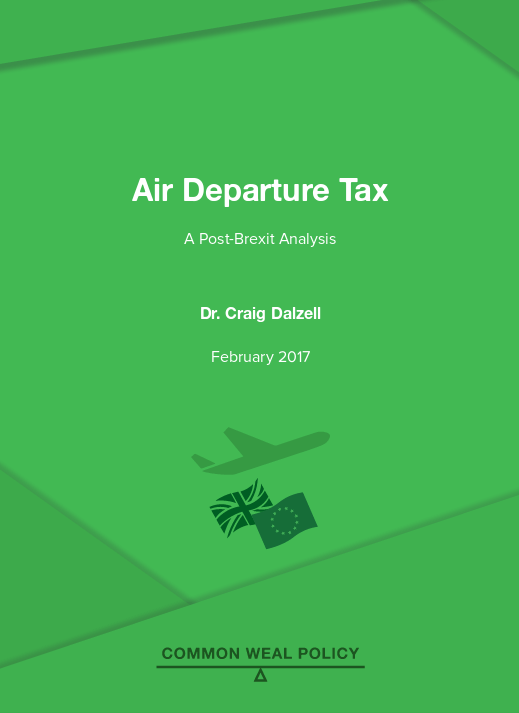
ADT Cover.png

The Scottish Government put out a call for evidence for their proposal to cut and eventually eliminate air passenger duty (or, as it’s now going to be known, Air Departure Tax).

Common Weal duly obliged and updated our previous work on the topic to account for the impact of Brexit. You can read the new report here or by clicking the image above.

It’s just as well that we’ve done this as it has since been reported that the Government itself has done precisely zero economic analysis of the impact of the tax cut and, as it turns out, our report is the only economically based submission which is against the tax cut (The RSPB have submitted an objection on the grounds of a very well founded environmental impact analysis). More than half of the other submissions and the bulk of those in favour of the cut are from companies and groups within the airport and airline industry. There is a great deal of concern that unless the government does pull its weight and do the maths itself then this policy could pass through simply on the say so of those who stand to benefit directly from the tax cut and at the expense of those who will lose out due to the impact on tourism and the lost revenue to public services.

Preface and Key Points below the fold.

Continue reading

Scotland’s New Deal

“Remember, the EU isn’t as keen on “Special Deals” as it once was”, The Common Green, 11th February, 2017.

I’m always more than happy to be proven wrong especially when it’s in a pleasantly surprising manner.

This week saw the news story in The National that, contrary to my impressions up till now, that a report had been written by the European Parliament’s Committee on Constitutional Affairs recommending that the EU should  indeed be considering some kind of “Special Deal” for Scotland which would allow it stay within the Single Market even if we remain within the UK after Brexit.

Continue reading

QuEUing up for Membership

Don’t want to read 2600 words? Twitter version: None of the things people say will be hard are. Few are talking about things which will be.

SaltireEU2

Only in the madhouse world of UK politics that a government which is actually embarking on the process of taking Scotland out of the EU against its will while claiming that this would be a wonderful thing could somehow contrive to simultaneously try to sell us that line that an independent Scotland would be out of the EU against its will and that would be terrible.

Whilst this is going on, the same several year old phony war surrounding Scotland’s membership of the EU continues with a great many people still claiming that we would a) be forced to join the euro and b) Scotland would be punted to the back of the accession “queue” doomed to wait till all other potential members (including, possibly, Turkey) have joined before we’ll get a look in.

This week has seen the publication of a couple of commentators on Scotland’s precise position regarding our EU membership, independence and the interaction with Brexit which has sent every man and their dug howling at the moon and trying to spin themselves into position to get another shot in.

So lets take the opportunity here to take a slightly more sober, honest and open look at how things work in the EU and plot out a couple of likely (that is, actually possible) pathways from which Scotland goes from here, through Brexit and independence and to an independent Scotland within the EU.

Continue reading

You’ll Have Had Your Devolution?

The Supreme Court has rendered its judgement on Article 50 and Brexit. In an 8-3 ruling they have decided, as reasonably expected, that Parliament must vote on the triggering of Article 50 and the beginning of the Brexit process.

On the second point of the case, that the devolved Parliaments should also be consulted, the Court ruled 11-0 that:

SCJudge.jpeg

In essence saying that whilst Westminster could consult the devolved Parliaments and could even state that their formal recognition was required it doesn’t have to and the Supreme Court will not force it to do so. In practice, we all know that this means it won’t. Scotland’s will can be overruled at Westminster’s. Power devolved is power retained.

Wallonia will now have more power than Scotland to negotiate, influence and – eventually – veto or approve the Brexit deal. So much for that “most powerful devolved government in the world“.

The idea of a Federal UK is now dead. Westminster is sovereign. As a former UK Federalist, this is a painful and depressing idea to admit. I cannot see any possible pathway to reach that destination. Those still in favour of it may have to have some very hard thinking to do now. (Mind you, if Wallonia DOES end up writing up more of the Brexit deal than Scotland does, this may be a good argument in favour of EU Federalism. That’s possibly a discussion for the future)

This also means that the SNP’s “Scotland’s Place in Europe” paper has only one pathway forward now and that’s through amendments to the Article 50 trigger bill when it comes through (something they’ve already pledged to do). If Scotland will not have its say from its own Parliament then it will have a voice at Westminster. And if we’re told that we’re to have no influence there either…?

tcg-logo-7

The White Paper Project

“Work as if you live in the early days of a better nation.” – Alasdair Gray

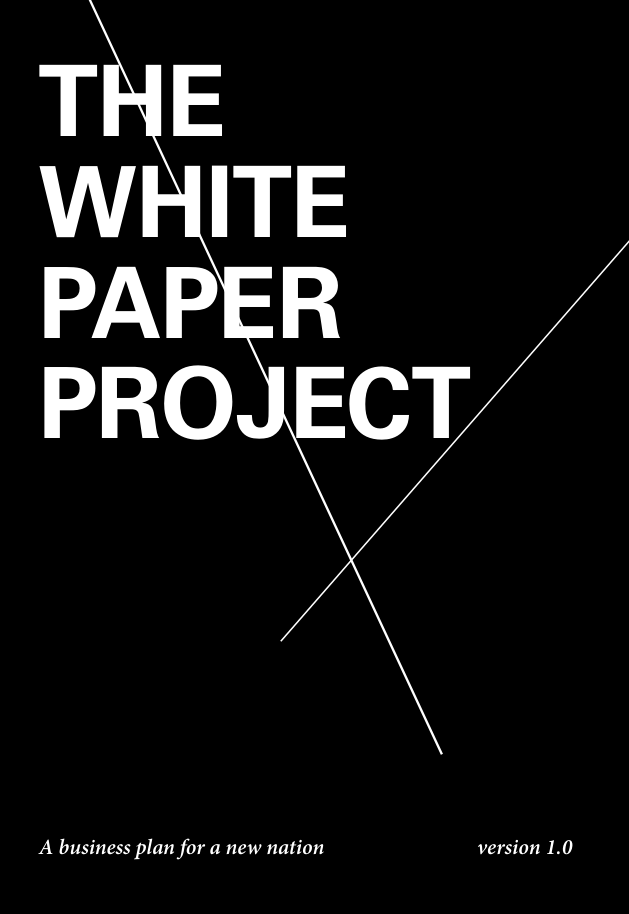
wpp-v1-cover

Today I get to announce the launch of a very long awaited project I and the rest of Common Weal have been working on for quite some time now. We announced back in September that we have been working on renewing the case for Scottish independence by publishing a successor to the Scottish Government’s “Scotland’s Future” document.

Version 1.0 of the Common Weal White Paper can be download here or by clicking the image above.

This is a leaner document than Scotland’s Future was. That document was as much a party political campaign device as it was a blueprint for independence. It not only sought to describe the powers which would come to Scotland independence but also sought to convince voters of the SNP’s own vision for independence. There was nothing inherently wrong with this latter task per se and other parties too sought to promote their own distinct visions as well – as they will all do so again throughout the next independence campaign but this is not the task of an independence White Paper. This paper shall, as far as possible, not seek to propose a list of policy ideas which an independent Scotland could do nor shall it attempt to convince you of the merits of those policies. It merely lays out the technical and structural requirements which must be in place for Scotland to become an independent country once we, the voters, decide that it should become so.

It is a “consolidated business plan for the establishment of a new nation state”.

To this end, the White Paper is split into several broad sections. Part 1, Process and Structures, covers the foundation of a National Commission – a cross party and cross administration body which will be tasked with designing and implementing the institutions and systems which need to be set up in the time between the independence referendum and the formal independence day. It is one thing to state, for instance, “There shall be a Scottish Central Bank”. It is quite another to decide how large it needs to be, where it needs to be based and who needs to be hired to run it. The National Commission shall also be given interim borrowing powers so that it is able to issue bonds, raise capital and fund the construction of the vital infrastructure Scotland would need to either move from rUK or build from fresh.

Part 2, Key Institutions of an Independent Scotland, covers all those things we kept being asked questions about during the last referendum. Would we have a constitution? A currency? What would we do about borders? Defence? All these and more. Of course it’s not yet possible to answer every question in this regard. Some of it will be up for negotiation with rUK, some of it will be dependent on the shape of the Brexit deal between the UK and the EU and Scotland’s relationship with both in the run up to independence but we’re making a stab at as much as we can and this is the section which will perhaps be most expanded upon as the Project is iterated in future versions.

Speaking of negotiations, Part 3 covers the prospective shape of some of these – chiefly the allocation of debt and assets and what rUK’s response to our leaving shall mean for our claim on them. Also covered to some degree is how Scotland will interact with various international and supranational organisations although it should be stated once again that no case shall be strongly made for Scotland’s joining or refusal to join any of these organisations. That shall be left to the party or parties which seek to form the first independent Scottish parliament.

Finally, Part 4 outlines the position of Scotland as far as finance and borrowing goes as well as outlining as best we can the default fiscal budget for year one of independence. It is, of course, almost impossible to place any kind of actual certainty or promise on such a budget as it is based on several key assumptions such as the desire to keep both public spending and the various tax revenue streams broadly similar to their position at present. If a party decided to scrap the entire tax system and replace it with one of their own devising then it would have to be up to them to explain how that worked and project the revenue to be gained from it and how it would be spent. Other assumptions include Scotland spending the money assigned to it in GERS for various “UK projects” on projects of similar value and in similar accounting lines (so that, to pick an arbitrary example, our “share” of UK economic development funding spent outside Scotland but from which Scotland “benefits” would instead be spent on economic development within Scotland). Again, whether or not this happens will be a case for the individual parties to make and will depend entirely on accurately and precisely how the current fiscal projections for a devolved Scotland within the UK map onto the fiscal situation of an independent Scotland.

Once again, this is not the completion of the White Paper. This is the beginning. You will see that there are several sections which need to be expanded and built upon and items like costs and figures will be updated as time goes on (the default budget, for instance, is based on 2015-16 figures but – as we’ve probably noticed by now – Scotland didn’t become independent in 2015-16 so these precise figures will be revised as and when they should be). Some areas require the attention of people with specific experience and expertise in them to be able to complete so we are openly calling for those experts who are able and willing to contribute. Please contact us if you want to be involved. Let’s work to build the early days of our better nation.

TCG Logo 7.png

Beyond GERS

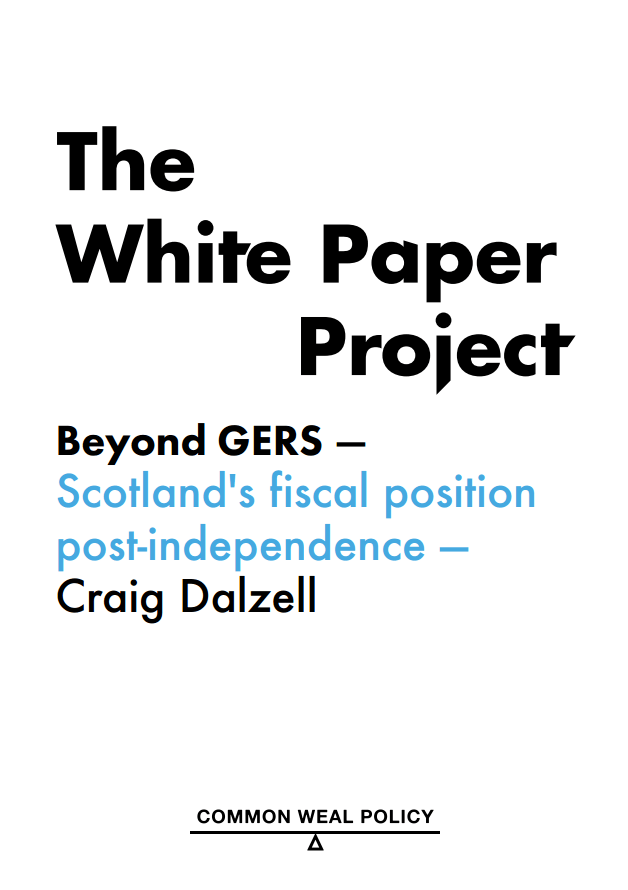
Today has seen the publication of my latest contribution to Common Weal’s White Paper Project. Click here to take you to the launch page or on the image below to take your directly to the paper. Further coverage can be found here and here in The National.

Beyond GERS cover.png

Preface

GERS (Government Expenditure and Revenue Scotland) 2015/16 reported Scotland’s fiscal deficit to be in the region of £14 billion per year, portraying Scotland as the country experiencing some of the most challenging financial circumstances in Europe.

However, this study must be viewed firmly in the light of Scotland being a member nation of the United Kingdom and, as such, any attempt to use them to project the finances of an independent Scotland must be treated with caution and qualification.

The very act of independence will result in significant redistributions and reallocations of government resources which will likely result in economic benefits accruing to Scotland. Additionally, decisions on how to establish and govern new Scottish state institutions will also improve Scotland’s budget at the point of set-up, further strengthening the fiscal position vis-à-vis that presented in GERS and that of the rest of the United Kingdom.

Key Points

• The act of independence brings with it many structural changes which will significantly benefit Scotland’s fiscal position to the effect of several billion pounds equivalent per year.

• By shifting the focus of defence from one of outward projection and nuclear deterrent to one more in line with modern European nations, savings of approximately £1.1 billion per year can be realised. Even in the event of Scotland committing to NATO member defence spending targets of 2% of GDP, the increased spending within Scotland can be expected to have additional economic benefits resulting in tax revenue increases of around £300 million per year compared to the status quo.

• A reasonable case for the debt and asset negotiations due to independence will result in Scotland saving up to £1.7 billion per year in debt interest repayments.

• The legal requirement of the UK Government to provide the UK State Pension for all those who have met the criteria would likely have to be the subject of negotiation post-independence, but the expectation would be that this would lead to billion-pound savings for the Scottish Government in at least the first year.

• A substantial fraction of unidentifiable spending accounted to Scotland is, in all likelihood, spending to cover UK wide government functions which Scotland may or may not choose to replicate or reproduce in some form post independence. Whilst savings will be made by reason of lower running costs and wages in Scotland compared to London, the additional economic benefits of spending in Scotland instead of elsewhere in the UK could result in additional tax revenues of approximately £719 million per year.

• The opportunity for an independent Scotland to redesign the tax code from the ground up, eliminating built in inefficiencies, loopholes and exceptions will help reduce the “tax gap” by approximately one-third, increasing revenue by about £3.5 billion per year.

• Whilst the UK’s tax revenue as a percentage of GDP is around the OECD average, many countries neighbouring it successfully maintain higher rates of tax revenues which, if replicated in Key Points: Scotland, could further improve the financial situation by several billions per year.

• Even without increasing tax revenue as a percentage of GDP, an independent Scotland could be placed in a position of relative “deficit parity” with the current UK budget.


Regular readers will know now that Common Weal has been very hard at work looking at the issues surrounding the independence debate, especially those arguments which just simply didn’t convince a certain segment of voters. We were all hoping that ‘someone else’ would come along and do this right after the last referendum but, for various reasons, it hasn’t happened. So Common Weal has decided to just roll up our collective sleeves and do it.

We’ve already published a paper reopening the currency debate, debt and assets, a proposal for a National Investment Bank and others. We want to produce further papers on pensions, defence, customs and excise, a detailed paper on the role of the Central Bank of Scotland, and others. All working up to a paper not just showing the limitations of accounting exercises like GERS but doing away with it entirely and building a case for an independent Scottish budget built from the ground up to suit our needs, rather than just being a tweaked version of what the UK does.

We are incredibly under resourced for this work but we think it’s work worth doing.

If you do too, perhaps you’d like to consider a donation to Common Weal to help us on our way: www.allofusfirst.org/donate
tcg-logo6c