“No democratic nation has ever signed up to be bound by such an extensive regime, imposed externally without any democratic control over the laws applied, nor the ability to decide to exit the arrangement.” – Dominic Raab in his resignation letter as Brexit Secretary.
I pity the journalists who have to do this kind of thing for a living. Especially the ones who have to wait several hours before seeing their article in print. A week is a lifetime in politics. Today, an hour merely felt like one.
The Brexit Withdrawal Agreement has finally been agreed between the EU and UK negotiating teams. It has also been agreed by the Cabinet of the government – albeit only “collectively” (read: not unanimously – merely by majority. Rumours speak of an 18-11 vote). It now needs to be passed by the UK and EU Parliaments and then it’s done. So…what could go wrong?
“There will be no downside to Brexit, only a considerable upside” – David Davis, October 2016
“Qu’ils mangent de la brioche” – Apocrypha, commonly attributed to Marie Antoinette
I hesitated to write this article. Why, shall become clear in the reading but the short version of it is that this is not just a sensitive topic but the mere act of talking or writing about it may provoke the negative effects discussed.
I am talking about the recent stories that as we enter the “kinetic phase” of Brexit, beyond which any meaningful control of the course can be made, it is looking increasingly likely that the negotiations will conclude without a deal. The UK’s own red lines are insurmountable and are themselves incompatible with the EU’s red lines.
“I think it would be a good idea” – Apocrypha attributed to M. Gandhi on his being asked what he thought of Western civilisation.
The UK Government’s handling of Brexit continues to be veer somewhere between being a shambles and a criminally negligent disaster.
From its position on customs which remains something like “We have no idea what we want and we’re damn sure we’re not going to lift a finger to plan for it.”
Through its tearing away from anything even remotely connected to the EU – including Euratom (which means good luck running a nuclear power plant or obtaining a medical radiological), the Gallileo satellite system (to which the British response was a petulant “We’ll build our own…somehow”) and fundamental human rights which protect us all from the whims of governments that act a bit like the current UK one does.
“Sooner or later every war of trade becomes a war of blood.” – Eugene V Debs
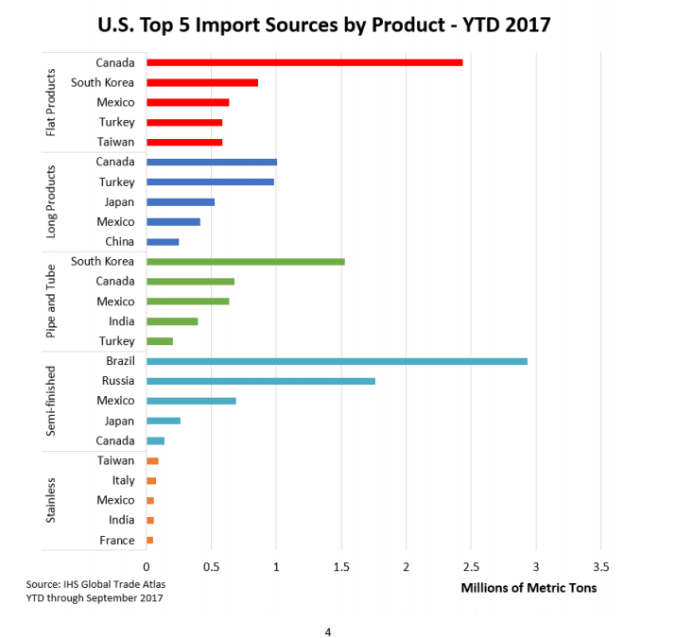
This past week has been an interesting one in terms of international trade news. President Trump announced, via a Tweet, that he was slapping import tariffs on Chinese steel and that “trade wars are good, and easy to win“.
The ripples of this announcement are still spreading but already countries and trading blocs like Canada and the EU are considering retaliatory tariffs.
The thing is, China isn’t even a particularly major player in US steel imports. It barely factors on any of the top fives by specific products.
“Cut the EU red tape choking Britain after Brexit to set the country free” – The Telegraph
The EU (Withdrawal) Bill is currently moving through Parliament. The purpose of this bill is to transfer the laws currently governed by the EU into UK law so that there are no breaks or holes in legal competence once Brexit happens. Of course, there are also opportunities to make changes, big and small, to the laws being transfered as they come in and when something of this size comes through there is precious little time for detailed oversight of the process and the opportunity for some of these changes to fit ideological ends can become irresistible.
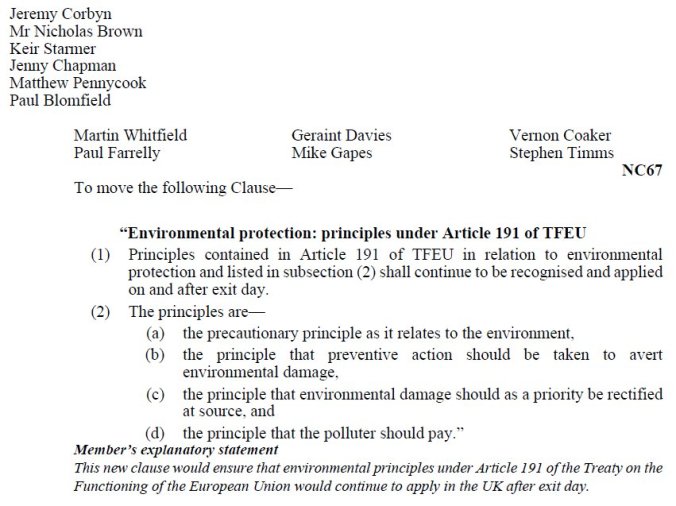
For example, last night Labour put up an amendment which would have ensured that the EU’s “precautionary principle” over environmental legislation would be protected and the Tories voted is down 313-297.
This represents the clearest sign yet that the Tories are planning a post-Brexit regulatory slash-and-burn.
It’s important to consider just what the precautionary principle is and why it is important.
The Usher Hall voting >90% in favour of Scotland adopting its own independent currency.
On the 4th of November I spoke at the Scottish Independence Convention’s Building Bridges to Independence conference. As with my SIC talk in January, it fell to me to be the one with the graphs and statistics – this time on the topic of public finances and the impact of independence on Scotland’s budget.
“It’s a Common Weal program for government.” – In an email sent to Common Weal today.
Today saw the return of the Scottish Parliament for the 2017/18 session and the opening speech by the First Minster introducing her program for government. You can watch the full speech below.
After far too long of what seemed like the political doldrums of a couple of fairly drab elections and the ever endless string of intentionally depressing political headlines, this speech was a remarkably refreshing change of pace with some fairly strong statements of intent in several areas.
Notably, Common Weal appears to be finally having a significant influence on the political direction of government with several of our policies now being talked about openly or outright adopted as policy.
“The GERS figures are not meant to be anything other than a way of showing the current position under the present arrangements.” – The BBC
The annual Government Expenditure and Revenue report is out and, as withpreviousyears, I’ve written an analysis of the report and what it means for Scotland. The GERS report itself can be downloaded here.
A more detailed analysis I have prepared for Common Weal can also be read here.
The UK is a deeply unequal union and London continues to capture a greater and greater proportion of the wealth of the state to the detriment of everywhere else. This single fact has to frame everything we think and say about the finances of Scotland.
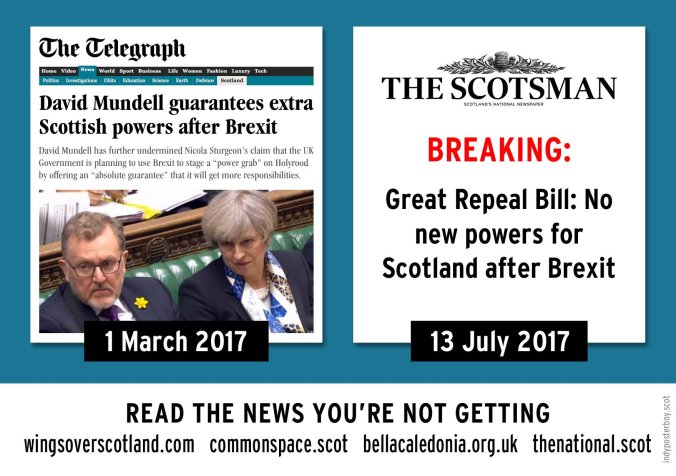
“I can give an absolute guarantee that after the United Kingdom leaves the EU, the Scottish Parliament and Scottish Ministers will have more powers than they have today” – David Mundell, 1st March, 2017.
The UK Government published the Great Repeal BillEuropean Union (WIthdrawal) Bill 2017-19 yesterday and I’ll let you guess how long that “absolute guarantee” lasted.
I’m going to have a look at the Repeal Bill (as I shall refer to it for the rest of this article) but I would heartily encourage folk to read the reactions of Ian Dunt and Andrew Tickell first. They are wise, know much and I can merely summarise for them.
“Annual income twenty pounds, annual expenditure nineteen nineteen and six, result happiness. Annual income twenty pounds, annual expenditure twenty pounds ought and six, result misery.” – Dickens, David Copperfield
The shape of the next UK economic crisis has become apparent. It may have already begun and it’s not at all clear how it can be avoided or mitigated.
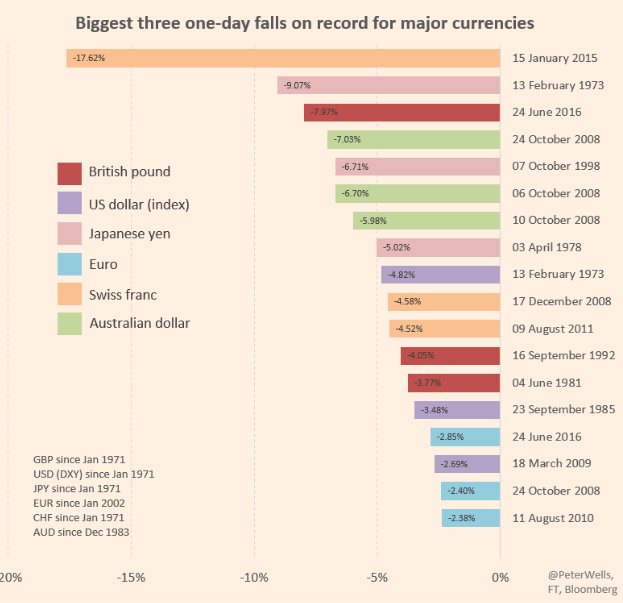
On the 23rd June 2016, the United Kingdom, for a variety of reasons, voted to leave the European Union. The immediate impact of this was an almost unprecedented drop in the value of the pound with respect to its major trading partner currencies.
Not much of a problem, the defenders said, as a weakened currency has its merits as well as demerits. Exports should become cheaper, which would boost foreign trade.
This may have been true in times gone by but economies have grown vastly more complex than this. Many products manufactured in the UK consist of sub-components drawn from multiple countries and globalised supply chains have grown STAGGERINGLY complex.
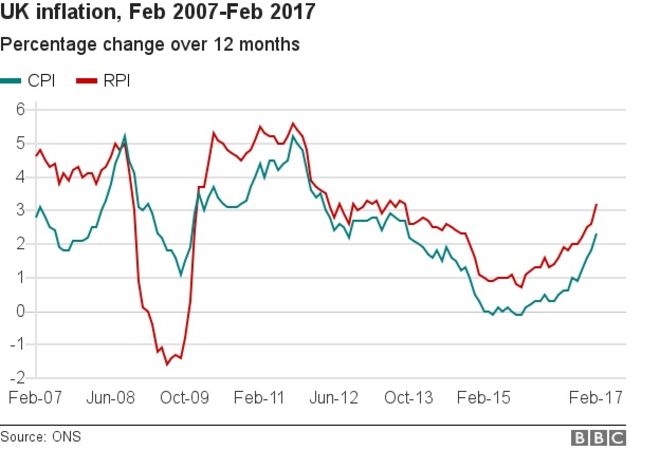
What this has meant is that even the goods that Britain manufactures here have seen their “input prices” increase, which has pushed up the price of goods even despite the fall in currency strength. Add to that, the fact that the UK imports far more than it exports – it has one of the largest trade deficits as %GDP in the OECD – and it becomes clear why prices have started rising again in Britain. After five years of declining inflation rates and almost a year of zero price increases, inflation has returned with a vengeance.
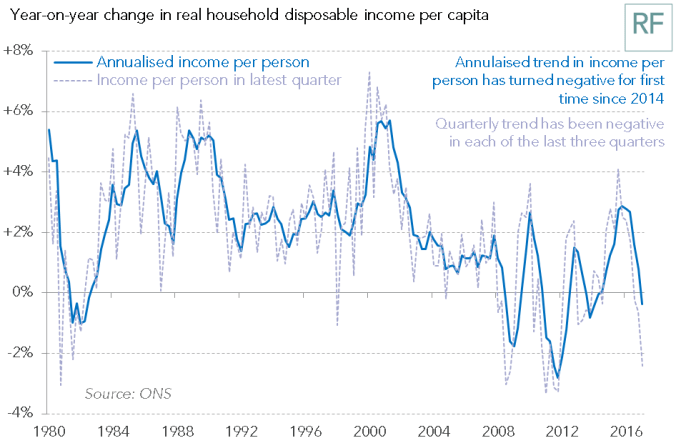
But this needn’t be a terrible thing. In fact, inflation can often be quite useful as it erodes the value of debts (which is why creditors and asset holders hate it so much). So long as wages keep up with the rising prices then for those who don’t depend on the rising value of assets or debts it can be manageable. So how are we doing on that point?
So inflation is rising and wages are declining, so we’re in the situation where meeting our needs and maintain a decent standard of living is becoming more and more difficult. But even this could be mitigated or reversed if the government were to step in and support the economy by investing or by otherwise injecting money into it.
And so this is the root of the coming crisis. Prices are rising, wages are stagnating, savings have been drained, credit cards have been maxed out, and the government is pulling out of the business of providing government and public services so you need to spend even more to replace it. We no longer have enough money to meet our basic needs, never mind the disposable income to buy the widgets we need to consume to keep the wheels of the economy turning.
Up here in Scotland, there are signs that the crisis is already upon us. The Fraser of Allander Institute published a report today warning about the precarious nature of the Scottish economy saying that it was stagnating with relation to the UK economy as a whole. Some will almost certainly be quick to blame this on the Scottish government (the phrase “uncertainty of a divisive second independence referendum” comes to mind). There are certainly some things that the Scottish Government could do to help – a National Investment Bank should be high on the list and a good shake up of the domestic agenda would be welcome – but the ultimate cause of this slow-down does not originate in Scotland nor will its solution come from here (at least until the levers of power are returned to the country upon independence).
The problem, ultimately, is that Britain isn’t Great. Britain is Weird. Britain is a deeply unequal country on a scale which, compared to its neighbours, is utterly baffling.
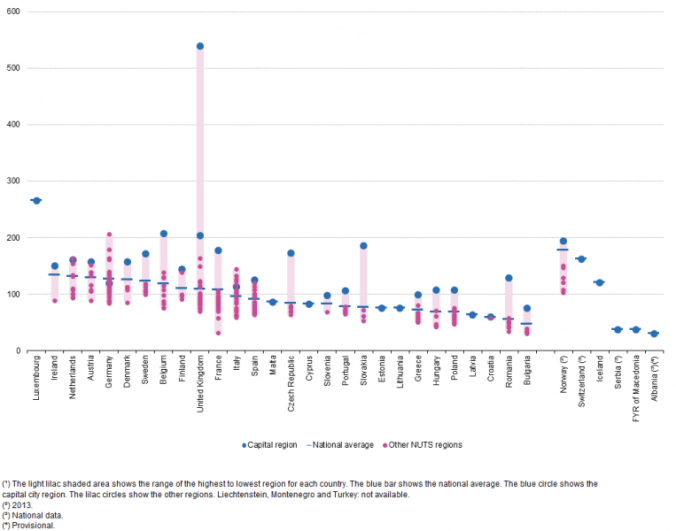
In many countries, the capital city will be the richest region of the nation. This is normal – Money wants to be close to power – but the UK’s disparity really needs to be seen to be believed. Here is the GDP/capita for each of the EU28 and EFTA countries broken down by region. Spot the odd one out.
(Note that the UK has two capital dots. The lower one is London as a whole. The upper one is just Inner London)
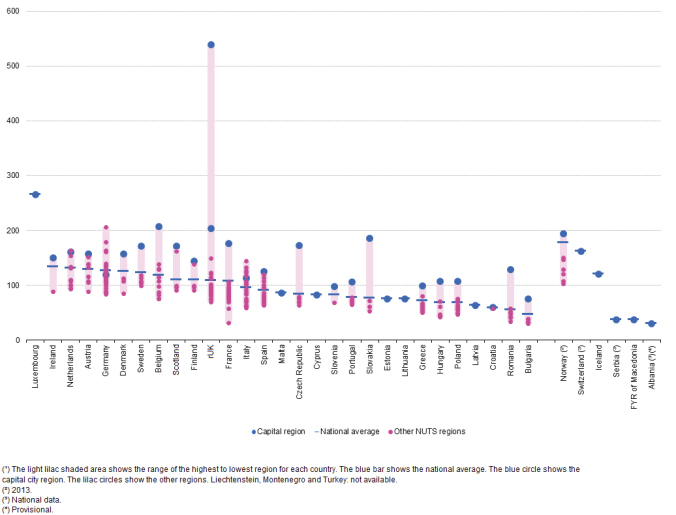
Whenever statistics about Scotland are produced, they’re often given with reference to the “UK average” or the “UK as a whole” but the extreme disparity of Britain masks the picture. Detailed analysis by Prof Mike Danson of Heriott-Watt University has shown that Scotland’s GDP per capita is the third highest region of the UK (after London and the South-East) and, if we were an independent state, we’d be the 9th highest in Europe. In fact, we can disaggregate out the Scottish data from the chart above and catch a glimpse what we’d look like as an independent country.
Taken on this view, Scotland no longer looks like a “below average” region of the UK but a fairly normal Western European country. Far more like Finland or Denmark than, say, Greece.
As Prof Danson says, the obsession with comparing Scotland to misleading “UK average” figures leads to commentators ending up unable to take a step back and ask what is happening across and within the UK and where the problems really are. Until this happens, Scotland will continue to stagnate within the UK as the overinvestment of London continues (and is likely to get worse through the Brexit process in a desperate attempt to prop up the financial sector there).
As said earlier, there is a way out of the coming credit crisis but it’s going to involve not more Austerity but a whole lot less. Economists are increasingly coming around to the realisation that the Government’s debt is your surplus and that governments can take on that debt almost without limit (unlike you who have hard limits on credit and the ability to repay it) and – if they have their own currency – can print money in order to provide services (unlike, again, you who would go to jail if you tried that).
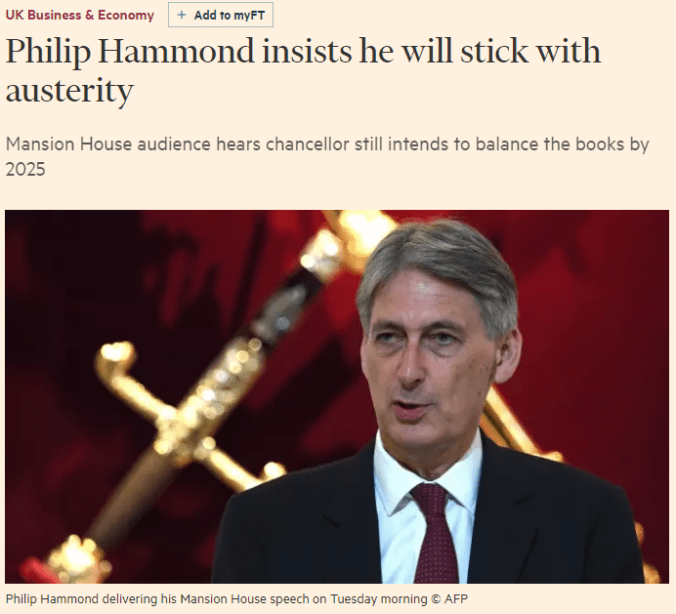
Once again, there is a certain amount that the Scottish government can – and should – do at the moment to help but it will always be stymied by the very tight rules of devolution. There’s little to no hope of the UK changing course any time soon (even Corbyn’s Labour is solidly committed to “balancing the budget“) and the hard Brexit the Tories and Labour are both pursuing is being increasingly differentiated by the amount of damage the plans will cause rather than any attempt to prevent it. The Sick Man of Europe seems destined to return to the UK. I only hope that Scotland doesn’t catch its cold.




 The Common Green