How Common is your manifesto?

“Every election is determined by the people who show up.” – Larry J. Sabato

This blog post previously appeared in Common Weal’s weekly magazine. Sign up to our Daily Briefing and Weekly Magazine newsletters here.

If you’d like to support my work for Common Weal or support me and this blog directly, see my donation policy page here.

The elections are now just hours away and pretty soon we’ll all be scrambling into action to hold the parties in Parliament (particularly those who end up in Government) to get them to fulfil the promises they’ve made to you.

In this, my last post before the vote, I want to have a very brief look through some of the main manifestos to pull out the most and least ‘Common Weal’ policy in each them. Parties – even those constantly at loggerheads over the slightest ideological deviation and even those who appear to have almost no ideological overlap at all often agree with each other on a surprising number of policies (even if they get to them from wildly different positions and motivations – for example, a party might want a Universal Basic Income because it would allow them to eradicate poverty while another might want it because it would allow them to privatise public services and hand out vouchers for you to spend to buy those services instead).

None of this should be in any way construed as an endorsement of any of the parties mentioned though. Common Weal is party neutral and we lobby all parties to adopt our ideals (obviously this is an easier task with some than with others though).

I also can’t cover every party standing in this election. I’m sticking to the largest ones which, according to current polling, have a reasonable chance of winning seats after the election. I have a library of many of the manifestos for this election which includes some of the smaller parties, though even this is non-exhaustive. Apologies if the party you personally support isn’t covered here due to those caveats (though if your party’s manifesto isn’t yet in my library, please let me know and I’ll get it added!).

As a final caveat, do please go and read Nick Kempe’s article looking at mentions of care and care reform in the manifestos as this is also an area that Common Weal are heavily involved in. To avoid doubling our work, I’m steering a little away from care here and looking at Common Weal policies in other areas instead.

SNP

The SNP are almost certainly going to be the largest party in Parliament after next week and will have a good chance of being returned as the principle party of Government. The question in this election really seems to be more whether they’ll have an outright majority, will form another minority government and try to pass budgets etc with ad hoc alliances (likely with the Lib Dems and/or Greens) or whether they’ll form a more formal coalition or cooperation agreement with one or more other parties.

The difference from a lobbying standpoint for us is that minority governments may need to negotiate with other partners to get votes passed and therefore are more open to compromise or outside ideas whereas majority governments can just whip things through on party loyalty.

Most Common Policy

It’s only a single half-sentence in the manifesto but the announcement of a National Housing Agency isn’t just in alignment with Common Weal ideals but is an idea that comes directly from us. We’ve been campaigning for a decade now for such an agency to coordinate housebuilding in Scotland, strategically plan it, ensure adequate building standards and to help to train builders in the latest techniques (something that will be essential if we want to build houses to PassivHaus equivalent standards). None of that is in the half-sentence of course but we have been in contact with the Government and one of our projects for this year is to design the Agency that we think Scotland deserves.

Least Common Policy

The least Common Weal idea in the SNP manifesto as far as I can see is the continuation, and in fact doubling down, of adherence to conventional economic orthodoxy around the only measure of economic “success” being GDP growth and the only means by which Scotland could and should achieve that growth is by “foreign direct investment”. Gone from this manifesto compared to 2021 is any mention of Circular Economy, 15 minute neighbourhoods, Repair hubs (other than a fund for repairing bicycles) or other policies that promote sustainability through deconsumerism.

Reform UK

It goes without saying that Reform are almost entirely ideologically unaligned with Common Weal. Our very mantra “All of Us First” runs directly against their core belief that only some people matter and some matter more than others.

Most Common Policy

Reform are fighting this election based on flipping over the table of governance and pulling power away from the nationalists in Edinburgh and one of the results of that is that they are surprisingly supportive of plans for local government that wouldn’t look too far out of place coming from us with a demand to devolve more power to local authorities. They don’t end up in quite the same place though, as they also support merging Scotland’s already too-large Local Authorities and concentrating power into the hands of “city mayors”.

Least Common Policy

Pretty much everything they have to say about immigration, immigrants and people reliant on social security.

Labour

Labour are the pro-union party that Common Weal has the closest relationship with. We find a lot of common ground on many issues even where we quite happily and openly disagree on others. In the previous Parliament, for example, we collaborated constructively on substantial aspects of care reform (again, see Nick’s article) as well as Members’ Bills on Freedom of Information, Land Reform, what became the PassivHaus Bill and others.

Most Common Policy

Labour are the only party in this list to explicitly mention the National Care Service as an endeavour that they want to bring back in the next Parliament and have explicitly adopted our phrasing that the NCS must be an institution “worthy of the name”. There aren’t a lot of details about what they want to do or what they’ll be able to do if they aren’t in Government, but this is an area that is high on our priority list for the next Parliament and so one that we will be pushing on for more information.

Least Common Policy

Labour’s energy policy doesn’t mention public ownership of energy (at community, Local Authority or Scotland level) beyond a bare mention of the existence of UK controlled GB Energy – which still doesn’t appear to have a clearly defined purpose or stated ambition of how much of Scotland’s energy it would bring into public ownership.

Scottish Greens

The Greens are another party that we’ve worked closely with over the course of the previous Parliament (My own political inclination leans environmentalist, and I was a member of the party for several years though I think my skills and services are much better applied in a cross-party sense these days) and they are in an interesting position in the upcoming election. A potential substantial increase in votes and seats beckons, though the shadow of the uncomfortable coalition with the SNP and its acrimonious collapse looms overhead too which may well limit their influence more than their number of seats suggests.

Most Common Policy

The Scottish Greens have campaigned for a replacement to Council Tax for almost as long as they’ve existed as a party so this isn’t exactly a policy they’ve taken from us in general, but the details of how to implement a proportional Property Tax are now pretty well defined as a result of our work and their policy here closely aligns with our own vision including in terms of its allocation of discounts and surcharges (particularly on ensuring that landlords can’t keep profiting from rent hikes).

Least Common Policy

While the Greens have included a carbon emission tax on land in their manifesto, they have dropped mention of an outright property tax on land. This is an error. Taxing the pollution created by the use of land is important but so is taxing the concept of ownership of excessive land ownership in principle – even managed appropriately, the accumulation of wealth via land ownership must have its limits. This said, the Greens have formally adopted the former Labour position (now missing from the latter’s manifesto) to place a cap on the maximum amount of Scotland that any person can own.

Conservatives

Like Reform, there is little cross-over between Conservative policy and Common Weal’s, though it has happened. We’ve worked constructively particularly at a local level on local democracy reform and it was Conservative voices that proved critical to campaigns we’ve supported in areas like rent controls and Covid policies. With that party looking like it’ll be largely devoured by Reform though, their influence in the next Parliament may be limited. On the other hand, that may force a reevaluation of their political positions and possibly lead to hands reaching out to unlikely allies.

Most Common Policy

If anything, there’s even less in the Conservative manifesto for Common Weal fans than in Reform’s. One of the few policies I’ve found where we’d be pointing in the same direction is in our opposition to the Building Safety Levy but we do so on very different grounds. We oppose it because it has effectively dumped the cost of cleaning up the mess of companies installing unsafe cladding onto house buyers where we believe that more should be done to recover the costs from the companies and their former owners if those companies have been wound up to avoid paying compensation, whereas the Conservatives merely want to make houses a fraction cheaper (they also want to scrap the PassivHaus legislation on up front cost grounds despite the fact that passive houses are cheaper to run and would eliminate fuel poverty).

Least Common Policy

Tax cuts. The Conservatives are quite simply mathematically wrong on their assertions that every devolved tax is on the far side of the peak of the Laffer Curve and that everything will get better if we just cut taxes in ways that benefit the already rich more than those too poor to pay tax as it is. If 40 years of trickle-down economics was going to work, we would have seen it by now.

Liberal Democrats

Along with the Greens, the Lib Dems may be the ones to watch in this election as they will also be vying to become Kingmakers if the SNP don’t win a majority. Indeed, wariness of the former from the SNP after the coalition collapsed along with a less environment and more business leaning FM Swinney may mean they’d prefer a partner wearing orange rather than green. For their own part, the Lib Dems have ruled out any formal coalition but would consider voting for SNP budgets – as they have done the last two times – if the price is right.

Most Common Policy

Although the Lib Dems are still ideologically against independence, they have quite a lot to say about other aspects of constitutional reform that Common Weal has advocated for. They are one of the few parties in Scotland still advocating for a fully Federal United Kingdom (though we caution that this must be framed as true democratic reform, not merely an alternative to independence or a barrier against it) and they have adopted our policies that Citizens Assemblies should be embedded at all levels of government from local to national and that Freedom of Information should apply to private companies that provide government services.

Least Common Policy

Energy policy again. While the Lib Dems are anti-fracking, they are solidly pro-nuclear (despite it being the most expensive form of low-carbon energy generation) and they are pro-carbon capture (despite the inconvenient fact that it doesn’t work). This said, while the Lib Dems aren’t generally the first choice party when it comes to supporting public ownership of things like energy, their manifesto this year does discuss the government taking equity stakes, reforming ScotWind (adopting our own recommendations) and given Local Authorities the power to bring energy into public ownership if they choose.

Conclusion

As I say, none of this is an endorsement of any party nor are we going to state which part is the most Common Weal of them all – all of them have taken on policies that we could support but all of them have also made promises that we’re going to have to fight against. This is fine. It gives us plenty of scope to stay busy in the next Parliament. We’re certainly going to be stuck right in there to try and get as much as we can done and we’ll work with alliances where we can make and join them. If you’d like to support us as we try to pull all of the parties in a more Common Weal direction then please do so here. And I’ll be back on the topic in the next couple of weeks to break down what the results mean once we see what they actually are.

Tool Libraries Are Overdue

“I have always imagined that Paradise will be a kind of library.” – Jorge Luis Borges

This blog post previously appeared in Common Weal’s weekly newsletter. Sign up for the newsletter here.

If you’d like to support my work for Common Weal or support me and this blog directly, see my donate page here.

image_2025-01-09_143839802

In December 2021, the Scottish Government made a promise to the Scottish Climate Assembly. In December 2024, their deadline passed with the promise now overdue.

Continue reading

Scotland Deserves Local Democracy

“Nationalism can be a destructive force when it promotes intolerance and division. But it can also be a force for good, when it seeks to defend local autonomy against the homogenizing forces of larger entities.” – Maxime Bernier

(This blog post previously appeared in Common Weal’s weekly newsletter. Sign up for the newsletter here.)

image_2023-02-19_103755469

At the last UK General Election, the party that would go on to form the Government made a manifesto promise to increase police numbers across the whole of the UK. It was a popular policy and probably won a few votes, but there was a problem with meeting that policy. Policing is a devolved matter. The UK Government only has control over the police in England. They could, of course, invest heavily in police numbers and that investment would increase the Block Grant sent to devolved nations but there’s absolutely no guarantee that the money would be used to increase the number of cops in Scotland. There would be a certain amount of political pressure to “pass the money on” as intended and that pressure has certainly been sufficient in the past, but the structure of devolution means that the Scottish Government has the absolute right to spend the money on anything it sees fit. This makes perfect sense as the needs and demands of policing in Scotland might well be very different from that in England as might the style of policing – Scotland simply may not want or need a highly militarised, American style force designed to suppress any thought of democratic protest. Anyway, the people of Scotland didn’t vote for the policy at the last Scottish election so there was no mandate to act at all.

Westminster’s defence was that it simply didn’t trust the calibre of politicians in Holyrood to act responsibly and it didn’t really matter what they thought given that they were either safely compliant or could be written off as merely the opposition complaining for the sake of complaining (damned if you do; damned if you don’t). The UK Government really wanted to meet that manifesto pledge however and decided it wouldn’t look good if the devolved nations resist their will so it took steps. Three options were available. They could, with ease, simply pull the powers over policing away from the Scottish Government and place them in the hands of the UK Justice Minister. All that would take is a simple majority vote in the Commons, which they could easily whip through. The second option was to ring-fence the funding – to simply tell the Scottish Government that they weren’t getting it unless they promised to use it as the UK Government wanted. Finally, they could outright threaten Holyrood with “financial penalties” if they tried to divert the money elsewhere.

If this happened, I’m sure that Holyrood’s response would be similar to yours – one of democratic outrage and calls for Westminster to back off and stop stepping on the toes of devolution. How dare they even make a manifesto promise that lay outwith their powers?

Do we all share the same outrage when the Scottish Government does something similar to Scottish Local Authorities?

Scotland is one of the most centralised states in Europe (especially as we don’t have an actually-local tier of municipal government – our “Local” Authorities would be called Regional Government almost everywhere else in Europe). In fact, if Scottish independence resulted merely in all reserved powers at Westminster transferring to Holyrood then a single national Government would directly control more than 85% of all public spending in Scotland. This figure is even worse when we consider the amount of money that is ring-fenced by Holyrood and merely administered by Councils. Holyrood has in recent years directly threatened Councils with withheld funds unless Councils used their powers over one of the few taxes that they actually control to maintain the Council Tax freeze and, just last week, has actively threatened to fine Councils unless they use money as directed to boost teacher numbers. Meanwhile, John Swinney’s recent budget stated that he was using Holyrood’s powers “to the maximum extent that is responsible” which carries the implication that using Holyrood’s powers to pass reforms to Local Authority tax raising powers would be “irresponsible”.

This week, Scottish Local Authorities having been negotiating their budgets for the year. It’s a grim process. Folk I’ve spoken to in several councils and across multiple parties have been essentially saying that they’re being put in the position of either breaking the law by not passing a budget or breaking the law by passing a budget that causes active harm to people because of the inevitable cuts to social services. After years of “trimming the fat”, then “cutting to the bone”, Councils are at the point of outright amputations – simply closing down leisure centres or stopping care services for folk who need them. If you’ve seen more potholes in your local roads due to the last rounds of cuts then we might expect them to not get repaired or to get worse in coming years.

The strictures of Devolution are tight but they are not nearly as tight as the Scottish Government have implied. Whenever groups like ourselves have campaigned for the broadening of the Scottish tax base via tools like Council Tax reform, land taxes, wealth taxes or pollution taxes, we’re told that the Scottish Government doesn’t have the power to do so. This is only a half-truth. These taxes cannot be implemented as national taxes controlled by Holyrood and where the revenue flows to Holyrood, but many of them can be implemented if they are done so as local taxes where the revenue flows to the relevant Local Authority.

In 2013, the Scottish Government made its pledge towards treatment of Local Government, including promises of maintaining subsidiarity and local decision-making. More recently, they have pledged a reform of local government finances, guided by a Citizens’ Assembly, by the end of this Parliament though they’ve also made it clear that the reforms themselves would only be implemented beyond the next electoral horizon (should they be in power to do so). It is likely far too late now to give Local Authorities the powers to avert a budget crisis this year and I’ve yet to see willingness from Government to spend their way out of this hole – we’ll see soon what the implications of that will be – but this only heightens the urgent need for reform of Scotland’s finances and democratic frameworks to make them more sustainable and to avoid this kind of crisis in the future. Enabling legislation should be passed as soon as possible to give Councils more control over their own finances and to set local taxes as they deem appropriate, including in areas such as wealth, land and pollution.

With the resignation of Nicola Sturgeon this week and the SNP now likely to fight a leadership contest that hasn’t been seen in the party essentially for decades, it would be worth all candidates considering their pitch not just as one where they believe that they are the best personality to lead the party and, likely, the country but also one where they consider their policy pitch and agenda for their tenure. I will be watching closely to see if any of the candidates promise to uphold and accelerate those pledges. Who knows, we might even end up with something really radical – like the kind of truly local democracy that almost all of our peer nations in Europe simply call “normal”.

TCG Logo 2019

Collaboration, Not Competition

“Collaboration has no hierarchy. The Sun collaborates with soil to bring flowers on the earth.” – Amit Ray

(This blog post previously appeared in Common Weal’s weekly newsletter. Sign up for the newsletter here.)

image_2022-09-11_180147092

This week saw the annual launch of the Scottish Government’s Programme for Government – its stated aims for the next year in Parliament. Usually at this time I’d be taking you through a deep dive of the various policy announcements and what they might mean for Scotland. The truth is though there isn’t really all that much there to dive into. Most of the major programmes mentioned in it (such as the National Care Service or the Circular Economy) have already been announced and are underway and many of the truly new announcements simply aren’t all that exciting. Even I, policy-geek amongst policy-geeks, can’t bring myself to get too excited about the devolution of the Aggregates Levy – the tax paid on taking stones and soil to landfill. It was one of the taxes devolved to Scotland in the wake of Indyref, the Smith Commission and the eventual Scotland Act 2016. The others were Income Tax (significant, but already straining at the seams of what is possible under devolution), Air Passenger Duty (the devolution of which was scrapped because of a potential legal fight with the EU), the assignment of VAT revenues (the devolution of which was scrapped because no-one could work out how to actually do it) and now Aggregates Levy (which will finally be devolved seven years and two Holyrood Elections after the mandate to do so). According to GERS, it’s currently worth around £58 million per year which is almost 1/16 of the estimated margin of error in the calculation of Scotland’s overall tax revenue.

The only other really noteworthy item is that the Scottish Government has finally acceded to the campaign to bring in the kind of tourist tax that almost all of us will be familiar with if we’ve travelled anywhere in Europe. Back in August, I spoke to the National about this kind of tax and mentioned the possibility of using it to fund or subsidise public transport and that perhaps tourists could be granted a free travel pass when they arrive in return.

But let’s talk about the most important policy announcement in this year’s PfG – so important that someone decided to leak it to the press ahead of time. The Scottish Government has decided to bring in an emergency rent freeze – backdated to the day of the PfG, though the legislation still needs to pass through Parliament. At the time of writing, we don’t yet know many of the details of the freeze itself including whether or not the Government will subsidise landlords for implementing the freeze. The news report announcing the leak mentioned a source who said that if the cost of the freeze was met by landlords then it would cost the Government nothing – this certainly suggests that if the landlords don’t cover the freeze then the Government may look at giving them partial or full compensation in the way that Liz Truss may be about to do to energy companies. It’s difficult to say how much this could cost as the freeze may only be for a limited duration (say, till March 2023) and many landlords – particularly in the public sector – only raise rates anyway once per Financial Year in April and some private landlords either do the same or weren’t planning to raise rates anyway (will they claim otherwise now if they can expect “free” money from the Government for doing so?).

Continue reading

Let the Information be Free!

“The only way to deal with an unfree world is to become so absolutely free that your very existence is an act of rebellion.” – Albert Camus

(This blog post previously appeared in Common Weal’s weekly newsletter. Sign up for the newsletter here.)

I have an update to my article from a few weeks back on Freedom of Information. In that article I made the case that our FOI laws are woefully insufficient. An FOI request allows you to bring Government information into the public domain simply by you asking for it. To look at it another way, all information that could be released by an FOI request is already potentially in the public domain but for the lack of the appropriate question being asked. This is a major limit in itself as to get at that information:- First we need to be able to ask that appropriate question.

However my wife Ellen and I discovered that what we mean by “public domain” and what the Scottish Government means by it may be two very different things. It appeared to us that while the Government regularly publishes the replies to FOI requests to its online archive, it does not appear to publish every reply there though they consider a private reply directly to the requester to be equivalent to posting the information into the public domain. Communication with the Information Commissioner revealed that there was no legal obligation for the Government to post replies to a public archive at all, merely that it was considered “best practice”. As we had personal experience of an FOI request not being posted to that archive and it got us wondering how often this happened. By examining the unique serial codes of the FOI requests that were published and making the assumption that they were assigned to requests sequentially as they arrived, I estimated that around 30% of replies made it to the public archive. But I thought I could do better than that so I decided to FOI some information about FOIs.

Continue reading

What Kind of Scene Are We Setting?

“It is politically easier to rev up GDP and hope some of it trickles down to the poor than it is to distribute existing income more fairly.” – Jason Hickel

(This blog post previously appeared in Common Weal’s weekly newsletter. Sign up for the newsletter here.)

Last week the Scottish Government, represented by Nicola Sturgeon and Patrick Harvie, launched the first paper in a series of papers framing their view of the next stage of the Scottish Independence campaign. This first paper – Independence in the Modern World. Wealthier, Happier, Fairer: Why Not Scotland? – is described as a “scene setter” and a description of the world as it is now rather than what it could be under independence. As such, it probably raised more questions from than delivered answers to the journalists at the press conference. It does nothing to answer or advance arguments around currency, borders or pensions or any of the other topics that I and other independence activists have been immersed in for a decade now but it wasn’t ever supposed to. All this paper has done is take several economic metrics such as GDP and inequality and compared the UK to several other countries in Europe. We’ve seen this approach before:– this paper is essentially an abbreviated and updated version of the first third of the 2018 report by Andrew Wilson’s Sustainable Growth Commission and the ideology that informed that report is woven throughout this new one.

Continue reading

No Freedom Without Information

“There is not a crime, there is not a dodge, there is not a trick, there is not a swindle, there is not a vice which does not live by secrecy.” – Joseph Pulitzer

(This blog post previously appeared in Common Weal’s weekly newsletter. Sign up for the newsletter here.)

(Since the original publication of this post, Ellen joined me on the Common Weal Policy Podcast to discuss the issues raised in more detail. You can listen to that show here.)

Common Weal has been at the forefront of Scottish democratic and governance reform since our inception – it’s one of the things that attracted me personally into the orbit of the organisation. One of our earliest campaign success stories was the creation of the Scottish lobbying register which, despite its many and still critical flaws, at least gives us some insight into who is talking to the Scottish Government and about what. Another area where we’ve been gaining ground is our ongoing campaign for better Scottish statistics – the Scottish Government has still not picked up our call for a dedicated Scottish Statistics Agency to fill gaps in data provision despite overwhelming support from SNP members three years ago.

Where these two areas intersect is how we, as citizens, gain access to data and information produced by the government which might be difficult to find or not published at all. You have a right called Freedom of Information which allows you to ask public bodies (including the government itself) about the information it holds on various topics. It can be a question such as how much has been spent on a project? Or how many times a Minister has met a specific person? Or anything else that isn’t routinely published or that the Government has good reason to not publish (perhaps due to national security concerns). There are, of course, caveats such as declining to publish information that would be difficult or expensive to obtain (perhaps the question was too broad or requires someone to trawl through a half-forgotten archive of paper records). All of this legislation is important. If we don’t know who is talking to government, what government is telling itself or what they’re not telling us then we cannot hold them to account for their actions. I’d go as far to say that an opaque government is inherently corrupt or, at least, cannot adequately demonstrate that it is not.

However, there are flaws in the current FOI legislation as well and we have been campaigning on reform to the legislation as well. In 2019 I took part in a very memorable meeting at the Scottish Parliament where we discussed various aspects of possible reform.

 These reforms include ending “corporate confidentiality” in public-private contracts after the contracts have been signed (so we know precisely how much we’re spending and on what – especially on large infrastructure projects), mandating that private companies in receipt of public money should be covered by FOI when they spend it (so that government can’t hide behind a wall of privatisation), and – most serious of all – that government should end its unlawful practice of treating FOI requests from some people differently from others (such as allowing Ministers to “review”, delay or block FOI requests submitted by journalists). One of our key recommendations was to address a fundamental flaw in the FOI process itself which is that in order to get information into the public domain, you first need to be able to ask a question about it.

To ask the question “For the minutes of the meeting between the Minister for Energy and Coal Billionaire Joe McSmoke in August 2019?”, you first need to have some kind of suspicion that such a meeting even took place and that there’s a possibility that it was minuted and that those minutes were recorded in a way that is publishable. Instead, we’ve called for public bodies to adopt what we’ve termed to be a “Glass Wall” approach whereby any information that would normally be disclosed by a properly submitted FOI should be proactively published in a browsable archive (we may still need to submit something similar to an FOI to the curator of said archive to be able find said information but the point is that you wouldn’t need to).

I’m glad to say that many of these suggestions were accepted by the Committee and, eventually, by the Government itself. It brought about an investigation by the Information Commissioner to ensure that the recommendations were being carried out (especially the ending of unlawful interference of FOI by ministers) and which published last week.

It was this report that led me to discovering another fundamental flaw in the FOI process that surprised me and also throws the entire system into serious doubt as to its ability to ensure transparent government.

Folk in Indy circles will no doubt be aware of the ongoing story about the UK Government’s “secret polling” into public attitudes on the Union. This polling was done in around 2018 (so is almost certainly out of date now) but was never publicly published. A court case recently concluded with an instruction to publish the data and the latest in this story is that the UK Government is still refusing to publish and may need to be challenged again.

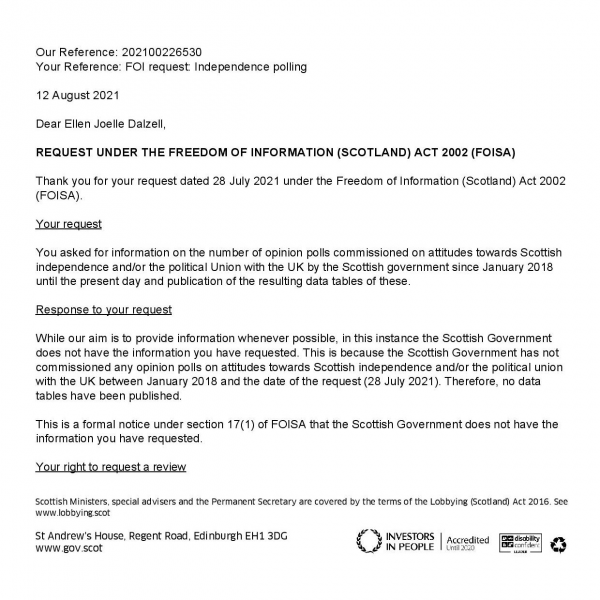
However, there is a twist to this story. When this all kicked off last year my wife Ellen asked the obvious but unasked question – If the UK Government isn’t publishing its polling on attitudes towards independence, why couldn’t the Scottish Government publish its own internal polling on the topic? Even better, once both were published, we could compare and contrast the results of the various questions asked. Not being able to find that polling in any of the public databases, Ellen submitted an FOI for its release and, to both of our surprise, we were told that the reason that this data hadn’t be published before and couldn’t be published now was because the Scottish Government hadn’t conducted any public polling on attitudes in the time between January 2018 and July 2021 when the request was submitted.

image_2022-06-18_082803455

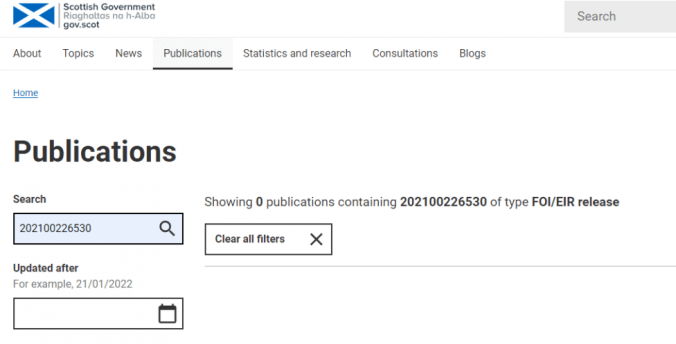
This could and should have been a major story last year and Ellen planned to send it around journalistic circles just as soon as a linkable version appeared on the Scottish Government FOI database.  Several days passed without it doing so. Then weeks. Then a couple of months. To this day, if you search for her FOI request it still returns no result.

The Information Commissioner’s report last week brought the topic back to the front of our mind and Ellen contacted the Commissioner to try to find out if there was a reason that this FOI would not be published. The prompt reply frankly shocked us. A private reply to an FOI is considered by the Scottish Government to be a fulfilment of FOI legislation and puts the information into the “public domain” but there is no obligation in the legislation for the reply to be entered into a public database. Doing so is merely considered “best practice”.

image_2022-06-18_082827080

Consider this for a moment. There is an obligation on the Scottish Government to respond to FOI requests but so long as they give the information to the person who asked the question, there is no obligation on them to let anyone else know about it. But, as it is now a public document, “leaking” it as I have done above isn’t even leaking – it’s just sharing a public document.

But this leads us to another question – how many FOI requests have been answered by private email and not shared more widely? I don’t think it’s a question anyone but the Scottish Government  can answer with certainty but there may be a way of taking at least a stab at it. Whenever you submit an FOI request, you are given a unique reference number. That number – as per Ellen’s FOI above – takes the form of the year of submission and then a string of numbers. That string of numbers appears to be not random but at least somewhat sequential. The earliest FOI in the database is FoI/16/00690 published on October 23rd 2017 and the most recent as of the time of writing – published on May 24th 2022 – is FOI/202200296591. As of the time of writing there are 8879 FOI replies in the database. I don’t know if the sequence of ID numbers includes documents other than FOIs (is document 202200296592 some other letter to or from a civil servant perhaps?) but I can’t imagine why it would. It may be that some of these FOIs have been sent to other public bodies (such as Local Authorities) and published in their own databases but – as said above – we have a clear example of at least one FOI to the Scottish Government that has not been published. Assuming each of these numbers does refer solely to a unique FOI request and its reply and the reference number is as sequential as it appears to be then that may suggest that in the worst case, less than 30% of FOI requests to the Scottish Government have been published in a public manner beyond a direct reply to the person who submitted the request. I dearly hope there’s an explanation out there that means that things aren’t as bad as that. If anyone has one, please do let me know.

I’d be really interested to hear your experiences with this. If you have submitted an FOI request and found that your reply is not on the database then let us know. I’m not sure what we can do from there. We could probably do more to train up volunteers to submit FOIs and have them share their replies with us but how can we do more than that? Does Common Weal have to publish these FOIs ourselves? Do we have to partner with some journalists to create a “Shadow Repository” of all of the FOIs the Government didn’t want you to see? Will just the threat of doing so force an explanation from the Government? Whether by actual legislation or, as a distant second, firm departmental commitments to actually follow “best practice” the Scottish Government should and must publish ALL FOI requests that it responds to. Even the “frivolous” ones. Even the “vexatious” ones. Even the “inconvenient” ones from journalists and especially even the ones that reveal that the Scottish Government hasn’t been doing work that it should have been doing as it prepares to fight another independence campaign. For their part, the Information Commissioner’s office confirmed to us that it is not within their remit to force FOI replies to be published again, because it is not a statutory requirement.

As I said at the top of this piece, I don’t think we can have a functioning democracy without transparency and accountability. Corruption is inevitable if power remains in the dark and behind closed doors. If only a select few have access to information, the same results. From a very practical standpoint, it’s also a complete waste of resources to have to blindly keep asking the same FOI questions because you didn’t know that someone else asked for the same information some time before you. In a very real sense there can be no freedom without freedom of information. The Scottish Government can and must ensure that all of us can see what it is doing at all times. If they don’t, we have to ask the final obvious, unasked question. What, precisely, are they hiding from us?

TCG Logo 2019

A Financial Flatspin

“Someone is sitting in the shade today because someone planted a tree a long time ago.” – Warren Buffett

(This blog post previously appeared in Common Weal’s weekly newsletter. Sign up for the newsletter here.)

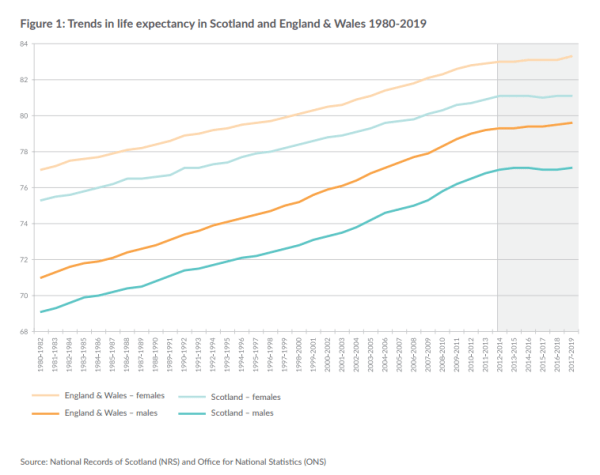
An extremely disturbing report was published this week looking into life expectancy in Scotland and the UK. It found that the consistent gains in life expectancy that we have experienced for much of the 20th century and into the first decade of the 21st has stalled and has even started to decline for some groups – especially the poorest and most deprived. This stall was abrupt and started in 2012 and has had the effect of knocking around 16 months of life off of the average Scot compared to pre-2012 trends.

image_2022-06-11_203636097

(Image Source: GCPH)

 This was not due to a “natural limit” of life expectancy being reached (though such a limit does almost certainly exist) nor have neighbouring countries experienced this stall to anywhere the same degree. The stall is not due to Covid, nor any other endemic illness. Drug-related deaths in Scotland are rising and this is having a measurable impact on average life expectancy but life expectancy has also stalled for non-drug users so this cannot explain everything either. Nor is it due to obesity or even due to climate change (though the former had more of an impact than the latter). All of these factors and more could be isolated, accounted for and controlled for in the study. Once this was done, there remained still an additional adverse impact on our life expectancy.

The conclusion of the report is that there is one stark cause above all of the other factors that has resulted in our lives being, on average, shorter than they otherwise would have been. In 2010 the UK Government began a massive socio-economic experiment called Austerity. This, the report finds, has been the primary cause above all others for the harm done to our health and wellbeing. It has sucked vital resources out of public services and starved households of the resources required to replace them. Poverty and deprivation – deliberately applied by political choice – has killed people earlier than they otherwise would have died.

It is in this context that we must view the other major reports published this week – the Scottish Government’s Resource Spending Review and Capital Spending Review. These financial reviews lay out the plans for devolved government spending over the next four or five years up till the end of this Parliament. The choices being made are grim.

Continue reading

Why I’m Voting Against The SNP/Green Deal

‘We must take advantage of the “tide of fortune”’.
‘I know about tides, sir. They leave little fish gaspin’.’ – Terry Pratchett


Edit 28/08/21 – The Scottish Green members voted overwhelmingly in favour of the deal and it was subsequently also voted through overwhelmingly by Council. The SNP members similarly voted overwhelmingly in favour in their consultative ballot. The deal shall now go ahead as written.


Tomorrow is going to be one of those turning point days in Scottish politics. The SNP and Greens have agreed to a cooperation deal that would see the closest relationship between the two parties in Holyrood, the closest that Greens anywhere in the UK have got to being in Government and the closest arrangement between any two parties in Scottish politics since the Labour/Lib Dem coalitions that ran the country between 1999 and 2007.

Tomorrow, the Green membership will decide whether or not to endorse that deal in a binding vote at an EGM.

In this blog, I’m going to lay out why I plan to vote against that endorsement.

image_2021-08-27_141315

Continue reading

Scottish Elections 2021:- The Results

“Elections belong to the people. It’s their decision. If they decide to turn their back on the fire and burn their behinds, then they will just have to sit on their blisters.” – Abraham Lincoln

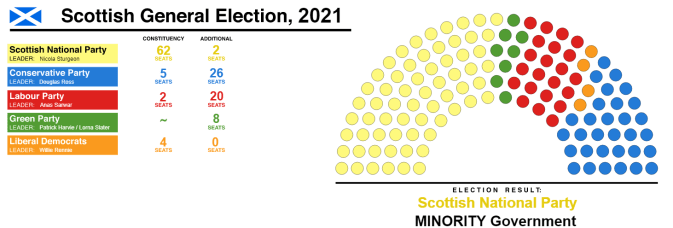
A strange election in strange times has, after more than the usual delay, returned a result that seems almost strangely familiar. Prior to the 2016 election, the “received wisdom” was that the majority SNP government was going to come back to power with that majority and thus usher in five years of “boring government” under a “one party state”. Instead, we got a minority government and everything that followed from that. This time round, the challenge to “restore” that majority government was rejected and we again find ourselves with a Parliament that looks really quite similar to the one in 2016. Many of the names have changed, many of the seats have not. The SNP have fallen one seat short of a majority, the Tories remain the “2nd party” by equalling their previous tally, the Greens have increased their ranks and Labour and the Lib Dems have reduced. Despite enthusiastic campaigning by their activist, no new parties have entered Parliament and none have left either (though the Lib Dems have dropped below the “major party” threshold which may have significant implications for them). From a pure democratic stance, at 63% the turnout was the highest of the devolution era – despite or in spite of fears that the pandemic would suppress it. More voters is always a good thing. As is diversity in the Parliament with record numbers of women, people of colour and other underrepresented groups in the House.

A full breakdown of the results in each constituency and region can be found here.

image_2021-05-09_101059

(Source here)

There will be discussion over the coming days about the makeup of Government and whether the SNP continue to run as a minority or whether they form a formal coalition – most likely with the Greens. For my part, with a track record of two minority governments I think that a coalition is unlikely and my preference would be against one anyway for reasons I’ll detail below but primarily because of my feeling laid out on Thursday that a Government that can rely on whipped loyalty will make less good decisions than one that has to justify itself to Parliament.

The call for a second independence referendum must now intensify. There is a Parliamentary majority capable of passing a referendum bill and instructing the Government to proceed with its manifesto promise. Indeed, between the SNP and the Greens there is now as many pro-independence MSPs in Parliament now as there were in 2011 when the first indyref was initiated. Mandates are sure to be traded – some more, some less valid – and we’re still lacking an effective pressure campaign to keep the tactical and strategic advantage on our side, but I think it is likely now that the only person who can actively prevent an independence referendum within the next Scottish Parliament is now Nicola Sturgeon. The campaign is there for her to take and run with.

For more detailed analysis of each of the parties and the overall political landscape, keep reading below the fold.

Continue reading