The White Paper Project

“Work as if you live in the early days of a better nation.” – Alasdair Gray

wpp-v1-cover

Today I get to announce the launch of a very long awaited project I and the rest of Common Weal have been working on for quite some time now. We announced back in September that we have been working on renewing the case for Scottish independence by publishing a successor to the Scottish Government’s “Scotland’s Future” document.

Version 1.0 of the Common Weal White Paper can be download here or by clicking the image above.

This is a leaner document than Scotland’s Future was. That document was as much a party political campaign device as it was a blueprint for independence. It not only sought to describe the powers which would come to Scotland independence but also sought to convince voters of the SNP’s own vision for independence. There was nothing inherently wrong with this latter task per se and other parties too sought to promote their own distinct visions as well – as they will all do so again throughout the next independence campaign but this is not the task of an independence White Paper. This paper shall, as far as possible, not seek to propose a list of policy ideas which an independent Scotland could do nor shall it attempt to convince you of the merits of those policies. It merely lays out the technical and structural requirements which must be in place for Scotland to become an independent country once we, the voters, decide that it should become so.

It is a “consolidated business plan for the establishment of a new nation state”.

To this end, the White Paper is split into several broad sections. Part 1, Process and Structures, covers the foundation of a National Commission – a cross party and cross administration body which will be tasked with designing and implementing the institutions and systems which need to be set up in the time between the independence referendum and the formal independence day. It is one thing to state, for instance, “There shall be a Scottish Central Bank”. It is quite another to decide how large it needs to be, where it needs to be based and who needs to be hired to run it. The National Commission shall also be given interim borrowing powers so that it is able to issue bonds, raise capital and fund the construction of the vital infrastructure Scotland would need to either move from rUK or build from fresh.

Part 2, Key Institutions of an Independent Scotland, covers all those things we kept being asked questions about during the last referendum. Would we have a constitution? A currency? What would we do about borders? Defence? All these and more. Of course it’s not yet possible to answer every question in this regard. Some of it will be up for negotiation with rUK, some of it will be dependent on the shape of the Brexit deal between the UK and the EU and Scotland’s relationship with both in the run up to independence but we’re making a stab at as much as we can and this is the section which will perhaps be most expanded upon as the Project is iterated in future versions.

Speaking of negotiations, Part 3 covers the prospective shape of some of these – chiefly the allocation of debt and assets and what rUK’s response to our leaving shall mean for our claim on them. Also covered to some degree is how Scotland will interact with various international and supranational organisations although it should be stated once again that no case shall be strongly made for Scotland’s joining or refusal to join any of these organisations. That shall be left to the party or parties which seek to form the first independent Scottish parliament.

Finally, Part 4 outlines the position of Scotland as far as finance and borrowing goes as well as outlining as best we can the default fiscal budget for year one of independence. It is, of course, almost impossible to place any kind of actual certainty or promise on such a budget as it is based on several key assumptions such as the desire to keep both public spending and the various tax revenue streams broadly similar to their position at present. If a party decided to scrap the entire tax system and replace it with one of their own devising then it would have to be up to them to explain how that worked and project the revenue to be gained from it and how it would be spent. Other assumptions include Scotland spending the money assigned to it in GERS for various “UK projects” on projects of similar value and in similar accounting lines (so that, to pick an arbitrary example, our “share” of UK economic development funding spent outside Scotland but from which Scotland “benefits” would instead be spent on economic development within Scotland). Again, whether or not this happens will be a case for the individual parties to make and will depend entirely on accurately and precisely how the current fiscal projections for a devolved Scotland within the UK map onto the fiscal situation of an independent Scotland.

Once again, this is not the completion of the White Paper. This is the beginning. You will see that there are several sections which need to be expanded and built upon and items like costs and figures will be updated as time goes on (the default budget, for instance, is based on 2015-16 figures but – as we’ve probably noticed by now – Scotland didn’t become independent in 2015-16 so these precise figures will be revised as and when they should be). Some areas require the attention of people with specific experience and expertise in them to be able to complete so we are openly calling for those experts who are able and willing to contribute. Please contact us if you want to be involved. Let’s work to build the early days of our better nation.

TCG Logo 7.png

Beyond GERS

Today has seen the publication of my latest contribution to Common Weal’s White Paper Project. Click here to take you to the launch page or on the image below to take your directly to the paper. Further coverage can be found here and here in The National.

Beyond GERS cover.png

Preface

GERS (Government Expenditure and Revenue Scotland) 2015/16 reported Scotland’s fiscal deficit to be in the region of £14 billion per year, portraying Scotland as the country experiencing some of the most challenging financial circumstances in Europe.

However, this study must be viewed firmly in the light of Scotland being a member nation of the United Kingdom and, as such, any attempt to use them to project the finances of an independent Scotland must be treated with caution and qualification.

The very act of independence will result in significant redistributions and reallocations of government resources which will likely result in economic benefits accruing to Scotland. Additionally, decisions on how to establish and govern new Scottish state institutions will also improve Scotland’s budget at the point of set-up, further strengthening the fiscal position vis-à-vis that presented in GERS and that of the rest of the United Kingdom.

Key Points

• The act of independence brings with it many structural changes which will significantly benefit Scotland’s fiscal position to the effect of several billion pounds equivalent per year.

• By shifting the focus of defence from one of outward projection and nuclear deterrent to one more in line with modern European nations, savings of approximately £1.1 billion per year can be realised. Even in the event of Scotland committing to NATO member defence spending targets of 2% of GDP, the increased spending within Scotland can be expected to have additional economic benefits resulting in tax revenue increases of around £300 million per year compared to the status quo.

• A reasonable case for the debt and asset negotiations due to independence will result in Scotland saving up to £1.7 billion per year in debt interest repayments.

• The legal requirement of the UK Government to provide the UK State Pension for all those who have met the criteria would likely have to be the subject of negotiation post-independence, but the expectation would be that this would lead to billion-pound savings for the Scottish Government in at least the first year.

• A substantial fraction of unidentifiable spending accounted to Scotland is, in all likelihood, spending to cover UK wide government functions which Scotland may or may not choose to replicate or reproduce in some form post independence. Whilst savings will be made by reason of lower running costs and wages in Scotland compared to London, the additional economic benefits of spending in Scotland instead of elsewhere in the UK could result in additional tax revenues of approximately £719 million per year.

• The opportunity for an independent Scotland to redesign the tax code from the ground up, eliminating built in inefficiencies, loopholes and exceptions will help reduce the “tax gap” by approximately one-third, increasing revenue by about £3.5 billion per year.

• Whilst the UK’s tax revenue as a percentage of GDP is around the OECD average, many countries neighbouring it successfully maintain higher rates of tax revenues which, if replicated in Key Points: Scotland, could further improve the financial situation by several billions per year.

• Even without increasing tax revenue as a percentage of GDP, an independent Scotland could be placed in a position of relative “deficit parity” with the current UK budget.


Regular readers will know now that Common Weal has been very hard at work looking at the issues surrounding the independence debate, especially those arguments which just simply didn’t convince a certain segment of voters. We were all hoping that ‘someone else’ would come along and do this right after the last referendum but, for various reasons, it hasn’t happened. So Common Weal has decided to just roll up our collective sleeves and do it.

We’ve already published a paper reopening the currency debate, debt and assets, a proposal for a National Investment Bank and others. We want to produce further papers on pensions, defence, customs and excise, a detailed paper on the role of the Central Bank of Scotland, and others. All working up to a paper not just showing the limitations of accounting exercises like GERS but doing away with it entirely and building a case for an independent Scottish budget built from the ground up to suit our needs, rather than just being a tweaked version of what the UK does.

We are incredibly under resourced for this work but we think it’s work worth doing.

If you do too, perhaps you’d like to consider a donation to Common Weal to help us on our way: www.allofusfirst.org/donate
tcg-logo6c


We Need To Talk About: GERS (2015-16 Edition)

O wad some Pow’r the giftie gie us. To see oursels as ithers see us! – To a Louse, Robert Burns

It’s that time again. The annual Government Expenditure and Revenue Scotland report is out. Click the link or the image below to read it for yourself.

GERS 2015-16

Actually it seems like only March that the last edition was out. What’s happening here?

Well, there was a consultation that almost no-one knew about which discussed a few methodological changes to GERS in line with the ‘new powers’ we’re getting and it also asked if the next report should be brought forward. I’m completely convinced that the fact that this means that we’re getting the report well before the Council election campaign next year is absolutely just a convenient side effect(!)…but no matter. We’ve got the data.

Tomorrow’s Headline Today

Scotland’s budget deficit remains at a little under £15 billion. As with last year, don’t expect a single news outlet to go one single step further with the story than that. Except maybe to say that oil revenue has dropped from £1.802 billion last year to just £60 million this year.

So what’s happened? Why hasn’t Scotland, which is “totally dependent on oil”, completely collapsed now that oil revenues have basically dropped to zero?

Last year, total revenues dropped by  around £500 million on 2013-14. This year, total revenues have INCREASED by £181 million. In fact, total revenue is higher than it was in 2012-13 when we received some £5.3 billion in oil revenue.

It’s also worth noting that if you only look at GERS 2015-16 then it looks like our deficit has increased by a couple of hundred million in the past year but if you look a bit deeper, and compare the numbers to previous GERS reports then something interesting happens.

In GERS 2014-15 our deficit was recorded as £14.8 billion but in GERS 2015-16 the 2014-15 deficit has somehow dropped by £622 million to £14.3 billion. Essentially, this shows one of the limits of GERS in that it is based on sometimes highly speculative estimates which get revised over time. It may be five years before we finally know the “true” accounts figures for this year. This accounting adjustment is extremely significant compared to, say, our “budget underspends” but unless you’ve read it here I expect it to pass entirely unnoticed.

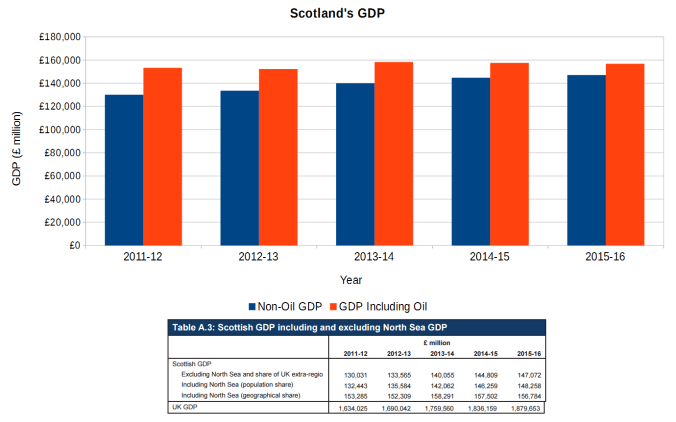
Now, what about our all hallowed GDP? It’s down by 0.45% from £157.502 billion in 2014-15 to £156.784 billion in 2015-16 (with non-oil GDP having increased by over £2.2 billion, the highest it’s ever been).

GDP GERS 2015-16.png

You know, perhaps it’s time we started measuring our economy in terms other than just GDP. We know it’s flawed. We know it throws up extremely strange results like Ireland’s “economy” growing by 25% because a few American companies moved their nameplates around. We know it doesn’t even particularly correlate to things like tax and ability to service debt very well.

Maybe it’s time we started measuring (and taxing) our country based on the things which actually matter.

But back to GERS.

Dutch Disease with Scottish Characteristics

So what’s going on here? Essentially it’s the same pattern first picked up last year. As oil prices drop, so do fuel costs. Which means everything from the costs of transporting goods to the heating and lighting costs for your home drops. This means you have more money to spend in the economy and companies have fewer overheads leading to either greater profits (thus, ideally, more tax revenue) or more room to invest in expansion.

This is a clear demonstration of the so-called “Dutch Disease” where high oil prices choke off the non-oil based economy in the form of the aforementioned fuel costs (it also tends to harden one’s currency but this is less of a factor in the Scottish case given that we don’t yet have one).

At the time of the last report I was criticised for pointing this out on the grounds that the oil price collapse “hadn’t fully fed through” hence I was jumping the gun on the observation. It shall be interesting to see if anyone says the same thing now. Could revenues drop any lower?

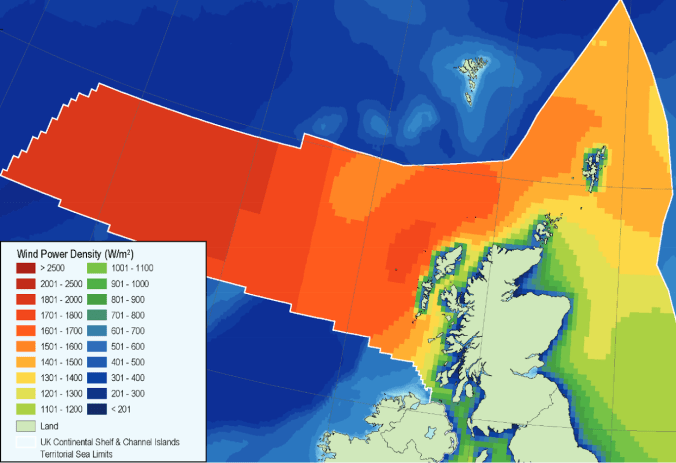
This should serve as somewhat of a warning to those itching for the return of high oil prices and certainly for those desperate to “replace” offshore oil with onshore fracking. It’s maybe time to have a good hard rethink about what kind of resources we want to develop in Scotland. Now, to be sure, I’ve nothing against our offshore industry and for those folk out there it’s been a pretty dreadful time. It’s just that, certainly as a Green, I think our offshore industry is on the wrong side of the country and should be based on wind/wave and tide rather than oil. You can be sure that  if the wind and tide stops flowing we’ll be dealing with problems a little bit larger than the state of our finances.

Scotland Offshore Wind Power Density

Scotland’s offshore Wind Power Density map

Sweet Fiscal Autonomy

As mentioned earlier, part of the methodological changes discussed in the GERS consultation was to do with looking at the taxes to be devolved to Scotland under the series of “vast, new powers” we’ve been generously granted.

In terms of actual revenue, chief amongst these is income tax (excluding interest and dividends, the ability to move the Personal Allowance or to adjust the definition of “income”) and VAT (excluding any actual control at all. We’re getting the VAT added to Scottish coffers and then an equivalent amount removed from the block grant. Yay.) along with comparatively minor taxes like landfill tax, aggregate levy and air passenger duty.

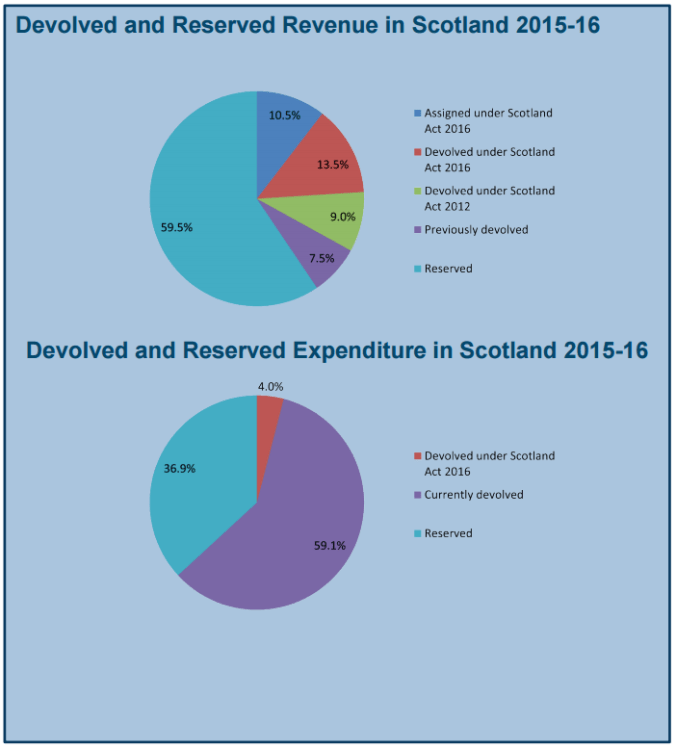
In total, the Scottish government will directly receive 40.5% of Scottish revenue (£21.8 billion this year) and, given the limitations on VAT and income tax, have actual, practical control over perhaps half of that. Devolved expenditure, however, will soon sit at 63.1% of total (£43.3 billion). Basically the Scottish government can only directly control enough income to fund perhaps about a quarter of what it’s directly responsible for delivering.

SFA.png

There’s a side issue in all of this related to that old topic of the budget underspends. Tucked away on page 47 of GERS there’s an interesting line which looks at the confidence intervals for some of the tax revenues used. Remember that the revenues given are estimates and are subject both to revision over time and change due to circumstances that the government cannot control. For example, if you move job half way through the tax year your income, therefore income tax, can change. If your job moves you to England, your entire income tax contribution moves from the Scotland side of the budget to the rUK one. Hence, the total income tax revenue estimate is subject to a margin of error, in this case of 1.0%.

The same goes for other taxes to greater or lesser degree to the effect that the margin of error over all of the taxes measured there is 1.6% or ±£570 million.

Remember that the Scottish Government has extremely limited borrowing powers. It can only “overspend” on the current budget by £200 million in a single year and cannot exceed a total current debt of £500 million. And yet income revenue, on which expenditure must be planned, has a margin of error of ±£570 million.

In the event, this year Scotland’s “underspend” was only £150 million. If you think you can plan a budget better than this then please, send it in. If not, might be a good idea to stop reporting and moaning about underspends.

Paying For It

PFI.png

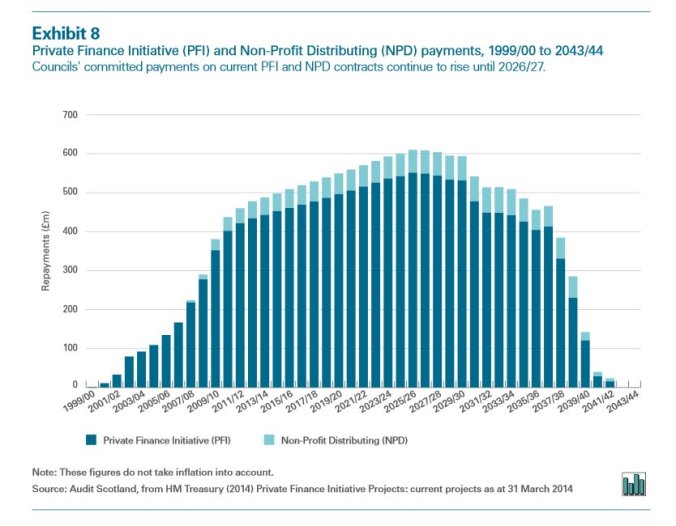
Another little line that seems to have been added to GERS this year (on page 37) is a breakdown of the annual costs of financing Labour’s PFI and the SNP’s replacement NPD loans. There’s been a bit of a milestone reached there with the availability costs of PFI now exceeding £1 billion per year or over 15% of Scotland’s total capital budget and slated to increase even further over the next decade unless something is done about it. Don’t be surprised if this becomes a major issue for the council elections next year.

PFI.jpg

Of course and once again you wouldn’t know this if all you did was watch our Great British Broadcaster, the BBC. Their recent “investigation” into PFI couldn’t even bring itself to mention the name of the party which lumped this crippling financial burden on us.

Finally

I could go on. We could nip-pick at details like the mysterious addition to the expenditure budget of net EU contributions (there’s always been an annex discussing this but this is first year it has explicitly been counted in a separate line in Total Expenditure) or notice that for the first time in at least five years our debt interest paid has increased as our UK debt increases have started to outweigh the effect of falling bond yields.

It’s all a shell game though. We know that GERS isn’t nearly as important as people hold it to be nor is it nearly as informative as it should be. It’s not going to change many minds on its own nor does it tell us one single thing about the finances of an independent Scotland. If we want to do that, we’re going to need to build a national budget from scratch, taking into account all of the taxes (existing and new) that an independent Scotland might choose to levy. We also need to have a look again at what Scotland actually needs to spend its money on. Could we use Citizen’s Income to create from scratch a welfare system worthy of the name? Would a Scottish Government able to issue its own bonds on its own debt be able to get a better deal than the one we have right now?

Quite simply can Scotland as a nation see ourselves as better than others would prefer us to be seen?

tcg-logo6c

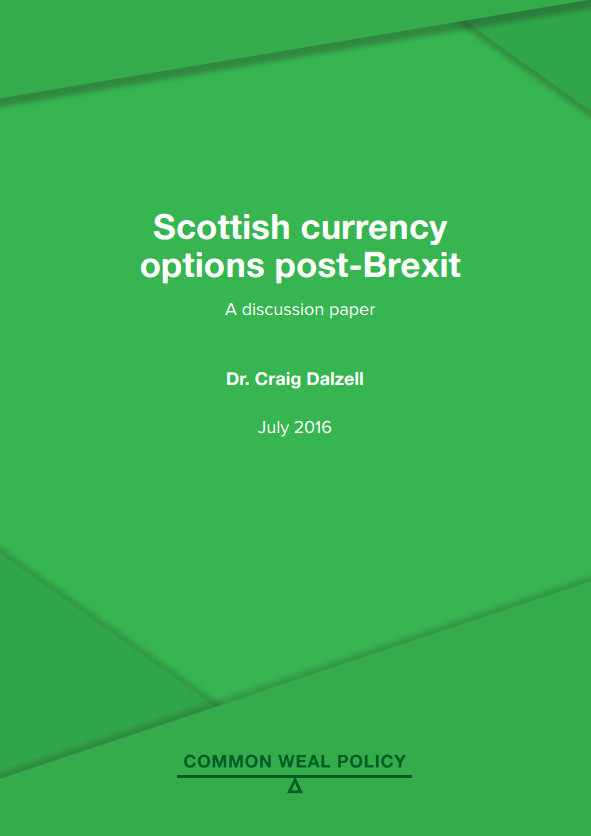
A Sovereign Currency for an Independent Scotland

As promised, I can finally reveal my work examining Scotland’s currency options going forward into the next independence campaign.

My report has been published through Common Weal and can be read here or by clicking the image below.

Currency cover

In it I first examine the macroeconomic considerations which go into selecting a currency option, chiefly looking at the interaction between movement of capital, interest rates and exchange rates. It turns out that it is impossible to have full control over all three at any one time so all currency options entail therefore some degree of risk or management requirements including the founding of infrastructure such as a Central Bank. All options have their advantages and disadvantages, their risks and rewards.

Continue reading

EU’re Out, Apparently

SaltireEU2.png

Well that’s that then. Votes cast and counted and the UK, by a margin of 51.9% to 48.1% have voted to Leave the European Union. The long, fractious and never really embracing journey that the UK has been on shall now enter a new phase. I can only guess as to where it’ll end up.

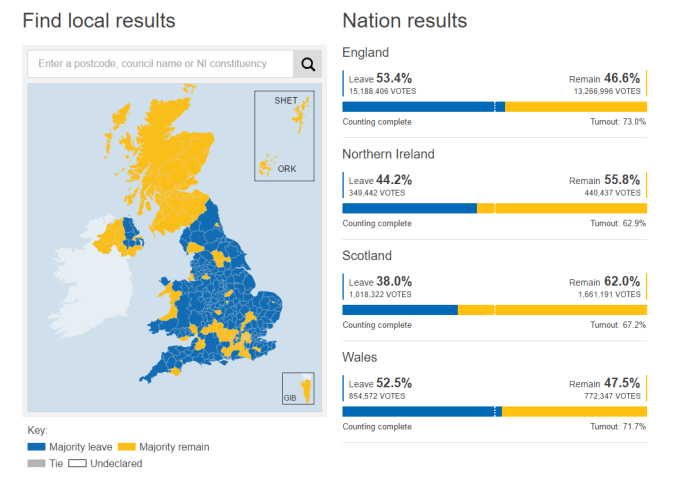
You may have heard by now though that the vote across the nations and regions of our “One Nation” was not homogeneous.

EU Results

England and Wales voted to Leave. Scotland and Northern Ireland voted to Remain. It represents yet another rejection by Scotland of “UK” politics and I believe that, as previously stated, a second independence referendum is now inevitable. The First Minister has herself confirmed this morning that the Scottish Government is now going to actively pursue one whilst also seeking to negotiate directly with the EU to try to preserve and protect our relationship. I do not believe that we will find that door to be particularly tightly closed.

As for Leave, once they’ve dealt with the resignation of David Cameron, probably a few key allies too, and have taken over the Tory party they’ll have to get into the grit of actually disengaging with the EU.

The EU Commission has already made it clear, understandably, that they would prefer Article 50 to be triggered as soon as possible so that they can get the whole business done and dusted. Leave, however, are still trying to be cagey. Some of the talking heads in the media today are still even hinting at an “alternative” plan like a Vienna Convention type disengagement. The big problem with that idea is that, even if it’s possible, it can be vetoed by any of the remaining 27 states. If the EU insists that Article 50 and a formal discussion is the way to go then it can indeed insist that it shall be.

It’s still very far from certain what the UK’s future relationship with Europe will actually be once all is done and dusted.

Indeed, there’s an outside chance that a Brexit may not yet happen. It could be that the Tory leadership changeover results in a General Election…which the Tories then lose. Labour, especially one which actively campaigned on the point, could well ignore the referendum result. At this point I wouldn’t discount any possibility, no matter how unlikely.

Assuming though that Boris Johnson and chums take the reigns and we go through Article 50 and Brexit happens, there’s still several possibilities (ranging from EFTA, through a set of Swiss style biateral treaties, through a CETA/TTIP type deal and out to the “default” WTO regulations only) which I outlined here.

I’m particularly disturbed by some of the rhetoric which stuck. Lord Ashcroft’s on-the-day polling found a solid correlation between likelihood of voting Leave and support for the argument that it would help “Take Back Control”.

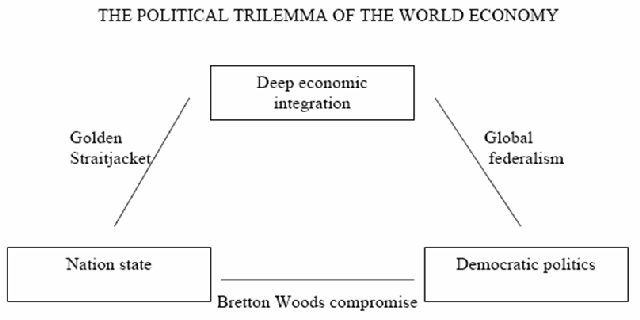
trilemma

I mentioned in my article on sovereignty that countries which pin themselves to the idea of national level politics, especially to the point of it becoming a geas, can bind themselves into the Globalisation Trilemma. If, as I suspect they will, Leave use their win to forge towards turning the UK into some kind of Free Market paradise then the concept of democratic politics could find itself severely compromised.

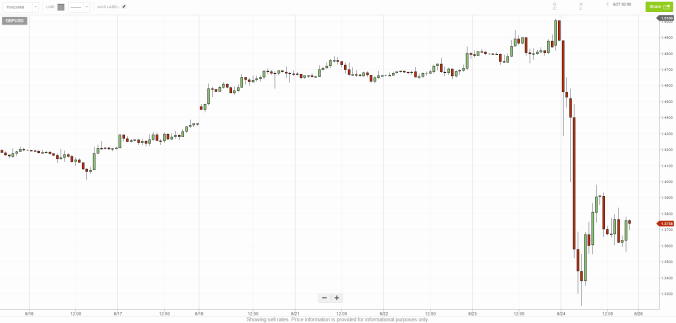
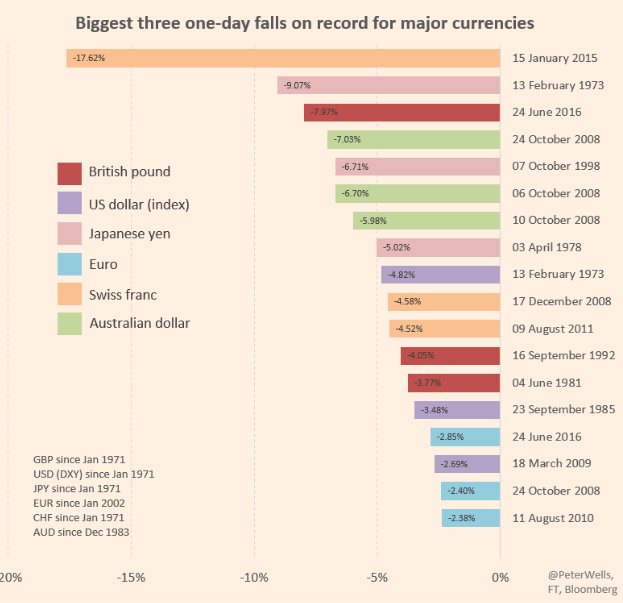
Speaking of the Free Market, it was in the financial world that the most “excitement” of election night was to be found. The polls, public and private, in the days running up to voting day had starting indicating a Remain vote. This had pushed the value of the GBP up significantly as traders started “buying the rumour“. When the Sunderland vote came in though it was the first indication that things were not going to go well for Remain. That one result caused a panic sell in the markets which did not improve as the night went on. By morning, the “Great” British pound had fallen to the weakest point seen since 1985 and, after a morning-after retracement, had lost 8% of its value. This is the worst single day hit that the pound has ever taken, twice as deep as plunge as 1992’s “Black Wednesday” and the third deepest single day hit ANY major currency has taken in modern times. History books shall be written on this point alone.

GBPUSD 240616.png

Currency fall

It should be of very careful note that against the Euro, the Pound lost about 10% of its value compared to 2015. This is important because the UK had a trade deficit with the EU of about £68 billion in 2015. Assuming all things other than currency being equal then that trade deficit could be expected to rise to £75 billion simply because it’s now more expensive to import goods and services from Europe.

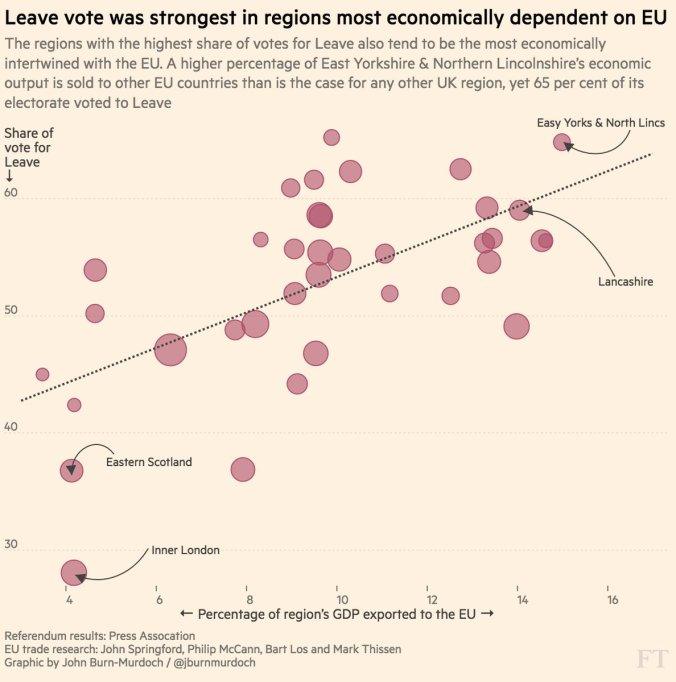
This difference in trade, around £7 billion, represents almost exactly the amount that Leave claimed that we’d “save” in net contributions to the EU. There may well be no gains, no money for the NHS or anything else that was promised. I hope I’m wrong. Because if I’m not, the areas which most voted Leave are also the areas most likely to be dependent on the EU for trade. They will be the areas most reliant on a good deal and/or economic plan for what comes after.

FTEUDependents.jpg

As for Scotland, it’s looking now almost inevitable that this result will hasten another go at an independence referendum and, this time, not only will it not be called until we’re ready but it’s looking rather like a lot of former No voters who had been promised that their vote would ensure their EU membership have now seen that whisked away. It has been enough to convince many that independence is now the best option ahead of Scotland. If you happen to be one of them, Welcome.

https://www.youtube.com/watch?v=t2nnwlx3qVY

The Greens and the SNP, will now be exploring all options to protect and preserve our EU relationship. We’re in very uncertain times now with few precedents to guide us so what form this will all take is a matter of pure speculation.

My own preferred option could take the form of direct negotiations between the Scottish Government and the EU resulting in some kind of deal whereby if an independence referendum is held and won in the period before formal Brexit then a newly independent Scotland could “inherit” the UK’s old seat with no loss of continuity. Of course, this would require the co-operation of the Westminster government to allow such negotiations to take place or to even acknowledge that the result in Scotland is significant. It would be a tragedy of democracy if we were simply ignored.

I’ve got no easy answers for the next few months, or years. I’m as much an unwilling passenger as everyone else who voted Remain yesterday. I’ll try my best to work out where we’re going just as soon as it becomes apparent though. And who knows. Maybe, just maybe, we’ll get off early.

tcg-logo6c

SP16: The Morning After

I’ll confess to being a lightweight. I snuck off for a few hours sleep right after the Clydesdale results were called and woke up right after the Lothian list so unlike virtually every other political pundit in Scotland right now, I’m able to type only marginally less coherently than normal.

So. How about those results?

The Green contingent has expanded three-fold and whilst I’m more than a little upset that neither of the two candidates covered by my branch, Kirsten Robb and Sarah Beattie-Smith, made it in I’m heartened by the success of the others notably Andy Wightman in Lothians. Who Owns Scotland? We’re about to find out!

My hypothesis that the SNP would come back with another majority appear to have been disproven although a clear pro-independence majority remains. Arguably, the Greens could call this a result significantly in our favour as we move to the wrangling over Parliamentary positioning begins.

I’m willing to be wrong again but I can’t see much appetite for an offer of a formal coalition. It doesn’t seem like good game theory for the SNP to offer up a Ministerial position (almost certainly something like Energy or Environment) just to avoid a two seat minority. Especially when they already have form for running a minority government with a fair degree of success.

I could see a discussion over some kind of Supply and Confidence arrangement based on some concessions that the Greens have campaigned on and over which there’s already a substantial level of support within the SNP membership.

I’ll make one prediction on this point. Unless the SNP are willing to rely on Tory support, Fracking will not happen in Scotland. Good.

I’d be hoping that there might be some more movement over local taxation and, perhaps, the Scottish Government will let Andy formally get his teeth and claws into the Land Reform Bill. That’ll be a joy to watch. The Greens campaigned on giving the Scottish Government the courage to be bolder on a range of issues. Here’s hoping it can.

So, on the vote itself. We saw hints of the total flight of the Right and Unionist vote within Labour as early as November last year but even as the last polls came in they appear to have underestimated the depth of that flight. Ruth Davidson’s campaign to get people to vote Unionist, rather than Conservative, appear to have been successful. What shall be interesting to watch now is what she does with that support. How far can they be pushed on Austerity (or how far can blame for it be deflected) before the Union-at-any-cost vote starts to tally up just that?

Where it leaves Labour is another great unknown. They’ve been utterly wiped from their birthplace in Glasgow and Lanarkshire and have retreated to the Morningside Reds of Edinburgh. They appear to have three choices ahead of them. Either ossify as an increasingly marginal voice in Scottish politics; Abandon the Unionist vote and try to out-left the SNP (I don’t think at this stage that even a drastic Home Rule or Federal position would draw back those now set on independence) or try to out-right the Tories (which would mean claiming, adopting and accelerating Austerity). I cannot honestly see a route back to the forefront of Scottish politics for Labour barring some singularity event such as actual independence or some act of self-destruction within the SNP greater even than the one that UK Labour appear bent on.

The proportionality of AMS was stretched rather to its limits last night. Despite narrowly missing out on a majority the SNP, as the largest party, were the largest beneficiaries of the system gaining approximately 9 seats more than their regional vote percentage would have suggested. The Tories though also benefited gaining about two more seats than their regional vote share whilst Labour broke about even, the Greens losing one seat and the Lib Dems being rather drubbed by the system, losing three seats to the maths. This calculation would have been mitigated by the addition of 6 “Other” seats which, on these results, would have more likely have been distributed amongst the sitting parties rather than going to smaller ones. In most proportional voting systems around the world a minimum threshold of 5% is often applied and, in our case last night, no small party achieved more than 2% nationally or more than 4% in any single region.

Seat Allocation

It’ll be interesting to see if there are any calls for electoral reform based on these results the way even the SNP made a mild complaint about their overwhelming success under FPTP last year.

Another topic which will now need to be thrashed out is the position of Presiding Officer. I reckon that this year the wrangling over whether the party/ies of government or of opposition give up an MSP for the post will be particularly intense this year given the slim margins and the tactical situations faced by each of the parties. The SNP won’t want to dilute their minority any further, Labour won’t want to shrink further either, the Tories and Greens will want to capitalise on their gains to maximum effect and if the Lib Dems lose one more MSP they cease to be an official parliamentary group.

Personally, I’m rather disturbed by the concept of choosing the PO from the MSPs in the first place. Why should the electorate who have only just chosen their representatives have to give one up as the PO must remain neutral, must resign from the political party and whip and have severe restrictions on where and how they vote (Only in the event of a tie and only to maintain the status quo or further the debate). To me, this isn’t a job for a Member of the Scottish Parliament. I’d look towards inspiration from the “checks and balances” of the US. Perhaps the PO should be appointed from a pool of senior judges or similar judicial positions? They are already used to applying impartially the rule of law so should trivially be able to manage Parliament in a neutral manner.

Of course, an alternative to a Presiding Officer could be an elected President, but that is likely to be a discussion for a post-independence situation…

Where do we go from here? I honestly have no idea. Going from bracing for a substantial majority and “the most boring Parliament” of the devolution period (as one pundit put it) to back to the days of actual discussion about policy I think the next five years could be one filled with potential…if we choose to allow it. For a last word:

Grey.png

tcg-logo5

How To Vote in SP16: A Quick Guide

The Scottish elections for the fifth session since the Restoration of Parliament are almost upon us. Fun Fact: Due to the voting age being lowered to 16, this will be the first election to include voters born AFTER the start of the first session in 1999.

The following is a quick guide on how to cast your vote (especially if it’s your first time):

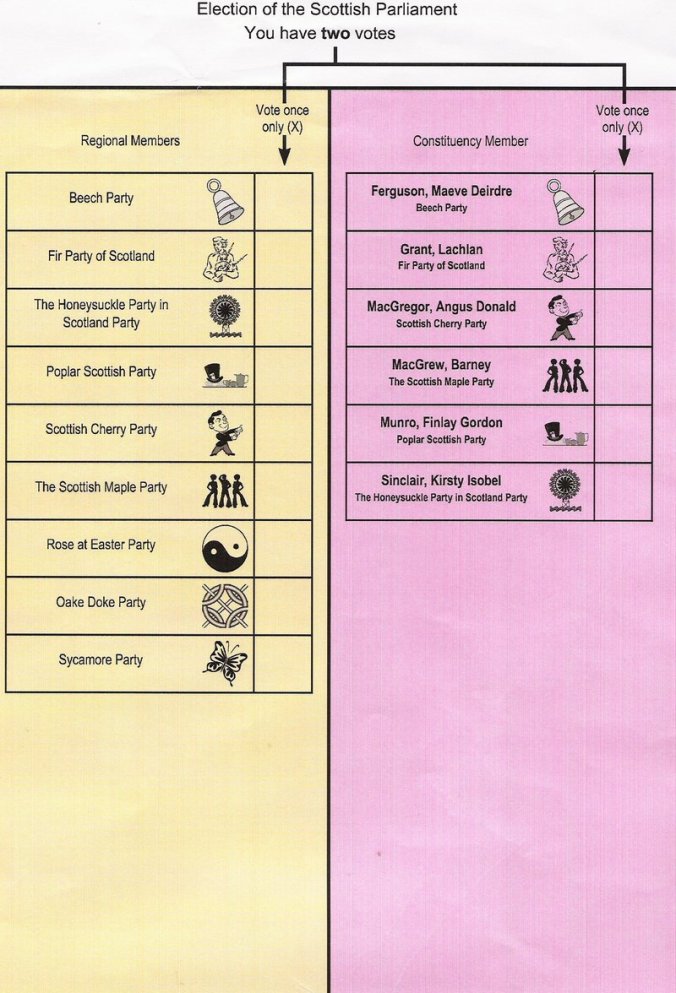
You will receive two ballot papers somewhat like these fictional examples:

ballot.jpg

On the PURPLE Constituency paper, you will see a list of PEOPLE who are competing to represent your constituency. They may or may not be a member of a party and will indicate thus under their name. Place an X in the box next to the person you think will best represent your constituency. (If they are a member of a party, this may or may not inform your choice)

On the PEACH Regional paper, you will see a list of PARTIES competing to gain the most seats in Parliament. The Parties may have a final advertising pitch or by-line such as “Nicola Sturgeon for First Minister” or somesuch under their name.
Place an X in the box next to the party whose policies most appeal to you and that you would like to see have more seats in Parliament.

Do not place any other markings, writing etc on either ballot as this may void that vote.

Then follow instructions in your polling place telling you in which box to place each paper.

More details on how your votes are counted as well as some myths and common misconceptions can be read here:

https://thecommongreen.wordpress.com/2015/06/06/how-scotland-votes-a-guide-to-the-scottish-elections/

tcg-logo5

The Economics of Fracking

“It can be concluded that both shale oil and shale gas are unlikely to be economically viable in this current low hydrocarbon price environment and even if there is a return to recent higher prices; it is likely that the industry would require significant subsidy or significant efficiency progression before it could be used at any kind of scale.”

“Even if the extraction can be proven to be environmentally ‘safe’ the experience of the United States shows that it risks bringing boom-and-bust to our communities as waves of temporary jobs move rapidly through without rooting themselves in local economies.”

CWFrack

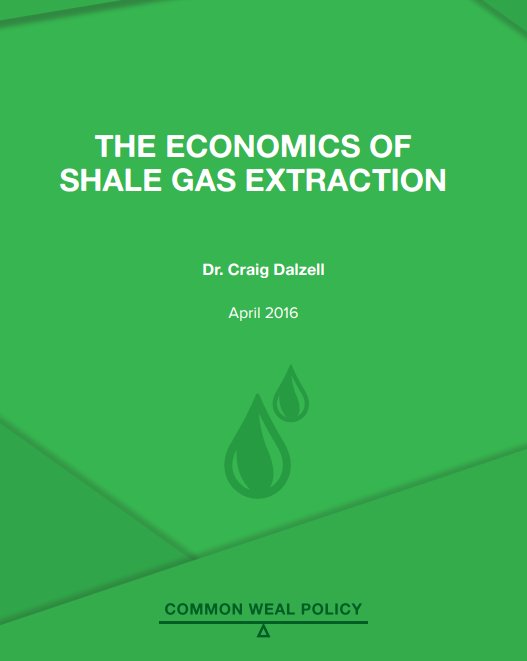
My first paper written for the Common Weal has been published today. The Economics of Shale Gas Extraction is the first major paper to be published in Scotland focusing on the economic, rather than environmental, impacts of the industry particularly on the local communities which will be hosting the wells.

Key Findings:-

  • The SGE market in the US and, so far, in the UK is dominated by larger companies occupying the most profitable licences. There is little scope for community owned or small company development to occupy a significant market share.
  • Individual wells become largely non-productive within a few years of development which, due to market demand for constant production, forces companies to continue drilling new wells in new locations at a rapid pace.
  • The low recoverable volumes and high capital and running costs of wells may render profit margins comparatively small and extremely sensitive to oil and gas pricing. There appears to be little scope for economic development of SGE in the UK until and unless wholesale prices return to historic highs and even then significant subsidy may be required.
  • Communities are likely to be significantly adversely impacted by nearby SGE fields. The concentrated pattern of land ownership and comparatively weak situation of local government renders communities vulnerable to being unable to capture wealth generated by nearby wells whereas the burden of environmental degradation or even simply the threat of such degradation can lead to community stress and negative economic effects.
  • The jobs created by SGE appear to be short-lived and highly mobile. The job demographic of the planning, drilling and production phases are each relatively exclusive meaning that they will move to the next site more rapidly than the wells themselves do. This creates the risk of a “Boom-Bust” effect in communities.
  • Shale oil and gas is considered a relatively poor source of fuel due to high extraction costs. The UK’s reserves are also likely to have an insignificant impact on global markets and hence a negligible impact on end-user prices.
  • Significant externalities have been identified in the form of environmental degradation due to methane leaks. The costs to mitigate these may exceed the lifetime revenues generated by the well which produced them. Further, the UK has a poor record in terms of ensuring adequate decommissioning and restoration bonds which may lead to further public funding being required after the SGE companies have left an area.

Whilst much of the attention on the shale oil/gas and fracking industry has been focused on the environmental impact, less attention has been paid to the economic effects. Even if the extraction can be proven to be environmentally “safe” the experience of the United States shows that it risks bringing boom-and-bust to our communities as waves of temporary jobs move rapidly through without rooting themselves in local economies. Scotland’s history of concentrated land ownership and comparatively poor local government also risks creating a vast transfer of wealth benefiting the already wealthy whilst potentially leaving communities to foot the bill for cleaning up. All for a fuel which the government has been told will not even benefit us in the form of lower energy bills.

There should be no place for fracking in Scotland or the UK.

tcg-logo5

Paying For It

“I would say is that every public-private partnership in Scotland has delivered new hospitals or new schools in Scotland on time and within budget and that’s the sort of success I want to see in every building.” – Jack McConnell, 2002

wall

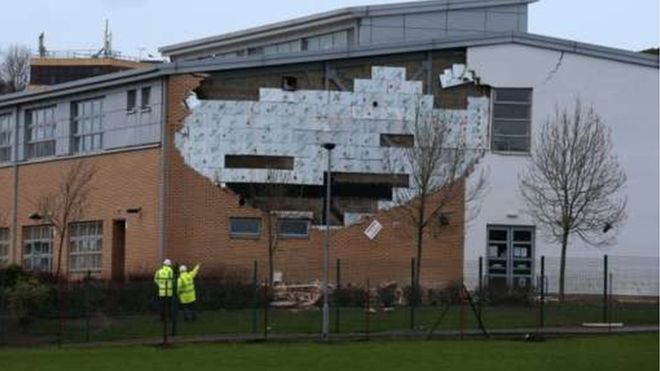
Oxgangs Primary School, 2016. Built by PFI in 2005

The dramatic news from Edinburgh in the past couple of weeks has put into sharp focus the failures of some of the finance models used by our regional councils to build schools, hospitals and other public buildings in recent years. Public/Private Partnerships (PPP), Private Finance Initiatives (PFI) and, less well known, Lender Option, Buyer Option (LOBO) Loans have burdened our councils with near-crippling financial obligations and, as we now know, have too often failed to deliver on even the basic standards of results required. Just what these deals are and why they have been used is a topic which requires a bit of discussion.

PPP/PFI

Public Private Partnerships, of which Private Finance Initiatives are a specific type, are a form of capital investment introduced to the UK in the early 1990’s by Major’s Conservative government as an alternative to tradition procurement methods of the time. In traditional public investment models a local authority might decide to build an asset such as a school itself in a purely publicly funded model or it might contract a private source to build the school and then take over the full running costs of the project afterwards. The Tories were driven by an ideological pledge to reduce the budget deficit (then known by the catchy title of “public sector borrowing requirement“) and identified the use of PFI as a means to do this.

Instead of paying for a project out of the capital budget either up-front or over the span of the construction phase, PFI would spread the costs over a medium or long term contract, often more than 20 years. This reduced the single year outlay and hence massaged the budget figures.

It was under the Labour government though that PFI really took off as it had the advantage of taking capital debts “off-book” and allowed Gordon Brown to simply stop counting them towards the deficit entirely. This gave the illusion of the fiscal prudence on which he banked much of his reputation. This was doubled down in Scotland by Jack McConnell’s Labour/Lib Dem government which led to Scotland, with 8.5% of the UK population, ending up with some 40% of the UK’s PFI funded schools.

The lie to the illusion can be found in the realisation that the private sector doesn’t work for free. These contracts almost certainly mean that the total cost to the council over the lifetime of the council is significantly larger than the up-front capital costs.

PFI

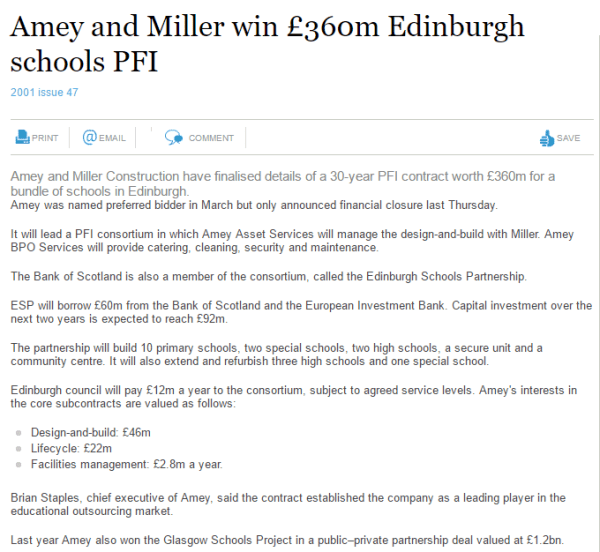
To take a recent example concerning some of the schools in Edinburgh, the private company involved will be paid £12 million per year for 30 years for a project valued at £68 million in up-front costs and an additional £84 million in management costs. Subtracting the running costs, this represents an annualised return on capital investment for the company of 10% per year. For contrast, David Cameron’s offshore tax haven shares “only” earned him about 6.75% per year.

And this doesn’t even represent the worst example of increased costs due to PFI. Contracts worth three or four times the capital investment are common. Some have been found to be worth a staggering ten or even twelve times the total outlay.

It is these ongoing payments which are particularly affecting our own regional councils and the problem is only going to get worse with the peak of the outgoing payments not expected to hit till the mid 2020’s.

PFI

Whilst one of the advantages of PPP’s often touted is the obligation for the private company to maintain the asset over the lifetime of the contract this can be a double-edged sword. One of the other “advantages”, mentioned in the UN ESCAP video above, is the “realisation of private sector efficiency savings”. That can mean “cutting-corners” to you and me. If the company is required to maintain a school for only 30 years but is then free from that obligation on year 31 then the inducement to build to the minimum possible standards to see out that contract is strong. Indeed, there is some anecdotal eyewitness evidence that exactly this has taken place. Schools which, by today’s standards are insufficient but which nonetheless stood for more than 100 years are being replaced with buildings designed to last less than a quarter of that and, has been seen, sometimes don’t even make it that far. This is not “long term planning”. It is certainly not helped by the generally low standards of our building regulations. A private company will rarely build at anything other than barely above the minimum legal standards so if we’re going to continue involving “the market” in our infrastructure projects then we’re going to need to have a discussion about increasing those standards to something more suitable for the 21st century. Whilst PFI specifically may have been abandoned in Scotland, this discussion over standards remains.

LOBO Loans

Lender Option, Buyer Option loans make up a far smaller proportion of council borrowing than PPP/PFI and have hit fewer headlines but they are still a symptom of the chronic dysfunction of our public borrowing system.

These loans were launched in 2000 as an alternative to the National Loans Fund which, whilst cheap and stable due to being funded by UK gilts, are sometimes quite limited in scope and therefore not always avaliable when required. Instead, the public body can approach a commercial bank for a long term, often more than 40 years, loan which is offered at an initially low “teaser rate” but which includes a clause which allows the lender to change the interest rate, usually upwards, are regular, often annual, intervals.

Sometimes these rate adjustments carry with them a contract exit clause but one can imagine the conversation in that case.

Bank: “So, we’re planning on increasing your interest rate from 2% to 5%. Under Section 4 of our contract, you can exit the loan by paying back the outstanding primary plus our exit fee.”
Council: “If we had that kind of money, we wouldn’t have needed the loan.”
Bank: “Ok. 5% it is. See you next year!”

These loans were often offered to and accepted by councils without the council quite appreciating the potential volatility and uncertainty that these changes would represent, which is quite understandable as these contracts have been criticised as being some of the most complex in the financial world and as our locally elected representatives aren’t necessarily chartered accountants it’s perhaps understandable that some would have simply been sucked in by those teaser rates which, at the time, undercut even those bonds offered by the NLF.

What Next?

I’m not going to pretend I have a magic solution to all of this. Some have discussed simply canceling and renationalising PFI funded assets but whilst I have some sympathy for this I have concerns also. Right now, we simply don’t know how far the record of substandard workmanship within the works built runs and, in fairness to the companies behind this disaster, they are upholding their obligation to pay the costs of repair and, if required, rebuild of these schools. If the contracts were canceled before we know the extend of the repair bill then we might simply be bailing out a huge debt. I can see some kind of scope for some kind of renegotiation over the annual payments or contract terms, perhaps with some kind of profit cap. Perhaps the companies could be offered an exit but made to put up a bond in case future issues arise although as we’ve seen from the coal and, more recently, the steel industry those bonds themselves need to be planned carefully lest they prove insufficient or evadable.

In future, a more sustainable method of public borrowing and investment needs to be examined. The Common Weal has a proposal to use a mutual limited company to leverage funds backed by Scottish issued bonds to invest in our public infrastructure which is perhaps one of the better ways to go about this issue although it is acknowledged that Scotland’s very limited borrowing powers even under the “new powers” of the Scotland Act 2015 will likely cap the viability of such a scheme. Obviously, an independent Scotland wouldn’t have that problem but until that’s sorted, we may need to think of something else.

tcg-logo5

Greening Tax

“Unless Scotland has the boldness and the courage of its convictions to use the abilities that the Scottish Parliament is going to have in the next session to have a fairer, more progressive approach to taxation…many more communities are going to find that the public services they rely on will continue to be under threat.” – Patrick Harvie

Yesterday, the Scottish Greens published our proposals for reform of both the national income tax and a replacement for the local council tax. The proposals themselves can be read by clicking on the image below but I’ll spend a bit of time here explaining how they work and what might have been missed in some of the media coverage about them.
Green Tax


First though we need to remember just what the purpose of tax is for. It’s so easy to get caught up in the arguments over how much more or less a particular tax or tax change would raise without considering the deeper impacts of what a particular tax is supposed to do.

The Principles of Taxation

Why do we tax people in the first place? It’s a substantial chunk out of your paycheck every month and there’s not one of us who has, at some point, wondered what they could have done with that money instead.

The reasons for taxation are broadly covered by three principles:

Revenue Generation:- There are many services, such as roads, emergency services, healthcare, education etc, which we, as a society, have decided are best funded collectively. We may argue over just how much is paid for in this way and how much is funded ad hoc or privately but there are vanishingly few full blown anarcho-libertarians, especially in Scotland, who believe that absolutely everything should be in private hands and that Government shouldn’t exist at any level. For everything else, taxes are collected to fund the State and its operations.

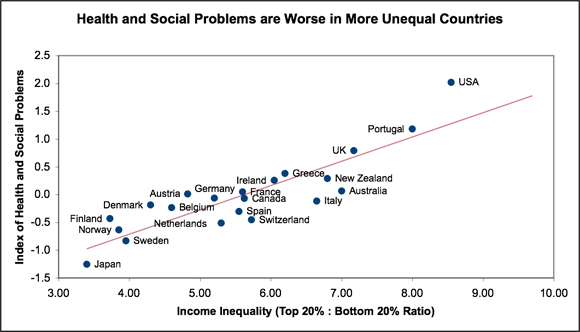
Redistribution:- Societies are rarely entirely equal at every level. Some people end up earning or accumulating more than others, some people end up not earning enough money to meet their basic needs. Some regions end up with a greater concentration of wealth than others. Some, due to size or geographical constraints (such as the Highlands and Islands) simply require more funds to deliver the same level of services than others. It is well known that more equal societies experience greater levels of wellbeing and lower levels of ill health and other negative effects. Most societies, therefore, employ tax, alongside policies such as social security and welfare, in a progressive manner such that the richer pay more according to their abilities and the poorer gain more according to their needs.
inequality

Reshaping:- This is the carrot-and-stick approach of taxation. Governments often develop policies designed to encourage their citizens towards certain activities or discourage them from others. One prominent example at the national level would be the levies on tobacco and alcohol which are, at least partly, there to try to encourage us to smoke and drink less (obviously, taxes can fall into multiple categories and the Revenue Generation aspects of these taxes cannot be discounted, especially when used improperly).

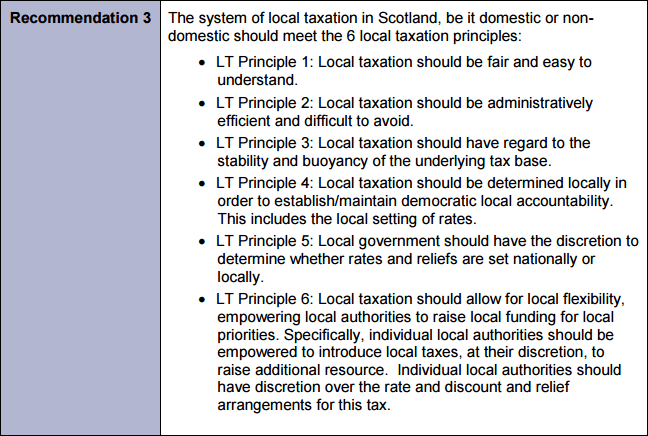
In addition to these principles on the purpose of a tax, we must consider how it is structured so that it works in an effective manner. In 2013, local council body COSLA published a report into the effectiveness of current local taxes and in it laid out six principles outlined below.
LT Prin

Essentially, these principles boil down to taxes being fair, easy to manage and employing a sense of subsidiarity whereby local powers should, wherever possible, be used to effect local solutions. Whenever discussing a potential tax, local or national, all of these principles must be upheld or accounted for.

Income Tax
SGP Tax Bands.png

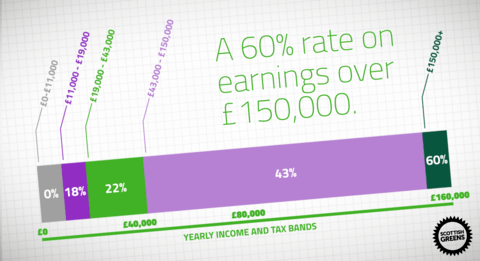
The Green proposal for the use of the income tax powers due to come with the implementation of the Scotland Act 2015 includes not just a tweaking of the rates nor the use of clumsy rebates as Labour (briefly) seem to have  considered but the full use of what powers we shall have to create new bands appropriate to Scottish income distribution.

The headlining feature of these proposals, as one may have suspected, was the inclusion of a 60% rate on earnings over £150,000.

This certainly did grab the headlines coming so soon after the SNP announced that they would not be raising the top rate past it’s current 45%. Their decision was based on this document which suggests that the “tax induced elasticity” (TIE) of the richest 1% in Scotland may be substantially higher than in the UK as a whole. Simply put, they fear that Scottish millionaires may flee elsewhere if we tax them at a higher rate than their southron counterparts. Their claim is that in the worst case scenario, enough high earners would leave that the actual revenue collected could be up to £30 million less than would be if tax rate remained as it is (one has to remember that if a top rate tax payer leaves, you also lose what they’ve paid in lower bands too).

Now, I have a couple of reasons to doubt this will impact as badly as they fear. In particular, having had a read through the book on which the UK TIE figures are based and having back-calculated their suggested maximum top-rate income tax for those UK figures, the implication appears that if the high end TIE rate the SNP suggests (0.75 compared to 0.46 for the UK) were to come to pass the maximum allowable income tax rate would be something on the order of just 30%. I would suggest therefore that the conviction attached to that worst case scenario is somewhat low as not even the Scottish Tories have went into this election on a platform of cutting the top rate of income tax.

My other reason for skepticism over this fear of tax flight in relation to internal tax boundaries is the case actually seen in the United States (In particular, as found by this paper by Young et al in their study of tax migration and border effects) where each state has far more control over many taxes than Scotland has and consequently sees quite sharp tax boundaries between states. Now this is not to say that that tax induced migration does not occur but in the words of the paper linked to above it seems to occur “only at the margins of statistical and socio-economic significance”. This appears to be true even at easily commutable borders so don’t be readily expecting a cluster of Scottish millionaires moving to Carlisle or Newcastle.
[Edit: Alternate link to the Young paper here.]

The reason for this is quite profound. As it turns out we can broadly place the richest echelons of society into to one of two groups. The “transitory millionaires” who really are just seeking somewhere to park as much of their wealth as possible without contributing much to society in general and the “embedded elites” who more closely fit that classic-to-the-point-of-cliché term of “job-creator”. These folk are the ones who have built a business in their locale and, as it turns out, it is not a simple case to uproot it and move it wholesale elsewhere (especially when higher property prices may make the operation of that business significantly more expensive). Perhaps, we in politics have been too quick to conflate these two distinct attitudes among the most well off in society. Perhaps we should instead be asking which of the two groups we would prefer to have influence our policy decisions?

On the Greens’ part, we are not making any prediction of revenue based on our 60% rate. We’re operating on the basis that our changes to the top rate of income tax will not attract any additional revenue (although the changes overall could bring in some £331 million per year) and this managed to attract some attention during the recent STV Leader’s Debate with the Tories asking what the point was if revenue didn’t change and asking how that would improve the economy. Well, we’ve seen the answer to that in the principles section above. The Green tax plan would significantly reduce inequality within Scotland. From a social standpoint, this should significantly improve general wellbeing within Scottish society and from an economic standpoint there will be benefits due to what’s known as the Marginal Propensity to Consume. Essentially, if you increase a multi-billionaire’s income by £100 then it means next to nothing to them or their lifestyle but if you increase the income or decrease the tax burden of a minimum wage worker by £100 then it will give them the ability to pay down debts or spend more on goods and services on which they would not otherwise have been able to do so. By this means, a revenue neutral tax change which decreases inequality most certainly can have a positive economic benefit. It reflects poorly on Ruth Davidson that during that debate she either didn’t know or didn’t want others to understand that fairly fundamental point.

Property Tax

Incidentally, the Young paper linked to in the previous section points out that a far more significant cause of high-earner migration than income tax is a draw towards expensive housing which is a famously immobile asset and which leads us neatly on to the second half of the Greens’ proposals.

Given how limited the set of devolved national taxes actually are and given how long overdue we have been for doing something, anything, about the Council Tax, it’s perhaps no surprise that a large proportion of the campaigning has been dedicated to those taxes over which Holyrood does have near unfettered control.

Faced with the increasingly loud rhetoric over the need for change from many parties and the cross-party consensus on the need for radical change laid down by the Commission on Local Tax Reform’s final report it’s therefore been a deep disappointment that it has been left to the Greens to be the only party to lay down a system of local residential property tax which is meaningfully different from the Council Tax. The Lib Dems have dropped their long standing aspiration towards a local income tax. RISE have stuck to the plan for an income based service tax inherited from the SSP but have appear to have opted to set rates nationally thus remove the advantages of local control. The SNP have decided to keep the present system, including the quarter century old, out of date valuations, but will increase the rate multiplier, nationally, on the top couple of bands. Labour have come up with a system of a per household flat rate poll tax with the addition of value based percentile tax (In my previous article I mischaracterised this as a banded tax due to a misunderstanding of their press statements on the topic. I was in error.) which, on the face of it, is an interesting change but their actual calculations will leave us again with a tax which is deeply regressive with respect to house value.

The Greens, however, have opted to levy a local property tax based entirely as a percentage of the property’s value. This Residential Property Tax would be nominally set to 1% of the property’s value but it will be entirely within the local council’s power to set that rate at whichever value they wish and will be coupled with a scheme of reliefs for low earners similar to the system currently in place.

Of course, such a large step change in the tax system requires careful management and people will need time to adjust their financial affairs to reflect the change so we also propose phasing in the new RPT over the course of the next five year Parliament by stepping over to the new system in 20% increments until Council Tax is fully abolished.

The graph below shows this transition as well as a comparison of the tax regimes proposed by the SNP and Labour as a percentage of a house’s value (RISE’s SST, being income rather than property based, isn’t directly comparable in this way).
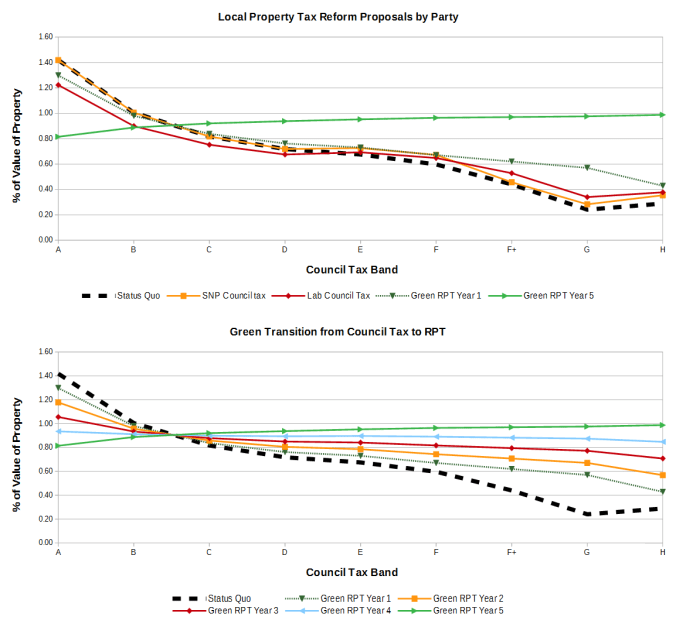
Green RPT Both

The contrast is quite profound. Incidentally, the large change in nominally band “C” and above properties may look alarming but one must remember that the lack of revaluations since 1992 has led to many houses, some 57% of the total stock, sit now in the wrong council tax band. The house I’m currently in is a fairly graphic example of this being a band “D” house with a present market valuation of approximately £100,000. Converting from the present Council Tax to a 1% RPT would actually cut the bill here by some 10%.

Also of specific note within these plans is a system of redistribution across councils. Essentially, there are some council areas containing a lot of very expensive houses (Edinburgh, say) and some where property prices are comparatively cheap. It couldn’t be fair that one of the higher priced areas takes the decision that they could cut property taxes to a bare minimum and still fund local services, as happens in places like Westminster, whereas lower priced areas must pull those tax levers harder. Therefore, the block grant given to councils will be calculated on the assumption that they will charge the 1% RPT which will remove much of the temptation from those councils with higher property values from perpetuating the cycle of inequality. They still would have the power to reduce those rates, but they’d have to be accountable to their voters for doing so.

But what of land? Isn’t that a core tenant of Green policy? Well, herein lies an aspect of property tax which has been almost entirely missed by the media and yet lays the path towards possibly the greatest change within them. The RPT includes a slider which will allow a council to weight the RPT between taxing property and taxing land. If a council decided to, say, weight 100% towards property and 0% on land then the system would look most like the present council tax (albeit, as said, greatly more progressive) whereas if another council weighted 0% on property and 100% on land then the system would be functionally equivalent to a Land Value Tax and those who owned not just a large house but also a large estate would have to account for those holdings. In practice, many councils will seek some compromise between the two and the Green proposal lays out an example as currently used in Denmark where a typical weighting is something like 70% on property and 30% on land. Once again, localism is the key here. Council regions which are largely urban will likely wish to weight towards property whereas more rural areas, particularly those with patterns of unequal land ownership, may wish to weight towards land. Simply setting a national rate is unlikely to be sufficient or effective in every region of the country.

Conclusion

I  hope this then lays out our proposals for income and property taxation. I know. It’s a complicated issue which doesn’t soundbite very easily but we’re entering an interesting phase of Scottish politics whereby our Parliament will be getting more power than ever before and the need to use those powers effectively will become more important than ever before. Scotland Can be bolder if we want it to be.

tcg-logo5

My thanks to Andy Wightman for technical advice provided for this post. His blog Land Matters can be read here.