Reformers Reforming Reforms

“The present Council Tax system must end.” – The Commission on Local Tax Reform’s Final Report

Whilst we’re still just a bit too far away from the elections to get to see the actual manifestos, something resembling policy is now starting to trickle out from the parties.

Given the currently still limited nature of tax raising policy within Scotland it’s natural to focus on those areas where control is possible and since the publication and acceptance of the Commission on Local Tax Reform’s report on the need for an overhaul in local taxation in Scotland. So far, both the SNP and Labour have released their detailed plans and, so far, both have been somewhat lacking in ambition.

Continue reading

The Devolution Journey: Part 1 – The Treaty of Union

This is Part 1 of what shall become a companion piece to my previous history of devolution and tax powers which can be read here.

As we edge closer to the the May elections and (maybe) to the passing of the Scotland Act 2015 we can continue our reflection on the process and “journey” of devolution. My last piece on the subject looked solely at the transfer of tax powers to the Scottish Government since 1999. This one will look at several of the other functions of governance and the process of the transfer of power over other important areas. To do this though, we need to look back a little further.

Continue reading

We Need To Talk About: Local Taxation


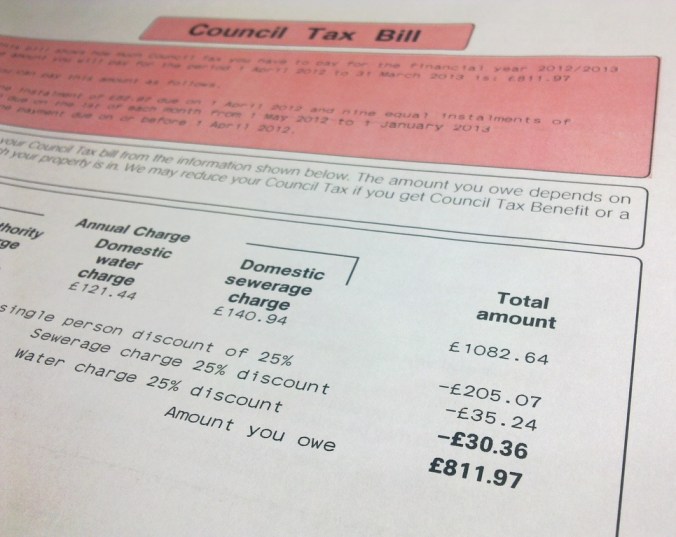
Council

Source: Flickr

Next year brings in the Scottish Parliamentary Elections and with it comes the proposals from each of the parties on how best to use the limited powers that the Scottish Government will have at its disposal. No doubt, much of the news and comment will be around whether or not the (marginally) expanded powers over income tax coming in under the Scotland Bill 2012 will be used and by how much.

Our approach towards local taxation, however, will perhaps lead to a far more fundamental change to the fabric of our society. There is also far greater scope within the devolution powers to do something a bit more radical that simply raising or lowering the rate of tax by a penny or so (or repeatedly defending one’s reasons for not doing so). It is therefore important, before the campaigning season begins in earnest, to understand what our options are and the potential impacts of them.

Continue reading

The Devolution Journey: Devolution and Tax

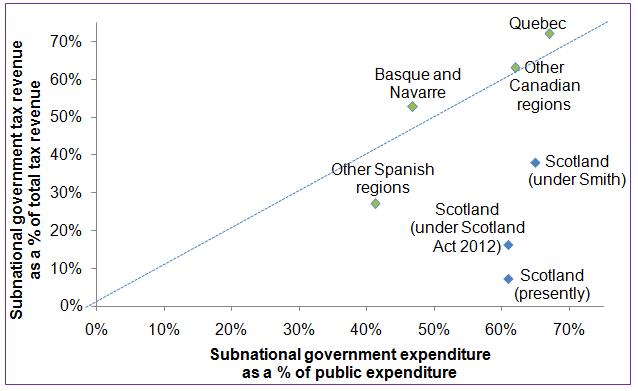
A comparison of the % of devolved control in Scotland now, under 2012 and under Smith as well as a comparison with Spain and Canada. Source: Scottish Government.

A comparison of the % of devolved control in Scotland now, as it will be under the Scotland Act 2012 and under Smith Commission recommendations as well as a comparison with Spain and Canada. Source: Scottish Government.

Monday the 9th of November saw the Scotland Bill 2015 make a further step towards completion. This Bill, which has been the result of the aftermath of the 2014 independence referendum, will mark another milestone on the devolution “journey” Scotland is traveling upon.

Some of the commentary both during the actual debate in the House of Commons and in the days since have shown considerable confusion at just how the system of devolution in the UK works at the moment and how it is to change with the implementation of the Bill. Before we really settle into a meaningful debate on whether or not any “additional powers” for Scotland will be to and for Scotland’s benefit we need to actually understand what those new powers are, what we have now and how they can be used.

This article shall focus on the powers over taxation devolved to the Scottish Parliament as this area will be undergoing several rapid changes over the next few years and much of the confusion amongst members of the public has arisen from the conflation of several phases of devolution.

One must understand the rather unplanned and piecemeal nature of the progression of devolution for Scotland, there is certainly no clear “destination” to that “journey”, and this reflects and contributes to the confusion but there are three major points in the form of the Scotland Act 1998 which formed the Scottish Parliament after the success of 1997 Devolution Referendum; the Scotland Act 2012 which resulted from the 2007 Calman Commission and the aforementioned Scotland Act 2015 resulting from the Smith Commission of 2014.

Continue reading

We Need To Talk About: Budget Underspends

Victoria Quay

Q. When is a surplus not a surplus?
A. When someone is talking down the Scottish Government.

Today the Auditor General published its annual report detailing an independent opinion on how well the Scottish Government is managing its finances (or how badly it is failing to do so).

This year, as last, there have been howls of anguish from those opposed to the Scottish Government at the fact highlighted by the Auditor General that the Government spent £350 million less last year than it was given in the Block Grant.

As the opening question suggests in most normal countries when your government spends less than it has available to spend then it is running what is known as a budget surplus. This is, especially in today’s economic climate, generally considered to be a “good thing“. Not so in Scotland, apparently, where the phrase to be used instead is “budget underspend”.

How this has occurred, is due to the peculiar way by which the Scottish Government is funded and is constrained to spend its money.

Continue reading