Scotland’s National Bank

The Croatian National Bank shall be the central bank of the Republic of Croatia.
The Croatian National Bank shall be autonomous and independent, and shall report on its work to the Croatian Parliament.
The Croatian National Bank shall be managed and its operations shall be conducted by the Governor of the Croatian National Bank.
The organisation, purpose, tasks and remit of the Croatian National Bank shall be governed by law.
Article 53, The Constitution of the Republic of Croatia.

Today sees the launch of my latest contribution to the Common Weal White Paper Project on the very important topic of Central Banking in an independent Scotland.

It has received a front page splash in The National which can be read here alongside a summary by me here.

And the paper itself can be downloaded here or by clicking the image below.

wppcentralbank

If, as I hope we should, Scotland uses the opportunity of independence to launch our own sovereign currency then one of the departments of government that we’ll need to set up is our own Central Bank. This paper outlines the principles that we’ll need to examine and follow as we design that bank.

Continue reading

We Need To Talk About: GERS (2016-17 Edition)

“The GERS figures are not meant to be anything other than a way of showing the current position under the present arrangements.” – The BBC 

The annual Government Expenditure and Revenue report is out and, as with previous years, I’ve written an analysis of the report and what it means for Scotland. The GERS report itself can be downloaded here.

GERS banner

A more detailed analysis I have prepared for Common Weal can also be read here.

GERS CW Banner

The UK is a deeply unequal union and London continues to capture a greater and greater proportion of the wealth of the state to the detriment of everywhere else. This single fact has to frame everything we think and say about the finances of Scotland.

Continue reading

Twas the Night Before GERSmas

‘Twas the night before GERSmas, and all through Scotland
The bloggers were screiving; their time near at hand.
The headlines were crafted with doom and despair
In hopes that Lord Darling soon would be there.
The MPs were nestled all snug in their beds,
While visions of oil money gushed through their heads.

santadarling

And Brown with his spreadsheet, and Mackay (who’ll fudge it),
had just settled accounts and balanced the budget –
When outside the office there came such a racket,
They wondered if Ewing had started to frack it.

Continue reading

Trading Places

“GDP is increasingly a poor measure of prosperity. It is not even a reliable gauge of production” – The Economist

There’s a bit of a story happening around Scotland’s oil trade since Wings Over Scotland highlighted an otherwise completely unreported change in the way the UK measures how much oil it trades with the world and where in the UK it comes from.

rtsur

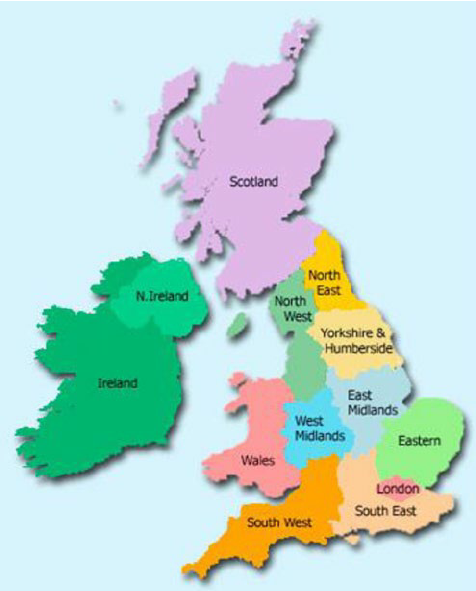
The story stems from the way that the UK calculates its balance of trade with the rest of the world and specifically how it then decides which region of the UK is responsible for that trade. To do this, the UK is split into 12 regions based on the Government Office Regions of England plus Scotland, Wales and Northern Ireland. (These boundaries are also used by Eurostat for their NUTS 1 statistics)

Fig-4-NUTS-1-regions-of-the-UK

There’s another “region” of the UK not displayed on the map. Not all trade can be firmly allocated to a single region and not all trade can be allocated to a region at all. This is the “Unknown Regions” of the UK. Most prominent amongst this kind of trade, at least within Scottish political circles, is trade generated by offshore activities.

There are many different ways one could approach this allocation – the methodology – and the way you do it can result in very different results. Now, if you’re the UK and are looking at UK stats these figures don’t really matter so much but they do become very relevant if you’re looking at one part of the UK and what its economy might look like if it decided to, say, discuss holding a vote for independence. Suddenly, even UK government departments start getting very interested in Scottish trade.

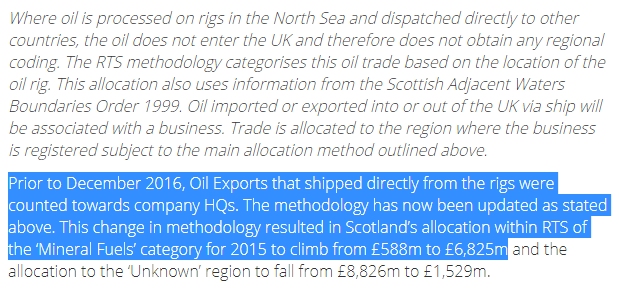
The particular story here concerns a change in the trade methodology around offshore oil in Scotland waters. Particularly, oil which is exported out of the UK directly from the rigs without it ever touching the UK land boundaries. Previously, much of this oil has been allocated to the Unknown Region but the change now meant that it would be allocated to Scotland. This has led to an increase in the recorded value of Scottish minerals exports for 2015 from £588 million to £6,825 million. Quite a substantial jump and one which has spread around social media. Time for a wee breakdown of what it means and take the chance to clear up a few misunderstandings I’ve seen along the way.
(This is a complex topic, after all)

Continue reading

Grim Drama Parked

“Tomorrow’s GDP figures will confirm whether or not Scotland entered a second quarter of economic downturn in the first three months of 2017.” – Scottish Conservatives. 4th July 2017.

The quarterly Scottish GDP figures were released today after a long build up in a press anxious to see if Scotland was on, as the Express put it, the “BRINK OF RECESSION” (their emphasis).

The figures themselves rather put a misstep into their charge.

bbcgdp

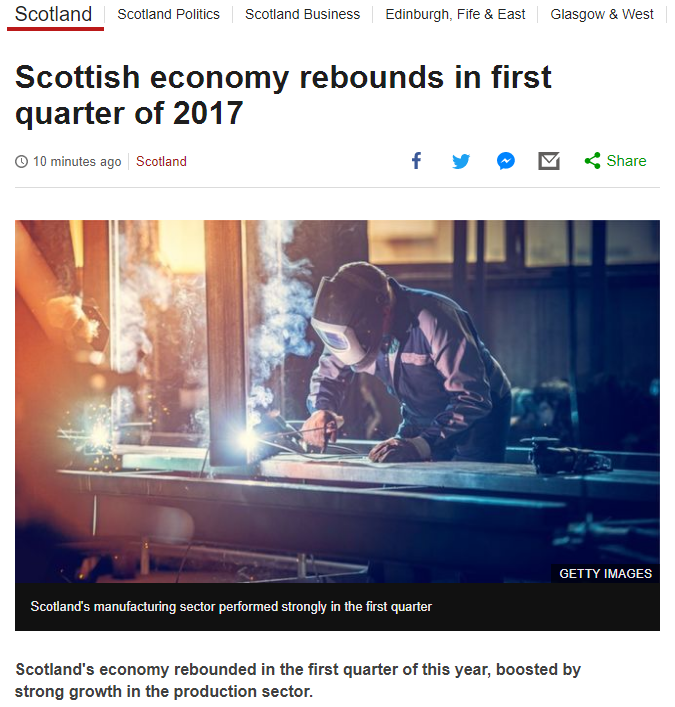
The headline figures are that in Q1 2017, Scotland’s economy grew by 0.8% which is up substantially on the -0.2% contraction seen in Q4 2016. This positive growth also means that the two successive quarters of negative growth which define a technical recession were not met.

The UK’s GDP growth over Q1 2017 was 0.2% though in my last blog post I put substantial attention onto the point that we should treat such comparisons with a great deal of care given the large regional inequalities within the UK. I’d very much like to see the GDP of the UK broken down across its regions (especially London) before commenting too much on it.

And before we all start patting ourselves on the back at avoiding our “predicted” recession, it’s worth actually diving into the numbers and seeing what they do and do not tell us about the Scottish economy.

Continue reading

The Return of the Sick Man

“Annual income twenty pounds, annual expenditure nineteen nineteen and six, result happiness. Annual income twenty pounds, annual expenditure twenty pounds ought and six, result misery.” – Dickens, David Copperfield

The shape of the next UK economic crisis has become apparent. It may have already begun and it’s not at all clear how it can be avoided or mitigated.

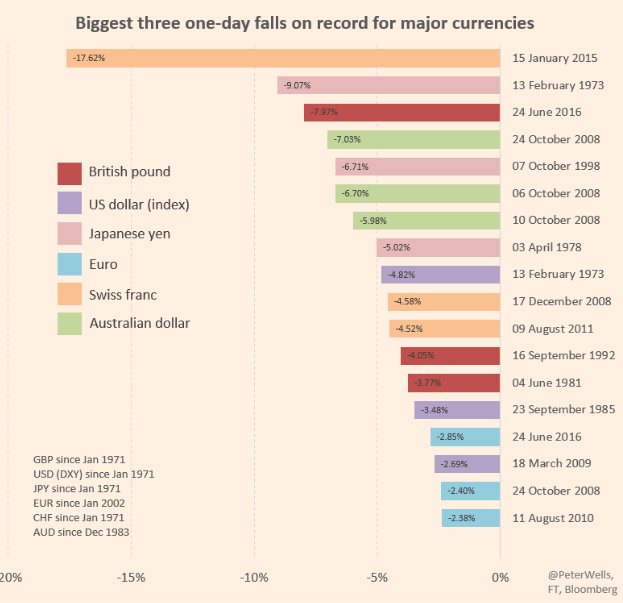
On the 23rd June 2016, the United Kingdom, for a variety of reasons, voted to leave the European Union. The immediate impact of this was an almost unprecedented drop in the value of the pound with respect to its major trading partner currencies.

Currency fall

Not much of a problem, the defenders said, as a weakened currency has its merits as well as demerits. Exports should become cheaper, which would boost foreign trade.

This may have been true in times gone by but economies have grown vastly more complex than this. Many products manufactured in the UK consist of sub-components drawn from multiple countries and globalised supply chains have grown STAGGERINGLY complex.

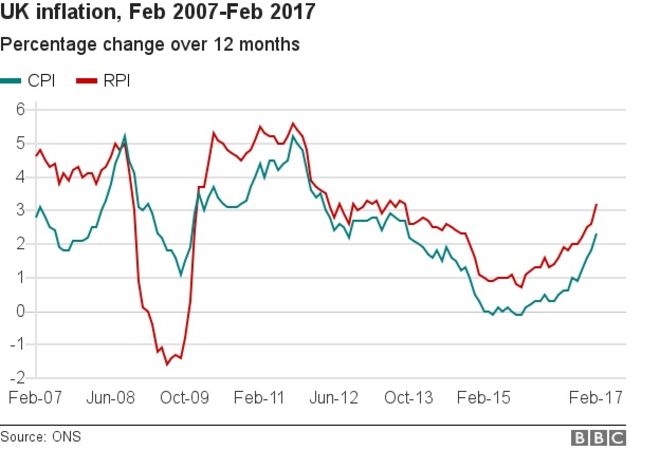
What this has meant is that even the goods that Britain manufactures here have seen their “input prices” increase, which has pushed up the price of goods even despite the fall in currency strength. Add to that, the fact that the UK imports far more than it exports – it has one of the largest trade deficits as %GDP in the OECD –  and it becomes clear why prices have started rising again in Britain. After five years of declining inflation rates and almost a year of zero price increases, inflation has returned with a vengeance.

_95250708_chart_inflation_mar17

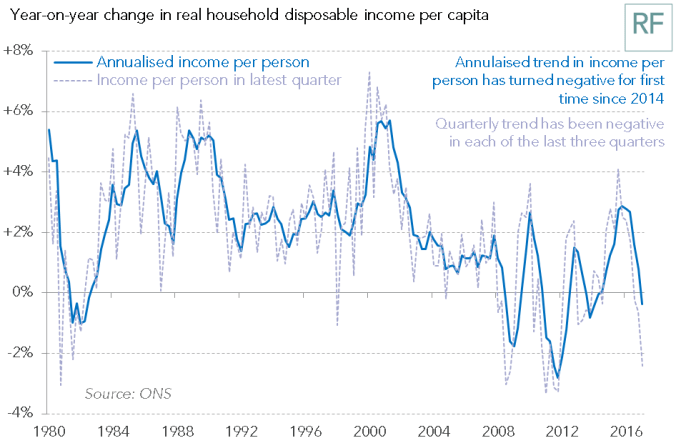
But this needn’t be a terrible thing. In fact, inflation can often be quite useful as it erodes the value of debts (which is why creditors and asset holders hate it so much). So long as wages keep up with the rising prices then for those who don’t depend on the rising value of assets or debts it can be manageable. So how are we doing on that point?

Oh…

income.jpg

We’re not doing so well.

So inflation is rising and wages are declining, so we’re in the situation where meeting our needs and maintain a decent standard of living is becoming more and more difficult. But even this could be mitigated or reversed if the government were to step in and support the economy by investing or by otherwise injecting money into it.

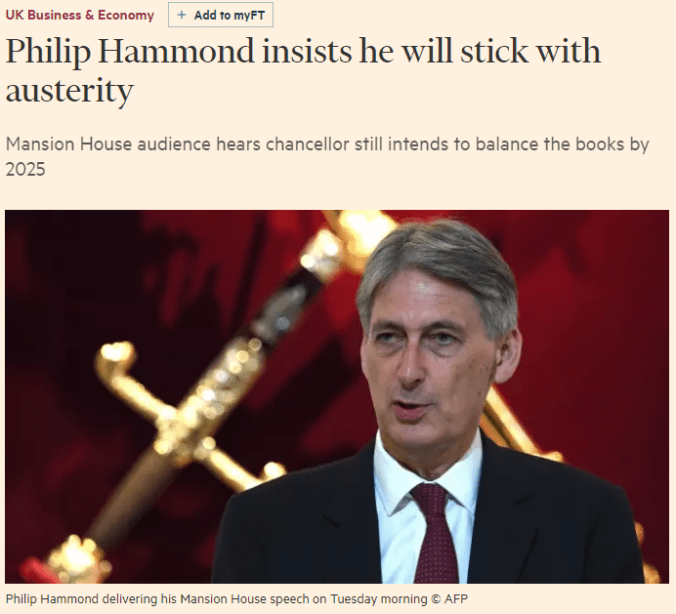
So how’s the UK dealing with things? Well…

FT.png

And so this is the root of the coming crisis. Prices are rising, wages are stagnating, savings have been drained, credit cards have been maxed out, and the government is pulling out of the business of providing government and public services so you need to spend even more to replace it. We no longer have enough money to meet our basic needs, never mind the disposable income to buy the widgets we need to consume to keep the wheels of the economy turning.

Up here in Scotland, there are signs that the crisis is already upon us. The Fraser of Allander Institute published a report today warning about the precarious nature of the Scottish economy saying that it was stagnating with relation to the UK economy as a whole. Some will almost certainly be quick to blame this on the Scottish government (the phrase “uncertainty of a divisive second independence referendum” comes to mind). There are certainly some things that the Scottish Government could do to help – a National Investment Bank should be high on the list and a good shake up of the domestic agenda would be welcome – but the ultimate cause of this slow-down does not originate in Scotland nor will its solution come from here (at least until the levers of power are returned to the country upon independence).

The problem, ultimately, is that Britain isn’t Great. Britain is Weird. Britain is a deeply unequal country on a scale which, compared to its neighbours, is utterly baffling.

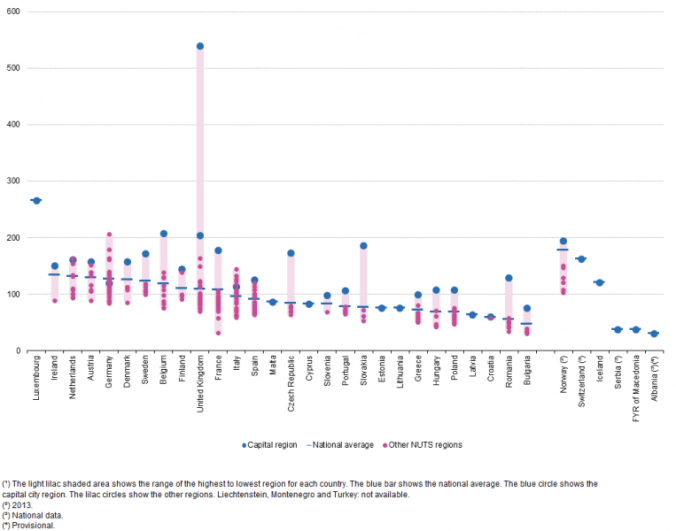
In many countries, the capital city will be the richest region of the nation. This is normal –  Money wants to be close to power – but the UK’s disparity really needs to be seen to be believed. Here is the GDP/capita for each of the EU28 and EFTA countries broken down by region. Spot the odd one out.

763px-Gross_domestic_product_(GDP)_per_inhabitant_in_purchasing_power_standard_(PPS)_in_relation_to_the_EU-28_average,_by_NUTS_2_regions,_2014_(%_of_the_EU-28_average,_EU-28_=_100)_RYB2016.png

(Note that the UK has two capital dots. The lower one is London as a whole. The upper one is just Inner London)

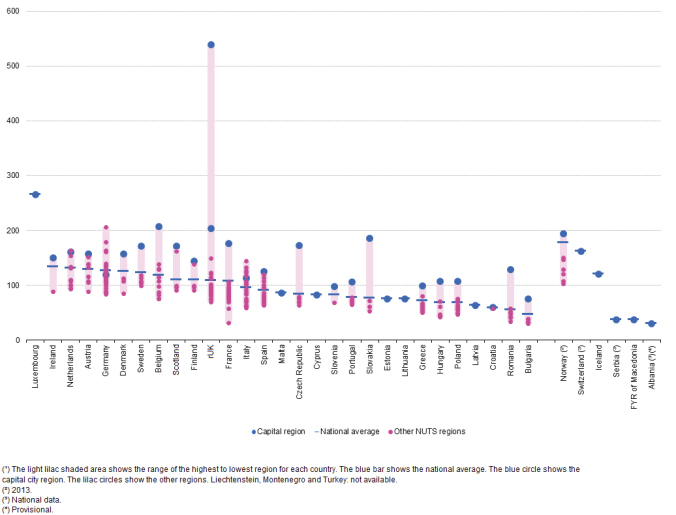
Whenever statistics about Scotland are produced, they’re often given with reference to the “UK average” or the “UK as a whole” but the extreme disparity of Britain masks the picture. Detailed analysis by Prof Mike Danson of Heriott-Watt University has shown that Scotland’s GDP per capita is the third highest region of the UK (after London and the South-East) and, if we were an independent state, we’d be the 9th highest in Europe. In fact, we can disaggregate out the Scottish data from the chart above and catch a glimpse what we’d look like as an independent country.

EU28 plus Scotland GDPcapita

(Edinburgh data estimated from 2011 NUTS 3 database)

Taken on this view, Scotland no longer looks like a “below average” region of the UK but a fairly normal Western European country. Far more like Finland or Denmark than, say, Greece.

As Prof Danson says, the obsession with comparing Scotland to misleading “UK average” figures leads to commentators ending up unable to take a step back and ask what is happening across and within the UK and where the problems really are. Until this happens, Scotland will continue to stagnate within the UK as the overinvestment of London continues (and is likely to get worse through the Brexit process in a desperate attempt to prop up the financial sector there).

As said earlier, there is a way out of the coming credit crisis but it’s going to involve not more Austerity but a whole lot less. Economists are increasingly coming around to the realisation that the Government’s debt is your surplus and that governments can take on that debt almost without limit (unlike you who have hard limits on credit and the ability to repay it) and – if they have their own currency – can print money in order to provide services (unlike, again, you who would go to jail if you tried that).

Once again, there is a certain amount that the Scottish government can – and should – do at the moment to help but it will always be stymied by the very tight rules of devolution. There’s little to no hope of the UK changing course any time soon (even Corbyn’s Labour is solidly committed to “balancing the budget“)  and the hard Brexit the Tories and Labour are both pursuing is being increasingly differentiated by the amount of damage the plans will cause rather than any attempt to prevent it. The Sick Man of Europe seems destined to return to the UK. I only hope that Scotland doesn’t catch its cold.

tcg-logo-7


Air Departure Tax Post-Brexit

“We haven’t commissioned to the best of my knowledge any independent research of our own. If committee wishes me to look at that, I will certainly consider that absolutely.” – Derek Mackay on the Government’s (lack of) analysis into the proposed ADT cut.

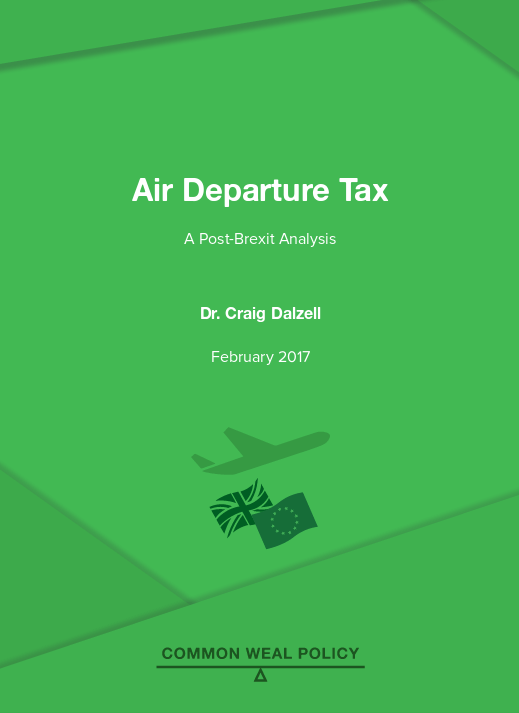
ADT Cover.png

The Scottish Government put out a call for evidence for their proposal to cut and eventually eliminate air passenger duty (or, as it’s now going to be known, Air Departure Tax).

Common Weal duly obliged and updated our previous work on the topic to account for the impact of Brexit. You can read the new report here or by clicking the image above.

It’s just as well that we’ve done this as it has since been reported that the Government itself has done precisely zero economic analysis of the impact of the tax cut and, as it turns out, our report is the only economically based submission which is against the tax cut (The RSPB have submitted an objection on the grounds of a very well founded environmental impact analysis). More than half of the other submissions and the bulk of those in favour of the cut are from companies and groups within the airport and airline industry. There is a great deal of concern that unless the government does pull its weight and do the maths itself then this policy could pass through simply on the say so of those who stand to benefit directly from the tax cut and at the expense of those who will lose out due to the impact on tourism and the lost revenue to public services.

Preface and Key Points below the fold.

Continue reading

We Need To Talk About: Defending Currencies

“Whenever politicians and rulers, from Nero onwards, interfere with monetary arrangements for political ends, disaster follow.” – John Chown, A History of Monetary Unions.
Currency remains one of the great potential uncertainties surrounding the debates about Scottish economics and independence. Last year I published the various options facing an independent Scotland along with the merits and demerits of each. Having selected as the preferred option an independent £Scot initially pegged to the Pound Sterling, Common Weal subsequently published a detailed plan on how precisely to go about making this currency a reality. Rather pleasingly, the news this week coming from the Scottish Government’s Growth Commission hints that they are looking at things from very much the same point of view as we have and may well be coming to the same conclusion.

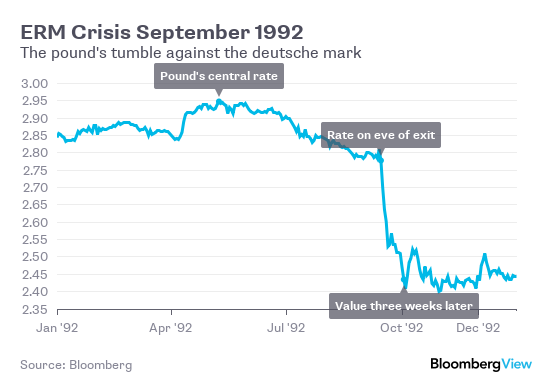
The main lesson of discussion about currency options is that all of them have their disadvantages along with their advantages and one of the primary disadvantages of this option lies in the peg to Sterling, particularly if it is to be maintained beyond the transition and launch period of the new currency. There could be the potential for the international speculative market to mount an attack on the currency in order to knock it out of the peg (as infamously happened to the Sterling in 1992 when it was knocked out of the European Exchange Rate Mechanism). A discussion of the likelihood of this happening and how one can defend against it is therefore required.

As with many things of this nature, the detailed study of this kind of thing can run rather to the technical (the links there are made available for those who wish to study them) so I’ll attempt to break it down into something a little more accessible.

What Makes a Currency Vulnerable To Attack?

The entire purpose of a currency market is to allow that market to determine the most efficient price of the currency. This is generally only considered an attack when the currency is pegged to another. When the currency floats, a market driven price movement is considered the entire point of the exercise. This is part of the reason why “Black Wednesday” came close to bringing down the UK government whereas the 2016 Brexit devaluation was much less politically damaging despite being a larger depreciation in percentage terms.

So why attack a currency in the first place? There are multiple reasons but they essentially boil down to one. The peg is perceived as being “wrong” for the currency and the economy it supports. Either it is over or under valued. Usually it is the former as politicians tend to link a “strong” currency to national pride cases of undervaluation such as in China or Germany do exist (It should be noted that neither of these economies are under serious speculative attack at present).

Assuming an overvalued currency, the attack generally takes place by speculators “short selling”, or “shorting” the currency on the markets. To do this, they will borrow a great deal of the currency at the overvalued rate and sell it on the foreign exchange markets. This floods the markets with supply of the currency and depresses the price. The speculator can then buy back the currency he sold at the new lower price, pay off the loan and pocket the difference.

Before an attack happens though the speculators need to be sure of one of two things. Either A) The country under attack lacks the will to defend the currency peg or B) It lacks the tools to successfully defend against it. If the attack fails, then the speculators could be out of pocket to a very significant degree. Whilst George Soros infamously made off with £1bn in 1992, there are reports that he had to borrow some £6.5bn to do it. He was sure of his bet and it certainly paid off for him that time, but that’s still a big gamble to take and lose.

How to Defend a Currency

An attack can be defended in one of two ways (or a combination of both). First, the Central Bank can raise interest rates to discourage further borrowing of the currency (if interest payments on the loans exceed the expected gain, speculators will back off) and to encourage investors to start buying currency at the same rate as it’s being sold (so they can benefit from the increased returns on the interest). Or Secondly, the Central Bank can sell foreign reserves and buy their currency back themselves to limit supply and force the value back up. If they do this until the attackers themselves run out of the ability to borrow more of the target currency then the attackers give up and take the losses. (For an undervalued currency, the tools are used in the opposite direction as China is currently doing)

The third option is to consider both the economic and political situation and decide that if the currency really is mis-valued and that the political cost of unsuccessfully (or perhaps even successfully) defending the currency is too high then the defence simply isn’t viable. In this case the peg is dropped and the currency is intentionally allowed to revalue.

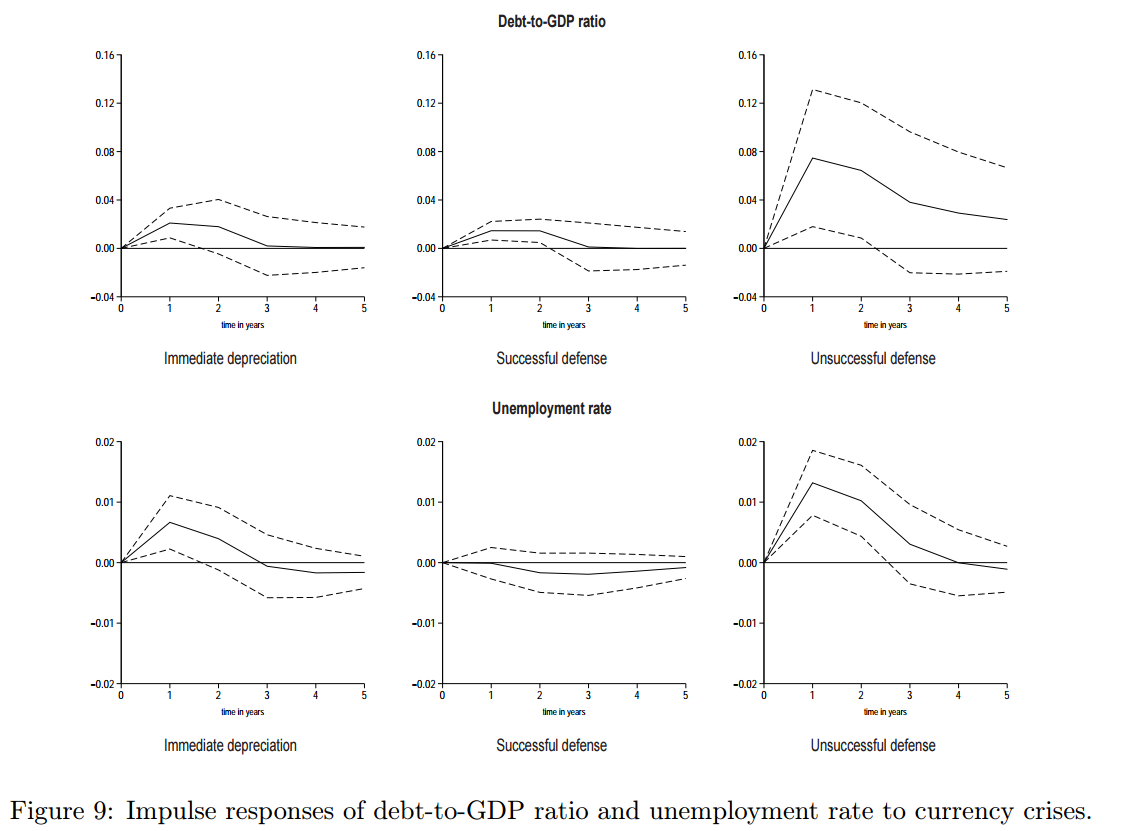
Herein lies the risk for Central Banks. The cost – which can take the form of higher interest rates, higher inflation, depleted national reserves, lower GDP and higher unemployment – of unsuccessfully defending the currency may be much higher than not defending it at all but not defending may carry a higher cost than a successful defence.

It is important to note that the failures to defend a currency are often higher profile than the successes which, by their nature, do not generate so many tabloid headlines or history books. At least one study has noted that of the 163 speculative attacks identified between 1960-2011, 42 were not defended against, 34 were defended unsuccessfully and 87 were successfully warded off.
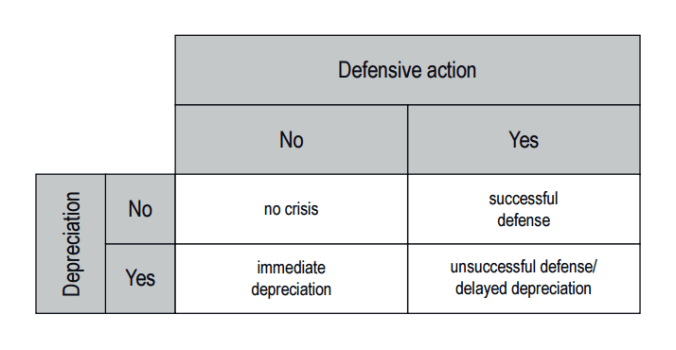
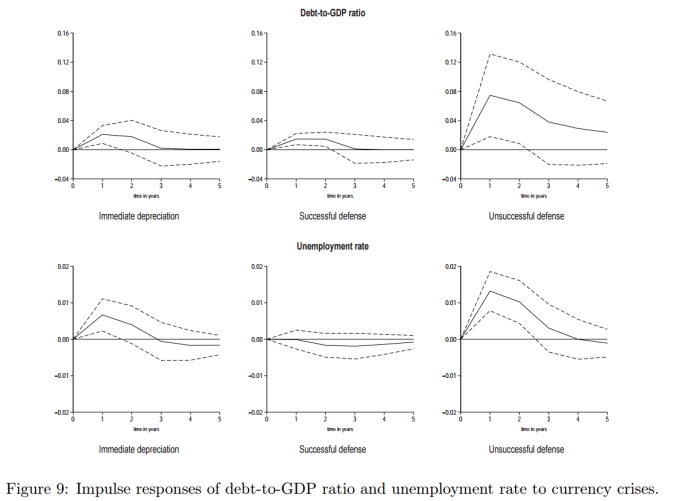
cd1

CD2.png

Charts from S. Rebelo, (2000)

To look at the 1992 Black Wednesday example caused when the GBP dropped out of the Exchange Rate Mechanism. The ERM (which was the precursor to the Euro) essentially pegged member currencies to the German Deutsche Mark. The value at which the GBP was pegged on entering – 2.9 DMK/GBP – was considered far too high and opened the road to the infamous speculative attack. The Bank of England responded by raising interest rates from 10% to 15% on the day of the attack and they sold £4bn worth of reserves (almost £8bn in 2017 pounds and about 1/3rd of what they had in reserve at the time). This turned out to be insufficient and the peg was eventually abandoned. The exchange rate fell to 2.413 DMK/GBP and the GBP fell out of the ERM. Papers released from within the BoE in the years since have mulled over the impacts and costs of their defence strategy, the causes of its failure and whether or not it was worth mounting in the first place.

Is Scotland Vulnerable?

So would this apply to Scotland in the event of our independence? There’s never a certainty with these things and the state of the international money markets are that size of one’s economy is probably no sure defence against all possible attacks (short of erecting massive capital controls and isolating Scotland from the global trade market, but this too carries its own consequences). However, I do believe that Scotland would be less vulnerable to a speculative attack than some may suppose for the following reasons.

First (and possibly most importantly): If we peg to Sterling then it’ll be on a 1:1 basis therefore will be at the same value that it is currently. To believe that the £Scot is over or under valued is to believe that the GBP is currently, right now, unsuitable for the Scottish economy which begs the question of why we’re even in a currency union with rUK. This may change post-independence as our economies diverge but in that case the question of whether or not to continue that 1:1 peg opens up. I personally think we’ll either float the £Scot or move to some kind of basket peg shortly after the three year transition and launch period but this is ultimately a political decision as well as an economic one and it may be that the option to move away from the Sterling peg is one debated and decided by the second independent Scottish Parliamentary elections. If a party wishes to hold to the Sterling peg (or any other) then it’ll be for them to determine if that’s a viable option and to convince voters of the same.

Second: We’re proposing to hold rather substantially more foreign reserves than the UK holds as a proportion of GDP. We’re looking initially at somewhere between £15bn-£40bn (Common Weal is currently working on a formal paper looking at how precisely we’d generate these reserves though I have spoken about it somewhat here) with options to use the normal tools available to normal, independent countries to adjust this amount as required. Combined with the lower available trading volume of being a smaller currency (one can only even potentially borrow as many £Scots as exist, especially if it is issued solely by the Central Bank) then this should be sufficient to hold off an attack or even just to display that we’d be willing to do so. Combined with tighter regulation and legislation on the financial industry Scotland should present itself to the world as a country upheld by its strong and reliable approach to fiscal and monetary policy.

Third: Interest rates are at an all time low which gives a fair bit more scope to raise them in the event of an attack than was the case in 1992. One has to be a bit cautious with this though as our private debt levels (particularly mortgages) are leveraged to the hilt so there will be severe consequences if this lever is pulled too hard. This said, the low interest rates are also crippling savers, investors and pension holders. They could well benefit from a raised rate such that an “attack” by the market may well come to be seen as a signal to change political and economic policy rather than a simple profiteering exercise by the speculators. As with life, balance in all things is best.

Conclusion

In short, Scotland is probably less likely than feared to suffer a speculative attack on the currency in the short term following independence and more than able to defend against more should it happen, particularly if we keep the heid and approach the separation rationally and in a well planned manner. Beyond this, it shall be a matter of analysing both the economics and the politics of the situation and never becoming too attached to any particular choice so that if a successful defence of the currency can be mounted, it should, if not, it shouldn’t and if a peg should be modified, changed or abandoned then it must.

tcg-logo-7

The White Paper Project

“Work as if you live in the early days of a better nation.” – Alasdair Gray

wpp-v1-cover

Today I get to announce the launch of a very long awaited project I and the rest of Common Weal have been working on for quite some time now. We announced back in September that we have been working on renewing the case for Scottish independence by publishing a successor to the Scottish Government’s “Scotland’s Future” document.

Version 1.0 of the Common Weal White Paper can be download here or by clicking the image above.

This is a leaner document than Scotland’s Future was. That document was as much a party political campaign device as it was a blueprint for independence. It not only sought to describe the powers which would come to Scotland independence but also sought to convince voters of the SNP’s own vision for independence. There was nothing inherently wrong with this latter task per se and other parties too sought to promote their own distinct visions as well – as they will all do so again throughout the next independence campaign but this is not the task of an independence White Paper. This paper shall, as far as possible, not seek to propose a list of policy ideas which an independent Scotland could do nor shall it attempt to convince you of the merits of those policies. It merely lays out the technical and structural requirements which must be in place for Scotland to become an independent country once we, the voters, decide that it should become so.

It is a “consolidated business plan for the establishment of a new nation state”.

To this end, the White Paper is split into several broad sections. Part 1, Process and Structures, covers the foundation of a National Commission – a cross party and cross administration body which will be tasked with designing and implementing the institutions and systems which need to be set up in the time between the independence referendum and the formal independence day. It is one thing to state, for instance, “There shall be a Scottish Central Bank”. It is quite another to decide how large it needs to be, where it needs to be based and who needs to be hired to run it. The National Commission shall also be given interim borrowing powers so that it is able to issue bonds, raise capital and fund the construction of the vital infrastructure Scotland would need to either move from rUK or build from fresh.

Part 2, Key Institutions of an Independent Scotland, covers all those things we kept being asked questions about during the last referendum. Would we have a constitution? A currency? What would we do about borders? Defence? All these and more. Of course it’s not yet possible to answer every question in this regard. Some of it will be up for negotiation with rUK, some of it will be dependent on the shape of the Brexit deal between the UK and the EU and Scotland’s relationship with both in the run up to independence but we’re making a stab at as much as we can and this is the section which will perhaps be most expanded upon as the Project is iterated in future versions.

Speaking of negotiations, Part 3 covers the prospective shape of some of these – chiefly the allocation of debt and assets and what rUK’s response to our leaving shall mean for our claim on them. Also covered to some degree is how Scotland will interact with various international and supranational organisations although it should be stated once again that no case shall be strongly made for Scotland’s joining or refusal to join any of these organisations. That shall be left to the party or parties which seek to form the first independent Scottish parliament.

Finally, Part 4 outlines the position of Scotland as far as finance and borrowing goes as well as outlining as best we can the default fiscal budget for year one of independence. It is, of course, almost impossible to place any kind of actual certainty or promise on such a budget as it is based on several key assumptions such as the desire to keep both public spending and the various tax revenue streams broadly similar to their position at present. If a party decided to scrap the entire tax system and replace it with one of their own devising then it would have to be up to them to explain how that worked and project the revenue to be gained from it and how it would be spent. Other assumptions include Scotland spending the money assigned to it in GERS for various “UK projects” on projects of similar value and in similar accounting lines (so that, to pick an arbitrary example, our “share” of UK economic development funding spent outside Scotland but from which Scotland “benefits” would instead be spent on economic development within Scotland). Again, whether or not this happens will be a case for the individual parties to make and will depend entirely on accurately and precisely how the current fiscal projections for a devolved Scotland within the UK map onto the fiscal situation of an independent Scotland.

Once again, this is not the completion of the White Paper. This is the beginning. You will see that there are several sections which need to be expanded and built upon and items like costs and figures will be updated as time goes on (the default budget, for instance, is based on 2015-16 figures but – as we’ve probably noticed by now – Scotland didn’t become independent in 2015-16 so these precise figures will be revised as and when they should be). Some areas require the attention of people with specific experience and expertise in them to be able to complete so we are openly calling for those experts who are able and willing to contribute. Please contact us if you want to be involved. Let’s work to build the early days of our better nation.

TCG Logo 7.png

Beyond GERS

Today has seen the publication of my latest contribution to Common Weal’s White Paper Project. Click here to take you to the launch page or on the image below to take your directly to the paper. Further coverage can be found here and here in The National.

Beyond GERS cover.png

Preface

GERS (Government Expenditure and Revenue Scotland) 2015/16 reported Scotland’s fiscal deficit to be in the region of £14 billion per year, portraying Scotland as the country experiencing some of the most challenging financial circumstances in Europe.

However, this study must be viewed firmly in the light of Scotland being a member nation of the United Kingdom and, as such, any attempt to use them to project the finances of an independent Scotland must be treated with caution and qualification.

The very act of independence will result in significant redistributions and reallocations of government resources which will likely result in economic benefits accruing to Scotland. Additionally, decisions on how to establish and govern new Scottish state institutions will also improve Scotland’s budget at the point of set-up, further strengthening the fiscal position vis-à-vis that presented in GERS and that of the rest of the United Kingdom.

Key Points

• The act of independence brings with it many structural changes which will significantly benefit Scotland’s fiscal position to the effect of several billion pounds equivalent per year.

• By shifting the focus of defence from one of outward projection and nuclear deterrent to one more in line with modern European nations, savings of approximately £1.1 billion per year can be realised. Even in the event of Scotland committing to NATO member defence spending targets of 2% of GDP, the increased spending within Scotland can be expected to have additional economic benefits resulting in tax revenue increases of around £300 million per year compared to the status quo.

• A reasonable case for the debt and asset negotiations due to independence will result in Scotland saving up to £1.7 billion per year in debt interest repayments.

• The legal requirement of the UK Government to provide the UK State Pension for all those who have met the criteria would likely have to be the subject of negotiation post-independence, but the expectation would be that this would lead to billion-pound savings for the Scottish Government in at least the first year.

• A substantial fraction of unidentifiable spending accounted to Scotland is, in all likelihood, spending to cover UK wide government functions which Scotland may or may not choose to replicate or reproduce in some form post independence. Whilst savings will be made by reason of lower running costs and wages in Scotland compared to London, the additional economic benefits of spending in Scotland instead of elsewhere in the UK could result in additional tax revenues of approximately £719 million per year.

• The opportunity for an independent Scotland to redesign the tax code from the ground up, eliminating built in inefficiencies, loopholes and exceptions will help reduce the “tax gap” by approximately one-third, increasing revenue by about £3.5 billion per year.

• Whilst the UK’s tax revenue as a percentage of GDP is around the OECD average, many countries neighbouring it successfully maintain higher rates of tax revenues which, if replicated in Key Points: Scotland, could further improve the financial situation by several billions per year.

• Even without increasing tax revenue as a percentage of GDP, an independent Scotland could be placed in a position of relative “deficit parity” with the current UK budget.


Regular readers will know now that Common Weal has been very hard at work looking at the issues surrounding the independence debate, especially those arguments which just simply didn’t convince a certain segment of voters. We were all hoping that ‘someone else’ would come along and do this right after the last referendum but, for various reasons, it hasn’t happened. So Common Weal has decided to just roll up our collective sleeves and do it.

We’ve already published a paper reopening the currency debate, debt and assets, a proposal for a National Investment Bank and others. We want to produce further papers on pensions, defence, customs and excise, a detailed paper on the role of the Central Bank of Scotland, and others. All working up to a paper not just showing the limitations of accounting exercises like GERS but doing away with it entirely and building a case for an independent Scottish budget built from the ground up to suit our needs, rather than just being a tweaked version of what the UK does.

We are incredibly under resourced for this work but we think it’s work worth doing.

If you do too, perhaps you’d like to consider a donation to Common Weal to help us on our way: www.allofusfirst.org/donate
tcg-logo6c