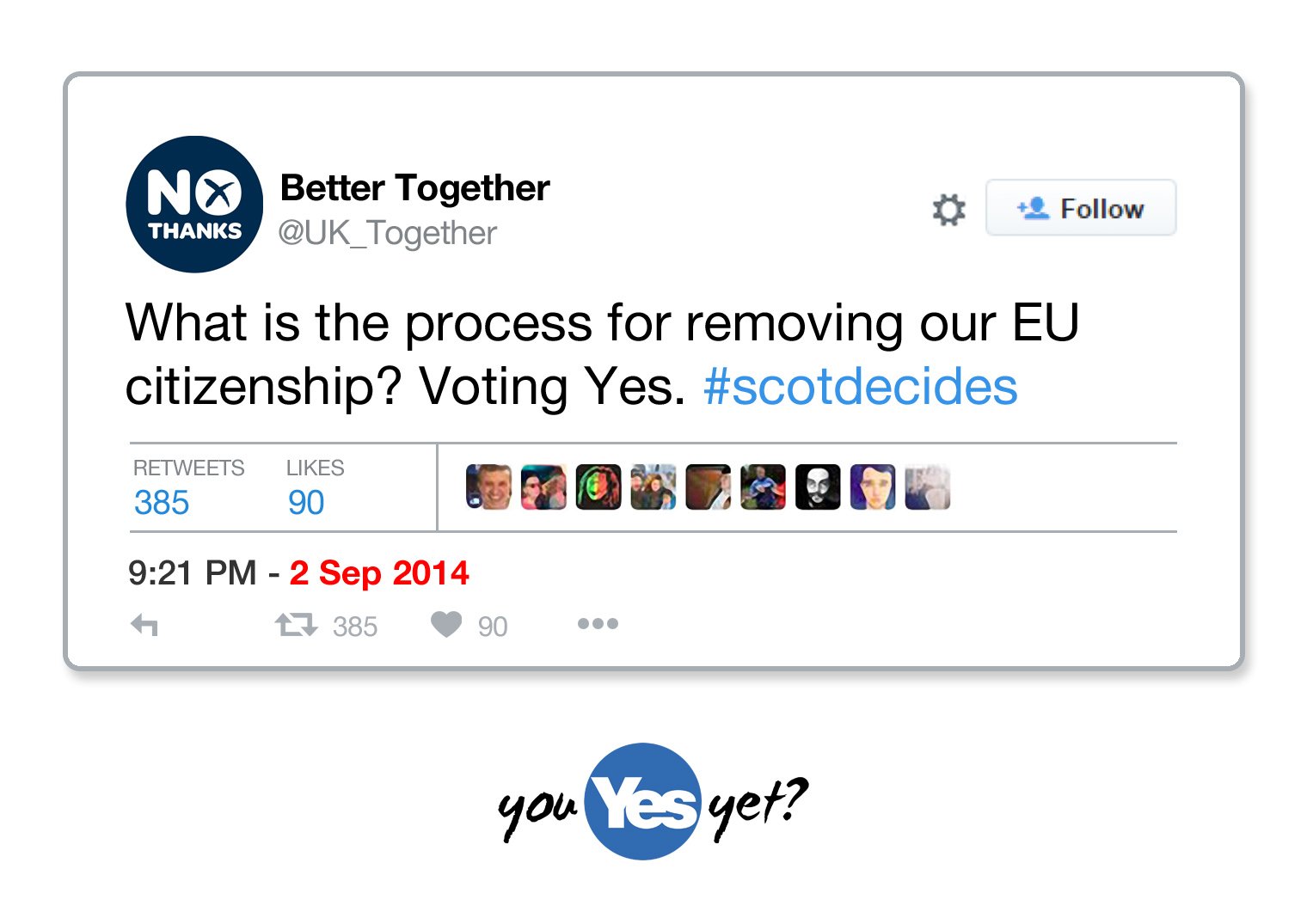
When was the moment you became afraid, genuinely afraid, for the outcome of Brexit?
Maybe it happened a while ago. Maybe it hasn’t happened yet. I hit that point today.
We’re less than a week into the Brexit process and the UK has already told the EU that there may be security concerns…nudge nudge…if it doesn’t get what it wants (although that was just a misunderstanding, don’t you know?).
Then the Government was utterly blindsided by Spain gaining a veto over any deal which involves Gibraltar – despite those in the actual know talking about it for literally months prior to the vote.
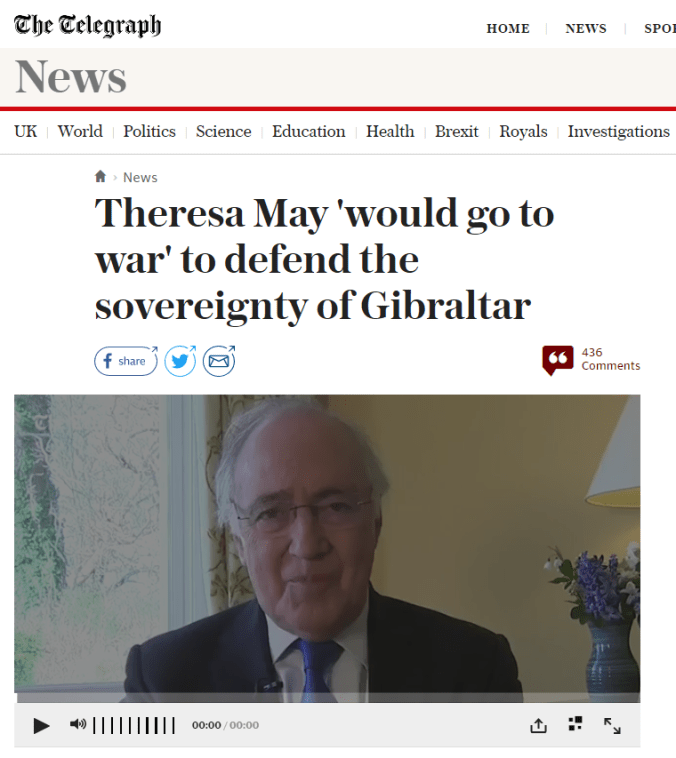
In response, senior politicians in the UK – a NATO member – are threatening another NATO member with the prospect of actual war.
And the negotiations haven’t even started yet.
As part of my EU Referendum series, back right before the Brexit vote I stated that I didn’t believe the hype that a Leave vote would be the utter ruination of everything.
I even felt that J. J. Patrick’s threepartseries on the road to a Dystopian Brexit was, if plausible, at least well out on the edge of the probable. At best a warning rather than a prediction.
What I hadn’t, obviously, fully appreciated was the utter incompetence of the UK Government’s Brexit team. I’m not just talking about the bumbling excuse for a clown that is Boris Johnson – such a Titanic Success he’s been – but also David Davis, who nine months after the vote and just days before the triggering of Article 50 couldn’t answer even basic questions about the “plan”.
But even all that is just incompetence. Even that would just lead to the UK being out-negotiated on every major issue by the EU until it either accepts the deal offered or stomps off into the sunset without one.
And this latter option is what looks increasingly likely. It really does look like the “plan” is to walk out of talks and to find some way of blaming the EU for it happening.
But back to that headline. The sight of the UK threatening another European nation with war as a negotiating tactic – for that is what it is, make no mistake there – is deeply disturbing. At heart, I’m a pacifist. War should never be considered an “option” in the diplomatic process, not even the final option. It should be considered to be the consequence of the failure of the last option. Even the threat of a war is one which can rapidly spiral out of control, if one ever presumed for a moment that it could have been controlled.
What’s the strategy here anyway? By launching an attack on another NATO member, the UK would pull in other NATO members, most of them also European. Does the UK want to pull the USA into this to pick an ally? Or hang one side (or both) out to dry?
Is the UK relying on Donald Trump being a rational and impartial mediator in all of this?
As has been noted elsewhere, this shouldn’t even have been any kind of issue at all. Most of the deals of any competence within the EU divorce settlement, including the Gibraltar/Spain border issue, need to be ratified by the entire EU27, including Spain, anyway. At this point it looks as though the inclusion of the explicit Spanish veto was added to the EU’s strategy document for one (or both) of two purposes. a) As a sweetener to keep Spain “on-side” and acting within the whole of the EU27 “as one” and/or b) to test the UK’s plan to see what they’d do and to test the robustness of its strategy ahead of the negotiations.
The UK didn’t just blink in the face of this test. It has shut its eyes, screamed loudly and ran right off the cliff. The EU now knows that the UK has buttons which can be pressed. Westminster needs to ramp down the rhetoric immediately and get a serious grip of itself before it reaches the negotiation table proper if it wants to be taken seriously. From the lack of planning, through the deliberate exclusion of the devolved nations (and Gibraltar) from any kind of involvement in negotiations out to frankly stupid statements like this the UK has done a great deal of harm to its own reputation and the chances of making Brexit bearable, never mind making it a “success”.
And we’re less than a week into the Brexit process. Two years to go.
“[I]f there is to be meaningful debate on this issue then the SNP have a lot of work to do to produce best possible data. The last thing they should do is trust that from London.” – Richard Murphy
Tax expert Richard Murphy, who is currently most notable for exposing the UK’s massive £120 billion per year tax gap, has written an article warning of relying on UK economic data to make the case against Scottish independence.
Before he gets attacked too badly by hacks telling him that the Scottish economic data is produced by Scottish civil servants (Edit: I may already be too late on that) I thought I’d write a parallel piece pointing out what those civil servants have told me about the limits of some of their stats.
The first thing to remember in all of this is that the UK is not a federation or a confederation, it considers itself to be a unitary state of which Scotland is just one region of twelve (plus the “extra-regio” offshore regions). Therefore there is currently no real obligation to even gather the distinct statistics for Scotland and it really only has become important because of the independence campaign.
Tax Revenue
As I’ve pointed out in my paper Beyond GERS, the issue of apportioning tax revenue is fraught with subtle difficulty. GERS itself has updated its methodologies multiple times over the years (particularly since the SNP took the government in 2007. The GERS of today is no longer very closely related to the GERS created by Ian Lang to discredit Scotland in the early ’90’s). There are still differences in the results presented straight by HMRC and the data eventually “Scottishised” [To use the stats folk’s term] and presented in GERS.
Onshore corporation tax is a good example of this. Where an overall UK stat may simply count the location of the HQ of a company for the purposes of assigning corporation tax and this may make sense from a unitary state perspective (albeit this is becoming less true as globalisation increases the ability for multi-national companies to move resources across borders).
For many companies though, the profits one which corporation tax are paid are not generated at the HQ. This is obvious in the case of, for example, a large retail chain which has stores across the country. To correct for this, HMRC and GERS both use different methodologies to apportion the tax more evenly. Various measures (and the weighting applied to those measures) such as estimating volume of sales, number of employees, amount of capital spent in the region and overall population are all used in different ways to reach slightly different estimates. As a result, HMRC estimates that in 2015-16 Scotland produced 7.1% of the UK’s corporation tax compared to 7.3%% estimated by GERS – a gap of about £100 million.
One can also see possible limits of these methodologies especially if taken individually. For example if one looks at employees then one could probably consider a company (and, it should be stressed that this is a completely hypothetical company) which employs a dozen people in Scotland to make, say, a high value, highly exportable product with a geographic link (call it a similarly hypothetical product like “Scotch blisky”) and then employs a couple of hundred people in London to market it. It may be very difficult to properly apportion the “value” of that product and its profits based on employees alone. It’s possible, after all, to find a market without marketing but a bit harder to drink an advertising campaign.
VAT is another issue where these figures can differ for similar reasons. The UK doesn’t demand point of sale ID to determine the location of VAT spend (If you nip down the road to Carlisle for your shopping, then that results in VAT paid in England but Tesco neither knows nor cares where you came from to get there). Again, various methodologies are used to try to estimate the proportions paid and the estimates are slowly aligning (HMRC claims Scotland paid 8.4% of the UK’s VAT compared to GERS’ 8.6% – a gap of £110 million). There is also a further complication wherein the results between HMRC and GERS are simply presented in a different manner (HMRC measures the cash receipts, GERS measures the accruals)
A third prominent example is Income Tax, and is going to become pertinent now as IT is largely devolved to Scotland and all Scottish residents are to be assigned a distinct Scottish tax code and especially now that the income tax bands in Scotland will soon start to diverge from the UK bands. However, HMRC has been recently criticised for a series of administration issues which is making it difficult to roll out this tax code. As with the difficulties in rolling out devolved welfare, this won’t be nearly so much of an issue once Scotland is independent but highlights the difficulty in trying to run a devolved situation from a centralised unitary setup. This said, both HMRC and GERS arrive at a proportion of about 7.2% of the UK’s income tax coming from Scotland although this may change as the new systems are launched (even if tax rates are kept the same).
It is not possible to say whether the HMRC or GERS estimate is “better” or “worse” than the other. The Institute of Fiscal Studies has commented saying, especially of corporation tax:
“Neither of these estimates is clearly superior to the other, and both may be some way off. Profits are not necessarily generated in proportion to the number of employees, or their wages. Some employees may be more instrumental in generating profits than others; and profits also arise from capital assets – both physical (such as buildings and equipment) and intangible (such as intellectual property and brand value) – the location and contribution of which may differ from the location and wages of employees. Calculating how much of a company’s profits are attributable to economic activity in different locations is conceptually and practically difficult and is the source of many problems in international corporate taxation”
Balance of Trade
This is the big one that has attracted a lot of shouting in the past few months. Once again, the UK’s status as a unitary state causes much of the furore over the published numbers to be based on false premises and over-massaged numbers. The UK’s balance of trade figures are published here and probably do do a decent job of estimating the UK’s position in the world. What it doesn’t do is show the internal movements of trade within the UK. As a unitary state it simply doesn’t matter to the external balance of trade whether or not Yorkshire is a net exporter to Sussex. The UK does produce figures which try to estimate the trade balance between the regions with the rest of the world but it only covers goods, not services (hence excludes nearly half of the UK’s total trade) and it does not cover internal trade. For that internal trade, we turn to ESS – Export Statistics Scotland – which surveys exporting companies in Scotland and asks them where they send their goods and services (contrary to a semi-popular belief, these statistics don’t care how the goods reach their destination so it doesn’t matter if they physically leave the UK via an “English port“). There are some limits, again, to this methodology.
First, not all companies know where their goods are going (see the example of Tesco again. If someone from Carlisle buys a crate of beer in Glasgow then goes home then that’s a Scottish export but Tesco wouldn’t be able to record it easily) so they won’t appear in the survey. Goods which are shipped to England then either re-packaged or used as a sub-component before being exported from England to somewhere else (or even back to Scotland) would be counted only as far as their export to England and there may be some cases where service “exports” are caused by, for example, someone in London buying insurance for their house in London from the London branch of a provider who just happens to have a brass plate in Edinburgh. The total proportion of these anomalies in the data is simply unknown at this point and unlikely to be knowable until after independence.
Beyond the Horizon
And this takes us to the most important point in this whole article. Even if the methodologies above all align and all can capture the full economic picture of Scotland and everyone can agree on the figures produced and everyone agrees that they produce an accurate and complete picture of Scotland’s economy within the Union there is a fact which should be utterly indisputable (and certainly is within the team which put together these stats).
Independence. Changes. Everything.
None of these figures have any validity if you try to use them to project beyond the independence horizon. Corporation tax may change due to the redomiciling of businesses post-independence. Both those seeking to remain within the UK and those seeking to remain within the EU or EEA may shift operations. Trade exports may suddenly become a lot easier to assign (whether there’s a “hard border” or not) and that “extra-regio” oil which is often excluded from stats due to historical and supply chain accounting issues suddenly has to be accounted for. Those tax streams which are simply too embedded to discuss in any terms other than by a population share have to be audited. And all of this is before Scotland starts to make changes to the tax system to optimise it for the Scottish economy or to do things like close the tax gap.
As with everything in science and in economics, statistics are based on models, models are only ever as strong as their underlying assumptions and projections are only ever as strong as the person making the prediction’s understanding of the limits of those assumptions and the models.
(One day I’ll write an article about the “Porcupine Plots” which get created when inappropriate models are used year after year in spite of reality)
I don’t mind discussing the economy of Scotland within the Union. I don’t even mind speculating on the economy of an independent Scotland. But I sense that the next two years of campaigning will get very frustrating if pundits continue to stretch their own models past the point of credibility in a quest to push their political point. This, I should warn, goes for both sides. We need a more meaningful economic debate than we saw last time. Let’s get beyond the headlines to create one.
Don’t want to read 2600 words? Twitter version: None of the things people say will be hard are. Few are talking about things which will be.
Only in the madhouse world of UK politics that a government which is actually embarking on the process of taking Scotland out of the EU against its will while claiming that this would be a wonderful thing could somehow contrive to simultaneously try to sell us that line that an independent Scotland would be out of the EU against its will and that would be terrible.
Whilst this is going on, the same several year old phony war surrounding Scotland’s membership of the EU continues with a great many people still claiming that we would a) be forced to join the euro and b) Scotland would be punted to the back of the accession “queue” doomed to wait till all other potential members (including, possibly, Turkey) have joined before we’ll get a look in.
This week has seen the publication of a couple of commentators on Scotland’s precise position regarding our EU membership, independence and the interaction with Brexit which has sent every man and their dug howling at the moon and trying to spin themselves into position to get another shot in.
So lets take the opportunity here to take a slightly more sober, honest and open look at how things work in the EU and plot out a couple of likely (that is, actually possible) pathways from which Scotland goes from here, through Brexit and independence and to an independent Scotland within the EU.
The Supreme Court has rendered its judgement on Article 50 and Brexit. In an 8-3 ruling they have decided, as reasonably expected, that Parliament must vote on the triggering of Article 50 and the beginning of the Brexit process.
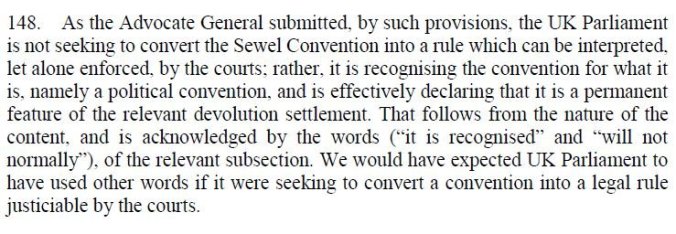
On the second point of the case, that the devolved Parliaments should also be consulted, the Court ruled 11-0 that:
In essence saying that whilst Westminster could consult the devolved Parliaments and could even state that their formal recognition was required it doesn’t have to and the Supreme Court will not force it to do so. In practice, we all know that this means it won’t. Scotland’s will can be overruled at Westminster’s. Power devolved is power retained.
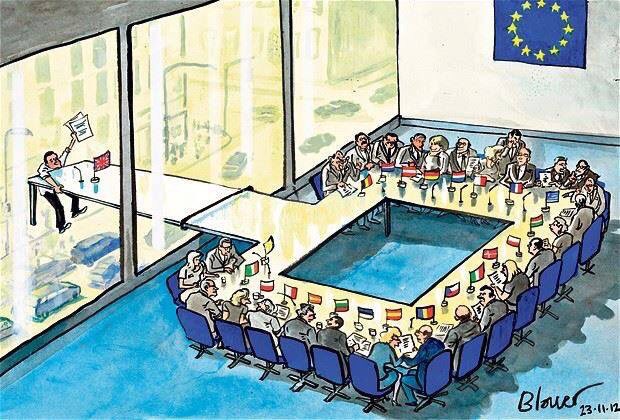
Wallonia will now have more power than Scotland to negotiate, influence and – eventually – veto or approve the Brexit deal. So much for that “most powerful devolved government in the world“.
The idea of a Federal UK is now dead. Westminster is sovereign. As a former UK Federalist, this is a painful and depressing idea to admit. I cannot see any possible pathway to reach that destination. Those still in favour of it may have to have some very hard thinking to do now. (Mind you, if Wallonia DOES end up writing up more of the Brexit deal than Scotland does, this may be a good argument in favour of EU Federalism. That’s possibly a discussion for the future)
This also means that the SNP’s “Scotland’s Place in Europe” paper has only one pathway forward now and that’s through amendments to the Article 50 trigger bill when it comes through (something they’ve already pledged to do). If Scotland will not have its say from its own Parliament then it will have a voice at Westminster. And if we’re told that we’re to have no influence there either…?
“Work as if you live in the early days of a better nation.” – Alasdair Gray
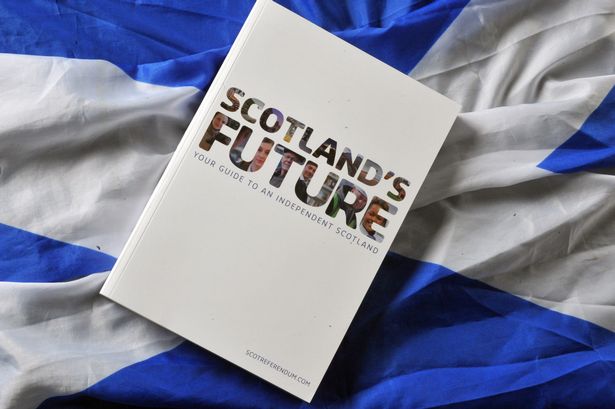
Today I get to announce the launch of a very long awaited project I and the rest of Common Weal have been working on for quite some time now. We announced back in September that we have been working on renewing the case for Scottish independence by publishing a successor to the Scottish Government’s “Scotland’s Future” document.
Version 1.0 of the Common Weal White Paper can be download here or by clicking the image above.
This is a leaner document than Scotland’s Future was. That document was as much a party political campaign device as it was a blueprint for independence. It not only sought to describe the powers which would come to Scotland independence but also sought to convince voters of the SNP’s own vision for independence. There was nothing inherently wrong with this latter task per se and other parties too sought to promote their own distinct visions as well – as they will all do so again throughout the next independence campaign but this is not the task of an independence White Paper. This paper shall, as far as possible, not seek to propose a list of policy ideas which an independent Scotland could do nor shall it attempt to convince you of the merits of those policies. It merely lays out the technical and structural requirements which must be in place for Scotland to become an independent country once we, the voters, decide that it should become so.
It is a “consolidated business plan for the establishment of a new nation state”.
To this end, the White Paper is split into several broad sections. Part 1, Process and Structures, covers the foundation of a National Commission – a cross party and cross administration body which will be tasked with designing and implementing the institutions and systems which need to be set up in the time between the independence referendum and the formal independence day. It is one thing to state, for instance, “There shall be a Scottish Central Bank”. It is quite another to decide how large it needs to be, where it needs to be based and who needs to be hired to run it. The National Commission shall also be given interim borrowing powers so that it is able to issue bonds, raise capital and fund the construction of the vital infrastructure Scotland would need to either move from rUK or build from fresh.
Part 2, Key Institutions of an Independent Scotland, covers all those things we kept being asked questions about during the last referendum. Would we have a constitution? A currency? What would we do about borders? Defence? All these and more. Of course it’s not yet possible to answer every question in this regard. Some of it will be up for negotiation with rUK, some of it will be dependent on the shape of the Brexit deal between the UK and the EU and Scotland’s relationship with both in the run up to independence but we’re making a stab at as much as we can and this is the section which will perhaps be most expanded upon as the Project is iterated in future versions.
Speaking of negotiations, Part 3 covers the prospective shape of some of these – chiefly the allocation of debt and assets and what rUK’s response to our leaving shall mean for our claim on them. Also covered to some degree is how Scotland will interact with various international and supranational organisations although it should be stated once again that no case shall be strongly made for Scotland’s joining or refusal to join any of these organisations. That shall be left to the party or parties which seek to form the first independent Scottish parliament.
Finally, Part 4 outlines the position of Scotland as far as finance and borrowing goes as well as outlining as best we can the default fiscal budget for year one of independence. It is, of course, almost impossible to place any kind of actual certainty or promise on such a budget as it is based on several key assumptions such as the desire to keep both public spending and the various tax revenue streams broadly similar to their position at present. If a party decided to scrap the entire tax system and replace it with one of their own devising then it would have to be up to them to explain how that worked and project the revenue to be gained from it and how it would be spent. Other assumptions include Scotland spending the money assigned to it in GERS for various “UK projects” on projects of similar value and in similar accounting lines (so that, to pick an arbitrary example, our “share” of UK economic development funding spent outside Scotland but from which Scotland “benefits” would instead be spent on economic development within Scotland). Again, whether or not this happens will be a case for the individual parties to make and will depend entirely on accurately and precisely how the current fiscal projections for a devolved Scotland within the UK map onto the fiscal situation of an independent Scotland.
Once again, this is not the completion of the White Paper. This is the beginning. You will see that there are several sections which need to be expanded and built upon and items like costs and figures will be updated as time goes on (the default budget, for instance, is based on 2015-16 figures but – as we’ve probably noticed by now – Scotland didn’t become independent in 2015-16 so these precise figures will be revised as and when they should be). Some areas require the attention of people with specific experience and expertise in them to be able to complete so we are openly calling for those experts who are able and willing to contribute. Please contact us if you want to be involved. Let’s work to build the early days of our better nation.
Today has seen the publication of my latest contribution to Common Weal’s White Paper Project. Click here to take you to the launch page or on the image below to take your directly to the paper. Further coverage can be found here and here in The National.
Preface
GERS (Government Expenditure and Revenue Scotland) 2015/16 reported Scotland’s fiscal deficit to be in the region of £14 billion per year, portraying Scotland as the country experiencing some of the most challenging financial circumstances in Europe.
However, this study must be viewed firmly in the light of Scotland being a member nation of the United Kingdom and, as such, any attempt to use them to project the finances of an independent Scotland must be treated with caution and qualification.
The very act of independence will result in significant redistributions and reallocations of government resources which will likely result in economic benefits accruing to Scotland. Additionally, decisions on how to establish and govern new Scottish state institutions will also improve Scotland’s budget at the point of set-up, further strengthening the fiscal position vis-à-vis that presented in GERS and that of the rest of the United Kingdom.
Key Points
• The act of independence brings with it many structural changes which will significantly benefit Scotland’s fiscal position to the effect of several billion pounds equivalent per year.
• By shifting the focus of defence from one of outward projection and nuclear deterrent to one more in line with modern European nations, savings of approximately £1.1 billion per year can be realised. Even in the event of Scotland committing to NATO member defence spending targets of 2% of GDP, the increased spending within Scotland can be expected to have additional economic benefits resulting in tax revenue increases of around £300 million per year compared to the status quo.
• A reasonable case for the debt and asset negotiations due to independence will result in Scotland saving up to £1.7 billion per year in debt interest repayments.
• The legal requirement of the UK Government to provide the UK State Pension for all those who have met the criteria would likely have to be the subject of negotiation post-independence, but the expectation would be that this would lead to billion-pound savings for the Scottish Government in at least the first year.
• A substantial fraction of unidentifiable spending accounted to Scotland is, in all likelihood, spending to cover UK wide government functions which Scotland may or may not choose to replicate or reproduce in some form post independence. Whilst savings will be made by reason of lower running costs and wages in Scotland compared to London, the additional economic benefits of spending in Scotland instead of elsewhere in the UK could result in additional tax revenues of approximately £719 million per year.
• The opportunity for an independent Scotland to redesign the tax code from the ground up, eliminating built in inefficiencies, loopholes and exceptions will help reduce the “tax gap” by approximately one-third, increasing revenue by about £3.5 billion per year.
• Whilst the UK’s tax revenue as a percentage of GDP is around the OECD average, many countries neighbouring it successfully maintain higher rates of tax revenues which, if replicated in Key Points: Scotland, could further improve the financial situation by several billions per year.
• Even without increasing tax revenue as a percentage of GDP, an independent Scotland could be placed in a position of relative “deficit parity” with the current UK budget.
Regular readers will know now that Common Weal has been very hard at work looking at the issues surrounding the independence debate, especially those arguments which just simply didn’t convince a certain segment of voters. We were all hoping that ‘someone else’ would come along and do this right after the last referendum but, for various reasons, it hasn’t happened. So Common Weal has decided to just roll up our collective sleeves and do it.
We’ve already published a paper reopening the currency debate, debt and assets, a proposal for a National Investment Bank and others. We want to produce further papers on pensions, defence, customs and excise, a detailed paper on the role of the Central Bank of Scotland, and others. All working up to a paper not just showing the limitations of accounting exercises like GERS but doing away with it entirely and building a case for an independent Scottish budget built from the ground up to suit our needs, rather than just being a tweaked version of what the UK does.
We are incredibly under resourced for this work but we think it’s work worth doing.
If you do too, perhaps you’d like to consider a donation to Common Weal to help us on our way: www.allofusfirst.org/donate
Today sees the news that the High Court has ruled that the Prime Minister cannot declare the triggering of Article 50 of the Treaty of the European Union ex cathedra and must seek the approval of Parliament before doing so.
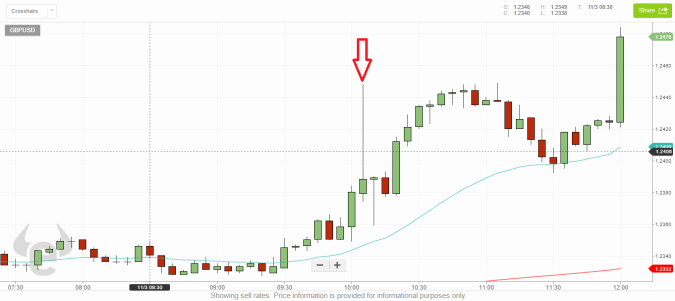
This news triggered a spike in the value of the beleaguered pound…for all of six minutes before it fell back to a baseline rise in preparation of the Bank of England’s inflation and interest rate report 90 minutes later.
Of course, the UK Government will protest this ruling and likely appeal it to the Supreme Court which may overturn the ruling but assuming it does not, what can Parliament do to Article 50?
Already there are murmurs of the possibility to the House of Commons voting against the possibility of triggering Article 50 at all and effectively canceling Brexit altogether. Whilst this could be legal – the EU Referendum was entirely a consultation and conferred no obligation on the government one way or the other – I can’t possibly fathom a situation of this happening without there being actual riots in the pro-Leave streets of England and Wales.
Whilst Scottish and Northern Irish MPs may well have a mandate to back such a move on the grounds that those nations voted to Remain there is perhaps a wiser mode of opposition, one which could be adopted by pro-Remain or at least pro-NotADugsBrexit MPs.
Instead of opposition to Article 50 entirely, there should be a principle of opposition to an Article 50 trigger which takes us into negotiations without the foggiest clue of what we want to negotiate.
Imagine we tried to pull that trick in indyref1
Four months on from the referendum it’s clear that “No Running Commentary” has been code for “We Have No Plans”. That’s completely unacceptable now. It is time to see the Brexit White Paper. Both Government and Opposition should bring to Parliament a list of their goals, objections and red lines and fashion them into an initial statement of will to take to the EU negotiating table. Sure, there will be compromise and change after that and yes, there may be “no running commentary” throughout the process but the people of the UK must be able to judge what we come out with against what we went in with so that we may decide if the negotiations are successful enough to accept the deal offered.
There may well be a Parliamentary vote – or perhaps even another referendum – on that said deal in due course although it should be noted that once Article 50 is triggered there’s no very clear way back in – although the door is being held open by the EU. Any such vote will not be based on the “deal” versus “Stay in the EU, no harm, no foul”. It’ll be between the ‘deal’ and ‘the hardest of all Brexits’.
So that’s my challenge to the various UK parties – both Leave and Remain. What does Brexit mean to you?
Regular readers will know now that Common Weal has been very hard at work looking at the issues surrounding the independence debate, especially those arguments which just simply didn’t convince a certain segment of voters. I think we were all hoping that ‘someone else’ would come along and do this right after the last referendum but, for various reasons, it hasn’t happened. So Common Weal has decided to just roll up our collective sleeves and do it.
We’ve already published a paper reopening the currency debate, debt and assets, a proposal for a National Investment Bank and others We want to produce further papers on pensions, defence, customs and excise, a detailed paper on the role of the Central Bank of Scotland, and others. All working up to a paper not just showing the limitations of accounting exercises like GERS but doing away with it entirely and building a case for an independent Scottish budget built from the ground up to suit our needs, rather than just being a tweaked version of what the UK does.
We are incredibly under resourced for this work but we think it’s work worth doing.
If you do too, perhaps you’d like to consider a donation to Common Weal to help us on our way: www.allofusfirst.org/donate
Actually it seems like only March that the last edition was out. What’s happening here?
Well, there was a consultation that almost no-one knew about which discussed a few methodological changes to GERS in line with the ‘new powers’ we’re getting and it also asked if the next report should be brought forward. I’m completely convinced that the fact that this means that we’re getting the report well before the Council election campaign next year is absolutely just a convenient side effect(!)…but no matter. We’ve got the data.
Tomorrow’s Headline Today
Scotland’s budget deficit remains at a little under £15 billion. As with last year, don’t expect a single news outlet to go one single step further with the story than that. Except maybe to say that oil revenue has dropped from £1.802 billion last year to just £60 million this year.
So what’s happened? Why hasn’t Scotland, which is “totally dependent on oil”, completely collapsed now that oil revenues have basically dropped to zero?
Last year, total revenues dropped by around £500 million on 2013-14. This year, total revenues have INCREASED by £181 million. In fact, total revenue is higher than it was in 2012-13 when we received some £5.3 billion in oil revenue.
It’s also worth noting that if you only look at GERS 2015-16 then it looks like our deficit has increased by a couple of hundred million in the past year but if you look a bit deeper, and compare the numbers to previous GERS reports then something interesting happens.
In GERS 2014-15 our deficit was recorded as £14.8 billion but in GERS 2015-16 the 2014-15 deficit has somehow dropped by £622 million to £14.3 billion. Essentially, this shows one of the limits of GERS in that it is based on sometimes highly speculative estimates which get revised over time. It may be five years before we finally know the “true” accounts figures for this year. This accounting adjustment is extremely significant compared to, say, our “budget underspends” but unless you’ve read it here I expect it to pass entirely unnoticed.
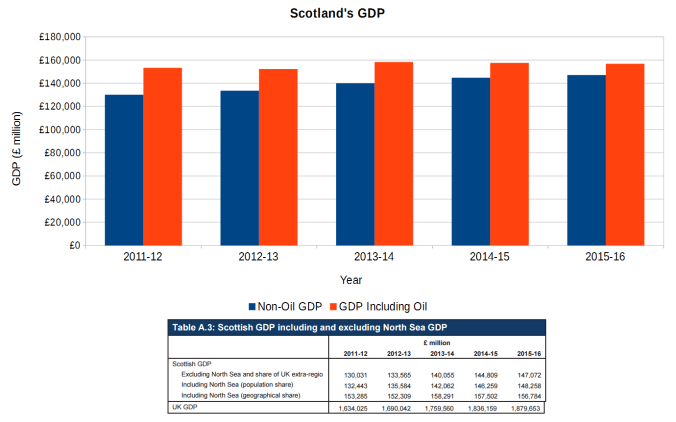
Now, what about our all hallowed GDP? It’s down by 0.45% from £157.502 billion in 2014-15 to £156.784 billion in 2015-16 (with non-oil GDP having increased by over £2.2 billion, the highest it’s ever been).
You know, perhaps it’s time we started measuring our economy in terms other than just GDP. We know it’s flawed. We know it throws up extremely strange results like Ireland’s “economy” growing by 25% because a few American companies moved their nameplates around. We know it doesn’t even particularly correlate to things like tax and ability to service debt very well.
Maybe it’s time we started measuring (and taxing) our country based on the things which actually matter.
But back to GERS.
Dutch Disease with Scottish Characteristics
So what’s going on here? Essentially it’s the same pattern first picked up last year. As oil prices drop, so do fuel costs. Which means everything from the costs of transporting goods to the heating and lighting costs for your home drops. This means you have more money to spend in the economy and companies have fewer overheads leading to either greater profits (thus, ideally, more tax revenue) or more room to invest in expansion.
This is a clear demonstration of the so-called “Dutch Disease” where high oil prices choke off the non-oil based economy in the form of the aforementioned fuel costs (it also tends to harden one’s currency but this is less of a factor in the Scottish case given that we don’t yet have one).
At the time of the last report I was criticised for pointing this out on the grounds that the oil price collapse “hadn’t fully fed through” hence I was jumping the gun on the observation. It shall be interesting to see if anyone says the same thing now. Could revenues drop any lower?
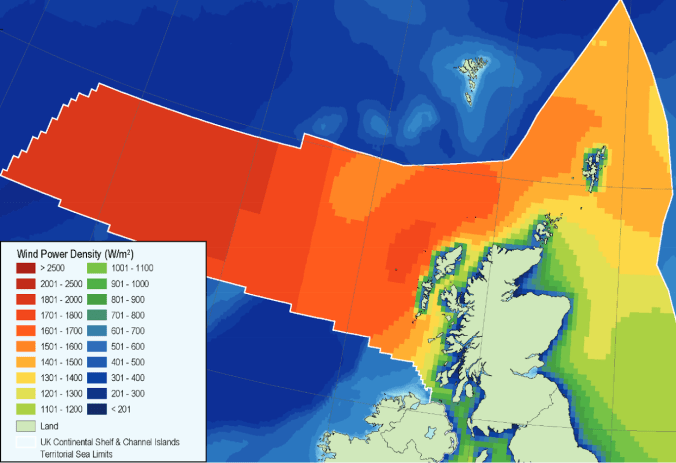
This should serve as somewhat of a warning to those itching for the return of high oil prices and certainly for those desperate to “replace” offshore oil with onshore fracking. It’s maybe time to have a good hard rethink about what kind of resources we want to develop in Scotland. Now, to be sure, I’ve nothing against our offshore industry and for those folk out there it’s been a pretty dreadful time. It’s just that, certainly as a Green, I think our offshore industry is on the wrong side of the country and should be based on wind/wave and tide rather than oil. You can be sure that if the wind and tide stops flowing we’ll be dealing with problems a little bit larger than the state of our finances.
Scotland’s offshore Wind Power Density map
Sweet Fiscal Autonomy
As mentioned earlier, part of the methodological changes discussed in the GERS consultation was to do with looking at the taxes to be devolved to Scotland under the series of “vast, new powers” we’ve been generously granted.
In terms of actual revenue, chief amongst these is income tax (excluding interest and dividends, the ability to move the Personal Allowance or to adjust the definition of “income”) and VAT (excluding any actual control at all. We’re getting the VAT added to Scottish coffers and then an equivalent amount removed from the block grant. Yay.) along with comparatively minor taxes like landfill tax, aggregate levy and air passenger duty.
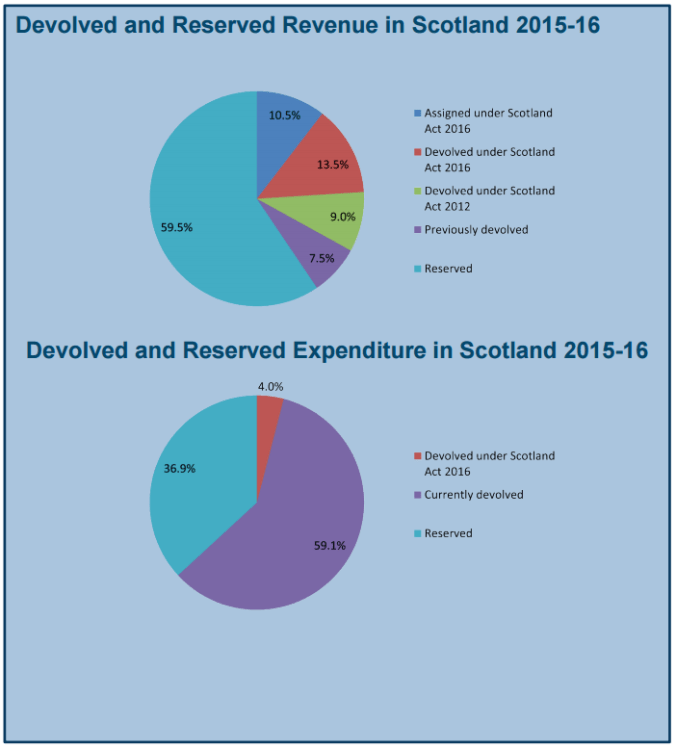
In total, the Scottish government will directly receive 40.5% of Scottish revenue (£21.8 billion this year) and, given the limitations on VAT and income tax, have actual, practical control over perhaps half of that. Devolved expenditure, however, will soon sit at 63.1% of total (£43.3 billion). Basically the Scottish government can only directly control enough income to fund perhaps about a quarter of what it’s directly responsible for delivering.
There’s a side issue in all of this related to that old topic of the budget underspends. Tucked away on page 47 of GERS there’s an interesting line which looks at the confidence intervals for some of the tax revenues used. Remember that the revenues given are estimates and are subject both to revision over time and change due to circumstances that the government cannot control. For example, if you move job half way through the tax year your income, therefore income tax, can change. If your job moves you to England, your entire income tax contribution moves from the Scotland side of the budget to the rUK one. Hence, the total income tax revenue estimate is subject to a margin of error, in this case of 1.0%.
The same goes for other taxes to greater or lesser degree to the effect that the margin of error over all of the taxes measured there is 1.6% or ±£570 million.
Remember that the Scottish Government has extremely limited borrowing powers. It can only “overspend” on the current budget by £200 million in a single year and cannot exceed a total current debt of £500 million. And yet income revenue, on which expenditure must be planned, has a margin of error of ±£570 million.
In the event, this year Scotland’s “underspend” was only £150 million. If you think you can plan a budget better than this then please, send it in. If not, might be a good idea to stop reporting and moaning about underspends.
Paying For It
Another little line that seems to have been added to GERS this year (on page 37) is a breakdown of the annual costs of financing Labour’s PFI and the SNP’s replacement NPD loans. There’s been a bit of a milestone reached there with the availability costs of PFI now exceeding £1 billion per year or over 15% of Scotland’s total capital budget and slated to increase even further over the next decade unless something is done about it. Don’t be surprised if this becomes a major issue for the council elections next year.
Of course and once again you wouldn’t know this if all you did was watch our Great British Broadcaster, the BBC. Their recent “investigation” into PFI couldn’t even bring itself to mention the name of the party which lumped this crippling financial burden on us.
Finally
I could go on. We could nip-pick at details like the mysterious addition to the expenditure budget of net EU contributions (there’s always been an annex discussing this but this is first year it has explicitly been counted in a separate line in Total Expenditure) or notice that for the first time in at least five years our debt interest paid has increased as our UK debt increases have started to outweigh the effect of falling bond yields.
It’s all a shell game though. We know that GERS isn’t nearly as important as people hold it to be nor is it nearly as informative as it should be. It’s not going to change many minds on its own nor does it tell us one single thing about the finances of an independent Scotland. If we want to do that, we’re going to need to build a national budget from scratch, taking into account all of the taxes (existing and new) that an independent Scotland might choose to levy. We also need to have a look again at what Scotland actually needs to spend its money on. Could we use Citizen’s Income to create from scratch a welfare system worthy of the name? Would a Scottish Government able to issue its own bonds on its own debt be able to get a better deal than the one we have right now?
Quite simply can Scotland as a nation see ourselves as better than others would prefer us to be seen?
First up, my apologies for going a little dark on the blog recently. Last month, I promised my thoughts on Scotland’s currency options going into the next independence campaign. That promise has turned into something a little bit larger than expected and will be coming soon. I think you’ll like it.
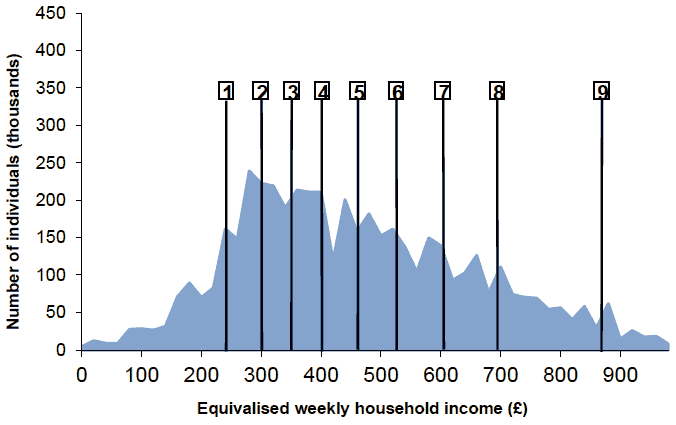
Scotland’s Income Distribution 2013-14
In the meantime, I’ve been pondering on some possible options regarding how we could reform Scotland’s welfare system, especially in the light that the UK has been explicitly called out by the United Nations for breaching human rights obligations due to the suffering caused by Austerity, inequality and the unfair and miserly welfare system in which too many find themselves trapped. The use of sanctions has been singled out as particularly cruel with countless cases of hardship and even deaths being directly linked to their use.
Both the Greens and Common Weal have been steadfast supporters of the policy of Citizen’s Income (or Universal Basic Income), a policy which is rapidly gaining traction around the world and is starting to look as if its time has come.
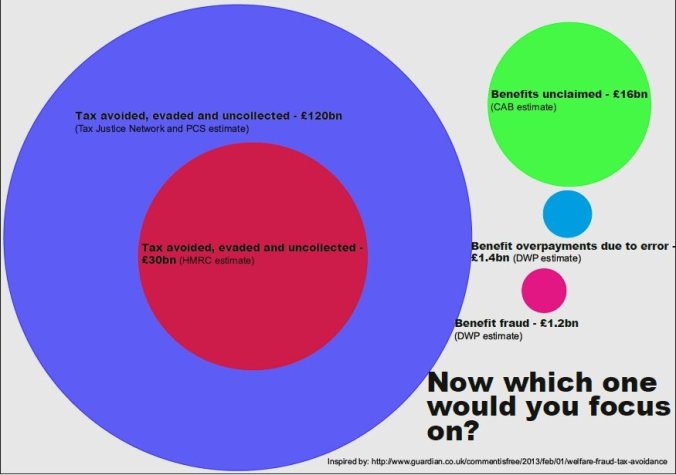
Under this policy the entire welfare system – with all its inequalities, complicated means-tested targeting, exceptions, exemptions, loopholes, paperwork, cheats, dodges, admin errors, fraudsters, bureaucracy and people simply missing out entirely because they don’t know they’re owed money or do but don’t, can’t or won’t claim – is done away with and replaced with a simple, regular payment to every citizen. You can’t claim money you’re not owed (except possibly by claiming for a dead relative or for kids you don’t have) and you can’t be missing out on money you don’t think you’re due. By the way, unclaimed money in the UK welfare system outweighs fraudulently claimed money by more than a factor of 10 and is dwarfed by tax avoidance by up to a factor of 100!
A Universal Basic Income also gives everyone a stake in the system and a guaranteed safety net if and when it is needed (in much the same way that the NHS is open and free at the point of use even if you can afford private care).
One of the downsides of Basic Income is that it does involve a large amount of money transfers. If we wanted to give all 5.3 million citizens of Scotland a Basic Income of, say, £73.10 per week (~£3,800 per year, the same as the current Jobseekers Allowance) then it would involve a monetary transfer of £20.1 billion per year which is only a couple of billion less than the entire social protection program for Scotland (which, of course, pays out a rather larger sum than £73.10 per week to many people such as pensioners and those with disabilities). Now, of course, this doesn’t imply that Basic Income would cost £20 billion per year. The idea would be that some threshold income would be set above which the income would be taxed back off you until the costs balanced and then onwards till you were a net contributor and helped to fund others (or, as an alternate POV, you were paying into the system to cover yourself for the times when you needed to withdraw). Regardless, the scale of the monetary transfers may be a significant bureaucratic barrier but so is the current piece-meal system that it would be replacing.
I fully support Citizen’s Income as a policy for an independent Scotland but we can’t do it now as we don’t have powers over welfare. I’m not keen on putting grand plans on hold till that day though so I’ve been giving thought to how Scotland could achieve a similar goal of a universal safety net using powers that we have right now. We don’t have power over welfare but do, finally and after great trials and tribulations, have powers over most of income tax.
This led me to thinking about a project advocated in 1968 by the economist Milton Friedman. The Negative Income Tax.
The concept is this. Instead of just having a low earnings threshold below which you pay zero tax (The UK Personal Allowance fulfills this purpose here) why not a threshold below which you receive a tax refund?
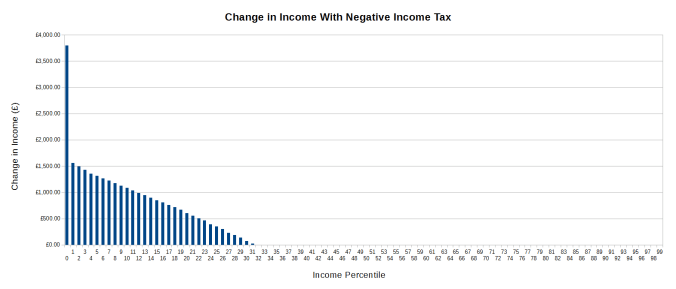
In this scheme Scotland could set an income threshold, say £16,500 – the equivalent of a full time job on the Living Wage. If you earn less than that in a year, the difference between what you earn and the threshold could be taxed at NEGATIVE 23%. If you only earned, say, £10,000. You would receive as a stipend 23% of £6,500 which is £1,495. If you earned nothing in the year, you’d receive 23% of £16,500 which is around £3,800 – The same as the current Jobseekers Allowance. The tax rate of -23% was chosen specifically to create that latter situation. One could easily imagine different rates or even a progressive system to cover people who fall seriously below the threshold proportionately more than those who only fall slightly under.
This system wouldn’t be a perfect substitution for Citizen’s Income for a few reasons. Most significantly, it is a lot easier to abuse or cheat the system by under-reporting one’s income, for example. If rates and thresholds are set inappropriately it may also lead to disincentives to work at around the threshold where someone converts from a recipient to a contributor though in the simple scheme proposed here this is less of an issue.
Negative income tax does have an advantage over Citizen’s Income by reducing the volume of monetary transfer though as only those who are earning below the threshold receive the stipend rather than everyone.
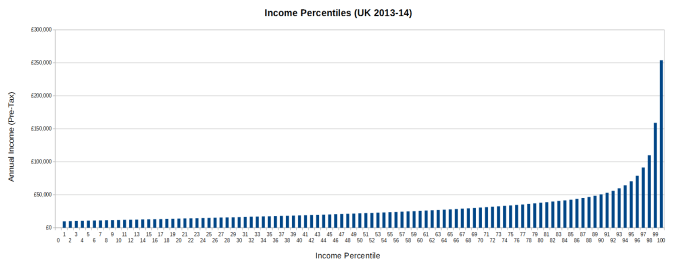
So how much would this cost? To find out, I’ve done some modelling using available income statistics, in particular the breakdown of income percentiles for the UK (percentile resolution income data for Scotland doesn’t seem to be easily available. If anyone out there knows of someone who does have it then please contact me, I’d be very interested in seeing it) .
One shocking thing about the UK is that the threshold we set, of £16,500 per year (which is, remember, the amount that said to be required to maintain a decent standard of living) is not reached until the 32nd percentile. Almost one in three workers in the UK are not earning enough to live on.
If we now add our negative income tax to this model to see how much a median person within each percentile would receive it looks something like the following.
Something to bear in mind it this income percentile data only includes people who have at least some kind of earned income. It does not include the unemployed or those who are unable to or are not seeking work, the “economically inactive”. The ONS estimates that these two groups together make up around 21.6% of the UK working age population. If we factor that group into the figures modeled here (and assuming that Scotland’s figures are roughly in line with the UK’s which will be good enough for this back-of-envelope calculation) we can estimate that the negative income tax would cost Scotland around £2.4 billion per year.
This is where things get a little tricky for the policy idea. The obvious answer to meet the costs is by adjusting the upper rates of income tax to render the scheme revenue neutral. The problem is that the UK (and Scotland) are predominantly low wage, high inequality countries. We’ve already stated that if you’re on the absolute basic wage you’re already earning more than almost a third of other workers (and this doesn’t include those earning nothing). If you pay the 40% Higher Rate, you’re in at least the 86th percentile – the top 15% of earners – and if you pay the 45% Additional Rate (assuming you are even taking those earnings as “income” and aren’t transferring money into dividends or using more arcane accounting wizardry to minimise one’s tax bill) then you are in at the very least the top 2% of earners. This doesn’t leave a very large tax base from which to levy the required funds (This was one of the reasons that the policy advocated by the Greens for the return of the 50% rate was based on reasons of income and wealth equality rather than revenue raising and did not make any spending predictions or promises based on additional revenue from this band).
If one DID want to raise income taxes to find the £2.4bn then doing it solely through the Additional Rate simply would not be possible. Even raising it to 95% (and assuming that everyone pays it) would only cover half of that bill. In order to do it with the Higher Rate, both Higher and Additional Rates would need to be raised to a minimum of 58%.
Now, a normal, independent country would not face this problem because it would be able to tailor the other half of the balance sheet as well. If a negative income tax is replacing welfare spending then the welfare budget would decrease and the balance sheet would..well..balance. But in Scotland’s case, welfare is reserved so what becomes a simple exercise in government policy which would pay for itself and hugely benefit the poorest in our society becomes a constitutional question and a financial bung of £2.4 billion per year to Westminster. Whilst we have the “powers” to adjust our tax rates, Scotland just simply does not have the ability to use them in any kind of effective manner. Those who demand that “we use the powers we have” whilst blocking the levers which would otherwise allow us to do so should reflect on their actions and words. I’m thinking particularly of our Secretary of State “for” Scotland, the “Right Honourable” David Mundell who, as we remember, has not only taunted the Scottish Government towards “using our powers” but has also threatened to tax any welfare top-ups the Scottish Government might be willing to grant. I hold no great hope of Westminster’s generosity extending to them returning saved welfare money in order to pay for a negative income tax.
I’m open to suggestions at this point. If anyone can square this circle, please…please tell me. I think I’ve found a policy which, on paper, would be within Scotland’s current powers to implement but I can’t find a way to make it work within the pitiful financial constraints of our devolution. I don’t want to have to “wait till indy” to get some of this vital work started nor am I content knowing that people could be helped but cannot be because of Westminster’s refusal to either do it or to hand over the reigns to someone who will.
This shouldn’t be such a difficult process. Only in Scotland, within the United Kingdom, in the 21st century, where we’re told we’re incapable of governing ourselves, whilst those who say that they can govern stand by and either do nothing or actively work against us, does it become one.
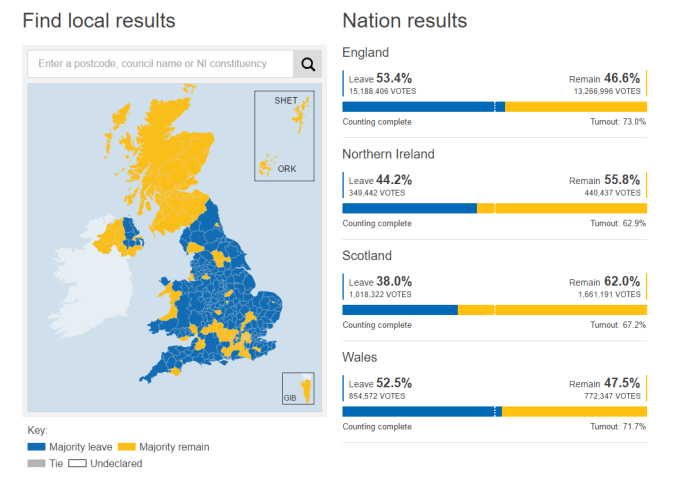
Well that’s that then. Votes cast and counted and the UK, by a margin of 51.9% to 48.1% have voted to Leave the European Union. The long, fractious and never really embracing journey that the UK has been on shall now enter a new phase. I can only guess as to where it’ll end up.
You may have heard by now though that the vote across the nations and regions of our “One Nation” was not homogeneous.
England and Wales voted to Leave. Scotland and Northern Ireland voted to Remain. It represents yet another rejection by Scotland of “UK” politics and I believe that, as previously stated, a second independence referendum is now inevitable. The First Minister has herself confirmed this morning that the Scottish Government is now going to actively pursue one whilst also seeking to negotiate directly with the EU to try to preserve and protect our relationship. I do not believe that we will find that door to be particularly tightly closed.
As for Leave, once they’ve dealt with the resignation of David Cameron, probably a few key allies too, and have taken over the Tory party they’ll have to get into the grit of actually disengaging with the EU.
The EU Commission has already made it clear, understandably, that they would prefer Article 50 to be triggered as soon as possible so that they can get the whole business done and dusted. Leave, however, are still trying to be cagey. Some of the talking heads in the media today are still even hinting at an “alternative” plan like a Vienna Convention type disengagement. The big problem with that idea is that, even if it’s possible, it can be vetoed by any of the remaining 27 states. If the EU insists that Article 50 and a formal discussion is the way to go then it can indeed insist that it shall be.
It’s still very far from certain what the UK’s future relationship with Europe will actually be once all is done and dusted.
Indeed, there’s an outside chance that a Brexit may not yet happen. It could be that the Tory leadership changeover results in a General Election…which the Tories then lose. Labour, especially one which actively campaigned on the point, could well ignore the referendum result. At this point I wouldn’t discount any possibility, no matter how unlikely.
Assuming though that Boris Johnson and chums take the reigns and we go through Article 50 and Brexit happens, there’s still several possibilities (ranging from EFTA, through a set of Swiss style biateral treaties, through a CETA/TTIP type deal and out to the “default” WTO regulations only) which I outlined here.
I’m particularly disturbed by some of the rhetoric which stuck. Lord Ashcroft’s on-the-day polling found a solid correlation between likelihood of voting Leave and support for the argument that it would help “Take Back Control”.
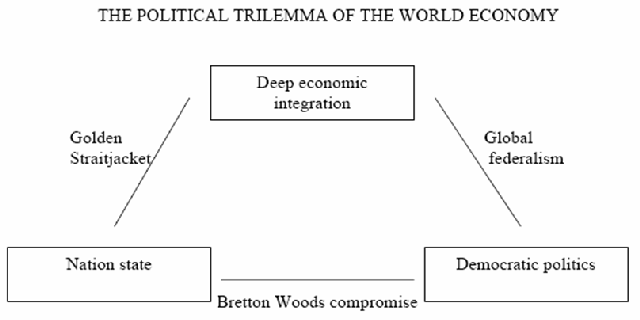
I mentioned in my article on sovereignty that countries which pin themselves to the idea of national level politics, especially to the point of it becoming a geas, can bind themselves into the Globalisation Trilemma. If, as I suspect they will, Leave use their win to forge towards turning the UK into some kind of Free Market paradise then the concept of democratic politics could find itself severely compromised.
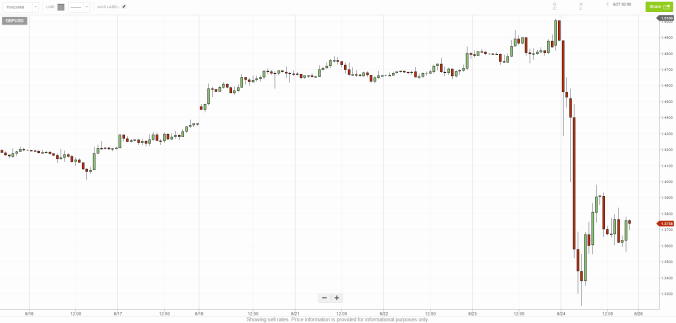
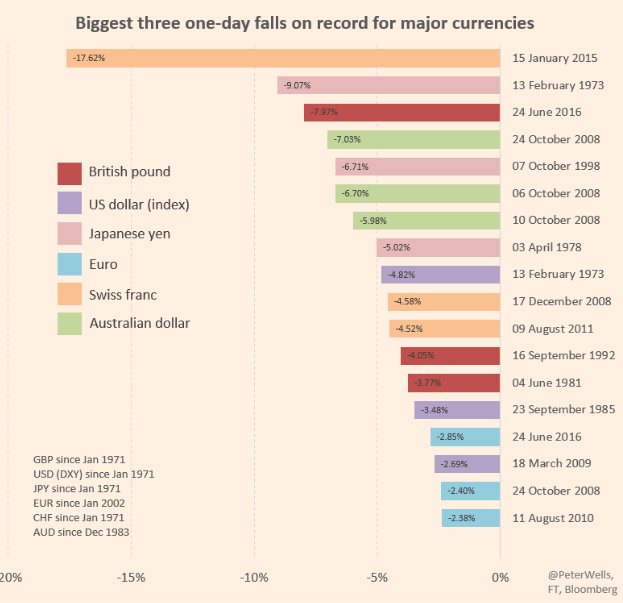
Speaking of the Free Market, it was in the financial world that the most “excitement” of election night was to be found. The polls, public and private, in the days running up to voting day had starting indicating a Remain vote. This had pushed the value of the GBP up significantly as traders started “buying the rumour“. When the Sunderland vote came in though it was the first indication that things were not going to go well for Remain. That one result caused a panic sell in the markets which did not improve as the night went on. By morning, the “Great” British pound had fallen to the weakest point seen since 1985 and, after a morning-after retracement, had lost 8% of its value. This is the worst single day hit that the pound has ever taken, twice as deep as plunge as 1992’s “Black Wednesday” and the third deepest single day hit ANY major currency has taken in modern times. History books shall be written on this point alone.
It should be of very careful note that against the Euro, the Pound lost about 10% of its value compared to 2015. This is important because the UK had a trade deficit with the EU of about £68 billion in 2015. Assuming all things other than currency being equal then that trade deficit could be expected to rise to £75 billion simply because it’s now more expensive to import goods and services from Europe.
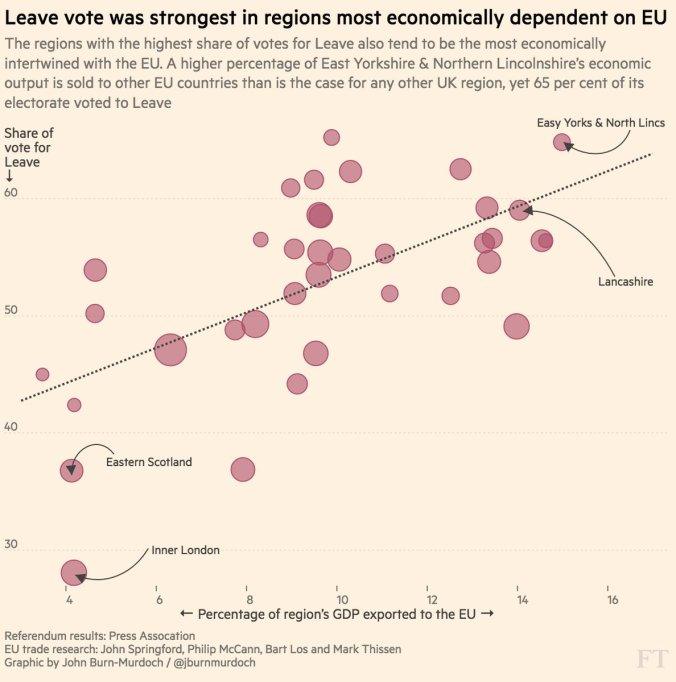
This difference in trade, around £7 billion, represents almost exactly the amount that Leave claimed that we’d “save” in net contributions to the EU. There may well be no gains, no money for the NHS or anything else that was promised. I hope I’m wrong. Because if I’m not, the areas which most voted Leave are also the areas most likely to be dependent on the EU for trade. They will be the areas most reliant on a good deal and/or economic plan for what comes after.
As for Scotland, it’s looking now almost inevitable that this result will hasten another go at an independence referendum and, this time, not only will it not be called until we’re ready but it’s looking rather like a lot of former No voters who had been promised that their vote would ensure their EU membership have now seen that whisked away. It has been enough to convince many that independence is now the best option ahead of Scotland. If you happen to be one of them, Welcome.
The Greens and the SNP, will now be exploring all options to protect and preserve our EU relationship. We’re in very uncertain times now with few precedents to guide us so what form this will all take is a matter of pure speculation.
My own preferred option could take the form of direct negotiations between the Scottish Government and the EU resulting in some kind of deal whereby if an independence referendum is held and won in the period before formal Brexit then a newly independent Scotland could “inherit” the UK’s old seat with no loss of continuity. Of course, this would require the co-operation of the Westminster government to allow such negotiations to take place or to even acknowledge that the result in Scotland is significant. It would be a tragedy of democracy if we were simply ignored.
I’ve got no easy answers for the next few months, or years. I’m as much an unwilling passenger as everyone else who voted Remain yesterday. I’ll try my best to work out where we’re going just as soon as it becomes apparent though. And who knows. Maybe, just maybe, we’ll get off early.







 The Common Green