It’s (hopefully) no secret that I’m not a member of the SNP so some may question my stepping in to this current scandal. I am, however, a member of Yes Clydesdale and it was through them that I first met Philippa Whitford (in fact, it was a talk organised by our group which went viral and was responsible for launching her political career).
Through the course of the indyref I had the opportunity to sit on Q&A panels alongside Philippa and can find absolutely nothing but praise to say about her.
She is a person of incredible knowledge and inspiration who took the incredibly brave step of moving from a hard fought career in healthcare to casting herself into the thankless “kindergarten where people make animal noises” which is the House of Commons.
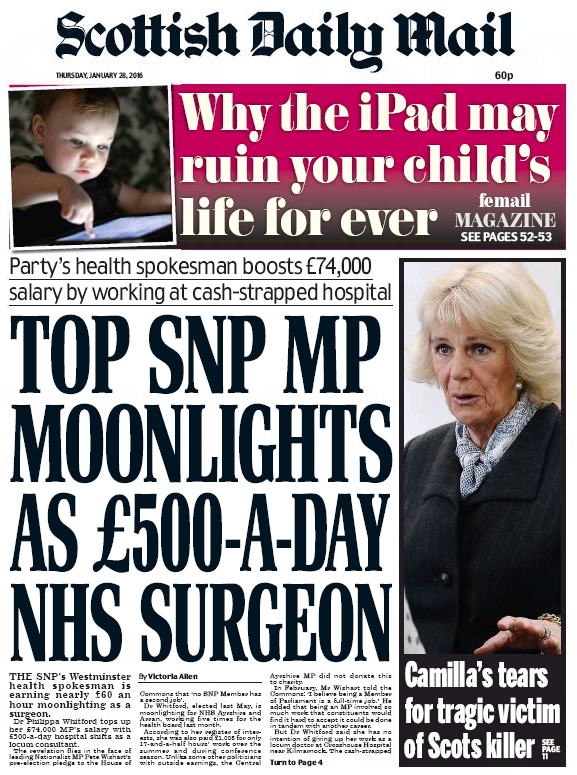
So to today and Dr Whitford finds herself the target of the latest and lamest SNPBAD smear yet.
The actual story is that she gave up a substantial chunk of her Christmas and New Year holiday to cover for a sick colleague. She spent 5 days saving lives while others in the benches opposite hers spend their “moonlighting” days being paid to destroy the very NHS in which she works. (As Wings Over Scotland points out, she is also compelled to work a certain number of days as a surgeon per year if she is to maintain her license to practice so it’s hardly a job she’s just doing to top up her pocket money)
A little further digging reminds us of the increasing problems with medical staff in England causing more hospitals to hire locum doctors at fees of, on average, £1,700 per day.
That Labour’s Jackie Baillie would have the temerity to be complicit in this transparent smear is just one more notch on that party’s slide into irrelevance. If even they cannot resist their urge to try to find just one more SNPBAD story then I cannot see any reason why any voter would think them worthy of being the party of opposition in next year’s Parliament.
I’d put out a call asking the Baillie and Daily Mail to retract and apologise for this piece but I know how futile that would be. I do hope that everyone, even those on the other side of the political landscape from Dr Whitford and myself, feel as utterly appalled and ashamed for the state of the press as I do. We deserve so much better.
“It seems obvious: the reason only a tiny percentage of new…buildings and retrofits aren’t green isn’t cost. It’s lack of ingenuity or knowledge of new construction techniques — architects and builders wed to the ‘same-old,’ lenders leery of anything unconventional.” – Sustainable Energy Africa
The Scottish Greens have launched our new #ThisCouldBeHome campaign aimed at greatly strengthening the current movements towards better land reform.
There are currently around 11,000 hectares of land in Scotland current derelict or un- or underused which, through the application of a Land Value Tax, could be freed up to build a new generation of affordable housing. Here is Andy Wightman introducing the campaign.
As the campaign points out, the current UK housing bubble is pushing rents up beyond the affordability of far too many people and those increasingly fortunate few who can scrape together a deposit and have secure enough employment to sustain a mortgage are looking with trepidation towards the day that the Bank of England starts pushing interest rates back up towards pre-2008 levels. For hard pressed people who can barely afford to pay the bills as it is, moves like this could result in yet another crash in the housing market and more families facing default, foreclosure and eviction.
We also live in a country with the second highest level of excess winter mortality of any European country north of the Alps, driven in large part by our lax building standards and fuel poverty.
For this reason, we should take this opportunity to ensure that those new houses which are built adhere to strict building regulations which push the limits of our technological abilities to ensure that energy bills and the other ongoing costs of running a building are kept at an absolute minimum. Of course, buildings are themselves often constructed to meet only the very minimum standards set by law as to do otherwise would eat into the private construction industry’s precious profit margin.
Of course, as the headline quote states, cost isn’t nearly the greatest obstacle to greener housing development and, as I have written previously, the Scottish government will soon be handed the power to borrow money far cheaper than can any bank or private company (As an alternative, the Common Weal has also pointed out that the Government has the power, today, to set up Scottish Housing Company to perform the same function) and could use that money, paid back through rents, to undercut the private industry and ensure that the highest green standards are adhered to. The precedent for this already exists in Scotland where, according to official government figures, the social rented housing stock are generally more energy efficient than private builds and contain a higher percentage of B and C grade housing (where the overall Scottish average is merely grade D). If we are willing to push things as far as we need to to reach a zero-carbon economy then a greater pool of cheap, efficient housing will force the private sector to either step up its game or step aside.
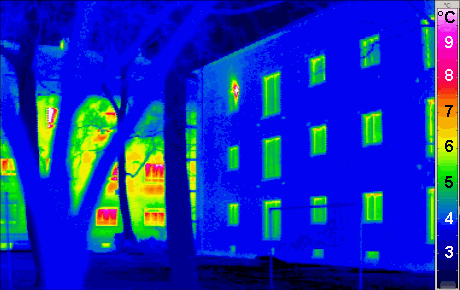
A Thermal image of an energy efficient “Passive House” compared to a more traditional, less well insulated dwelling behind it. Source: Passivhaus Institut
But how do we get everyone to A grade? One pathway can be found in the Passivhaus Standard which employs a strict understanding and approach to engineering and techniques such as solar thermal panels on roofs, underfloor ground source heat pumps, insulation throughout the house and architectural elements designed in from the start to minimise heat loss and maximise the amount of energy which can be harvested from the environment. Properly employed, these standards reduce a house’s heating requirements to below 15 kWh per square metre per year. By comparison the average Scottish house requires approximately 140 kWh per square metre per year to keep it warm. It’s no wonder so many of us struggle in winter. (Fun fact about Passivhaus, they have built a compliant dwelling now on every continent on Earth. Including Antarctica!)
With heating making up 55% of Scotland’s overall annual energy demand and only 10% of that heating coming from renewable sources (including renewable electricity) then it is clear that this is the area which, if targeted, will have the most potential to reduce our requirement to run a carbon based economy. This needs to be stressed. Whilst the Scottish Government has made great strides in pushing renewables (and despite the UK government’s increasingly hostile attitude towards them) if we only focus on meeting of our current electrical demands then we’ll still be reliant on fossil fuels for over three quarters of our energy and this doesn’t factor in the doubling of electrical demand which will come if we translate our transport system over to electric vehicles (assuming we don’t also reduce demand there too).
To achieve this may seem to require brave choices. But we can’t sustain the “same old” attitude for much longer. Pretty soon, doing nothing will be even “braver” (in the Yes Minister sense). I believe that a strong Green voice in the Scottish Parliament from May will help the government make those brave choices and your vote for the Greens in May will help that happen. As noted earlier, it’s not a problem of money or power holding us back here. Merely the will to roll up our sleeves and do it. We’ll be glad for it once we have. We’ll wonder why we didn’t do it sooner.
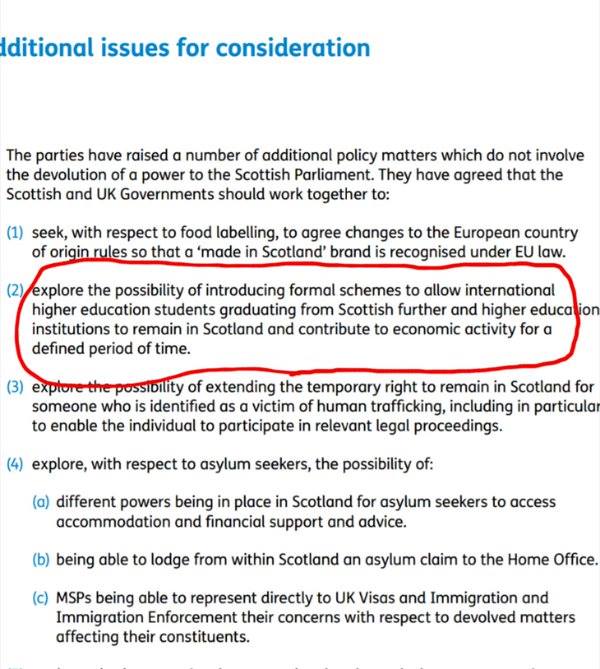
The relevant passage from the Smith Commission Report. Page 28.
David Mundell, who is currently crowing that the Smith Commission has been delivered “in full”, has just blocked a key element of it.
All of the Smith parties agreed to consult on the possibility of allowing Scotland to issue post-study visas for visiting students to allow them to continue working (and paying taxes) in Scotland, the country which educated them, after they graduate.
Mundell has just blocked that proposal without such consultation and before the Scottish Affairs Committee looking into it has even had a chance to report back. (Story here)
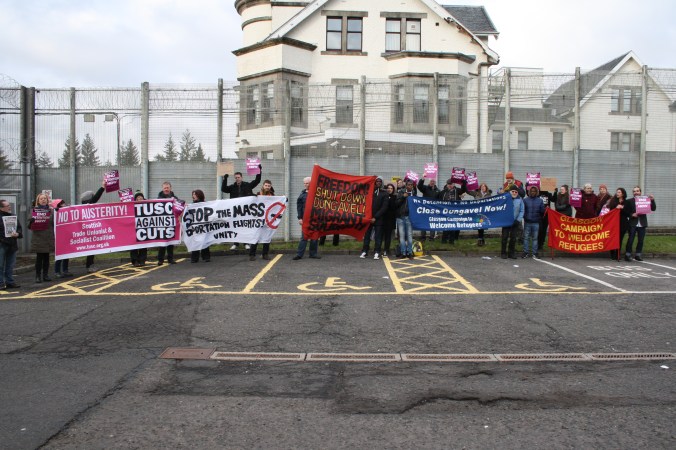
One of the most upsetting moments in my own personal indyref campaign was hearing from a young lass whose partner was one such visiting student. He had come to Scotland to study engineering and, after falling in love both with our country and one of its inhabitants he decided that he wanted to stay, to build his career and to make Scotland his home. Just two weeks after his graduation, the UK Government rewarded his endeavour with arrest, incarceration in Dungavel and deportation.
Protests outside the Dungavel Detention Centre. Source: Wikipedia.
This is not how a civilised country should treat other human beings. Instead, we should be encouraging those who, after all, pay significant sums of money towards their education to find a place within Scotland should they choose to do so. Many will find high paid, highly skilled and highly sought after jobs. Many others will start businesses of their own and CREATE those same jobs. Even the graduates who choose to leave Scotland will, if they are treated with respect, go on to strengthen our trade and business links with the countries to which they go. Something to bear in mind with respect to the UK’s worrying trade deficit combined with a currency value currently at the lowest level since the Tories took power and which is rapidly approaching the weakest value it’s had in 30 years.
Think about it David. If you were incarcerated and forcibly ejected from here simply because you had graduated, would you look upon this country favourably afterwards? Of course not. Would you consider sending your kids to study in a country which threatened to do the same to them? Of course you wouldn’t.
As Smith notes, this policy doesn’t require any additional powers to be devolved, indeed the similar Fresh Talent scheme used to be implemented in Scotland between 2005 and 2008 and was rolled out successfully to the entire UK until 2012 when it was scrapped by the Coalition government. Mundell’s decision therefore seems especially arbitrary, short-sighted and, frankly, smacks of nothing less than a jumped-up Governor throwing his weight around simply because he thinks he cannot be challenged.
The European Court of Justice has released its judgment of the Scottish Government’s proposals to introduce a minimum unit price on alcohol.
Their judgment, published here, states that the proposals as written would be illegal on the grounds of being discriminatory towards cheap alcohol imports and thus would be a restriction on the free movement of goods within the EU.
They have, however, upheld the Scottish Governments arguments that MUP would lead to substantial health and social benefits and have agreed that it would, indeed, meet the goals of both reducing hazardous alcohol consumption and alcohol consumption in general (in an earlier article I noted that Scottish consumption of alcohol can be seen as substantially higher than the UK average simply by examining the tax records).
The court has therefore not banned MUP completely but has ruled that it cannot be implemented until and unless the national courts (i.e. Edinburgh and then the inevitable appeal to the Supreme Court in London) rule that the same alcohol reductions cannot be achieved via taxation. This sets out a test to be met by the Scottish Government.
But if that test is failed and taxation ruled appropriate, what form could it take?
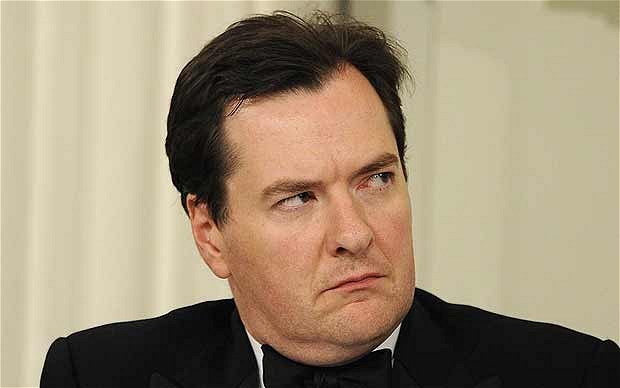
The obvious first step would be alcohol duty but this is currently a reserved power and its devolution was ruled out of the Smith Agreement and the subsequent Scotland Act 2015 Bill. I would think it unlikely, given the current track record, that an amendment to devolve alcohol duty would succeed at this point so I think I’m safe in assuming that it will remain in Westminster hands. Nor, do I suspect, will George Osborne be keen to adjust his own plans for the UK simply to allow the Nationalists even a moment of victory so I can’t see him being amenable to changing alcohol duty at UK level either.
There is another way though, as pointed out by Andy Wightman on Twitter today, the Scottish Government currently DOES have the power to create new LOCAL taxes. If the courts ultimately agree with the ECJ that taxation would be just an effective method of reducing alcohol consumption as MUP then this would be a method within the competence of the Scottish Government to implement without further devolution or delay.
Such a tax need not be set locally, national legislation could fix the rate, though the advantages to doing so are quite strong. By keeping money within areas particularly blighted by alcoholism and alcohol abuse and by allowing the rates to be set to particularly target these areas the greatest good could be done the fastest. Conversely, those areas which perhaps see a lot of through traffic, people traveling into town for a responsible night out say, but suffer little actual harm from chronic abuse may wish to set rates somewhat lower so as to avoid driving away too much business.
While we’re looking at locally devolved alcohol sales taxes we could also take the advantage of the discussion to bring back proposals for alcohol production taxes too. Scotland is perhaps best known for its whisky exports but what is lesser known is the fact that many of the most famous distilleries actually employ comparatively few people and yet produce vast sums of money for their generally multinational corporate owners without doing all that much for a local area which often gives their very name to that drink. Given that these distilleries, and many brewers and other manufacturers, cannot easily move elsewhere (and certainly cannot move out of Scotland) then a local production tax seems particularly apt. Again, by setting it locally and by allowing local people a say in how it is set then they are in a position of power again and can directly benefit from our renowned exports.
Personally, I welcome the prospect of minimum unit pricing and do believe that it would be an effective aid to our national alcohol problem but my challenge to the government is that if the courts rule otherwise, there is still something we can do. Indeed, even if they don’t….why not both?
Next year brings in the Scottish Parliamentary Elections and with it comes the proposals from each of the parties on how best to use the limited powers that the Scottish Government will have at its disposal. No doubt, much of the news and comment will be around whether or not the (marginally) expanded powers over income tax coming in under the Scotland Bill 2012 will be used and by how much.
Our approach towards local taxation, however, will perhaps lead to a far more fundamental change to the fabric of our society. There is also far greater scope within the devolution powers to do something a bit more radical that simply raising or lowering the rate of tax by a penny or so (or repeatedly defending one’s reasons for not doing so). It is therefore important, before the campaigning season begins in earnest, to understand what our options are and the potential impacts of them.
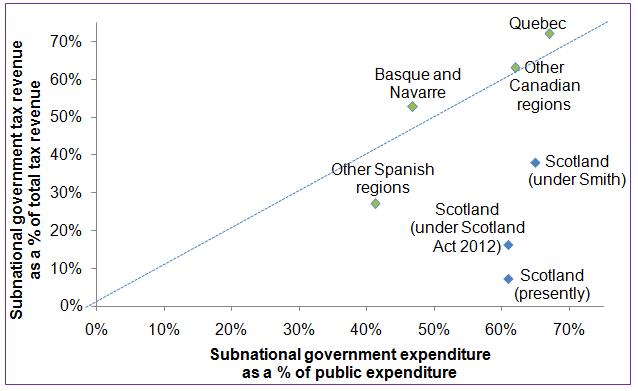
A comparison of the % of devolved control in Scotland now, as it will be under the Scotland Act 2012 and under Smith Commission recommendations as well as a comparison with Spain and Canada. Source: Scottish Government.
Monday the 9th of November saw the Scotland Bill 2015 make a further step towards completion. This Bill, which has been the result of the aftermath of the 2014 independence referendum, will mark another milestone on the devolution “journey” Scotland is traveling upon.
Some of the commentary both during the actual debate in the House of Commons and in the days since have shown considerable confusion at just how the system of devolution in the UK works at the moment and how it is to change with the implementation of the Bill. Before we really settle into a meaningful debate on whether or not any “additional powers” for Scotland will be to and for Scotland’s benefit we need to actually understand what those new powers are, what we have now and how they can be used.
This article shall focus on the powers over taxation devolved to the Scottish Parliament as this area will be undergoing several rapid changes over the next few years and much of the confusion amongst members of the public has arisen from the conflation of several phases of devolution.
One must understand the rather unplanned and piecemeal nature of the progression of devolution for Scotland, there is certainly no clear “destination” to that “journey”, and this reflects and contributes to the confusion but there are three major points in the form of the Scotland Act 1998 which formed the Scottish Parliament after the success of 1997 Devolution Referendum; the Scotland Act 2012 which resulted from the 2007 Calman Commission and the aforementioned Scotland Act 2015 resulting from the Smith Commission of 2014.
The White Ensign. Possibly a fitting flag for the United Kingdom of England (plus others).
Thursday, October 22nd 2015. The day that Westminster ended, finally, any pretence that the United Kingdom consisted either of “One Nation” or of four nations joined as equals.
Now we live in a state in which one of those nations maintains a right and power over the other three and representatives from those latter nations have fewer rights to speak, to influence and to legislate than their colleagues and, by way of extension, voters from those nations have less control over how their state is run.
Last night George Osborne’s Fiscal Charter was voted on and rammed through Parliament on the back of the Tory’s majority. Today, the media focusing more on the shambles that is the current Labour party and their confused approach to supposed Opposition combined with the rumbling rebellion in the ranks as the party tries in vain to come to terms with what their members actually want the party to stand for.
Consequently, as usual, much less has been said about the actual contents of the Bill and its effects on our economy.
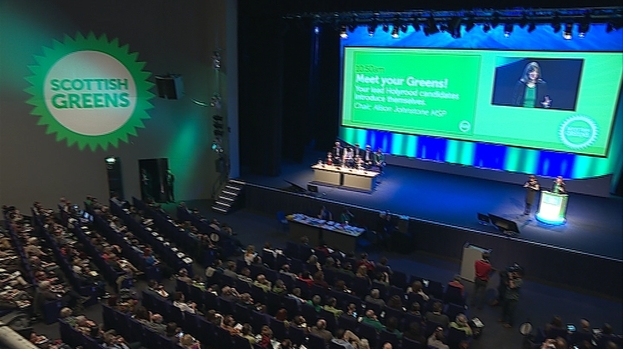
As I write, the Scottish Greens are mid-way through our 2015 Conference. The largest one in the party’s history with around 700 members turning out to the SECC in Glasgow.
The blog hit a bit of a milestone today. 20,000 pageviews and over 16,500 visits!
All I can say is thank you for all of the support, especially in the last few days when things have went a bit viral. Here’s to the next few thousand visitors and to continuing efforts to shine just a little bit of light and opinion on the topics to come.
I’m still here to talk about all things Common and Green but if there’s anything else you think I can provide some insight on just give me a shout and I’ll see what I can do.






 The Common Green
