How Scotland Votes: A Guide to the European Elections

Disclosure and Disclaimer: Whilst I am politically active and an active member of the Scottish Green party, this post is intended to be objective and politically neutral. This is a guide on how to vote, not a blog to try to convince you to vote for or against any particular person or party.

This is a blog that even up to a few weeks ago, I did not expect to have to write. The UK was originally due to leave the EU before this point and as of the current situation, has the right to leave at any time if the UK parliament can ratify the agreed Withdrawal Arrangement. Even now, at this late stage, there is a possibility that this blog will prove redundant. But as things stand, a deal is looking unlikely and it is almost certain that the UK will, possibly for the last time, take part in the European Parliamentary elections on the 23th of May.

If you are unsure on how to vote – not who to vote for, unsure about how to actually cast your vote – then this blog is for you and is a continuation of my long running series which has also covered the UK General Elections, The Scottish Parliamentary Elections and the Scottish Local Authority Elections.

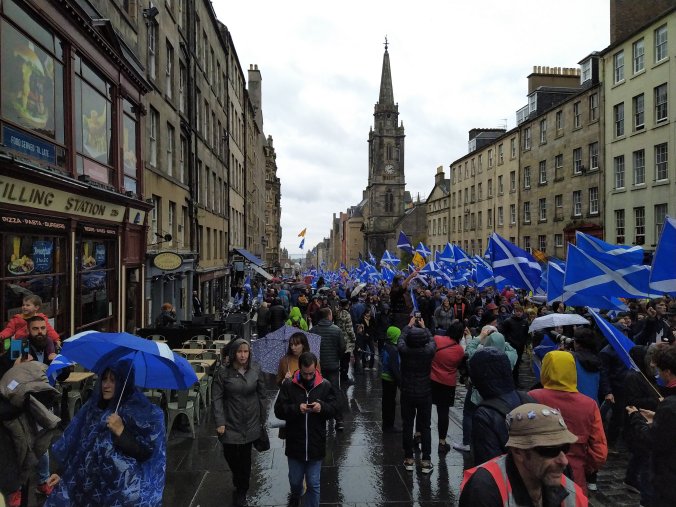
32376266987_711b1e1f2a_k.jpg

Source: Flickr

Continue reading

Measuring A Nation

“When moral posturing is replaced by an honest assessment of the data, the result is often a new, surprising insight.” – Steven D. Levitt

Statistics Laptop Thumb.png

The SNP conference was marked by several important topics that were thrashed out on the floor on the day and in the press and online in the weeks and months preceding. On the Growth Commission in particular, I was personally invested in a great deal of that discussion so I know how many tens of thousands of words were written around that topic.

The following day saw another topic discussed which was somewhat less well covered in the press was the motion presented by Agnes McAuley and Ronnie Cowan MP on the creation of a Scottish Statistics Agency. Continue reading

Nowhere Left To Grow

“Perhaps the answer is that it is necessary to slow down, finally giving up on economistic fanaticism and collectively rethink the true meaning of the word “wealth.” Wealth does not mean a person who owns a lot, but refers to someone who has enough time to enjoy what nature and human collaboration place within everyone’s reach.” – Franco Bifo Berardi

This weekend will see the SNP conference and the long awaited vote on whether or not to adopt the Sustainable Growth Commission’s report as the party’s main economic strategy for an independent Scotland. After almost a year of discussing this document, the party will have their final say on whether or not to adopt it as party policy.

I have written tens of thousands of words of critique, commentary and policy work on this topic. There will be more to come between the time that this blog is published and the vote on Saturday afternoon. Much of it has been centred around currency and the macroeconomic policies. Here, I’d like to look at things from a slightly different lens. How does the Growth Commission reflect upon Nicola Sturgeon’s plan to introduce a Scottish Green New Deal?

value

Continue reading

That Was 2018

Bliadhna mhath ùr.

181122 Balance.jpg

Light and dark, land and sky in perfect balance. As all things should be at the turn of the year.

This year past has been one of the most rewarding I’ve experienced so far but also one of the most challenging. Principally, my colleague Ben’s moving from Head of Policy at Common Weal to Editor of CommonSpace led to me taking on the joint role of Head of Policy and Research and taking on roles in the co-ordination of various lines of policy work with various groups and volunteers who having been working with us in addition to the six policy papers I have personally authored through the year.

This doesn’t include the various newspaper articles and media appearances in which I’ve represented Common Weal nor my ongoing and extremely enjoyable Policy Tour in which I have visited pro-indy political party branches, Yes groups and, of course, Common Weal locals all over Scotland. I don’t have an exact count of how many talks I’ve given this year but I think I’ve been averaging around three per month. (I’m already taking bookings for 2019 so if you’d like me to visit your group, give me a shout)

Continue reading

Withdrawing Agreement

“Diplomacy is the art of letting someone else have your way.” – Sir David Frost

I was preparing this week to talk about the “Meaningful Vote” in the House of Commons which would have ratified or rejected Theresa May’s woefully inadequate Brexit deal.

A parody timeline of the Brexit negotiations. An incomprehensible tangle of flow lines point to scenarios such as "We're screwed", "Bring back Nick Clegg" and "Jacob Rees-Mogg as PM".

But things have progressed somewhat since I started planning that post. In a direction not necessarily to the advantage of the UK government. Theresa May, Strong and Stable, took her deal from the table.  She started into the face of the humiliation of losing a vote possibly by a triple digit majority and ran away to try to renegotiate with the EU – who have already said that renegotiation is not possible. If it turns out that they were not entirely solid on that principle, then they’ll surely exact a high price for any changes.

Continue reading

Fishing Lines

“Teach all men to fish, but first teach all men to be fair. Take less, give more. Give more of yourself, take less from the world. Nobody owes you anything, you owe the world everything.” – Suzy Kassem

A political declaration has been published jointly by the UK Government and EU which aims to take the first small steps along the very long road between where we are right now with the Brexit Withdrawal Agreement out to the final trade deal and future relationship between the UK and EU beyond the expected transition period post March 2019.

Others will go through the whole thing in detail with far more competence than I can manage. I particularly recommend Ian Dunt’s Twitter thread here.

I do want to comment on one are in particular because it has already caused more than a bit of a fight up here in Scotland and as it does a good job of highlighting the political divisions involved in Brexit in certain interesting ways. Let’s discuss fishing.

RS-HMS-Scylla-colllides-with-Odinn-Credit-Ian-Newton

The UK/Iceland “Cod Wars”: The UK is no stranger to getting into a fight over fish

Continue reading

Transition Timelines

“Expect the best, plan for the worst, and prepare to be surprised.” – Denis Waitley

Robin McAlpine wrote an interesting article for his CommonSpace column this week. In it, he congratulates the response to the SNP’s National Assemblies especially the response of the attendees to our own campaign for an independent Scotland to establish a currency by day one of independence. Having spoken to the Common Weal activists who were there for us, and from my own experiences talking to groups around the country, I know how overwhelming the feeling is in favour of our position.

The Ideas Board from the Edinburgh National Assembly.

This is not to say that the feeling is unanimous though and a significant line of questioning is arising around Common Weal’s policy around the area of what this means for the transition period between a successful independence referendum and the formal date of independence. Some have voiced concern about our plan to take a full three years from the referendum to build the institutions that we need before becoming independent. So I want to lay out precisely why we have proposed this by contrasting it with other proposals on the table. I certainly wish to refute any claim that we’ve been somehow misleading in our campaign by trying to hide or downplay our three year timetable. After all, it’s right there on paragraph one of page one of our book How to Start a New Country (which you can buy or download for free here).

Pg1.png

Continue reading

We Need To Talk About: The Growth Commission Report

If this is a discussion document – It’s time to start discussing it.

The Growth Commission’s long-awaited report is finally out and will surely take some time to fully digest. It has been described as a discussion document and a starting point for the revitalised case for independence; not the final word on SNP policy or national trajectory.

In many ways, the report covers ground now very familiar to campaigners in the independence debate. We’re all now quite familiar with the deep and systemic flaws of the UK’s economic system especially its regional inequality which, quite frankly, is embarrassing when compared to neighbouring countries in Europe.

14

(Source: Eurostat)

Continue reading

An Unequal Kingdom

“A system of government as close to federalism as you can have in a nation where one part forms 85% of the population” – Gordon Brown, 2014

The “F-word” is rearing its head again in Scottish politics. Federalism. An idea sometimes presented as a “credible” alternative to Scottish independence and a way of granting Scotland greater autonomy over its own affairs whilst maintaining the unity of the United Kingdom. Unfortunately, it’s also an idea that is rarely presented in any greater detail than that previous sentence.

Both Scottish Labour and the Scottish Liberal Democrats have flirted with this idea throughout their history and have been doing so again recently. In an attempt to raise the level of debate about this subject, I have just co-authored my latest policy paper for Common Weal with long-time constitutional activist Isobel Lindsay which you can read here or by clicking the image below. Isobel also has an article in the Sunday Herald which you can read here.

Unequal Kingdom Cover

Continue reading

Irrigating the Data Desert

“Why speculate when you can calculate?” – John Baez, American mathematical physicist

Last week saw the release of Common Weal’s latest policy paper, Scotland’s Data Desert, which examined the gaps in statistical data for Scotland and called for a Scottish Statistics Agency to help fill them.

We weren’t the only ones studying the problem of the dearth of data in Scotland. As part of a year-long program of research into this topic, we got involved with the Scottish Parliament’s Economy, Jobs and Fair Work Committee who had launched their own public consultation looking specifically at the state of economic data in Scotland.

Our response to that consultation led to us being invited to present evidence directly to the committee in September 2017.

The final report from the committee’s investigations was published a few days ago and we are very pleased to say that many of our recomendations have been accepted in the conclusions of the report.

Econ Report.png

Continue reading