“Fracking is the toxic fag-end of the fossil fuel age” – Mark Ruskell MSP
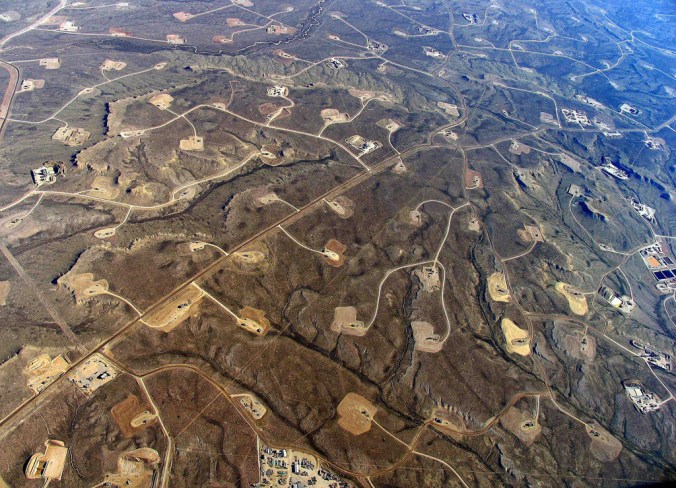
Exciting news tonight as Scotland has now formally banned fracking. Not for us, the sight of mazes of pads burning their way across the landscape as has happened in the USA and elsewhere.
“GDP is increasingly a poor measure of prosperity. It is not even a reliable gauge of production” – The Economist
There’s a bit of a story happening around Scotland’s oil trade since Wings Over Scotland highlighted an otherwise completely unreported change in the way the UK measures how much oil it trades with the world and where in the UK it comes from.
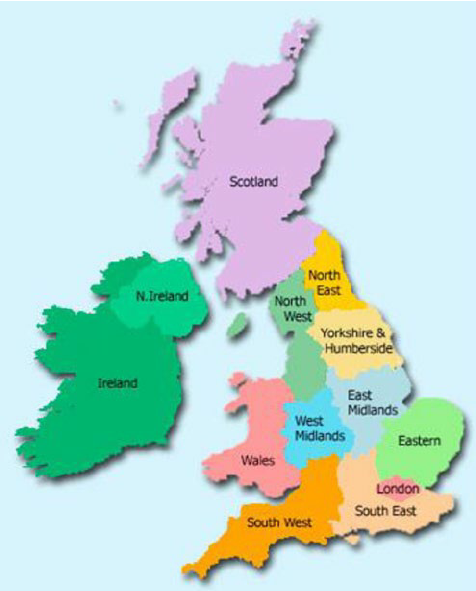
The story stems from the way that the UK calculates its balance of trade with the rest of the world and specifically how it then decides which region of the UK is responsible for that trade. To do this, the UK is split into 12 regions based on the Government Office Regions of England plus Scotland, Wales and Northern Ireland. (These boundaries are also used by Eurostat for their NUTS 1 statistics)
There’s another “region” of the UK not displayed on the map. Not all trade can be firmly allocated to a single region and not all trade can be allocated to a region at all. This is the “Unknown Regions” of the UK. Most prominent amongst this kind of trade, at least within Scottish political circles, is trade generated by offshore activities.
There are many different ways one could approach this allocation – the methodology – and the way you do it can result in very different results. Now, if you’re the UK and are looking at UK stats these figures don’t really matter so much but they do become very relevant if you’re looking at one part of the UK and what its economy might look like if it decided to, say, discuss holding a vote for independence. Suddenly, even UK government departments start getting very interested in Scottish trade.
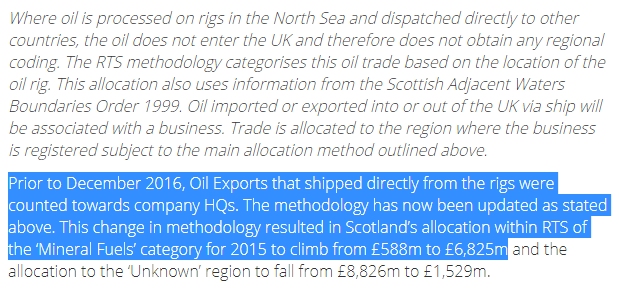
The particular story here concerns a change in the trade methodology around offshore oil in Scotland waters. Particularly, oil which is exported out of the UK directly from the rigs without it ever touching the UK land boundaries. Previously, much of this oil has been allocated to the Unknown Region but the change now meant that it would be allocated to Scotland. This has led to an increase in the recorded value of Scottish minerals exports for 2015 from £588 million to £6,825 million. Quite a substantial jump and one which has spread around social media. Time for a wee breakdown of what it means and take the chance to clear up a few misunderstandings I’ve seen along the way.
(This is a complex topic, after all)
“Tomorrow’s GDP figures will confirm whether or not Scotland entered a second quarter of economic downturn in the first three months of 2017.” – Scottish Conservatives. 4th July 2017.
The quarterly Scottish GDP figures were released today after a long build up in a press anxious to see if Scotland was on, as the Express put it, the “BRINK OF RECESSION” (their emphasis).
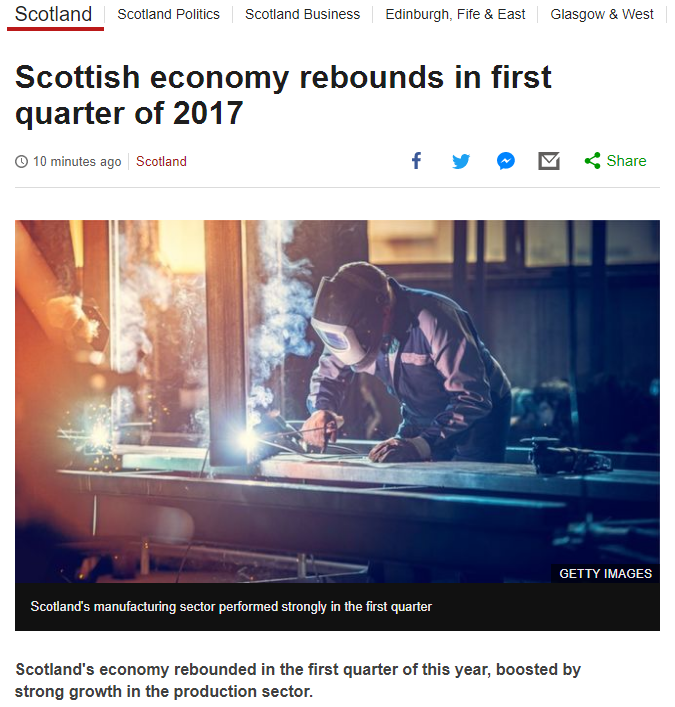
The headline figures are that in Q1 2017, Scotland’s economy grew by 0.8% which is up substantially on the -0.2% contraction seen in Q4 2016. This positive growth also means that the two successive quarters of negative growth which define a technical recession were not met.
The UK’s GDP growth over Q1 2017 was 0.2% though in my last blog post I put substantial attention onto the point that we should treat such comparisons with a great deal of care given the large regional inequalities within the UK. I’d very much like to see the GDP of the UK broken down across its regions (especially London) before commenting too much on it.
And before we all start patting ourselves on the back at avoiding our “predicted” recession, it’s worth actually diving into the numbers and seeing what they do and do not tell us about the Scottish economy.
“The measure of a man is what he does with power.” – Plato
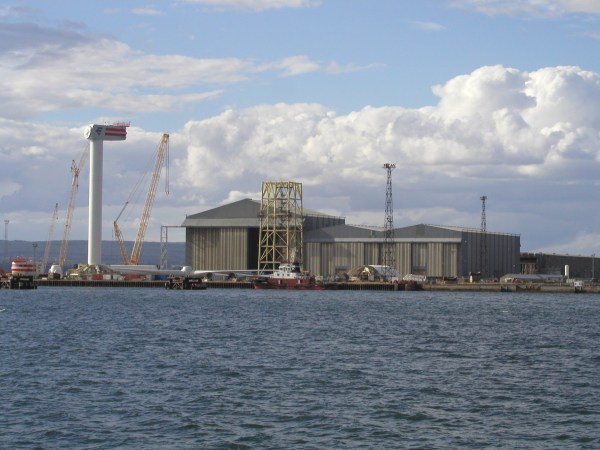
5MW wind turbine under construction at Nigg Energy Park
The National Grid does not serve our nation.
The UK’s electricity network is not designed for the 21st century. It is certainly not designed to be able to best exploit the resources we will want to be using in the post-oil age.
“It can be concluded that both shale oil and shale gas are unlikely to be economically viable in this current low hydrocarbon price environment and even if there is a return to recent higher prices; it is likely that the industry would require significant subsidy or significant efficiency progression before it could be used at any kind of scale.”
“Even if the extraction can be proven to be environmentally ‘safe’ the experience of the United States shows that it risks bringing boom-and-bust to our communities as waves of temporary jobs move rapidly through without rooting themselves in local economies.”
My first paper written for the Common Weal has been published today. The Economics of Shale Gas Extraction is the first major paper to be published in Scotland focusing on the economic, rather than environmental, impacts of the industry particularly on the local communities which will be hosting the wells.
Key Findings:-
The SGE market in the US and, so far, in the UK is dominated by larger companies occupying the most profitable licences. There is little scope for community owned or small company development to occupy a significant market share.
Individual wells become largely non-productive within a few years of development which, due to market demand for constant production, forces companies to continue drilling new wells in new locations at a rapid pace.
The low recoverable volumes and high capital and running costs of wells may render profit margins comparatively small and extremely sensitive to oil and gas pricing. There appears to be little scope for economic development of SGE in the UK until and unless wholesale prices return to historic highs and even then significant subsidy may be required.
Communities are likely to be significantly adversely impacted by nearby SGE fields. The concentrated pattern of land ownership and comparatively weak situation of local government renders communities vulnerable to being unable to capture wealth generated by nearby wells whereas the burden of environmental degradation or even simply the threat of such degradation can lead to community stress and negative economic effects.
The jobs created by SGE appear to be short-lived and highly mobile. The job demographic of the planning, drilling and production phases are each relatively exclusive meaning that they will move to the next site more rapidly than the wells themselves do. This creates the risk of a “Boom-Bust” effect in communities.
Shale oil and gas is considered a relatively poor source of fuel due to high extraction costs. The UK’s reserves are also likely to have an insignificant impact on global markets and hence a negligible impact on end-user prices.
Significant externalities have been identified in the form of environmental degradation due to methane leaks. The costs to mitigate these may exceed the lifetime revenues generated by the well which produced them. Further, the UK has a poor record in terms of ensuring adequate decommissioning and restoration bonds which may lead to further public funding being required after the SGE companies have left an area.
Whilst much of the attention on the shale oil/gas and fracking industry has been focused on the environmental impact, less attention has been paid to the economic effects. Even if the extraction can be proven to be environmentally “safe” the experience of the United States shows that it risks bringing boom-and-bust to our communities as waves of temporary jobs move rapidly through without rooting themselves in local economies. Scotland’s history of concentrated land ownership and comparatively poor local government also risks creating a vast transfer of wealth benefiting the already wealthy whilst potentially leaving communities to foot the bill for cleaning up. All for a fuel which the government has been told will not even benefit us in the form of lower energy bills.
There should be no place for fracking in Scotland or the UK.
“It seems obvious: the reason only a tiny percentage of new…buildings and retrofits aren’t green isn’t cost. It’s lack of ingenuity or knowledge of new construction techniques — architects and builders wed to the ‘same-old,’ lenders leery of anything unconventional.” – Sustainable Energy Africa
The Scottish Greens have launched our new #ThisCouldBeHome campaign aimed at greatly strengthening the current movements towards better land reform.
There are currently around 11,000 hectares of land in Scotland current derelict or un- or underused which, through the application of a Land Value Tax, could be freed up to build a new generation of affordable housing. Here is Andy Wightman introducing the campaign.
As the campaign points out, the current UK housing bubble is pushing rents up beyond the affordability of far too many people and those increasingly fortunate few who can scrape together a deposit and have secure enough employment to sustain a mortgage are looking with trepidation towards the day that the Bank of England starts pushing interest rates back up towards pre-2008 levels. For hard pressed people who can barely afford to pay the bills as it is, moves like this could result in yet another crash in the housing market and more families facing default, foreclosure and eviction.
We also live in a country with the second highest level of excess winter mortality of any European country north of the Alps, driven in large part by our lax building standards and fuel poverty.
For this reason, we should take this opportunity to ensure that those new houses which are built adhere to strict building regulations which push the limits of our technological abilities to ensure that energy bills and the other ongoing costs of running a building are kept at an absolute minimum. Of course, buildings are themselves often constructed to meet only the very minimum standards set by law as to do otherwise would eat into the private construction industry’s precious profit margin.
Of course, as the headline quote states, cost isn’t nearly the greatest obstacle to greener housing development and, as I have written previously, the Scottish government will soon be handed the power to borrow money far cheaper than can any bank or private company (As an alternative, the Common Weal has also pointed out that the Government has the power, today, to set up Scottish Housing Company to perform the same function) and could use that money, paid back through rents, to undercut the private industry and ensure that the highest green standards are adhered to. The precedent for this already exists in Scotland where, according to official government figures, the social rented housing stock are generally more energy efficient than private builds and contain a higher percentage of B and C grade housing (where the overall Scottish average is merely grade D). If we are willing to push things as far as we need to to reach a zero-carbon economy then a greater pool of cheap, efficient housing will force the private sector to either step up its game or step aside.
A Thermal image of an energy efficient “Passive House” compared to a more traditional, less well insulated dwelling behind it. Source: Passivhaus Institut
But how do we get everyone to A grade? One pathway can be found in the Passivhaus Standard which employs a strict understanding and approach to engineering and techniques such as solar thermal panels on roofs, underfloor ground source heat pumps, insulation throughout the house and architectural elements designed in from the start to minimise heat loss and maximise the amount of energy which can be harvested from the environment. Properly employed, these standards reduce a house’s heating requirements to below 15 kWh per square metre per year. By comparison the average Scottish house requires approximately 140 kWh per square metre per year to keep it warm. It’s no wonder so many of us struggle in winter. (Fun fact about Passivhaus, they have built a compliant dwelling now on every continent on Earth. Including Antarctica!)
With heating making up 55% of Scotland’s overall annual energy demand and only 10% of that heating coming from renewable sources (including renewable electricity) then it is clear that this is the area which, if targeted, will have the most potential to reduce our requirement to run a carbon based economy. This needs to be stressed. Whilst the Scottish Government has made great strides in pushing renewables (and despite the UK government’s increasingly hostile attitude towards them) if we only focus on meeting of our current electrical demands then we’ll still be reliant on fossil fuels for over three quarters of our energy and this doesn’t factor in the doubling of electrical demand which will come if we translate our transport system over to electric vehicles (assuming we don’t also reduce demand there too).
To achieve this may seem to require brave choices. But we can’t sustain the “same old” attitude for much longer. Pretty soon, doing nothing will be even “braver” (in the Yes Minister sense). I believe that a strong Green voice in the Scottish Parliament from May will help the government make those brave choices and your vote for the Greens in May will help that happen. As noted earlier, it’s not a problem of money or power holding us back here. Merely the will to roll up our sleeves and do it. We’ll be glad for it once we have. We’ll wonder why we didn’t do it sooner.
Another day. Another broken promise from Westminster. I had been expecting news like this since the referendum last September but I’ve been frankly shocked by the rate at which they’ve been coming and where the hammer-blows have been falling.
Today it was announced that the Government will sell off the Green Investment Bank. The bank, capitalised with some £3 billion of taxpayers money, was set up in 2012 with the mandate for providing investment and incentive for renewable schemes across the UK. Its headquarters were located in Edinburgh in a bid, as it was reported at the time, to attempt to head off the push for Scottish Independence. Indeed, even just the week before the referendum dire warnings were uttered about the potential of Scotland “losing” the bank if we voted Yes (The news that the bank hadn’t actually been investing more than a token amount within Scotland in its first year or so was, of course, conveniently placed to the side).
Instead, now that we’ve “safely” voted No, the bank is to have up to 70% of its shares sold off to private interests for somewhere around £1.4 billion, under half of its initial capitalisation, at a time when it has just announced that it has become profitable.
Of course it’s not all just about the outright betrayal of Scottish voters. In this move, as well as last week’s scrapping of onshore wind incentives, David Cameron and his new Tory majority government are flexing their ideological muscles. Gone utterly is their “Greenest Government Ever“. To quote Scottish Greens co-convener Patrick Harvie on the topic today:
“The sell-off of the Green Investment Bank proves that David Cameron’s comment about wanting to ‘cut the green crap’ has now become a full-blown mantra for a right-wing Government determined to wreck our renewable energy opportunities. The bank was a half-hearted effort by the Tory-Libdem Coalition, with limited powers and funding. Rather than taking another backward step we need governments to go further and faster on developing new energy sources and cleaner industries as the need to leave fossil fuels in the ground becomes ever more urgent.”
Added to this is the call from Green Party of England and Wales MP Caroline Lucas:
“The Government’s rash and irresponsible plan to sell off a large chunk of the Green Investment Bank calls into question their commitment to investing in a low carbon economy.
“At precisely the time when we should be leading the world in the fight against climate change our Government appears to be in retreat. The Government should keep at least a majority stake in the Green Investment Bank to ensure investor confidence is upheld and the commitment to low-carbon lending remains.”
This is just another string of sell-offs by the Government of profitable parts of public service at a substantial loss to the taxpayer (joining such company as the East Coast Mail Line, The Channel Tunnel, The Royal Mail and many of the banks bailed out in 2008). It is purely an ideological move by the Tories to get the Government out of the business of owning any kind of body capable of serving the public.
I have to wonder what they think the endgame is. Just what do they want Tory Britain to look like?
Scotland has enormous reserves of varioustypes of energy. Which sources should we exploit and why?
Scotland’s resources are so vast that they far outstrip our own reasonable demands. Industrial estimates put Scotland’s total renewable electricity potential alone to be some five times greater than our domestic needs. Instead, we need to think about the kind of country we would be building around those resources.
We could leave our energy potential in the hands of others. We could see the last of the North Sea sucked dry with no plan of how to replace the jobs and industries currently relying on that resource. When the oil companies move on, what happens to the workers they leave behind?
We could buy our renewable hardware from the lowest bidder. German and Chinese companies could deliver the wind turbines owned by multinational corporations which take their profits from your utility bill.
We could allow ourselves to be utterly exploited by companies building the new generation of nuclear plants. I cannot justify the government allowing these companies to charge not less than double the current electricity rate as a pre-condition of merely building these plants when there are better ways already coming online. The extortionate profits from those plants will be channelled into public services…in France and China. Nationalised electricity companies are, apparently, only for “foreign” countries.
We could be content to allow very, very rich people with intimate links to the Westminster Government to frack shale gas out from under your house without your permission and with very limited recourse if things go wrong. If you have not seen the story of fracking in America laid out by Josh Fox’s documentary Gasland then please seek it out. Frankly, it scared me.





 The Common Green