Six more ideas to revitalise the high street

“Look at the sky: that is for you. Look at each person’s face as you pass them on the street: those faces are for you. And the street itself, and the ground under the street, and the ball of fire underneath the ground: all these things are for you.” – Miranda July

This blog post previously appeared in Common Weal’s weekly magazine. Sign up to our Daily Briefing and Weekly Magazine newsletters here.

If you’d like to support my work for Common Weal or support me and this blog directly, see my donation page here.
A photo of an above-shop flat in a high street in Glasgow. The building, apart from the shop, is entirely boarded up.

Andy Burnham’s tenure as UK PM hasn’t exactly been a fast take-off. He’s kept many of the more objectionable policies from the Starmer government and his ministerial appointments have been a mixed bag. His attitude towards constitutional reform has been similarly mixed. On one hand telling English regions that he wants to decentralise the UK, on the other telling them that he’ll centralise that power into the hands of mayors. On one hand telling Scotland that he will not discuss constitutional reform, on the other musing about codifying the UK’s constitution in a way that may give Scotland a codified exit mechanism from our voluntary union….or may make secession explicitly illegal or practically impossible.

He’s made some positive policy announcements though many of them have been cost-free or very inexpensive (at a UK level, anything that costs less than about £1 billion a year is a budgeting rounding error). One of those was made this week and while it’s small, it’s actually pretty good. He wants to make it easier for councils to regulate the opening of vape shops and betting shops so that he can revitalise high streets.

As a policy, it’s fine. Councils should have full subsidiarity over their local planning decisions and that they didn’t was a major oversight. Personally, I’d prefer that addictive products were regulated even further with things like vapes being reclassified as medical devices to be prescribed to those trying to quit smoking or, at the very least, sold in government owned stores the way strong alcohol is in many countries in Europe and elsewhere.

But if we just want to stick with better planning policy, that’s still a positive step. However, if Burnham seriously wants to revitalise high streets then there are other policies he could implement too. And yes, many of the policies I’m going to discuss are devolved issues so if Burnham doesn’t want to do them, Scotland could get on with it in his stead.

1) Redevelop high streets so that there are more people walking around them instead of cars driving through them.

One of the biggest drivers of custom to small businesses in High Streets is the ability for passers-by to just drop in. This is difficult to do if you’re driving past at 30mph and streets simply cannot be made in a way that allows for mass car parking outside the shops. Wherever this has been done, it contributes to lower pedestrian footfall and even fewer customers. Instead, converting roads to pedestrian-only or, at the very least, pedestrian-first streets allows for people to drop in to shops, even those they didn’t come to the high street specifically for.

2) Tax and regulate predatory online platforms like Amazon that push up prices and crush local businesses.

Cory Doctorow has written many times over many years about the predatory nature of online platforms like Amazon. It’s not just the ease-of-use of online shopping that means we don’t need to leave the house any more (believe me…I enjoy that too), but it goes worse than that. Amazon has a history of jacking up platform fees and forcing marketers to pay even more to ensure their product appears near the top of the search list.

Then Amazon copies their product and sells a knock-off version themselves (they can easily undercut on price because they don’t need to pay themselves platform fees, and they can adjust their own search algorithm to ensure that their products always appear top of the list). Worse, they’ve been known to enforce price controls such that if you try to sell your product in your own physical store at a lower price, they’ll kick you off Amazon.

So when you do go into the a shop, you might end up paying a price including platform fees. Rather than making goods cheaper, Amazon makes everything, everywhere more expensive, and then they still rip merchants off and steal their sales. We need to better regulate online platforms and properly tax them. Personally, I’d regulate such that a company that provides an online marketplace cannot also sell their own products on that market. They can either own the market, or they can sell through it – not both.

3) Bring vacant high-street houses back into use.

An interesting fact emerges in our increasing xenophobic politics. It is becoming received wisdom that immigrants are competing for houses and are pushing out native-born families and homeless households. This is, to put it bluntly, total crap. The problems in the housing sector are much more being driven by housing developers who drip-feed construction in order to keep their own profits high.

Another issue though is vacant housing. There are about 7,000 asylum seekers in Scotland right now. There are about 34,000 homeless households in Scotland. There are about 89,000 long term vacant homes in Scotland. This means that if we really wanted to, we could give every asylum seeker in Scotland, every homeless household TWO homes each…and there would still be more than 7,000 empty homes in Scotland.

Many of the empty homes in Scotland are flats sitting above high street shops. These are often cheaper to renovate up to appropriate standards as compared to building a brand new house somewhere – by some estimates, it might be possible renovate three houses for the price of one new one. Doing this would bring people into the heart of the high street and turn them into thriving 15 minute neighbourhoods. This, in turn, would bring entrepreneurs close to their place of work and close to their customers.

4) Pay workers enough and reduce their rent/utility bills enough so that they can afford to shop based on local quality instead of cheapest import.

Have you been feeling the pinch in terms of affordability lately? I know I have (reminder, Common Weal is almost entirely funded by small donations of an average of £10/month). Even where wages have somewhat kept up with inflation, there seems to be some data coming in that there is a shift in what we spend out money on.

This is going to be a bit of a research for me in the near future (right after a slightly different report on affordability currently in the pipeline..and another project that I’ll be talking about soon) but looking at data on what we actually spend our money on appears to be revealing that a greater percentage of that money is vanishing into rents/mortgages and energy bills. It’s no wonder therefore that we have to cut back on “discretionary spending”.

I certainly eat out far less often than I used to. And if we want a high street of local businesses, we can’t assume that they’ll be able to compete on cost with cheap imports. If we want people to buy quality goods or have quality experiences in the high street then we need to pay workers more and we need to aggressively reduce rents and utility bills so that people have more to spend and it doesn’t cost businesses so much to deliver their services.

“High Streets should be the heart of our towns and cities. They should be the places within our 15 minute neighbourhoods where we choose to go for most of our needs.”

5) More low emission zones and re-naturing of urban spaces to make them more comfortable to be in, especially during heat waves.

I was in Glasgow recently for the first time in several months and something struck me – the city was a lot quieter than I remembered. It wasn’t entirely down to reduced footfall either, the volume of traffic in the city was greatly reduced and the noise the vehicles were making was much less too. A good chunk of this is the transition to electric vehicles and legislation like the Low Emission Zone which keeps nosier combustion engines out of the area.

It also makes the air much cleaner. I remember the days working in our office in Union Street (a building that is now sadly lost to the recent fire – see the point above about regulating vape shops) and I remember getting to the end of the day with the rasp in my lungs due to the exhaust fumes. Imagine then living in that space. Air pollution is one of the biggest killers in our society and it makes even visiting a dense area like a high street simply unpleasant to be in at best and an active health hazard at worse. This goes double as the climate emergency bites further and our cities get hotter and more unsafe.

We could revitalise high streets by making them urban oases. We should Green our cities to provide shade, actively prevent heat islands and pull pollution out of the air while at the same time double down on LEZ legislation to reduce that pollution in the first place. Ignore the far-right and other climate deniers who claim to be fighting for ‘freedom’. Their promises to repeal low emission zones should be called out for what they are – policies that will kill thousands of people every year.

6) Create more deconsumerised community spaces.

I want you to think about your local area. Think about a place where you can go where you could: a) Accidentality meet someone you know. b) Stay as long as you like. c) Not have to make a purchase either to get in or once you’re there.

It’s quite likely that the place you’re thinking about is a park (unless you’re in England and it has an entry fee) or a library. It might be a museum. Maybe an art gallery? Might it even be a set of concrete steps? Does your community have any of those kinds of spaces? A major draw to the high street must be to do something other than to spend money.

We should be able to spend time there too, without having to spend money. Whatever the revitalised High Street has – men’s sheds, drop-in centres, community kitchens, art galleries, maker spaces so that locals can make art for the gallery, or whatever – we should be able to enjoy ourselves there in a multitude of different ways.

Conclusion

As hinted above, many of these suggestions are actually issues devolved either to Holyrood or to local authorities so, in Scotland, they aren’t Andy Burnham’s to do. This doesn’t mean they shouldn’t be done though. I’ll even throw in a secret seventh idea – one perhaps a bit more radical as I don’t necessarily approve of the gambling aspect within it.

In 1950s Taiwan where businesses were largely dealing in cash and were hiding their sales volumes to avoid tax, the government brought in an “invoice lottery”. Customers would get a lottery ticket printed on their receipts that would pay out a share of revenue from business rates. Now customers had a vested interest in businesses creating an official paper trail and revenue shot up – more than paying for the lottery. The scheme is still popular to this day.

With efforts to part-devolve VAT to Scotland still underway, perhaps we could do something similar. Perhaps Scottish-owned high street businesses could be registered for a similar state-owned invoice lottery – shop Scottish, maybe win a prize! As I say, I’m not keen on gambling myself, but it might well be a good nudge to choose a local high street shop over a bigger chain, even one next door.

High Streets should be the heart of our towns and cities. They should be the places within our 15 minute neighbourhoods where we choose to go for most of our needs – not just our shopping but to meet people and take part in our community. Letting them rot vacant or, worse, letting them get homogenised under the crushing weight of private equity does us no good as a society or for our economy.

Andy Burnham has started his tenure with a series of small but generally positive steps. He’s going to have to ramp up beyond the small if he wants to get anywhere (hint: calling a COBRA meeting to discuss the English drought and heatwaves and coming out after with a proposal to consider banning disposable BBQs isn’t looking beyond the small) but if he’s willing to make those small steps or even just a large series of those small steps then we could get somewhere positive.

And if he doesn’t, well – maybe Scotland should stop waiting for him to walk and start running ahead instead.

The Common Green logo Green text on a dark green background, above a version of the Common Weal "balance" logo.

Communities have been priced out of owning Scotland

“My people are few. They resemble the scattering trees of a storm-swept plain…There was a time when our people covered the land as the waves of a wind-ruffled sea cover its shell-paved floor, but that time long since passed away with the greatness of tribes that are now but a mournful memory.” – Chief Seattle, Chief Seattle’s Speech (1854)

This blog post previously appeared in Common Weal’s weekly newsletter. Sign up for the newsletter here.

If you’d like to support my work for Common Weal or support me and this blog directly, see my donation policy page here.

Two new reports show that the rate of land transfers to community ownership in Scotland has dropped to the lowest level since the start of devolution and that a poll of the Scottish public shows near-unanimous support for more land reform over and above that which may be delivered by the recent Land Reform Bill.

The recently passed Land Reform Bill is simultaneously “the most radical land reform legislation in the history of devolution” (the Government’s characterisation of it) and so weak that even before it has achieved Royal Assent, 96% of people polled say it doesn’t go far enough and that they want more. Who the other 4% are is not known but they’re probably the kind of person who would answer in the negative to a question like “Are puppies cute?”

How these two statement can both be true and accurate is a reflection not of the strength of the 2025 Land Reform Bill but a reflection of the weakness of the previous round of land reform in 2016.

This Bill was designed to strengthen community right to buy rules laid down in yet still previous land reform attempts in 2015 and 2003, specifically granting Ministers the power to force a compulsory sale of sale to communities for the purposes of sustainable development even if the land owner wasn’t willing to sell or couldn’t be identified.

A few years ago, I wrote an analysis of a report published looking at the rate of transfers of land to Scottish communities since the start of devolution. The results were stark. It found that despite the 2016 round of reforms being specifically aimed at making community land transfers easier, there were serious other barriers looming. In particular, the assets being transferred were getting smaller and smaller even though the overall number of transfers were still proceeding steadily. What this meant is that where before a community might have been able to enact a community buyout of the entire estate on which they lived or their local wind farm, communities were instead only buying out perhaps their village hall or even just the old phone box to turn into a medical station or pop-up craft store.

I’m not berating some of these initiatives as they are undoubtedly a good thing. I’m not even trying to suggest that communities lack ambition in their purchases. I’m saying that they are being blocked from realising their ambition by land prices surges that are making it impossible to purchase land.

One of the aspects of the latest Bill is that communities must be notified ahead of a large land sale and must be given time to put together a purchase bid. But if the price is still so high that they cannot put together the cash regardless of time, then the notice is merely an insult added to the injury.

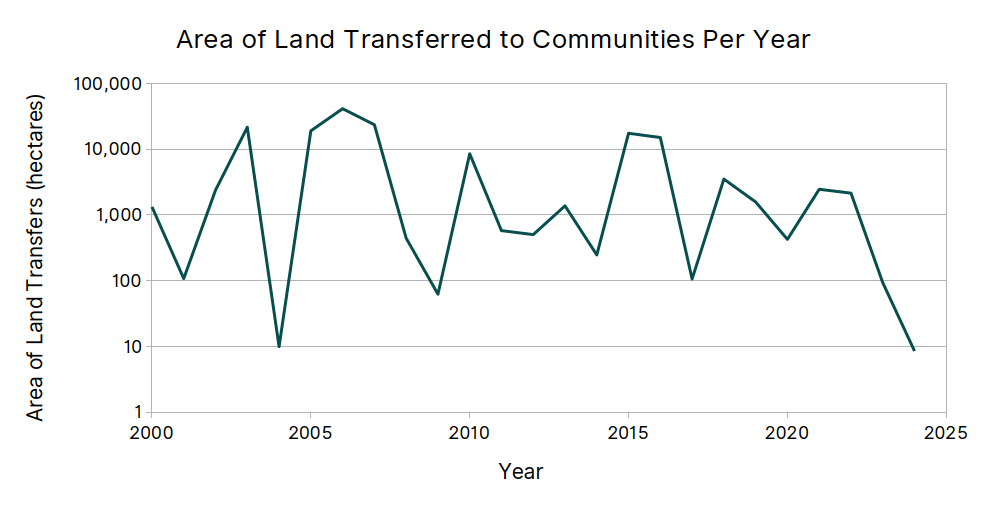
Move forwards three years to now and that community land report has been refreshed and brought up to date. Unfortunately, the results are even worse now. In the years between 2000 and 2023, an average of 7,023 hectares of land were transferred to community ownership each year. In 2024, just 8.46 hectares were transferred to community ownership. This is the lowest rate of transfer in a single year since 2000.

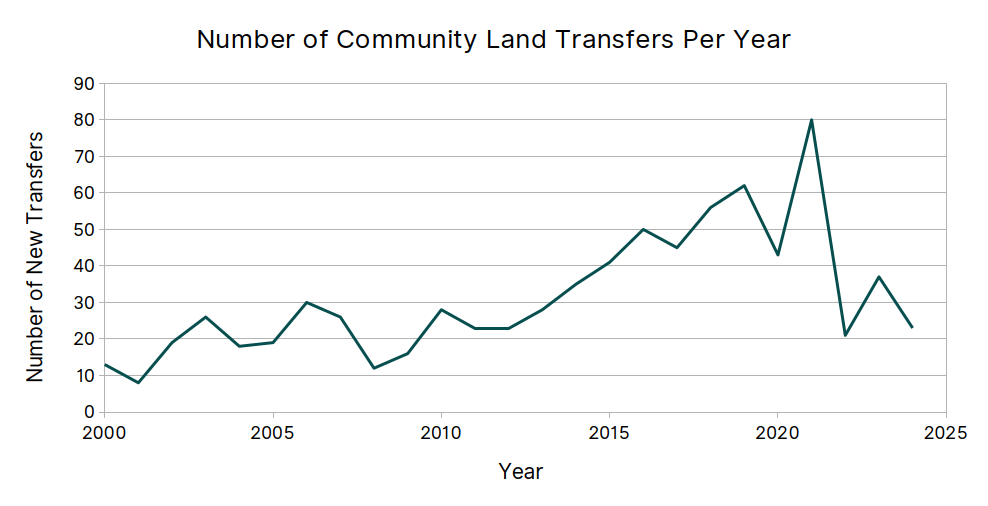
Worse, the total number of transfers has fallen off a cliff too. From a peak of 80 transfers in 2021, Scotland only transferred 23 parcels of land to communities in 2024.

Now, that peak of 80 in 2021 does show some evidence of delays caused by Covid in 2020 but even then, while the country was in total lockdown for much of that year, 43 transfers were made covering 423 hectares. In 2020, during the worst global pandemic of a lifetime, Scotland managed to transfer to community ownership 50 times as much land as it was able to do in 2024.

The drop in 2024 represents a total reversal of the progress made from 2014 which saw a substantial and sustained rise in communities being able to buy the land under their feet. These results show that far from the 2016 Act accelerating land transfers, they have almost halted since then. 95% of all of the land in community ownership in Scotland was transferred to communities before the 2016 Act took effect.

“The latest round of Land Reform clearly won’t be enough to fix this problem and it’s clearly not enough to satisfy what is as close to a unanimous poll of the Scottish public as it is practically possible to find.”

I believe that the reason for this stagnation is the same as the one I noted in 2022. Scottish land prices are being inflated beyond any reasonable expectation by speculators going all in on buying up land for carbon offsetting, encouraged by a Scottish Government that is similarly all in on encouraging “foreign direct investment” as the sole tool of boosting Scottish GDP, regardless of the cost to our future economy or our present communities.

The thing is though, I wonder if the votes on the Land Reform Bill might have been different had this latest report been public knowledge before it passed. It would have been valuable leverage for those campaigning for strong powers of community buyouts in that Bill. It might well have led to amendments designed to counter this trend of people being priced off the land.

I wonder why the Government didn’t publish this report then or even allude to its findings via its own amendments. I’m fairly sure that they would have had advance knowledge of the findings of the report to some degree (I know this because I recently had a Freedom of Information request on another issue knocked back on the excuse that while the Government had the data, it was due to be published anyway within a couple of months – which it duly was). Yet little was said during the various debates around this Bill.

The latest round of Land Reform clearly won’t be enough to fix this problem and it’s clearly not enough to satisfy what is as close to a unanimous poll of the Scottish public as it is practically possible to find. This is clearly an issue that must be revisited in the next Parliament. We’ll be keeping a close eye on manifestos as they are published and, of course, we’ll continue to campaign (with your support) for real land reform so that Scotland can start working for All of Us, rather than just the very few who can afford to buy the land under our feet.

To Build Houses, First Buy The Land

“I think we’ve been through a period where too many people have been given to understand that if they have a problem, it’s the government’s job to cope with it. ‘I have a problem, I’ll get a grant.’ ‘I’m homeless, the government must house me.’ They’re casting their problem on society. And, you know, there is no such thing as society. There are individual men and women, and there are families.” – Margaret Thatcher

This blog post previously appeared in Common Weal’s weekly newsletter. Sign up for the newsletter here.

If you’d like to support my work for Common Weal or support me and this blog directly, see my donate page here.

image_2025-01-29_150318951

Why are houses so expensive?

There are many reasons. To take just a few, Developers only build private housing at a rate just high enough to keep prices up and subsidies flowing, certain areas are being particularly pressured by those rich enough to own multiple homes at the expense of the local community, and – as we pointed out in our book All of Our Futures – the UK’s decision to push the burden of pensions away from the state and onto individuals has created a culture of “climbing the housing ladder” with “victory” meaning extracting the wealth you’ve accumulated through ever increasing house prices so that you can pay for retirement or, increasingly, so that you can give it to a private care firm owned by a tax-dodging hedge fund. That is, if you’re allowed to buy a house at all and aren’t destined to be one of the increasing number of private renting pensioners who face destitution due to rents and the lack of means to pay for care (something we warned about in All of our Futures but only recently being picked up as a problem by places like the FT).

Continue reading

It’s Time To Tax Scottish Land

“All I wish to make clear is that, without any increase in population, the progress of invention constantly tends to give a larger proportion of the produce to the owners of land, and a smaller and smaller proportion to labor and capital.” – Henry George

This blog post previously appeared in The National as part of Common Weal’s In Common newsletter.
If you’d like to throw me a wee tip to support this blog, you can here.

image_2024-09-09_204513798

Last week, I had the pleasure to address SNP members at the Revive Coalition’s fringe meeting on land reform where I presented Common Weal’s proposal to bring a land tax to Scotland. As the meeting wasn’t filmed, I want to discuss the issue here for the benefit of members (and non-members) who couldn’t be there. I am also delighted that after our fringe, members gave overwhelming support to two motions that would enable such a tax. Taxing land in Scotland is now solidly SNP policy and the Scottish Government should bring forward a Bill to enable it at the earliest opportunity. With the Scottish Government pledging to bring in fresh cuts of in excess of £500 million, to ignore a tool that would almost entirely avoid the need for them is simply unacceptable.

Continue reading

Repopulating Cleared Scotland

“This high-souled gentry and this noble and far-descended peasantry, ‘their country’s pride,’ were set at naught and ultimately obliterated for a set of greedy, secular adventurers, by the then representatives of the Ancient Earls of Sutherland.” – Donald Sage

(If you’d like me to speak at your conference or activist group, give me a shout. Find out more about the training and outreach I offer here. If you’d like to throw me a wee personal tip to support that work, you can here.)

brown and grey stone house near hills

My Provocation Speech at Community Land Scotland’s “Own Yersel” land reform conference on 10th May. You can watch my speech and the others in the session below.

Continue reading

Land Reform, Or Another Power Grab?

“The free society is characterized by the radical decentralization of all kinds of power. Confederal structures do not rule over communities; they are the means by which communities cooperate.” – Roy San Filippo

(This blog post previously appeared on Bella Caledonia.)

Corgarff

The Scottish government has introduced land reform legislation to encourage community ownership by granting ministers powers to intervene in the sale of estates of more than 1,000 hectares. The ruling Scottish National party said the bill, the biggest package of reforms in years, aimed to “revolutionise land ownership in Scotland” by empowering rural and island communities and increasing transparency in large land transactions.

In 2016 the last round of Land Reform made it easier for communities to buy out parcels of land, however the rampant rise in land prices – often now driven by so-called “Green Lairds” looking to cash in on carbon credits – have locked those same communities out of being able to afford to buy that land. With a few exceptions – such as in Langholm – the parcels of land being bought by communities have been getting smaller.  A report published in 2022 found that despite a steady rate of successful community buyout projects continuing much as it had since the start of devolution, the actual hectarage of land transferred had all but stalled with around 97% of all community owned land in Scotland being transferred before the passing of the 2016 Act.

Continue reading

Wealth Taxes and Land Reform

“It takes a strong leader to collaborate with others in an effort to bring about real change.” – Germany Kent

(My speech at the 2024 Scottish Labour Spring Conference fringe event on land reform, hosted by REVIVE)

gray concrete building near lake under white sky during daytime

Devolution has meant that Scotland has more responsibility than power. Tax powers as they are have limited scope to effect meaningful change to an unequal society.

Our most powerful devolved tax – income tax – has proven extremely hard to use and eats a lot of political capital – chiefly as it’s too easy for the very rich to avoid and everyone else doesn’t get paid nearly enough.

But income inequality is far outstripped by wealth inequality both in Scotland and in the UK and in a capitalist economy where those with wealth can use it to rent-seek off the backs of the folk who worked to earn it, we have a problem where it matters less who gets paid how much, it’s who hoards it after that.
We need a system of wealth taxes to rebalance our economy, cut down on the dragon’s hordes of the multi-billionaires who could never hope to spend it usefully in a lifetime and to ensure that assets are more efficiently used for the benefit of all of us.

Scotland has a lot of power to do good here if we choose to and while this isn’t the time or the place to discuss what we could do if the Scottish Parliament had more powers, it most certainly is the place to discuss what we can do now.

Continue reading

Levelling Glasgow

“It is not the beauty of a building you should look at; its the construction of the foundation that will stand the test of time.” – David Allan Coe

(This blog post previously appeared in Common Weal’s weekly newsletter. Sign up for the newsletter here.)

In May 2019, Glasgow City Council declared a climate emergency. In November 2021, the city hosted COP26 and made a substantial effort in front of an international audience to show off its climate credentials. Over the next couple of years, it will be betraying all of that by continuing its long and apparently proud tradition of levelling and replacing every building it can get away with regardless of the financial, social or climate cost.

image_2023-02-03_105613545

Continue reading

Whose Land?

The land so much needed by men was tilled by these people, who were on the verge of starvation, so that the corn might be sold abroad and the owners of the land might buy themselves hats and canes, and carriages and bronzes, etc.” – Leo Tolstoy

(This blog post previously appeared in Common Weal’s weekly newsletter. Sign up for the newsletter here.)

image_2022-10-25_091146266

If you read the Scottish press last week, you might have seen some headlines promoting the spectacular success of transfers of land to community ownership over the devolution era. The amount of land now in community ownership in Scotland has “skyrocketed” in the past twenty-odd years. If you heard the Scottish Government’s own statements on the news, you’d be forgiven in thinking that the last round of land reform in 2016 was a huge success.

If you read the actual report, your enthusiasm might be more muted. The actual rate at which hectares of land have transferred to community ownership in Scotland has completely flatlined since the last round of land reform legislation in 2016 with over 99% of all community owned land being transferred before that act came into effect.

Continue reading

Land Reform Requires Democracy

“As soon as the land of any country has all become private property, the landlords love to reap where they never sowed, and demand a rent even for its natural produce.” – Adam Smith

(This blog post previously appeared in Common Weal’s weekly newsletter. Sign up for the newsletter here.)

The Scottish Government is currently consulting on a new Land Reform Bill. The consultation closes next week so while there’s still time for you to submit your own response there isn’t much and you should get it in as soon as possible. We’ll be publishing our own response next week. In brief, the Scottish Government’s proposals are that Scotland should better regulate large-scale landholdings by forcing them to comply with the already existing but voluntary Land Rights and Responsibilities Statement that recommends actions to better care for land. The proposals suggest that a breach of the statement could lead to fines or cutting off access to Scottish Government subsidies.

The proposals also suggest that large-scale landowners regularly submit a Land Management Plan laying out, amongst other things, how the owner(s) will use the land, how that land use will contribute to “Net Zero” and how they will engage with the local community on reaching the goals and objectives they lay out for the land.

image_2022-09-20_101204975

Continue reading