This Could Be Home

“It seems obvious: the reason only a tiny percentage of new…buildings and retrofits aren’t green isn’t cost. It’s lack of ingenuity or knowledge of new construction techniques — architects and builders wed to the ‘same-old,’ lenders leery of anything unconventional.” – Sustainable Energy Africa
TCBH-SMALL-FB

Sign the petition or get involved here.

The Scottish Greens have launched our new #ThisCouldBeHome campaign aimed at greatly strengthening the current movements towards better land reform.

There are currently around 11,000 hectares of land in Scotland current derelict or un- or underused which, through the application of a Land Value Tax, could be freed up to build a new generation of affordable housing. Here is Andy Wightman introducing the campaign.

As the campaign points out, the current UK housing bubble is pushing rents up beyond the affordability of far too many people and those increasingly fortunate few who can scrape together a deposit and have secure enough employment to sustain a mortgage are looking with trepidation towards the day that the Bank of England starts pushing interest rates back up towards pre-2008 levels. For hard pressed people who can barely afford to pay the bills as it is, moves like this could result in yet another crash in the housing market and more families facing default, foreclosure and eviction.

We also live in a country with the second highest level of excess winter mortality of any European country north of the Alps, driven in large part by our lax building standards and fuel poverty.

For this reason, we should take this opportunity to ensure that those new houses which are built adhere to strict building regulations which push the limits of our technological abilities to ensure that energy bills and the other ongoing costs of running a building are kept at an absolute minimum. Of course, buildings are themselves often constructed to meet only the very minimum standards set by law as to do otherwise would eat into the private construction industry’s precious profit margin.

Of course, as the headline quote states, cost isn’t nearly the greatest obstacle to greener housing development and, as I have written previously, the Scottish government will soon be handed the power to borrow money far cheaper than can any bank or private company (As an alternative, the Common Weal has also pointed out that the Government has the power, today, to set up Scottish Housing Company to perform the same function) and could use that money, paid back through rents, to undercut the private industry and ensure that the highest green standards are adhered to. The precedent for this already exists in Scotland where, according to official government figures, the social rented housing stock are generally more energy efficient than private builds and contain a higher percentage of B and C grade housing (where the overall Scottish average is merely grade D). If we are willing to push things as far as we need to to reach a zero-carbon economy then a greater pool of cheap, efficient housing will force the private sector to either step up its game or step aside.
Passivhaus

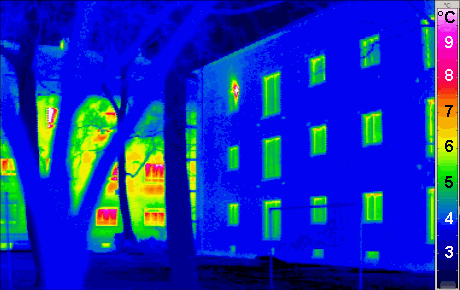
A Thermal image of an energy efficient “Passive House” compared to a more traditional, less well insulated dwelling behind it. Source: Passivhaus Institut

But how do we get everyone to A grade? One pathway can be found in the Passivhaus Standard which employs a strict understanding and approach to engineering and techniques such as solar thermal panels on roofs, underfloor ground source heat pumps, insulation throughout the house and architectural elements designed in from the start to minimise heat loss and maximise the amount of energy which can be harvested from the environment. Properly employed, these standards reduce a house’s heating requirements to below 15 kWh per square metre per year. By comparison the average Scottish house requires approximately 140 kWh per square metre per year to keep it warm. It’s no wonder so many of us struggle in winter. (Fun fact about Passivhaus, they have built a compliant dwelling now on every continent on Earth. Including Antarctica!)

With heating making up 55% of Scotland’s overall annual energy demand and only 10% of that heating coming from renewable sources (including renewable electricity) then it is clear that this is the area which, if targeted, will have the most potential to reduce our requirement to run a carbon based economy. This needs to be stressed. Whilst the Scottish Government has made great strides in pushing renewables (and despite the UK government’s increasingly hostile attitude towards them) if we only focus on meeting of our current electrical demands then we’ll still be reliant on fossil fuels for over three quarters of our energy and this doesn’t factor in the doubling of electrical demand which will come if we translate our transport system over to electric vehicles (assuming we don’t also reduce demand there too).

To achieve this may seem to require brave choices. But we can’t sustain the “same old” attitude for much longer. Pretty soon, doing nothing will be even “braver” (in the Yes Minister sense). I believe that a strong Green voice in the Scottish Parliament from May will help the government make those brave choices and your vote for the Greens in May will help that happen. As noted earlier, it’s not a problem of money or power holding us back here. Merely the will to roll up our sleeves and do it. We’ll be glad for it once we have. We’ll wonder why we didn’t do it sooner.


tcg-logo5


No, The EU Didn’t Just Ban Alcohol Minimum Pricing

whisky-572025_960_720

Just a small sample

But even if they did, we can still do something.

The European Court of Justice has released its judgment of the Scottish Government’s proposals to introduce a minimum unit price on alcohol.

Their judgment, published here, states that the proposals as written would be illegal on the grounds of being discriminatory towards cheap alcohol imports and thus would be a restriction on the free movement of goods within the EU.

They have, however, upheld the Scottish Governments arguments that MUP would lead to substantial health and social benefits and have agreed that it would, indeed, meet the goals of both reducing hazardous alcohol consumption and alcohol consumption in general (in an earlier article I noted that Scottish consumption of alcohol can be seen as substantially higher than the UK average simply by examining the tax records).

The court has therefore not banned MUP completely but has ruled that it cannot be implemented until and unless the national courts (i.e. Edinburgh and then the inevitable appeal to the Supreme Court in London) rule that the same alcohol reductions cannot be achieved via taxation. This sets out a test to be met by the Scottish Government.

But if that test is failed and taxation ruled appropriate, what form could it take?

The obvious first step would be alcohol duty but this is currently a reserved power and its devolution was ruled out of the Smith Agreement and the subsequent Scotland Act 2015 Bill. I would think it unlikely, given the current track record, that an amendment to devolve alcohol duty would succeed at this point so I think I’m safe in assuming that it will remain in Westminster hands. Nor, do I suspect, will George Osborne be keen to adjust his own plans for the UK simply to allow the Nationalists even a moment of victory so I can’t see him being amenable to changing alcohol duty at UK level either.

There is another way though, as pointed out by Andy Wightman on Twitter today, the Scottish Government currently DOES have the power to create new LOCAL taxes. If the courts ultimately agree with the ECJ that taxation would be just an effective method of reducing alcohol consumption as MUP then this would be a method within the competence of the Scottish Government to implement without further devolution or delay.

Such a tax need not be set locally, national legislation could fix the rate, though the advantages to doing so are quite strong. By keeping money within areas particularly blighted by alcoholism and alcohol abuse and by allowing the rates to be set to particularly target these areas the greatest good could be done the fastest. Conversely, those areas which perhaps see a lot of through traffic, people traveling into town for a responsible night out say, but suffer little actual harm from chronic abuse may wish to set rates somewhat lower so as to avoid driving away too much business.

While we’re looking at locally devolved alcohol sales taxes we could also take the advantage of the discussion to bring back proposals for alcohol production taxes too. Scotland is perhaps best known for its whisky exports but what is lesser known is the fact that many of the most famous distilleries actually employ comparatively few people and yet produce vast sums of money for their generally multinational corporate owners without doing all that much for a local area which often gives their very name to that drink. Given that these distilleries, and many brewers and other manufacturers, cannot easily move elsewhere (and certainly cannot move out of Scotland) then a local production tax seems particularly apt. Again, by setting it locally and by allowing local people a say in how it is set then they are in a position of power again and can directly benefit from our renowned exports.

Personally, I welcome the prospect of minimum unit pricing and do believe that it would be an effective aid to our national alcohol problem but my challenge to the government is that if the courts rule otherwise, there is still something we can do. Indeed, even if they don’t….why not both?

tcg-logo4

We Need To Talk About: Local Taxation


Council

Source: Flickr

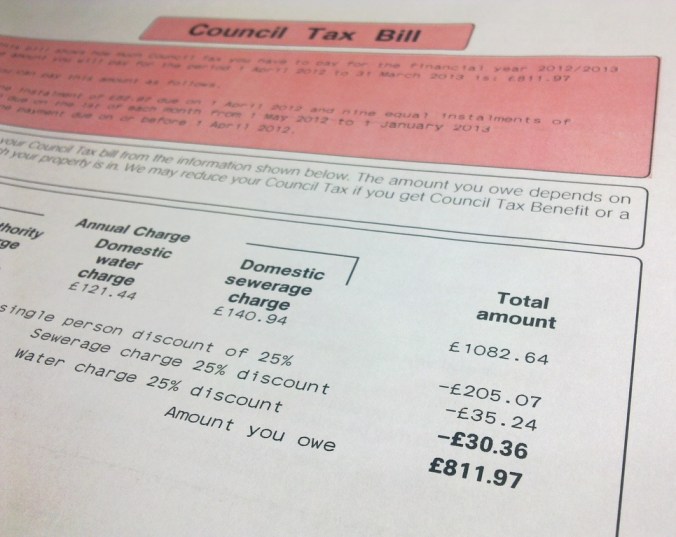
Next year brings in the Scottish Parliamentary Elections and with it comes the proposals from each of the parties on how best to use the limited powers that the Scottish Government will have at its disposal. No doubt, much of the news and comment will be around whether or not the (marginally) expanded powers over income tax coming in under the Scotland Bill 2012 will be used and by how much.

Our approach towards local taxation, however, will perhaps lead to a far more fundamental change to the fabric of our society. There is also far greater scope within the devolution powers to do something a bit more radical that simply raising or lowering the rate of tax by a penny or so (or repeatedly defending one’s reasons for not doing so). It is therefore important, before the campaigning season begins in earnest, to understand what our options are and the potential impacts of them.

Continue reading

20,000 Visits to The Common Green

20,000 Views

The blog hit a bit of a milestone today. 20,000 pageviews and over 16,500 visits!

All I can say is thank you for all of the support, especially in the last few days when things have went a bit viral. Here’s to the next few thousand visitors and to continuing efforts to shine just a little bit of light and opinion on the topics to come.

I’m still here to talk about all things Common and Green but if there’s anything else you think I can provide some insight on just give me a shout and I’ll see what I can do.

TCG logo

Holyrood 2016 Candidate Selection – First Hustings

I’ve just returned from my first hustings as part of the candidate selection for the Scottish Greens Holyrood 2016 campaign in the South of Scotland.

First, my thanks to the good folk at Dumfries and Galloway Greens for running an excellent evening. You did an amazing job keeping all 12 of us strictly to time.
The videos of all of the talks by candidates will be available soon and I’ll post my own here when it is.

I was thoroughly impressed with the quality of all of the candidates. Each one coming to the Green movement from our own directions and each showing their own particular areas of interest and expertise. The party has a tough choice ahead in terms of top billing of the list next year but no matter who is up there we’ll be a strong and effective party for it. The very best of luck to all.

Can’t wait to see you all again at Biggar on the 14th and in Ayr on the 20th.Holyrood2016