We Need To Talk About: A Negative Income Tax

First up, my apologies for going a little dark on the blog recently. Last month, I promised my thoughts on Scotland’s currency options going into the next independence campaign. That promise has turned into something a little bit larger than expected and will be coming soon. I think you’ll like it.

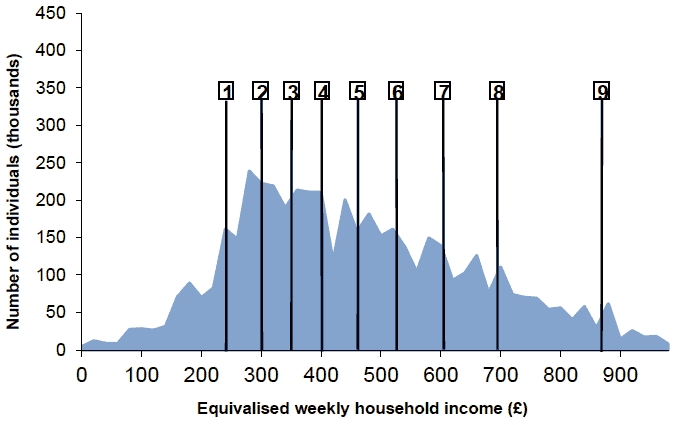
income decile

Scotland’s Income Distribution 2013-14

In the meantime, I’ve been pondering on some possible options regarding how we could reform Scotland’s welfare system, especially in the light that the UK has been explicitly called out by the United Nations for breaching human rights obligations due to the suffering caused by Austerity, inequality and the unfair and miserly welfare system in which too many find themselves trapped. The use of sanctions has been singled out as particularly cruel with countless cases of hardship and even deaths being directly linked to their use.

Both the Greens and Common Weal have been steadfast supporters of the policy of Citizen’s Income (or Universal Basic Income), a policy which is rapidly gaining traction around the world and is starting to look as if its time has come.

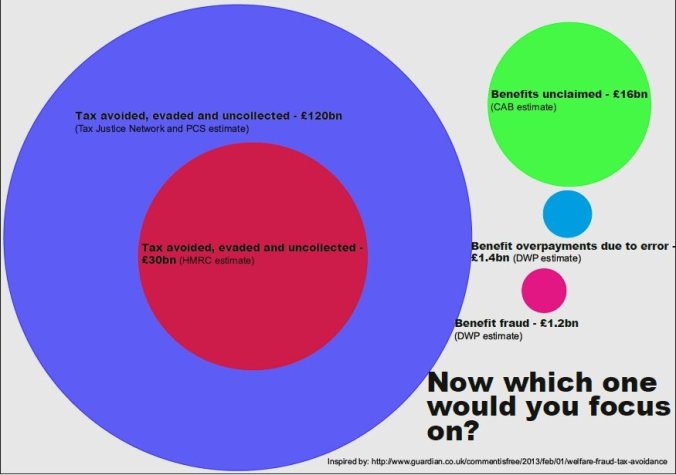
Under this policy the entire welfare system – with all its inequalities, complicated means-tested targeting, exceptions, exemptions, loopholes, paperwork, cheats, dodges, admin errors, fraudsters, bureaucracy and people simply missing out entirely because they don’t know they’re owed money or do but don’t, can’t or won’t claim – is done away with and replaced with a simple, regular payment to every citizen. You can’t claim money you’re not owed (except possibly by claiming for a dead relative or for kids you don’t have) and you can’t be missing out on money you don’t think you’re due. By the way, unclaimed money in the UK welfare system outweighs fraudulently claimed money by more than a factor of 10 and is dwarfed by tax avoidance by up to a factor of 100!

tax-v-benefit-fraud-graph-excellent-2

A Universal Basic Income also gives everyone a stake in the system and a guaranteed safety net if and when it is needed (in much the same way that the NHS is open and free at the point of use even if you can afford private care).

One of the downsides of Basic Income is that it does involve a large amount of money transfers. If we wanted to give all 5.3 million citizens of Scotland a Basic Income of, say, £73.10 per week (~£3,800 per year, the same as the current Jobseekers Allowance) then it would involve a monetary transfer of £20.1 billion per year which is only a couple of billion less than the entire social protection program for Scotland (which, of course, pays out a rather larger sum than £73.10 per week to many people such as pensioners and those with disabilities). Now, of course, this doesn’t imply that Basic Income would cost £20 billion per year. The idea would be that some threshold income would be set above which the income would be taxed back off you until the costs balanced and then onwards till you were a net contributor and helped to fund others (or, as an alternate POV, you were paying into the system to cover yourself for the times when you needed to withdraw). Regardless, the scale of the monetary transfers may be a significant bureaucratic barrier but so is the current piece-meal system that it would be replacing.

I fully support Citizen’s Income as a policy for an independent Scotland but we can’t do it now as we don’t have powers over welfare. I’m not keen on putting grand plans on hold till that day though so I’ve been giving thought to how Scotland could achieve a similar goal of a universal safety net using powers that we have right now. We don’t have power over welfare but do, finally and after great trials and tribulations, have powers over most of income tax.

This led me to thinking about a project advocated in 1968 by the economist Milton Friedman. The Negative Income Tax.

The concept is this. Instead of just having a low earnings threshold below which you pay zero tax (The UK Personal Allowance fulfills this purpose here) why not a threshold below which you receive a tax refund?

In this scheme Scotland could set an income threshold, say £16,500 – the equivalent of a full time job on the Living Wage. If you earn less than that in a year, the difference between what you earn and the threshold could be taxed at NEGATIVE 23%. If you only earned, say, £10,000. You would receive as a stipend 23% of £6,500 which is £1,495. If you earned nothing in the year, you’d receive 23% of £16,500 which is around £3,800 – The same as the current Jobseekers Allowance. The tax rate of -23% was chosen specifically to create that latter situation. One could easily imagine different rates or even a progressive system to cover people who fall seriously below the threshold proportionately more than those who only fall slightly under.

This system wouldn’t be a perfect substitution for Citizen’s Income for a few reasons. Most significantly, it is a lot easier to abuse or cheat the system by under-reporting one’s income, for example. If rates and thresholds are set inappropriately it may also lead to disincentives to work at around the threshold where someone converts from a recipient to a contributor though in the simple scheme proposed here this is less of an issue.

Negative income tax does have an advantage over Citizen’s Income by reducing the volume of monetary transfer though as only those who are earning below the threshold receive the stipend rather than everyone.

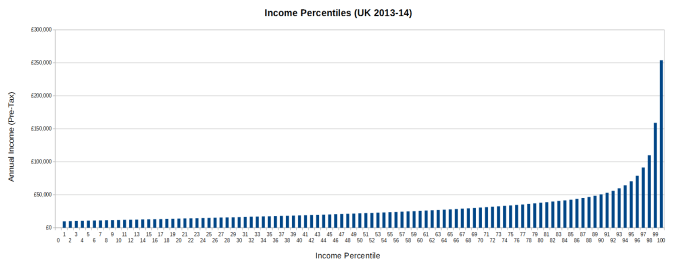
So how much would this cost? To find out, I’ve done some modelling using available income statistics, in particular the breakdown of income percentiles for the UK (percentile resolution income data for Scotland doesn’t seem to be easily available. If anyone out there knows of someone who does have it then please contact me, I’d be very interested in seeing it) .

Income Percentiles

One shocking thing about the UK is that the threshold we set, of £16,500 per year (which is, remember, the amount that said to be required to maintain a decent standard of living) is not reached until the 32nd percentile. Almost one in three workers in the UK are not earning enough to live on.

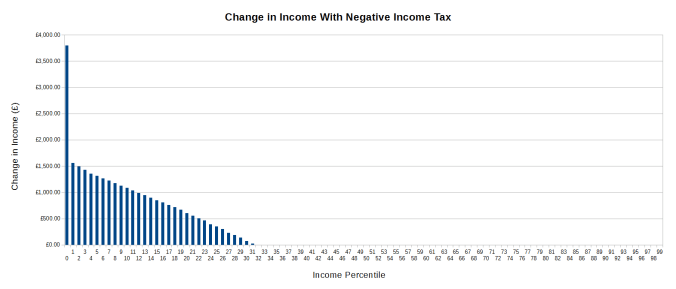
If we now add our negative income tax to this model to see how much a median person within each percentile would receive it looks something like the following.

Change in Income - No UR Tax

Something to bear in mind it this income percentile data only includes people who have at least some kind of earned income. It does not include the unemployed or those who are unable to or are not seeking work, the “economically inactive”. The ONS estimates that these two groups together make up around 21.6% of the UK working age population. If we factor that group into the figures modeled here (and assuming that Scotland’s figures are roughly in line with the UK’s which will be good enough for this back-of-envelope calculation) we can estimate that the negative income tax would cost Scotland around £2.4 billion per year.

This is where things get a little tricky for the policy idea. The obvious answer to meet the costs is by adjusting the upper rates of income tax to render the scheme revenue neutral. The problem is that the UK (and Scotland) are predominantly low wage, high inequality countries. We’ve already stated that if you’re on the absolute basic wage you’re already earning more than almost a third of other workers (and this doesn’t include those earning nothing). If you pay the 40% Higher Rate, you’re in at least the 86th percentile – the top 15% of earners – and if you pay the 45% Additional Rate (assuming you are even taking those earnings as “income” and aren’t transferring money into dividends or using more arcane accounting wizardry to minimise one’s tax bill) then you are in at the very least the top 2% of earners. This doesn’t leave a very large tax base from which to levy the required funds (This was one of the reasons that the policy advocated by the Greens for the return of the 50% rate was based on reasons of income and wealth equality rather than revenue raising and did not make any spending predictions or promises based on additional revenue from this band).

If one DID want to raise income taxes to find the £2.4bn then doing it solely through the Additional Rate simply would not be possible. Even raising it to 95% (and assuming that everyone pays it) would only cover half of that bill. In order to do it with the Higher Rate, both Higher and Additional Rates would need to be raised to a minimum of 58%.

Now, a normal, independent country would not face this problem because it would be able to tailor the other half of the balance sheet as well. If a negative income tax is replacing welfare spending then the welfare budget would decrease and the balance sheet would..well..balance. But in Scotland’s case, welfare is reserved so what becomes a simple exercise in government policy which would pay for itself and hugely benefit the poorest in our society becomes a constitutional question and a financial bung of £2.4 billion per year to Westminster. Whilst we have the “powers” to adjust our tax rates, Scotland just simply does not have the ability to use them in any kind of effective manner. Those who demand that “we use the powers we have” whilst blocking the levers which would otherwise allow us to do so should reflect on their actions and words. I’m thinking particularly of our Secretary of State “for” Scotland, the “Right Honourable” David Mundell who, as we remember, has not only taunted the Scottish Government towards “using our powers” but has also threatened to tax any welfare top-ups the Scottish Government might be willing to grant. I hold no great hope of Westminster’s generosity extending to them returning saved welfare money in order to pay for a negative income tax.

I’m open to suggestions at this point. If anyone can square this circle, please…please tell me. I think I’ve found a policy which, on paper, would be within Scotland’s current powers to implement but I can’t find a way to make it work within the pitiful financial constraints of our devolution. I don’t want to have to “wait till indy” to get some of this vital work started nor am I content knowing that people could be helped but cannot be because of Westminster’s refusal to either do it or to hand over the reigns to someone who will.

This shouldn’t be such a difficult process. Only in Scotland, within the United Kingdom, in the 21st century, where we’re told we’re incapable of governing ourselves, whilst those who say that they can govern stand by and either do nothing or actively work against us, does it become one.

tcg-logo6c

EU’re Out, Apparently

SaltireEU2.png

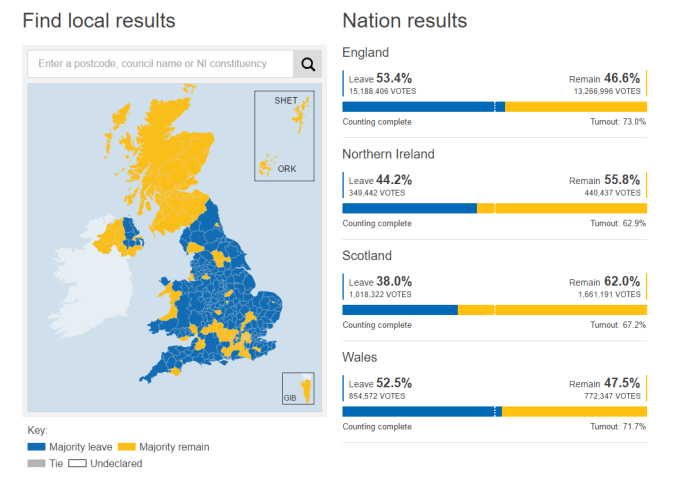
Well that’s that then. Votes cast and counted and the UK, by a margin of 51.9% to 48.1% have voted to Leave the European Union. The long, fractious and never really embracing journey that the UK has been on shall now enter a new phase. I can only guess as to where it’ll end up.

You may have heard by now though that the vote across the nations and regions of our “One Nation” was not homogeneous.

EU Results

England and Wales voted to Leave. Scotland and Northern Ireland voted to Remain. It represents yet another rejection by Scotland of “UK” politics and I believe that, as previously stated, a second independence referendum is now inevitable. The First Minister has herself confirmed this morning that the Scottish Government is now going to actively pursue one whilst also seeking to negotiate directly with the EU to try to preserve and protect our relationship. I do not believe that we will find that door to be particularly tightly closed.

As for Leave, once they’ve dealt with the resignation of David Cameron, probably a few key allies too, and have taken over the Tory party they’ll have to get into the grit of actually disengaging with the EU.

The EU Commission has already made it clear, understandably, that they would prefer Article 50 to be triggered as soon as possible so that they can get the whole business done and dusted. Leave, however, are still trying to be cagey. Some of the talking heads in the media today are still even hinting at an “alternative” plan like a Vienna Convention type disengagement. The big problem with that idea is that, even if it’s possible, it can be vetoed by any of the remaining 27 states. If the EU insists that Article 50 and a formal discussion is the way to go then it can indeed insist that it shall be.

It’s still very far from certain what the UK’s future relationship with Europe will actually be once all is done and dusted.

Indeed, there’s an outside chance that a Brexit may not yet happen. It could be that the Tory leadership changeover results in a General Election…which the Tories then lose. Labour, especially one which actively campaigned on the point, could well ignore the referendum result. At this point I wouldn’t discount any possibility, no matter how unlikely.

Assuming though that Boris Johnson and chums take the reigns and we go through Article 50 and Brexit happens, there’s still several possibilities (ranging from EFTA, through a set of Swiss style biateral treaties, through a CETA/TTIP type deal and out to the “default” WTO regulations only) which I outlined here.

I’m particularly disturbed by some of the rhetoric which stuck. Lord Ashcroft’s on-the-day polling found a solid correlation between likelihood of voting Leave and support for the argument that it would help “Take Back Control”.

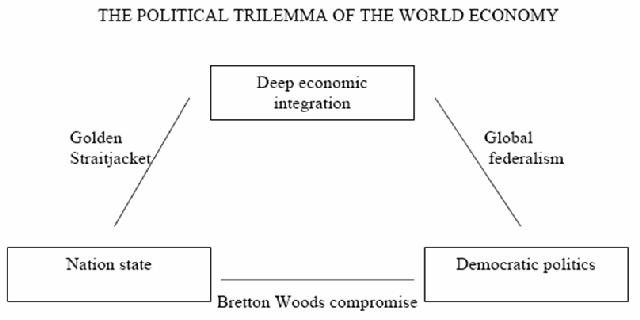
trilemma

I mentioned in my article on sovereignty that countries which pin themselves to the idea of national level politics, especially to the point of it becoming a geas, can bind themselves into the Globalisation Trilemma. If, as I suspect they will, Leave use their win to forge towards turning the UK into some kind of Free Market paradise then the concept of democratic politics could find itself severely compromised.

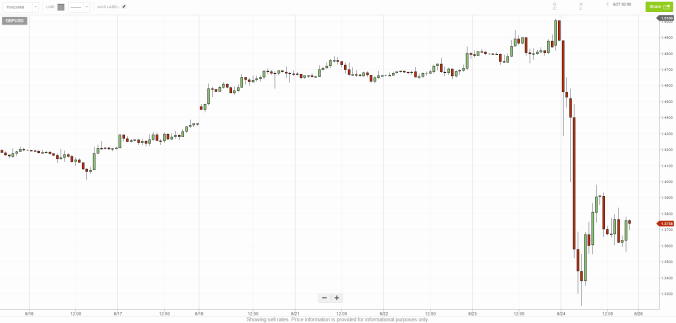
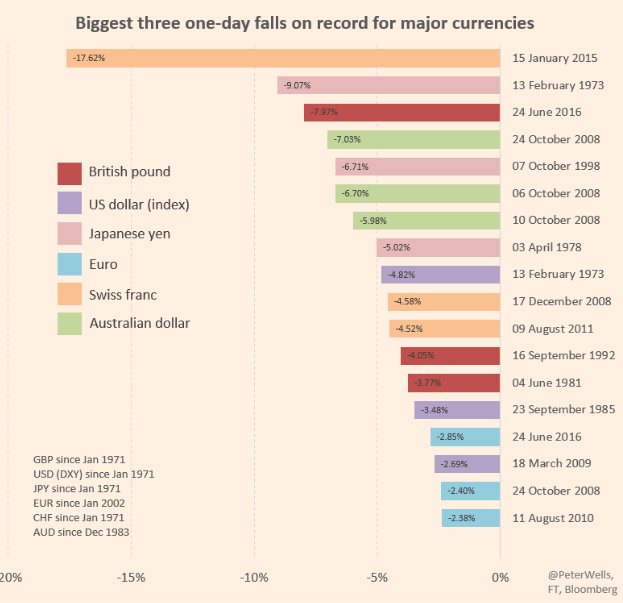
Speaking of the Free Market, it was in the financial world that the most “excitement” of election night was to be found. The polls, public and private, in the days running up to voting day had starting indicating a Remain vote. This had pushed the value of the GBP up significantly as traders started “buying the rumour“. When the Sunderland vote came in though it was the first indication that things were not going to go well for Remain. That one result caused a panic sell in the markets which did not improve as the night went on. By morning, the “Great” British pound had fallen to the weakest point seen since 1985 and, after a morning-after retracement, had lost 8% of its value. This is the worst single day hit that the pound has ever taken, twice as deep as plunge as 1992’s “Black Wednesday” and the third deepest single day hit ANY major currency has taken in modern times. History books shall be written on this point alone.

GBPUSD 240616.png

Currency fall

It should be of very careful note that against the Euro, the Pound lost about 10% of its value compared to 2015. This is important because the UK had a trade deficit with the EU of about £68 billion in 2015. Assuming all things other than currency being equal then that trade deficit could be expected to rise to £75 billion simply because it’s now more expensive to import goods and services from Europe.

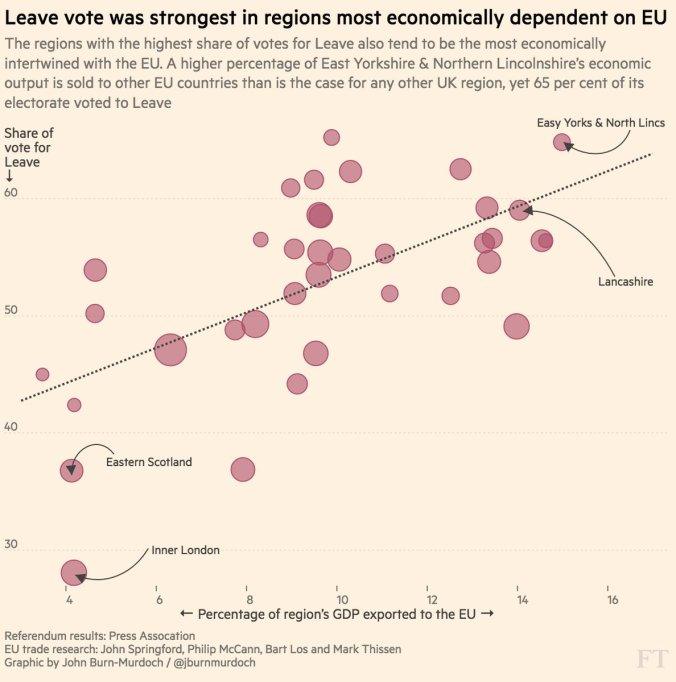
This difference in trade, around £7 billion, represents almost exactly the amount that Leave claimed that we’d “save” in net contributions to the EU. There may well be no gains, no money for the NHS or anything else that was promised. I hope I’m wrong. Because if I’m not, the areas which most voted Leave are also the areas most likely to be dependent on the EU for trade. They will be the areas most reliant on a good deal and/or economic plan for what comes after.

FTEUDependents.jpg

As for Scotland, it’s looking now almost inevitable that this result will hasten another go at an independence referendum and, this time, not only will it not be called until we’re ready but it’s looking rather like a lot of former No voters who had been promised that their vote would ensure their EU membership have now seen that whisked away. It has been enough to convince many that independence is now the best option ahead of Scotland. If you happen to be one of them, Welcome.

The Greens and the SNP, will now be exploring all options to protect and preserve our EU relationship. We’re in very uncertain times now with few precedents to guide us so what form this will all take is a matter of pure speculation.

My own preferred option could take the form of direct negotiations between the Scottish Government and the EU resulting in some kind of deal whereby if an independence referendum is held and won in the period before formal Brexit then a newly independent Scotland could “inherit” the UK’s old seat with no loss of continuity. Of course, this would require the co-operation of the Westminster government to allow such negotiations to take place or to even acknowledge that the result in Scotland is significant. It would be a tragedy of democracy if we were simply ignored.

I’ve got no easy answers for the next few months, or years. I’m as much an unwilling passenger as everyone else who voted Remain yesterday. I’ll try my best to work out where we’re going just as soon as it becomes apparent though. And who knows. Maybe, just maybe, we’ll get off early.

tcg-logo6c

Are EU In or Out? – Part 6: The Issues – Sovereignty

Qualifier: The following article shall cite political views which represent, to the best of my understanding, the positions of the Official Remain and Leave campaigns. As such they may not necessarily represent the views held by myself or by any organisations or political parties of which I am a member. My own views shall be indicated throughout.

Part 1: What is The EU? can be read here

Part 2: A Brief History of Brexit can be read here

Part 3: The Issues – Immigration can be read here

Part 4: The Issues – Trade, Economy and Finance can be read here

Part 5: The Issues – Brexit Negotiations can be read here

A Side Note – A Review of Vote Leave’s “Leaving Framework” can be read here

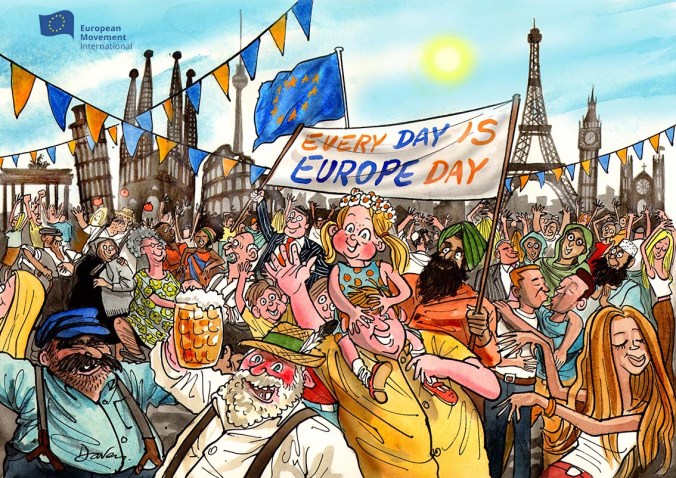
Europe Day

A poster for EMI’s 2016 Europe Day events.

Sovereignty

Likely to be one of the “softer” issues in this debate as unlike immigration and unlike the economy it’s one that doesn’t render down so easily into simply numbers. This doesn’t mean it’s any less important. How we feel about the concept of “Europe” plays a very large part both in what we will want out of that relationship, what we will want Europe to become and what we want ourselves to become either within or outwith the Union. It also tells us a lot about how we see our relationship with our governments which means that the result on Thursday may well have deeper ramifications on how the United Kingdom itself is governed. Sovereignty, who controls the locus of power and where it resides, is a policy on which your position may well lie in how you define it.

Continue reading

SP16: The Morning After

I’ll confess to being a lightweight. I snuck off for a few hours sleep right after the Clydesdale results were called and woke up right after the Lothian list so unlike virtually every other political pundit in Scotland right now, I’m able to type only marginally less coherently than normal.

So. How about those results?

The Green contingent has expanded three-fold and whilst I’m more than a little upset that neither of the two candidates covered by my branch, Kirsten Robb and Sarah Beattie-Smith, made it in I’m heartened by the success of the others notably Andy Wightman in Lothians. Who Owns Scotland? We’re about to find out!

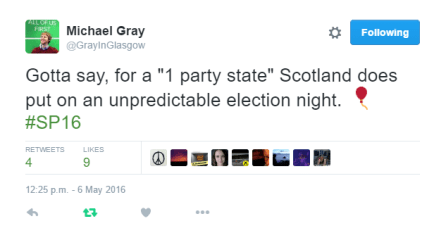
My hypothesis that the SNP would come back with another majority appear to have been disproven although a clear pro-independence majority remains. Arguably, the Greens could call this a result significantly in our favour as we move to the wrangling over Parliamentary positioning begins.

I’m willing to be wrong again but I can’t see much appetite for an offer of a formal coalition. It doesn’t seem like good game theory for the SNP to offer up a Ministerial position (almost certainly something like Energy or Environment) just to avoid a two seat minority. Especially when they already have form for running a minority government with a fair degree of success.

I could see a discussion over some kind of Supply and Confidence arrangement based on some concessions that the Greens have campaigned on and over which there’s already a substantial level of support within the SNP membership.

I’ll make one prediction on this point. Unless the SNP are willing to rely on Tory support, Fracking will not happen in Scotland. Good.

I’d be hoping that there might be some more movement over local taxation and, perhaps, the Scottish Government will let Andy formally get his teeth and claws into the Land Reform Bill. That’ll be a joy to watch. The Greens campaigned on giving the Scottish Government the courage to be bolder on a range of issues. Here’s hoping it can.

So, on the vote itself. We saw hints of the total flight of the Right and Unionist vote within Labour as early as November last year but even as the last polls came in they appear to have underestimated the depth of that flight. Ruth Davidson’s campaign to get people to vote Unionist, rather than Conservative, appear to have been successful. What shall be interesting to watch now is what she does with that support. How far can they be pushed on Austerity (or how far can blame for it be deflected) before the Union-at-any-cost vote starts to tally up just that?

Where it leaves Labour is another great unknown. They’ve been utterly wiped from their birthplace in Glasgow and Lanarkshire and have retreated to the Morningside Reds of Edinburgh. They appear to have three choices ahead of them. Either ossify as an increasingly marginal voice in Scottish politics; Abandon the Unionist vote and try to out-left the SNP (I don’t think at this stage that even a drastic Home Rule or Federal position would draw back those now set on independence) or try to out-right the Tories (which would mean claiming, adopting and accelerating Austerity). I cannot honestly see a route back to the forefront of Scottish politics for Labour barring some singularity event such as actual independence or some act of self-destruction within the SNP greater even than the one that UK Labour appear bent on.

The proportionality of AMS was stretched rather to its limits last night. Despite narrowly missing out on a majority the SNP, as the largest party, were the largest beneficiaries of the system gaining approximately 9 seats more than their regional vote percentage would have suggested. The Tories though also benefited gaining about two more seats than their regional vote share whilst Labour broke about even, the Greens losing one seat and the Lib Dems being rather drubbed by the system, losing three seats to the maths. This calculation would have been mitigated by the addition of 6 “Other” seats which, on these results, would have more likely have been distributed amongst the sitting parties rather than going to smaller ones. In most proportional voting systems around the world a minimum threshold of 5% is often applied and, in our case last night, no small party achieved more than 2% nationally or more than 4% in any single region.

Seat Allocation

It’ll be interesting to see if there are any calls for electoral reform based on these results the way even the SNP made a mild complaint about their overwhelming success under FPTP last year.

Another topic which will now need to be thrashed out is the position of Presiding Officer. I reckon that this year the wrangling over whether the party/ies of government or of opposition give up an MSP for the post will be particularly intense this year given the slim margins and the tactical situations faced by each of the parties. The SNP won’t want to dilute their minority any further, Labour won’t want to shrink further either, the Tories and Greens will want to capitalise on their gains to maximum effect and if the Lib Dems lose one more MSP they cease to be an official parliamentary group.

Personally, I’m rather disturbed by the concept of choosing the PO from the MSPs in the first place. Why should the electorate who have only just chosen their representatives have to give one up as the PO must remain neutral, must resign from the political party and whip and have severe restrictions on where and how they vote (Only in the event of a tie and only to maintain the status quo or further the debate). To me, this isn’t a job for a Member of the Scottish Parliament. I’d look towards inspiration from the “checks and balances” of the US. Perhaps the PO should be appointed from a pool of senior judges or similar judicial positions? They are already used to applying impartially the rule of law so should trivially be able to manage Parliament in a neutral manner.

Of course, an alternative to a Presiding Officer could be an elected President, but that is likely to be a discussion for a post-independence situation…

Where do we go from here? I honestly have no idea. Going from bracing for a substantial majority and “the most boring Parliament” of the devolution period (as one pundit put it) to back to the days of actual discussion about policy I think the next five years could be one filled with potential…if we choose to allow it. For a last word:

Grey.png

tcg-logo5

Paying For It

“I would say is that every public-private partnership in Scotland has delivered new hospitals or new schools in Scotland on time and within budget and that’s the sort of success I want to see in every building.” – Jack McConnell, 2002

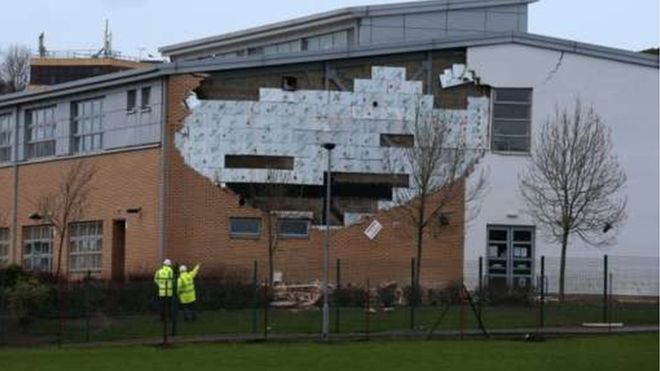
wall

Oxgangs Primary School, 2016. Built by PFI in 2005

The dramatic news from Edinburgh in the past couple of weeks has put into sharp focus the failures of some of the finance models used by our regional councils to build schools, hospitals and other public buildings in recent years. Public/Private Partnerships (PPP), Private Finance Initiatives (PFI) and, less well known, Lender Option, Buyer Option (LOBO) Loans have burdened our councils with near-crippling financial obligations and, as we now know, have too often failed to deliver on even the basic standards of results required. Just what these deals are and why they have been used is a topic which requires a bit of discussion.

PPP/PFI

Public Private Partnerships, of which Private Finance Initiatives are a specific type, are a form of capital investment introduced to the UK in the early 1990’s by Major’s Conservative government as an alternative to tradition procurement methods of the time. In traditional public investment models a local authority might decide to build an asset such as a school itself in a purely publicly funded model or it might contract a private source to build the school and then take over the full running costs of the project afterwards. The Tories were driven by an ideological pledge to reduce the budget deficit (then known by the catchy title of “public sector borrowing requirement“) and identified the use of PFI as a means to do this.

Instead of paying for a project out of the capital budget either up-front or over the span of the construction phase, PFI would spread the costs over a medium or long term contract, often more than 20 years. This reduced the single year outlay and hence massaged the budget figures.

It was under the Labour government though that PFI really took off as it had the advantage of taking capital debts “off-book” and allowed Gordon Brown to simply stop counting them towards the deficit entirely. This gave the illusion of the fiscal prudence on which he banked much of his reputation. This was doubled down in Scotland by Jack McConnell’s Labour/Lib Dem government which led to Scotland, with 8.5% of the UK population, ending up with some 40% of the UK’s PFI funded schools.

The lie to the illusion can be found in the realisation that the private sector doesn’t work for free. These contracts almost certainly mean that the total cost to the council over the lifetime of the council is significantly larger than the up-front capital costs.

PFI

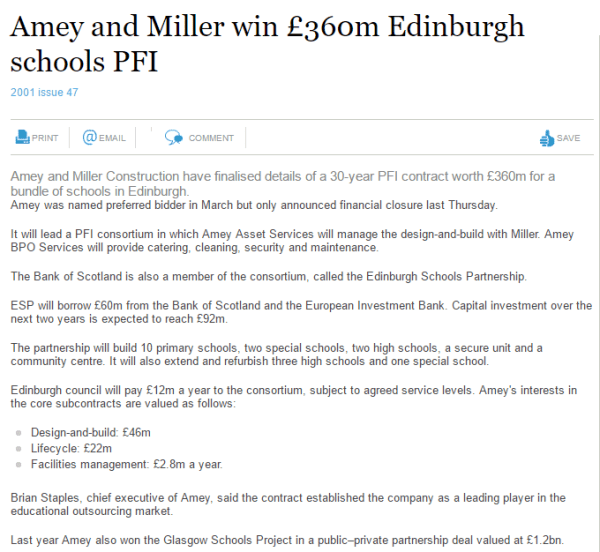
To take a recent example concerning some of the schools in Edinburgh, the private company involved will be paid £12 million per year for 30 years for a project valued at £68 million in up-front costs and an additional £84 million in management costs. Subtracting the running costs, this represents an annualised return on capital investment for the company of 10% per year. For contrast, David Cameron’s offshore tax haven shares “only” earned him about 6.75% per year.

And this doesn’t even represent the worst example of increased costs due to PFI. Contracts worth three or four times the capital investment are common. Some have been found to be worth a staggering ten or even twelve times the total outlay.

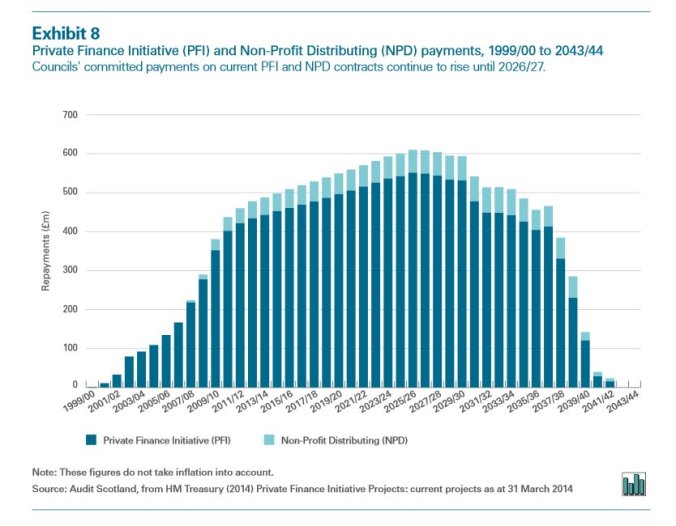
It is these ongoing payments which are particularly affecting our own regional councils and the problem is only going to get worse with the peak of the outgoing payments not expected to hit till the mid 2020’s.

PFI

Whilst one of the advantages of PPP’s often touted is the obligation for the private company to maintain the asset over the lifetime of the contract this can be a double-edged sword. One of the other “advantages”, mentioned in the UN ESCAP video above, is the “realisation of private sector efficiency savings”. That can mean “cutting-corners” to you and me. If the company is required to maintain a school for only 30 years but is then free from that obligation on year 31 then the inducement to build to the minimum possible standards to see out that contract is strong. Indeed, there is some anecdotal eyewitness evidence that exactly this has taken place. Schools which, by today’s standards are insufficient but which nonetheless stood for more than 100 years are being replaced with buildings designed to last less than a quarter of that and, has been seen, sometimes don’t even make it that far. This is not “long term planning”. It is certainly not helped by the generally low standards of our building regulations. A private company will rarely build at anything other than barely above the minimum legal standards so if we’re going to continue involving “the market” in our infrastructure projects then we’re going to need to have a discussion about increasing those standards to something more suitable for the 21st century. Whilst PFI specifically may have been abandoned in Scotland, this discussion over standards remains.

LOBO Loans

Lender Option, Buyer Option loans make up a far smaller proportion of council borrowing than PPP/PFI and have hit fewer headlines but they are still a symptom of the chronic dysfunction of our public borrowing system.

These loans were launched in 2000 as an alternative to the National Loans Fund which, whilst cheap and stable due to being funded by UK gilts, are sometimes quite limited in scope and therefore not always avaliable when required. Instead, the public body can approach a commercial bank for a long term, often more than 40 years, loan which is offered at an initially low “teaser rate” but which includes a clause which allows the lender to change the interest rate, usually upwards, are regular, often annual, intervals.

Sometimes these rate adjustments carry with them a contract exit clause but one can imagine the conversation in that case.

Bank: “So, we’re planning on increasing your interest rate from 2% to 5%. Under Section 4 of our contract, you can exit the loan by paying back the outstanding primary plus our exit fee.”
Council: “If we had that kind of money, we wouldn’t have needed the loan.”
Bank: “Ok. 5% it is. See you next year!”

These loans were often offered to and accepted by councils without the council quite appreciating the potential volatility and uncertainty that these changes would represent, which is quite understandable as these contracts have been criticised as being some of the most complex in the financial world and as our locally elected representatives aren’t necessarily chartered accountants it’s perhaps understandable that some would have simply been sucked in by those teaser rates which, at the time, undercut even those bonds offered by the NLF.

What Next?

I’m not going to pretend I have a magic solution to all of this. Some have discussed simply canceling and renationalising PFI funded assets but whilst I have some sympathy for this I have concerns also. Right now, we simply don’t know how far the record of substandard workmanship within the works built runs and, in fairness to the companies behind this disaster, they are upholding their obligation to pay the costs of repair and, if required, rebuild of these schools. If the contracts were canceled before we know the extend of the repair bill then we might simply be bailing out a huge debt. I can see some kind of scope for some kind of renegotiation over the annual payments or contract terms, perhaps with some kind of profit cap. Perhaps the companies could be offered an exit but made to put up a bond in case future issues arise although as we’ve seen from the coal and, more recently, the steel industry those bonds themselves need to be planned carefully lest they prove insufficient or evadable.

In future, a more sustainable method of public borrowing and investment needs to be examined. The Common Weal has a proposal to use a mutual limited company to leverage funds backed by Scottish issued bonds to invest in our public infrastructure which is perhaps one of the better ways to go about this issue although it is acknowledged that Scotland’s very limited borrowing powers even under the “new powers” of the Scotland Act 2015 will likely cap the viability of such a scheme. Obviously, an independent Scotland wouldn’t have that problem but until that’s sorted, we may need to think of something else.

tcg-logo5

Reformers Reforming Reforms

“The present Council Tax system must end.” – The Commission on Local Tax Reform’s Final Report

Whilst we’re still just a bit too far away from the elections to get to see the actual manifestos, something resembling policy is now starting to trickle out from the parties.

Given the currently still limited nature of tax raising policy within Scotland it’s natural to focus on those areas where control is possible and since the publication and acceptance of the Commission on Local Tax Reform’s report on the need for an overhaul in local taxation in Scotland. So far, both the SNP and Labour have released their detailed plans and, so far, both have been somewhat lacking in ambition.

Continue reading

We Need To Talk About: GERS (2014-15 Edition)

Economics: The art of explaining why all of your models fail to predict either the future or the past.

GERS

Click image above for data

It’s that time of year again when everyone starts looking at the first page of a dense booklet of economic data and uses it to wildly forecast despite long known limitations in doing so. So it’s also, once again, time for me to try looking a little further to tease out some details that others might have missed.

First, to get some of the headline figures out of the way. There has been a slump in offshore oil revenue due, largely, to the crash in the oil price resulting from the ongoing economic conflict going on between Saudi Arabia and the US.

This has caused oil revenues to drop from £4.0bn in 2013-14 to £1.8bn in these current figures. And thus came sic a cry of a “>£2 billion BLACK HOLE” from certain sources…

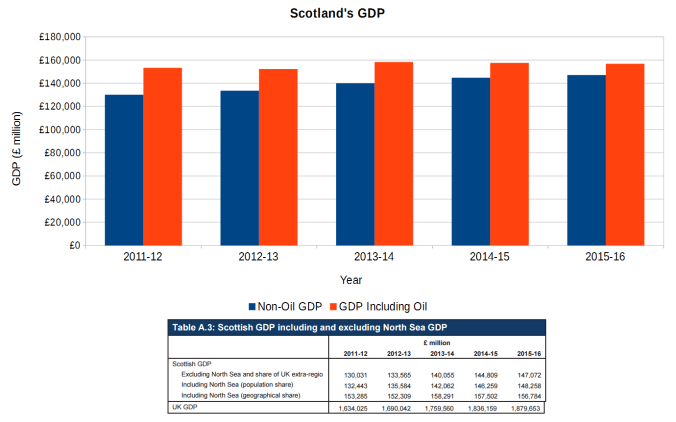
…except…total current revenue is only down £600 million. Down from £54.050 billion last year to £53.443 billion this year. That’s just a touch over 1% of a change and is comparable to some of previous year’s “budget underspends“, thus it could even be said to be within the margin of error of budget estimates. So what is going on?

Continue reading

We Need To Talk About: The “Tactical Vote”

“People who think about politics every day greatly overestimate how much time the average person spends thinking about politics” – A maxim that every political activist should pin on their wall.

Wheel.png

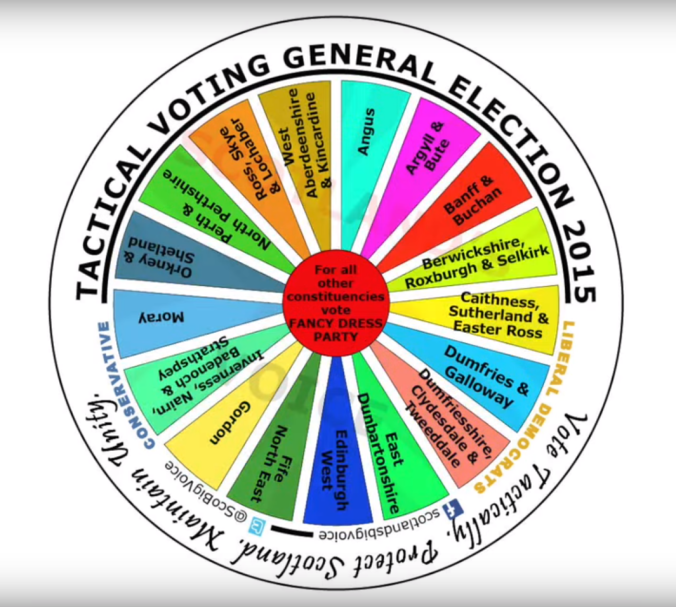
One of the many, many parodies of the #SNPOUT “Tactical Voting Wheel” seen in the run up to the 2015 UK General Election. Source: Youtube

We’re just about to cross into the single digit weeks remaining before the 2016 Holyrood elections and among a subset of the political campaigning community the inevitable debate over the “tactical vote” rumbles on. I, myself, have had a couple of fairly interesting conversations with a few such voters over the past couple of days which crystalised a few thoughts in my head about it.

Continue reading

The Devolution Journey: Part 1 – The Treaty of Union

This is Part 1 of what shall become a companion piece to my previous history of devolution and tax powers which can be read here.

As we edge closer to the the May elections and (maybe) to the passing of the Scotland Act 2015 we can continue our reflection on the process and “journey” of devolution. My last piece on the subject looked solely at the transfer of tax powers to the Scottish Government since 1999. This one will look at several of the other functions of governance and the process of the transfer of power over other important areas. To do this though, we need to look back a little further.

Continue reading

An Arbitrary Failure

Smith

The relevant passage from the Smith Commission Report. Page 28.

David Mundell, who is currently crowing that the Smith Commission has been delivered “in full”, has just blocked a key element of it.

All of the Smith parties agreed to consult on the possibility of allowing Scotland to issue post-study visas for visiting students to allow them to continue working (and paying taxes) in Scotland, the country which educated them, after they graduate.

Mundell has just blocked that proposal without such consultation and before the Scottish Affairs Committee looking into it has even had a chance to report back. (Story here)

One of the most upsetting moments in my own personal indyref campaign was hearing from a young lass whose partner was one such visiting student. He had come to Scotland to study engineering and, after falling in love both with our country and one of its inhabitants he decided that he wanted to stay, to build his career and to make Scotland his home. Just two weeks after his graduation, the UK Government rewarded his endeavour with arrest, incarceration in Dungavel and deportation.

Dungavel3.jpg

Protests outside the Dungavel Detention Centre. Source: Wikipedia.

This is not how a civilised country should treat other human beings. Instead, we should be encouraging those who, after all, pay significant sums of money towards their education to find a place within Scotland should they choose to do so. Many will find high paid, highly skilled and highly sought after jobs. Many others will start businesses of their own and CREATE those same jobs. Even the graduates who choose to leave Scotland will, if they are treated with respect, go on to strengthen our trade and business links with the countries to which they go. Something to bear in mind with respect to the UK’s worrying trade deficit combined with a currency value currently at the lowest level since the Tories took power and which is rapidly approaching the weakest value it’s had in 30 years.

Think about it David. If you were incarcerated and forcibly ejected from here simply because you had graduated, would you look upon this country favourably afterwards? Of course not. Would you consider sending your kids to study in a country which threatened to do the same to them? Of course you wouldn’t.

As Smith notes, this policy doesn’t require any additional powers to be devolved, indeed the similar Fresh Talent scheme used to be implemented in Scotland between 2005 and 2008 and was rolled out successfully to the entire UK until 2012 when it was scrapped by the Coalition government.  Mundell’s decision therefore seems especially arbitrary, short-sighted and, frankly, smacks of nothing less than a jumped-up Governor throwing his weight around simply because he thinks he cannot be challenged.

tcg-logo4