Scotland can’t keep hoping we’ll ‘get lucky’ when storms hit

“Climate change will manifest as a series of disasters viewed through phones with footage that gets closer and closer to where you live until you’re the one filming it” – @PerthshireMags, Twitter

This blog post previously appeared in The National as part of Common Weal’s In Common newsletter.

If you’d like to support my work for Common Weal or support me and this blog directly, see my donation policy page here.
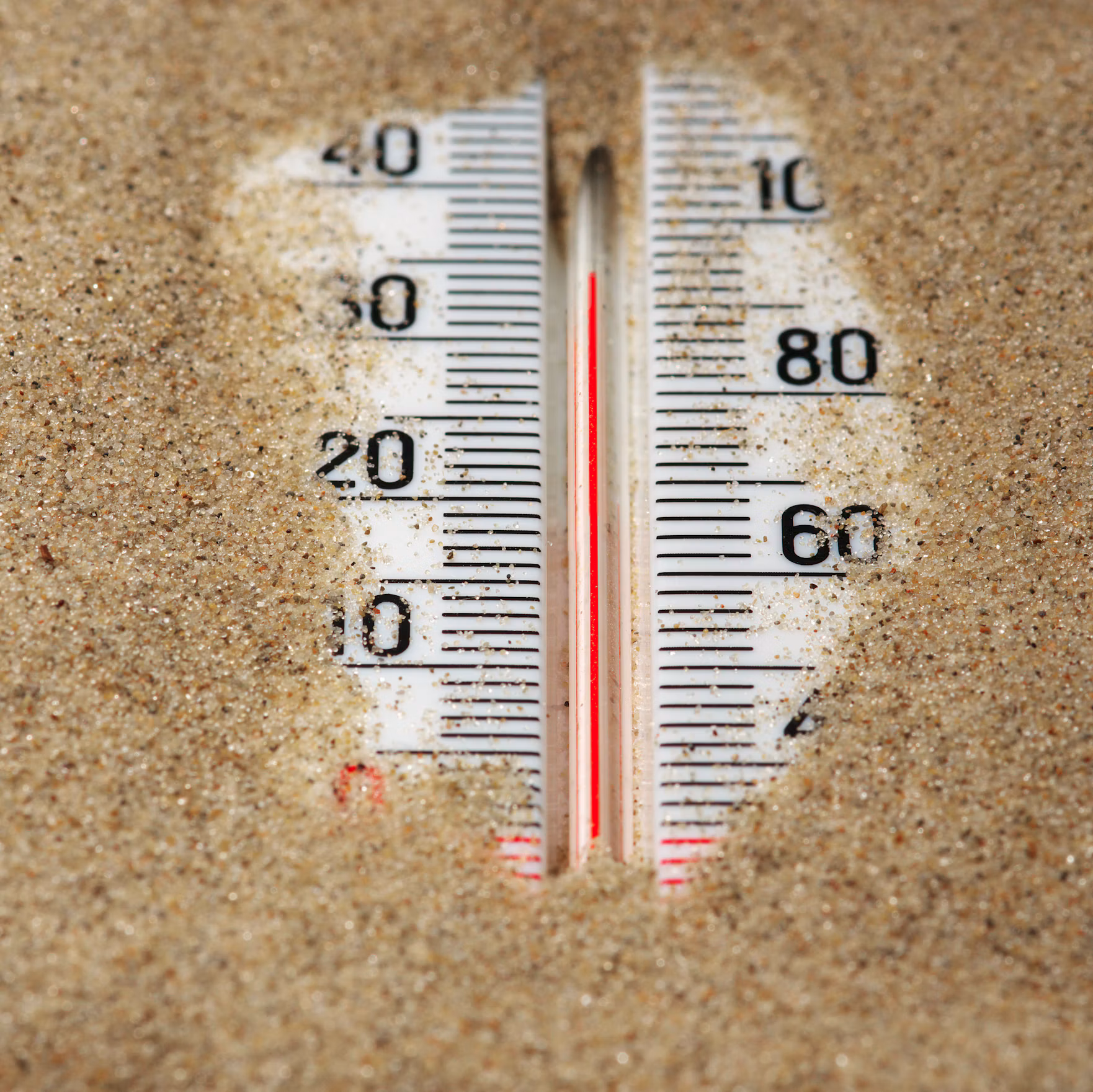
A stock image of a thermometer half-buried in sand. The thermometer reads 34 degrees centigrade.

I hope everyone came through the storms this week without harm. We were lucky. Our own garden ended up a bit of a mess and our basketry willow grove is rather bedraggled but everything and everyone is otherwise fine. Some of my friends and neighbours weren’t so lucky with quite a few reports of leaking roofs, downed trees and escaped gazebos.

This year is yet another year in a run of years of increasingly chaotic weather. With the 2026-27 El Niño boosting temperatures further and it being the most intense ever recorded, it is likely that 2026 will itself be the hottest year on record, just as so many of the years of my lifetime were also the “hottest year on record” of the time. The natural annual cycles of temperature mean that not every single year broke that highest temperature, but what was a “relatively cool” year in 2019 would have been the “hottest year on record” had it happened in 2010. Similarly, the “hottest year on record” in 1998 or 1981 would look weirdly cold by today’s baseline. It is a sobering thought to realise that I will likely never live to see years as cold as the decade I was born in, even though that was then the hottest decade human civilisation had seen for centuries.

This has implications for everything we do in Scotland and that is going to be true even if we start ignoring the pro-oil climate deniers and start actually taking the actions we need to take to transition away from fossil fuels rather than opening up more wells to further enrich already rich oil barons at our own expense.

We will, for example, need to consider not just how we insulate our houses against winter cold (even in a warming planet, climate chaos means we will still see “weather bombs” dump cold air and snow on us) but also against summer heat (the record heatwaves this year saw around 50,000 people die in Europe, with around 33,000 attributed to human-caused climate change).

We also need to consider our food supplies given that agriculture is going to become increasingly difficult in parts of the world including in this country where climate is changing faster than farmers can adapt to new crops or techniques and where climate chaos means more harvests lost to storms and other extreme events.

The old model of protecting ourselves was just to declare that Globalisation would save us. We could just buy in products from elsewhere. In fact, we could even get them cheaper by allowing companies to exploit workers who were far enough away that we couldn’t see them.

We’re seeing now the folly of that and how quickly global supply chains can turn from genuinely impressive miracles of engineering into a severe liability due to events as big as a new pandemic to as little as one man’s ego and a needless and illegal war over a vital chokepoint.

During the pandemic, Common Weal produced a series of papers entitled “Resilient Scotland” which started with the economic underpinnings of a strategy to make Scotland less vulnerable to shocks as it caused and went on to produce papers with a short, medium and long term transition plan to get us there.

This, combined with our 2019 Common Home Plan on a Green New Deal, should be the focus of socio-economic planning right now. We need to move to an economy that is secure in its fundamental – things like food, energy and housing – and can better cope with disruptions to everything else. This means deconsumerising as much as we can, sharing and borrowing more within our communities, building up community infrastructure and gearing our economy more for wellbeing and circularisation rather than endless growth.

Right now, things are going the opposite direction. In addition to boosting fossil fuel extraction, emergency planning from the UK Labour Government has published a “Deil tak the hindmaist” individualistic approach to things like food stockpiling in what can only be described as the final victory of Thatcher’s declaration that there is “no such thing as society” and the Scottish Government is so absolutely wedded to inwards investment that they are trying to sell off absolutely everything they can to “the market”. I was reminded this week that the Scottish Government’s own approach to nature investment, the “Natural Capital Market Framework”, is entirely about opening Scotland’s natural assets to private investment and describes the scope of those assets as “our geology, soil, air, water, plants and animals”.

The consequences of decades of inaction on climate and on ignoring the warnings of short-term profit-chasing in the economy are coming home to roost simultaneously right now. We’re seeing the impacts in the thrashing trees outside our windows and the fact that we can’t afford to buy what we used to consider the basics of food and fuel. We know what the solutions are because the same folk issuing the warnings have been holding them in out for us too.

It seems though that our leaders are still intent on ignoring those warnings and those solutions though, and to instead keep listening to the people who have been largely responsible for both the problems we’re seeing and for our lack of resilience in the face of them. If that doesn’t change, then our future will just keep running along the same trend of my lifetime so far. More “hottest years on record”, and a hope that we’ll be lucky in the next storm too.
The Common Green logo Green text on a dark green background, above a version of the Common Weal "balance" logo.

John Swinney Is Acting Like a Climate Denier

“Adults keep saying: “We owe it to the young people to give them hope.”
But I don’t want your hope.
I don’t want you to be hopeful.
I want you to panic.
I want you to feel the fear I feel every day.
And then I want you to act.
I want you to act as you would in a crisis.
I want you to act as if our house is on fire.
Because it is.”
– Greta Thunberg

This blog post previously appeared in Common Weal’s weekly magazine. Sign up to our Daily Briefing and Weekly Magazine newsletters here.

If you’d like to support my work for Common Weal or support me and this blog directly, see my donation page here.

A photo of an oil rig bracketed by a blue sky and blue ocean.

There was a time when Scotland was proud of its climate credentials. The first national government in the world to declare a Climate Emergency, followed by many of its local councils. Setting ambitious, legally binding targets to reach Net Zero well ahead of the promises being made by peer countries. Even being the first nation in the world to officially admit that the Global North had a responsibility to repair and compensate Global South nations because of the damage we had and were causing to them.

I will grant you that Common Weal has been rightly critical of the actions that proceeded from these words. You should always watch what a politician does rather than what they say.

Scotland declared a Climate Emergency, then tried to avoid changing policies to match the severity of the problem – like someone who response to their home having a Roof Fire Emergency by turning off the gas stove then going back to bed.

The legally binding targets were legally bound but with no clear policy pathway to meeting them. The climate promises made, if added together, would not have created a Net Zero Scotland and we all knew that promises would be broken along the way so that the actual additive impact of actions would fall short by even further.

And while Scotland did put some cash into the fund for Global climate loss and damage, the amount was well short of the actual damage Scotland has caused. Scotland’s bill for our share of global climate emissions amount to something like £2.5 billion per year, every year until we reach Net Zero. Scotland promised a total of £100 million for the fund across just two pledges.

Still. Contrast those lofty promised followed by half-hearted actions with the current Government. This month, John Swinney has been campaigning hard on giving a massive tax bung to oil and gas companies. The same companies that have profited to the tune of trillions of pounds while setting the world on fire. The same companies that have actively lobbied to halt and prevent measures to stop them doing this. The same companies that even as they take more cash to help them make more profits are simultaneously shedding old assets in the same North Sea so that they don’t need to pay to decommission them.

It’s hard to show just how much of a U-turn this is for the Scottish Government but there is one thing that illustrates this.

Donald Trump – a man who vocally denies climate change and erroneously thinks that ‘windmills’ make people poorer and don’t exist in China, while actively waging illegal oil wars in the Middle East and Latin America – also believes that oil companies are making too much money. Right now, John Swinney is more extreme on oil subsidies than Donald Trump.

We can therefore safely assume – in the absence of actions to the contrary – that despite John Swinney serving in the Governments that made those previous commitments, he is himself is acting like a climate denier. He is looking at the Roof Fire Emergency and is actively turning all of the gas hobs to full burn before going back to bed.

I know that Trump isn’t claiming that oil companies are making too much money because he’s secretly a ‘nationalise all assets’ communist who has a strong moral conviction in public good. It’s because he wants the money for himself because if he isn’t personally benefiting from any ‘deal’ then he thinks he’s being taken advantage of and the last thing he wants to be is a ‘loser’.

“Our Common Home Plan remains the most comprehensive blueprint for a Scottish Green New Deal.”

Swinney doesn’t have this excuse though. He should know better. Actions speak far louder than words though and right now we’re seeing the actions of a man calling for oil companies to be able to make even more obscene profits at the expense of the planet at the same time that wildfires are raging through the Cairngorms and heatwaves have killed thousands of people in Britain this summer alone (never mind the thousands more across Europe and even more globally).

I know he still claims to cling to the policy that he’d only approve of new oil and gas extraction if it met certain “climate criteria” but he is yet to lay out what he thinks those criteria would be and whether he thinks any new extraction would pass it. What, precisely, does he think a “Net Zero” oil well would look like?

If I’m wrong and John Swinney is not a climate denier, if he does, in fact, still believe that we’re living in Climate Emergency and that emergency has only gotten worse since his government declared it, then I expect to see another set of actions. I expect him to endorse Monica Lennon’s proposed Ecocide Bill when it returns to Parliament and then to start aggressively prosecuting people who are committing ecocide. I expect him to align all public policy with what the science says Scotland must do to meet our obligations under the climate emergency.

Common Weal has already shown what he can do. Our Common Home Plan remains the most comprehensive blueprint for a Scottish Green New Deal. Following it through to its conclusion would lead us to a world where oil barons no longer have the power to lobby politicians for their own profit because that world simply won’t contain oil barons. This is, of course, why those oil barons continue to try to make sure politicians don’t take those actions.

Right now, John Swinney is taking the actions of a climate denier on behalf of those oil barons. If he wants his political legacy to be something other than that, he knows what he needs to do.

The Common Green logo Green text on a dark green background, above a version of the Common Weal "balance" logo.

Submerged In Leith

“And so castles made of sand slips into the sea, eventually.” – Jimi Hendrix

(This blog post previously appeared in Common Weal’s weekly newsletter. Sign up for the newsletter here.)

Why is Edinburgh considering building housing on land that may be underwater before their mortgages are paid off?

In the Herald this week, a plan was announced to build 300-odd houses in a currently brownfield site at Edinburgh Harbour in Leith. This comes just over a year after approval was granted for a 600 home development at the other end of the harbour. Scotland has a housing crisis and the only way out of it is to build up housing stock so that it exceeds demand and begins to bring house prices down to actually affordable levels again and we build them in a way that doesn’t subject the residents to fuel poverty or, as may be the case here, assets stranded as a result of poor construction or the climate emergency. Scotland may have been one of the first countries in the world to declare a climate emergency but we’re still far from acting like it when it comes to policy.

In 2019, Edinburgh Council followed Holyrood in accepting that climate emergency and soon after they published a climate readiness plan on what they planned to do about it. It’s actually pretty good in terms of the policies it lays out and from what I’ve seen of Edinburgh lately, they seem to be making a decent shout of making progress towards the goals as stated, however there is one glaring omission to the plan and it pains this resident of a land-locked Local Authority to point it out – the plan only mentions the threat of sea level rise once, only does so in passing and does not recommend any policies or actions to address it. I’ve discussed this issue before with respect to Scotland’s airports, but it’s obviously time to look at it again.

Continue reading →