“A lie can run round the world before the truth has got its boots on.” – Terry Pratchett
This is an original post, not published elsewhere. If you’d like to support my work for Common Weal or support me and this blog directly, see my donation page here.
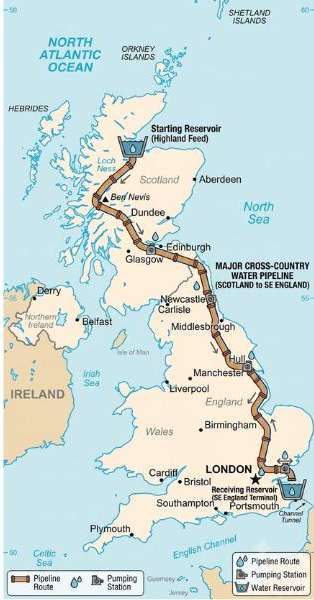
There’s an image going viral around Scottish nationalist circles right now about hypothetical plans to build an aqueduct to move water from Scotland to England. There are grains of rationality behind it. England is suffering widespread and worsening droughts due to climate change, Scotland still has reasonably abundant water and low demand, at least one UK Prime Minister has actively floated the idea in the past, and there is a long history of Scottish resources being exported from Scotland without the people of Scotland being adequately compensated.
The problem with this idea is that it won’t work – the physics is against it.
For water to flow under gravity, there needs to be a minimum gradient. Current British water pipe standards suggest about 1:100 as a rough rule of thumb – for every 100m the conduit runs horizontally, it needs to drop 1m vertically. The shallowest Roman aqueducts ran at 1:1,000 though they clogged up pretty quickly without constant maintenance. The longest Roman aqueduct – about a 5th of the length of this proposal – had a gradient of about 1:660 along much of its course.
The straight-line distance between Aberdeen and London is 720km. This means the pipe at Inverness would need to be between 720m-7,200m above sea level to drop the water down to London. If your reservoir is on top of a Munro and you can build like a Roman, you might make it so long as there are no other hills in the way. If you build to British water standards, I doubt you will.
Ah, but we have pumps! Pumps can lift water back up so you can make many small steps down instead on one large one. Yes. That’s the second issue. Pumps cost energy to run. To lift 1,000kg (1 cubic metre – enough for one household for 2-3 days) of water from sea level to between 720m and 7,200m and to transport it at a rate of 1 cubic metre per hour, will cost you between 2kWh and 20kWh. It doesn’t matter how much that costs or whether you get the power from fossil fuels or from solar panels, you still need that power.
To desalinate 1,000kg from sea water in the South East will cost you between 1kWh and 3.5kWh per cm/h.
Therefore, to make an aqueduct from Scotland to England economically viable [See Note] we need a) the capital costs of the longest aqueduct in the UK to be massively lower than that of a bunch of desalination plants and b) to build the pipes more efficiently than current British water standards.
And this is before we consider that a more effective means of supplying demand might be to introduce better, more local resource efficiency measures, to build more reservoirs to store water for the dry seasons or to nationalise the private water companies and prosecute the former directors to recover the costs to repair the leaking pipes.
We also need to consider that a transnational water conduit that the SE absolutely requires is going to be an absurd national security risk given that it could be burst open by a single drone anywhere along its length. Desalination plants are already vulnerable as we can see by the war crimes currently being committed by the US and Iran to that effect, but at least they can be distributed so that taking out one still means that some water can flow.
So no. England isn’t going to build an aqueduct to transport all of Scotland’s water away. It’s going to be much easier for England to build power cables to transport away Scotland’s energy to feed their desalinators instead.
Note:- There are extremely long water pipelines in the world – the longest feeds from a pressurised fossil aquifer so has a degree of head lift that surface water does not and others tend to drop down from mountains rather higher than Scotland’s.
There are also extremely long, economically viable pumped oil pipelines. Oil costs between a hundred and a thousand times more than water on a per litre basis, so the economics of energy use are very different.
“It`s not how old you are, it`s how you are old.” – Jules Renard
This blog post previously appeared in Common Weal’s weekly magazine. Sign up to our Daily Briefing and Weekly Magazine newsletters here.
If you’d like to support my work for Common Weal or support me and this blog directly, see my donation page here.
I’ve written before about one of the successes of the Scottish Parliament in recent years to do with its attitude both towards human rights and towards international treaties.
On the latter, Scotland’s lack of independence means that our country can only join international treaties as part of the UK and the Scottish Government has no direct say on whether or not we can do so. For example, Scotland cannot formally sign the UN’s Convention on the Rights of the Child but we can do something else which can signal our support of it.
We can simply pass legislation that acts “as if” we were members of the convention anyway. The CRC isn’t the best example of this in that the UK has been a member of it since the early 1990s but on the other hand, the UK is a “dualist” country which believes that international laws do not apply until and unless the UK passes an appropriate domestic law to bring it into effect (this allows the UK to maintain the stance that its Parliament is superior to international law rather than subordinate to it as is the case with “monist” countries like Germany).
But this approach doesn’t always mean that the UK adopts those conventions as thoroughly as it could, which is why the CRC does give a good example of Scotland deciding to go further in 2024 by incorporating the Convention into domestic law even where the UK’s laws in Scotland didn’t not yet apply.
There was a limit to this. A successful Supreme Court challenge by the UK Government saw the Scottish law modified to make it clear that it didn’t apply to the UK Government’s actions in Scotland (again, allowing the UK to maintain the stance that its Parliament was superior over the Scottish one). This particularly meant that the UK Government could potentially legally treat unaccompanied children claiming asylum in Scotland in ways that would be illegal if the Scottish Government did it. This is a flaw that can only be corrected through independence.
Still, Scotland has successfully pushed forward in protecting the rights of children in Scotland and this is a good thing. There is an opportunity coming up to potentially do it again but this time with respect to the rights of older people. The UN has started the process that may eventually lead to a Convention on the Rights of Older People that would aim to prevent ageism and protect older people in areas where they are currently discriminated against such as the workplace, polices affecting the rights of people in care homes, policies that protect or fail to protect people due to climate change and even policies that discriminate arbitrarily based on age (such as state pension provisions or blocking older people from serving on juries) which may not be appropriate as life expectancies increase or may be better served with individual health and capability assessments.
Many of these areas are subjects that I and Bill Johnston covered in our book All of Our Futures so it is welcome to see parallel developments reach the United Nations in a way that may one day become law.
The Scottish Government should pay attention to this move and monitor it to see where they can legislate domestically to bring Scottish law up to its standards if and where we currently fall short. As with the rights of the child, there are limits to what we can do pre-independence over reserved issues like Pensions though Scottish devolved benefits may be usefully employed if need be and the Government should push harder for the power to introduce a Scottish Universal Basic Income that would allow people to retire earlier if their health requires it while not forcing them to just because they hit a certain age. In some respects we may already go further than this potential treaty might in that we already have the UK Equalities Act which prevents discrimination based on age.
Therein, though, lies the fundamental issue with rights-based legislation.Rights are only as powerful as the rights-holder’s ability to have them upheld. If someone breaches your rights, you need to know that your right has been broken and you need to have the ability to, for example, take the person responsible for upholding your right to court to challenge the failure and seek redress, and those responsible for protecting your rights need to have the resources to be able to do so. This can be difficult or impossible which is why discrimination based on age still takes place in the workplace and why children are still homeless in Scotland despite every Local Authority being legally bound to eliminate child homelessness.
The Scottish Government can’t sign this potential new treaty on the rights of older people but they could get involved with those shaping it to present best practice as applied in Scotland and to show where we ourselves could go further too. If we still can’t sign it by the time it comes into force, then we can do as we did for children and bring our laws up to its standards where they fall short.
Acting “as if” we are part of the international community when it comes to shaping and protecting human rights will be an important step towards us gaining acceptance by that community when we are finally ready to join it formally. Who knows, we might even be able to bring the UK along with us too.
“The secret of the successful fool is that he’s no fool at all.” – Isaac Asimov
This blog post previously appeared in Common Weal’s weekly magazine. Sign up to our Daily Briefing and Weekly Magazine newsletters here.
If you’d like to support my work for Common Weal or support me and this blog directly, see my donation page here.
The most powerful person in Court is not the King, not his advisors, nor any of the shadowed hands behind the throne. The most powerful person in Court is the Jester. For they alone have the power speak the truth that no-one else dare utter for fear of the consequences of their words.
Nigel Farage has been under increasing pressure due to scrutiny of his opaque finances – in particular his failure to declare a £5 million “gift” made to him that he claimed was to bolster his personal security. Not used to being under the kind of scrutiny that an elected Member of Parliament must undergo in the wake of various “cash for access” scandals, he has resigned as an MP, forced a by-election and has declared he’ll stand again as a candidate. He hopes that by getting re-elected, he can claim a “people’s mandate” – if the voters think he’s a sound candidate after this election despite the financial news stories, then maybe the investigations will stop (they probably won’t).
Normally, the major political parties would face a choice when something like this happens. They could fight the by-election like they would any other, put up a spread of candidates and see what happens (this would likely result in a Farage win given the First Past the Post voting system). They could decide that knocking Farage out of Parliament is more important than their own rivalries and could stand a “unity candidate”, either all of the parties bar one dropping out and endorsing the remainder or by standing an “independent” candidate agreed and supported by all (either would have been unlikely given that the parties dropping out included those both to the left and to the right of Farage and Reform therefore have little common ground with each other).
The option they went with instead was just to refuse to play Farage’s game. He sought a “people’s mandate” by beating the other parties in a straight fight…they’ve chosen to not fight and all of the parties with elected members have chosen to not stand an candidates. The candidates actually standing include a handful of even-more-fringe far-right party members, Jeremy Corbyn’s conspiracy theorist older brother, a man dressed as a fish finger and….Count Binface.
The election is likely therefore to be a farce. Farage is still likely to win, but very likely on the basis of a very low turnout and he can’t point to have beaten any credible opponent. He’ll still have to maintain the form of trying to get elected because to do otherwise gives up any remaining hope of claiming that credible mandate. But he’ll have to do it in a theatre where his most high profile opponent is a man playing the character of an alien wearing a bin on his head.
It’s for this reason that I’ve seen a few commentators now say that this makes a mockery of the solemn duty of our representative democracy and therefore Binface should not be standing, or should at the very least take the bin off and stand as himself. I disagree. Binface is a satirical character. He follows in the tradition of a long line of “joke candidates” in our election. But in this he is not, himself, a joke. He plays a role, and that role is to uphold our democracy by being the jester in the court.
Binface’s “manifesto” is not to be taken serious on its own face. But they are reflections of serious politics, and especially of politicians who claim to be serious about certain issues but in the end let us down.
“I have long held that a good test of a political promise is to find what I call the “Minimum Promised Deliverable”.”
The best examples of this is his housing policy. If elected, Count Binface shall promise to build “at least one affordable house”.
I have long held that a good test of a political promise is to find what I call the “Minimum Promised Deliverable”. This is the least action that a politician can take that would let them stand up and say that they’ve met the promise in full. Someone who promises to “End Climate Change” has a harder task ahead of them than someone who promises to “Achieve Net Zero by the end of this Parliament” which is again harder than someone who merely promises to “Reduce emissions by the end of this Parliament”. The third politician may well meet their promise accidentality or even despite actively trying not to.
And so with housing, we are well used to politicians claiming that they will build so many thousands of homes, or so many more than their opponent will. We are used to them being criticised by said opponent for failing to meet that promise. We all know that the term “affordable home” is so vague as to mean nothing – a house that sells for a little below the market average can be deemed “affordable” even if almost no-one can afford to buy it.
His pledge isn’t one so ludicrous low that he cannot fail to deliver it. The truth he speaks to power is that their pledges are aren’t likely to be met and aren’t likely to be sufficient even if they are. Pledging to build one house more than your opponent doesn’t answer the question “Is that enough houses?”.
There are 34,000 homeless households in Scotland. The SNP pledged in their recent manifesto to build 110,000 affordable homes in this Parliament. It would be technically possible to give a new affordable home to a homeless family for free (something that would be cheaper than leaving them homeless) and end homelessness in Scotland within two years. But there is little appetite for that to happen from Government, this would likely mean other people who also need houses having to wait a bit longer and, probably most importantly for the government, it might hurt developer profits.
Count Binface and all others who take part in his tradition of the “joke candidate” should not be condemned for doing so. They serve a vital and important role in keeping our “serious” politicians honest, setting a floor of what they can get away with with their policies and, above all, acting like the slave who’d stand behind a Triumphant Roman General reminding them of their mortality although in this case the words being whispered might instead be “you have taken yourself too seriously”.
And while the election against Farage is very likely only going to go one way, there is a chance that it might not and the man behind the bin may well find himself entering Parliament (headwear being prohibited by the arcane rules of that place). This may well not be a bad thing in itself. Occasionally, even the joke candidate can win.
“O, Sunlight! The most precious gold to be found on Earth.” – Roman Payne
This blog post previously appeared in The National as part of Common Weal’s In Common newsletter. If you’d like to support my work for Common Weal or support me and this blog directly, see my donation policy page here.
The problem with renewable energy, we’ve been told for decades, is that it doesn’t work on the schedules of our choosing. Turbines don’t turn when there’s no wind. The sun doesn’t shine at night. And therefore we need fossil fuels and nuclear power plants. Only they are reliable enough to power our society 24 hours a day.
And so, even though we bake in the hottest year of our lives, again, and look forward to every year of the rest of our lives being even hotter. Even though thousands in Britain and thousands more across Europe will not now ever live to see a hotter year – the magnitude of death going almost unnoticed by the media in a way that it would not had it been an act of terrorism. Even as the same people who caused those deaths lobby our governments to let them cause more and make money doing so. Even as all that happens, we’re still told that renewables could never replace fossil fuels because the sun doesn’t shine at night.
What if it did though?
I’m not talking about the Techbro supervillain idea being trailed by an American company to put mirrors in orbit to reflect sunlight. That won’t work, will only burn billions of dollars that could have been spent more sensibly and even if the mirrors launch they will cause untold damage to the environment, to scientific equipment like telescopes and will further wreck our shared Commons that is our view into space.
A much more down-to-Earth solution is, of course, batteries. Battery technology has come on faster than anyone – including renewable energy optimists – could have predicted. Twelve years ago, while Scotland was having its independence referendum, a grid-scale battery cost around $300 per kWh (a kilowatt.hour is a unit of stored energy – a 1kWh battery could run a 1kW electric heater continuously for one hour).
By 2019 when we published our Common Home Plan, the price had more than halved and was closing in on $100/kWh which was considered a major milestone in technological achievement (not for any real physical reason – humans just like round numbers). Now, batteries cost closer to $60/kWh and we’re starting to approach a real milestone. One that will really change the game in terms of how we use these things.
“Crucially, for Scotland, sodium batteries have the advantage that we could make them here if we wanted to”
That milestone is $20/kWh. At $20, these batteries cross a threshold. Connected to enough solar panels to charge them (solar panels have also dropped in price by an astounding degree and now generate human-usable energy cheaper than any technology ever invented by humans going right back to when we first harnessed fire), a $20 battery is capable to delivering energy cheaper than coal, cheaper than nuclear and cheaper than gas.
With just solar panels and batteries, the economic case for burning fossil fuels at night disappears. The fact that batteries can ramp up their delivery very quickly also means that they can take over the job currently done by “peaker” gas turbines that kick in when there is sudden high demand for short periods of time. These peaker plants are the most expensive form of generation on the grid and so replacing them with cheap batteries will have a substantial impact on our energy bills as well as our environmental emissions.
Chinese company BYD has announced that it aims to be the ones to crack that threshold (with their rivals CATL trying to do similar). They are launching a $40/kWh battery next year with further improvements in the months after. Unlike the lithium batteries which have dominated the sector until now, the new battery will be based on sodium.
Sodium is safer to deploy (sodium fires aren’t great, but they’re not as runaway explosive as lithium fires are), easier to extract (you can get it from the salt in seawater) and is a lot cheaper and overall more plentiful than lithium. The major downside is that a sodium battery of a certain size will never store as much energy as the same size of lithium battery. This is a problem for electric vehicles (though sodium battery cars designed to make short hops within towns are coming online too) but less so for grid-scale batteries where space is less of a factor.
Crucially, for Scotland, sodium batteries have the advantage that we could make them here if we wanted to. Scotland doesn’t have substantial lithium deposits but we have plenty of salt in our seas!
Of course, the substantial delays in the kind of investment that Scotland should have been doing to make that happen mean that China has stolen a march on us as they have in so much else of the energy sector. It’s not too late for Scotland. As I said in a recent column (“Scotland is already losing out on green energy. Here’s what we can do.”, The National, 26th February 2026), even if we’re forced to buy Chinese tech to push forward our green transition as urgently as we need to right now, we should also recognise that that tech has a finite lifespan of a few decades and so we should be investing now so that the tech we replace it with is manufactured domestically.
Environmentalists have predicted this moment for decades – decades that were stretched out longer because the oil barons convinced politicians to line their pockets a little longer – but economics now mean that it’s finally here. The transition is unstoppable. Renewables are the future we need. Scotland should work to be on the right side of that future rather than being left behind with the past.
“Every gun that is made, every warship launched, every rocket fired signifies in the final sense, a theft from those who hunger and are not fed, those who are cold and are not clothed. This world in arms is not spending money alone. It is spending the sweat of its laborers, the genius of its scientists, the hopes of its children. This is not a way of life at all in any true sense. Under the clouds of war, it is humanity hanging on a cross of iron.” – Dwight D. Eisenhower
This blog post previously appeared in Common Weal’s weekly magazine. Sign up to our Daily Briefing and Weekly Magazine newsletters here.
If you’d like to support my work for Common Weal or support me and this blog directly, see my donation page here.
There is an observation amongst peace-campaigners that politicians claim that there is never enough money to spend on social welfare but those same politicians are always quick to find that same money when they need to spend it on war.
That trend appears to have been broken in the UK, but in the worst possible way. Now we’re being told that there isn’t enough money for the war either, and so the social welfare has to go to pay for it. The UK is aiming to spend £10 on war for every £1 it will spend on foreign aid and Keir Starmer’s likely last major policy decision has been to announce an increase in the military budget by an extra £15 billion a year, funded by cuts to long term investments in transport and energy infrastructure as well as broader cuts across the board.
This will have multiple impacts on public spending. The first is the impact of the direct cuts, as mentioned. The second will be the knock-on effects on devolved government spending – investment in roads and to a lesser extent energy generates “Barnett Consequentials” which feed through to the Scottish budget but spending on defence does not. Every £1bn out of the transport budget and putting it into the military means an effective cut of £80mn to the Scottish budget. The third is that as a “job creation tool”, the military is a terrible means of economic stimulus. Yes, the military spending will create jobs, but spending £1bn on just about anything else – particularly things like energy infrastructure – would create even more jobs. It is likely that this defence plan will be net-negative for job growth. And that’s before we consider the final point – money spent on a bomb that isn’t used is a waste of money (even more so when we consider the wastefulness of military procurement). Money spent on a bomb that IS used, destroys the bomb and whatever (or whomever) it is dropped on. War as a negative sum game. Even the “winners” lose.
And this is all assuming that this is what the UK actually needs or should be doing right now. The problem with the discussions about what the UK defence sector is actually defending us from is woefully inadequate. Rare is the military chief who actually lays out the threats to the country and allows their spending to be democratically scrutinised. This is despite Lord George Robertson rather ironically saying in a Parliamentary evidence session this week that “if people become aware of the dangers and the risks to this country then they will make the demands that will allow us to do it.”
But if the military folk won’t tell us what they think those dangers and risks are then we’ll need to work it out for ourselves. Instead of building nukes to “defend” ourselves from shadows and the enemies they’d like to have, we need a reality-based security strategy.
The single most serious threat to the UK and our way of life is climate change. This is a self-inflicted problem and it is now too late to prevent but not too late to limit or to adapt to. But doing so will require investments in the kind of things that Starmer’s defence strategy will pull money away from at a critical time. It’s not just the climate itself, but Trump’s illegal war with Iran and Putin’s with Ukraine has shown the folly of relying on fossil fuels when we now have renewable alternatives that cannot be disrupted in the way those wars did to our fuel supplies. Opting out of being forced to fight oil wars is a much more sensible strategy than merely hoping we can win one.
Substantial domestic threats exist in the form of smuggling, criminal gangs, radicalised terrorists or fascists like the ones recently spotted outside Holyrood last week. These are all policing matters rather than military though. Cutting police budgets, social welfare and other community-based initiatives to funnel into war will make these problems worse, not better.
The same goes for non-climate environmental threats. If we wanted a reality-based security strategy to consider the number of British people killed each year then we’d be waging war against pollution. Recent data has shown that the London Ultra-Low Emission Zone (which was opposed by the political right, including Starmer) has started to save around 3,000 lives per year (I haven’t been able to find comparable data for Glasgow or Edinburgh’s LEZ impacts yet). If a terrorist or hostile state killed 3,000 British civilians in a year, we know what the response would be. If a politician tried to win an election on the promise of murdering 3,000 people, I doubt they’d win a vote. And yet, there are politicians and political parties still claiming to want to roll back on urban LEZ legislation. A reality-based security strategy would treat that appropriately.
Next on the threat scale is probably something like Hybrid War – unconventional attacks on our infrastructure via things like hacking attempts and drone warfare. The UK has, in fact, experienced attacks like this from state actors – we now know that Russia was likely behind the shutdown of Jaguar Land Rover last year. We also know that Trump’s USA has been actively spying on European Governments, digitally sanctioning human rights lawyers, and is quite capable of ordering Microsoft to lock down Scotland’s ability to pass legislation should he choose to. The threat from this kind of hybrid war isn’t therefore coming only from our “enemies” and cannot be defended against by building more bombs to aim at them. A reality-based security strategy would be following the EU’s lead and developing a digital sovereignty strategy to remove the threat of such hacks from the table. Common Weal are actively working on what a Scottish digital strategy could look like.
“If we prepare for war, we will get war. If we want peace, we must prepare for peace instead.”
On the far side of the threat spectrum in terms of probability is actual territorial invasion which is vanishingly low for somewhere like Britain. The country being held up as a threat in this regard, Russia, has already shown the limits of its capabilities in Ukraine. It may well still be a threat on the borders of NATO, but that’s a very different prospect to the idea of seeing T-90 tank in Tottenham. Once again, when considering territorial invasion, we cannot ignore our supposed “ally” the USA, which is still threatening to annex Greenland. However, the thought does bring up the thing that has been absolutely missing from discourse on defence spending till now – time.
The new Starmer plan has a long time horizon. It will be years before the actual money starts to ramp up weapons production and development and decades before the results of that spending results in deployable equipment (this is particularly the case with things like nuclear weapons and new submarines to launch them). If we take as given that Putin’s Russia is the massive overbearing threat that the establishment would have us fear, then we have to remember that Putin himself is mortal and already past UK state retirement age. He will quite likely be dead or otherwise no longer in power before any of Starmer’s new weapons can be aimed at him. Who will replace him? What can the UK and Europe do now to normalise relations with his successor so that post-Putin Russia is not a threat? Would doing that be cheaper than us threatening to nuke Moscow, murdering 5 million civilians in the process? Might it work better?
Pacifists like myself are never listened to in times of peace. In times of war, we are openly scorned as not having the solutions to the conflict that could have been avoided had we been listened to in times of peace. Warmongers need war and the threat of war to justify their own existence and to bloat their already unjustifiable budgets and they must be called out on this fact. If we prepare for war, we will get war. If we want peace, we must prepare for peace instead. If we want a strategy that results in actual security, we must deal with the reality we have, not the one the warmongers would prefer we were afraid of instead.
“Evil begins when you begin to treat people as things.” – Terry Pratchett
This blog post previously appeared in Common Weal’s weekly magazine. Sign up to our Daily Briefing and Weekly Magazine newsletters here.
If you’d like to support my work for Common Weal or support me and this blog directly, see my donation page here.
Buried under the higher profile news that the UK is embarking on a new push of ever-greater militarism – aiming to spend more than twice as much than it used to on the military and aiming to spend more than £10 on war for every £1 it will spend on foreign aid – is a new goal of further discriminating against asylum seekers and refugees, including those driven to flee their countries to the UK due to the UK’s own policies of spending more on war and less on aid.
The new plan is that there will be an additional tax placed on refugees who have had their asylum claim accepted that will see them bear a completely arbitrary debt of £10,000 to be paid back after they start working and earning and with any future application for indefinite leave to remain or citizenship blocked until the debt is paid.
Let’s start with the language used in the reporting around this. The policy is said to target “people granted asylum”. We have a word for people who have claimed asylum, found to have a valid claim and then asylum granted on that basis. They are refugees. This is important. Such is the dismal state of the public discussion around migration that far too many people hear the word “asylum seeker” in a manner that rhymes with “illegal migrant” and this is starting to bleed into the rhetoric on legal migrants too. There are politicians in Parliament right now who have made statements that would, if they became policies, would make it difficult or even impossible for my family to remain in this country safely.
Rather than resist the extremes of the right in the UK, the current Labour Government seems to be chasing them instead.
The full announcement of the proposed changes to asylum are here and do go beyond just that additional and arbitrary tax on migrants. Other punitive policies include significantly narrowing the definition of “family” for the purposes of human rights protections (did you flee a country with an uncle who is your only surviving relative after the war? You’re no longer “family” in the eyes of the UK Government), making it easier to subject people to slavery if they’ve found themselves with even a short custodial sentence in the UK (perhaps even due to a crime commit at the compulsion of their enslaver?) and by introducing a “legal route” to asylum that can only take place via individuals or organisations “sponsoring” a claimant which will almost certainly mean that those without the power to win a sponsor will be least able to claim asylum that they need.
There have also been proposals for annual caps on the number of admissions meaning that if you seek asylum then your ability to reach safety might depend on your arriving in June rather than in August. Welcome to Refugee Hunger Games, currently accepting applications from Districts Three through Six exclusively. Applicants from all other Districts, better luck next year!
Separately from this announcement, the UK is now also planning to bring in “age-verification technology” that they already know, from testing it, will result in children being falsely classified as adults and being stripped of their asylum rights. They also know that the tech is worse at distinguishing children from adults when the subject is Sub-Sarahan African compared to Eastern European and if they are female rather than male so this means that they are planning to bring in this tool despite knowing that it contains inbuilt, systemic racial and gender biases.
“Asylum is a right for all of us. You are not much more than one bad day away from becoming a refugee.”
Back on the £10k “success” fee for asylum seekers who become refugees. The fee itself appears to be arbitrary and only tangentially linked to the costs of supporting someone during their asylum process. That process itself can be entirely variable depending on whether someone is housed in a social house within a community, in a military barracks or in a privately run hotel that is squeezing the government and its residents for maximum profit extraction. It also entirely depends on the length of time it takes to process an application. The cuts to the Home Office over many years (likely to get worse now that Starmer is asking for even more cuts to public services to fund his expansion to the military) mean that the rising number of asylum seekers in the UK right now has as much to do with the failure to promptly process their cases and convert them to refugee status as it does with the number of people arriving. It would be entirely unfair to put the burden of “paying” for the extra costs of a service if the delays that increase those costs are due to the government, not the person.
If the £10k figure has been arrived at as a kind of average cost per applicant across all applicants though then it serves as a tacit admission from the Government that the actual cost of the asylum process is relatively small. The reporting says that the total cost of the asylum system is about £4bn per year (and this sum is likely to rapidly decline in coming years as we come off the peak of the last spike in claimants). Starmer casually announced this week that he wants to add almost four times that to the military budget. If the entire burden of these costs were placed on income tax payers alone (they aren’t. Income tax isn’t the sole tax in the UK) then this would mean that, on average, an income tax payer would see about £120 a year of their income tax go towards supporting asylum seekers and about £450 go towards Starmer’s military budget increase (on top of what is already being spent on war).
Not that the £10k repayment will actually save the Government or taxpayers any money. The Home Office’s own policy and financial assessment says as much – and their assessment of the stripping of slavery protections are likely to cost more money than they save due to the inevitably successful lawsuits.
If the problem of asylum seeking is that it costs too much money per seeker (and assuming that the problem isn’t actually that Centrist politicians are afraid of right-wing competitors courting racism and dividing society against marginalised groups) then there is a much, much better way to allow asylum seekers to support themselves while waiting on the Home Office to get its act together and that is to remove the prohibition that prevent asylum seekers from working. If people can support themselves and their own accommodation then the Government doesn’t need to spend so much money housing people in barracks or hotels.
Asylum is a right for all of us. You are not much more than one bad day away from becoming a refugee. It’s not just being married to an immigrant that brings this fact close to home for me. If you are a donor to Common Weal (if you are not and would like to, you can sign up here) then you pay me to agitate against the state. Our support for Scottish Independence is not just a political position. In some countries, doing what I do for Common Weal would be illegally promoting sedition and would be punishable with anything up to lengthy prison sentences or even capital punishment. I am literally only a bad government away from having to seek political asylum too.
This is why I’m so strident on human rights more generally. You cannot limit rights for one human without limiting them for every human. The UK is travelling a very dark path by playing the game set by right wing extremists. It only ever leads to an end where some people are declared to be less human than other humans, or to not really be human at all.