“A lie can run round the world before the truth has got its boots on.” – Terry Pratchett
This is an original post, not published elsewhere. If you’d like to support my work for Common Weal or support me and this blog directly, see my donation page here.
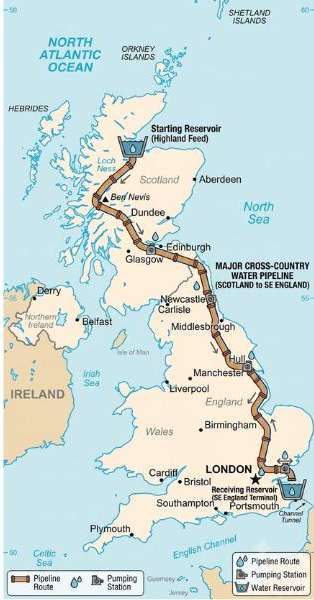
There’s an image going viral around Scottish nationalist circles right now about hypothetical plans to build an aqueduct to move water from Scotland to England. There are grains of rationality behind it. England is suffering widespread and worsening droughts due to climate change, Scotland still has reasonably abundant water and low demand, at least one UK Prime Minister has actively floated the idea in the past, and there is a long history of Scottish resources being exported from Scotland without the people of Scotland being adequately compensated.
The problem with this idea is that it won’t work – the physics is against it.
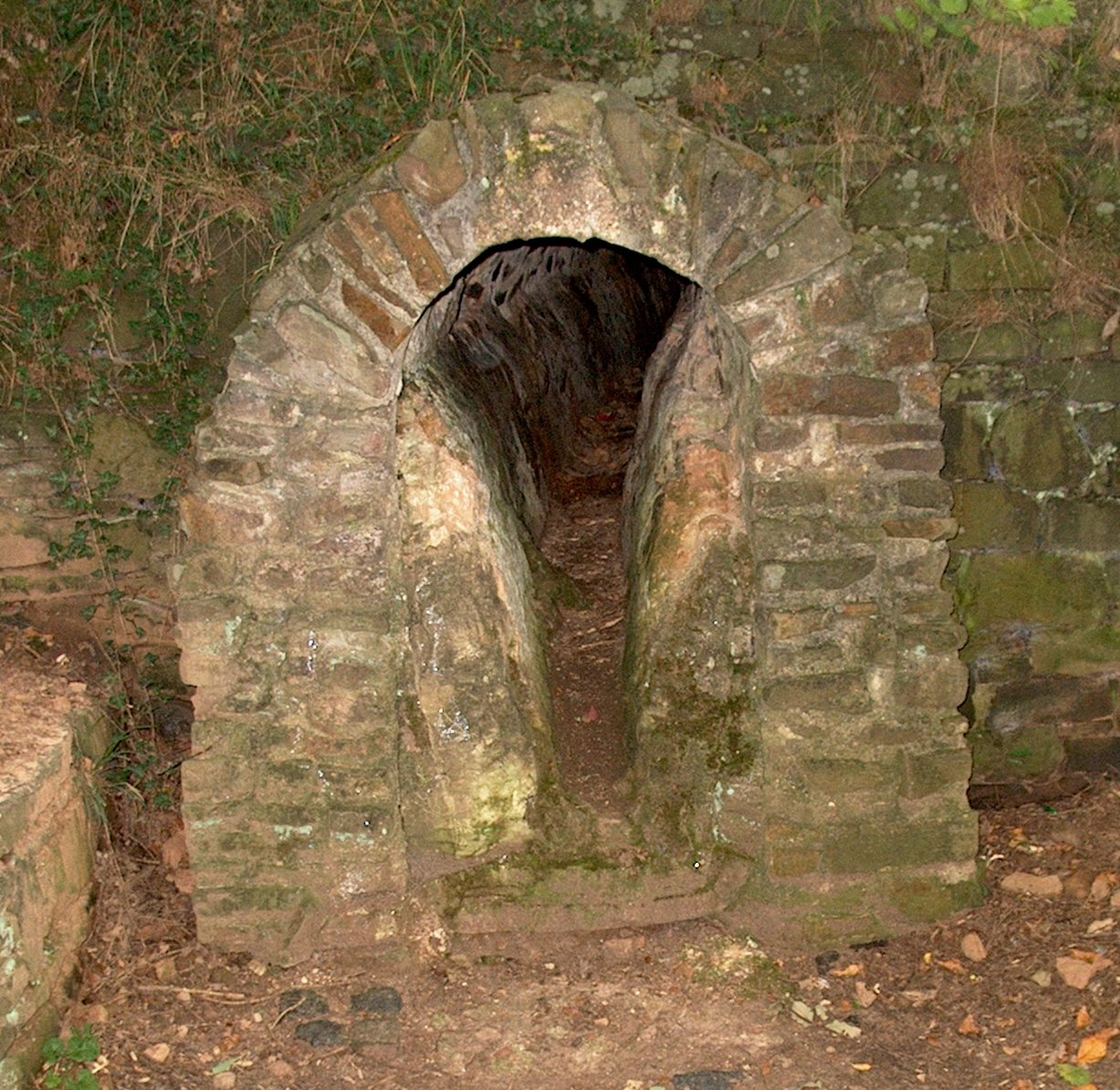
For water to flow under gravity, there needs to be a minimum gradient. Current British water pipe standards suggest about 1:100 as a rough rule of thumb – for every 100m the conduit runs horizontally, it needs to drop 1m vertically. The shallowest Roman aqueducts ran at 1:1,000 though they clogged up pretty quickly without constant maintenance. The longest Roman aqueduct – about a 5th of the length of this proposal – had a gradient of about 1:660 along much of its course.
The straight-line distance between Aberdeen and London is 720km. This means the pipe at Inverness would need to be between 720m-7,200m above sea level to drop the water down to London. If your reservoir is on top of a Munro and you can build like a Roman, you might make it so long as there are no other hills in the way. If you build to British water standards, I doubt you will.
Ah, but we have pumps! Pumps can lift water back up so you can make many small steps down instead on one large one. Yes. That’s the second issue. Pumps cost energy to run. To lift 1,000kg (1 cubic metre – enough for one household for 2-3 days) of water from sea level to between 720m and 7,200m and to transport it at a rate of 1 cubic metre per hour, will cost you between 2kWh and 20kWh. It doesn’t matter how much that costs or whether you get the power from fossil fuels or from solar panels, you still need that power.
To desalinate 1,000kg from sea water in the South East will cost you between 1kWh and 3.5kWh per cm/h.
Therefore, to make an aqueduct from Scotland to England economically viable [See Note] we need a) the capital costs of the longest aqueduct in the UK to be massively lower than that of a bunch of desalination plants and b) to build the pipes more efficiently than current British water standards.
And this is before we consider that a more effective means of supplying demand might be to introduce better, more local resource efficiency measures, to build more reservoirs to store water for the dry seasons or to nationalise the private water companies and prosecute the former directors to recover the costs to repair the leaking pipes.
We also need to consider that a transnational water conduit that the SE absolutely requires is going to be an absurd national security risk given that it could be burst open by a single drone anywhere along its length. Desalination plants are already vulnerable as we can see by the war crimes currently being committed by the US and Iran to that effect, but at least they can be distributed so that taking out one still means that some water can flow.
So no. England isn’t going to build an aqueduct to transport all of Scotland’s water away. It’s going to be much easier for England to build power cables to transport away Scotland’s energy to feed their desalinators instead.

Note:- There are extremely long water pipelines in the world – the longest feeds from a pressurised fossil aquifer so has a degree of head lift that surface water does not and others tend to drop down from mountains rather higher than Scotland’s.
There are also extremely long, economically viable pumped oil pipelines. Oil costs between a hundred and a thousand times more than water on a per litre basis, so the economics of energy use are very different.
Discover more from The Common Green
Subscribe to get the latest posts sent to your email.


@thecommongreen.scot
If the canal network was properly maintained, as a national water distribution system, then Kent probably wouldn't need to steal anyone's water 😟
https://en.wikipedia.org/wiki/Tryweryn_flooding
LikeLike
Remote Reply
Original Comment URL
Your Profile
Why do I need to enter my profile?
This site is part of the ⁂ open social web, a network of interconnected social platforms (like Mastodon, Pixelfed, Friendica, and others). Unlike centralized social media, your account lives on a platform of your choice, and you can interact with people across different platforms.
By entering your profile, we can send you to your account where you can complete this action.
@thecommongreen.scot
We stole your oil for decades. Do you think mere physics and economics is going to stop us taking the water, too?
LikeLike
Remote Reply
Original Comment URL
Your Profile
Why do I need to enter my profile?
This site is part of the ⁂ open social web, a network of interconnected social platforms (like Mastodon, Pixelfed, Friendica, and others). Unlike centralized social media, your account lives on a platform of your choice, and you can interact with people across different platforms.
By entering your profile, we can send you to your account where you can complete this action.