Borders are easy – but not necessarily simple

“Once a friend, always a friend. Why should borders stop that?” – Erin Hunter

This blog post previously appeared in Common Weal’s weekly magazine. Sign up to our Daily Briefing and Weekly Magazine newsletters here.

If you’d like to support my work for Common Weal or support me and this blog directly, see my donation page here.

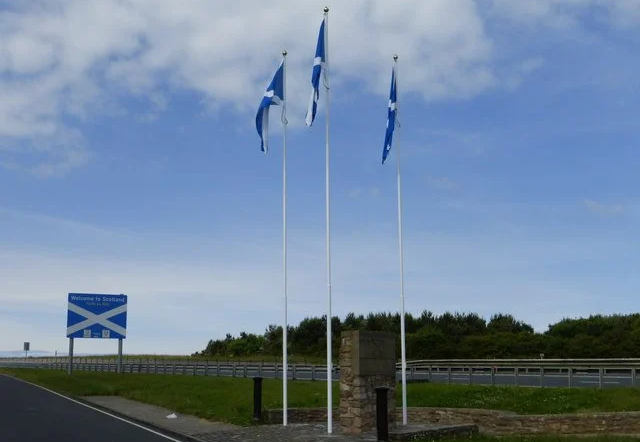
A photo of the Anglo-Scottish border, from the English side, looking towards the Welcome to Scotland sign. Three saltire flags on flagpoles in the centre.

Image Source: Wikimedia

In our initial promo for our new project – A Prospectus for a New State – we made quite possibly a controversial statement.

In describing the outline of the Prospectus and the kinds of areas it will cover as we lay out the institutions Scotland will need to set up between the point of an independence referendum and Independence Day, we said that compared to some of the other topics “borders are easy”.

It’s worth exploring what we meant by that. We’re not saying that building up the infrastructure to manage Scotland’s independent borders will be easy. We’re saying that the choice whether or not to do so is easy. It’s barely a choice at all.

In How to State a New Country, we laid out the process of becoming an independent country in a linear narrative form, taking the timeline of events that need to happen to show that the whole process should be bound not by arbitrary deadlines (like the “18 months” promised by the Scottish Government in 2014) but by how long it would reasonably take to set up the essentials (for example, we thought that the fastest reasonable time it would take to set up a new currency and the banking infrastructure required to manage it would take about three years).

In this new Prospectus, we’re taking a more project management approach. Each of the tasks we identify (we’ve identified around 80 at the moment) will be split according to various degrees of sovereignty that Scotland will have over the process.

Some we’ve deemed “essential”, as in there is only one clear option and that an independent Scotland must do it. An independent Scotland must have a borders and customs office of some description. It’s an “easy” choice to make that we should do this, because it’s not really a choice at all. It will also be an “easy” task to work out what kinds of job that office will perform and how it could perform them as there are modern international standards that Scotland obviously should abide by. “Should Scotland set up a borders agency?” is an “easy” question – yes we should.

“An independent Scotland will have fully sovereign control over our borders, but there are equally sovereign countries on the other side of those borders too.”

Slightly more complicated are our “options”. When it comes to borders, this is about how that office should be run. Currently, borders and customs are highly reserved to the UK, highly centralised and overly focused on the restricting the movement of people rather than monitoring the movement of goods, and so while we will undoubtedly be able to poach some staff or assets from the UK, we will need to build up the office and run it ourselves.

We may have options on whether to run it as a centralised agency or a decentralised one and we may need to decide pre-independence as this may result in the construction of physical infrastructure at or near borders and ports of entry. It’s possible to run an agency in different ways and so many of these will be true options – equally viable thought with their own trade-offs. Common Weal may have our own opinion on which of those options we pick – but others may disagree with more or less validity.

Next on the list will be “negotiating positions”. An independent Scotland will have fully sovereign control over our borders, but there are equally sovereign countries on the other side of those borders too. When it comes to the movement of people, Scotland may face an exclusive choice between more-or-less free movement with the rest of the UK (via the Common Travel Area) or we may decide to align more with the EU (perhaps via agreed frameworks of association with the EU). What we can’t do is force our counterparts to agree. Scotland may desire to remain in the Common Travel Area but the rest of the UK (perhaps reduced to the Kingdom of England by this point) may decide it wants to build a wall. Scotland doesn’t have a veto on this, but we can have negotiating positions, including potential retaliatory sanctions should our partners decide to be unreasonable.

And then there are the issues that aren’t really options for independence even though they seem as if they might be and so are “not required” at the moment. On day one of independence Scotland will not be a formal member of the European Union (assuming we wish to join – which is an “option” alongside not doing so). We may have strong diplomatic ties with them. We may be submitting our membership application on day one.

We may even have spend several years (perhaps even preceding the referendum) aligning Scots Law to ensure that the membership process runs as smoothly as possible. But the procedure of joining does mean that we need to be independent and then join, not the other way around. That means that in terms of borders we will not be fully integrated into EU customs systems nor will we be a member of the Schengen area.

We may want to do this. There may be good arguments for and against doing this. But those debates are likely to happen after independence, not before. So if it’s a deal-breaker for you that you’ll only support independence if Scotland joins/does not join the EU then you can be assured that it’s currently the wrong question. We can legitimately have that discussion at another time – perhaps the better question to ask would be “Should Scotland have the right to ask that question?”, because right now we don’t. Scotland got the Brexit the UK Government negotiated, largely without the input and even against the wishes and needs of Scotland.

And finally, there’s the topic that will no doubt be the top line headline of the whole project – “Cost”. For borders, we need to know how much it will cost Scotland to set up the required infrastructure, how much it might cost to run it on an annual basis, but also other costs like the cost to the economy of not properly controlling our borders (see the link above about the amount of rotten food that leaks into the UK, but also other issues like drug smuggling coming up north by road or via our porous coastline).

This is a subject that will be easier in some respects than others (we already know roughly how much a Scottish Central Bank would cost to set up an operate, and we can set “percentage of GDP” targets in things like military spending) but other areas may take a bit more research or will be highly dependent on our policy options (e.g. for security, the envelope between an Irish “Peace Force” style security sector and a pro-NATO, pro-Trump interventionist approach).

As you can see, this article is over 1,000 words, it only covers borders and it’s only an outline – the Prospectus for a New State is going to be a major undertaking for Common Weal, which is why we’re asking for your support with our crowdfunder to help make it happen. But there is a clear plan there, there are standards and procedures to follow and options to lay out and discuss.

So as we say, “Borders are easy”. But we didn’t say they’d be “simple”.

The Common Green logo Green text on a dark green background, above a version of the Common Weal "balance" logo.

Burnham hasn’t changed the game, but he has taken to the field

“Opportunity does not waste time with those who are unprepared.” – Idowu Koyenikan

This blog post previously appeared in Common Weal’s weekly magazine. Sign up to our Daily Briefing and Weekly Magazine newsletters here.

If you’d like to support my work for Common Weal or support me and this blog directly, see my donation page here.

A Go board in an advanced state - to the lay observer, it is not clear whether white or black is winning.

Prime Minister Andy Burnham took a significant step into the independence debate recently when, at PMQS, he was questioned by SNP MP Chris Law on the disparity between the constitutional mechanism for Northern Ireland formally seceding from the UK (contained within the Good Friday Agreement) and for Scotland to do the same (there isn’t one). Burnham replied that the mechanism for Scotland was “exactly the same” as for Northern Ireland.

That is, when it “seems likely” to the Secretary of State for Scotland (currently Douglas Alexander) that public opinion is such that a referendum would return a result in favour of Scottish independence, then such a referendum should be arranged.

There are a whole bunch of caveats to this constitutional clause. It is still, by far, nowhere near the democratic right to self-initiated, self-governance (c.f. Article 4 of the Constitution of Liechtenstein which allows any of the municipal councils to self-organise a secession referendum at a time of their own choosing). The clause that an independence referendum could only happen if it “seems likely” to succeed is subject to the Secretary of State not being stubbornly and wilfully blind to rising sentiment on the ground.

It has certainly been the case over the last decade of constitutional squabbling that the UK Government and successive Scottish Secretaries have been quite happy to tangle a target that they thought was unreachable only to yank it away when they realised that it might be. Is “once in a generation” the “not less than seven years” contained within the GFA? Or is it 25 years? Or is it not until every single person who voted in 2014 is dead and buried? UK Government has floated all of these positions at some point or another.

The Scottish Government is, with merit, now trying to bed the principle that Scotland should have the same constitutional right as Northern Ireland into law to make it harder for Burnham or his successor to backslide later.

It is certainly the case however that while Burnham has set a firm and reachable target now, the actual position of the goalpost hasn’t materially changed. The process of becoming independent was never path dependent on a constitutional arrangement and this remains true. The core argument should never have been “How do we get a new independence referendum?” or even “How do we bypass the need for a referendum with this One Weird Trick Lawyers Don’t Want You To Know?”.

It was always “How do we convince a majority of the Scottish population to support independence such that the pressure of their collective voice could not be ignored?”

It we win that consensus, the route to bringing Westminster to the negotiating table to agree and sign the required documents was always going to be a relative formality.

So how do we answer that important question? The key is to understand the demographics of independence. When support for independence rises, it’s not picking people up at random. It’s better to think of the kind of person who would be the next person to change their mind when support rises from X% to X%+1.

We can split Scotland into four groups of people. The “Convinced Nationalists” are those for whom independence is a core part of their identity and will likely always vote for it given the chance. It’s likely that you are one of them. The “Convinced Unionists” are the opposite – with an identity linked to the Union as a concept as strong as a Nationalist’s desire to break away. They will never vote for independence – though they may accept it as the will of the people afterwards in the same way as anti-devolutionists did after 1997. These two groups make up something between half and two-thirds of the population. Neither of these two groups are the target audience right now. Their votes won’t change.

Instead, think of the two groups in the middle – Converted Supporters who were the kind of people who began to support independence during the 2014 campaign as sentiment rose from its pre-2011 baseline of about 25% (the Convinced Nationalists) to 45% on the day. I’m part of that group. Most of this group are now pretty solid in their views. It’s a lot harder to get someone to change their worldview twice than it is to change once. I had to be convinced to support independence. Convincing me not to now would be a challenge. This is the primary reason that, contrary to some expectations, independence support did not fall back to the Nationalist baseline after 2014.

This means that the really important group are the people who sit in that realm of independence support rising from about 50% up to the Unionist ceiling somewhere near 70 or 75% and we really only need to win over about half of them.

“If an independence referendum happened this afternoon and returned a 60% Yes, are we, as a movement, prepared for that?”

When you examine the social attitudes of the Convinced Nationalists and the Convinced Unionists, they tend to be (though aren’t exclusively) quite different from each other. Support for independence is wrapped up in a lot of other fairly ideological policies such as being pro-Europe (if not always pro-EU), anti-monarchy, anti-imperialist, anti-nuclear, pro-immigration, Left-of-Centre and quite a few other topics whereas Convinced Unionists are much more likely to be opposed to many or all of these things (again, not exclusively – your individual experience may vary and there plenty of people in the Left of Scottish politics who agree with each other on almost everything except independence even if that one small difference prevents collaboration on everything else).

It’s not the Nationalists who are the isolated group though. The groups in the middle – even the Not-Yet Supporters – tend to be a bit closer in view to the Nationalists and especially to the Converteds than they are to the Unionists. In other words, the type of person who’d vote Yes at 60% is more “winnable” than the type of person who’d vote No at 40%.

We’ve talked about this phenomenon before. That the people we just barely failed to convince in 2014 weren’t ideologically against us. They actually agreed with the kind of Scotland they thought we were presenting. The problem wasn’t the vision, but the execution. They didn’t believe we’d fulfil our promises. And, frankly, who could blame them?

This is the main issue we’ve squandered over the past decade. We’ve been arguing process instead of policy. We’ve been hoping for “One Weird Trick” like a previously unknown legal route to indy or a Unionist politician standing up and say “Ah, go on then”. We haven’t really been preparing for what to do if that happened.

Seriously ask that question now. If an independence referendum happened this afternoon and returned a 60% Yes, what would be the next step? Are we, as a movement, prepared for that?

Not only do we need to be prepared, the act of the preparation is the thing that will convince the people who would bring support from 50% up to 60%. The act of preparation is the thing that will apply the pressure on Andy Burnham and Douglas Alexander that is needed for them to decide that independence “seems likely”.

In 2018, Common Weal produced our book How to Start A New Country which detailed the steps that need to be taken between referendum day and formal independence day in order to create a viable, independent nation state. It went through all of the institutions Scotland would need to set up or reform in order to take over the jobs currently being done “for” us in London. It’s still a powerful book but it’s getting on a bit and the world has changed a lot since it was written (the long version of the book is also almost entirely sold out, though you can get a digital copy here and we still have plenty of copies of the shorter version). It could use a bit of a refresh itself especially if it “seems likely” that it’s going to be needed sooner rather than later.

Next week, we’ll tell you what we’re planning to do about that.

The Common Green logo Green text on a dark green background, above a version of the Common Weal "balance" logo.

Marking my ten years at Common Weal

“Everything in politics seems impossible until the moment it becomes inevitable” – Craig Dalȝell

This blog post previously appeared in Common Weal’s weekly magazine. Sign up to our Daily Briefing and Weekly Magazine newsletters here.

If you’d like to support my work for Common Weal or support me and this blog directly, see my donation policy page here.
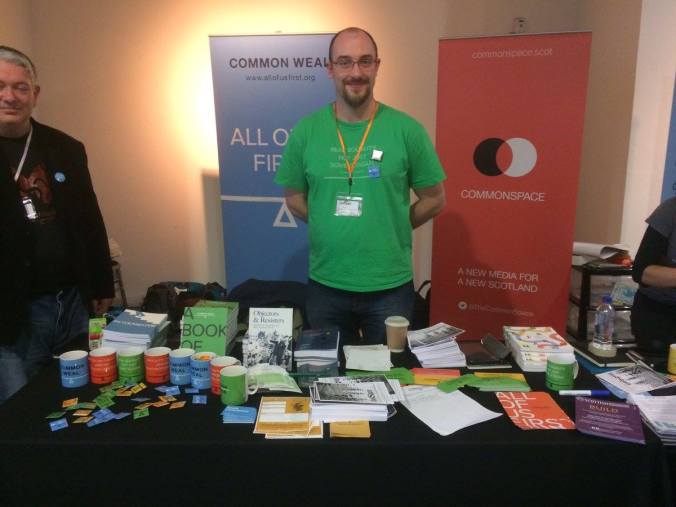

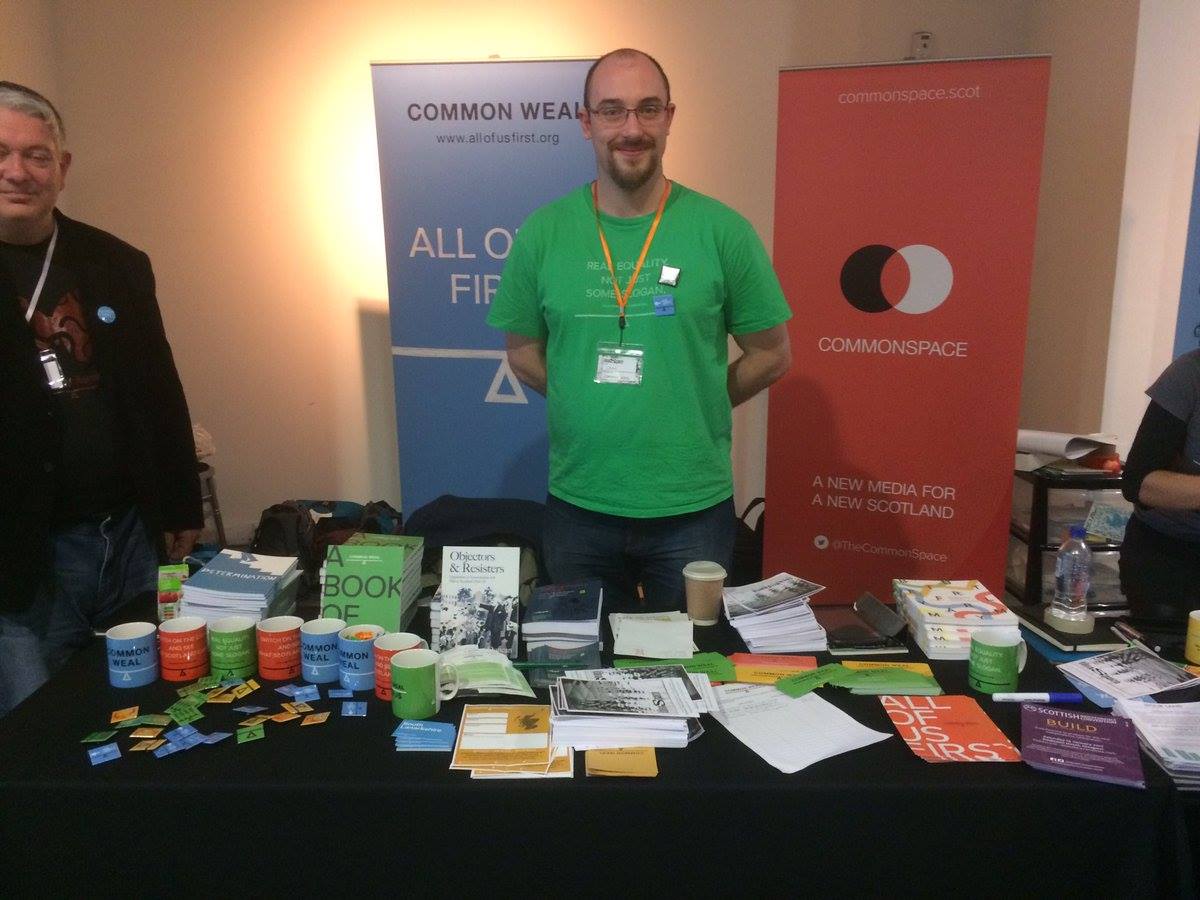
(I think this is the first photo of me at a Common Weal event – IdeaSpace, October 2016)

Time certainly does fly. Last week marked ten years since I published my first policy paper through Common Weal. By 2016, I had gone through a bit of a journey from my political radicalisation during the independence referendum, to losing my job and, as it turned out, my career as a laser engineer at the tail end of 2015.

In that intervening time I had kept up my political writing through my personal blog and it was an article there about GERS that caught the eye of Robin (who already knew me via previous campaigning together) and led him to asking me if I could help on a project about Fracking.

At that time, the political winds (including within the Scottish Government) were pushing very much in favour of fracking the hell out of Scotland and while the anti-fracking campaign had (and still has) a very strong case in terms of climate change, local environmental impact and in terms of long term energy security, the pro-fracking side were talking mostly about economics and when it comes to a campaign based on environmental principles vs a campaign based on making the GDP line go up, politicians are often much more easily swayed by the latter than by the former.

Hence the need for something different. I was asked to investigate the Economics of Shale Gas Extraction with a critical eye to see just how they actually held up. The result: They didn’t. Fracking does well to boost the profits of the owner of the well but the industry would create few jobs (especially in comparison to renewables or even the legacy oil industry), would produce even fewer local jobs and would do absolutely nothing in terms of energy security or the price of energy bills.

Even the profits made would only be made if gas prices are pushed anomalously high (thus, as we’ve most recently seen, the industry is sensitive to geopolitics) and if the companies involved are allowed to not pay the costs created by the pollution of the extraction and the burning of the gas.

I’m proud to say that that paper had a significant impact. It was widely read and adopted throughout the anti-fracking campaign in Scotland and that campaign would go on to win a moratorium against extraction that persists to this day (although there are still those seeking power who would reverse that ban).

Not bad for a first attempt at a policy paper!

Ten years later, I’ve published probably more than twenty more, plus co-authored half a dozen books, produced hundreds of hours of audio and video interviews and more. And don’t worry, this isn’t a retirement message quite yet – I still have at least a few more in me (you’ll very much want to keep an eye on the one I’m just finishing up at the moment!).

I’m always a bit embarrassed to self-promote but this seems like a moment that I shouldn’t pass up. I’d like to present the five policy papers written by myself that I look back on most fondly, either because of their sheer impact in the political scene or because they meant a lot to me in terms of subject matter.

Beyond GERS – 2016

If my fracking paper was the one that kicked off my time at Common Weal, Beyond GERS was the one that made my mark on the Scottish political scene. Beyond GERS sought to recontextualise the way we, as a nation, talked about the annual Government Expenditure and Revenue Scotland report as it was increasingly being used as a stick to beat the independence movement when it was, in fact, showing something rather different – that Scotland’s accounts were being grossly distorted by the fact that we were not independent in ways that made it very difficult to even talk about the finances of what lay beyond that horizon.

For example, just the fact of independence would cause a lot of civil servant jobs in London who are doing work ‘for’ Scotland to move to Scotland – along with the economic impact they would have when they live their lives in and around Edinburgh instead of in London.

The negotiations around debt and asset splits would cause significant changes which could very well lead to Scotland paying much less in debt interest each year (and almost certainly not more in interest even in a ‘worst case’ scenario). And then actual policy changes like choices to be made over how and where military budgets are spent or where and how large Scotland’s embassies would be could have significant impacts on our annual budgets.

The actual numbers in that paper are now out of date as is much of the methodology that went into calculating them. This was because, in additional to changes to devolution in 2017, one of the impacts this paper had was to change (and in my view improve) how GERS itself was presented. Other impacts were an increased focus on GERS in the context of independence which led to similar papers being produced looking at Wales and at Northern Ireland, which both reached similar conclusions to my own paper. It also led to multiple Scottish Government Ministers promising to produce their own version of a set of “post-indy accounts” for Scotland, though none have actually materialised yet.

Social Security for All of Us – 2017

It was Common Weal’s paper in 2013, In Place of Anxiety that was a major early developer of my political viewpoints, particularly its case for a Universal Basic Income. The concept had been around before then, of course, but that was my own introduction to it. In 2017, I had the opportunity to revisit the topic as part of a broader work on how an independent Scotland could redesign its welfare state.

As part of this I produced one of Scotland’s first fully costed Universal Basic Income schemes. It is meagre by today’s standards (equivalent to Universal Credit, but truly Universal) and I would now advocate for a UBI that meets some kind of adequacy standard of being able to actually prevent poverty rather than merely allow someone to live in poverty.

This paper had multiple impacts on the Scottish political world – not least, it played a role in pushing the major parties to make pledges around the idea of a UBI in the 2021 Scottish elections. The SNP, Greens and Lib Dems all came out in favour of a UBI and Scottish Labour presented a counter-plan around a Minimum Income Guarantee.

Sadly, none came to pass. The UBI pilot scheme proposed by the Scottish Government was blocked by the UK Government and their report into Minimum Income was all-but buried by the Government who had by then changed First Minister twice and were evidently no longer interested.

Ambitions for the next Parliament have also been scaled back with Labour and the Lib Dems dropping their pledges entirely, the SNP promising only pilot study of a Minimum Income study for artists and the Greens proposing a similar pilot for a UBI for care leavers. Both pilots are welcome, of course, but it’s still a step back from the loftier promises of 2021.

However, that journey from 2017 to now has been a remarkable one. Back then UBI was still a radically utopian idea in Scotland, fit only for academics and weird policy wonks. By 2021, Scotland had a Parliamentary majority in favour of UBI even if it lacked the power to implement one and that majority went across the constitutional divide – a rare thing these days.

It also led me to being picked up this year by Basic Income Network Scotland and joining them as a Trustee, so you can believe that I’ll be keeping the issue live as we go into the next Parliament to make sure those pilot schemes happen and then we eventually get a Basic Income rolled out to All of Us.

A Silver Chain – 2018

The Sustainable Growth Commission was the first major push by the SNP to produce a body of work on Scottish independence since the publication of its Scotland’s Future White Paper in 2014. It was widely anticipated but at Common Weal we had heard whispers and rumours that we weren’t going to like what was in it. Sure enough, when it was published we were, quite frankly, appalled. I received an ‘advance’ copy of the report just two hours before its midnight embargo and stayed up till 3am reading it – I was then on the radio at 8am the following morning being interviewed about it which made the late night rather worth it.

Over the course of that publication day, I hammered out this policy paper which was published a few days later. The biggest difficulty we had with the report was the ‘six tests’ it laid out that were put in place to block the launch of an independent Scottish currency in the event of independence. Tests that we still maintain would have been impossible to meet and that the act of adhering to the tests would have made it harder, not easier, to launch a new currency.

This wasn’t the only objection we had but it was the one that gained the most traction. The party had to put substantial effort into railroading an adoption motion through their conference that year – the rebellion amongst members was almost as great as the one they saw during the debate to become a pro-NATO party. It also led to the formation of what would become the Scottish Currency Group who have taken our work on an independent Scottish currency and have pushed on far beyond it. Keep an eye out for their next sets of work in the coming months.

Good Houses For All – 2020

There is no logical reason that I can fathom for building houses that leak unnecessary amounts of heat when the technology to build them better doesn’t just exist but now costs virtually the same as building them badly. At the same time, incentives to improve existing houses don’t exist because why should landlords bother to properly retrofit when it’s the tenant who pays less on their bills and instead you could just jack up their rent because they have nowhere better to go.

This paper sought to solve both problems. It laid out the finances of building passive energy efficiency grade houses (though not necessarily the PassivHaus standard as there are other ways to achieve similar levels of efficiency) for social rented stock. I found that doing this could deliver houses cheaper than the private sector would while still being profitable for Local Authorities. This would mean Councils could build essentially unlimited social houses and outcompete the private sector in both price and in quality.

In 2022, I was asked at a fairly high profile public event if I could win just one policy in my political career, which would it be? I chose this one. It has the potential to not just reduce but to eliminate fuel poverty in Scotland and would leave a legacy lasting potentially centuries.

So imagine my shock and surprise that just a few weeks later, MSP Alex Rowley got in touch and took us up on that challenge, introducing a Members Bill to make passive energy efficiency the minimum standard for new homes in Scotland. The Government, facing a massive defeat if they opposed the Bill, did the smart thing instead by simply adopting it as Government policy. There’s still a long road to go in making it all happen but there’s an excellent chance that it will. I hope that I don’t only win one Government policy in my entire career, but if I do I’ll be happy if I only win this one.

ScotWind: Privatising Scotland’s Future Again – 2022

In January 2022, the Scottish Government announced that the Crown Estate Scotland (an arms-length org, but one owned by and accountable to Scottish Ministers since 2017) had completed its auction of options to develop what was then the world’s largest offshore wind project – ScotWind.

Basically, companies bid to buy the right to come up with a plan to develop a particular patch of seas and then they can choose to either return the right to the Estate or “exercise their option” and start the process of developing it. The Government PR machine went into overdrive to talk up the benefits of selling these options. Headlines touted the hundreds of millions of pounds that would flow into the Scottish Treasury and what could be done with it as well as promises around the ‘supply chain’ that would bring hundreds of jobs to Scotland.

But I was looking at the actual reports and things didn’t seem right. As it turned out, the auction was badly flawed. Rather than a traditional option where the highest bid wins or one where a lowest reserve price was set, this one had a maximum bid ceiling set on it. Every winning bid won their option at exactly the bid ceiling (suggesting they might have paid more). Other problems became evident, such as absolutely minimal protections that in many cases would make it cheaper to break those supply chain promises and to pay the fines than to actually fulfil them.

I very quickly put together a report of these findings and we published just a few days after the initial announcement. Instantly, the news coverage flipped from repeating the party line of the success of the auction to taking a more critical eye. The newspaper article covering my report ended up being the most read article in the Herald’s history of publishing online. My follow up report a year later revealed that Scotland has potentially lost out on billions or maybe even tens of billions of pounds by botching the auction the way it did and an investigation into what happened is now underway.

The Next Ten(?) Years

Obviously, my actual job at Common Weal has changed substantially over the decade. I spend more time now managing our Working Groups and the various other people working on policies than I do writing myself. I also keep up with contributions to our Daily Briefing and weekly Magazine (you are subscribed to both, aren’t you?) and I do a lot of outreach, networking and public engagements (want me to speak at your local campaign group about any of my work? Get in touch!). But, I’m still heavily involved in developing my own policies too and, as I say, I think you’re going to like the one I’ve got coming up next.

And so, where for the next ten years? Honestly, the unemployed laser engineer I was ten years ago couldn’t have predicted where I’d be today so who knows? I do know that I couldn’t have done it without you. It’s folk who support Common Weal with their £10/month that have let me do everything I’ve done and can support me and the rest of the team to keep doing it. So, as proud as I am to have done it all, I’m so grateful to have been allowed to do so. Thank you.

And here’s to the next decade, where ever it takes us.

Process over policy was never a route to Indy

“Il nous faut de l’audace, encore de l’audace, toujours de l’audace!” – Georges Jacques Danton

This blog post previously appeared in Common Weal’s weekly magazine. Sign up to our Daily Briefing and Weekly Magazine newsletters here.

If you’d like to support my work for Common Weal or support me and this blog directly, see my donation policy page here.

The Scottish Parliament’s Constitution Committee has recently concluded a short investigation into legal mechanisms for triggering a second independence referendum. The final report and the reports of the evidence sessions are worth reading, but the conclusions are fairly simple albeit in a direction that probably won’t please anyone who has an especially vested interest in the process for Scottish independence.

Essentially, the principle of becoming independent is itself legal (as opposed to many states which have constitutions that explicitly prohibit the secession of components of the state) but there is currently no legal mechanism in place that would allow for Scotland either to unilaterally declare independence nor to unilaterally hold a public referendum (even an “advisory” one) on the question of Scottish independence. This stands in contrast with various other states which explicitly legislate to allow components to secede either unilaterally or provide a mechanism to translate the democratic will of their residents into the legislative process of independence.

Instead, the processes which would allow for independence cannot be enacted unilaterally and may only be enacted via the UK Government or UK Parliament. This includes a mechanism similar to the one in place for Northern Ireland which would allow for a poll on leaving the UK and reunifying with Ireland if public sentiment makes it seem likely to the UK Secretary of State for Northern Ireland that such a poll would return a result for reunification. That’s a slightly technical wording but the crucial point is that public polls in favour of reunification are only a mandate for a referendum if the UK Government chooses to not be wilfully blind to them – the veto is still in their hands.

As is the legislative process of becoming independent – that can’t be done by the Scottish Parliament passing a ‘Divorce Act’, but instead by Westminster passing legislation to enact independence. The obvious route to my mind is that they would amend the Scotland Act to delete Schedule 5 and so remove the list of reserved powers – essentially devolving everything not already devolved.

Then it might add Scotland to the Statute of Westminster 1931 which essentially says that new UK laws won’t apply to Dominions and the Commonwealth nations unless they explicitly request or consent to it. Only then could this be followed by a Scottish Act or Constitution Article to make it unlawful to request or consent to such laws plus further laws to remove the role of the UK Supreme Court and other state apparatus that may remain plus something to clarify questions around Crown succession or to remove the Magic Hat entirely and become a Republic.

Another crucial conclusion is that there is no international law that can be applied to legislatively compel Westminster to act on public sentiment or on the calls for a referendum. The UN isn’t going to send in blue-helmeted peacekeepers to enforce some hypothetical ‘Decolonialisation Mandate’ or something like that.

Instead, the Committee concludes, that the question of independence was less a legislative question but more a diplomatic and democratic one. Essentially, that independence could be legislated for should it need to be, but this is only going to happen in practice when the UK Government decides that it needs to be.

Here’s the thing – This was also pretty much exactly the thought process that went in to us writing our books Direction in 2023 and our policy paper Within Our Grasp in 2019. It’s important to note that the latter paper was written before the Supreme Court ruled that a unilateral advisory referendum would be unlawful – a decision that at the time seemed likely but far from assured and therefore until that moment was ambiguous.

“Our goal should be to set up the situation where Westminster has absolutely no choice but to come to the negotiating table to enable independence because not doing so would be worse for them.”

We recognised long before this Committee was even conceived that the question of independence was going to be more about democracy and diplomacy than sheer legislation and we’ve taken quite some flak over the years from trying to push back against elements of the independence campaign who tried to magic independence into being by finding ‘one weird trick the lawyers won’t tell you about’ that would somehow invalidate the Act of Union and prove that Scotland had, in fact, been independent all along. I remember with wry fondness one person who reacted to my explainer of the legislative process above by calling me a “Colonialist Westminster Shill”.

Wishing independence into being isn’t going to make it happen, but the lack of a clear legislative process with goalposts and milestones isn’t a weakness either. Goodhart’s Law very much applies here in that some process that demands that, for example, public polls show 60%+ support for a sustained period of six months before a referendum can be considered could always be knocked into the long grass by a single 59% poll or – perhaps worse – could bounce us into campaign mode without a plan for the day after (like Brexit). Even the SNP’s foolish target of calling for a referendum if there’s an SNP majority in May grants the UK Government the ability to decline that offer even if every single MSP in Holyrood is openly pro-indy, but only 63 of them are SNP.

Instead we should recognise that the precise legislative formulation for independence is ultimately irrelevant. If Westminster has the ultimate veto over whether or not it goes ahead, then we must recognise that they will always enact that veto if doing so causes them fewer problems than not doing so. This is why Sturgeon’s 2017 demand for a referendum was dismissed with a curt “now is not the time” and every other attempt with even less.

This was the purpose of our book and policy paper. Our goal should be to set up the situation where Westminster has absolutely no choice but to come to the negotiating table to enable independence because not doing so would be worse for them. I’ll leave the details of that strategy behind the links to the book and paper (please go read them and buy the book) other than to say that only one component of it is building the public support for independence to undeniable levels.

We also need to consider building an escalating pressure campaign whereby Westminster essentially realises that governing a Scotland that no longer wants to be governed is more hassle than it’s worth (which, if the propaganda is true, is already not worth much because we’re such a money sink).

We weren’t invited to give evidence to the Committee, despite the detailed work we’ve done on the topic, but if we had been we may have questioned the reason for the inquiry being called. Its conclusion was obvious to us long before it was even started and so should have been obvious to the people who called it. I fear that the inquiry was never designed to be part of a coordinated ladder of escalating pressure but was instead another attempt at substituting process for policy.

There’s a simple test of whether I’m right or not. One that will separate a checkbox exercise designed to let the parties tell potential voters they’re doing something from one where they are actually doing something to bring about independence.

The Committee’s final conclusion calls for the Scottish Government and UK Government to negotiate a pathway to exercising Scotland’s right to determine its constitutional future as a matter of urgency.

The test is this: What will you, the politicians, do when (not if) Westminster once again says ‘No’?

Use energy to win independence, rather than independence to win energy

“The problem with the idea of cause and effect is that what is deemed the cause is an effect.” –  Mokokoma Mokhonoana

This blog post previously appeared in The National as part of Common Weal’s In Common newsletter.
If you’d like to support my work for Common Weal or support me and this blog directly, see my donation policy page here.

Scotland doesn’t need independence to start owning our own energy.

It feels like 2025 has come full circle for us at Common Weal. January started for us with an announcement from the Scottish Government that it was “not possible” to bring Scottish renewable energy into public ownership – an announcement made after the publication of a poll showing that more than 80% of people in Scotland favoured them doing so. We responded with a briefing paper called “How to own Scottish energy” which laid out the logic behind their announcement, why that logic was flawed and how they could bring energy into public ownership despite their own objections.

In short, the Government’s stance is based on an extremely narrow reading of the Scotland Act which actively prohibits the Scottish Government or Scottish Ministers from owning electricity generating, storage or transmission assets. Under this reading, there cannot be a “National Electricity Company” designed and owned in the same way as some public corporations in Scotland like CalMac or ScotRail.

However, we showed in our paper that various options were not blocked by this prohibition. For example, a Minister-owned “National Heat Company” could be designed to build and own district heat networks to keep us all warm (the prohibition is specifically about electricity, not other forms of energy). The Government could also build a National Energy Company and hand ownership over to a consortium of Scotland’s 32 Local Authorities. Or each Council could own their own energy companies. Or the Government could back the creation of a private energy company that is mutually owned by every adult resident of Scotland. Or, instead of complaining about the limits of devolution, they could be applying pressure on the UK Government to amend what is very clearly a completely obsolete prohibition in the Scotland Act (especially as a narrow reading of it also prohibits the Scottish Government from erecting solar panels on its own buildings).

Come forward now to December and the SNP have kicked off their 2026 election campaign with a new paper essentially saying the same thing as they did earlier this year except framing it around “we’ll do it, but only after independence”. On public ownership in particular, they aren’t advocating for the full-scale nationalisation of energy but their ambition appears to extend only to communities owning up to 20% of local renewable projects.

20% is far better than the current level of a rounding error above 0%, but it’s clear that even within devolution, the Scottish Government could do far more than it’s currently doing to support communities by giving them grants and loans to purchase stakes in developments, to pressure developers to sell or grant those stakes to communities as a condition of planning permission or the renewal of licences and to actively use opportunities like the “repowering” of developments, the end of their licence periods and break-clauses in contracts that would allow poorly performing developers to have their licences withdrawn and transferred to public bodies (in much the same way as the Government took ScotRail back from Abelio in 2022)

This doesn’t get the UK Government off the hook though.

Their recent announcement that some £28 billion will be added to consumer energy bills to pay for vital energy grid upgrades is going to stick in the craw of people whose energy bills are already too high. Worse will be that most of the profits of that investment will flow into multinational companies – including foreign public energy companies – with none returning to the consumers themselves. These investments, too, should be made on a staked ownership basis so that the people paying for them – us – should become shareholders in the investments and see a return on our investment. To make things perfectly clear, if the UK Government had announced that it was going to fully publicly own the assets built via this spending, then the added costs on your bill would be the same. In other words, the choice to publicly own the UK’s new energy assets will cost you the same as the choice to leave them in private hands.

“Can’t we use our public owned energy to help win back our independence, rather than claiming more weakly that we can use independence to win back our energy?”

The same will be true of assets in an independent Scotland – but given the Scottish Government’s “all in” approach to “inward investment” (something their plan published this week mentions more often than public ownership), I can completely see them making the same mistake and forcing us to pay for assets that someone else will profit from.

I freely admit that there are aspects of Scotland’s energy transition that are not in Scotland’s hands and which are not likely to be easily negotiated away as part of an adjustment to devolution such as Scottish consumers being forced to pay for extremely expensive and risky nuclear projects that even NESO (formerly, the National Grid) now says are not needed to meet Green energy targets but this does not let the Scottish Government off from making the changes it can make now rather than using the dangling carrot of independence as a means of delaying action. If anything, independence will come less from making a promise that might be fulfilled afterwards but by taking tangible actions now that push devolution to the limit and then saying to voters “if you want more, you know what to do”.

If it truly is, as the Scottish Government says, Scotland’s Energy – then shouldn’t we take back as much as we can now as use that as leverage to win the rest? Can’t we use our public owned energy to help win back our independence, rather than claiming more weakly that we can use independence to win back our energy?

Undermining Our Principles

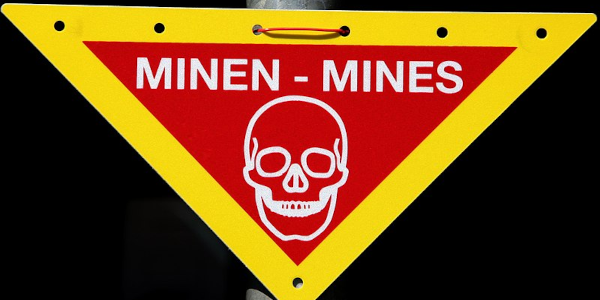
“The more expeditiously we can end this plague on earth caused by the landmine, the more readily can we set about the constructive tasks to which so many give their hand in the cause of humanity.” – Diana, Princess of Wales

This blog post previously appeared in The National as part of Common Weal’s In Common newsletter.
If you’d like to throw me a wee tip to support this blog, you can here.

image_2024-12-07_131858185

In a year of countless and boundless horrors, where war crimes and crimes against humanity are now so routinely fed to us in real time on social media that we are seemingly utterly numb to those suffering them and indifferent to or even cheering on those who commit them, who had “Scottish First Minister apparently breaches international land mine ban treaty” on their list of things to watch out for?

As reported by LBC’s Gina Davidson, last week, outside a primary school where he was launching a new literacy programme, FM John Swinney was asked about the then breaking news that the USA was changing its policies and giving Ukraine anti-personnel land mines to deploy during its war against Russia. Swinney stated that territorial integrity must be defended and that he “supported the actions taken”.

There’s a problem with this – that statement looks very much like a breach of Article 1(c) of the 1997 Ottawa Treaty that banned the use of AP mines – and in particular banned any state signed up to the treaty from taking any action to “assist, encourage or induce” any other state (whether signed up to the treaty or not) from using such weapons. The UK – and thus Scotland – is a state party to the treaty and all aspects of government, including the devolved governments, are bound by it.

Continue reading →

Ageing For Indy?

“The afternoon knows what the morning never suspected.” – Robert Frost

This blog post previously appeared in Common Weal’s weekly newsletter. Sign up for the newsletter here.
If you’d like to throw me a wee tip to support this blog, you can here.

image_2024-09-21_120152945

I’m writing this on the 18th of September 2024. Ten years on from the independence referendum is a day of sober reflection. I certainly have a lot of memories of that day in particular as I spent it under a warm blue sky (much like today, though not quite as warm) going door-to-door to get out the vote amongst folk our campaign group, Yes Clydesdale, had identified as likely to vote Yes. The shattering of my hope was still several hours away, the grief of the following days and the determination to get back on my feet again was a little further away again. I remember many of my conversations that day but two stick out in particular right now.

Continue reading →

Rolling Over Scotland

“As the tail on our back disappeared as we no longer had any use for it, nuclear weapons will also disappear once we realize, we no longer have any need for them. But no matter how much we daydream, it will never happen as some sort of grand geopolitical gesture of international collaboration – somebody has to take the first step – one nuclear-capable state has to take that first leap of bold faith and naive trust! The question is, who will it be? The first nuclear nation to abandon its nuclear weapons, will be the First Peacemaking Nation of Earth – and their head of state, the First Peacemaker.” – Abhijit Naskar

(This blog post previously appeared in Common Weal’s weekly newsletter. Sign up for the newsletter here.)

This week saw the publication of the 11th paper in the series of the Building A New Scotland Independence White Papers by the Scottish Government, this time looking at the defence and foreign affairs and the policies that the current SNP/Green Scottish Government would advocate should they form the Government of that independence Scotland.

The paper was recently described by Alyn Smith as a sign that the Government had “done its homework when it comes to foreign policy and security”. Unfortunately, he is very far from the mark on that. The paper instead shows a profound ignorance about the process of becoming an independent state and a serious contempt for the internal party democracies of the parties involved.

Continue reading →

The Welsh Way Forward

“Where two principles really do meet which cannot be reconciled with one another, then each man declares the other a fool and a heretic”
– Ludwig Wittgenstein

(This blog post previously appeared in Common Weal’s weekly newsletter. Sign up for the newsletter here.)

image_2024-02-07_124803052

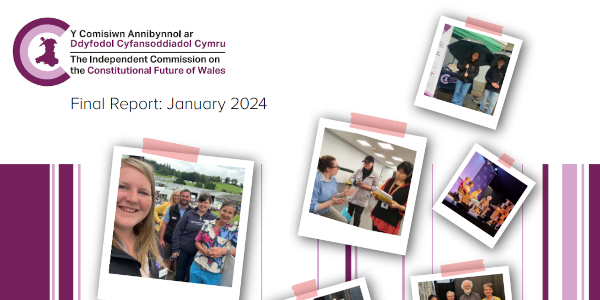
The only reasonable constitutional future for Wales that is not viable is the status quo. This was the ultimate conclusion of the final report from the Independent Commission on the Constitutional Future of Wales which published last week after several years of patient, diligent and thorough work. While initially set up to examine the prospect of Welsh independence, it took a much broader view, pulling in thoughts and ideas from across the constitutional divide in a way that Scotland could and must learn from.

Continue reading →

Better For Who?

“If politicians don’t care about the electorate and lie to them, they can’t expect the electorate to care back and vote them in. An election must be more than a search for honesty in a snake pit.” – Stewart Stafford

(This blog post previously appeared in Common Weal’s weekly newsletter. Sign up for the newsletter here.)

This month marked eight years since the Scottish Independence Referendum and it’s fair to say that they have not been a quiet eight years. Brexit, pandemic, economic turmoil and the grinding poverty caused by over a decade of Austerity are taking their toll on the wellbeing of the country. It’s certainly not the promised “sunlit uplands” or even the pre-2014 “status quo” that many thought they were voting for. As we move into a fresh independence campaign, it’s worth looking back at some of the things we were promised in 2014 by the pro-Union campaign and how those promises have panned out since.

image_2022-10-03_134124375

Continue reading →