“The measure of a man is what he does with power.” – Plato
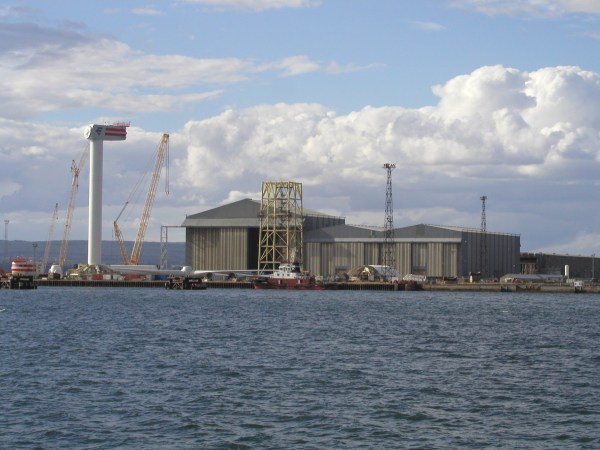
5MW wind turbine under construction at Nigg Energy Park
The National Grid does not serve our nation.
The UK’s electricity network is not designed for the 21st century. It is certainly not designed to be able to best exploit the resources we will want to be using in the post-oil age.
Actually it seems like only March that the last edition was out. What’s happening here?
Well, there was a consultation that almost no-one knew about which discussed a few methodological changes to GERS in line with the ‘new powers’ we’re getting and it also asked if the next report should be brought forward. I’m completely convinced that the fact that this means that we’re getting the report well before the Council election campaign next year is absolutely just a convenient side effect(!)…but no matter. We’ve got the data.
Tomorrow’s Headline Today
Scotland’s budget deficit remains at a little under £15 billion. As with last year, don’t expect a single news outlet to go one single step further with the story than that. Except maybe to say that oil revenue has dropped from £1.802 billion last year to just £60 million this year.
So what’s happened? Why hasn’t Scotland, which is “totally dependent on oil”, completely collapsed now that oil revenues have basically dropped to zero?
Last year, total revenues dropped by around £500 million on 2013-14. This year, total revenues have INCREASED by £181 million. In fact, total revenue is higher than it was in 2012-13 when we received some £5.3 billion in oil revenue.
It’s also worth noting that if you only look at GERS 2015-16 then it looks like our deficit has increased by a couple of hundred million in the past year but if you look a bit deeper, and compare the numbers to previous GERS reports then something interesting happens.
In GERS 2014-15 our deficit was recorded as £14.8 billion but in GERS 2015-16 the 2014-15 deficit has somehow dropped by £622 million to £14.3 billion. Essentially, this shows one of the limits of GERS in that it is based on sometimes highly speculative estimates which get revised over time. It may be five years before we finally know the “true” accounts figures for this year. This accounting adjustment is extremely significant compared to, say, our “budget underspends” but unless you’ve read it here I expect it to pass entirely unnoticed.
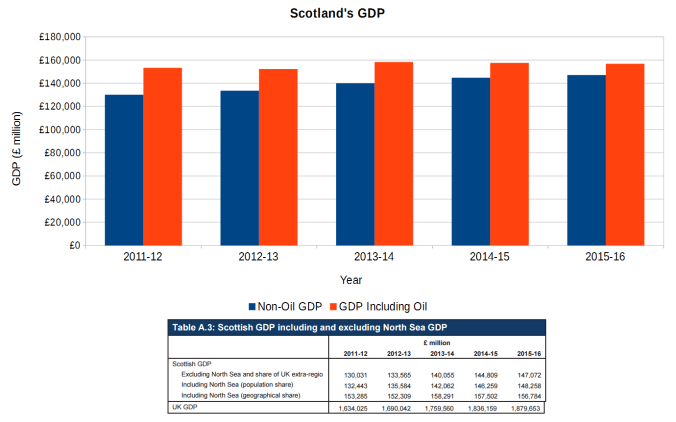
Now, what about our all hallowed GDP? It’s down by 0.45% from £157.502 billion in 2014-15 to £156.784 billion in 2015-16 (with non-oil GDP having increased by over £2.2 billion, the highest it’s ever been).
You know, perhaps it’s time we started measuring our economy in terms other than just GDP. We know it’s flawed. We know it throws up extremely strange results like Ireland’s “economy” growing by 25% because a few American companies moved their nameplates around. We know it doesn’t even particularly correlate to things like tax and ability to service debt very well.
Maybe it’s time we started measuring (and taxing) our country based on the things which actually matter.
But back to GERS.
Dutch Disease with Scottish Characteristics
So what’s going on here? Essentially it’s the same pattern first picked up last year. As oil prices drop, so do fuel costs. Which means everything from the costs of transporting goods to the heating and lighting costs for your home drops. This means you have more money to spend in the economy and companies have fewer overheads leading to either greater profits (thus, ideally, more tax revenue) or more room to invest in expansion.
This is a clear demonstration of the so-called “Dutch Disease” where high oil prices choke off the non-oil based economy in the form of the aforementioned fuel costs (it also tends to harden one’s currency but this is less of a factor in the Scottish case given that we don’t yet have one).
At the time of the last report I was criticised for pointing this out on the grounds that the oil price collapse “hadn’t fully fed through” hence I was jumping the gun on the observation. It shall be interesting to see if anyone says the same thing now. Could revenues drop any lower?
This should serve as somewhat of a warning to those itching for the return of high oil prices and certainly for those desperate to “replace” offshore oil with onshore fracking. It’s maybe time to have a good hard rethink about what kind of resources we want to develop in Scotland. Now, to be sure, I’ve nothing against our offshore industry and for those folk out there it’s been a pretty dreadful time. It’s just that, certainly as a Green, I think our offshore industry is on the wrong side of the country and should be based on wind/wave and tide rather than oil. You can be sure that if the wind and tide stops flowing we’ll be dealing with problems a little bit larger than the state of our finances.
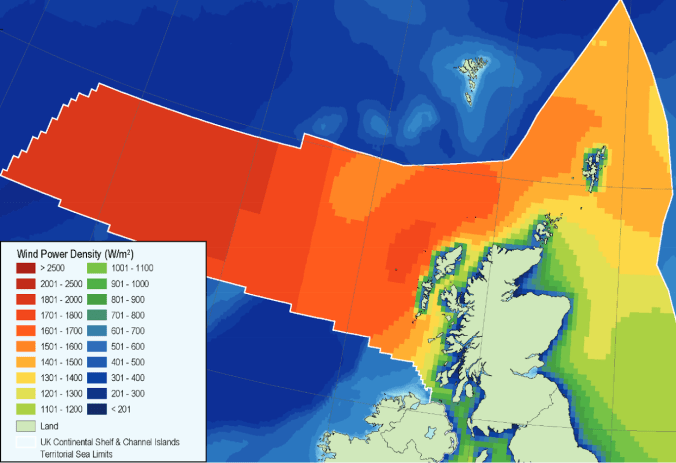
Scotland’s offshore Wind Power Density map
Sweet Fiscal Autonomy
As mentioned earlier, part of the methodological changes discussed in the GERS consultation was to do with looking at the taxes to be devolved to Scotland under the series of “vast, new powers” we’ve been generously granted.
In terms of actual revenue, chief amongst these is income tax (excluding interest and dividends, the ability to move the Personal Allowance or to adjust the definition of “income”) and VAT (excluding any actual control at all. We’re getting the VAT added to Scottish coffers and then an equivalent amount removed from the block grant. Yay.) along with comparatively minor taxes like landfill tax, aggregate levy and air passenger duty.
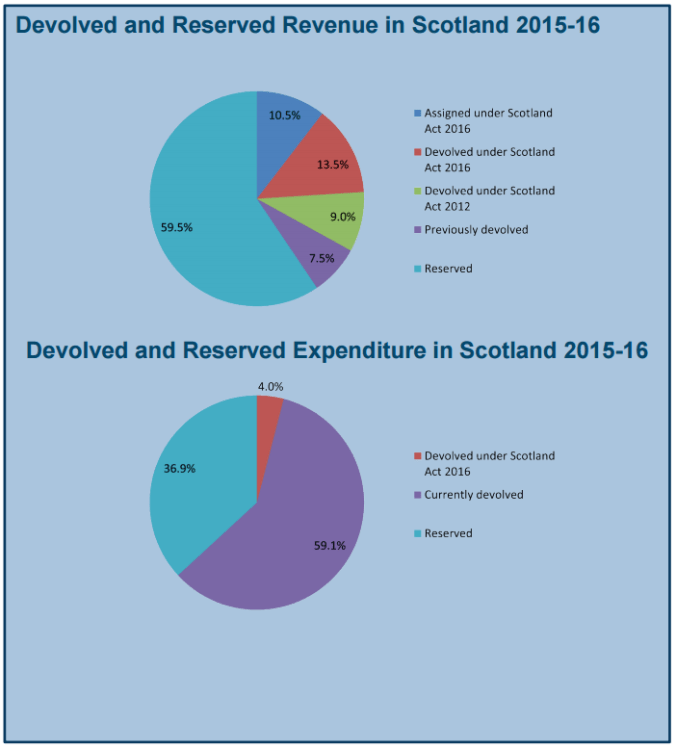
In total, the Scottish government will directly receive 40.5% of Scottish revenue (£21.8 billion this year) and, given the limitations on VAT and income tax, have actual, practical control over perhaps half of that. Devolved expenditure, however, will soon sit at 63.1% of total (£43.3 billion). Basically the Scottish government can only directly control enough income to fund perhaps about a quarter of what it’s directly responsible for delivering.
There’s a side issue in all of this related to that old topic of the budget underspends. Tucked away on page 47 of GERS there’s an interesting line which looks at the confidence intervals for some of the tax revenues used. Remember that the revenues given are estimates and are subject both to revision over time and change due to circumstances that the government cannot control. For example, if you move job half way through the tax year your income, therefore income tax, can change. If your job moves you to England, your entire income tax contribution moves from the Scotland side of the budget to the rUK one. Hence, the total income tax revenue estimate is subject to a margin of error, in this case of 1.0%.
The same goes for other taxes to greater or lesser degree to the effect that the margin of error over all of the taxes measured there is 1.6% or ±£570 million.
Remember that the Scottish Government has extremely limited borrowing powers. It can only “overspend” on the current budget by £200 million in a single year and cannot exceed a total current debt of £500 million. And yet income revenue, on which expenditure must be planned, has a margin of error of ±£570 million.
In the event, this year Scotland’s “underspend” was only £150 million. If you think you can plan a budget better than this then please, send it in. If not, might be a good idea to stop reporting and moaning about underspends.
Paying For It
Another little line that seems to have been added to GERS this year (on page 37) is a breakdown of the annual costs of financing Labour’s PFI and the SNP’s replacement NPD loans. There’s been a bit of a milestone reached there with the availability costs of PFI now exceeding £1 billion per year or over 15% of Scotland’s total capital budget and slated to increase even further over the next decade unless something is done about it. Don’t be surprised if this becomes a major issue for the council elections next year.
Of course and once again you wouldn’t know this if all you did was watch our Great British Broadcaster, the BBC. Their recent “investigation” into PFI couldn’t even bring itself to mention the name of the party which lumped this crippling financial burden on us.
Finally
I could go on. We could nip-pick at details like the mysterious addition to the expenditure budget of net EU contributions (there’s always been an annex discussing this but this is first year it has explicitly been counted in a separate line in Total Expenditure) or notice that for the first time in at least five years our debt interest paid has increased as our UK debt increases have started to outweigh the effect of falling bond yields.
It’s all a shell game though. We know that GERS isn’t nearly as important as people hold it to be nor is it nearly as informative as it should be. It’s not going to change many minds on its own nor does it tell us one single thing about the finances of an independent Scotland. If we want to do that, we’re going to need to build a national budget from scratch, taking into account all of the taxes (existing and new) that an independent Scotland might choose to levy. We also need to have a look again at what Scotland actually needs to spend its money on. Could we use Citizen’s Income to create from scratch a welfare system worthy of the name? Would a Scottish Government able to issue its own bonds on its own debt be able to get a better deal than the one we have right now?
Quite simply can Scotland as a nation see ourselves as better than others would prefer us to be seen?
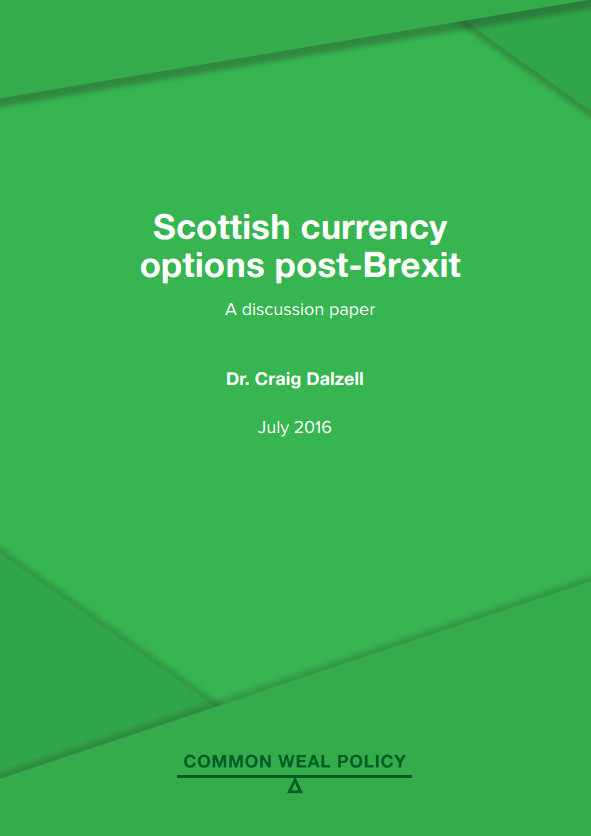
As promised, I can finally reveal my work examining Scotland’s currency options going forward into the next independence campaign.
My report has been published through Common Weal and can be read here or by clicking the image below.
In it I first examine the macroeconomic considerations which go into selecting a currency option, chiefly looking at the interaction between movement of capital, interest rates and exchange rates. It turns out that it is impossible to have full control over all three at any one time so all currency options entail therefore some degree of risk or management requirements including the founding of infrastructure such as a Central Bank. All options have their advantages and disadvantages, their risks and rewards.
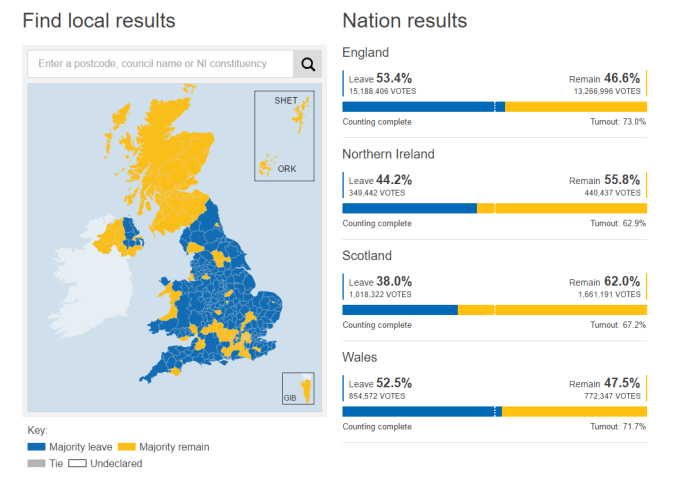
Well that’s that then. Votes cast and counted and the UK, by a margin of 51.9% to 48.1% have voted to Leave the European Union. The long, fractious and never really embracing journey that the UK has been on shall now enter a new phase. I can only guess as to where it’ll end up.
You may have heard by now though that the vote across the nations and regions of our “One Nation” was not homogeneous.
England and Wales voted to Leave. Scotland and Northern Ireland voted to Remain. It represents yet another rejection by Scotland of “UK” politics and I believe that, as previously stated, a second independence referendum is now inevitable. The First Minister has herself confirmed this morning that the Scottish Government is now going to actively pursue one whilst also seeking to negotiate directly with the EU to try to preserve and protect our relationship. I do not believe that we will find that door to be particularly tightly closed.
As for Leave, once they’ve dealt with the resignation of David Cameron, probably a few key allies too, and have taken over the Tory party they’ll have to get into the grit of actually disengaging with the EU.
The EU Commission has already made it clear, understandably, that they would prefer Article 50 to be triggered as soon as possible so that they can get the whole business done and dusted. Leave, however, are still trying to be cagey. Some of the talking heads in the media today are still even hinting at an “alternative” plan like a Vienna Convention type disengagement. The big problem with that idea is that, even if it’s possible, it can be vetoed by any of the remaining 27 states. If the EU insists that Article 50 and a formal discussion is the way to go then it can indeed insist that it shall be.
It’s still very far from certain what the UK’s future relationship with Europe will actually be once all is done and dusted.
Indeed, there’s an outside chance that a Brexit may not yet happen. It could be that the Tory leadership changeover results in a General Election…which the Tories then lose. Labour, especially one which actively campaigned on the point, could well ignore the referendum result. At this point I wouldn’t discount any possibility, no matter how unlikely.
Assuming though that Boris Johnson and chums take the reigns and we go through Article 50 and Brexit happens, there’s still several possibilities (ranging from EFTA, through a set of Swiss style biateral treaties, through a CETA/TTIP type deal and out to the “default” WTO regulations only) which I outlined here.
I’m particularly disturbed by some of the rhetoric which stuck. Lord Ashcroft’s on-the-day polling found a solid correlation between likelihood of voting Leave and support for the argument that it would help “Take Back Control”.
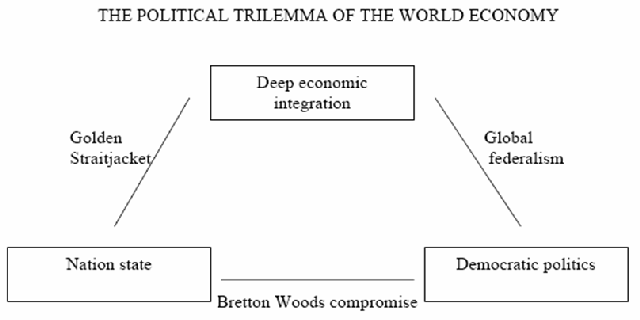
I mentioned in my article on sovereignty that countries which pin themselves to the idea of national level politics, especially to the point of it becoming a geas, can bind themselves into the Globalisation Trilemma. If, as I suspect they will, Leave use their win to forge towards turning the UK into some kind of Free Market paradise then the concept of democratic politics could find itself severely compromised.
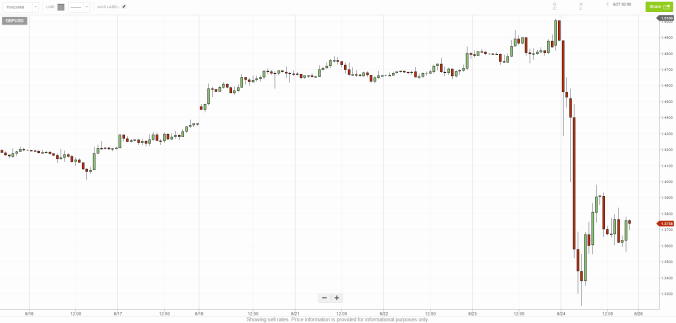
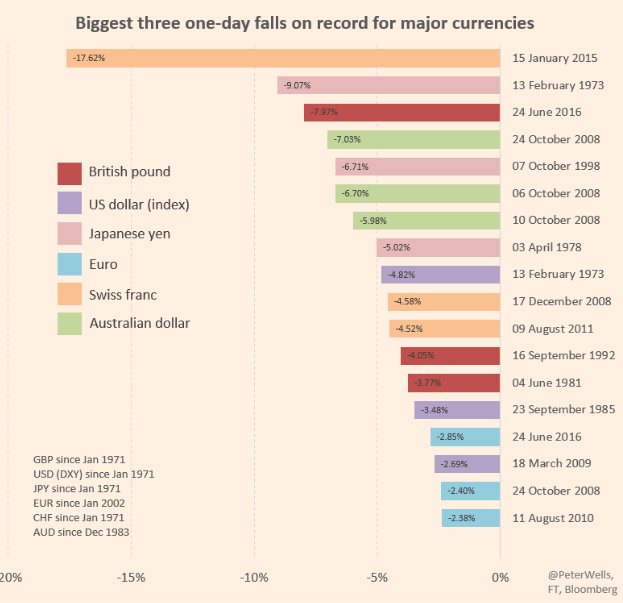
Speaking of the Free Market, it was in the financial world that the most “excitement” of election night was to be found. The polls, public and private, in the days running up to voting day had starting indicating a Remain vote. This had pushed the value of the GBP up significantly as traders started “buying the rumour“. When the Sunderland vote came in though it was the first indication that things were not going to go well for Remain. That one result caused a panic sell in the markets which did not improve as the night went on. By morning, the “Great” British pound had fallen to the weakest point seen since 1985 and, after a morning-after retracement, had lost 8% of its value. This is the worst single day hit that the pound has ever taken, twice as deep as plunge as 1992’s “Black Wednesday” and the third deepest single day hit ANY major currency has taken in modern times. History books shall be written on this point alone.
It should be of very careful note that against the Euro, the Pound lost about 10% of its value compared to 2015. This is important because the UK had a trade deficit with the EU of about £68 billion in 2015. Assuming all things other than currency being equal then that trade deficit could be expected to rise to £75 billion simply because it’s now more expensive to import goods and services from Europe.
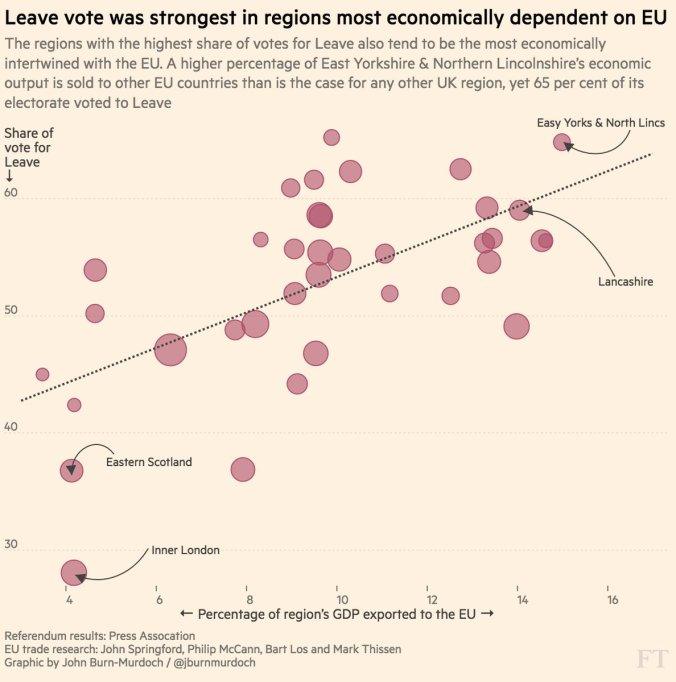
This difference in trade, around £7 billion, represents almost exactly the amount that Leave claimed that we’d “save” in net contributions to the EU. There may well be no gains, no money for the NHS or anything else that was promised. I hope I’m wrong. Because if I’m not, the areas which most voted Leave are also the areas most likely to be dependent on the EU for trade. They will be the areas most reliant on a good deal and/or economic plan for what comes after.
As for Scotland, it’s looking now almost inevitable that this result will hasten another go at an independence referendum and, this time, not only will it not be called until we’re ready but it’s looking rather like a lot of former No voters who had been promised that their vote would ensure their EU membership have now seen that whisked away. It has been enough to convince many that independence is now the best option ahead of Scotland. If you happen to be one of them, Welcome.
The Greens and the SNP, will now be exploring all options to protect and preserve our EU relationship. We’re in very uncertain times now with few precedents to guide us so what form this will all take is a matter of pure speculation.
My own preferred option could take the form of direct negotiations between the Scottish Government and the EU resulting in some kind of deal whereby if an independence referendum is held and won in the period before formal Brexit then a newly independent Scotland could “inherit” the UK’s old seat with no loss of continuity. Of course, this would require the co-operation of the Westminster government to allow such negotiations to take place or to even acknowledge that the result in Scotland is significant. It would be a tragedy of democracy if we were simply ignored.
I’ve got no easy answers for the next few months, or years. I’m as much an unwilling passenger as everyone else who voted Remain yesterday. I’ll try my best to work out where we’re going just as soon as it becomes apparent though. And who knows. Maybe, just maybe, we’ll get off early.
Qualifier: The following article shall cite political views which represent, to the best of my understanding, the positions of the Official Remain and Leave campaigns. As such they may not necessarily represent the views held by myself or by any organisations or political parties of which I am a member. My own views shall be indicated throughout.
Likely to be one of the “softer” issues in this debate as unlike immigration and unlike the economy it’s one that doesn’t render down so easily into simply numbers. This doesn’t mean it’s any less important. How we feel about the concept of “Europe” plays a very large part both in what we will want out of that relationship, what we will want Europe to become and what we want ourselves to become either within or outwith the Union. It also tells us a lot about how we see our relationship with our governments which means that the result on Thursday may well have deeper ramifications on how the United Kingdom itself is governed. Sovereignty, who controls the locus of power and where it resides, is a policy on which your position may well lie in how you define it.
This is just a quick side note to my Are EU In or Out? series as a response to Vote Leave‘s recently published Leaving Framework, their plans for what comes after a Leave vote. If you will, it’s their White Paper moment. You can read it here (or here).
Qualifier: The following article shall cite political views which represent, to the best of my understanding, the positions of the Official Remain and Leave campaigns. As such they may not necessarily represent the views held by myself or by any organisations or political parties of which I am a member. My own views shall be indicated throughout.
Are EU In or Out? – Part 1: What is The EU? can be read here
Are EU In or Out? – Part 2: A Brief History of Brexit can be read here
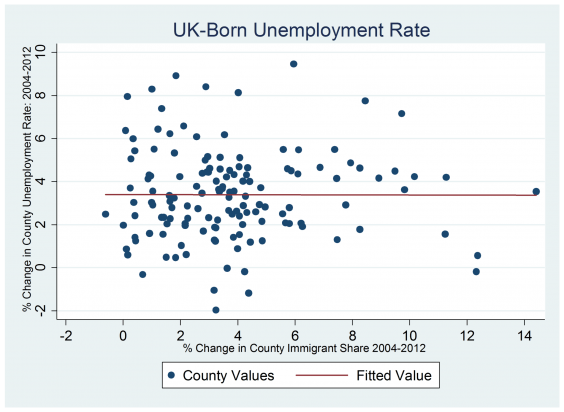
Are EU In or Out? – Part 3: The Issues – Immigration can be read here
Are EU In or Out? – Part 4: The Issues – Trade, Economy and Finance can be read here
Brexit Negotiations
One of the more contentious moments of the 2014 Scottish Independence campaign came about within the discussions over “what comes next?”. The post-vote negotiations over the unstitching of Scotland from the rest of the UK would have represented challenge at least on par with the separation of Ireland or the decolonisation process, if not greater. This may not have been helped by the fact that the British Union does not contain a formal legal mechanism for constituent member nations to leave, the Edinburgh Agreement and all that came after was essentially invented ad hoc. In contrast, the European Union does have a formal leaving mechanism in the form of Article 50 of the Treaty of the European Union, albeit that this mechanism has not been put into practice and was drafted only after the experience of Greenland’s process of leaving the European Communities in 1985. As this paper points out though, the comparison between Greenland and any UK leaving process is unlikely to be more than superficially similar as Greenland’s economic and political interaction with the EC at the time revolved very substantially around their fishing industry whereas the UK is far more economically and politically integrated.
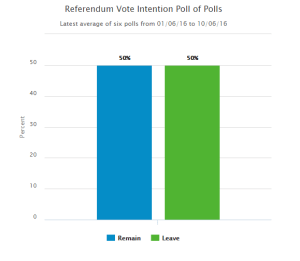
The polls are tight. Neck-and-neck, even. Far too close to call and we’re only a couple of weeks away now. I think we owe it to ourselves to consider the possibility of a Brexit vote and to ask just what the Official Leave campaign wants to get out of their desired result, whether or not it’d be easy – or even possible – to achieve and if it actually chimes with the desires of many of their voters.
Qualifier: The following article shall cite political views which represent, to the best of my understanding, the positions of the Official Remain and Leave campaigns. As such they may not necessarily represent the views held by myself or by any organisations or political parties of which I am a member. My own views shall be indicated throughout.
Are EU In or Out? – Part 1: What is The EU? can be read here
Are EU In or Out? – Part 2: A Brief History of Brexit can be read here
Are EU In or Out? – Part 3: The Issues – Immigration can be read here
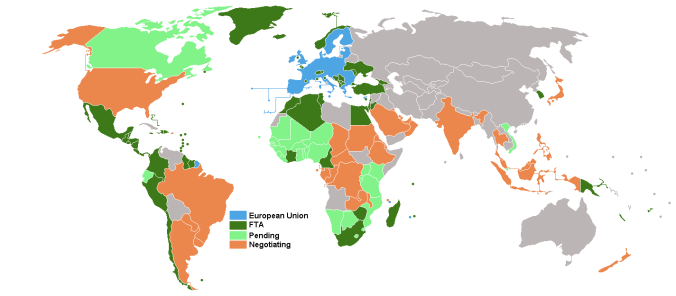
Active, Pending and Proposed Free Trade Agreements involving the EU
Trade, Economy and Finance
If immigration has been the big push card for Leave then the Economy has been the same for the official Remain campaign. Once again, as in the 2014 Scottish Independence Campaign, nothing says “Project Fear” like that Great Leap into the Unknown that comes with trying to predict the state of the economy after a shock event like Brexit (Little tip. In this era of rampant financial speculation, if anyone could actuallypredict the economy, there wouldn’t be one because that person would now have ALL the money). Similarly, Leave, whilst fighting a much weaker campaign in this respect, are promoting the fear of overburdening and uncontrollable regulation which is holding the UK back from its true potential. Of course, the parallels with the 2014 indyref abound on both sides. It certainly shall be interesting if and when a second indyref comes round and the words spoken by several prominent figureheads involved in this current campaign end up held against them (of course, this may well happen to unwary activists on our side too)
Qualifier: The following article shall cite political views which represent, to the best of my understanding, the positions of the Official Remain and Leave campaigns. As such they may not necessarily represent the views held by myself or by any organisations or political parties of which I am a member. My own views shall be indicated throughout.
Are EU In or Out? – Part 1: What is The EU? can be read here
Are EU In or Out? – Part 2: A Brief History of Brexit can be read here
The EU Referendum Issues
I’ll say again that I believe that the “Official” Remain and Leave campaigns in this referendum are almost as dreary and dire as the other. It’s rather depressing how we’re witnessing something as momentous as the potential future of Europe being used as leverage for something as petty as an internal debate about the future leader of the Conservative party. Worse than that though is the attitude towards the issues. It’s almost as if BOTH sides looked at “Project Fear” – the 2014 Scottish anti-independence campaign which, through unrelenting negativity and naesaying, managed to turn a 30 point lead into a 10 point lead and ravaged public trust in both their member political parties (Labour in particular) and in the media which reported for them – and took the very worst aspects of it into their hearts.
It’s been left to the “Unofficial” campaign to speak not only to and for the Scottish dimension (as typified by “The Wee BlEU Book” by Alyn Smith MEP and Ian Hudghton MEP and which I consider to be required reading before the vote) but also for Green and Left voters (as typified by groups such as Another Europe is Possible and DiEM25 which recently held an excellent conference on the Left case for Remain).
This series of articles began as a response to someone I know who was asking for as balanced a case as I could write on the debate. I find that I cannot, given the campaign and my place in it, give a strictly neutral view but I can do as follows. I shall take the primary issues as encountered in the media and shall attempt to lay out the “Official” position on that issue by Leave and Remain. I shall then add my own commentary on that issue. This may result in my agreeing with one or other of the “Official” campaigns or it may have me disagreeing with both and offering an alternative path.
The big hot-button issue of the debate. Immigration. The implications for the UK both in and out of the EU and the positions of the Official Remain and Leave campaigns as well as my own thoughts.
So what happens next if Leave wins? What are our options for future UK-EU relations and which of them come closest to what you want compared to what the Official Leave campaign wants?
A side note on Vote Leave’s Leaving Framework White Paper. In my opinion, it is seriously lacking in several factual areas and deserves widespread media scrutiny.