We Need To Talk About: A Financial Transaction Tax

“We bailed out the City 10 years ago when the crash came, we poured hundreds of billions of pounds into it. Since then £100bn has been given out in bonuses in the City. So we are asking for a small contribution…to fund our public services.” – John McDonnell MP

Image result for "corbyn hood" tax

Last night, Labour announced one of their keynote policies ahead of the 2017 General Election. A financial transaction tax on the City of London. Time for a blog to outline just what in the name of Jim it actually is and what it’s supposed to do.

Continue reading →

Discussing Danish Debt

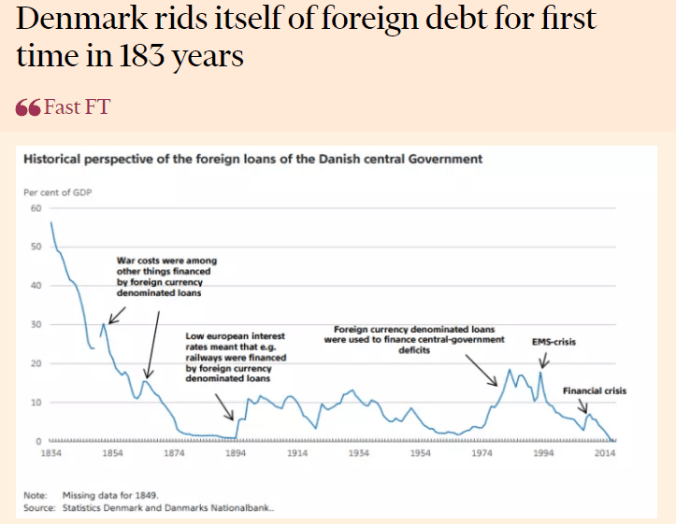
There’s an interesting wee story doing the rounds that moment regarding Denmark and their foreign debt.

Dane.png

I’ve seen a few folk get a bit over excited about the story and have misinterpreted it as saying that Denmark is now debt free. First up, it’s not. Their national debt is at about 38% of GDP (compared to the UK’s 85.4%). This isn’t about the Danes paying off all of their national debt, it’s just saying that they no longer have any debt which is denominated in foreign currencies. All of the Danish national debt is, for the moment, denominated in Danish krone.

There’s a more interesting story under here about why it has happened though. It’s the story of managing one’s currency and maintaining a currency peg with regard to another. This is something that folk in Scotland should be watching closely as our own debate about currencies heats up again.

Not long ago I wrote an article on defending one’s currency against speculative attacks but many of the lessons also apply to more gradual changes in currency value and the effects are being borne out in Denmark as we speak.

Recently the instability in the Eurozone and reduction in confidence in the euro has seen investors selling euros and buying krone, seeing it as a safer investment. This is pushing up the value of krone which, if it was freely floating, would affect the exchange rate between it and the euro. But Denmark seeks to maintain a stable exchange rate between the krone and the euro (At a rate of 7.46038 DKK/EUR ± 2.25%) so its central bank must intervene to prevent the rise in value. It does this by cutting interest rates (to make further purchases less attractive) and selling DKK and buying foreign currencies. This influx of foreign currency has allowed it to pay off foreign denominated debt but has also caused its foreign reserve holdings to boom from 200,000 million krone in 2008 to over 400,000 million krone today.

If the opposite case had been true, if the DKK was weakening with respect to the EUR, we might expect the levers to be pulled in the opposite direction. Interests rates would increase to attract investment and foreign reserves would be drawn down as foreign currencies were sold to buy up krone holdings and support the value of the currencies and we might see the central bank issue bonds marked in foreign currencies rather than paying them off.

It may well be that Denmark can continue do defend its currency peg for some time, although some have eyed the possibility of a break similar to the one Switzerland went through in January 2015. A couple of years on from the Swiss break the risk of Denmark following suit appears to have receded for the moment.

All in Denmark – currently the 2nd happiest county on Earth – is showing what happens when a small country of 5-and-a-bit million people, its own currency and the will to manage it can do and whether or not Scotland specifically chooses a path similar to this (by pegging a £Scot to the GBP or, indeed, the EUR), Denmark should be taken as an example of what can be done. A small island of light and clarity in a world where the people of Scotland are about to be told repeatedly and in detail what some folk think we can’t do.

tcg-logo-7

Beyond The Headlines

“[I]f there is to be meaningful debate on this issue then the SNP have a lot of work to do to produce best possible data. The last thing they should do is trust that from London.” – Richard Murphy

Tax expert Richard Murphy, who is currently most notable for exposing the UK’s massive £120 billion per year tax gap, has written an article warning of relying on UK economic data to make the case against Scottish independence.

Murphy

Before he gets attacked too badly by hacks telling him that the Scottish economic data is produced by Scottish civil servants (Edit: I may already be too late on that) I thought I’d write a parallel piece pointing out what those civil servants have told me about the limits of some of their stats.

The first thing to remember in all of this is that the UK is not a federation or a confederation, it considers itself to be a unitary state of which Scotland is just one region of twelve (plus the “extra-regio” offshore regions). Therefore there is currently no real obligation to even gather the distinct statistics for Scotland and it really only has become important because of the independence campaign.

Tax Revenue

As I’ve pointed out in my paper Beyond GERS, the issue of apportioning tax revenue is fraught with subtle difficulty. GERS itself has updated its methodologies multiple times over the years (particularly since the SNP took the government in 2007. The GERS of today is no longer very closely related to the GERS created by Ian Lang to discredit Scotland in the early ’90’s). There are still differences in the results presented straight by HMRC and the data eventually “Scottishised” [To use the stats folk’s term] and presented in GERS.

Onshore corporation tax is a good example of this. Where an overall UK stat may simply count the location of the HQ of a company for the purposes of assigning corporation tax and this may make sense from a unitary state perspective (albeit this is becoming less true as globalisation increases the ability for multi-national companies to move resources across borders).

For many companies though, the profits one which corporation tax are paid are not generated at the HQ. This is obvious in the case of, for example, a large retail chain which has stores across the country. To correct for this, HMRC and GERS both use different methodologies to apportion the tax more evenly. Various measures (and the weighting applied to those measures) such as estimating volume of sales, number of employees, amount of capital spent in the region and overall population are all used in different ways to reach slightly different estimates. As a result, HMRC estimates that in 2015-16 Scotland produced 7.1% of the UK’s corporation tax compared to 7.3%% estimated by GERS – a gap of  about £100 million.

One can also see possible limits of these methodologies especially if taken individually. For example if one looks at employees then one could probably consider a company (and, it should be stressed that this is a completely hypothetical company) which employs a dozen people in Scotland to make, say, a high value, highly exportable product with a geographic link (call it a similarly hypothetical product like “Scotch blisky”) and then employs a couple of hundred people in London to market it. It may be very difficult to properly apportion the “value” of that product and its profits based on employees alone. It’s possible, after all, to find a market without marketing but a bit harder to drink an advertising campaign.

VAT is another issue where these figures can differ for similar reasons. The UK doesn’t demand point of sale ID to determine the location of VAT spend (If you nip down the road to Carlisle for your shopping, then that results in VAT paid in England but Tesco neither knows nor cares where you came from to get there). Again, various methodologies are used to try to estimate the proportions paid and the estimates are slowly aligning (HMRC claims Scotland paid 8.4% of the UK’s VAT compared to GERS’ 8.6% – a gap of £110 million). There is also a further complication wherein the results between HMRC and GERS are simply presented in a different manner (HMRC measures the cash receipts, GERS measures the accruals)

A third prominent example is Income Tax, and is going to become pertinent now as IT is largely devolved to Scotland and all Scottish residents are to be assigned a distinct Scottish tax code and especially now that the income tax bands in Scotland will soon start to diverge from the UK bands. However, HMRC has been recently criticised for a series of administration issues which is making it difficult to roll out this tax code. As with the difficulties in rolling out devolved welfare, this won’t be nearly so much of an issue once Scotland is independent but highlights the difficulty in trying to run a devolved situation from a centralised unitary setup. This said, both HMRC and GERS arrive at a proportion of about 7.2% of the UK’s income tax coming from Scotland although this may change as the new systems are launched (even if tax rates are kept the same).

It is not possible to say whether the HMRC or GERS estimate is “better” or “worse” than the other. The Institute of Fiscal Studies has commented saying, especially of corporation tax:

“Neither of these estimates is clearly superior to the other, and both may be some way off. Profits are not necessarily generated in proportion to the number of employees, or their wages. Some employees may be more instrumental in generating profits than others; and profits also arise from capital assets – both physical (such as buildings and equipment) and intangible (such as intellectual property and brand value) – the location and contribution of which may differ from the location and wages of employees. Calculating how much of a company’s profits are attributable to economic activity in different locations is conceptually and practically difficult and is the source of many problems in international corporate taxation”

Balance of Trade

This is the big one that has attracted a lot of shouting in the past few months. Once again, the UK’s status as a unitary state causes much of the furore over the published numbers to be based on false premises and over-massaged numbers. The UK’s balance of trade figures are published here and probably do do a decent job of estimating the UK’s position in the world. What it doesn’t do is show the internal movements of trade within the UK. As a unitary state it simply doesn’t matter to the external balance of trade whether or not Yorkshire is a net exporter to Sussex. The UK does produce figures which try to estimate the trade balance between the regions  with the rest of the world but it only covers goods, not services (hence excludes nearly half of the UK’s total trade) and it does not cover internal trade. For that internal trade, we turn to ESS – Export Statistics Scotland – which surveys exporting companies in Scotland and asks them where they send their goods and services (contrary to a semi-popular belief, these statistics don’t care how the goods reach their destination so it doesn’t matter if they physically leave the UK via an “English port“). There are some limits, again, to this methodology.

First, not all companies know where their goods are going (see the example of Tesco again. If someone from Carlisle buys a crate of beer in Glasgow then goes home then that’s a Scottish export but Tesco wouldn’t be able to record it easily) so they won’t appear in the survey. Goods which are shipped to England then either re-packaged or used as a sub-component before being exported from England to somewhere else (or even back to Scotland) would be counted only as far as their export to England and there may be some cases where service “exports” are caused by, for example, someone in London buying insurance for their house in London from the London branch of a provider who just happens to have a brass plate in Edinburgh. The total proportion of these anomalies in the data is simply unknown at this point and unlikely to be knowable until after independence.

Beyond the Horizon

And this takes us to the most important point in this whole article.  Even if the methodologies above all align and all can capture the full economic picture of Scotland and everyone can agree on the figures produced and everyone agrees that they produce an accurate and complete picture of Scotland’s economy within the Union there is a fact which should be utterly indisputable (and certainly is within the team which put together these stats).

Independence. Changes. Everything.

None of these figures have any validity if you try to use them to project beyond the independence horizon. Corporation tax may change due to the redomiciling of businesses post-independence. Both those seeking to remain within the UK and those seeking to remain within the EU or EEA may shift operations. Trade exports may suddenly become a lot easier to assign (whether there’s a “hard border” or not) and that “extra-regio” oil which is often excluded from stats due to historical and supply chain accounting issues suddenly has to be accounted for. Those tax streams which are simply too embedded to discuss in any terms other than by a population share have to be audited. And all of this is before Scotland starts to make changes to the tax system to optimise it for the Scottish economy or to do things like close the tax gap.

As with everything in science and in economics, statistics are based on models, models are only ever as strong as their underlying assumptions and projections are only ever as strong as the person making the prediction’s understanding of the limits of those assumptions and the models.

IMF GDP Growth

(One day I’ll write an article about the “Porcupine Plots” which get created when inappropriate models are used year after year in spite of reality)

I don’t mind discussing the economy of Scotland within the Union. I don’t even mind speculating on the economy of an independent Scotland. But I sense that the next two years of campaigning will get very frustrating if pundits continue to stretch their own models past the point of credibility in a quest to push their political point. This, I should warn, goes for both sides. We need a more meaningful economic debate than we saw last time. Let’s get beyond the headlines to create one.

tcg-logo-7

Air Departure Tax Post-Brexit

“We haven’t commissioned to the best of my knowledge any independent research of our own. If committee wishes me to look at that, I will certainly consider that absolutely.” – Derek Mackay on the Government’s (lack of) analysis into the proposed ADT cut.

ADT Cover.png

The Scottish Government put out a call for evidence for their proposal to cut and eventually eliminate air passenger duty (or, as it’s now going to be known, Air Departure Tax).

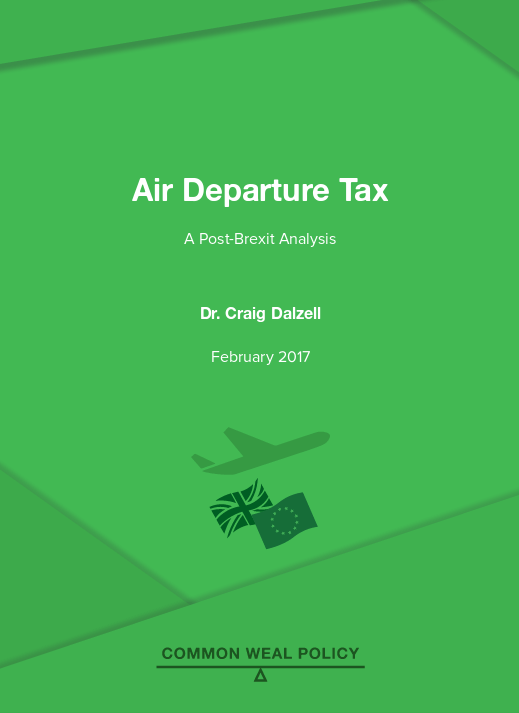
Common Weal duly obliged and updated our previous work on the topic to account for the impact of Brexit. You can read the new report here or by clicking the image above.

It’s just as well that we’ve done this as it has since been reported that the Government itself has done precisely zero economic analysis of the impact of the tax cut and, as it turns out, our report is the only economically based submission which is against the tax cut (The RSPB have submitted an objection on the grounds of a very well founded environmental impact analysis). More than half of the other submissions and the bulk of those in favour of the cut are from companies and groups within the airport and airline industry. There is a great deal of concern that unless the government does pull its weight and do the maths itself then this policy could pass through simply on the say so of those who stand to benefit directly from the tax cut and at the expense of those who will lose out due to the impact on tourism and the lost revenue to public services.

Preface and Key Points below the fold.

Continue reading →

QuEUing up for Membership

Don’t want to read 2600 words? Twitter version: None of the things people say will be hard are. Few are talking about things which will be.

SaltireEU2

Only in the madhouse world of UK politics that a government which is actually embarking on the process of taking Scotland out of the EU against its will while claiming that this would be a wonderful thing could somehow contrive to simultaneously try to sell us that line that an independent Scotland would be out of the EU against its will and that would be terrible.

Whilst this is going on, the same several year old phony war surrounding Scotland’s membership of the EU continues with a great many people still claiming that we would a) be forced to join the euro and b) Scotland would be punted to the back of the accession “queue” doomed to wait till all other potential members (including, possibly, Turkey) have joined before we’ll get a look in.

This week has seen the publication of a couple of commentators on Scotland’s precise position regarding our EU membership, independence and the interaction with Brexit which has sent every man and their dug howling at the moon and trying to spin themselves into position to get another shot in.

So lets take the opportunity here to take a slightly more sober, honest and open look at how things work in the EU and plot out a couple of likely (that is, actually possible) pathways from which Scotland goes from here, through Brexit and independence and to an independent Scotland within the EU.

Continue reading →

We Need To Talk About: Defending Currencies

“Whenever politicians and rulers, from Nero onwards, interfere with monetary arrangements for political ends, disaster follow.” – John Chown, A History of Monetary Unions.

Currency remains one of the great potential uncertainties surrounding the debates about Scottish economics and independence. Last year I published the various options facing an independent Scotland along with the merits and demerits of each. Having selected as the preferred option an independent £Scot initially pegged to the Pound Sterling, Common Weal subsequently published a detailed plan on how precisely to go about making this currency a reality. Rather pleasingly, the news this week coming from the Scottish Government’s Growth Commission hints that they are looking at things from very much the same point of view as we have and may well be coming to the same conclusion.

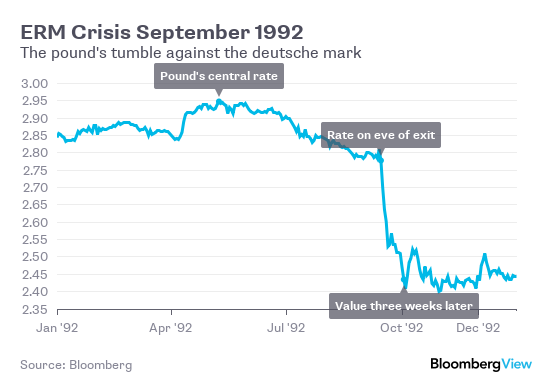
The main lesson of discussion about currency options is that all of them have their disadvantages along with their advantages and one of the primary disadvantages of this option lies in the peg to Sterling, particularly if it is to be maintained beyond the transition and launch period of the new currency. There could be the potential for the international speculative market to mount an attack on the currency in order to knock it out of the peg (as infamously happened to the Sterling in 1992 when it was knocked out of the European Exchange Rate Mechanism). A discussion of the likelihood of this happening and how one can defend against it is therefore required.

As with many things of this nature, the detailed study of this kind of thing can run rather to the technical (the links there are made available for those who wish to study them) so I’ll attempt to break it down into something a little more accessible.

What Makes a Currency Vulnerable To Attack?

The entire purpose of a currency market is to allow that market to determine the most efficient price of the currency. This is generally only considered an attack when the currency is pegged to another. When the currency floats, a market driven price movement is considered the entire point of the exercise. This is part of the reason why “Black Wednesday” came close to bringing down the UK government whereas the 2016 Brexit devaluation was much less politically damaging despite being a larger depreciation in percentage terms.

So why attack a currency in the first place? There are multiple reasons but they essentially boil down to one. The peg is perceived as being “wrong” for the currency and the economy it supports. Either it is over or under valued. Usually it is the former as politicians tend to link a “strong” currency to national pride cases of undervaluation such as in China or Germany do exist (It should be noted that neither of these economies are under serious speculative attack at present).

Assuming an overvalued currency, the attack generally takes place by speculators “short selling”, or “shorting” the currency on the markets. To do this, they will borrow a great deal of the currency at the overvalued rate and sell it on the foreign exchange markets. This floods the markets with supply of the currency and depresses the price. The speculator can then buy back the currency he sold at the new lower price, pay off the loan and pocket the difference.

Before an attack happens though the speculators need to be sure of one of two things. Either A) The country under attack lacks the will to defend the currency peg or B) It lacks the tools to successfully defend against it. If the attack fails, then the speculators could be out of pocket to a very significant degree. Whilst George Soros infamously made off with £1bn in 1992, there are reports that he had to borrow some £6.5bn to do it. He was sure of his bet and it certainly paid off for him that time, but that’s still a big gamble to take and lose.

How to Defend a Currency

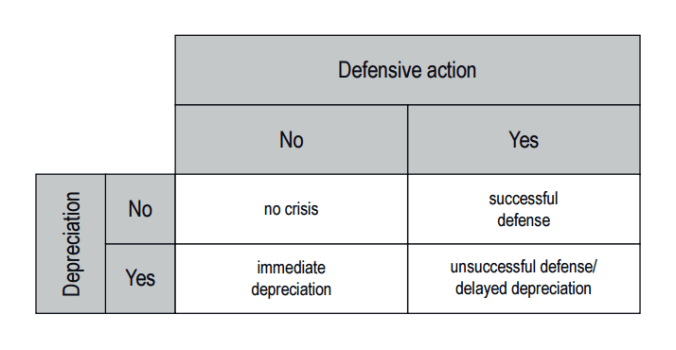
An attack can be defended in one of two ways (or a combination of both). First, the Central Bank can raise interest rates to discourage further borrowing of the currency (if interest payments on the loans exceed the expected gain, speculators will back off) and to encourage investors to start buying currency at the same rate as it’s being sold (so they can benefit from the increased returns on the interest). Or Secondly, the Central Bank can sell foreign reserves and buy their currency back themselves to limit supply and force the value back up. If they do this until the attackers themselves run out of the ability to borrow more of the target currency then the attackers give up and take the losses. (For an undervalued currency, the tools are used in the opposite direction as China is currently doing)

The third option is to consider both the economic and political situation and decide that if the currency really is mis-valued and that the political cost of unsuccessfully (or perhaps even successfully) defending the currency is too high then the defence simply isn’t viable. In this case the peg is dropped and the currency is intentionally allowed to revalue.

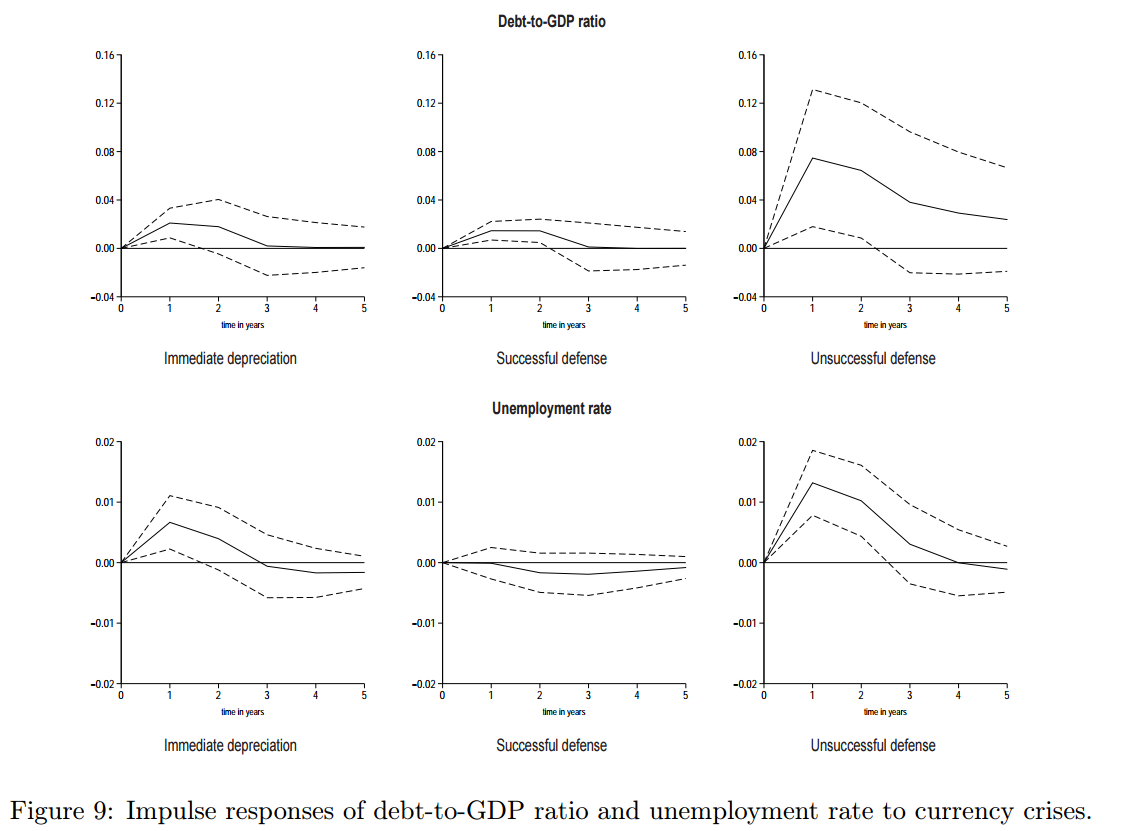
Herein lies the risk for Central Banks. The cost – which can take the form of higher interest rates, higher inflation, depleted national reserves, lower GDP and higher unemployment – of unsuccessfully defending the currency may be much higher than not defending it at all but not defending may carry a higher cost than a successful defence.

It is important to note that the failures to defend a currency are often higher profile than the successes which, by their nature, do not generate so many tabloid headlines or history books. At least one study has noted that of the 163 speculative attacks identified between 1960-2011, 42 were not defended against, 34 were defended unsuccessfully and 87 were successfully warded off.

cd1

CD2.png

Charts from S. Rebelo, (2000)

To look at the 1992 Black Wednesday example caused when the GBP dropped out of the Exchange Rate Mechanism. The ERM (which was the precursor to the Euro) essentially pegged member currencies to the German Deutsche Mark. The value at which the GBP was pegged on entering – 2.9 DMK/GBP – was considered far too high and opened the road to the infamous speculative attack. The Bank of England responded by raising interest rates from 10% to 15% on the day of the attack and they sold £4bn worth of reserves (almost £8bn in 2017 pounds and about 1/3rd of what they had in reserve at the time). This turned out to be insufficient and the peg was eventually abandoned. The exchange rate fell to 2.413 DMK/GBP and the GBP fell out of the ERM. Papers released from within the BoE in the years since have mulled over the impacts and costs of their defence strategy, the causes of its failure and whether or not it was worth mounting in the first place.

Is Scotland Vulnerable?

So would this apply to Scotland in the event of our independence? There’s never a certainty with these things and the state of the international money markets are that size of one’s economy is probably no sure defence against all possible attacks (short of erecting massive capital controls and isolating Scotland from the global trade market, but this too carries its own consequences). However, I do believe that Scotland would be less vulnerable to a speculative attack than some may suppose for the following reasons.

First (and possibly most importantly): If we peg to Sterling then it’ll be on a 1:1 basis therefore will be at the same value that it is currently. To believe that the £Scot is over or under valued is to believe that the GBP is currently, right now, unsuitable for the Scottish economy which begs the question of why we’re even in a currency union with rUK. This may change post-independence as our economies diverge but in that case the question of whether or not to continue that 1:1 peg opens up. I personally think we’ll either float the £Scot or move to some kind of basket peg shortly after the three year transition and launch period but this is ultimately a political decision as well as an economic one and it may be that the option to move away from the Sterling peg is one debated and decided by the second independent Scottish Parliamentary elections. If a party wishes to hold to the Sterling peg (or any other) then it’ll be for them to determine if that’s a viable option and to convince voters of the same.

Second: We’re proposing to hold rather substantially more foreign reserves than the UK holds as a proportion of GDP. We’re looking initially at somewhere between £15bn-£40bn (Common Weal is currently working on a formal paper looking at how precisely we’d generate these reserves though I have spoken about it somewhat here) with options to use the normal tools available to normal, independent countries to adjust this amount as required. Combined with the lower available trading volume of being a smaller currency (one can only even potentially borrow as many £Scots as exist, especially if it is issued solely by the Central Bank) then this should be sufficient to hold off an attack or even just to display that we’d be willing to do so. Combined with tighter regulation and legislation on the financial industry Scotland should present itself to the world as a country upheld by its strong and reliable approach to fiscal and monetary policy.

Third: Interest rates are at an all time low which gives a fair bit more scope to raise them in the event of an attack than was the case in 1992. One has to be a bit cautious with this though as our private debt levels (particularly mortgages) are leveraged to the hilt so there will be severe consequences if this lever is pulled too hard. This said, the low interest rates are also crippling savers, investors and pension holders. They could well benefit from a raised rate such that an “attack” by the market may well come to be seen as a signal to change political and economic policy rather than a simple profiteering exercise by the speculators. As with life, balance in all things is best.

Conclusion

In short, Scotland is probably less likely than feared to suffer a speculative attack on the currency in the short term following independence and more than able to defend against more should it happen, particularly if we keep the heid and approach the separation rationally and in a well planned manner. Beyond this, it shall be a matter of analysing both the economics and the politics of the situation and never becoming too attached to any particular choice so that if a successful defence of the currency can be mounted, it should, if not, it shouldn’t and if a peg should be modified, changed or abandoned then it must.

tcg-logo-7

The White Paper Project

“Work as if you live in the early days of a better nation.” – Alasdair Gray

wpp-v1-cover

Today I get to announce the launch of a very long awaited project I and the rest of Common Weal have been working on for quite some time now. We announced back in September that we have been working on renewing the case for Scottish independence by publishing a successor to the Scottish Government’s “Scotland’s Future” document.

Version 1.0 of the Common Weal White Paper can be download here or by clicking the image above.

This is a leaner document than Scotland’s Future was. That document was as much a party political campaign device as it was a blueprint for independence. It not only sought to describe the powers which would come to Scotland independence but also sought to convince voters of the SNP’s own vision for independence. There was nothing inherently wrong with this latter task per se and other parties too sought to promote their own distinct visions as well – as they will all do so again throughout the next independence campaign but this is not the task of an independence White Paper. This paper shall, as far as possible, not seek to propose a list of policy ideas which an independent Scotland could do nor shall it attempt to convince you of the merits of those policies. It merely lays out the technical and structural requirements which must be in place for Scotland to become an independent country once we, the voters, decide that it should become so.

It is a “consolidated business plan for the establishment of a new nation state”.

To this end, the White Paper is split into several broad sections. Part 1, Process and Structures, covers the foundation of a National Commission – a cross party and cross administration body which will be tasked with designing and implementing the institutions and systems which need to be set up in the time between the independence referendum and the formal independence day. It is one thing to state, for instance, “There shall be a Scottish Central Bank”. It is quite another to decide how large it needs to be, where it needs to be based and who needs to be hired to run it. The National Commission shall also be given interim borrowing powers so that it is able to issue bonds, raise capital and fund the construction of the vital infrastructure Scotland would need to either move from rUK or build from fresh.

Part 2, Key Institutions of an Independent Scotland, covers all those things we kept being asked questions about during the last referendum. Would we have a constitution? A currency? What would we do about borders? Defence? All these and more. Of course it’s not yet possible to answer every question in this regard. Some of it will be up for negotiation with rUK, some of it will be dependent on the shape of the Brexit deal between the UK and the EU and Scotland’s relationship with both in the run up to independence but we’re making a stab at as much as we can and this is the section which will perhaps be most expanded upon as the Project is iterated in future versions.

Speaking of negotiations, Part 3 covers the prospective shape of some of these – chiefly the allocation of debt and assets and what rUK’s response to our leaving shall mean for our claim on them. Also covered to some degree is how Scotland will interact with various international and supranational organisations although it should be stated once again that no case shall be strongly made for Scotland’s joining or refusal to join any of these organisations. That shall be left to the party or parties which seek to form the first independent Scottish parliament.

Finally, Part 4 outlines the position of Scotland as far as finance and borrowing goes as well as outlining as best we can the default fiscal budget for year one of independence. It is, of course, almost impossible to place any kind of actual certainty or promise on such a budget as it is based on several key assumptions such as the desire to keep both public spending and the various tax revenue streams broadly similar to their position at present. If a party decided to scrap the entire tax system and replace it with one of their own devising then it would have to be up to them to explain how that worked and project the revenue to be gained from it and how it would be spent. Other assumptions include Scotland spending the money assigned to it in GERS for various “UK projects” on projects of similar value and in similar accounting lines (so that, to pick an arbitrary example, our “share” of UK economic development funding spent outside Scotland but from which Scotland “benefits” would instead be spent on economic development within Scotland). Again, whether or not this happens will be a case for the individual parties to make and will depend entirely on accurately and precisely how the current fiscal projections for a devolved Scotland within the UK map onto the fiscal situation of an independent Scotland.

Once again, this is not the completion of the White Paper. This is the beginning. You will see that there are several sections which need to be expanded and built upon and items like costs and figures will be updated as time goes on (the default budget, for instance, is based on 2015-16 figures but – as we’ve probably noticed by now – Scotland didn’t become independent in 2015-16 so these precise figures will be revised as and when they should be). Some areas require the attention of people with specific experience and expertise in them to be able to complete so we are openly calling for those experts who are able and willing to contribute. Please contact us if you want to be involved. Let’s work to build the early days of our better nation.

TCG Logo 7.png

Beyond GERS:- A Response to Comments

And if he is compelled to look straight at the light, will he not have a pain in his eyes which will make him turn away to take and take in the objects of vision which he can see, and which he will conceive to be in reality clearer than the things which are now being shown to him? – Plato, The Republic. Book VII – The Allegory of the Cave

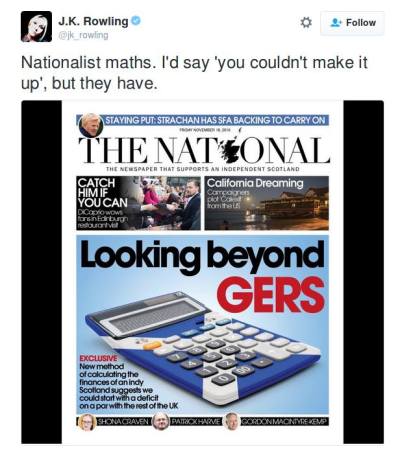
I probably should have foreseen the level of engagement that my latest article for the Common Weal White Paper Project – Beyond GERS – has generated.

Most of it has been positive and the best of the critical response has at least been constructive.
JKtweet.jpg

(As flattered as I am by the attention, I don’t particularly include this comment in either of those categories)

Spurred on by the mention of the paper by David Torrance in The Herald, I’ve become aware of several misunderstandings and misconceptions surrounding a few of the comments which have been made so feel that these must be addressed in a constructive manner. This paper represents a large leap away from where the independence debate has stood – more or less stationary – for the past two years so some further explanation of some of the points is warranted.

1. The Data Source is Wrong

This first clarification comes off the back of Kevin Hague’s article here which examines some of the figures used to back my arguments. His chief objection is that I used PESA 2016 (which covers up till financial year 2014/15) as the basis for my disaggregation of UK and Scottish geographic spends and that I should have used CRA 2015/16 instead (and, to his great credit, he makes the case that doing this strengthens our case from a financial perspective). Whilst this is a point to which I would not necessarily object I can only remind that Hague also admits that the latter source wasn’t actually published until after Beyond GERS thus was unavailable at the time of writing and that my conclusion makes it quite clear that this publication should be considered as a first step – to be updated as new data develops.

We must remember that the data for 2015/16 will continue to be updated and refined for several years from now – most of these documents will show refinements and adjustments running up to five years before they “drop off” the table. We must also remember that whilst this study assumes the case of Scotland becoming independent today, the simple fact is that we are not, we will not be and it will be several years at a reasonable minimum before we are. Despite the efforts of some economic analysts to divine the state of the economy several years hence, quite probably the only certain conclusion one can reliably reach on such things is that these predictions will be wrong to greater or lesser degree, one way or the other.

Would using GERS 2014/15 have made for a neater comparison? Possibly. Certainly though the baseline deficit was relatively similar so the task at hand not significantly different. But I’ll give you 20 £Scots to whatever that would be worth in £Sterling that the more shrill objectors I’ve encountered would have immediately demanded to know from where I was conjuring up £1.8 billion of oil revenue.

oil-revenue

(Of course, given that the 2016 Autumn Statement is now projecting >£1.5bn of oil revenue per annum in coming years, maybe I could have just claimed extraordinary prescience…)

On one particular point of attention, Hague wonders if I have overestimated the effect of overseas spending to the tune of £2.4 billion. This number was reached via a share of the total UK’s total overseas spend rather than the more modest figures assigned in CRA which applies a “who benefits” formula to spending where possible and a population share where not. The rationale for this choice being that, as outlined in the paper, one of the arguments used directly against Scottish independence was the breadth and reach of the UK’s diplomatic service. Whilst a credible case is made that the UK’s diplomatic service is, while broad, rather more inefficient than it need be I am left feeling comfortable with the idea that others who do not necessarily support independence would now surely recognise that if Scotland wanted to replicate that reach then it would be within our budget to do so. If it’s strictly an overestimate, that’s fine. I’d rather think of it as a potential for investment into Scotland being a genuine force for good in the world.

2. This Means Cuts to Scottish Defence

In two of the cases mentioned, Spending according to the EU average or at NATO target levels, this represents an INCREASE in the amount of spending within Scotland, along with estimations of the economic impact caused by this increase. Only in one of the cases – a level of spend similar to Ireland and in accordance with their policy of neutrality and involvement in UN Peacekeeping missions – would this represent an actual cut to defence. If one were to consider reducing actual in-Scotland spending on defence and were to do it in such a way as to risk jobs – then it would be absolutely right to consider how those savings could be invested into other sectors of the economy which may carry with them far higher fiscal multipliers than defence spending does. As the IMF have noted more than once, rational defence spending levels are rarely decided out of “concerns about the state of the economy“.

This said, defence is an issue which is very much bound up in policy and it is a subject that we really need to have a serious discussion about. Scotland’s defence requirements post-independence are likely to be very different from that of the UK as a whole or even Scotland within the UK.

If, for example, you believe that Scotland’s defence threats are, in order:
1) Nukes from Russia
2) Tanks from Russia
3) Terrorism
4) Troops from Russia

Then you’re likely to end up creating a defence force entirely inadequate at tackling the actual threats to our national security (The top four of which probably look more like: 1) Climate Change. 2) Internal unrest 3) Terrorism. 4) Cyber Attack. None of these need aircraft carriers, outward force projection or nukes to effectively combat). Common Weal will soon be producing our vision of what defence actually means in structural and strategic terms.

3. Closing the Tax Gap = Raising Income Tax

One of the implications made by Hague – and which was picked up by Torrance – was that closing the tax gap to raise an additional £3.5 billion could be equated to a ~30% increase in income tax level. This is a particularly misleading way of representing this particular point, not least because the research quoted in the paper makes it clear that the inefficiencies, loopholes and avenues for avoidance and evasion lie far more within the realms of VAT, corporation tax, capital gains and inheritance tax. The fact that these taxes are all currently reserved to Westminster aside, the implication that closing the tax gap automatically means an increase in tax rates for those who already pay their full share and obligation is simply wrong.

This mode of thinking, I believe, is symptomatic of the main problem that this paper is trying to tackle. Too many political commentators (on both sides of the debate) have gotten far too used to thinking about Scotland strictly in terms of being a wee region of the UK with limited powers. When just about the only major tax power Scotland has control over is income tax, perhaps it’s tempting to think of solutions purely in terms of that one tax but if you want to think about Scotland as an independent country – even if you’re against the idea and want to attack it – you must think about Scotland in terms of BEING an independent country. An independent Scotland would, of course, have full control over all of the taxes currently employed. Most importantly, it would be fully in control of the power and opportunity to completely dispense with the UK tax code and start again with a better, more efficient, more effective one designed explicitly for the Scottish economy. If a pro-Union commentator wishes to fight on this point then they have to be prepared to defend the current UK system, explain away its flaws and why we’re not getting any of the solutions that folk like Tax Research UK can identify as well as attacking any proposals that we push forward.

4. We’d Be Defaulting on the UK’s Debt

The stated objective of the Westminster government in the 2014 campaign was to have the rUK recognised as the “continuing” or, at least, the “successor” state to the United Kingdom (the difference is largely semantic. In the former, the UK would continue unchanged in law but with reduced territory and perhaps a change of name. In the latter, the UK would strictly cease to exist but rUK would inherit all of the rights and obligations of the former state) and for Scotland to be recognised as a “new” state (The link prior went so far as to claim that the 1707 Treaty of Union “extinguished” the country of Scotland as a legal entity despite the UK describing itself to the UN 2007 as being composed of “two countries [Scotland and England], one principality [Wales] and a province [Northern Ireland]“). This state of affairs would carry with it significant advantages for rUK – notably, it would lessen any serious challenge towards their holding the UK’s permanent seat on the UN Security Council which was the case when Russia became the successor to the USSR – but carries with it many obligations also. The historical precedents are clearly laid out and extensively referenced in my paper Claiming Scotland’s Assets but readers should also consider G.F. Treverton’s book on the subject Dividing Divided States.

Essentially, where one country successfully claims “continuing” or “successor” status then it accepts that all of the mobile debts and assets of the former state belong solely to it (non-mobile assets like mineral rights, military bases and public buildings – including public companies and any mobile assets deemed essential to their running – are almost always split geographically). This means that a “continuing” rUK owns all of the UK’s debt in its own name. Scotland can no more default on them than can a former lodger default on your mortgage.

Now, if the side negotiating on behalf of the UK wishes to make the case that Scotland should take on a share of debts, perhaps by offering a share of assets to their value, then this is something that Scotland could consider, accept or refuse. There is a very good case to be made that Scotland doesn’t actually need or want a population share of the UK’s mobile assets. We may need a few £billion worth of military equipment – assuming we can’t buy newer or more appropriate equipment elsewhere. We may need a couple of £billion (those stalwart supporters of independence, Scotland in Union, estimated not more than £1 billion) to set up essential government departments currently lacking – assuming we can’t borrow the money at better rates on the open market. We may need a couple tens of £billions to support our new currency and set up the investment banks we’ll need to start rebuilding our economy. After that, it really does start to become a stretch to consider what other assets we would actually need which would justify accepting over £130 billion worth of debt. Answers on a postcard on that one please.

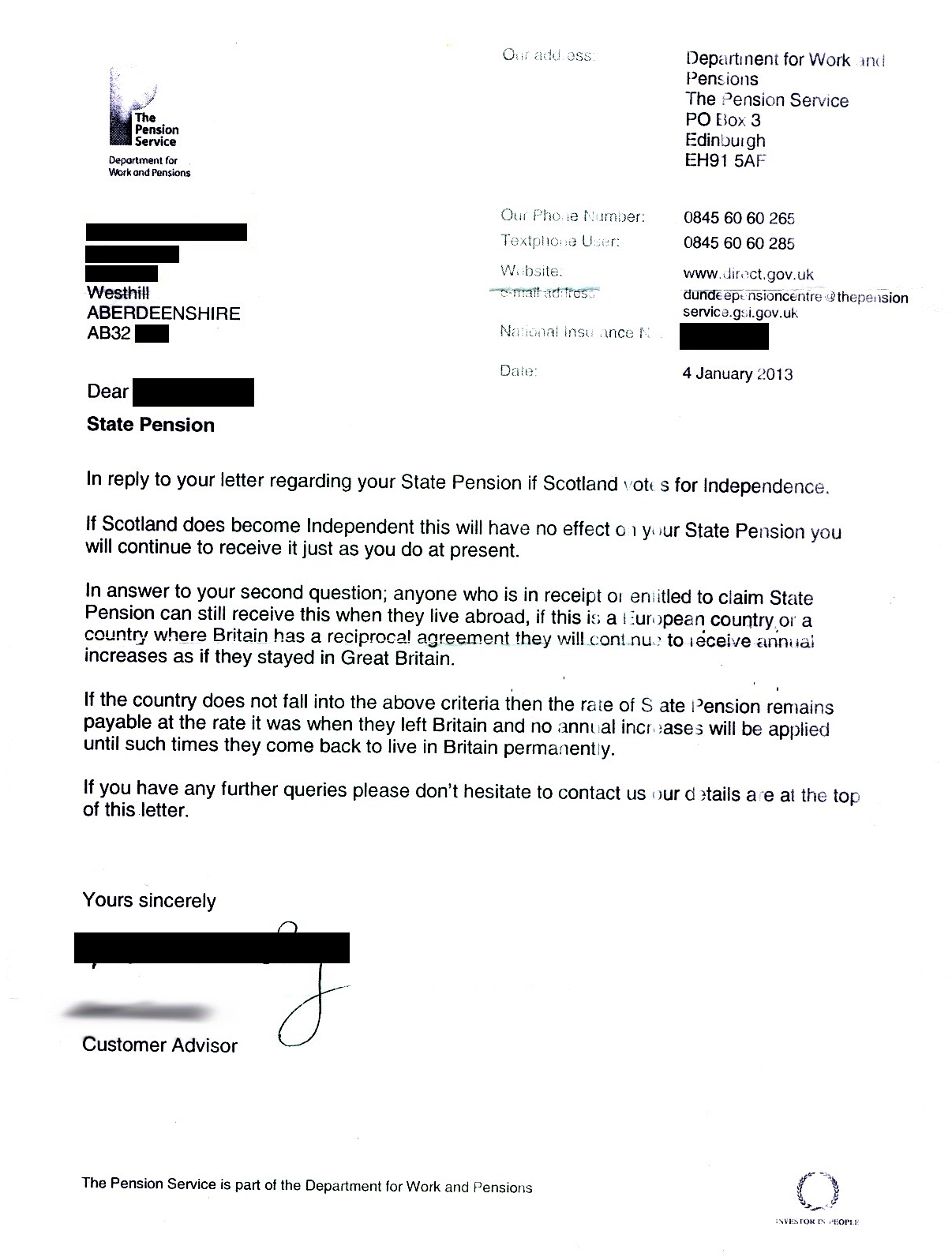
5. rUK Won’t Pay Pensions to People in Scotland

The current rules regarding the UK state pension are quite clear. If you meet the requirements for one, including paying up to 30 years worth of National Insurance, then you are entitled to a UK state pension when you retire. Should you retire outside of the UK then, depending on which country you retire to, you may or may not receive an annual increment to that pension and changes to things like exchange rate and purchasing power may erode or enhance the value of that pension but the basic premise is laid out. In the absence of an agreement to the contrary, if someone has reached their 30 years contribution before I-Day or has even already retired then they can expect their full UK pension. If, for example, they end up paying 25 years UK NI and then 5 years of Scottish NI (or equivalent) then they can expect both governments to pay according to those shares. If someone lives their entire working life in an independent Scotland then the full share of that pension lies with Scotland. By this logic, at the point of independence, the full component of pension liabilities would fall on rUK as, at that point, no Scottish NI would have been paid.

This should not be a controversial point as this was precisely the stance that the UK government itself took during indyref1 and is entirely consistent with the stance laid out above that rUK would act as the continuing state to the UK.

At least one commentator has suggested that the UK could “change the law at the stroke of a pen” to block payment of extra-rUK pensions. I guess they could. It’d be a “brave” move though. I doubt they’d be able to pass that bill over the howls of horror from all the other British emigrants currently drawing that pension. I’d also love to hear their explanation to both rUK citizens who choose to move to Scotland at some point after independence as well as to their core voting base of those British nationalists who would certainly seek to retain their UK citizenship post independence and may even reject the offer of taking Scottish citizenship to which they may be entitled.

That same commentator also suggested that, rather than a blanket ban on extra-rUK payments, the blockade could be limited solely to Scotland. I find it extremely difficult to suggest a way in which that this could be done which wouldn’t be seen as a blatantly discriminatory attack on pensioners based solely on place of residence.

“You can have your pension paid to you anywhere on the planet*”
*except Scotland

I’m far from a legal authority but I’m fairly sure that one could be challenged in the courts.

Now, if an agreement over pensions liability sharing IS reached then this may change and, being that it is entirely a political negotiation, it’s difficult to predict ahead of time what that agreement would look like. Common Weal will soon be producing our own suggestions about what a Scottish pension system may look like and how it would interact with the rest of the social security network. This may include some form of cash settlement from rUK to Scotland to compensate Scottish residents for the NI they’ve paid into the UK system over the years. More on that in good time.

It is true that the Scottish Government claimed in the Scotland’s Future White Paper that they would take up the pension liabilities. This was part of their stance that Scotland would share UK successor status with rUK and would share assets and debts. Remember that it was the No campaign which originally claimed that this wouldn’t be possible. If this has changed; if the pro-Union campaign wants now to seriously suggest asset and liability sharing. Time to make us a serious offer. We may even agree to it.

6. But the SNP said ‘X’ in their White Paper!

Whether on pensions or currency or any other campaign point this is the comment which, to my mind, represents a total vindication of what Common Weal are trying to achieve through our White Paper Project. That we’ve moved the debate on so much that these segments of No campaign have now flipped from saying that Scotland’s Future was utterly without merit and should be scrapped in entirety to now demanding that its proposals should be accepted in full we’ve revealed that their own case for the Union yet to move on one iota from their position two years ago. They haven’t adapted their arguments to the new circumstances caused, especially, by Brexit and they haven’t even considered the possibility that when they demanded that the Yes campaign drop a previous campaign point and adopt a new one that we might actually do it. They’re still stuck in the Cave, blinking at the light and yearning for the shadows they sneered at two years ago.

Finally

I completely welcome comment and scrutiny of this and other work that we produce. I am more than open to adopting suggestions where they contribute to the project and to updating figures as data are refined or as time moves circumstances on. I shan’t accept some of the more blatant misreadings of this report and I certainly shan’t accept some of the more low-brow comments dismissing this work based on my own academic credentials (as if one is incapable of utilising transferable skills or of ongoing learning after graduation) and as if this is an entirely solo effort with no more thought put into it than a casual personal blog rather than the extensively referenced, collaboratively researched and professionally peer reviewed work that it is.

I’ve often found in this “post-truth” age that those who’ll gleefully tell us not to listen to “experts” when they disagree with them are all too often the same people who demand that we only listen to “experts” when others say the same thing. I’d like to hope that all of us can put that attitude behind us and start discussing the actual issues.

tcg-logo6c

Beyond GERS

Today has seen the publication of my latest contribution to Common Weal’s White Paper Project. Click here to take you to the launch page or on the image below to take your directly to the paper. Further coverage can be found here and here in The National.

Beyond GERS cover.png

Preface

GERS (Government Expenditure and Revenue Scotland) 2015/16 reported Scotland’s fiscal deficit to be in the region of £14 billion per year, portraying Scotland as the country experiencing some of the most challenging financial circumstances in Europe.

However, this study must be viewed firmly in the light of Scotland being a member nation of the United Kingdom and, as such, any attempt to use them to project the finances of an independent Scotland must be treated with caution and qualification.

The very act of independence will result in significant redistributions and reallocations of government resources which will likely result in economic benefits accruing to Scotland. Additionally, decisions on how to establish and govern new Scottish state institutions will also improve Scotland’s budget at the point of set-up, further strengthening the fiscal position vis-à-vis that presented in GERS and that of the rest of the United Kingdom.

Key Points

• The act of independence brings with it many structural changes which will significantly benefit Scotland’s fiscal position to the effect of several billion pounds equivalent per year.

• By shifting the focus of defence from one of outward projection and nuclear deterrent to one more in line with modern European nations, savings of approximately £1.1 billion per year can be realised. Even in the event of Scotland committing to NATO member defence spending targets of 2% of GDP, the increased spending within Scotland can be expected to have additional economic benefits resulting in tax revenue increases of around £300 million per year compared to the status quo.

• A reasonable case for the debt and asset negotiations due to independence will result in Scotland saving up to £1.7 billion per year in debt interest repayments.

• The legal requirement of the UK Government to provide the UK State Pension for all those who have met the criteria would likely have to be the subject of negotiation post-independence, but the expectation would be that this would lead to billion-pound savings for the Scottish Government in at least the first year.

• A substantial fraction of unidentifiable spending accounted to Scotland is, in all likelihood, spending to cover UK wide government functions which Scotland may or may not choose to replicate or reproduce in some form post independence. Whilst savings will be made by reason of lower running costs and wages in Scotland compared to London, the additional economic benefits of spending in Scotland instead of elsewhere in the UK could result in additional tax revenues of approximately £719 million per year.

• The opportunity for an independent Scotland to redesign the tax code from the ground up, eliminating built in inefficiencies, loopholes and exceptions will help reduce the “tax gap” by approximately one-third, increasing revenue by about £3.5 billion per year.

• Whilst the UK’s tax revenue as a percentage of GDP is around the OECD average, many countries neighbouring it successfully maintain higher rates of tax revenues which, if replicated in Key Points: Scotland, could further improve the financial situation by several billions per year.

• Even without increasing tax revenue as a percentage of GDP, an independent Scotland could be placed in a position of relative “deficit parity” with the current UK budget.


Regular readers will know now that Common Weal has been very hard at work looking at the issues surrounding the independence debate, especially those arguments which just simply didn’t convince a certain segment of voters. We were all hoping that ‘someone else’ would come along and do this right after the last referendum but, for various reasons, it hasn’t happened. So Common Weal has decided to just roll up our collective sleeves and do it.

We’ve already published a paper reopening the currency debate, debt and assets, a proposal for a National Investment Bank and others. We want to produce further papers on pensions, defence, customs and excise, a detailed paper on the role of the Central Bank of Scotland, and others. All working up to a paper not just showing the limitations of accounting exercises like GERS but doing away with it entirely and building a case for an independent Scottish budget built from the ground up to suit our needs, rather than just being a tweaked version of what the UK does.

We are incredibly under resourced for this work but we think it’s work worth doing.

If you do too, perhaps you’d like to consider a donation to Common Weal to help us on our way: www.allofusfirst.org/donate
tcg-logo6c


Trump Tops It

Nemo autem regere potest nisi qui et regi.
No one is able to rule unless he is also able to be ruled. – Seneca, De Ira – On Anger.

trump.jpg

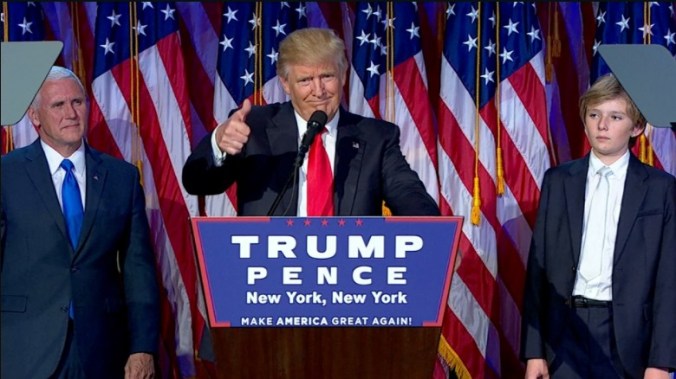
So Donald Trump will become the 45th President of the United States.

A sentence that I hoped I’d never have to actually write in a non-fictional article.

I’ll leave much of the “what went wrong” analysis to others except to say that maybe the “centre-left” (however broadly you want or need to define it) will finally come to realise that the short term gains of triangulating towards your right-wing opponents and just banking that your left wing base support will carry you through because they have no-where else to go has hit its limits. It didn’t work for Pasok. It didn’t work for Labour. It hasn’t worked for the Democrats.

Because, of course, the base does have somewhere else to go. They can choose to simply not vote or they can vote for the charismatic but context free option. Both of these choices happened last night. (Of course, there are other factors too. There seems to have been a very significant “Urban vs Rural” split just to name one).

What’s done is done though and now we need to adjust to our new reality as best we can. Scotland will feel the impact of this vote, so we need to have a think about where and how we can react.

TTIP

As with so many things, Trump has made deeply conflicted statements regarding his view of international trade agreements. He has both come out strongly against TTIP, TPP and NAFTA (mostly because Clinton was in favour) whilst also saying that post-Brexit UK would be “front of line” for a trade deal (mostly because Obama said we wouldn’t be).

For opponents of TTIP it may well be that the final nail in the coffin could come from an unlikely ‘ally’ indeed. Of course, if Trump manages to square his circle and fulfill both of his promises then independence may well be our bolthole to get away from them.

Climate Change

Trump is about to become the most powerful climate change denying leader on the face of our planet. I really do feel pity for folk in places like Florida who have voted for a series of polices which may well erase significant chunks of their state from the map.

Scotland should absolutely become the counter-example to his fossil energy expansion plans. If America is not going to be the world’s hub for renewable research, development and deployment then we should take it on (we’ll even welcome immigrant scientists and engineers who want to come and help us do it!).

We absolutely cannot sustain a fracking economy in the face of this. For a start, if Trump goes full frack then it may depress prices below the point of sustainability without subsidy. This is my warning to anyone hoping to kick the Scottish fracking can down the road till it’s safely after indy. There’s no mountain of cash for Scotland here. Turn away.

NATO

Trump has made several rather worrying comments about NATO. It looks greatly as if he will push hard for all members to raise defence spending up to the target level of 2% of GDP per annum (amongst other requirements). Right now, the UK is one of only a few member countries to do this (despite slashing spending within Scotland…but that’s a story for another time). More worryingly is Trump’s threat to hang NATO allies and even members out to dry should they “fail to pay”. I believe it is time for Scotland to revisit the discussion on our independence being predicated on NATO membership. For our own security, could it be that the EU’s proposed joint defence plans offer better security than the uncertain and unreliable ‘protection’ offered by Trump? Would Scotland be a better force for good in the world if we placed our efforts into UN Peacekeeping missions rather than by being part of an alliance built up to bulwark ourselves against a Warsaw Pact which no longer even exists?

Final Thoughts

These are, of course, the earliest of days and we’re going to have to wait to see both how President Trump differs from Candidate Trump (if, indeed, they do). Who Trump places in his cabinet (I’ve heard from friends in the States that VP Mike Pence may well be the one who does most of the day-to-day work behind the throne…except his record as governor of Indiana is far from stellar both within the economic and in social policy).

My slight hope is that Trump ends up surrounded by a very thick layer of advisors who are able to..”filter”..his outbursts and orders into something that’s a little more suitable for humans living on planet Earth. If that happens, maybe we’ll just about get through this.

tcg-logo6c

Postscript:- At time of writing, Clinton is still (marginally) AHEAD of Trump in the popular vote despite Electoral College going decisively to Trump. Come on America. It’s actually quite hard to create a voting system which is even worse than FPTP for selecting a single nationwide seat but somehow you’re still clinging on to it.
(Before anyone asks, my pre-result gutfeel prediction was that Clinton would win the EC and Trump would win the Popular Vote, the exact opposite of what appears to have happened. Rant still stands.)