Heart Under Blade

“If I ruled out a referendum, I would be deciding – completely unilaterally – that Scotland will follow the UK to a hard Brexit come what may, no matter how damaging to our economy and our society it turns out to be. 

 “That should not be the decision of just one politician – not even the first minister. It will be decided by the people of Scotland. It will be Scotland’s choice.” – Nicola Sturgeon, announcing the new independence campaign.

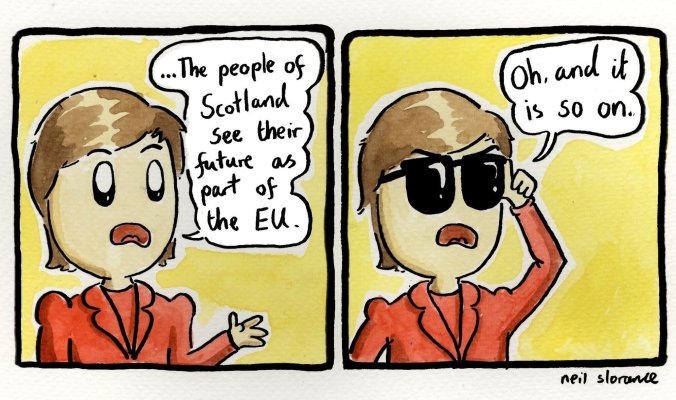
ItsOn.jpeg

We’re so officially on. Today Nicola Sturgeon announced that next week she shall seek Scottish parliamentary approval for a second independence bill and with the announcement that the Greens will unanimously support it, it has a pro-independence majority in Holyrood and so will pass with nothing more than the hollow wails and gnashing of teeth of the minority of Unionist MSPs to hold it back. Once the bill is passed, she shall request an order under Section 30 of the Scotland Act which, if approved by Westminster, will give Holyrood the power to hold the referendum (if Westminster declines such permission well…that should be an interesting bridge to cross).

Once the Section 30 order is approved, the First Minister has stated that the intention is to hold the referendum some time after the Brexit deal is clear but before (or, at the very latest, shortly after) Brexit day. The reasons for this are laid out in my article on the topic here. Essentially, we’ll need to know what the actual Brexit deal will look like but if we’re still in the UK once we’re out the EU and the UK starts making changes which affects our eligibility for EU membership then they could take a substantial amount of time to reverse if we want to rejoin the EU as a full member.

What happens after that? How do we organise the campaign? How prominent will the parties be?

Well these are questions that will be determined as we shape the independence campaign but on that last question it is quite instructive that the First Minister made this announcement today and not at the SNP party conference at the weekend. This is an encouraging signal that the campaign will emphatically not be a solo project by the party.

I have to say that the adrenaline has been rising in me since the press conference and it has reminded me of an old legend from the ninja of medieval Japan. Within their own name for themselves, 忍者 – shinobi-no-mono, there’s a story about the first symbol 忍. It is said that it can be broken into two. 心, meaning heart or spirit, sitting underneath 刃, a blade. Amongst many lessons, one that it teaches is that one must be steeled with the determination to act as though our actions have real meaning which will echo far beyond our own life and ego. History is being made now and we have a chance to play our own small but lasting part in that.
It’s going to be  a busy road ahead of us for the next 18 months but I, for one, am willing to put my heart under the blade and to work as absolutely best I can to build the strongest of foundations for the new campaign and to get out there and win it. I’ve already started with my work on the Common Weal White Paper Project (which we all hope you’d be willing to support to get it finished). I’ll be at the heart of my local Yes group and, of course, my local Green branch when we start getting back out chapping doors. Most importantly I’ll be acting as though I’m living in the early days of a better nation.

Come with me.

tcg-logo-7

Air Departure Tax Post-Brexit

“We haven’t commissioned to the best of my knowledge any independent research of our own. If committee wishes me to look at that, I will certainly consider that absolutely.” – Derek Mackay on the Government’s (lack of) analysis into the proposed ADT cut.

ADT Cover.png

The Scottish Government put out a call for evidence for their proposal to cut and eventually eliminate air passenger duty (or, as it’s now going to be known, Air Departure Tax).

Common Weal duly obliged and updated our previous work on the topic to account for the impact of Brexit. You can read the new report here or by clicking the image above.

It’s just as well that we’ve done this as it has since been reported that the Government itself has done precisely zero economic analysis of the impact of the tax cut and, as it turns out, our report is the only economically based submission which is against the tax cut (The RSPB have submitted an objection on the grounds of a very well founded environmental impact analysis). More than half of the other submissions and the bulk of those in favour of the cut are from companies and groups within the airport and airline industry. There is a great deal of concern that unless the government does pull its weight and do the maths itself then this policy could pass through simply on the say so of those who stand to benefit directly from the tax cut and at the expense of those who will lose out due to the impact on tourism and the lost revenue to public services.

Preface and Key Points below the fold.

Continue reading

Scotland’s New Deal

“Remember, the EU isn’t as keen on “Special Deals” as it once was”, The Common Green, 11th February, 2017.

I’m always more than happy to be proven wrong especially when it’s in a pleasantly surprising manner.

This week saw the news story in The National that, contrary to my impressions up till now, that a report had been written by the European Parliament’s Committee on Constitutional Affairs recommending that the EU should  indeed be considering some kind of “Special Deal” for Scotland which would allow it stay within the Single Market even if we remain within the UK after Brexit.

Continue reading

QuEUing up for Membership

Don’t want to read 2600 words? Twitter version: None of the things people say will be hard are. Few are talking about things which will be.

SaltireEU2

Only in the madhouse world of UK politics that a government which is actually embarking on the process of taking Scotland out of the EU against its will while claiming that this would be a wonderful thing could somehow contrive to simultaneously try to sell us that line that an independent Scotland would be out of the EU against its will and that would be terrible.

Whilst this is going on, the same several year old phony war surrounding Scotland’s membership of the EU continues with a great many people still claiming that we would a) be forced to join the euro and b) Scotland would be punted to the back of the accession “queue” doomed to wait till all other potential members (including, possibly, Turkey) have joined before we’ll get a look in.

This week has seen the publication of a couple of commentators on Scotland’s precise position regarding our EU membership, independence and the interaction with Brexit which has sent every man and their dug howling at the moon and trying to spin themselves into position to get another shot in.

So lets take the opportunity here to take a slightly more sober, honest and open look at how things work in the EU and plot out a couple of likely (that is, actually possible) pathways from which Scotland goes from here, through Brexit and independence and to an independent Scotland within the EU.

Continue reading

We Need To Talk About: Defending Currencies

“Whenever politicians and rulers, from Nero onwards, interfere with monetary arrangements for political ends, disaster follow.” – John Chown, A History of Monetary Unions.

Currency remains one of the great potential uncertainties surrounding the debates about Scottish economics and independence. Last year I published the various options facing an independent Scotland along with the merits and demerits of each. Having selected as the preferred option an independent £Scot initially pegged to the Pound Sterling, Common Weal subsequently published a detailed plan on how precisely to go about making this currency a reality. Rather pleasingly, the news this week coming from the Scottish Government’s Growth Commission hints that they are looking at things from very much the same point of view as we have and may well be coming to the same conclusion.

The main lesson of discussion about currency options is that all of them have their disadvantages along with their advantages and one of the primary disadvantages of this option lies in the peg to Sterling, particularly if it is to be maintained beyond the transition and launch period of the new currency. There could be the potential for the international speculative market to mount an attack on the currency in order to knock it out of the peg (as infamously happened to the Sterling in 1992 when it was knocked out of the European Exchange Rate Mechanism). A discussion of the likelihood of this happening and how one can defend against it is therefore required.

As with many things of this nature, the detailed study of this kind of thing can run rather to the technical (the links there are made available for those who wish to study them) so I’ll attempt to break it down into something a little more accessible.

What Makes a Currency Vulnerable To Attack?

The entire purpose of a currency market is to allow that market to determine the most efficient price of the currency. This is generally only considered an attack when the currency is pegged to another. When the currency floats, a market driven price movement is considered the entire point of the exercise. This is part of the reason why “Black Wednesday” came close to bringing down the UK government whereas the 2016 Brexit devaluation was much less politically damaging despite being a larger depreciation in percentage terms.

So why attack a currency in the first place? There are multiple reasons but they essentially boil down to one. The peg is perceived as being “wrong” for the currency and the economy it supports. Either it is over or under valued. Usually it is the former as politicians tend to link a “strong” currency to national pride cases of undervaluation such as in China or Germany do exist (It should be noted that neither of these economies are under serious speculative attack at present).

Assuming an overvalued currency, the attack generally takes place by speculators “short selling”, or “shorting” the currency on the markets. To do this, they will borrow a great deal of the currency at the overvalued rate and sell it on the foreign exchange markets. This floods the markets with supply of the currency and depresses the price. The speculator can then buy back the currency he sold at the new lower price, pay off the loan and pocket the difference.

Before an attack happens though the speculators need to be sure of one of two things. Either A) The country under attack lacks the will to defend the currency peg or B) It lacks the tools to successfully defend against it. If the attack fails, then the speculators could be out of pocket to a very significant degree. Whilst George Soros infamously made off with £1bn in 1992, there are reports that he had to borrow some £6.5bn to do it. He was sure of his bet and it certainly paid off for him that time, but that’s still a big gamble to take and lose.

How to Defend a Currency

An attack can be defended in one of two ways (or a combination of both). First, the Central Bank can raise interest rates to discourage further borrowing of the currency (if interest payments on the loans exceed the expected gain, speculators will back off) and to encourage investors to start buying currency at the same rate as it’s being sold (so they can benefit from the increased returns on the interest). Or Secondly, the Central Bank can sell foreign reserves and buy their currency back themselves to limit supply and force the value back up. If they do this until the attackers themselves run out of the ability to borrow more of the target currency then the attackers give up and take the losses. (For an undervalued currency, the tools are used in the opposite direction as China is currently doing)

The third option is to consider both the economic and political situation and decide that if the currency really is mis-valued and that the political cost of unsuccessfully (or perhaps even successfully) defending the currency is too high then the defence simply isn’t viable. In this case the peg is dropped and the currency is intentionally allowed to revalue.

Herein lies the risk for Central Banks. The cost – which can take the form of higher interest rates, higher inflation, depleted national reserves, lower GDP and higher unemployment – of unsuccessfully defending the currency may be much higher than not defending it at all but not defending may carry a higher cost than a successful defence.

It is important to note that the failures to defend a currency are often higher profile than the successes which, by their nature, do not generate so many tabloid headlines or history books. At least one study has noted that of the 163 speculative attacks identified between 1960-2011, 42 were not defended against, 34 were defended unsuccessfully and 87 were successfully warded off.

cd1

CD2.png

Charts from S. Rebelo, (2000)

To look at the 1992 Black Wednesday example caused when the GBP dropped out of the Exchange Rate Mechanism. The ERM (which was the precursor to the Euro) essentially pegged member currencies to the German Deutsche Mark. The value at which the GBP was pegged on entering – 2.9 DMK/GBP – was considered far too high and opened the road to the infamous speculative attack. The Bank of England responded by raising interest rates from 10% to 15% on the day of the attack and they sold £4bn worth of reserves (almost £8bn in 2017 pounds and about 1/3rd of what they had in reserve at the time). This turned out to be insufficient and the peg was eventually abandoned. The exchange rate fell to 2.413 DMK/GBP and the GBP fell out of the ERM. Papers released from within the BoE in the years since have mulled over the impacts and costs of their defence strategy, the causes of its failure and whether or not it was worth mounting in the first place.

Is Scotland Vulnerable?

So would this apply to Scotland in the event of our independence? There’s never a certainty with these things and the state of the international money markets are that size of one’s economy is probably no sure defence against all possible attacks (short of erecting massive capital controls and isolating Scotland from the global trade market, but this too carries its own consequences). However, I do believe that Scotland would be less vulnerable to a speculative attack than some may suppose for the following reasons.

First (and possibly most importantly): If we peg to Sterling then it’ll be on a 1:1 basis therefore will be at the same value that it is currently. To believe that the £Scot is over or under valued is to believe that the GBP is currently, right now, unsuitable for the Scottish economy which begs the question of why we’re even in a currency union with rUK. This may change post-independence as our economies diverge but in that case the question of whether or not to continue that 1:1 peg opens up. I personally think we’ll either float the £Scot or move to some kind of basket peg shortly after the three year transition and launch period but this is ultimately a political decision as well as an economic one and it may be that the option to move away from the Sterling peg is one debated and decided by the second independent Scottish Parliamentary elections. If a party wishes to hold to the Sterling peg (or any other) then it’ll be for them to determine if that’s a viable option and to convince voters of the same.

Second: We’re proposing to hold rather substantially more foreign reserves than the UK holds as a proportion of GDP. We’re looking initially at somewhere between £15bn-£40bn (Common Weal is currently working on a formal paper looking at how precisely we’d generate these reserves though I have spoken about it somewhat here) with options to use the normal tools available to normal, independent countries to adjust this amount as required. Combined with the lower available trading volume of being a smaller currency (one can only even potentially borrow as many £Scots as exist, especially if it is issued solely by the Central Bank) then this should be sufficient to hold off an attack or even just to display that we’d be willing to do so. Combined with tighter regulation and legislation on the financial industry Scotland should present itself to the world as a country upheld by its strong and reliable approach to fiscal and monetary policy.

Third: Interest rates are at an all time low which gives a fair bit more scope to raise them in the event of an attack than was the case in 1992. One has to be a bit cautious with this though as our private debt levels (particularly mortgages) are leveraged to the hilt so there will be severe consequences if this lever is pulled too hard. This said, the low interest rates are also crippling savers, investors and pension holders. They could well benefit from a raised rate such that an “attack” by the market may well come to be seen as a signal to change political and economic policy rather than a simple profiteering exercise by the speculators. As with life, balance in all things is best.

Conclusion

In short, Scotland is probably less likely than feared to suffer a speculative attack on the currency in the short term following independence and more than able to defend against more should it happen, particularly if we keep the heid and approach the separation rationally and in a well planned manner. Beyond this, it shall be a matter of analysing both the economics and the politics of the situation and never becoming too attached to any particular choice so that if a successful defence of the currency can be mounted, it should, if not, it shouldn’t and if a peg should be modified, changed or abandoned then it must.

tcg-logo-7

You’ll Have Had Your Devolution?

The Supreme Court has rendered its judgement on Article 50 and Brexit. In an 8-3 ruling they have decided, as reasonably expected, that Parliament must vote on the triggering of Article 50 and the beginning of the Brexit process.

On the second point of the case, that the devolved Parliaments should also be consulted, the Court ruled 11-0 that:

SCJudge.jpeg

In essence saying that whilst Westminster could consult the devolved Parliaments and could even state that their formal recognition was required it doesn’t have to and the Supreme Court will not force it to do so. In practice, we all know that this means it won’t. Scotland’s will can be overruled at Westminster’s. Power devolved is power retained.

Wallonia will now have more power than Scotland to negotiate, influence and – eventually – veto or approve the Brexit deal. So much for that “most powerful devolved government in the world“.

The idea of a Federal UK is now dead. Westminster is sovereign. As a former UK Federalist, this is a painful and depressing idea to admit. I cannot see any possible pathway to reach that destination. Those still in favour of it may have to have some very hard thinking to do now. (Mind you, if Wallonia DOES end up writing up more of the Brexit deal than Scotland does, this may be a good argument in favour of EU Federalism. That’s possibly a discussion for the future)

This also means that the SNP’s “Scotland’s Place in Europe” paper has only one pathway forward now and that’s through amendments to the Article 50 trigger bill when it comes through (something they’ve already pledged to do). If Scotland will not have its say from its own Parliament then it will have a voice at Westminster. And if we’re told that we’re to have no influence there either…?

tcg-logo-7

The White Paper Project

“Work as if you live in the early days of a better nation.” – Alasdair Gray

wpp-v1-cover

Today I get to announce the launch of a very long awaited project I and the rest of Common Weal have been working on for quite some time now. We announced back in September that we have been working on renewing the case for Scottish independence by publishing a successor to the Scottish Government’s “Scotland’s Future” document.

Version 1.0 of the Common Weal White Paper can be download here or by clicking the image above.

This is a leaner document than Scotland’s Future was. That document was as much a party political campaign device as it was a blueprint for independence. It not only sought to describe the powers which would come to Scotland independence but also sought to convince voters of the SNP’s own vision for independence. There was nothing inherently wrong with this latter task per se and other parties too sought to promote their own distinct visions as well – as they will all do so again throughout the next independence campaign but this is not the task of an independence White Paper. This paper shall, as far as possible, not seek to propose a list of policy ideas which an independent Scotland could do nor shall it attempt to convince you of the merits of those policies. It merely lays out the technical and structural requirements which must be in place for Scotland to become an independent country once we, the voters, decide that it should become so.

It is a “consolidated business plan for the establishment of a new nation state”.

To this end, the White Paper is split into several broad sections. Part 1, Process and Structures, covers the foundation of a National Commission – a cross party and cross administration body which will be tasked with designing and implementing the institutions and systems which need to be set up in the time between the independence referendum and the formal independence day. It is one thing to state, for instance, “There shall be a Scottish Central Bank”. It is quite another to decide how large it needs to be, where it needs to be based and who needs to be hired to run it. The National Commission shall also be given interim borrowing powers so that it is able to issue bonds, raise capital and fund the construction of the vital infrastructure Scotland would need to either move from rUK or build from fresh.

Part 2, Key Institutions of an Independent Scotland, covers all those things we kept being asked questions about during the last referendum. Would we have a constitution? A currency? What would we do about borders? Defence? All these and more. Of course it’s not yet possible to answer every question in this regard. Some of it will be up for negotiation with rUK, some of it will be dependent on the shape of the Brexit deal between the UK and the EU and Scotland’s relationship with both in the run up to independence but we’re making a stab at as much as we can and this is the section which will perhaps be most expanded upon as the Project is iterated in future versions.

Speaking of negotiations, Part 3 covers the prospective shape of some of these – chiefly the allocation of debt and assets and what rUK’s response to our leaving shall mean for our claim on them. Also covered to some degree is how Scotland will interact with various international and supranational organisations although it should be stated once again that no case shall be strongly made for Scotland’s joining or refusal to join any of these organisations. That shall be left to the party or parties which seek to form the first independent Scottish parliament.

Finally, Part 4 outlines the position of Scotland as far as finance and borrowing goes as well as outlining as best we can the default fiscal budget for year one of independence. It is, of course, almost impossible to place any kind of actual certainty or promise on such a budget as it is based on several key assumptions such as the desire to keep both public spending and the various tax revenue streams broadly similar to their position at present. If a party decided to scrap the entire tax system and replace it with one of their own devising then it would have to be up to them to explain how that worked and project the revenue to be gained from it and how it would be spent. Other assumptions include Scotland spending the money assigned to it in GERS for various “UK projects” on projects of similar value and in similar accounting lines (so that, to pick an arbitrary example, our “share” of UK economic development funding spent outside Scotland but from which Scotland “benefits” would instead be spent on economic development within Scotland). Again, whether or not this happens will be a case for the individual parties to make and will depend entirely on accurately and precisely how the current fiscal projections for a devolved Scotland within the UK map onto the fiscal situation of an independent Scotland.

Once again, this is not the completion of the White Paper. This is the beginning. You will see that there are several sections which need to be expanded and built upon and items like costs and figures will be updated as time goes on (the default budget, for instance, is based on 2015-16 figures but – as we’ve probably noticed by now – Scotland didn’t become independent in 2015-16 so these precise figures will be revised as and when they should be). Some areas require the attention of people with specific experience and expertise in them to be able to complete so we are openly calling for those experts who are able and willing to contribute. Please contact us if you want to be involved. Let’s work to build the early days of our better nation.

TCG Logo 7.png

The Common Green’s 2016 Retrospective

2016 has been a bit of a year.

The Reaping of the Celebrities aside, it feels to some like we’ve endured an annus horribilis matched or exceeded only by the 2008 global financial crisis.

Time for a little look back at some of the events on which I’ve pondered throughout the year.

Independence Day (Postponed)

On the 24th March, we marked the day that Scotland would have become independent had we voted Yes in 2014. We’ve all wondered what that day would have been like instead of the grey, slightly dismal day we had. As it was, I wrote a poem. No-one read it. Probably for the best.

It has been somewhat impressive that the independence movement has stayed as together as it has. It’s not what it was, sure, but the steady diminishing of “The Vow”has likely played a substantial part in keeping us focused on our goal. Our ‘Betters’ in Westminster have ploughed a steady furrow through the year from January and the casual dismissal of key parts of it right up to December and the UK Government relying on the ability to completely overturn everything devolution stands for as part of their defence in court.

Add to this, the constant, overriding obsession from the Unionist parties about claiming that the SNP has an overriding obsession about independence and it’s no wonder the agenda never really left the table. If I were them, I’d be spending less time ensuring independence becomes inevitable and the default mode of thought in Scotland and more time making the UK look like the kind of place we’d rather not leave. Of course, there’s also an old saying about never interrupting your opponent when they’re making a mistake…

The Scottish Elections

Seat Allocation

There didn’t seem to be much to actually talk about in the run up to the 2016 Scottish elections. Almost everyone seemed to assume that the SNP would walk another majority and the Unionist parties set mostly about trying to cannibalism each other’s vote with a display of almost policy free British nationalism. It was, of course, it was the Ruth Davidson Party for a Stronger Opposition To Admitting Which Party She Belongs To which won that contest.

Image result for ruth davidson campaign leaflet

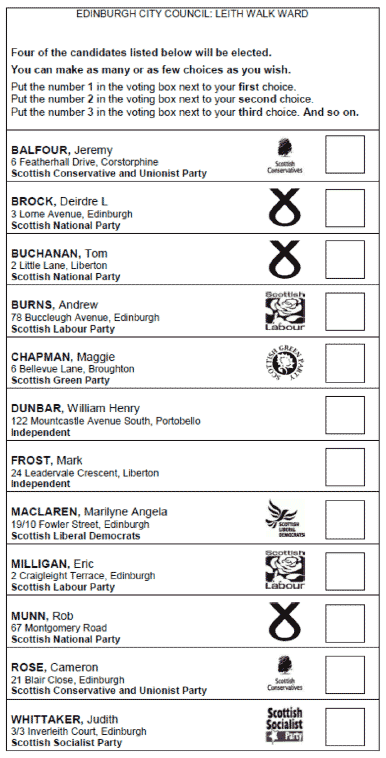
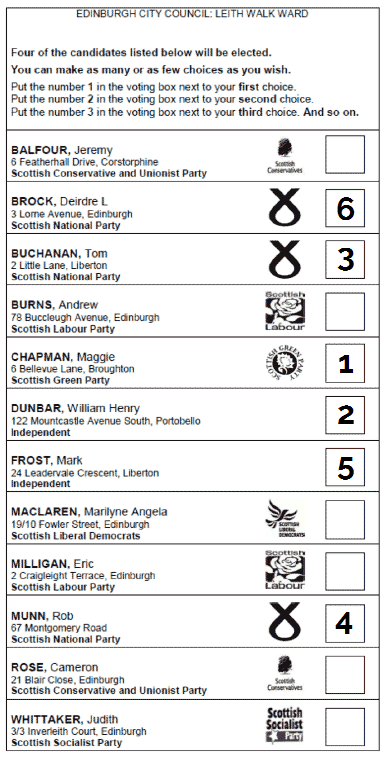
Most others seemed to be scrabbling around asking if some kind of “tactical voting” campaign would best benefit their own party of choice, something which I rejected for several reasons. Indeed the voting system used by Scotland actively discouraged such a thing in a way that the UK General Election’s FPTP system does not. A good thing as far as proportional democracy goes but this did  not help when I was out on the doorsteps and confronted by more than a few folk who simply didn’t understand how to vote using AMS. It’s not even easy to explain in a short sentence or two.
There were a few actual policies to come out of the campaigning though. The SNP promised to marginally modify Council Tax, Labour tried to marginally modify it marginally more, the Greens suggested actually fixing the whole thing instead. Whilst the SNP won the government, the lack of a clear majority means that this issue still isn’t quite settled. We’ll find out early next year how much compromise is made to the SNP’s manifesto and how much the various parties are willing to compromise on their stances in order to get the budget passed. Between this and the ongoing saga of the PFI scandals, it certainly sets things up to be interesting for next year’s regional authority elections.

The EU Referendum

Brexit

The big event of the year. If I had thought that the 2014 No campaign was dire and that the elections since then were facile, this one took the cake. BOTH official campaigns embarked on a fact-free trail of fire and woe which was utterly embarrassing to watch. It got to the point a couple of weeks before the vote that I had simply had enough of the propaganda, the willful misunderstanding of EU structures and the outright ignorance of basic facts that I had to write something about it myself. I thought that maybe two or three blog posts would be enough to cover things…I ended up writing eight plus a post-results round up. My “Are EU In or Out?” series has since been credited as being one of the more informative blogs on the subject (I’ll leave it to others to agree with those sentiments and thank those who made them) as despite my obvious leanings towards a remain vote I at least laid out the positions as fairly as possible and quoted my sources. Once again, I’ll be watching the ongoing events closely throughout next year as the UK Government slowly begins to realise that it’s not playing some kind of game of poker and starts trying to come up with something resembling an actual plan for leaving the EU in some kind of orderly and structured manner. I also have bridges to sell to anyone who’s interested.

Global Trumpism

Brexit will never happen. Trump won’t get the Republican nomination. Trump won’t come close in the elections. There’s no way he could win. There’s no way that his advisors will continue to let him spout off on twitter to his heart’s desire on many globally important subjects.

I think it’s safe to say that 2016 has not been a good year for political predictions in general.

I still maintain my hope that he’ll be surrounded by a group of advisors able to “filter” his commands into something a little more survivable but since that group of advisors increasingly seems to be the type of things he’s pulled up from the bottom of the swamp he promised to drain I’m wondering just how hopeful I should actually be.

Perhaps we should really have that discussion now about why things like Brexit and Trump have started happening.

Common Weal

More positively from my perspective, 2016 saw my joining Common Weal as a volunteer researcher and then becoming their Head of Research as they, we, gear up for our biggest project since the foundation of the think tank. The White Paper Project. A new case for independence based on our All of Us First ideals. My own work has established the case for an independent Scottish currency (and we’ll be producing another paper very shortly on the technical details of how one is launched), examining the historical precedents behind debt and asset allocation during separation negotiations and how they’d relate to Scotland and rUK, and explaining in detail the insufficiency of GERS as an indicator of Scotland’s financial position post-independence. Other papers have been produced by others on the case for a National Investment Bank, understanding the impacts of child poverty in Scotland, proposals for reforming Scotland’s housing policies and others.

Early in the new year, we’ll be publishing our White Paper at the Scottish Independence Convention and asking people to give their thoughts on what we have and to help improve it, approve of it and take it forward to the point where the entire independence movement can get behind it and push it into the next campaign. I hope to meet a few of you there.

Onwards to 2017

2016 has been a bit of a year. But not one that’s been as bad as I’ve probably made out. Globally, there have been a number of success stories as well and we’d do well to pay better and more attention to them (One of my own Resolutions for next year will be to do better do avoid getting stuck in the mire of gloom, anger and ‘fake news’ too abundant on social media). The potential for a Greener planet is increasing by the day as the cost of renewables continues its freefall. Scotland is doing well to take part in some of this revolution although it’s also clear that much more could be done if only we had the power to do it and weren’t constrained by a government still wedded to fracking and Big Capital nuclear boondoggles.

20160324_132351.jpg

So here’s a wee toast to the back end of 2016 and for a hopeful start to 2017. We got through this one, we’ll get through the next. Let’s try to enjoy it more this time.

tcg-logo6c

[Edit: Article posted about an hour before the announcement of the deaths of Carrie Fisher and Richard Adams. Screw you 2016.]