John Swinney Is Acting Like a Climate Denier

“Adults keep saying: “We owe it to the young people to give them hope.”
But I don’t want your hope.
I don’t want you to be hopeful.
I want you to panic.
I want you to feel the fear I feel every day.
And then I want you to act.
I want you to act as you would in a crisis.
I want you to act as if our house is on fire.
Because it is.”
– Greta Thunberg

This blog post previously appeared in Common Weal’s weekly magazine. Sign up to our Daily Briefing and Weekly Magazine newsletters here.

If you’d like to support my work for Common Weal or support me and this blog directly, see my donation page here.

There was a time when Scotland was proud of its climate credentials. The first national government in the world to declare a Climate Emergency, followed by many of its local councils. Setting ambitious, legally binding targets to reach Net Zero well ahead of the promises being made by peer countries. Even being the first nation in the world to officially admit that the Global North had a responsibility to repair and compensate Global South nations because of the damage we had and were causing to them.

I will grant you that Common Weal has been rightly critical of the actions that proceeded from these words. You should always watch what a politician does rather than what they say.

Scotland declared a Climate Emergency, then tried to avoid changing policies to match the severity of the problem – like someone who response to their home having a Roof Fire Emergency by turning off the gas stove then going back to bed.

The legally binding targets were legally bound but with no clear policy pathway to meeting them. The climate promises made, if added together, would not have created a Net Zero Scotland and we all knew that promises would be broken along the way so that the actual additive impact of actions would fall short by even further.

And while Scotland did put some cash into the fund for Global climate loss and damage, the amount was well short of the actual damage Scotland has caused. Scotland’s bill for our share of global climate emissions amount to something like £2.5 billion per year, every year until we reach Net Zero. Scotland promised a total of £100 million for the fund across just two pledges.

Still. Contrast those lofty promised followed by half-hearted actions with the current Government. This month, John Swinney has been campaigning hard on giving a massive tax bung to oil and gas companies. The same companies that have profited to the tune of trillions of pounds while setting the world on fire. The same companies that have actively lobbied to halt and prevent measures to stop them doing this. The same companies that even as they take more cash to help them make more profits are simultaneously shedding old assets in the same North Sea so that they don’t need to pay to decommission them.

It’s hard to show just how much of a U-turn this is for the Scottish Government but there is one thing that illustrates this.

Donald Trump – a man who vocally denies climate change and erroneously thinks that ‘windmills’ make people poorer and don’t exist in China, while actively waging illegal oil wars in the Middle East and Latin America – also believes that oil companies are making too much money. Right now, John Swinney is more extreme on oil subsidies than Donald Trump.

We can therefore safely assume – in the absence of actions to the contrary – that despite John Swinney serving in the Governments that made those previous commitments, he is himself is acting like a climate denier. He is looking at the Roof Fire Emergency and is actively turning all of the gas hobs to full burn before going back to bed.

I know that Trump isn’t claiming that oil companies are making too much money because he’s secretly a ‘nationalise all assets’ communist who has a strong moral conviction in public good. It’s because he wants the money for himself because if he isn’t personally benefiting from any ‘deal’ then he thinks he’s being taken advantage of and the last thing he wants to be is a ‘loser’.

“Our Common Home Plan remains the most comprehensive blueprint for a Scottish Green New Deal.”

Swinney doesn’t have this excuse though. He should know better. Actions speak far louder than words though and right now we’re seeing the actions of a man calling for oil companies to be able to make even more obscene profits at the expense of the planet at the same time that wildfires are raging through the Cairngorms and heatwaves have killed thousands of people in Britain this summer alone (never mind the thousands more across Europe and even more globally).

I know he still claims to cling to the policy that he’d only approve of new oil and gas extraction if it met certain “climate criteria” but he is yet to lay out what he thinks those criteria would be and whether he thinks any new extraction would pass it. What, precisely, does he think a “Net Zero” oil well would look like?

If I’m wrong and John Swinney is not a climate denier, if he does, in fact, still believe that we’re living in Climate Emergency and that emergency has only gotten worse since his government declared it, then I expect to see another set of actions. I expect him to endorse Monica Lennon’s proposed Ecocide Bill when it returns to Parliament and then to start aggressively prosecuting people who are committing ecocide. I expect him to align all public policy with what the science says Scotland must do to meet our obligations under the climate emergency.

Common Weal has already shown what he can do. Our Common Home Plan remains the most comprehensive blueprint for a Scottish Green New Deal. Following it through to its conclusion would lead us to a world where oil barons no longer have the power to lobby politicians for their own profit because that world simply won’t contain oil barons. This is, of course, why those oil barons continue to try to make sure politicians don’t take those actions.

Right now, John Swinney is taking the actions of a climate denier on behalf of those oil barons. If he wants his political legacy to be something other than that, he knows what he needs to do.

England isn’t going to steal Scotland’s water

“A lie can run round the world before the truth has got its boots on.” – Terry Pratchett

This is an original post, not published elsewhere. If you’d like to support my work for Common Weal or support me and this blog directly, see my donation page here.

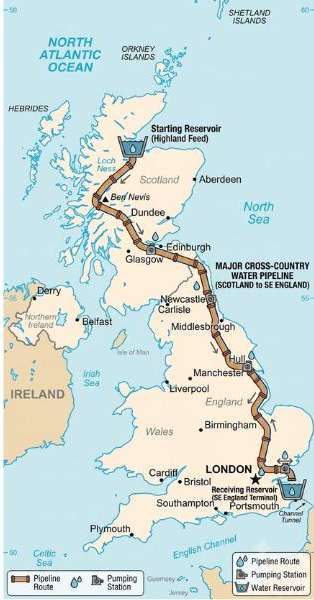
A viral image of an OS-style map showing a water pipeline running from Inverness to London

There’s an image going viral around Scottish nationalist circles right now about hypothetical plans to build an aqueduct to move water from Scotland to England. There are grains of rationality behind it. England is suffering widespread and worsening droughts due to climate change, Scotland still has reasonably abundant water and low demand, at least one UK Prime Minister has actively floated the idea in the past, and there is a long history of Scottish resources being exported from Scotland without the people of Scotland being adequately compensated.

The problem with this idea is that it won’t work – the physics is against it.

For water to flow under gravity, there needs to be a minimum gradient. Current British water pipe standards suggest about 1:100 as a rough rule of thumb – for every 100m the conduit runs horizontally, it needs to drop 1m vertically. The shallowest Roman aqueducts ran at 1:1,000 though they clogged up pretty quickly without constant maintenance. The longest Roman aqueduct – about a 5th of the length of this proposal – had a gradient of about 1:660 along much of its course.

The straight-line distance between Aberdeen and London is 720km. This means the pipe at Inverness would need to be between 720m-7,200m above sea level to drop the water down to London. If your reservoir is on top of a Munro and you can build like a Roman, you might make it so long as there are no other hills in the way. If you build to British water standards, I doubt you will.

Ah, but we have pumps! Pumps can lift water back up so you can make many small steps down instead on one large one. Yes. That’s the second issue. Pumps cost energy to run. To lift 1,000kg (1 cubic metre – enough for one household for 2-3 days) of water from sea level to between 720m and 7,200m and to transport it at a rate of 1 cubic metre per hour, will cost you between 2kWh and 20kWh. It doesn’t matter how much that costs or whether you get the power from fossil fuels or from solar panels, you still need that power.

To desalinate 1,000kg from sea water in the South East will cost you between 1kWh and 3.5kWh per cm/h.

Therefore, to make an aqueduct from Scotland to England economically viable [See Note] we need a) the capital costs of the longest aqueduct in the UK to be massively lower than that of a bunch of desalination plants and b) to build the pipes more efficiently than current British water standards.

And this is before we consider that a more effective means of supplying demand might be to introduce better, more local resource efficiency measures, to build more reservoirs to store water for the dry seasons or to nationalise the private water companies and prosecute the former directors to recover the costs to repair the leaking pipes.

We also need to consider that a transnational water conduit that the SE absolutely requires is going to be an absurd national security risk given that it could be burst open by a single drone anywhere along its length. Desalination plants are already vulnerable as we can see by the war crimes currently being committed by the US and Iran to that effect, but at least they can be distributed so that taking out one still means that some water can flow.

So no. England isn’t going to build an aqueduct to transport all of Scotland’s water away. It’s going to be much easier for England to build power cables to transport away Scotland’s energy to feed their desalinators instead.

Note:- There are extremely long water pipelines in the world – the longest feeds from a pressurised fossil aquifer so has a degree of head lift that surface water does not and others tend to drop down from mountains rather higher than Scotland’s.

There are also extremely long, economically viable pumped oil pipelines. Oil costs between a hundred and a thousand times more than water on a per litre basis, so the economics of energy use are very different.

How to make the sun shine at night

“O, Sunlight! The most precious gold to be found on Earth.” – Roman Payne

This blog post previously appeared in The National as part of Common Weal’s In Common newsletter.

If you’d like to support my work for Common Weal or support me and this blog directly, see my donation policy page here.
The problem with renewable energy, we’ve been told for decades, is that it doesn’t work on the schedules of our choosing. Turbines don’t turn when there’s no wind. The sun doesn’t shine at night. And therefore we need fossil fuels and nuclear power plants. Only they are reliable enough to power our society 24 hours a day.

And so, even though we bake in the hottest year of our lives, again, and look forward to every year of the rest of our lives being even hotter. Even though thousands in Britain and thousands more across Europe will not now ever live to see a hotter year – the magnitude of death going almost unnoticed by the media in a way that it would not had it been an act of terrorism. Even as the same people who caused those deaths lobby our governments to let them cause more and make money doing so. Even as all that happens, we’re still told that renewables could never replace fossil fuels because the sun doesn’t shine at night.

What if it did though?

I’m not talking about the Techbro supervillain idea being trailed by an American company to put mirrors in orbit to reflect sunlight. That won’t work, will only burn billions of dollars that could have been spent more sensibly and even if the mirrors launch they will cause untold damage to the environment, to scientific equipment like telescopes and will further wreck our shared Commons that is our view into space.

A much more down-to-Earth solution is, of course, batteries. Battery technology has come on faster than anyone – including renewable energy optimists – could have predicted. Twelve years ago, while Scotland was having its independence referendum, a grid-scale battery cost around $300 per kWh (a kilowatt.hour is a unit of stored energy – a 1kWh battery could run a 1kW electric heater continuously for one hour).

By 2019 when we published our Common Home Plan, the price had more than halved and was closing in on $100/kWh which was considered a major milestone in technological achievement (not for any real physical reason – humans just like round numbers). Now, batteries cost closer to $60/kWh and we’re starting to approach a real milestone. One that will really change the game in terms of how we use these things.

“Crucially, for Scotland, sodium batteries have the advantage that we could make them here if we wanted to”

That milestone is $20/kWh. At $20, these batteries cross a threshold. Connected to enough solar panels to charge them (solar panels have also dropped in price by an astounding degree and now generate human-usable energy cheaper than any technology ever invented by humans going right back to when we first harnessed fire), a $20 battery is capable to delivering energy cheaper than coal, cheaper than nuclear and cheaper than gas.

With just solar panels and batteries, the economic case for burning fossil fuels at night disappears. The fact that batteries can ramp up their delivery very quickly also means that they can take over the job currently done by “peaker” gas turbines that kick in when there is sudden high demand for short periods of time. These peaker plants are the most expensive form of generation on the grid and so replacing them with cheap batteries will have a substantial impact on our energy bills as well as our environmental emissions.

Chinese company BYD has announced that it aims to be the ones to crack that threshold (with their rivals CATL trying to do similar). They are launching a $40/kWh battery next year with further improvements in the months after. Unlike the lithium batteries which have dominated the sector until now, the new battery will be based on sodium.

Sodium is safer to deploy (sodium fires aren’t great, but they’re not as runaway explosive as lithium fires are), easier to extract (you can get it from the salt in seawater) and is a lot cheaper and overall more plentiful than lithium. The major downside is that a sodium battery of a certain size will never store as much energy as the same size of lithium battery. This is a problem for electric vehicles (though sodium battery cars designed to make short hops within towns are coming online too) but less so for grid-scale batteries where space is less of a factor.

Crucially, for Scotland, sodium batteries have the advantage that we could make them here if we wanted to. Scotland doesn’t have substantial lithium deposits but we have plenty of salt in our seas!

Of course, the substantial delays in the kind of investment that Scotland should have been doing to make that happen mean that China has stolen a march on us as they have in so much else of the energy sector. It’s not too late for Scotland. As I said in a recent column (“Scotland is already losing out on green energy. Here’s what we can do.”, The National, 26th February 2026), even if we’re forced to buy Chinese tech to push forward our green transition as urgently as we need to right now, we should also recognise that that tech has a finite lifespan of a few decades and so we should be investing now so that the tech we replace it with is manufactured domestically.

Environmentalists have predicted this moment for decades – decades that were stretched out longer because the oil barons convinced politicians to line their pockets a little longer – but economics now mean that it’s finally here. The transition is unstoppable. Renewables are the future we need. Scotland should work to be on the right side of that future rather than being left behind with the past.

How to solve renewable constraint payments

“We must be willing to let go of the life we planned so as to have the life that is waiting for us.” – Joseph Campbell

This blog post previously appeared in Common Weal’s weekly magazine. Sign up to our Daily Briefing and Weekly Magazine newsletters here.

If you’d like to support my work for Common Weal or support me and this blog directly, see my donation page here.

I would like you to try an experiment with me. Talk about renewables with someone you know who isn’t in the political bubble. It doesn’t really matter if they are for or against renewable energy, but I want you to keep track of how long it takes before they mention a particularly pointed claim against especially wind turbines.

“When it’s too windy, they pay the owners to turn them off!”

What they’re talking about is called “constraint payments”. And the people saying this have a good point. These payments are a major issue at this stage in the now inevitable transition away from fossil fuels and it’s a consequence of how renewable generators produce energy in a ‘non-dispatchable’ manner.

With many fossil fuel generators, the generators can be turned on or off to suit demand (it’s actually not as simple as that – many generators can’t really be ramped up and down or doing so is neither cheap nor efficient and things like nuclear plants are even more limited in how they can respond to demand) but wind turbines only produce energy when the wind blows. This is a problem if there’s no wind but there’s high demand, but it’s also a problem if there’s high wind but low demand – an overnight storm when everyone is sleeping could well overload the grid.

The problem is further compounded by the fact that the UK has an extremely privatised energy generation sector. If everything was owned by the State under, for example, GB Energy (not my preferred solution, but we’ll get back to that), then turbines could be strategically turned off so that supply matched demand. Under a state monopoly, the revenue from the generation would go down, but as revenue isn’t as important as service (I would hope that a single state energy company would run as a not-for-profit anyway) then it all balances out in the end anyway.

The problem comes when various different private companies own some but not all of the turbines. If the energy regulator issues an instruction to a private company to stop generating, then they lose revenue but their competitor who has been chosen today to keep their turbines turning might not.

The solution, to stop the private companies complaining, is constraint payments. Simply paying the generators to shut up and turn their turbines off for the greater good. It’s hardly an optimal solution and it rightly earns the ire of people who live near the turbines but are still paying through their teeth for energy because of all of the other problems we have in the system.

A possible solution came to me this week while reviewing some of the work coming out of our Energy Working Group. The UK is pumping out an overwhelming number of public consultations on energy transformation just now. Common Weal doesn’t usually respond to UK consultations but energy is such an important issue that we feel that we must. However, some of them are ‘public’ in name only as they are long, technical and extremely pedantic in a way that means that only those with specific expertise in the energy sector have a hope of responding to them meaningfully. They certainly don’t adhere to the UK’s own principles of good public consultation.

But our unsung heroes in the Energy Group are doing an amazing job – especially Gordon Morgan who has been taking the lead on many of the responses. I hope to share the latest of them with you all soon.

It was in one of his most recent responses that he mentions something that caught my eye. Common Weal is still arguing for the UK energy sector to be rearranged along the lines of Zonal Pricing. Rather than the current system that prices electricity essentially based on the distance between the generator and London and then from London to you house (there were good reasons for this in the age of coal, not so much now), Great Britain would be split into multiple zones and if your zone happened to be a net exporter of energy, then you could get a discount on your bills – as Scotland is a massive resource for renewables, this would almost certainly mean Scotland would get deeper discounts than, say, London.

There are complications with this plan that Sweden – which has implemented a form of zonal pricing – has to contend with. What happens if the energy exporting zone hits the limits of what it can export? If an Island is generating more energy than it can physically export to the mainland, or if the interconnectors between Scotland and England are maxxed out? If the bottleneck in the system isn’t the generators or the users, but the infrastructure in between?

In Sweden’s case, they have their own form of constraint payment – a congestion revenue – that kicks in and starts arising when generators need to move energy out of their zone. The system isn’t quite the same as the constraint payments issue but here is the key difference between here and there.

In Britain, the constraint payments can be stuffed into the pockets of the owner of the generator. In Sweden, the congestion revenue payments must either be returned to consumers as a discount or must be invested into means of reducing the need for future constraint payments. The payments pay to try to remove the need for themselves.

“If Sweden can do it, why can’t the UK?”

What this means in practice is that there are more investments into interconnectors between the Zones. It could also mean more investment into things like energy storage so that instead of shutting down capacity when limits are reached, then the batteries can be charged instead and then used when demand within the Zone exceeds supply.

Like Sweden does, I could even see a case for discounts or negative pricing for consumers to try to encourage more energy use within the Zone during these times (though in line with Circular Economy principles, we don’t want to encourage too much outright wasteful usage).

So my proposal is this: If Sweden can do it, why can’t the UK (or Scotland, if we ever become independent or energy gets more substantially devolved)?

We don’t have the inter-Zone issue because we don’t (yet) have Zonal Pricing, but the same principle could apply to constraint payments more generally. Companies could continue to collect payments in exchange for turning their turbines off during high winds, but they must not book the money as a profit for themselves. Instead, the payments must be invested into reducing the need for future constraints. They could invest the money into interconnectors (or into driving up more demand within high resource Zones to minimise the need for more interconnector cables), or into energy storage, or pass it down as a discount to customers. But they can’t just keep the cash.

As I say, none of this is my preferred solution. The private sector led, market model of energy doesn’t work (a view recently presented by a coalition of African trade unions, showing that commentators in the UK really need to start looking beyond our borders for better ideas) and we really should be bringing our energy sector back into public ownership. But until that happens, we could be regulating and running the private sector a lot more tightly than we currently do. This one idea – using constraint payments to drive the transition rather than pad the pockets of shareholders – could be a useful step in that direction.

The Iran War sounds a warning for all of Scotland’s Critical Minerals

“Sooner or later every war of trade becomes a war of blood.” – Eugene V. Debs

This blog post previously appeared in The National as part of Common Weal’s In Common newsletter.
If you’d like to support my work for Common Weal or support me and this blog directly, see my donation policy page here.

In the gap between me writing this and you reading it, a lot of things will have changed. If you read this online on Friday morning, the Scottish election polls were closed, but we didn’t know the results yet. If you read it in print in The National on Sunday, we’ll knew by then who would and would not be members of the next Scottish Parliament. By the time I’ve posted it here on this blog we might know who the actual Government would be.

And by then, maybe the Iran War would still be going on. Or maybe Trump would have pledged another ceasefire. Or maybe he’d reneged on it again.

Either way, the world price of oil is likely to still be high and volatile, and we’re all going to continue suffering problems because of it. People in rich countries will get poorer because everything will cost more. People in poor countries will likely lose access to critical materials completely. I am extremely concerned about the dual effects of the loss of fertilisers and fuel for agriculture, combined with a projected very strong El Niño climate event this year.

Politics in the UK appears to be scrabbling around how to deal with fuel disruptions, and more than a few political parties appear to be willing to set the world just a little more on fire by trying to boost production from the North Sea as a replacement for oil being diverted and disrupted due to the war.

Here’s the thing, though. If we replace one barrel of oil we’ve lost in imports with one barrel of domestic oil, we won’t reduce the price of oil (it being a globally priced commodity), and tomorrow, we need to find another barrel of oil. If, instead, we replace the demand for that barrel of oil with heat insulation and a wind turbine or a set of solar panels and batteries, we never need to buy that barrel of oil again.

Even if post-war trade returns to ‘normal’, the countries that have responded by weaning themselves further off of oil will never be threatened by that kind of oil war again, either in Iran or anywhere else that Trump or his successors or allies wish to invade next. The bonus is that right now, the solar panels and batteries are even cheaper than the oil they’d replace.

But there is a complication there, too. Building solar panels and batteries also requires critical minerals, and right now, that means often not just importing those minerals from vulnerable countries, but probably importing the finished products from countries like China with all of the problems that entails, too. Switching one insecurity for another doesn’t make us more secure.

This week, a paper I contributed to was launched by Friends of the Earth Scotland and various other coalition partners, calling for the UK and devolved governments to develop a better strategy around critical minerals of all kinds. The report Aligning UK critical mineral policies with the human rights and environmental priorities of devolved nations considers where critical minerals are, well, most critical to various aspects of our economy, from energy to industry to the military and advocates for a more strategic approach to their use via the implementation of Circular Economy principles.

“While I’ve come to believe that Scotland has largely lost control over the current renewable energy transition, we could and should be building up our manufacturing industries around repairing, recycling and rebuilding the next generation of renewables”

This is the insurmountable advantage that renewables have over oil. Oil is disposable because you have to burn it to make it useful. Renewable energy generators are reusable. They just keep generating energy after they are built. They are also recyclable. If designed properly, the materials in a solar panel or a battery can be used to make another solar panel or battery once the first one eventually breaks (the lithium in a battery can be recovered with something like 90% efficiency, meaning that lithium mined today could still be being used in a battery centuries from now).

I mentioned in a recent article in The National (26th Feb 2026) that while I’ve come to believe that Scotland has largely lost control over the current renewable energy transition, we could and should be building up our manufacturing industries around repairing, recycling and rebuilding the next generation of renewables so that when the current set of imported generators starts to wear out we can replace them with Scottish made (and owned!) versions. At the same time, we should be actively exploring alternatives to critical minerals so that we’re not so vulnerable to supplies being disrupted. Scotland doesn’t have a lot of lithium to mine, but we do have plenty of seawater and sodium batteries are becoming a very interesting alternative to lithium for many purposes.

Ultimately, the lesson of this new paper is that the whims of the “free market” do not hold up in environments where trade is not free and where autocrats can cause chaos for any real or imagined reason. This means that we need deliberate, strategic government policy in place to keep us safe, our economies resilient and our politicians listening only to profiteering megacorporations or lurching from crisis to crisis but actually building a country and ultimately a planet that puts All of Us First.

Marking my ten years at Common Weal

“Everything in politics seems impossible until the moment it becomes inevitable” – Craig Dalȝell

This blog post previously appeared in Common Weal’s weekly magazine. Sign up to our Daily Briefing and Weekly Magazine newsletters here.

If you’d like to support my work for Common Weal or support me and this blog directly, see my donation policy page here.


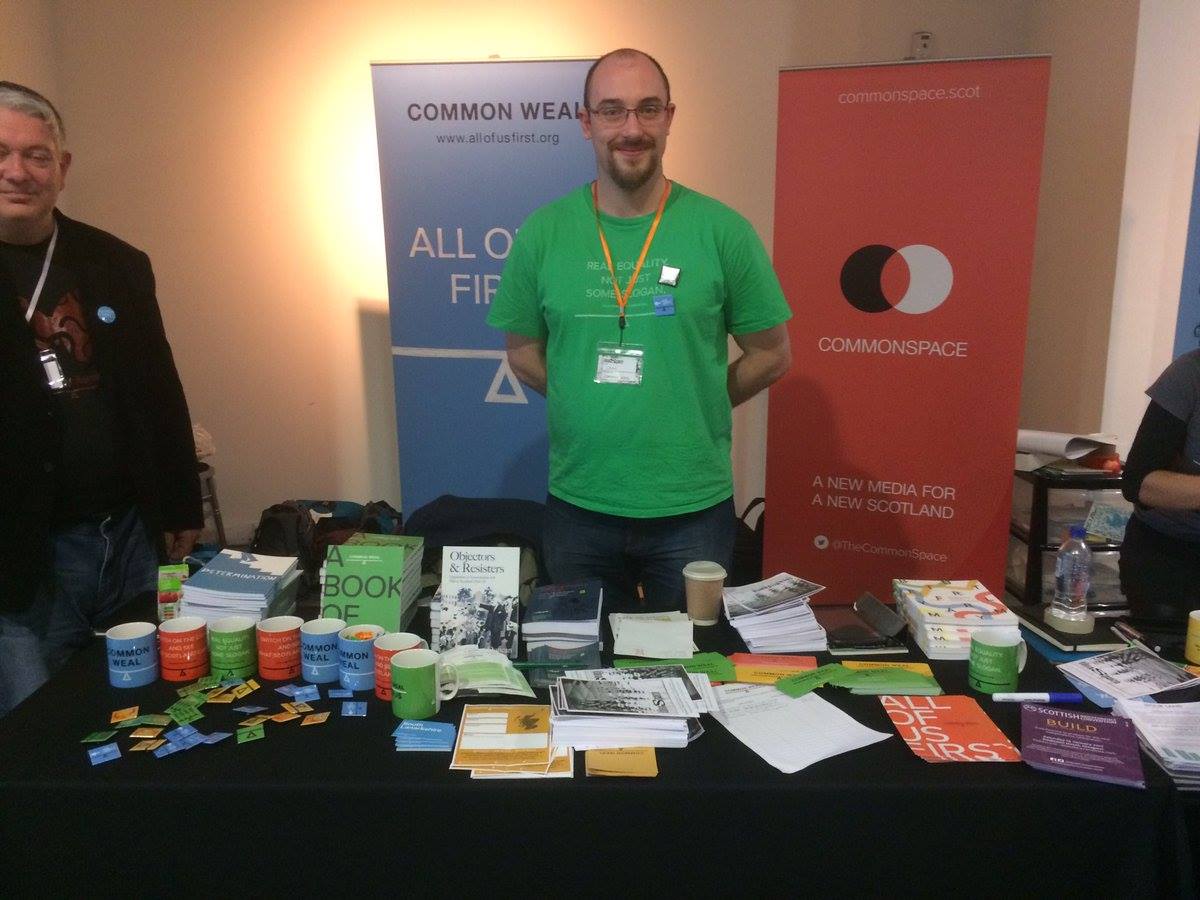
(I think this is the first photo of me at a Common Weal event – IdeaSpace, October 2016)

Time certainly does fly. Last week marked ten years since I published my first policy paper through Common Weal. By 2016, I had gone through a bit of a journey from my political radicalisation during the independence referendum, to losing my job and, as it turned out, my career as a laser engineer at the tail end of 2015.

In that intervening time I had kept up my political writing through my personal blog and it was an article there about GERS that caught the eye of Robin (who already knew me via previous campaigning together) and led him to asking me if I could help on a project about Fracking.

At that time, the political winds (including within the Scottish Government) were pushing very much in favour of fracking the hell out of Scotland and while the anti-fracking campaign had (and still has) a very strong case in terms of climate change, local environmental impact and in terms of long term energy security, the pro-fracking side were talking mostly about economics and when it comes to a campaign based on environmental principles vs a campaign based on making the GDP line go up, politicians are often much more easily swayed by the latter than by the former.

Hence the need for something different. I was asked to investigate the Economics of Shale Gas Extraction with a critical eye to see just how they actually held up. The result: They didn’t. Fracking does well to boost the profits of the owner of the well but the industry would create few jobs (especially in comparison to renewables or even the legacy oil industry), would produce even fewer local jobs and would do absolutely nothing in terms of energy security or the price of energy bills.

Even the profits made would only be made if gas prices are pushed anomalously high (thus, as we’ve most recently seen, the industry is sensitive to geopolitics) and if the companies involved are allowed to not pay the costs created by the pollution of the extraction and the burning of the gas.

I’m proud to say that that paper had a significant impact. It was widely read and adopted throughout the anti-fracking campaign in Scotland and that campaign would go on to win a moratorium against extraction that persists to this day (although there are still those seeking power who would reverse that ban).

Not bad for a first attempt at a policy paper!

Ten years later, I’ve published probably more than twenty more, plus co-authored half a dozen books, produced hundreds of hours of audio and video interviews and more. And don’t worry, this isn’t a retirement message quite yet – I still have at least a few more in me (you’ll very much want to keep an eye on the one I’m just finishing up at the moment!).

I’m always a bit embarrassed to self-promote but this seems like a moment that I shouldn’t pass up. I’d like to present the five policy papers written by myself that I look back on most fondly, either because of their sheer impact in the political scene or because they meant a lot to me in terms of subject matter.

Beyond GERS – 2016

If my fracking paper was the one that kicked off my time at Common Weal, Beyond GERS was the one that made my mark on the Scottish political scene. Beyond GERS sought to recontextualise the way we, as a nation, talked about the annual Government Expenditure and Revenue Scotland report as it was increasingly being used as a stick to beat the independence movement when it was, in fact, showing something rather different – that Scotland’s accounts were being grossly distorted by the fact that we were not independent in ways that made it very difficult to even talk about the finances of what lay beyond that horizon.

For example, just the fact of independence would cause a lot of civil servant jobs in London who are doing work ‘for’ Scotland to move to Scotland – along with the economic impact they would have when they live their lives in and around Edinburgh instead of in London.

The negotiations around debt and asset splits would cause significant changes which could very well lead to Scotland paying much less in debt interest each year (and almost certainly not more in interest even in a ‘worst case’ scenario). And then actual policy changes like choices to be made over how and where military budgets are spent or where and how large Scotland’s embassies would be could have significant impacts on our annual budgets.

The actual numbers in that paper are now out of date as is much of the methodology that went into calculating them. This was because, in additional to changes to devolution in 2017, one of the impacts this paper had was to change (and in my view improve) how GERS itself was presented. Other impacts were an increased focus on GERS in the context of independence which led to similar papers being produced looking at Wales and at Northern Ireland, which both reached similar conclusions to my own paper. It also led to multiple Scottish Government Ministers promising to produce their own version of a set of “post-indy accounts” for Scotland, though none have actually materialised yet.

Social Security for All of Us – 2017

It was Common Weal’s paper in 2013, In Place of Anxiety that was a major early developer of my political viewpoints, particularly its case for a Universal Basic Income. The concept had been around before then, of course, but that was my own introduction to it. In 2017, I had the opportunity to revisit the topic as part of a broader work on how an independent Scotland could redesign its welfare state.

As part of this I produced one of Scotland’s first fully costed Universal Basic Income schemes. It is meagre by today’s standards (equivalent to Universal Credit, but truly Universal) and I would now advocate for a UBI that meets some kind of adequacy standard of being able to actually prevent poverty rather than merely allow someone to live in poverty.

This paper had multiple impacts on the Scottish political world – not least, it played a role in pushing the major parties to make pledges around the idea of a UBI in the 2021 Scottish elections. The SNP, Greens and Lib Dems all came out in favour of a UBI and Scottish Labour presented a counter-plan around a Minimum Income Guarantee.

Sadly, none came to pass. The UBI pilot scheme proposed by the Scottish Government was blocked by the UK Government and their report into Minimum Income was all-but buried by the Government who had by then changed First Minister twice and were evidently no longer interested.

Ambitions for the next Parliament have also been scaled back with Labour and the Lib Dems dropping their pledges entirely, the SNP promising only pilot study of a Minimum Income study for artists and the Greens proposing a similar pilot for a UBI for care leavers. Both pilots are welcome, of course, but it’s still a step back from the loftier promises of 2021.

However, that journey from 2017 to now has been a remarkable one. Back then UBI was still a radically utopian idea in Scotland, fit only for academics and weird policy wonks. By 2021, Scotland had a Parliamentary majority in favour of UBI even if it lacked the power to implement one and that majority went across the constitutional divide – a rare thing these days.

It also led me to being picked up this year by Basic Income Network Scotland and joining them as a Trustee, so you can believe that I’ll be keeping the issue live as we go into the next Parliament to make sure those pilot schemes happen and then we eventually get a Basic Income rolled out to All of Us.

A Silver Chain – 2018

The Sustainable Growth Commission was the first major push by the SNP to produce a body of work on Scottish independence since the publication of its Scotland’s Future White Paper in 2014. It was widely anticipated but at Common Weal we had heard whispers and rumours that we weren’t going to like what was in it. Sure enough, when it was published we were, quite frankly, appalled. I received an ‘advance’ copy of the report just two hours before its midnight embargo and stayed up till 3am reading it – I was then on the radio at 8am the following morning being interviewed about it which made the late night rather worth it.

Over the course of that publication day, I hammered out this policy paper which was published a few days later. The biggest difficulty we had with the report was the ‘six tests’ it laid out that were put in place to block the launch of an independent Scottish currency in the event of independence. Tests that we still maintain would have been impossible to meet and that the act of adhering to the tests would have made it harder, not easier, to launch a new currency.

This wasn’t the only objection we had but it was the one that gained the most traction. The party had to put substantial effort into railroading an adoption motion through their conference that year – the rebellion amongst members was almost as great as the one they saw during the debate to become a pro-NATO party. It also led to the formation of what would become the Scottish Currency Group who have taken our work on an independent Scottish currency and have pushed on far beyond it. Keep an eye out for their next sets of work in the coming months.

Good Houses For All – 2020

There is no logical reason that I can fathom for building houses that leak unnecessary amounts of heat when the technology to build them better doesn’t just exist but now costs virtually the same as building them badly. At the same time, incentives to improve existing houses don’t exist because why should landlords bother to properly retrofit when it’s the tenant who pays less on their bills and instead you could just jack up their rent because they have nowhere better to go.

This paper sought to solve both problems. It laid out the finances of building passive energy efficiency grade houses (though not necessarily the PassivHaus standard as there are other ways to achieve similar levels of efficiency) for social rented stock. I found that doing this could deliver houses cheaper than the private sector would while still being profitable for Local Authorities. This would mean Councils could build essentially unlimited social houses and outcompete the private sector in both price and in quality.

In 2022, I was asked at a fairly high profile public event if I could win just one policy in my political career, which would it be? I chose this one. It has the potential to not just reduce but to eliminate fuel poverty in Scotland and would leave a legacy lasting potentially centuries.

So imagine my shock and surprise that just a few weeks later, MSP Alex Rowley got in touch and took us up on that challenge, introducing a Members Bill to make passive energy efficiency the minimum standard for new homes in Scotland. The Government, facing a massive defeat if they opposed the Bill, did the smart thing instead by simply adopting it as Government policy. There’s still a long road to go in making it all happen but there’s an excellent chance that it will. I hope that I don’t only win one Government policy in my entire career, but if I do I’ll be happy if I only win this one.

ScotWind: Privatising Scotland’s Future Again – 2022

In January 2022, the Scottish Government announced that the Crown Estate Scotland (an arms-length org, but one owned by and accountable to Scottish Ministers since 2017) had completed its auction of options to develop what was then the world’s largest offshore wind project – ScotWind.

Basically, companies bid to buy the right to come up with a plan to develop a particular patch of seas and then they can choose to either return the right to the Estate or “exercise their option” and start the process of developing it. The Government PR machine went into overdrive to talk up the benefits of selling these options. Headlines touted the hundreds of millions of pounds that would flow into the Scottish Treasury and what could be done with it as well as promises around the ‘supply chain’ that would bring hundreds of jobs to Scotland.

But I was looking at the actual reports and things didn’t seem right. As it turned out, the auction was badly flawed. Rather than a traditional option where the highest bid wins or one where a lowest reserve price was set, this one had a maximum bid ceiling set on it. Every winning bid won their option at exactly the bid ceiling (suggesting they might have paid more). Other problems became evident, such as absolutely minimal protections that in many cases would make it cheaper to break those supply chain promises and to pay the fines than to actually fulfil them.

I very quickly put together a report of these findings and we published just a few days after the initial announcement. Instantly, the news coverage flipped from repeating the party line of the success of the auction to taking a more critical eye. The newspaper article covering my report ended up being the most read article in the Herald’s history of publishing online. My follow up report a year later revealed that Scotland has potentially lost out on billions or maybe even tens of billions of pounds by botching the auction the way it did and an investigation into what happened is now underway.

The Next Ten(?) Years

Obviously, my actual job at Common Weal has changed substantially over the decade. I spend more time now managing our Working Groups and the various other people working on policies than I do writing myself. I also keep up with contributions to our Daily Briefing and weekly Magazine (you are subscribed to both, aren’t you?) and I do a lot of outreach, networking and public engagements (want me to speak at your local campaign group about any of my work? Get in touch!). But, I’m still heavily involved in developing my own policies too and, as I say, I think you’re going to like the one I’ve got coming up next.

And so, where for the next ten years? Honestly, the unemployed laser engineer I was ten years ago couldn’t have predicted where I’d be today so who knows? I do know that I couldn’t have done it without you. It’s folk who support Common Weal with their £10/month that have let me do everything I’ve done and can support me and the rest of the team to keep doing it. So, as proud as I am to have done it all, I’m so grateful to have been allowed to do so. Thank you.

And here’s to the next decade, where ever it takes us.

If energy powers get devolved – what then?

“Spring is the time of plans and projects.” – Leo Tolstoy

This blog post previously appeared in Common Weal’s weekly magazine. Sign up to our Daily Briefing and Weekly Magazine newsletters here.

If you’d like to support my work for Common Weal or support me and this blog directly, see my donation policy page here.

John Swinney has kicked of the election campaign with promise that should he be returned as First Minister then “on the first day” he’ll submit a Section 30 order to the UK Government to request the devolution of energy powers to Scotland.

I want to make something clear from the outset – Scotland should have more powers over energy and, given that Scotland holds a massively substantial share of the UK’s total renewable energy resources – the powers that do remain reserved should be jointly managed to a much greater degree than they are now.

The current bickering and grandstanding between governments combined with the, frankly, whining from either government that the other government is blocking progress as they see it serves none of us at a time when first the climate emergency and now escalating geopolitical turmoil is demanding that we get ourselves off of our dependence on fossil fuels as rapidly as possible. To that extent, a campaign for more devolved powers is not just welcome, but vital.

This is not to say that I believe that a simple call for those powers via a Section 30 order will be successful. I don’t think it will be, for the same reason that the Section 30 order for independence referendum powers almost a decade ago was not successful. Governments and politicians will only do something that they do not want to do when the consequences of not doing so – as they see and feel them – are worse than the consequences of acquiescing. If they are told to do something and there is no credible answer to the inevitable response “or what?”, then they won’t.

But let’s assume that they do. Let’s imagine a scenario after May where the Scottish Government clearly won’t win a campaign for a second independence referendum (which would inevitably absorb all other campaign energy and would, if successful, win the powers over energy anyway) but there is scope to win a “more devolution” campaign, including or centred around energy. It might well come about due to the SNP failing to win a majority of seats in Holyrood (and thus failing in their self-imposed prerequisite for an indyref campaign) but there nonetheless being a strong pro-independence majority in Parliament coupled with voices on the other side who don’t favour independence but would welcome more powers over energy (so…not much different from the recent outgoing Parliament then?).

What then?

The powers over energy get devolved to Holyrood, but what then? What is the plan for using those powers? here

I know what Common Weal would do with them. We’ve written extensively on energy matters for over a decade now and have pulled in expertise from some of the top people in the field. We have papers on how to reform the Grid written by people who have helped to run national grids. We have papers on how to heat homes, written by people who have helping to define the standards by which home energy needs are measured. We understand that trying to decarbonise the economy we have today without fundamentally changing that economy is doomed to failure.

So we have our own answers to the question of what we’d do with devolved energy powers and you can hear about a few more of them in my recent interview on the Scottish Independence Podcast here and below.

//cdn.embedly.com/widgets/media.html?src=https%3A%2F%2Fwww.youtube.com%2Fembed%2FFVkzh49OnjU%3Ffeature%3Doembed&display_name=YouTube&url=https%3A%2F%2Fwww.youtube.com%2Fwatch%3Fv%3DFVkzh49OnjU&image=https%3A%2F%2Fi.ytimg.com%2Fvi%2FFVkzh49OnjU%2Fhqdefault.jpg&type=text%2Fhtml&schema=youtube","width":854,"height":480,"resolvedBy":"youtube","providerName":"YouTube","thumbnailUrl":"https://i.ytimg.com/vi/FVkzh49OnjU/hqdefault.jpg"}” data-block-type=”22″ data-sqsp-block=”embed”>

I’m not convinced that the present Scottish Government has fully thought their answer to that question through though. From what I can see there are promises of energy price cuts without elaboration as to how it’d happen, there’s a manufacturing sector based almost entirely around inwards investment – though the UK’s blocking of the Ming Yang wind turbine factory on “national security” grounds (read: “we didn’t want to upset Daddy Trump”) is appalling – and there remains the continued risk that vital improvements like the proposed PassivHaus energy efficiency standards will get watered down and compromised by people who profit massively from your heating bill.

I am greatly concerned that the current Scottish Government’s plan, such that it is, will not be the overhaul of the energy sector that it needs. It won’t be based around bringing the sector into public ownership. I suspect this because they haven’t used the powers they currently have to bring much of it into public ownership.

They’ve also made efforts to privatise energy infrastructure that was in public ownership for no reason other than it would boost the “inwards investment” line a bit more – Scotland’s ‘public’ electric car charging network is now operated by an Austrian company. The Government also reviewed policies around community benefit fund recommendations and chose to reduce them in real terms compared to when they were first launched. And, of course, we’ve seen what happened with Scotland’s largest auction of offshore energy options where it’s very possible that the Scottish Government left many billions of pounds on the table due to undervaluing those assets.

As of the time of writing, we’ve yet to see the manifestos of most of the political parties (including the SNP) ahead of the elections next month but on this topic I’ll be paying particularly close attention. It’s simply not enough to call for more powers but to not lay out what to do with them and I am concerned that what the parties would do with them would just perpetuate the rip-off that the energy sector is. Powers must be used with purpose and that purpose should be not to serve the already wealthy and powerful, but All of Us.

May this be the last Oil War

“I’m going to say [to George W Bush], ‘And you tell me, what the noble cause is that my son died for.’ And if he even starts to say ‘freedom and democracy,’ I’m going to say, ‘bullshit.’ You tell me the truth. You tell me that my son died for oil. You tell me that my son died to make your friends rich. You tell me my son died so you can spread the cancer of Pax America, imperialism, in the Middle East” – Cindy Sheehan, (2005, Voices of a People’s History of the US)

This blog post previously appeared in Common Weal’s weekly magazine. Sign up to our Daily Briefing and Weekly Magazine newsletters here.

If you’d like to support my work for Common Weal or support me and this blog directly, see my donation policy page here.

sunset

For decades now – almost since the first barrel of oil was pulled out of the ground – the oil companies have been paying people to tell environmentalists that the world couldn’t possibly shut down the fossil fuel sector, especially not overnight! Furthermore, rather than spending those decades slowly ramping down fossil fuel dependency in favour of alternatives, we were told that we should just “Drill, Baby, Drill” and pump more black stuff into our consumer goods and into our atmosphere for the great profit of the oil barons. There will be parties in the upcoming Scottish elections who will be openly campaigning on this stance.

Well, thanks to those efforts and the efforts of some powerful men with apparent grudges against the future, we now live in a world where the fossil fuel sector can be shut off overnight.

Continue reading

Scotland is already losing out on green energy. Here’s what we can do

“It’s called socialism. Or, for those who freak out at that word, like Americans or international capitalist success stories reacting allergically to that word, call it public utility districts. They are almost the same thing. Public ownership of the necessities, so that these are provided as human rights and as public goods, in a not-for-profit way. The necessities are food, water, shelter, clothing, electricity, health care, and education. All these are human rights, all are public goods, all are never to be subjected to appropriation, exploitation, and profit. It’s as simple as that.” – Kim Stanley Robinson

This blog post previously appeared in The National, for which I received a commission.
If you’d like to support my work for Common Weal or support me and this blog directly, see my donation policy page here.

photo of truss towers

Scotland has an extremely poor track record of benefiting from our own energy resources. The decline of the First Age of energy wealth – based on coal – can still be seen in the scars of deprivation it left behind especially in the Central Belt towns and villages around where I live and where mining was most intensive.

In the Second Age, our oil wealth was – as Gavin McCrone warned – downplayed and then squandered under successive UK Governments while leaving Scotland vulnerable to oil shocks and we’re now seeing how we’re being held liable for the costs (economic and social) of drawing down the sector as it absolutely must be drawn down as the world wrestles with the challenges of the climate emergency caused largely by that oil even as the rich owners of the assets reap the profits and continue to lobby to delay or prevent change.

The problem is that unlike almost every other country that found itself with large reserves of energy wealth, we collectively decided that Scotland shouldn’t own any of it.

Rather than building up a robust public-owned oil sector, the UK Government flogged off the rights to exploit the resources to the lowest bidder, even offering generous subsidies rather than taxing their profits. The downstream infrastructure was privatised too not just sucked vast amounts of wealth into the pockets of billionaires like Jim Radcliffe but also granting them vast political power and the ability to make hypocritical statements about immigration while living the high life in their own offshore tax haven.

The Third Age of Scottish energy is our Green Transition – built initially around our vast onshore and offshore wind resources but now increasingly diversifying into other areas like solar and battery storage.

We see here that Scotland is in the process of losing out once again when it comes to energy resources that, if anything, vastly outstrip anything the oil sector could have ever promised because, unlike oil, the sun and the wind will continue to deliver that energy long after the last barrel of oil is extracted from the ground.

It promised to finally bring some ongoing benefit to communities that would be hosting the generators but even that failed. Neither Scotland nor the UK showed interest in developing public ownership of the assets and the “community benefit” funds were set at the lowest possible level of £5,000 per MW of capacity for wind (not uprated for inflation) and zero for other forms of renewables. It is estimated that a community owned wind turbine generates around 34 times as much revenue for the local community as does a privately owned one that pays its £5,000/MW community benefit. There is some evidence emerging that even this paltry sum is not being met in many cases with The Ferret reporting a shortfall of about £50 million across Scotland’s community benefit funds.

Offshore is arguable worse with the debacle of the ScotWind auction selling off the options to develop one of the largest offshore wind projects in the world in an auction that, for reasons still not adequately explained, set a maximum price cap on bids and potentially cost Scotland anywhere between billions and tens of billions of pounds in upfront capital.

Most crucially of all, we don’t even make the renewable generators and batteries that we don’t own. Decades of climate-denying politicians telling people that we shouldn’t bother trying to avert climate change because China wasn’t doing anything conveniently ignored that China was, in fact, rapidly building up its industrial base and was starting to sell the generators to the world.

So Scotland now imports the materials to build wind turbines that are owned by multinational companies and foreign public energy companies that export their profits elsewhere and pay communities sometimes less than the bare minimum. We don’t even get cheaper energy for it because the UK’s grid and pricing structures are still based on assumptions laid down in the Coal Age.

So what of the Fourth Age of Scottish energy? The thing about the current generation of privately owned energy assets is that they will eventually need to be replaced, and fairly soon – perhaps in 25 years time. This gives us an opportunity to start planning now.

Scotland needs to start building up its domestic wind and solar manufacturing base. We need to use our excellent universities to develop the materials to ensure that those generators are built to Circular Economy standards (current generation fibreglass wind turbine blades are disposable and are sent to landfill after use). We also need to start aggressively bringing assets into Scottish public ownership. Every time a renewable energy lease is up for renewal, it should be transferred to a Scottish public energy company (nationally or locally owned). This can also happen when a site is up for “repowering” – when old, smaller turbines are replaced with larger, more powerful ones but which exceed the previous lease’s maximum capacity terms.

New renewable sites should have their leases signed aggressively in favour of public ownership too. Rather than 60 or 99 year leases that cover the lifespan of multiple generations of turbines, they should be set to as low as 10 years. Enough time for the private developer to recoup their investment but also enough time for the Scottish public sector to take over the site and also make a profit without merely being saddled with the liability of decommissioning as we’re doing with the oil sector.

If any of this is not possible within devolution (some of it certainly is) and the UK is not willing to allow it, then while we are doing what we can, the case must be made for independence so that we can finish the job.

All of this will take time to set up which is why we need to start preparing the ground now. I don’t want to be here in 25 years talking being asked to comment on why we’re importing the next generation of technology and exporting the profits again. If we want to sit under a tree in 2050, maybe the best time to plant it is today.

Use energy to win independence, rather than independence to win energy

“The problem with the idea of cause and effect is that what is deemed the cause is an effect.” –  Mokokoma Mokhonoana

This blog post previously appeared in The National as part of Common Weal’s In Common newsletter.
If you’d like to support my work for Common Weal or support me and this blog directly, see my donation policy page here.

Scotland doesn’t need independence to start owning our own energy.

It feels like 2025 has come full circle for us at Common Weal. January started for us with an announcement from the Scottish Government that it was “not possible” to bring Scottish renewable energy into public ownership – an announcement made after the publication of a poll showing that more than 80% of people in Scotland favoured them doing so. We responded with a briefing paper called “How to own Scottish energy” which laid out the logic behind their announcement, why that logic was flawed and how they could bring energy into public ownership despite their own objections.

In short, the Government’s stance is based on an extremely narrow reading of the Scotland Act which actively prohibits the Scottish Government or Scottish Ministers from owning electricity generating, storage or transmission assets. Under this reading, there cannot be a “National Electricity Company” designed and owned in the same way as some public corporations in Scotland like CalMac or ScotRail.

However, we showed in our paper that various options were not blocked by this prohibition. For example, a Minister-owned “National Heat Company” could be designed to build and own district heat networks to keep us all warm (the prohibition is specifically about electricity, not other forms of energy). The Government could also build a National Energy Company and hand ownership over to a consortium of Scotland’s 32 Local Authorities. Or each Council could own their own energy companies. Or the Government could back the creation of a private energy company that is mutually owned by every adult resident of Scotland. Or, instead of complaining about the limits of devolution, they could be applying pressure on the UK Government to amend what is very clearly a completely obsolete prohibition in the Scotland Act (especially as a narrow reading of it also prohibits the Scottish Government from erecting solar panels on its own buildings).

Come forward now to December and the SNP have kicked off their 2026 election campaign with a new paper essentially saying the same thing as they did earlier this year except framing it around “we’ll do it, but only after independence”. On public ownership in particular, they aren’t advocating for the full-scale nationalisation of energy but their ambition appears to extend only to communities owning up to 20% of local renewable projects.

20% is far better than the current level of a rounding error above 0%, but it’s clear that even within devolution, the Scottish Government could do far more than it’s currently doing to support communities by giving them grants and loans to purchase stakes in developments, to pressure developers to sell or grant those stakes to communities as a condition of planning permission or the renewal of licences and to actively use opportunities like the “repowering” of developments, the end of their licence periods and break-clauses in contracts that would allow poorly performing developers to have their licences withdrawn and transferred to public bodies (in much the same way as the Government took ScotRail back from Abelio in 2022)

This doesn’t get the UK Government off the hook though.

Their recent announcement that some £28 billion will be added to consumer energy bills to pay for vital energy grid upgrades is going to stick in the craw of people whose energy bills are already too high. Worse will be that most of the profits of that investment will flow into multinational companies – including foreign public energy companies – with none returning to the consumers themselves. These investments, too, should be made on a staked ownership basis so that the people paying for them – us – should become shareholders in the investments and see a return on our investment. To make things perfectly clear, if the UK Government had announced that it was going to fully publicly own the assets built via this spending, then the added costs on your bill would be the same. In other words, the choice to publicly own the UK’s new energy assets will cost you the same as the choice to leave them in private hands.

“Can’t we use our public owned energy to help win back our independence, rather than claiming more weakly that we can use independence to win back our energy?”

The same will be true of assets in an independent Scotland – but given the Scottish Government’s “all in” approach to “inward investment” (something their plan published this week mentions more often than public ownership), I can completely see them making the same mistake and forcing us to pay for assets that someone else will profit from.

I freely admit that there are aspects of Scotland’s energy transition that are not in Scotland’s hands and which are not likely to be easily negotiated away as part of an adjustment to devolution such as Scottish consumers being forced to pay for extremely expensive and risky nuclear projects that even NESO (formerly, the National Grid) now says are not needed to meet Green energy targets but this does not let the Scottish Government off from making the changes it can make now rather than using the dangling carrot of independence as a means of delaying action. If anything, independence will come less from making a promise that might be fulfilled afterwards but by taking tangible actions now that push devolution to the limit and then saying to voters “if you want more, you know what to do”.

If it truly is, as the Scottish Government says, Scotland’s Energy – then shouldn’t we take back as much as we can now as use that as leverage to win the rest? Can’t we use our public owned energy to help win back our independence, rather than claiming more weakly that we can use independence to win back our energy?