Excluding Growth

“Anyone who thinks that you can have infinite growth on a finite planet is either a madman or an economist” – David Attenborough

I have a bit of a bugbear about the way many of us approach economics and the future potential of things like an independent Scotland. We focus rather too much on chasing after “growth”.

This focus permeates much of our thinking about the economy and what we should do to improve it. It frames our analysis of policy to the point where we can sometimes struggle to imagine any kind of alternative. “Growth is good”…even when it’s not.

value

But we live in an economy where we have experienced near-constant growth for decades. We have not all been equal participants in that growth. Of the nearly $4.5 trillion added to global GDP between 2016 and 2017, 82% of it was captured by the richest 1% of people. The poorest 50% of people saw no increase in their wealth at all.

Faced with such rampantly growing inequality, there have been steps taken to try to, if not solve the problem, at least make a it more palatable to voters.

Continue reading →

We Need To Talk About: GERS (2017-18 Edition)

“Facts are stubborn things, but statistics are pliable.” – Mark Twain

There’s no day that’s guaranteed to set the heather alight amongst Scottish political social media sects like the release day of the annual Government Expenditure and Revenue Scotland report – also known as GERS.

GERS

I want to make one thing clear up front. No serious commentator now suggests that GERS can be used as is as a projection of the finances of an independent Scotland. My 2016 paper “Beyond GERS” shows some of the changes that would need to be made for this to be the case. But as a set of accounts for Scotland, the region of the UK, I’m content to use GERS as it is. Maybe improvements can and should still be made, but this is true for all statistical publications and the team behind the report do the best they can within their remit.

So what does this year’s publication tell us about Scotland, the region? Continue reading →

It’s Beginning To Look A Lot Like GERSmas

A photo of the Scottish countryside. The sky is split between the moon and the night on the left and the sunset on the right.

It’s beginning to look a lot like GERSmas
It’s on the news, you know.
The size of the deficit, is all that matters to it
No deeper in shall the headlines go.

It’s beginning to look a lot like GERSmas
What will the numbers have in store?
To the rest of the UK, we compare ourselves today
It becomes a chore.

If a tax here is tweaked and everyone is freaked
imagine if they tried something more.
To reform all the land, make sure fracking stays banned
tax the rich till they’re sore.
But till we can then GERS we have and here it comes again.

It’s beginning to look a lot like GERSmas
Here, again, we go.
The fight about all the stats, the guesstimates and the facts
Where we stand I doubt we’ll ever know.

It’s beginning to look a lot like GERSmas
For calm, I shall now say.
Why don’t we have a truce, and not let Twitter run a loose
This GERSmas day….

Just this GERS-mas day.

Merry GERSmas everybody.

The Common Green logo comprising the words "The Common Green" above the Common Weal "balance" icon

Demanding Supplies – Supplying Demand

“There will be no downside to Brexit, only a considerable upside” – David Davis, October 2016

“Qu’ils mangent de la brioche” – Apocrypha, commonly attributed to Marie Antoinette

I hesitated to write this article. Why, shall become clear in the reading but the short version of it is that this is not just a sensitive topic but the mere act of talking or writing about it may provoke the negative effects discussed.

The artifact warehouse from Raiders of the Lost Ark.

I am talking about the recent stories that as we enter the “kinetic phase” of Brexit, beyond which any meaningful control of the course can be made, it is looking increasingly likely that the negotiations will conclude without a deal. The UK’s own red lines are insurmountable and are themselves incompatible with the EU’s red lines.

Continue reading →

We Need To Talk About: The Growth Commission Report

If this is a discussion document – It’s time to start discussing it.

The Growth Commission’s long-awaited report is finally out and will surely take some time to fully digest. It has been described as a discussion document and a starting point for the revitalised case for independence; not the final word on SNP policy or national trajectory.

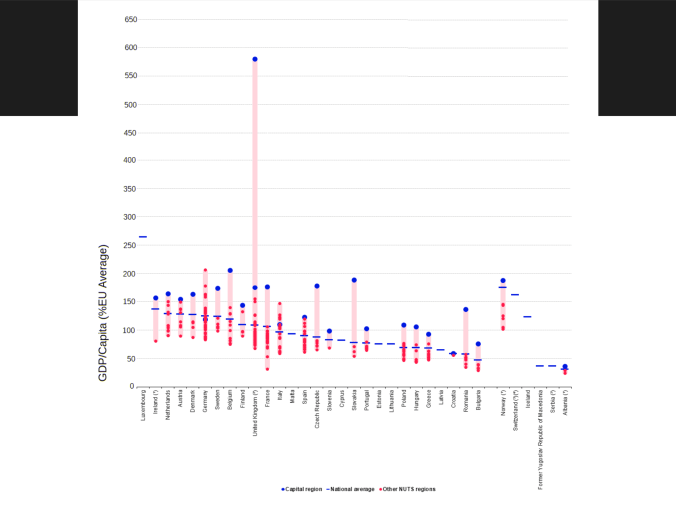
In many ways, the report covers ground now very familiar to campaigners in the independence debate. We’re all now quite familiar with the deep and systemic flaws of the UK’s economic system especially its regional inequality which, quite frankly, is embarrassing when compared to neighbouring countries in Europe.

14

(Source: Eurostat)

Continue reading →

We Need To Talk About: Hypothecated Taxes

Hypothecated taxes are designed to undermine the NHS – Prof. Richard Murphy

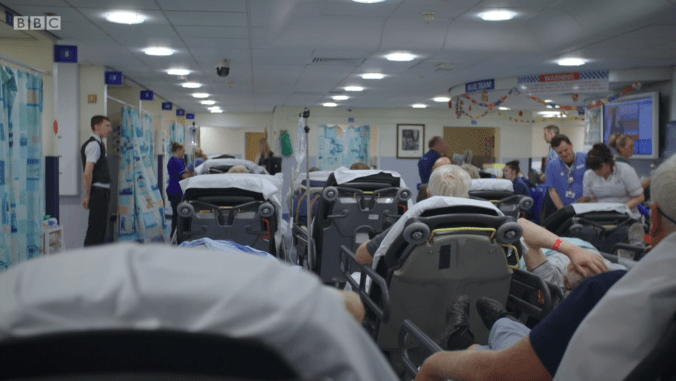
There’s been an idea floating around recently – mostly pushed by the Lib Dems but floated elsewhere too – that the solution to NHS England’s current, catastrophic crisis is an additional income-linked tax (either a new tax or an addition to income tax or National Insurance) which would raise money specifically for health spending.

NHSqueue.png

Queuing for bedspace in an English hospital

Other schemes have been suggested, like an addition to income tax to be spent on education. This idea of having a dedicated tax which raises revenue for a specific purpose is known as ‘hypothecation‘ and here is why it is a terrible idea.

Continue reading →

We Need To Talk About: The Deficit

Cutting the deficit by gutting our investments in innovation and education is like lightening an overloaded airplane by removing its engine. It may make you feel like you’re flying high at first, but it won’t take long before you feel the impact. – Barack Obama

Whenever we talk about national budgets, it doesn’t take long before someone mentions the “national deficit” and the “national debt”. Indeed, as I’ve noted in some of my commentary on GERS, sometimes it can seem like this is the only thing that makes it to the headlines at all. The almost unchallenged “wisdom” is that a government spending more than it raises in taxes is a terribly bad thing. It’ll leave future generations burdened with debt and, anyway, you wouldn’t run a household’s finances that way, would you?

This is a wisdom that has led us to Austerity and there is barely a politician out there who speaks for any other ideology. It’s not just the Tories. Corbyn’s team is at it, at least  by degrees and even Nicola Sturgeon often speaks the same language when defending Scotland’s finances. (And, yes, I’ve used that same language in the past too. Life is about learning.)

Of course, the root of the obsession lies with the fact that the “national deficit” is something that seems quite close to the politicians and therefore it’s something that they should be “sorting out”. But maybe the economy is a bit less simple than this. Maybe, like the fable of the blind men appraising the elephant, one can get a false impression of the whole by getting too close to one detail.

Brooklyn_Museum_-_Blind_Men_Appraising_an_Elephant_-_Ohara_Donshu.jpg

Continue reading →

Trumped Up Trade Talk

“Sooner or later every war of trade becomes a war of blood.” – Eugene V Debs

This past week has been an interesting one in terms of international trade news. President Trump announced, via a Tweet, that he was slapping import tariffs on Chinese steel and that “trade wars are good, and easy to win“.

The ripples of this announcement are still spreading but already countries and trading blocs like Canada and the EU are considering retaliatory tariffs.

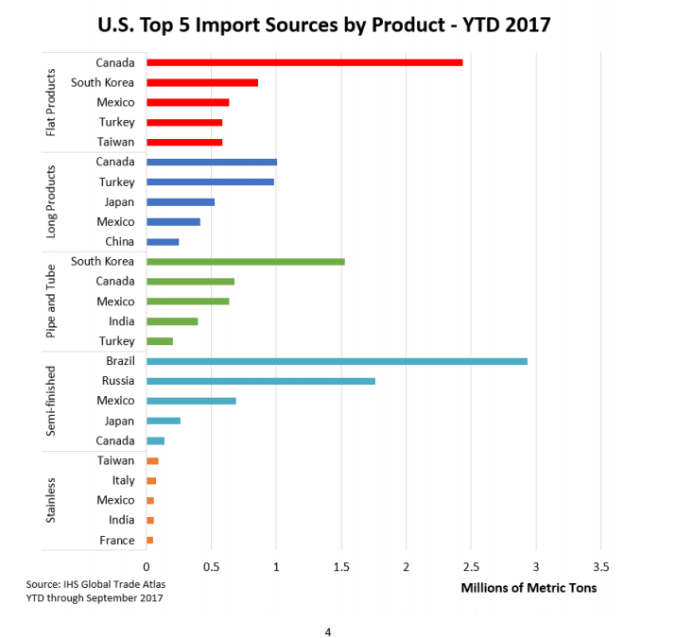
The thing is, China isn’t even a particularly major player in US steel imports. It barely factors on any of the top fives by specific products.

US Steel

Continue reading →

Irrigating the Data Desert

“Why speculate when you can calculate?” – John Baez, American mathematical physicist

Last week saw the release of Common Weal’s latest policy paper, Scotland’s Data Desert, which examined the gaps in statistical data for Scotland and called for a Scottish Statistics Agency to help fill them.

We weren’t the only ones studying the problem of the dearth of data in Scotland. As part of a year-long program of research into this topic, we got involved with the Scottish Parliament’s Economy, Jobs and Fair Work Committee who had launched their own public consultation looking specifically at the state of economic data in Scotland.

Our response to that consultation led to us being invited to present evidence directly to the committee in September 2017.

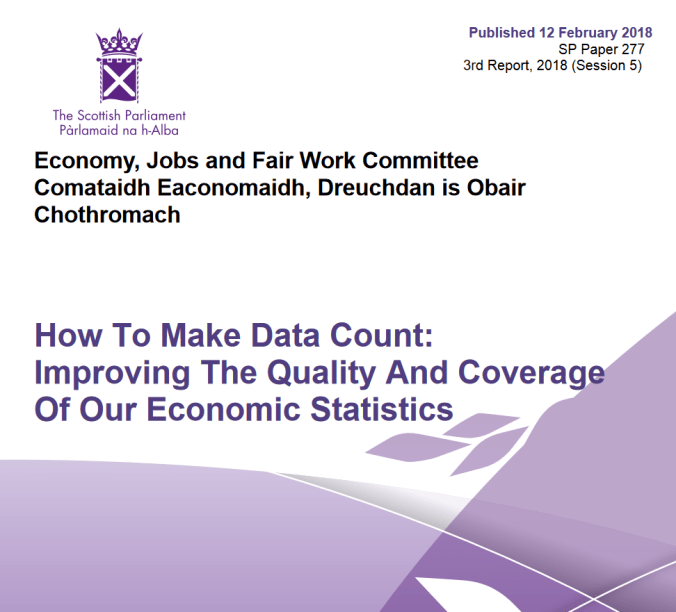
The final report from the committee’s investigations was published a few days ago and we are very pleased to say that many of our recomendations have been accepted in the conclusions of the report.

Econ Report.png

Continue reading →

Scotland’s Data Desert

My latest policy paper for Common Weal – Scotland’s Data Desert – has just been published and can be read here or by clicking the image below. There has also been coverage of the report in The National here and here.
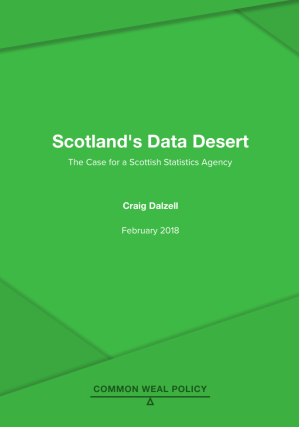
Cover

As a region of the UK, Scotland is in many ways better served by data gathering and analysis than its counterparts. However, as Scotland takes greater control over domestic issues and as the constitutional debate continues to look towards a future in which Scotland takes full responsibility for its own affairs the question is raised as to whether even this level of data provision is adequate for current or future needs – especially in a world where data becomes ever more vital in the development and support of policy. Well served though Scotland may be as a region, as a country it remains a relative “data desert” compared to nearby independent countries.

Many times we’ve watched as politicians and activists have misused data in the public sphere. Sometimes this manifests as a simple misunderstanding of what the data actually says (As when people ask how much of Scotland’s trade leaves the UK via “English ports”). Sometimes though, it’ll be used to make a political point in ways that the data doesn’t really support (such as discussions which use GERS to project beyond what it actually says on Scotland’s finances). There have also been instances of policies being implemented on the basis of limited evidence or of policies being implemented and then left to run without any program in place to monitor their effectiveness.

My latest policy paper for Common Weal is the culmination of over a year of research into the gaps and limitations of data provision in Scotland and discussion with people within the data sectors and civil service in Scotland and the UK. As a political lobbying and research organisation, we are – like many others – dependent on access to data to be able to inform our work and many times we have hit barriers where key data couldn’t be released or simply did not exist.

A Scottish Statistics Agency could help address many of these issues by expanding, co-ordinating and codifying data gathering within Scotland.

An independent Scotland will certainly need its own data and statistics agency but this isn’t just an independence issue as it could be done right now in a devolved Scotland and there are compelling reasons to do so. As said, Scotland already goes above and beyond the UK’s data gathering in many areas but there is certainly room to grow further.

The SSA could well take the form of a monolithic, centralised agency – a bit like the UK’s ONS – in which most or all policy level data is gathered by or for them. It could equally take the form of a more decentralised system whereby a central body co-ordinates and issues targets and directives but the actual gathering could be done by specialised bodies, statisticians embedded within government departments and even by academics and think-tanks. If this model was employed then a system of “kitemarks” could be used to mark data which meets the stringent Code of Practice which would identify data as being good enough for policy-making.

This kitemark system is already used by the UK Statistics Agency (the governing body which regulates the ONS) but could be used to either reflect a Scotland which applies even higher standards than the UK or could be expanded to identify data from outside of government (such as academics and think tanks) which meet those standards. This could allow for greater prespectives to influence government but could also limit the misuse of data by third parties by setting a benchmark to meet.

Of course, this isn’t just a problem of gathering data. As said above, often the data is gathered but difficult to find, difficult to manipulate or cannot be easily combined with other data due to conflicts in their methodologies. Where data can be combined, it has been a reported problem that different groups may be doing the same processing independently. This increases the chance of errors creeping in and also, crucially, results in a lot of time wasted between those groups.

An SSA could therefore be charged with ensuring that policy data meets high standards of trust, transparency, usability and consistency. It could also be responsible for maintaining a central data portal – much like Eurostat or the Gapminder Project – which would allow access to as much data as possible but can do it in a way which makes that data easy to view whether the viewer is an interested member of the public or an expert researcher.

People will, of course, ask how much an SSA would cost and, in truth, the answer is difficult unless we know the precise model – it’s harder to count the budget of a decentralised model than a centralised one – but where Scotland’s proportional share of the UK’s spend on statistics may be around £15 million, other nearby countries like Denmark and Sweden spend several times this figure and create several hundred highly skilled jobs in the process. Even these sums are comparatively small in terms of national budgets but will surely pay for themselves in terms of better targeted, better monitored and, quite simply, better policies.


Common Weal’s ability to do research of this kind is entirely reliant on the generosity of our donors and supporters, both one-off and regular. If you would like to contribute, please visit our website at: allofusfirst.org/donate/

TCG Logo 7