Disclosure and Disclaimer: Although I am politically active, this guide is intended to be objective and politically neutral. This is a guide on how to vote, not a blog trying to convince you to vote for or against any particular person or party.
Introduction

(2017 local authority election results map. Source: Wikipedia)
On May 5th, Scotland will once again go to the polls to elect councillors to our Local Authorities. This election will take place simultaneously with local authority elections in England and Wales along with elections to the Northern Ireland Assembly.
Scotland is presently organised into 32 local authorities commonly called councils split into smaller sub-units known as wards. These councils are elected every five year under the proportional representation voting system known as Single Transferrable Vote, or STV. The last election was in 2017.
As with elections everywhere, there will be people looking at this election as their first opportunity to vote and if you are one of them, this guide is aimed mainly at you. You can read previous similar guides to other elections in Scotland since I started this blog behind the links covering the 2016 Scottish Parliamentary Elections, the 2017 UK General Elections, the 2017 Scottish Local Authority Elections, the 2019 EU Parliamentary Elections, the 2019 UK General Elections, and the 2021 Scottish Parliamentary Elections.
This will be the second election in Scotland employing our expanded electoral franchise. There are no longer any citizenship tests involved in eligibility to vote. With very few exceptions, all that is required is that you are (or will be on May 5th) aged 16+, have permanent leave to reside in Scotland and are not currently serving a prison sentence of more than 12 months. The relatively short time since the expansion of the franchise means that it will not just be 16 year olds who can vote for the first time. It’s very possible that you are now able to vote where you were not able to in the last local election in 2017. Whoever ever you are, whomever you plan to vote for, it is important that you take this chance to exercise your democratic right and power. If you want to, but you’re not sure how – this guide is for you.
Step One:- Registering to vote
You cannot vote in this election unless you are registered to vote. It is also important to note that there is a deadline for registrations. You cannot just turn up at the Polling Place and register “on the day” as is possible in some places like the USA.
The deadline for this election is 11:59pm on the 18th of April which means that as of the posting of this article, you have only a few days left to do this.
You can register to vote HERE.
In order to be eligible to register you must meet several criteria. As noted above, the primary ones are that you are or will be aged 16 or more on May 6th 2021 and that you are a permanent resident of the UK living in Scotland. The full list of criteria for voting eligibility can be found here.
Once you have registered to vote you will remain registered until certain of your circumstances change (such as your address) so if you have already registered for a previous election then you should be registered for this one too assuming you are eligible.
Step Two:- Deciding how to vote
Not who to vote for – we’ll get to that – this is on deciding how you will actually cast your vote. The majority of voters do so in person at their designated polling place but some will want to do so by post or via a proxy (where you nominate someone to go to the polling place for you). If you wish to apply for a postal vote you can do so here but be aware that the application must by at your local electoral office no later than April 19th. Information on proxy voting can be found here.
There are advantages and disadvantages to all of these methods. Accessibility being the main advantage for postal and proxy voting – you may have many reasons why there may be a barrier to you going to your polling place on the day from personal reasons through bad weather or concerns about Covid (polling places are likely to have mitigation measures in place against this as guided by the Government). On the other hand, voting in person on the day has a sense of solidarity to it that is hard to match and as postal votes are often cast days or weeks ahead of the vote there is a chance that something could happen during the political campaign that means your decision when casting the postal vote is different compared to how you would vote on May 5th.
However, there is no “right” way from these options. That you cast your vote is far more important than how you do it.
If you do choose to vote in person you will receive (or may already have received) a card similar to the one below
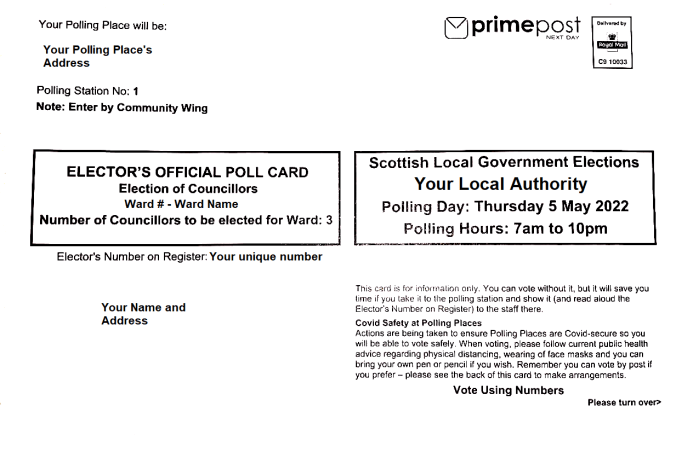
On the rear of this card there will be detailed instructions on how to vote, how to apply for postal or proxy votes (including how to do so in an emergency) as well as contact details for further information if you need it.
You do not need to bring this card with you when you vote but it can help to speed up the process, particularly at busy times. The agents at the polling place will be able to help direct you to the right station to cast your vote.
Step Three:- Deciding who to vote for.
As I said at the start of this article, this blog is not here to try to persuade you to vote for any particular person or party but you will have to make that choice as you come to cast your vote. The election campaign is in full swing and you are likely to have already been bombarded with leaflets, news articles and party manifestos. There are a lot of factors involved in this election and a good number of candidates and parties to choose from. No guide can be completely exhaustive but in a separate blog post I’ll try to link to as many of the party manifestos as I can though we also have to be aware that there may be local issues of significant importance to your community that don’t factor into those national campaigns and there may be minor parties or independent candidates in your area who have their own priorities or goals.
One useful resource is this one by Who Can I Vote For. If you enter your postcode, it will tell you your ward and local authority as well as which candidates you will have the opportunity to vote for.
Step Four:- Casting your vote
STV is not the easiest voting system to understand – harder even than the AMS system used in the Scottish elections. In principle, it’s simple to work out how to cast your vote but it’s a lot harder to work out how your vote translates into the final results. We’ll focus on the easy bit first.
When you cast your vote – either in person or by post – you’ll be presented with a ballot paper that looks a little like the one below.
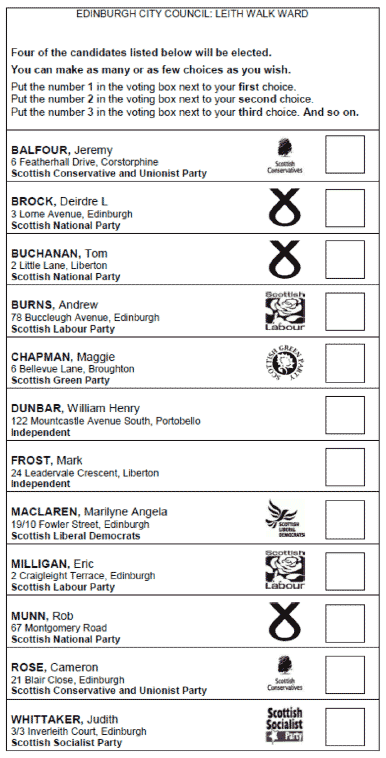
The candidates will be listed in alphabetical order by surname with their home address* and their party affiliation, if any, underneath. Also present may be a party logo or a slogan representing a core issue of the candidate/party.
One point to consider is that you are not strictly voting for a political party in this election (despite how most of the parties present things in their campaigns). Instead, you are voting for people. These people may or may not be members of parties (and their entry will indicate this) and they may be more or less likely to follow that party’s line rather than their own (or vice versa). There may also be more than one candidate on your ballot paper who belong to the same political party. This information may factor into your choice of vote.
To actually vote is slightly different from most of the other elections in Scotland. Unlike, say, the UK General Election you do not simply mark one box on the ballot paper with an X. Instead you RANK the candidates in order of preference using a discrete number for each – 1,2,3, etc.
You may not give two or more candidates “equal” rank. You do not need to rank every candidate. Once you get to the point where you have no preference amongst the remaining candidates, you may leave their boxes blank. This is sometimes known as “vote till ye boak”. Do not make any other marks on the ballot paper as this may result in your vote being invalidated and rejected. (This said, there is a fine tradition of expressing a protest against all candidates or against the election as a whole by deliberately spoiling one’s ballot – this is a much stronger form of protest than not voting at all)
Once completed your ballot paper may look something like this:
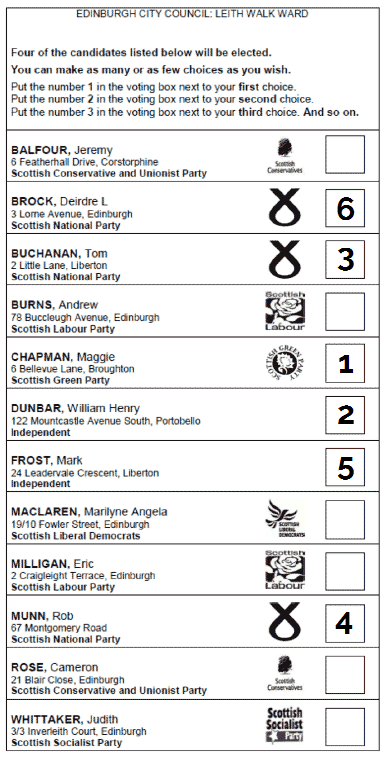
Note: Preferences listed here are for illustration only and do not represent an endorsement, recommendation or author’s personal preference.
Once you’ve dropped your completed ballot into the box or sent it away via your postal ballot, that’s it. Simple. The seats are then allocated out such that the candidates elected are the ones deemed highest ranked by the largest number of people.
* In previous LA elections (such as the one from which the example ballot paper came from), all candidates had to provide their current address on the ballot paper – effectively making where they lived a matter for the public domain. From 2022 onwards, their full address will only be printed if they live outwith the constituency in which they are standing.
The Hard Bit: Counting the Votes
Here comes the tricky part. Counting the votes and translating them to seats. This is a far more mathematical exercise than the FPTP system used in the UK elections (which is trivial in that the person with the most votes wins the seats, the party with the most seats (generally) wins the government) and more complicated even the d’Hondt system used in Scotland and the EU elections (which can be tabulated with a pen and paper if you have to). If you’re reading this on the front page of the blog and want to delve into this maths, then click below to unfold. If not, I hope this has been useful and good luck to your chosen candidate(s) in May. If you’re feeling particularly brave or interested, please click the Continue Reading button below. Even if you do, feel free to skip to the final section where I talk about some voting strategies.
Continue reading →



 The Common Green